
A Novel StatorPM Machine For Urban Transit System

A Novel Stator-PM Machine For Urban Transit System Application Presenter: L EI Meng ti ng 1 41 10 02 1 d Supervi sor: S. X. Ni u Dat e: 2 9/M ar/2 01 8
CONTENT I. Introduction II. Literature Review III. Methodology IV. Result V. Conclusion VI. Reference
INTRODUCTION - Background Advantages of stator-PM linear machine: 1. Simple structure and long lifetime 2. Good climbing ability 3. Low construction cost 4. Short length of the rail 5. Reduced noise
INTRODUCTION - Objectives 1. High Overall Efficiency 2. Large Output Force 3. Reasonable Force Ripple
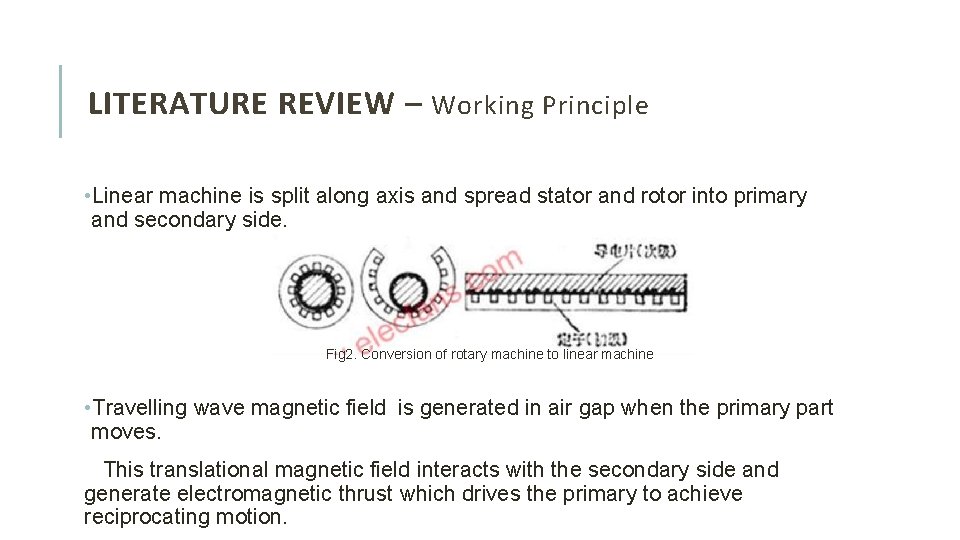
LITERATURE REVIEW – Working Principle • Linear machine is split along axis and spread stator and rotor into primary and secondary side. Fig 2. Conversion of rotary machine to linear machine • Travelling wave magnetic field is generated in air gap when the primary part moves. This translational magnetic field interacts with the secondary side and generate electromagnetic thrust which drives the primary to achieve reciprocating motion.
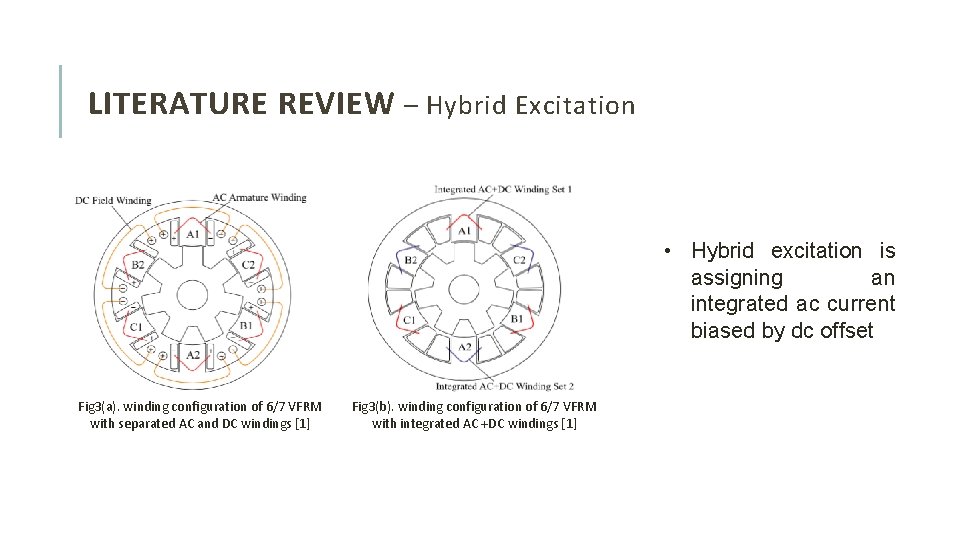
LITERATURE REVIEW – Hybrid Excitation • Hybrid excitation is assigning an integrated ac current biased by dc offset Fig 3(a). winding configuration of 6/7 VFRM with separated AC and DC windings [1] Fig 3(b). winding configuration of 6/7 VFRM with integrated AC +DC windings [1]
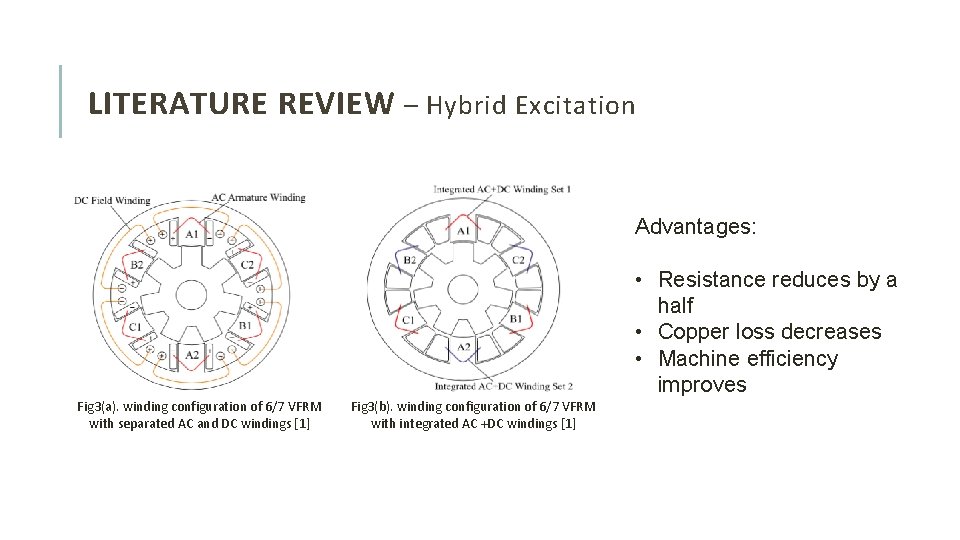
LITERATURE REVIEW – Hybrid Excitation Advantages: • Resistance reduces by a half • Copper loss decreases • Machine efficiency improves Fig 3(a). winding configuration of 6/7 VFRM with separated AC and DC windings [1] Fig 3(b). winding configuration of 6/7 VFRM with integrated AC +DC windings [1]
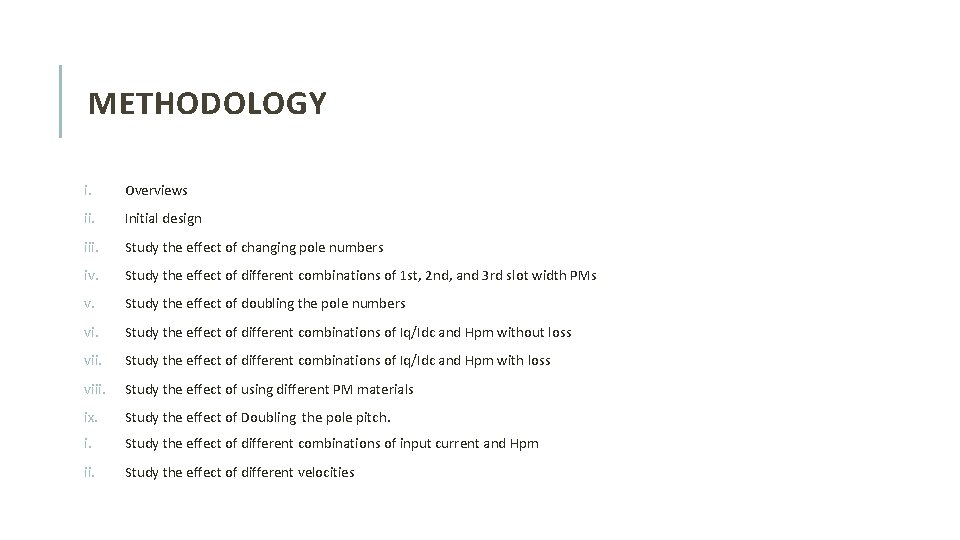
METHODOLOGY i. Overviews ii. Initial design iii. Study the effect of changing pole numbers iv. Study the effect of different combinations of 1 st, 2 nd, and 3 rd slot width PMs v. Study the effect of doubling the pole numbers vi. Study the effect of different combinations of Iq/Idc and Hpm without loss vii. Study the effect of different combinations of Iq/Idc and Hpm with loss viii. Study the effect of using different PM materials ix. Study the effect of Doubling the pole pitch. i. Study the effect of different combinations of input current and Hpm ii. Study the effect of different velocities
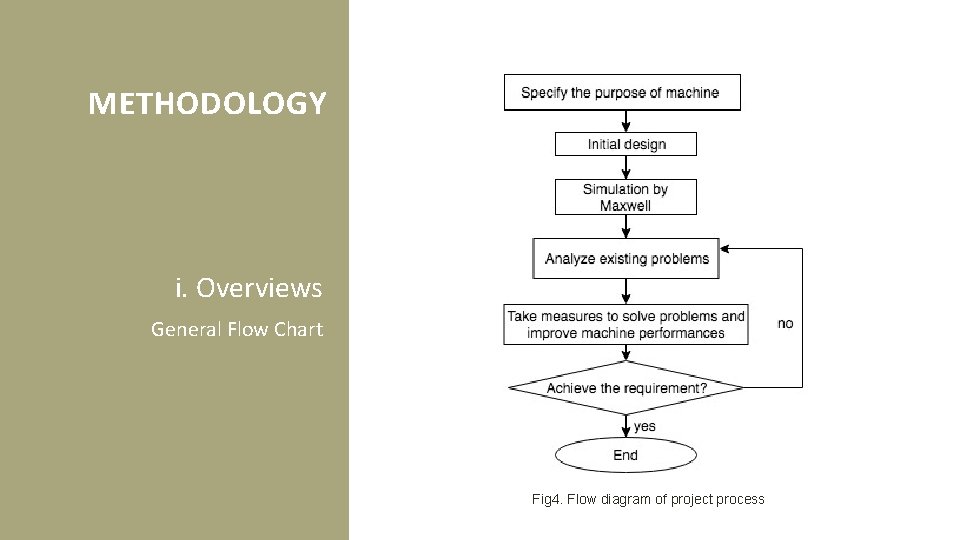
METHODOLOGY i. Overviews General Flow Chart Fig 4. Flow diagram of project process
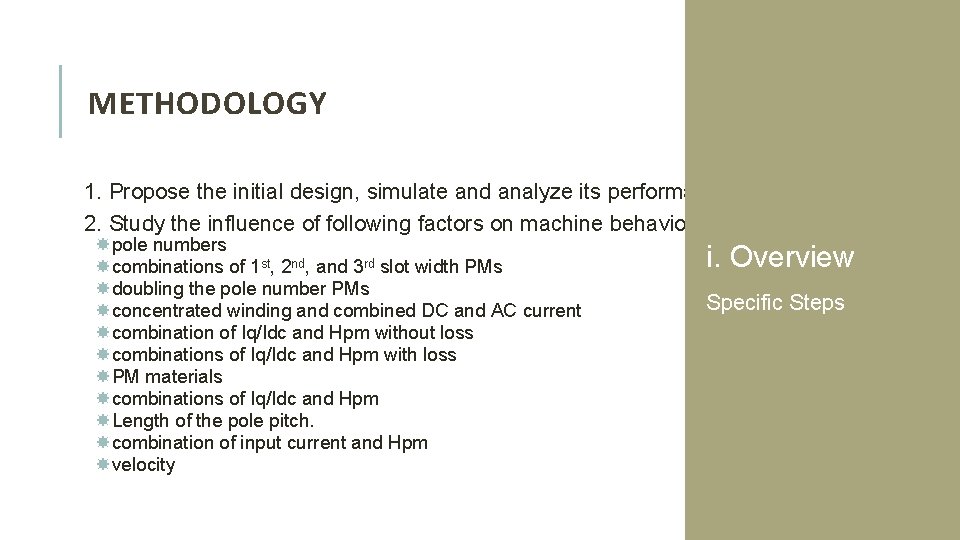
METHODOLOGY 1. Propose the initial design, simulate and analyze its performance. 2. Study the influence of following factors on machine behavior. pole numbers combinations of 1 st, 2 nd, and 3 rd slot width PMs doubling the pole number PMs concentrated winding and combined DC and AC current combination of Iq/Idc and Hpm without loss combinations of Iq/Idc and Hpm with loss PM materials combinations of Iq/Idc and Hpm Length of the pole pitch. combination of input current and Hpm velocity i. Overview Specific Steps
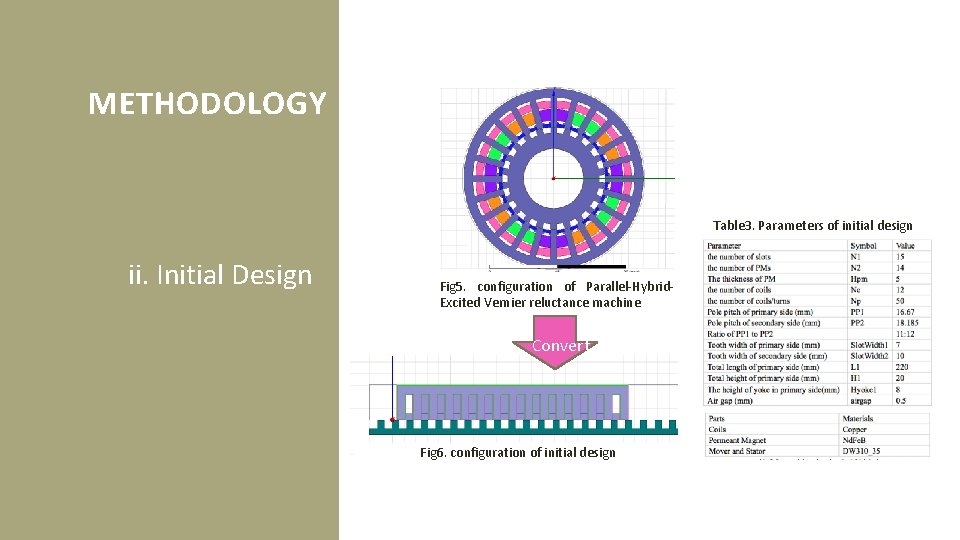
METHODOLOGY Table 3. Parameters of initial design ii. Initial Design Fig 5. configuration of Parallel-Hybrid. Excited Vernier reluctance machine Convert Fig 6. configuration of initial design
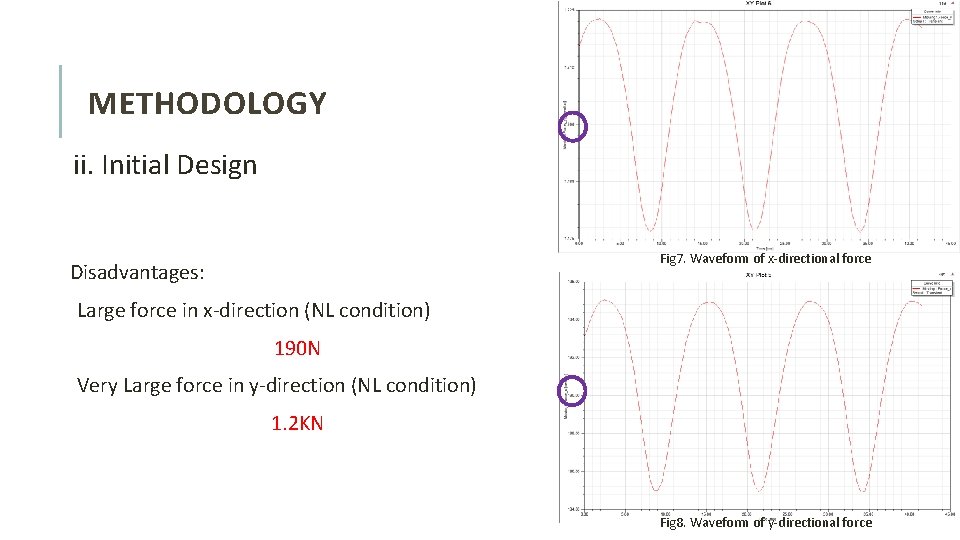
METHODOLOGY ii. Initial Design Fig 7. Waveform of x-directional force Disadvantages: Large force in x-direction (NL condition) 190 N Very Large force in y-direction (NL condition) 1. 2 KN Fig 8. Waveform of y-directional force
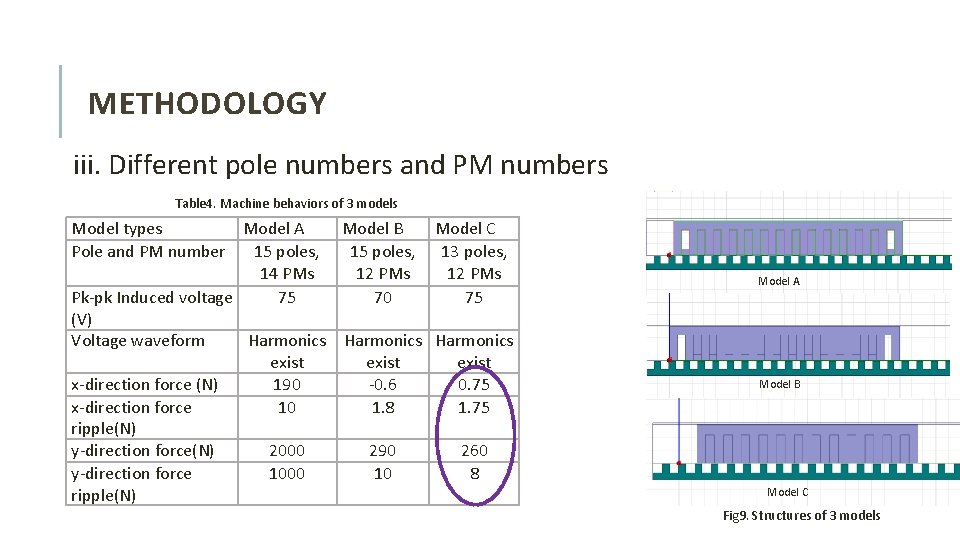
METHODOLOGY iii. Different pole numbers and PM numbers Table 4. Machine behaviors of 3 models Model types Model A Model B Model C Pole and PM number 15 poles, 13 poles, 14 PMs 12 PMs Pk-pk Induced voltage 75 70 75 (V) Voltage waveform Harmonics exist x-direction force (N) 190 -0. 6 0. 75 x-direction force 10 1. 8 1. 75 ripple(N) y-direction force(N) 2000 290 260 y-direction force 1000 10 8 ripple(N) Model A Model B Model C Fig 9. Structures of 3 models
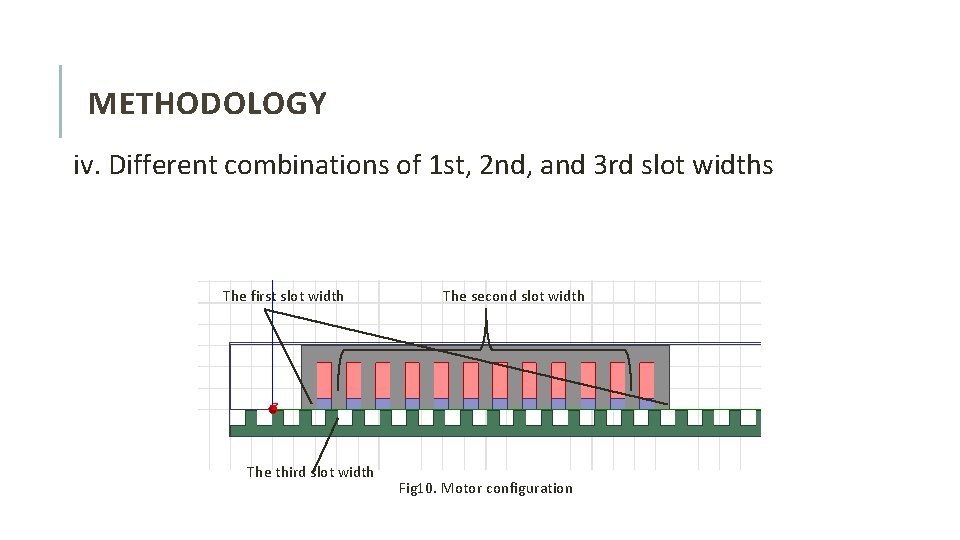
METHODOLOGY iv. Different combinations of 1 st, 2 nd, and 3 rd slot widths The first slot width The third slot width The second slot width Fig 10. Motor configuration
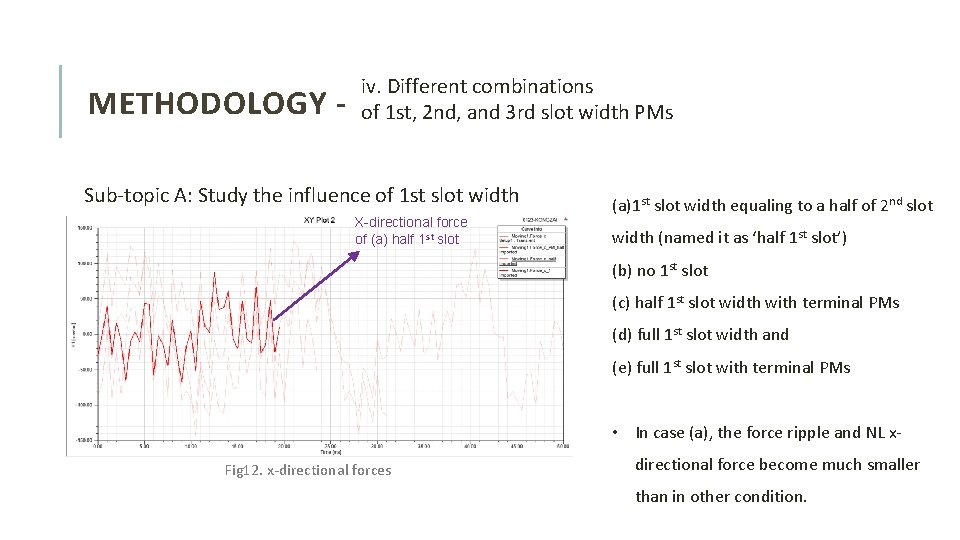
METHODOLOGY - iv. Different combinations of 1 st, 2 nd, and 3 rd slot width PMs Sub-topic A: Study the influence of 1 st slot width X-directional force of (a) half 1 st slot (a)1 st slot width equaling to a half of 2 nd slot width (named it as ‘half 1 st slot’) (b) no 1 st slot (c) half 1 st slot width with terminal PMs (d) full 1 st slot width and (e) full 1 st slot with terminal PMs • In case (a), the force ripple and NL x. Fig 12. x-directional forces directional force become much smaller than in other condition.
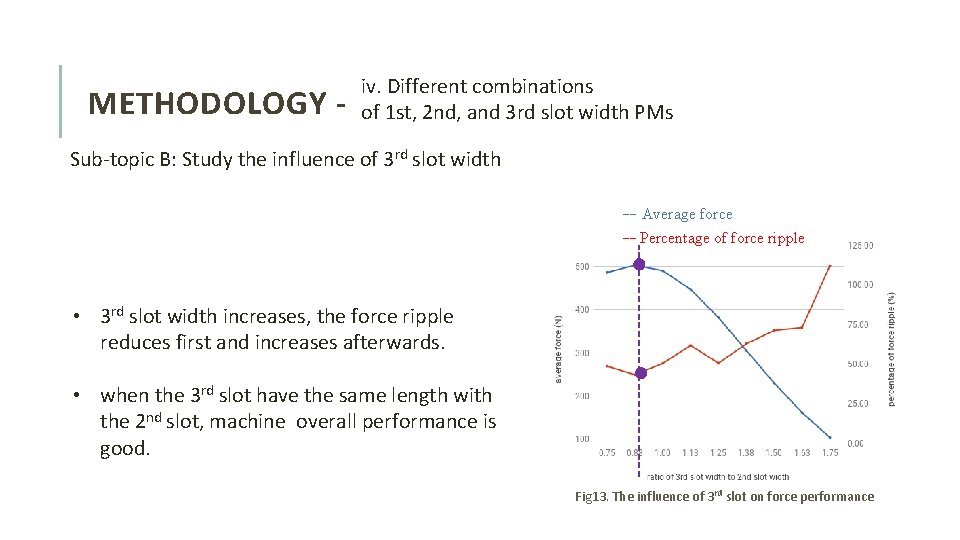
METHODOLOGY - iv. Different combinations of 1 st, 2 nd, and 3 rd slot width PMs Sub-topic B: Study the influence of 3 rd slot width -- Average force -- Percentage of force ripple • 3 rd slot width increases, the force ripple reduces first and increases afterwards. • when the 3 rd slot have the same length with the 2 nd slot, machine overall performance is good. Fig 13. The influence of 3 rd slot on force performance
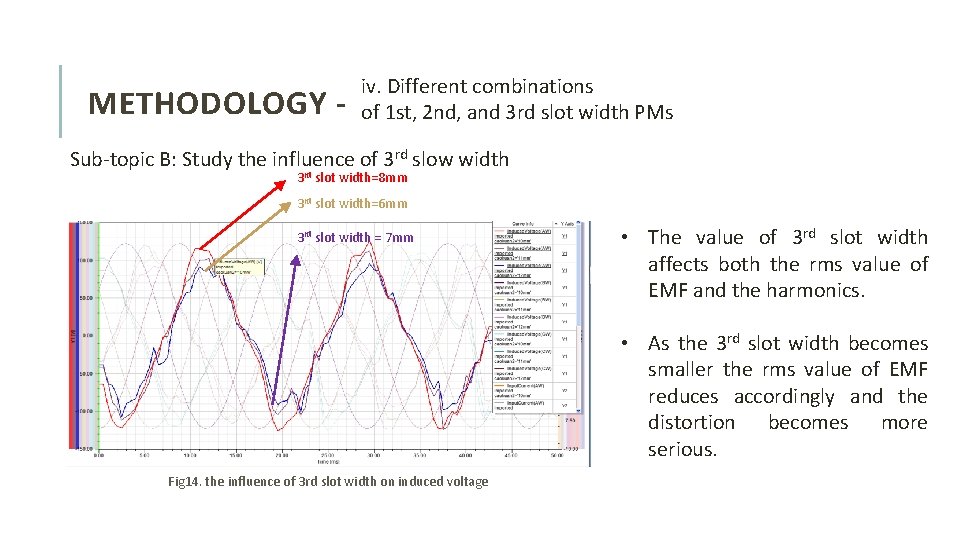
METHODOLOGY - iv. Different combinations of 1 st, 2 nd, and 3 rd slot width PMs Sub-topic B: Study the influence of 3 rd slow width 3 rd slot width=8 mm 3 rd slot width=6 mm 3 rd slot width = 7 mm • The value of 3 rd slot width affects both the rms value of EMF and the harmonics. • As the 3 rd slot width becomes smaller the rms value of EMF reduces accordingly and the distortion becomes more serious. Fig 14. the influence of 3 rd slot width on induced voltage
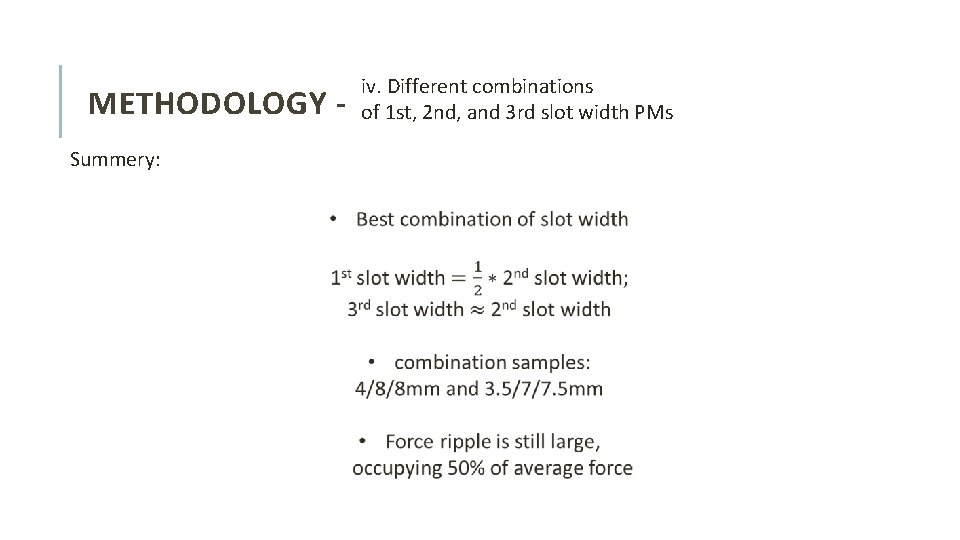
METHODOLOGY Summery: iv. Different combinations of 1 st, 2 nd, and 3 rd slot width PMs
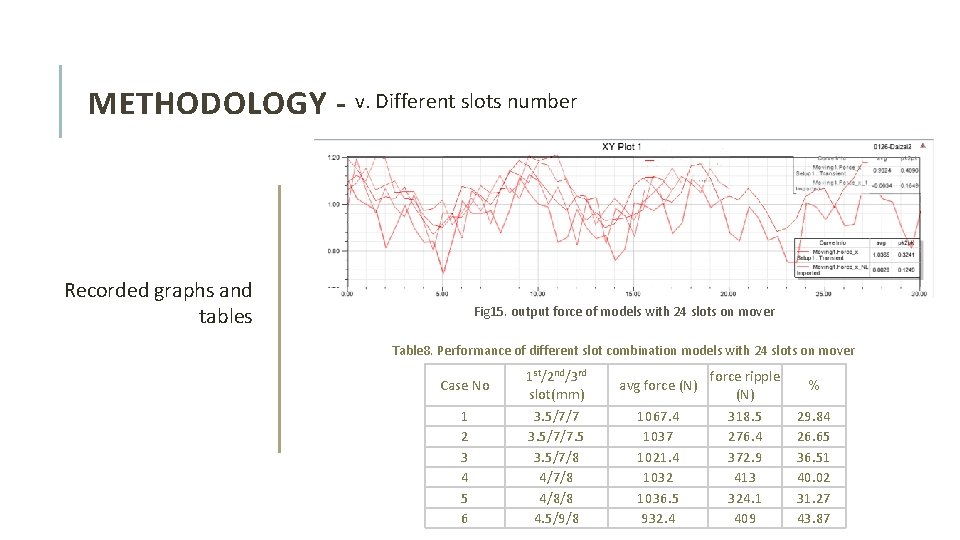
METHODOLOGY - v. Different slots number Recorded graphs and tables Fig 15. output force of models with 24 slots on mover Table 8. Performance of different slot combination models with 24 slots on mover Case No 1 2 3 4 5 6 1 st/2 nd/3 rd slot(mm) 3. 5/7/7. 5 3. 5/7/8 4/8/8 4. 5/9/8 avg force (N) 1067. 4 1037 1021. 4 1032 1036. 5 932. 4 force ripple (N) 318. 5 276. 4 372. 9 413 324. 1 409 % 29. 84 26. 65 36. 51 40. 02 31. 27 43. 87
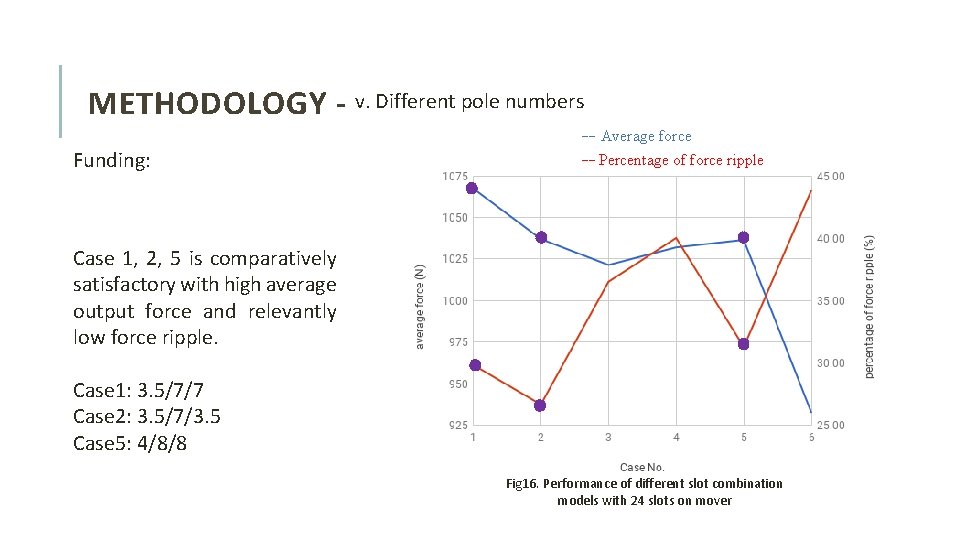
METHODOLOGY - v. Different pole numbers Funding: -- Average force -- Percentage of force ripple Case 1, 2, 5 is comparatively satisfactory with high average output force and relevantly low force ripple. Case 1: 3. 5/7/7 Case 2: 3. 5/7/3. 5 Case 5: 4/8/8 Fig 16. Performance of different slot combination models with 24 slots on mover
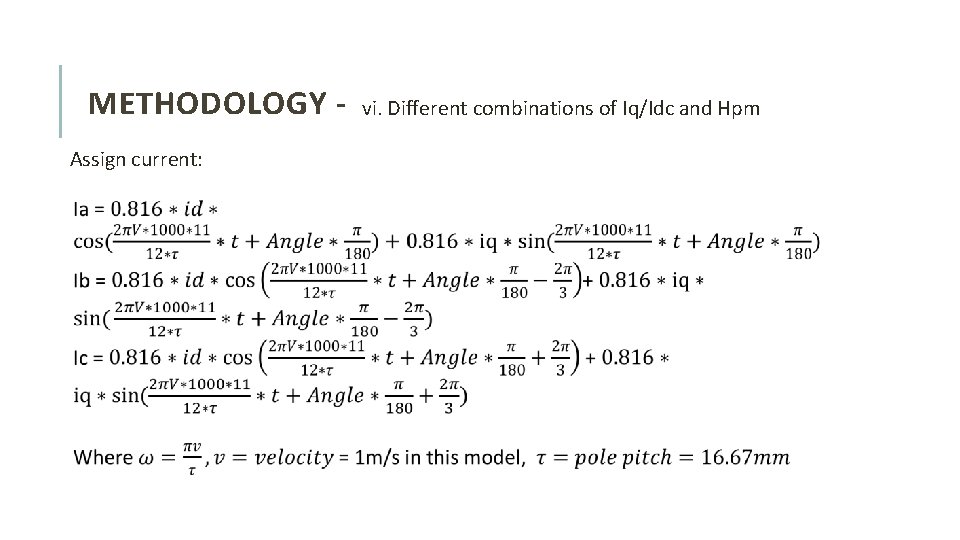
METHODOLOGY Assign current: vi. Different combinations of Iq/Idc and Hpm
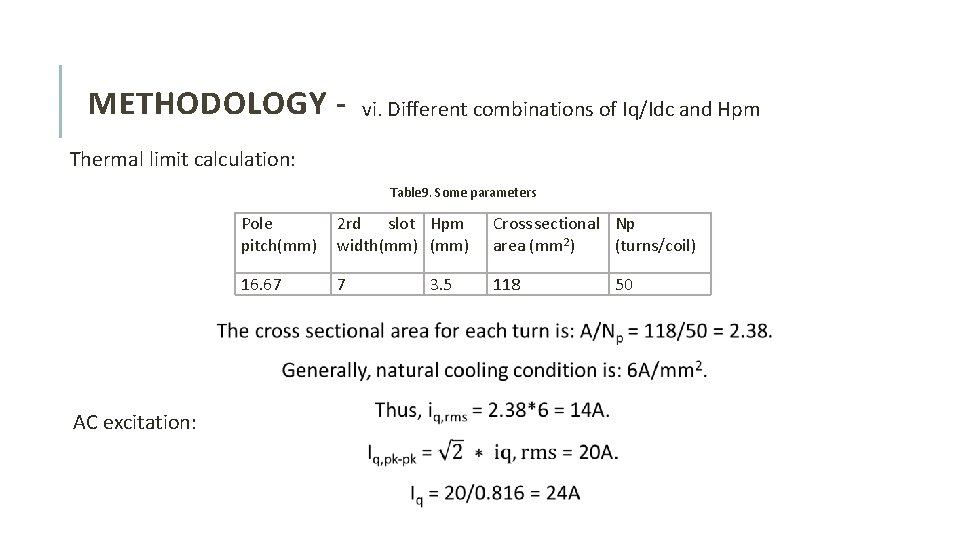
METHODOLOGY - vi. Different combinations of Iq/Idc and Hpm Thermal limit calculation: Table 9. Some parameters AC excitation: Pole pitch(mm) 2 rd slot Hpm width(mm) Cross sectional Np area (mm 2) (turns/coil) 16. 67 7 118 3. 5 50
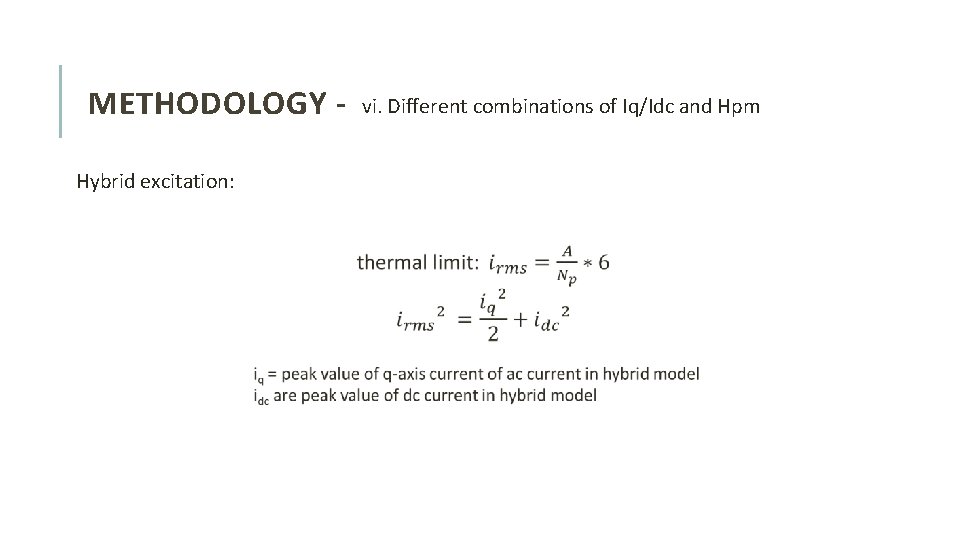
METHODOLOGY Hybrid excitation: vi. Different combinations of Iq/Idc and Hpm
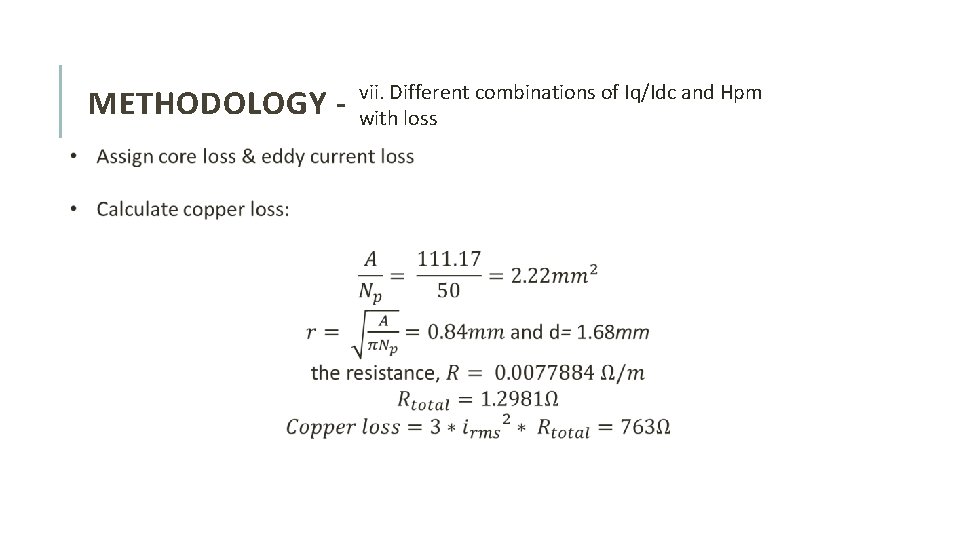
METHODOLOGY - vii. Different combinations of Iq/Idc and Hpm with loss
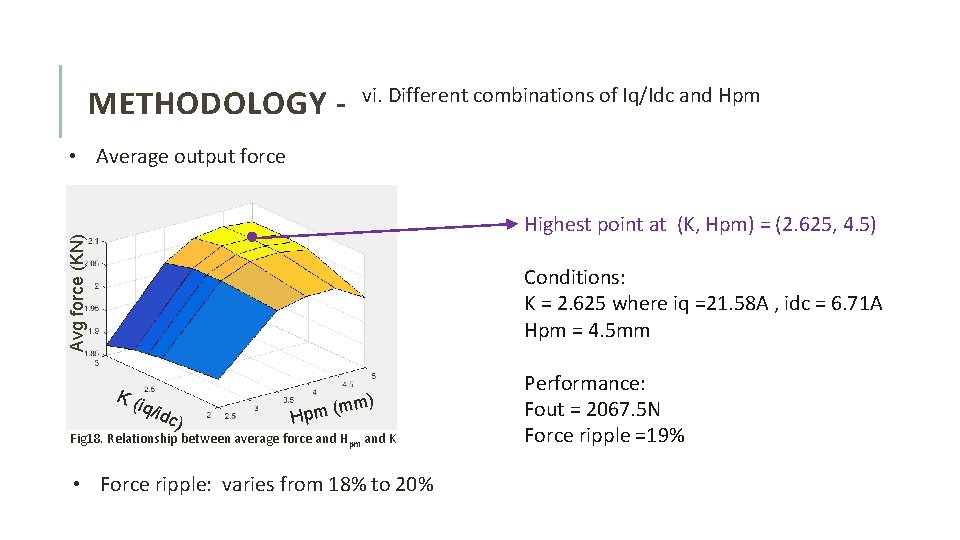
vi. Different combinations of Iq/Idc and Hpm METHODOLOGY • Average output force Avg force (KN) Highest point at (K, Hpm) = (2. 625, 4. 5) Conditions: K = 2. 625 where iq =21. 58 A , idc = 6. 71 A Hpm = 4. 5 mm K( iq/i dc) m) (m Hpm Fig 18. Relationship between average force and Hpm and K • Force ripple: varies from 18% to 20% Performance: Fout = 2067. 5 N Force ripple =19%
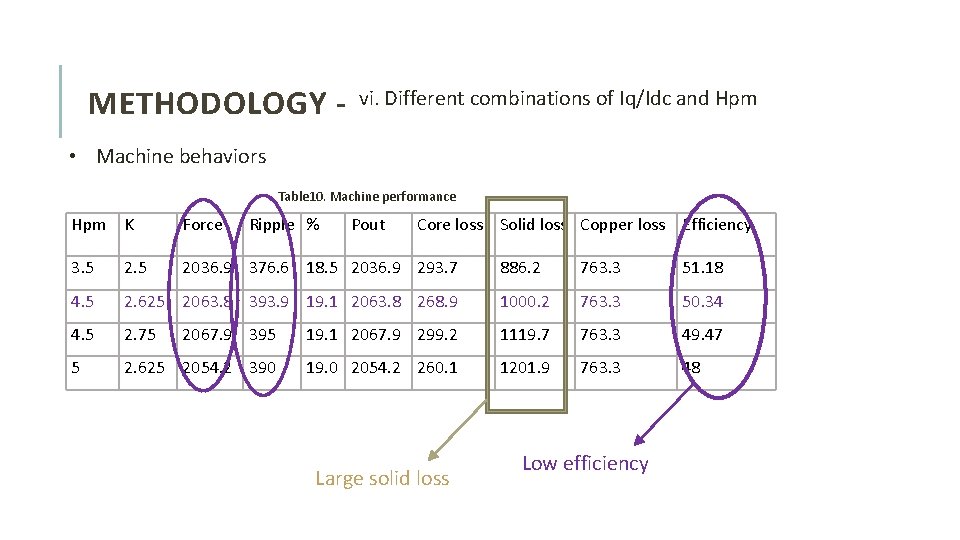
METHODOLOGY - vi. Different combinations of Iq/Idc and Hpm • Machine behaviors Table 10. Machine performance Hpm K Force Ripple % Pout Core loss Solid loss Copper loss Efficiency 3. 5 2036. 9 376. 6 18. 5 2036. 9 293. 7 4. 5 886. 2 763. 3 51. 18 2. 625 2063. 8 393. 9 19. 1 2063. 8 268. 9 1000. 2 763. 3 50. 34 4. 5 2. 75 2067. 9 395 19. 1 2067. 9 299. 2 1119. 7 763. 3 49. 47 5 2. 625 2054. 2 390 19. 0 2054. 2 260. 1 1201. 9 763. 3 48 Large solid loss Low efficiency
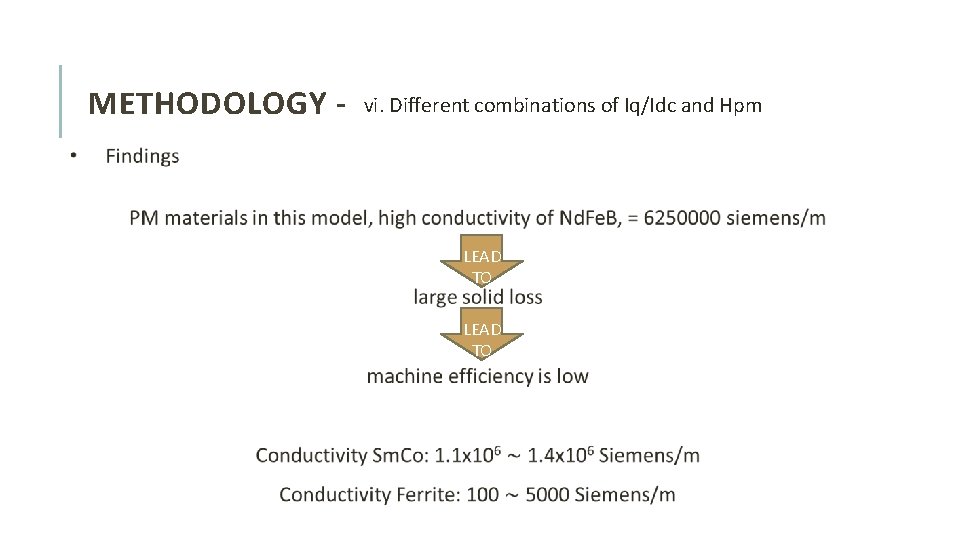
METHODOLOGY - vi. Different combinations of Iq/Idc and Hpm LEAD TO LEAD Convert TO
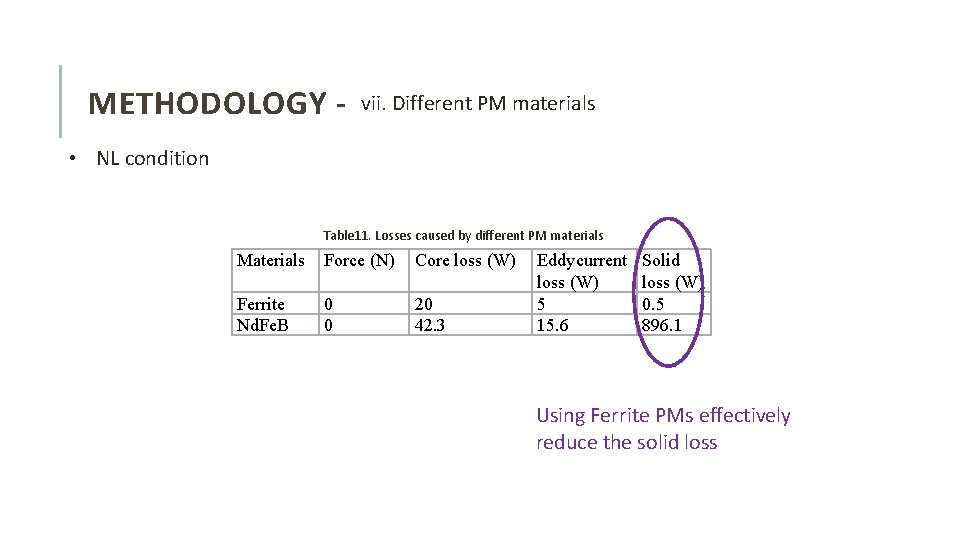
METHODOLOGY - vii. Different PM materials • NL condition Table 11. Losses caused by different PM materials Materials Force (N) Core loss (W) Ferrite Nd. Fe. B 0 0 20 42. 3 Eddy current loss (W) 5 15. 6 Solid loss (W) 0. 5 896. 1 Using Ferrite PMs effectively reduce the solid loss
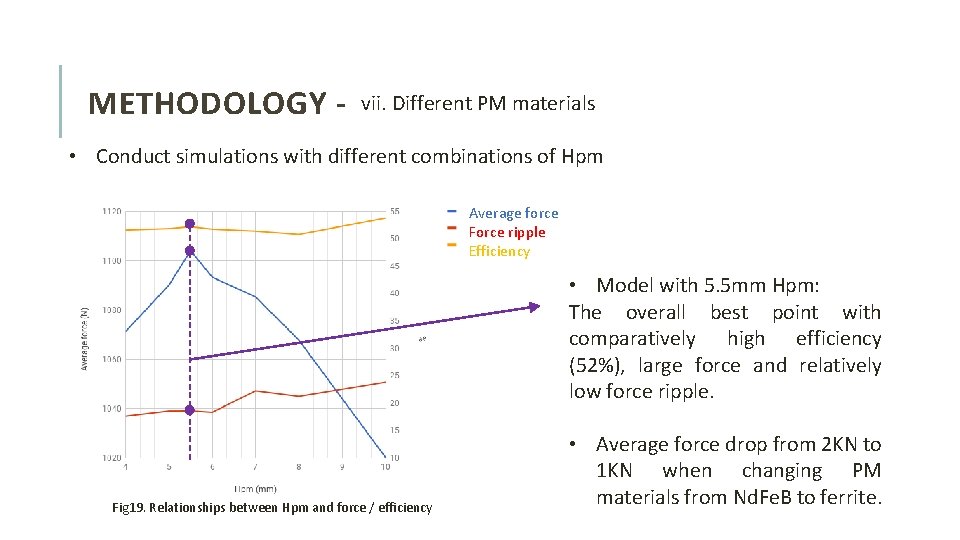
METHODOLOGY - vii. Different PM materials • Conduct simulations with different combinations of Hpm Average force Force ripple Efficiency • Model with 5. 5 mm Hpm: The overall best point with comparatively high efficiency (52%), large force and relatively low force ripple. Fig 19. Relationships between Hpm and force / efficiency • Average force drop from 2 KN to 1 KN when changing PM materials from Nd. Fe. B to ferrite.
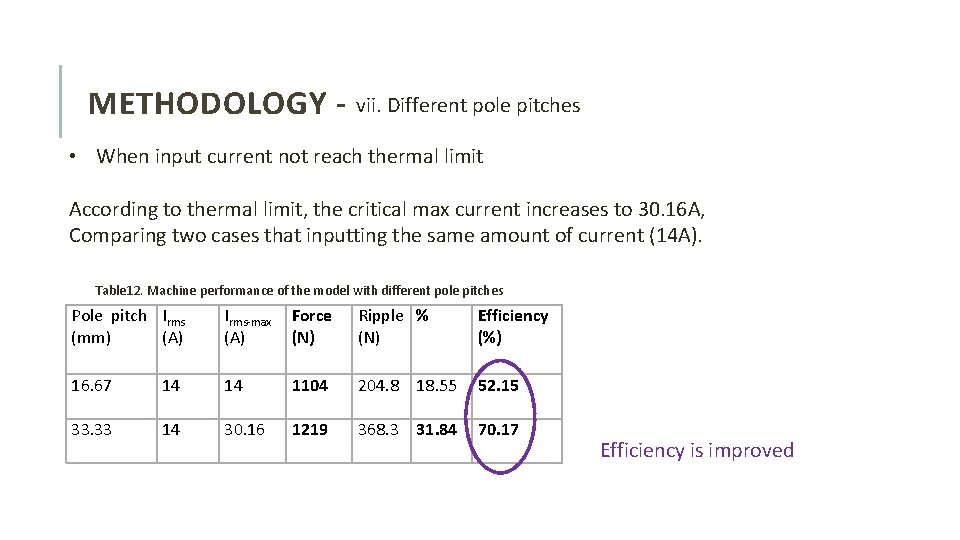
METHODOLOGY - vii. Different pole pitches • When input current not reach thermal limit According to thermal limit, the critical max current increases to 30. 16 A, Comparing two cases that inputting the same amount of current (14 A). Table 12. Machine performance of the model with different pole pitches Pole pitch Irms (mm) (A) Irms-max (A) Force (N) Ripple % (N) Efficiency (%) 16. 67 14 14 1104 204. 8 18. 55 52. 15 33. 33 14 30. 16 1219 368. 3 31. 84 70. 17 Efficiency is improved
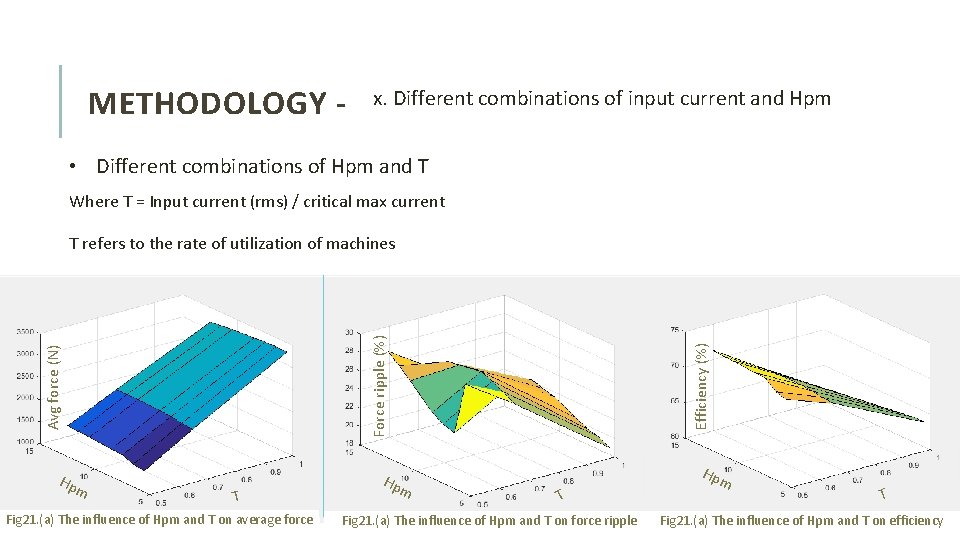
METHODOLOGY - x. Different combinations of input current and Hpm • Different combinations of Hpm and T Where T = Input current (rms) / critical max current Hp m T Fig 21. (a) The influence of Hpm and T on average force Hp Efficiency (%) Avg force (N) Force ripple (%) T refers to the rate of utilization of machines m Hp T Fig 21. (a) The influence of Hpm and T on force ripple m T Fig 21. (a) The influence of Hpm and T on efficiency
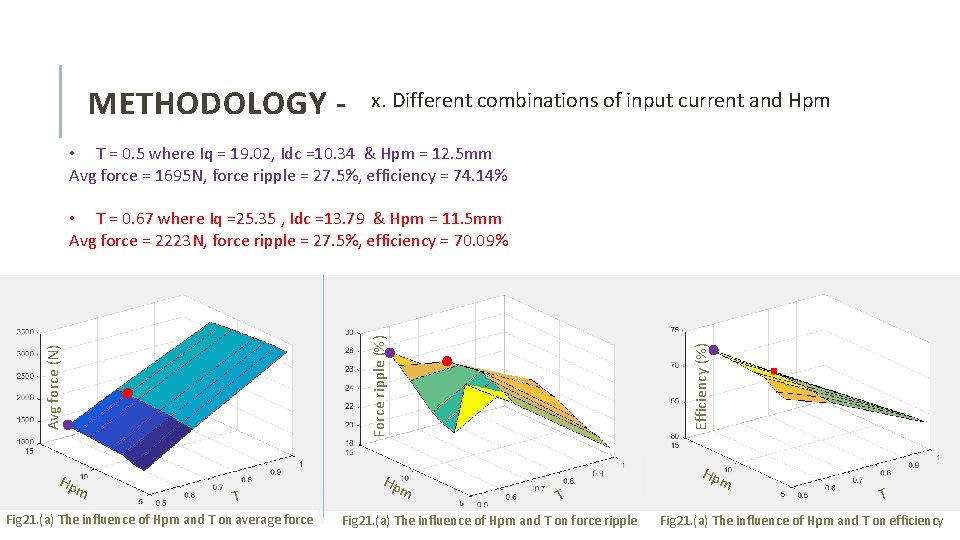
METHODOLOGY - x. Different combinations of input current and Hpm • T = 0. 5 where Iq = 19. 02, Idc =10. 34 & Hpm = 12. 5 mm Avg force = 1695 N, force ripple = 27. 5%, efficiency = 74. 14% Hp m T Fig 21. (a) The influence of Hpm and T on average force Hp Efficiency (%) Avg force (N) Force ripple (%) • T = 0. 67 where Iq =25. 35 , Idc =13. 79 & Hpm = 11. 5 mm Avg force = 2223 N, force ripple = 27. 5%, efficiency = 70. 09% m Hp T Fig 21. (a) The influence of Hpm and T on force ripple m T Fig 21. (a) The influence of Hpm and T on efficiency
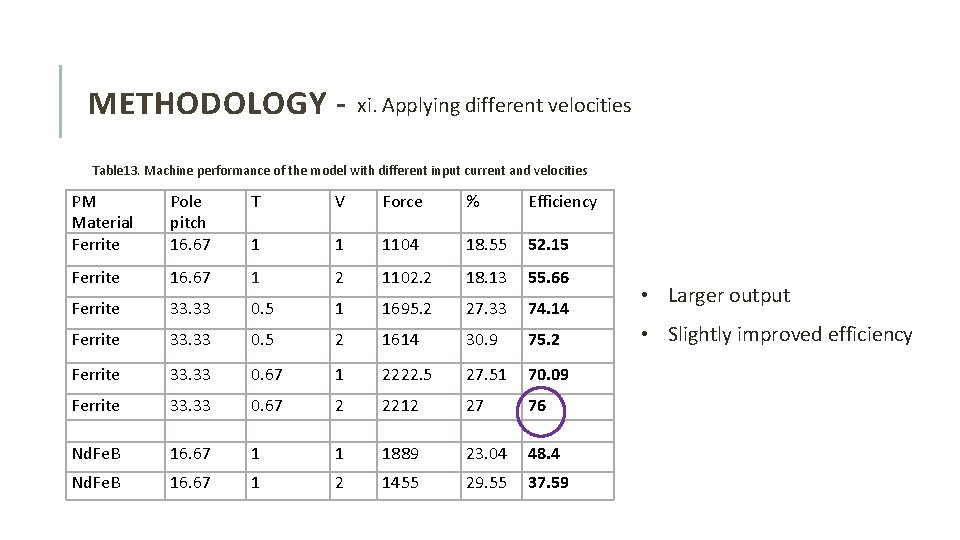
METHODOLOGY - xi. Applying different velocities Table 13. Machine performance of the model with different input current and velocities PM Material Ferrite Pole pitch 16. 67 T V Force % Efficiency 1 1 1104 18. 55 52. 15 Ferrite 16. 67 1 2 1102. 2 18. 13 55. 66 Ferrite 33. 33 0. 5 1 1695. 2 27. 33 74. 14 Ferrite 33. 33 0. 5 2 1614 30. 9 75. 2 Ferrite 33. 33 0. 67 1 2222. 5 27. 51 70. 09 Ferrite 33. 33 0. 67 2 2212 27 76 Nd. Fe. B 16. 67 1 1 1889 23. 04 48. 4 Nd. Fe. B 16. 67 1 2 1455 29. 55 37. 59 • Larger output • Slightly improved efficiency
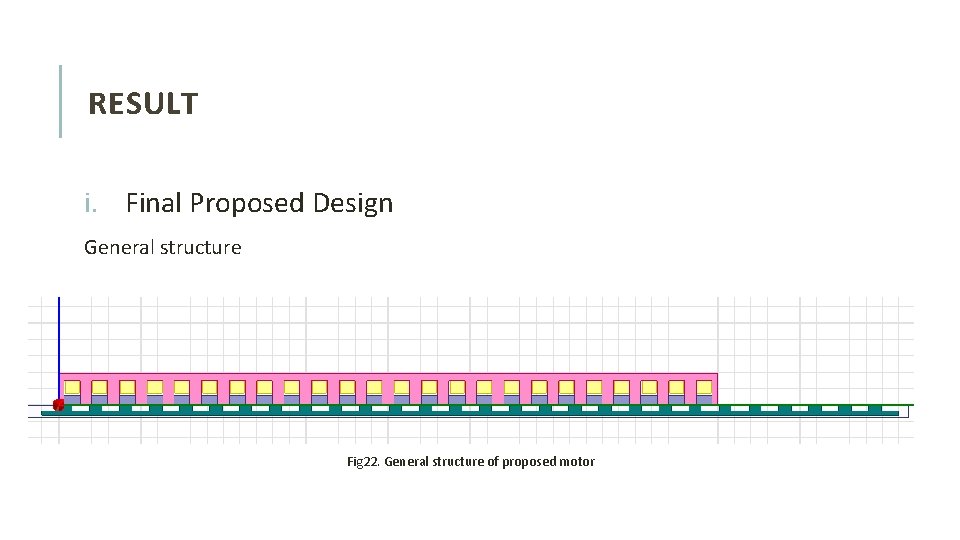
RESULT i. Final Proposed Design General structure Fig 22. General structure of proposed motor
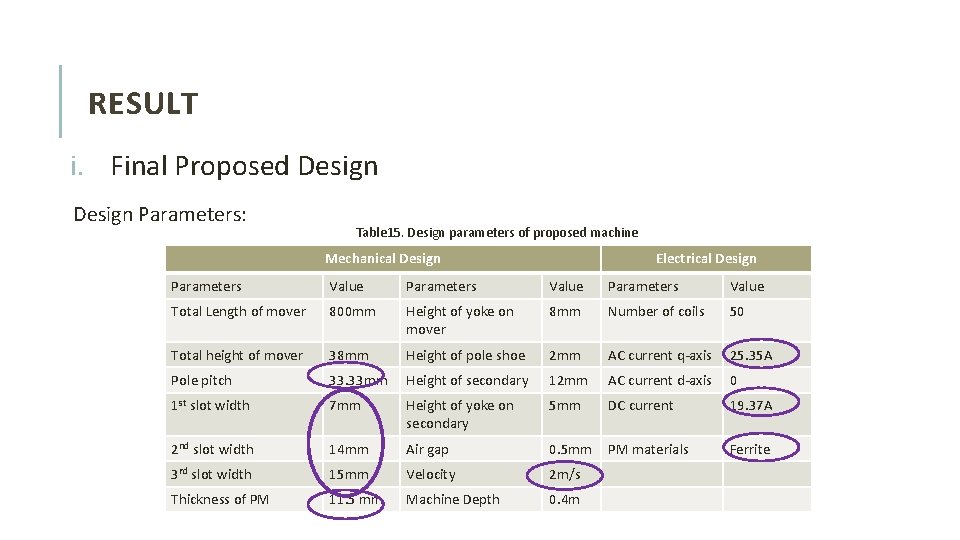
RESULT i. Final Proposed Design Parameters: Table 15. Design parameters of proposed machine Mechanical Design Electrical Design Parameters Value Total Length of mover 800 mm Height of yoke on mover 8 mm Number of coils 50 Total height of mover 38 mm Height of pole shoe 2 mm AC current q-axis 25. 35 A Pole pitch 33. 33 mm Height of secondary 12 mm AC current d-axis 0 1 st slot width 7 mm Height of yoke on secondary 5 mm DC current 19. 37 A 2 nd slot width 14 mm Air gap 0. 5 mm PM materials Ferrite 3 rd slot width 15 mm Velocity 2 m/s Thickness of PM 11. 5 mm Machine Depth 0. 4 m
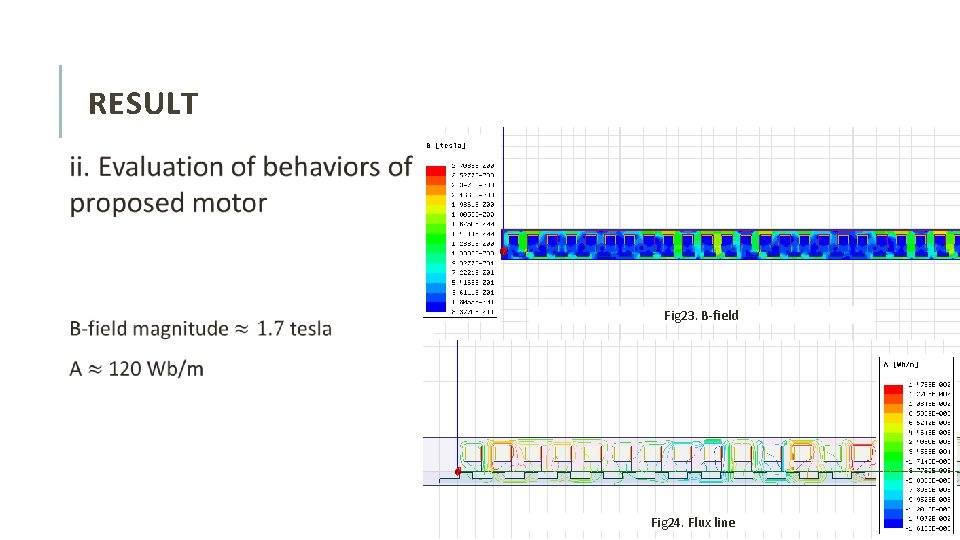
RESULT Fig 23. B-field Fig 24. Flux line
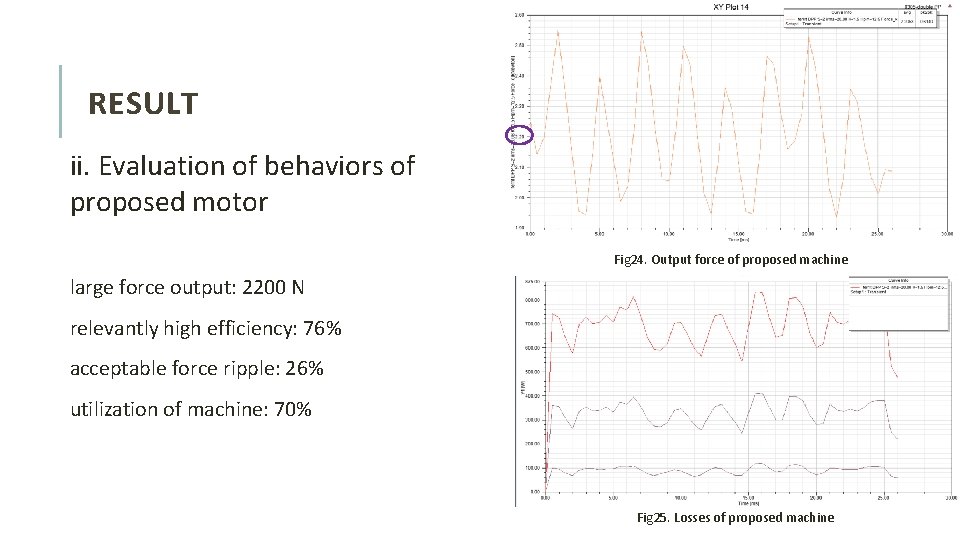
RESULT ii. Evaluation of behaviors of proposed motor Fig 24. Output force of proposed machine large force output: 2200 N relevantly high efficiency: 76% acceptable force ripple: 26% utilization of machine: 70% Fig 25. Losses of proposed machine
CONCLUSION 1. Initial design has been proposed. 2. Optimization measures have been taken, • adding pole shoe • modifying the slots numbers • selecting the most suitable slots width combinations • founding optimal thickness of PMs • changing materials of PMs • enlarging the pole pitch • choosing the best combinations of input current and thickness of PMs • accelerating the machine velocity
CONCLUSION 3. Effects of above measures • Large output force: 2200 N • Reasonable force ripple: 26% • Relatively high efficiency: 76%
![REFERENCE [1] Z. Q. Zhu and B. Lee, "Integrated Field and Armature Current Control](http://slidetodoc.com/presentation_image_h2/362416d322062cfefe17f835099ef95c/image-40.jpg "REFERENCE [1] Z. Q. Zhu and B. Lee, \"Integrated Field and Armature Current Control")
REFERENCE [1] Z. Q. Zhu and B. Lee, "Integrated Field and Armature Current Control for Dual Three-Phase Variable Flux Reluctance Machine Drives, " in IEEE Transactions on Energy Conversion, vol. 32, no. 2, pp. 447 -457, June 2017.

Thank you!
- Slides: 41