
A novel approach towards optimizing lightweight structures B
A novel approach towards optimizing lightweight structures B. Goller, R. Winkler, M. Gratt 3 rd Workshop on Structural Analysis of Lightweight Structures Natters, May 15, 2014
Contents • Introduction • Methods of analysis • Implementation in FE-software • Examples • Conclusions INTALES Gmb. H-Innsbrucker Str. 1 -, A-6161 Natters - www. intales. com
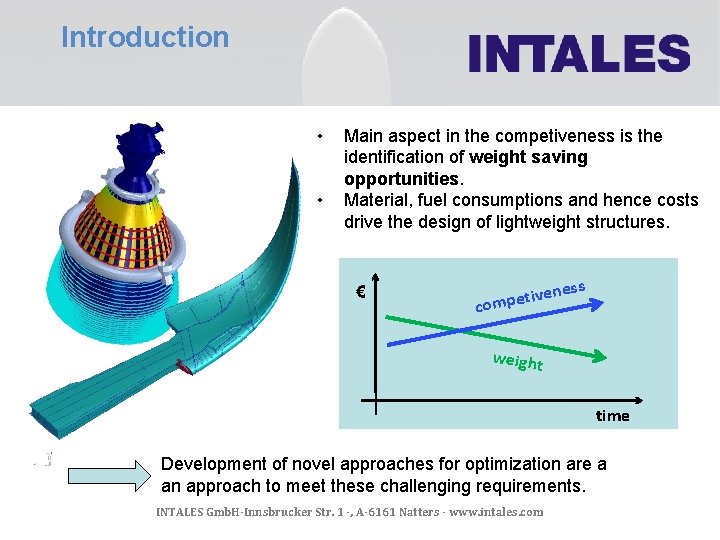
Introduction • • Main aspect in the competiveness is the identification of weight saving opportunities. Material, fuel consumptions and hence costs drive the design of lightweight structures. € ness tive e p m o c weight time Development of novel approaches for optimization are a an approach to meet these challenging requirements. INTALES Gmb. H-Innsbrucker Str. 1 -, A-6161 Natters - www. intales. com
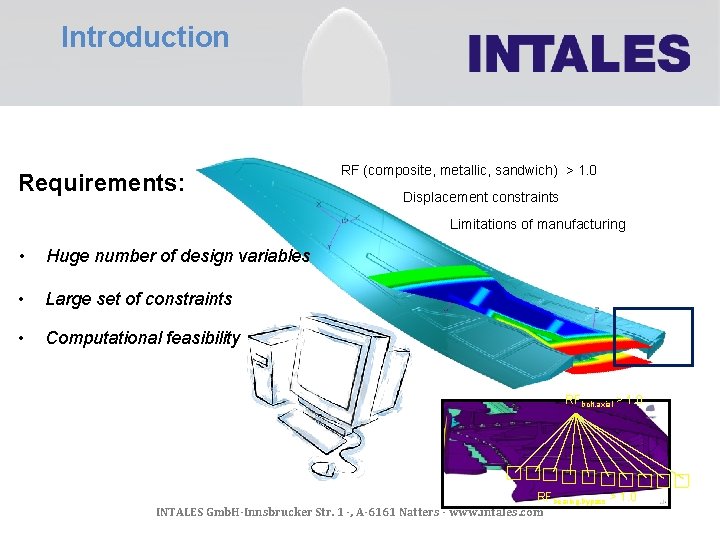
Introduction Requirements: RF (composite, metallic, sandwich) > 1. 0 Displacement constraints Limitations of manufacturing • Huge number of design variables • Large set of constraints • Computational feasibility RFbolt, axial > 1. 0 RFbearing, bypass > 1. 0 INTALES Gmb. H-Innsbrucker Str. 1 -, A-6161 Natters - www. intales. com
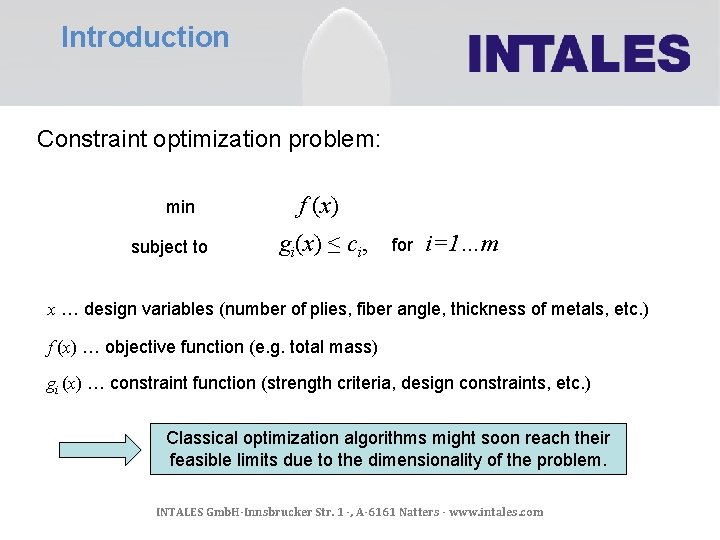
Introduction Constraint optimization problem: min subject to f (x) gi(x) ≤ ci, for i=1…m x … design variables (number of plies, fiber angle, thickness of metals, etc. ) f (x) … objective function (e. g. total mass) gi (x) … constraint function (strength criteria, design constraints, etc. ) Classical optimization algorithms might soon reach their feasible limits due to the dimensionality of the problem. INTALES Gmb. H-Innsbrucker Str. 1 -, A-6161 Natters - www. intales. com
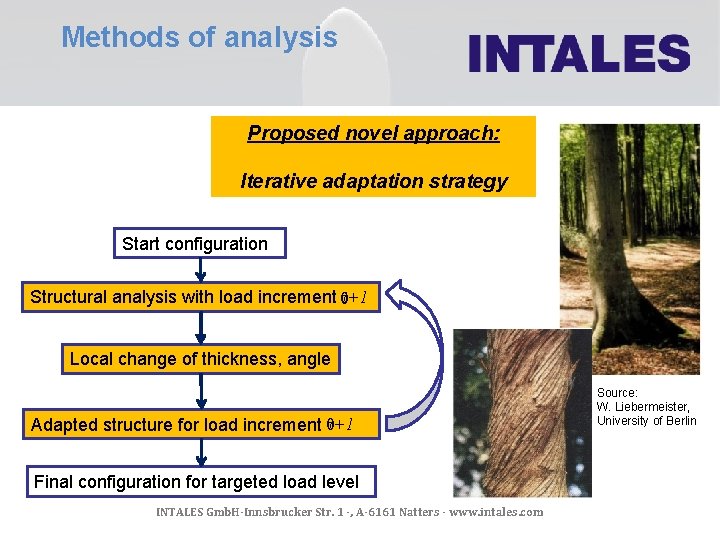
Methods of analysis Proposed novel approach: Iterative adaptation strategy Start configuration Structural analysis with load increment 0 i+1 Local change of thickness, angle Adapted structure for load increment 0 i+1 Final configuration for targeted load level INTALES Gmb. H-Innsbrucker Str. 1 -, A-6161 Natters - www. intales. com Source: W. Liebermeister, University of Berlin
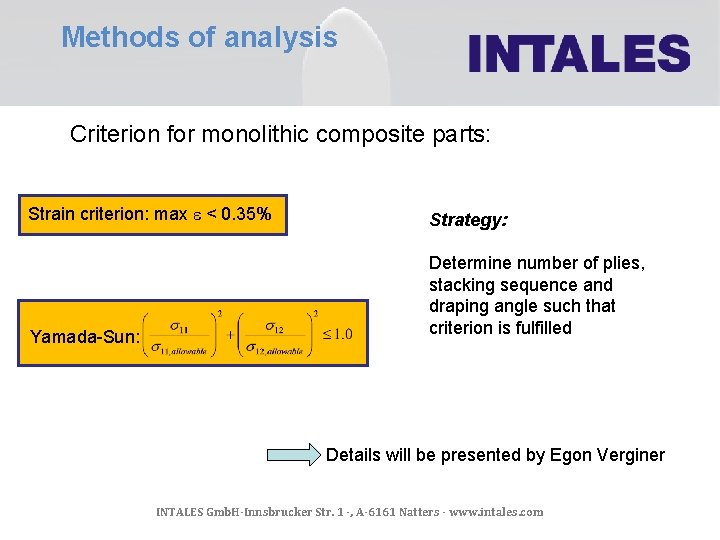
Methods of analysis Criterion for monolithic composite parts: Strain criterion: max e < 0. 35% Yamada-Sun: Strategy: Determine number of plies, stacking sequence and draping angle such that criterion is fulfilled Details will be presented by Egon Verginer INTALES Gmb. H-Innsbrucker Str. 1 -, A-6161 Natters - www. intales. com
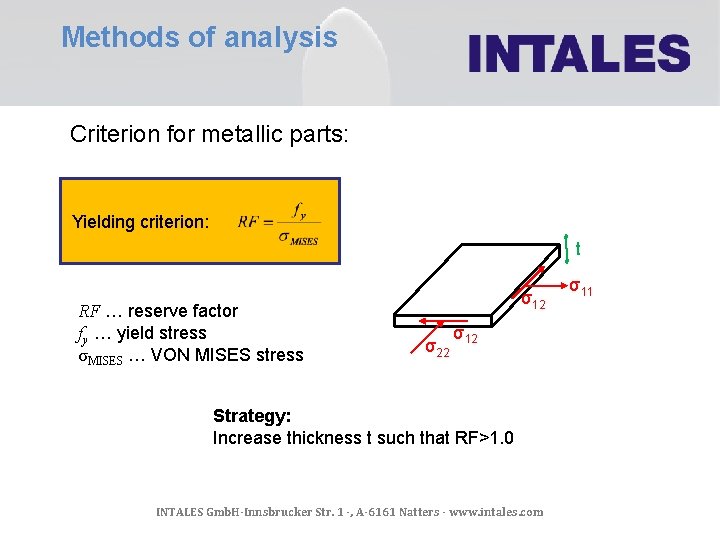
Methods of analysis Criterion for metallic parts: Yielding criterion: t RF … reserve factor fy … yield stress σMISES … VON MISES stress σ12 σ22 σ12 Strategy: Increase thickness t such that RF>1. 0 INTALES Gmb. H-Innsbrucker Str. 1 -, A-6161 Natters - www. intales. com σ11
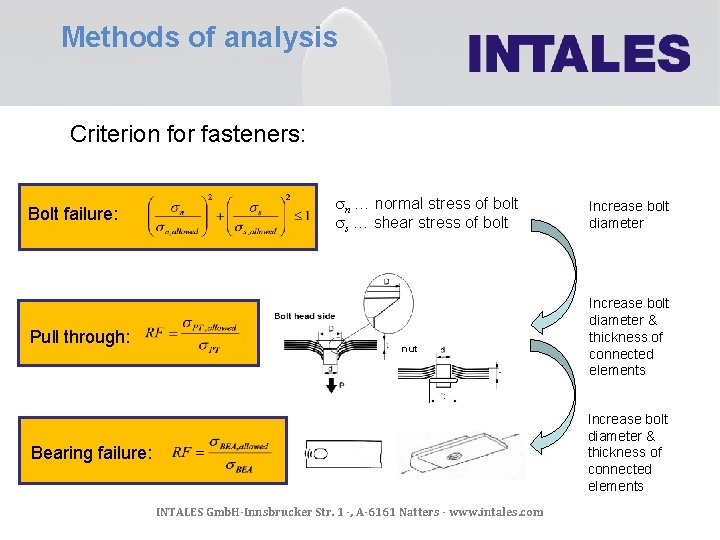
Methods of analysis Criterion for fasteners: Bolt failure: Pull through: sn … normal stress of bolt ss … shear stress of bolt nut Increase bolt diameter & thickness of connected elements Bearing failure: INTALES Gmb. H-Innsbrucker Str. 1 -, A-6161 Natters - www. intales. com
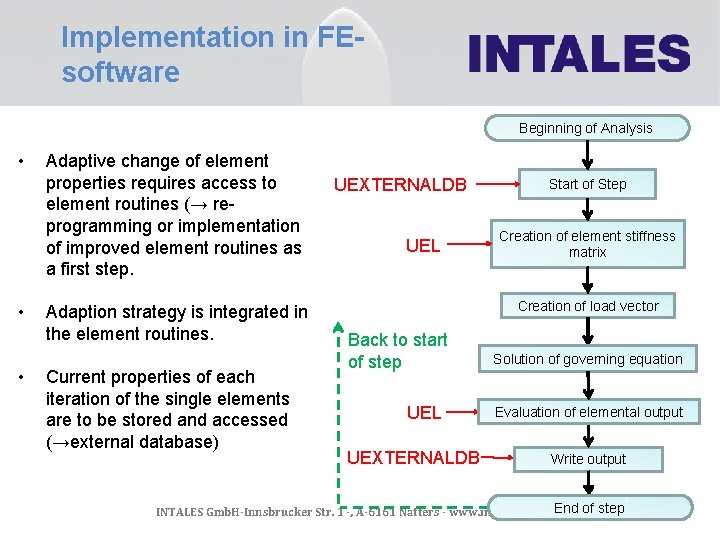
Implementation in FEsoftware Beginning of Analysis • • • Adaptive change of element properties requires access to element routines (→ reprogramming or implementation of improved element routines as a first step. Adaption strategy is integrated in the element routines. Current properties of each iteration of the single elements are to be stored and accessed (→external database) UEXTERNALDB UEL Start of Step Creation of element stiffness matrix Creation of load vector Back to start of step UEL UEXTERNALDB Solution of governing equation Evaluation of elemental output Write output INTALES Gmb. H-Innsbrucker Str. 1 -, A-6161 Natters - www. intales. com End of step
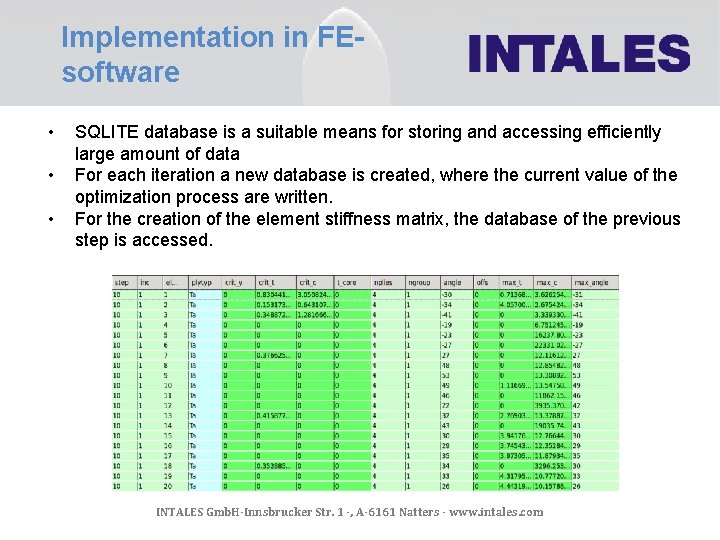
Implementation in FEsoftware • • • SQLITE database is a suitable means for storing and accessing efficiently large amount of data For each iteration a new database is created, where the current value of the optimization process are written. For the creation of the element stiffness matrix, the database of the previous step is accessed. INTALES Gmb. H-Innsbrucker Str. 1 -, A-6161 Natters - www. intales. com
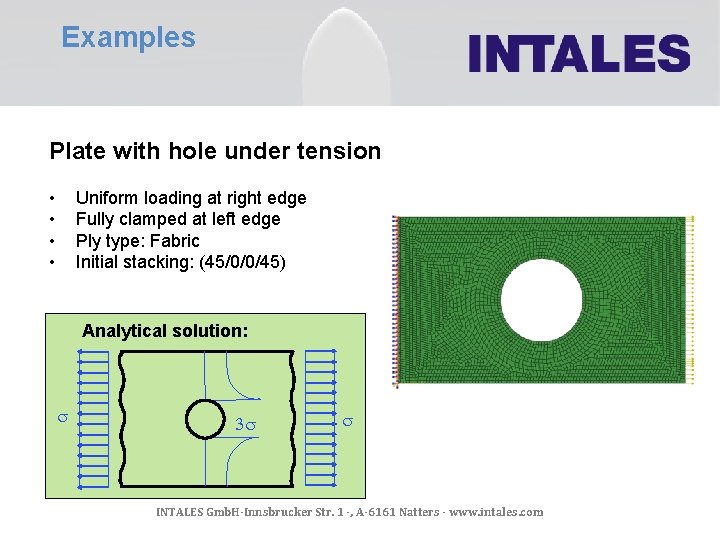
Examples Plate with hole under tension • • Uniform loading at right edge Fully clamped at left edge Ply type: Fabric Initial stacking: (45/0/0/45) Analytical solution: s 3 s s INTALES Gmb. H-Innsbrucker Str. 1 -, A-6161 Natters - www. intales. com
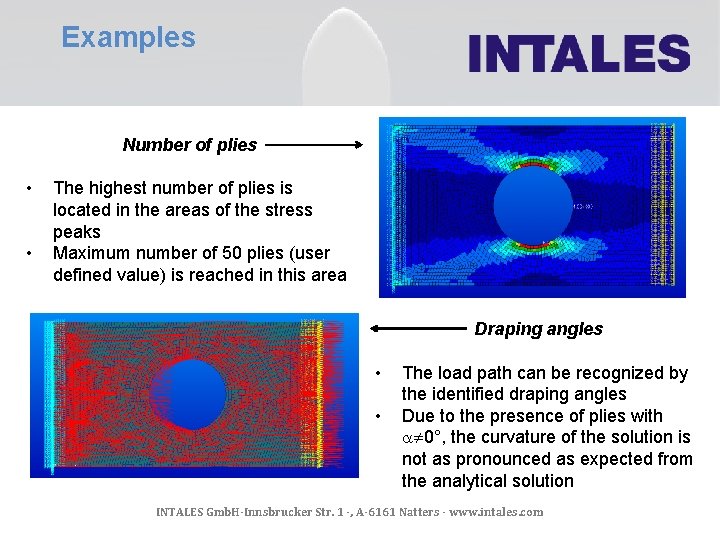
Examples Number of plies • • The highest number of plies is located in the areas of the stress peaks Maximum number of 50 plies (user defined value) is reached in this area Draping angles • • The load path can be recognized by the identified draping angles Due to the presence of plies with a 0°, the curvature of the solution is not as pronounced as expected from the analytical solution INTALES Gmb. H-Innsbrucker Str. 1 -, A-6161 Natters - www. intales. com
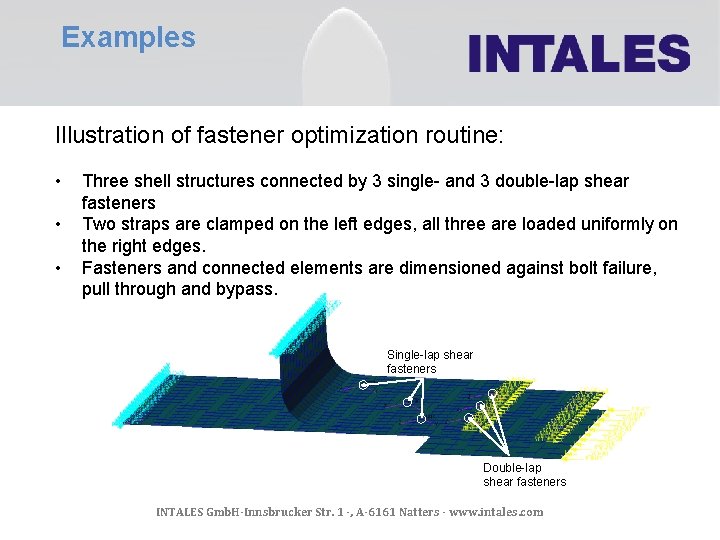
Examples Illustration of fastener optimization routine: • • • Three shell structures connected by 3 single- and 3 double-lap shear fasteners Two straps are clamped on the left edges, all three are loaded uniformly on the right edges. Fasteners and connected elements are dimensioned against bolt failure, pull through and bypass. Single-lap shear fasteners Double-lap shear fasteners INTALES Gmb. H-Innsbrucker Str. 1 -, A-6161 Natters - www. intales. com
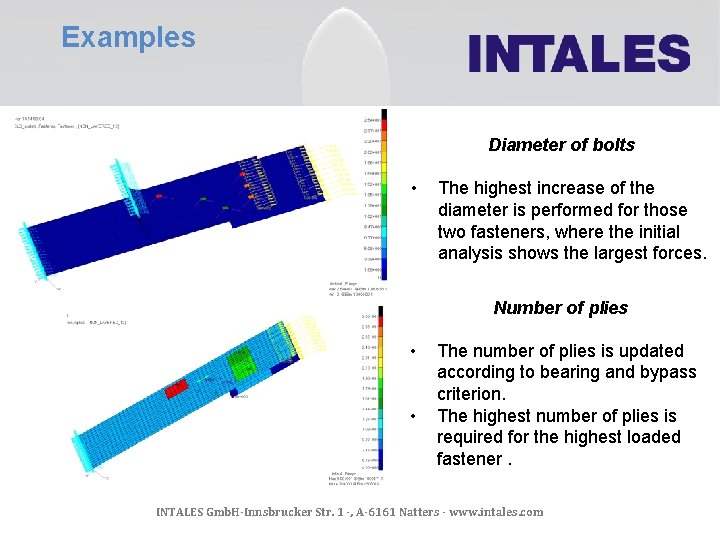
Examples Diameter of bolts • The highest increase of the diameter is performed for those two fasteners, where the initial analysis shows the largest forces. Number of plies • • The number of plies is updated according to bearing and bypass criterion. The highest number of plies is required for the highest loaded fastener. INTALES Gmb. H-Innsbrucker Str. 1 -, A-6161 Natters - www. intales. com
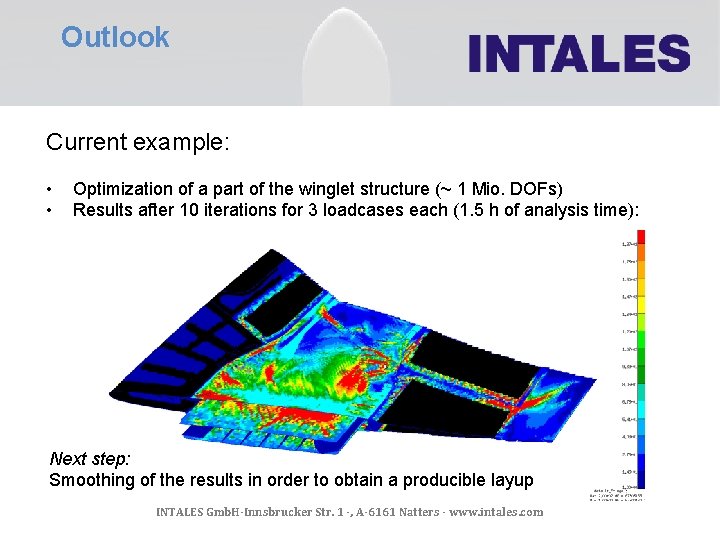
Outlook Current example: • • Optimization of a part of the winglet structure (~ 1 Mio. DOFs) Results after 10 iterations for 3 loadcases each (1. 5 h of analysis time): Next step: Smoothing of the results in order to obtain a producible layup INTALES Gmb. H-Innsbrucker Str. 1 -, A-6161 Natters - www. intales. com
Conclusions • • • A novel approach for the optimization of lightweight structures has been presented. The advantage of this approach is its applicability to FE-models involving a high number of design variables. The results shown in this presentation have been obtained after 10 iterations, which suggests its usability in case of large numerical models. Acknowledgements This project is financially supported by the Austrian Space Applications Programme (ASAP) of the Austrian Ministry for Transport, Innovation and Technology (BMVIT), which is deeply appreciated. INTALES Gmb. H-Innsbrucker Str. 1 -, A-6161 Natters - www. intales. com
- Slides: 17