
A Novel Approach to Resinbased Cysteine Alkylation Bin
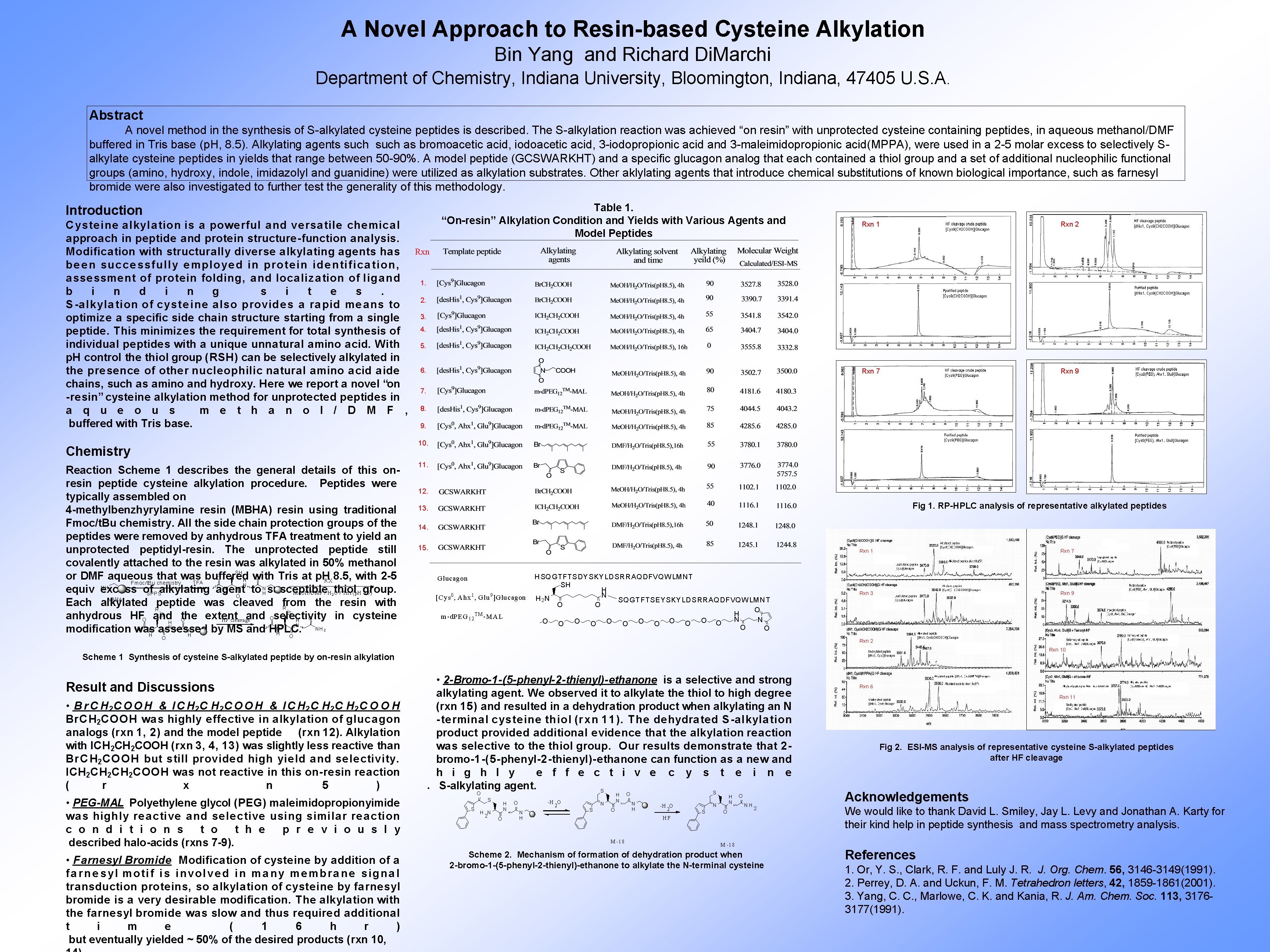
A Novel Approach to Resin-based Cysteine Alkylation Bin Yang and Richard Di. Marchi Department of Chemistry, Indiana University, Bloomington, Indiana, 47405 U. S. A. Abstract A novel method in the synthesis of S-alkylated cysteine peptides is described. The S-alkylation reaction was achieved “on resin” with unprotected cysteine containing peptides, in aqueous methanol/DMF buffered in Tris base (p. H, 8. 5). Alkylating agents such as bromoacetic acid, iodoacetic acid, 3 -iodopropionic acid and 3 -maleimidopropionic acid(MPPA), were used in a 2 -5 molar excess to selectively Salkylate cysteine peptides in yields that range between 50 -90%. A model peptide (GCSWARKHT) and a specific glucagon analog that each contained a thiol group and a set of additional nucleophilic functional groups (amino, hydroxy, indole, imidazolyl and guanidine) were utilized as alkylation substrates. Other aklylating agents that introduce chemical substitutions of known biological importance, such as farnesyl bromide were also investigated to further test the generality of this methodology. Table 1. “On-resin” Alkylation Condition and Yields with Various Agents and Model Peptides Introduction C yste ine a lkyla tion is a powe rful a nd ve rsa tile che mica l approach in peptide and protein structure-function analysis. Modification with structurally diverse alkylating agents has be e n succe ssfully e mploye d in prote in ide ntifica tion, a sse ssme nt of prote in folding, a nd loca liz a tion of liga nd b i n d i n g s i t e s. S -a lkyla tion of cyste ine a lso provide s a ra pid me a ns to optimize a specific side chain structure starting from a single peptide. This minimizes the requirement for total synthesis of individual peptides with a unique unnatural amino acid. With p. H control the thiol group (RSH) can be selectively alkylated in the presence of other nucle ophilic natural amino acid aide chains, such as amino and hydroxy. Here we report a novel “on -resin” cysteine alkylation method for unprotected peptides in a q u e o u s m e t h a n o l / D M F , buffered with Tris base. Rxn 1 Rxn 2 Rxn 7 Rxn 9 Rxn 1. 2. 3. 4. 5. 6. 7. 8. 9. 10. Chemistry Reaction Scheme 1 describes the general details of this onresin peptide cysteine alkylation procedure. Peptides were typically assembled on 4 -methylbenzhyrylamine resin (MBHA) resin using traditional Fmoc/t. Bu chemistry. All the side chain protection groups of the peptides were removed by anhydrous TFA treatment to yield an unprotected peptidyl-resin. The unprotected peptide still covalently attached to the resin was alkylated in 50% methanol SH or DMF aqueous that was buffered with Tris at p. H 8. 5, with 2 -5 O O H RX TFA Fmoc/t. Bu ch emistry N NH N N susceptible thiol group. equiv excess of alkylating agent to Me. OH /DMF / H O / Tris (p. H 8. 5) H H SPPS O MBHA Each alkylated peptide was cleaved from the resin with R R S S anhydrous HFO and the extent and selectivity in cysteine O O O HF cleavage H H N NH modification was by MS and HPLC. N assessed N H H H O 11. 12. Fig 1. RP-HPLC analysis of representative alkylated peptides 13. 14. 15. Glucagon 2 2 [Cys 0 , A hx 1 , G lu 9 ]G lucagon m-d. PEG 12 T M -MA L 2 H SQ GTFTSDY SKYLD SR R AQDFVQW LM NT SH H N H 2 N SQ GTFTSEYSKYLD SRR AQDF VQW LM N T O O O H N N O O O O Rxn 1 Rxn 7 Rxn 3 Rxn 9 Rxn 2 Rxn 10 Scheme 1 Synthesis of cysteine S-alkylated peptide by on-resin alkylation Result and Discussions • B r C H 2 C O O H & I C H 2 C O O H Br. C H 2 COOH was highly effective in alkylation of gluca gon analogs (rxn 1, 2) and the model peptide (rxn 12). Alkylation with ICH 2 COOH (rxn 3, 4, 13) was slightly less reactive than Br. C H 2 C O O H but still provide d high yie ld a nd se le ctivity. ICH 2 CH 2 COOH was not reactive in this on-resin reaction ( r x n 5 ) • PEG-MAL Polyethylene glycol (PEG) maleimidopropionyimide wa s highly re a ctive a nd se le ctive using simila r re a ction c o n d i t i o n s t o t h e p r e v i o u s l y described halo-acids (rxns 7 -9). • Farnesyl Bromide Modification of cysteine by addition of a fa rne syl motif is involve d in ma ny me mbra ne signa l transduction proteins, so alkylation of cysteine by farnesyl bromide is a very desirable modification. The alkylation with the farnesyl bromide was slow and thus required additional t i m e ( 1 6 h r ) but eventually yielded ~ 50% of the desired products (rxn 10, • 2 -Bromo-1 -(5 -phenyl-2 -thienyl)-ethanone is a selective and strong alkylating agent. We observed it to alkylate thiol to high degree (rxn 15) and resulted in a dehydration product when alkylating an N -terminal cyste ine thiol (r x n 11). The dehydrated S-a lkyla tion product provided additional evidence that the alkylation reaction was selective to the thiol group. Our results demonstrate that 2 bromo-1 -(5 -phenyl-2 -thienyl)-ethanone can function as a new and h i g h l y e f f e c t i v e c y s t e i n e. S-alkylating agent. S S O S S H N 2 H N O -H O 2 O N H H N N S O O N H -H O 2 H N N S O O NH 2 HF M -1 8 Scheme 2. Mechanism of formation of dehydration product when 2 -bromo-1 -(5 -phenyl-2 -thienyl)-ethanone to alkylate the N-terminal cysteine Rxn 6 Rxn 11 Fig 2. ESI-MS analysis of representative cysteine S-alkylated peptides after HF cleavage Acknowledgements We would like to thank David L. Smiley, Jay L. Levy and Jonathan A. Karty for their kind help in peptide synthesis and mass spectrometry analysis. References 1. Or, Y. S. , Clark, R. F. and Luly J. R. J. Org. Chem. 56, 3146 -3149(1991). 2. Perrey, D. A. and Uckun, F. M. Tetrahedron letters, 42, 1859 -1861(2001). 3. Yang, C. C. , Marlowe, C. K. and Kania, R. J. Am. Chem. Soc. 113, 31763177(1991).
- Slides: 1