
A Novel Antipsychotic Drug BLE Lucette BIZIMANA Charlotte
A Novel Antipsychotic Drug BLE Lucette BIZIMANA Charlotte COLIN Jean-Baptiste MORISOT Nicolas 1
Introduction • Antipsychotics remain the current standard of care for mental disorders including schizophrenia and bipolar mania. • Schizophrenia is a young people disease • Appearance between 18 and 25 years, before 45 years • Symptoms domains – Positive symptoms : hallucination – Negative symptoms : lack of motivation – Cognitive disturbances : memory disorders – General symptoms : depressive or anxiety symptoms 2
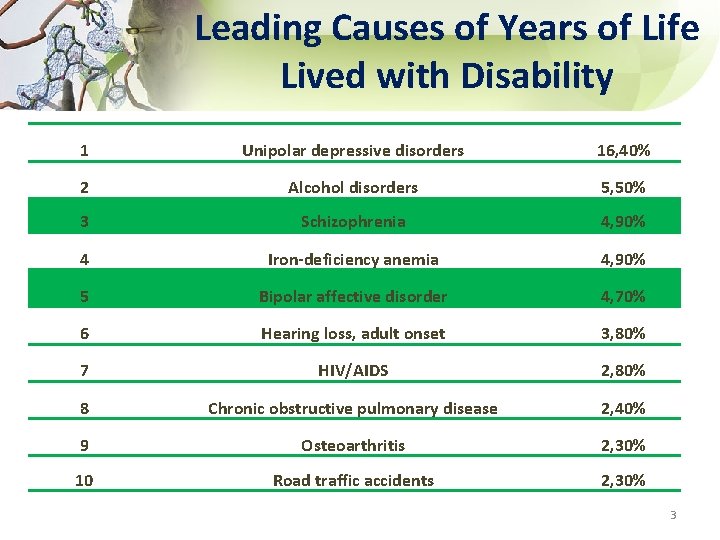
Leading Causes of Years of Life Lived with Disability 1 Unipolar depressive disorders 16, 40% 2 Alcohol disorders 5, 50% 3 Schizophrenia 4, 90% 4 Iron-deficiency anemia 4, 90% 5 Bipolar affective disorder 4, 70% 6 Hearing loss, adult onset 3, 80% 7 HIV/AIDS 2, 80% 8 Chronic obstructive pulmonary disease 2, 40% 9 Osteoarthritis 2, 30% 10 Road traffic accidents 2, 30% 3
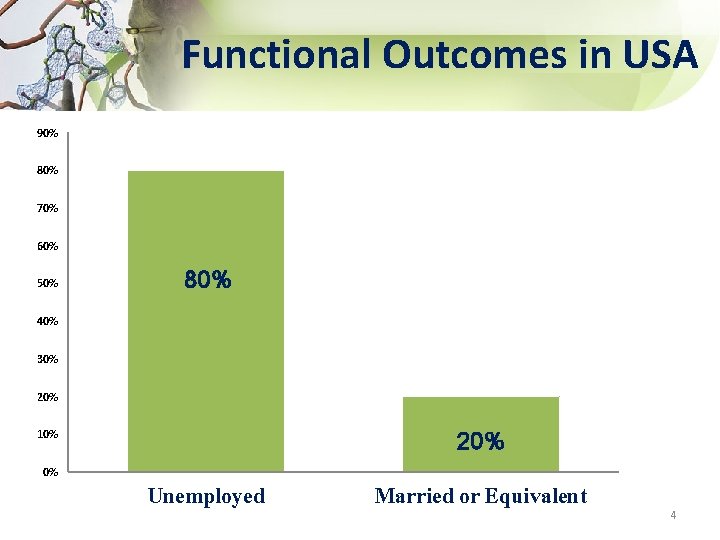
Functional Outcomes in USA 90% 80% 70% 60% 50% 80% 40% 30% 20% 10% 20% 0% Unemployed Married or Equivalent 4
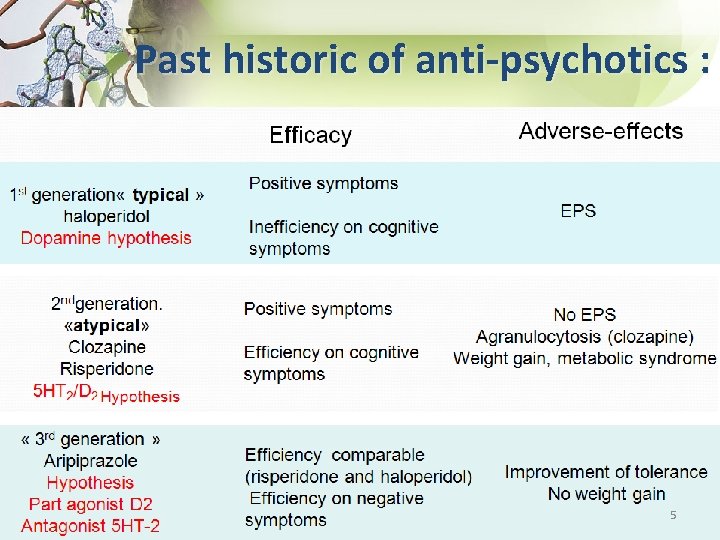
Past historic of anti-psychotics : 5
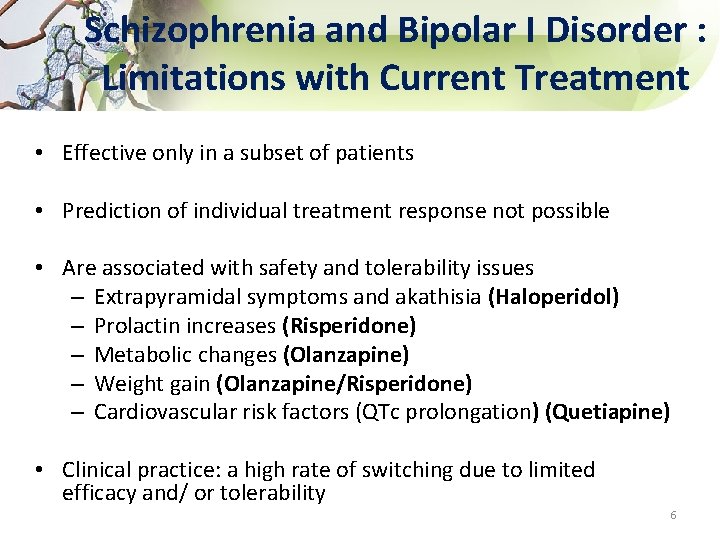
Schizophrenia and Bipolar I Disorder : Limitations with Current Treatment • Effective only in a subset of patients • Prediction of individual treatment response not possible • Are associated with safety and tolerability issues – Extrapyramidal symptoms and akathisia (Haloperidol) – Prolactin increases (Risperidone) – Metabolic changes (Olanzapine) – Weight gain (Olanzapine/Risperidone) – Cardiovascular risk factors (QTc prolongation) (Quetiapine) • Clinical practice: a high rate of switching due to limited efficacy and/ or tolerability 6
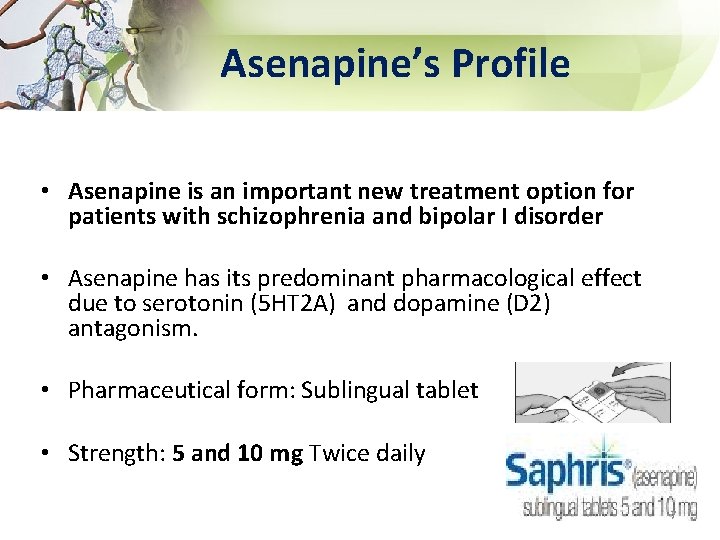
Asenapine’s Profile • Asenapine is an important new treatment option for patients with schizophrenia and bipolar I disorder • Asenapine has its predominant pharmacological effect due to serotonin (5 HT 2 A) and dopamine (D 2) antagonism. • Pharmaceutical form: Sublingual tablet • Strength: 5 and 10 mg Twice daily 7
Historic November 2006 November 2007 March 2009
OVERVIEW OF EFFICACY

Short-term trials in schizophrenia Phase 2 trial (41004) Asenapine 5 Risperidone 3 Placebo Asenapine 5 Phase 3 trial (41023) Asenapine 10 Haloperidol 4 Placebo Asenapine 5 Phase 3 trial (41021) Asenapine 10 Olanzapine 15 Placebo
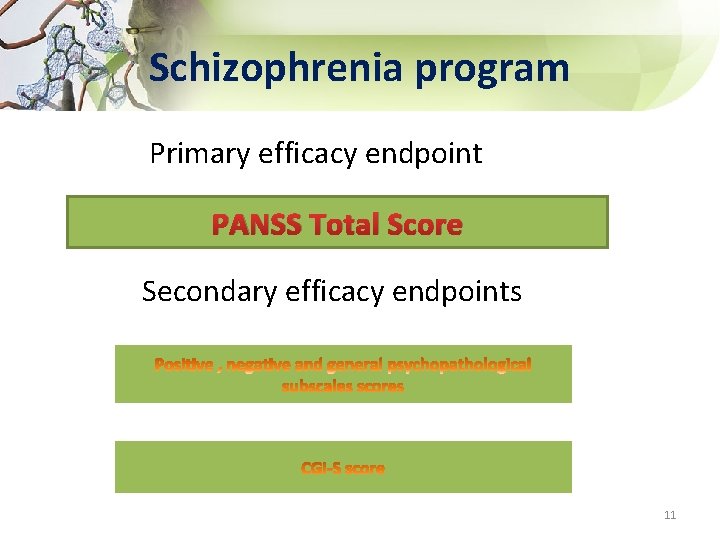
Schizophrenia program Primary efficacy endpoint PANSS Total Score Secondary efficacy endpoints 11
PANSS Score • Evaluation of the psychopathological symptoms • 3 dimensions: positive symptoms negative symptoms general psychopathology • 30 items, scored from 1 (absent) to 7 (extreme) 12
Positive subscale items • • P 1: delusion P 2: conceptual disorganisation P 3: hallucinatory behaviour P 4: excitement P 5: grandiosity P 6: suspiciousness/persecution P 7: hostility 13
Inclusion criteria • age >18 years • DSM-IV diagnosis of schizophrenia: disorganized, paranoid, catatonic or undifferentiated subtypes • acute exacerbation: CGI-S Score > 4 and PANSS > 60
Exclusion criteria • actively suicidal state • DMS-IV diagnosis of residual schizophrenia, schizo-affective disorder • primary psychiatric diagnosis other than schizophrenia
Trials design v patients randomly assigned v 3 (phase 2) or 4 (phases 3) arms v double-blind v double-dummy
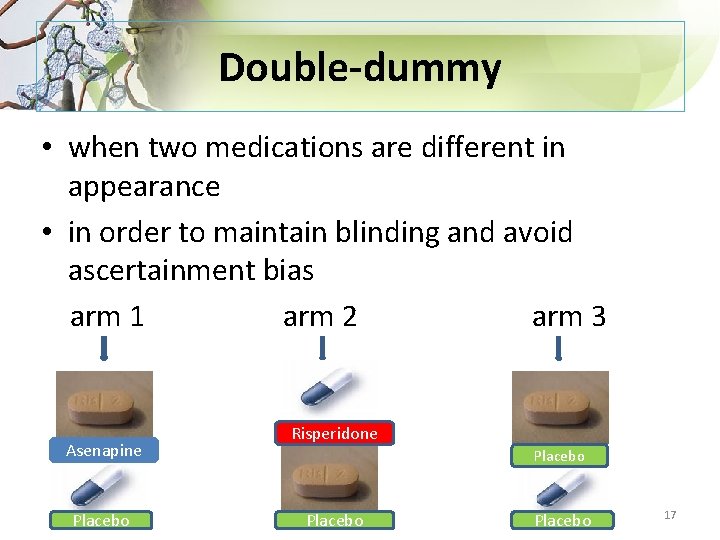
Double-dummy • when two medications are different in appearance • in order to maintain blinding and avoid ascertainment bias arm 1 arm 2 arm 3 Asenapine Placebo Risperidone Placebo 17
Trials design v patients randomly assigned v 3 (phase 2) or 4 (phase 3) arms v double-blind v double-dummy v measure of adherence: - before the trial - during the trial
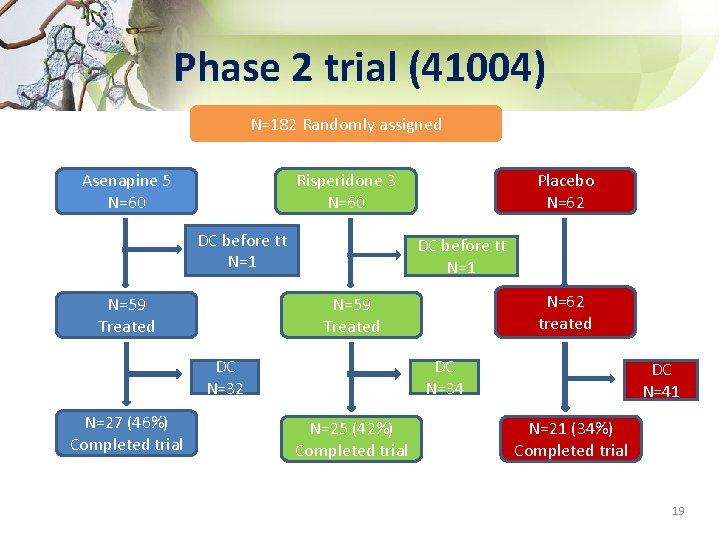
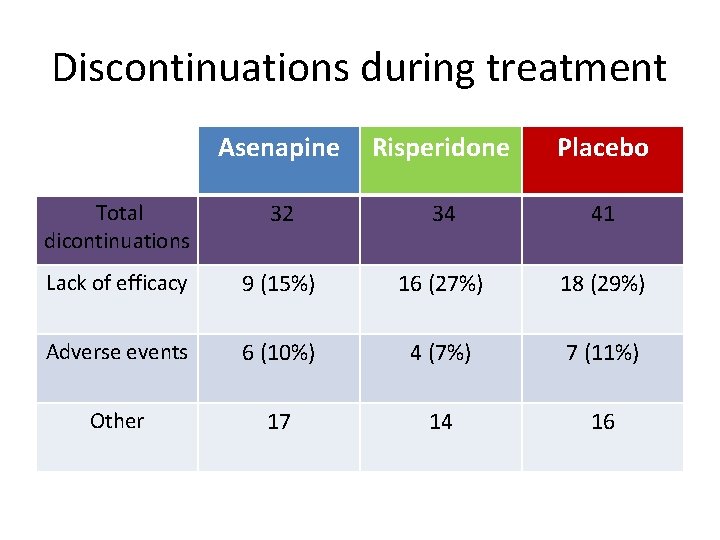
Phase 2 trial (41004) N=182 Randomly assigned Asenapine 5 N=60 Risperidone 3 N=60 DC before tt N=1 N=59 Treated DC before tt N=1 N=62 treated N=59 Treated DC N=32 N=27 (46%) Completed trial Placebo N=62 DC N=34 N=25 (42%) Completed trial DC N=41 N=21 (34%) Completed trial 19
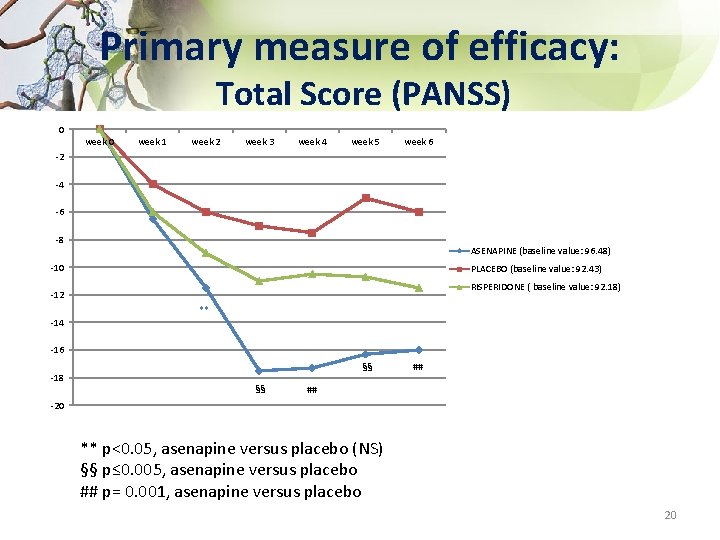
Primary measure of efficacy: Total Score (PANSS) 0 week 1 week 2 week 3 week 4 week 5 week 6 -2 -4 -6 -8 ASENAPINE (baseline value: 96. 48) -10 PLACEBO (baseline value: 92. 43) RISPERIDONE ( baseline value: 92. 18) -12 ** -14 -16 -18 §§ §§ ## ## -20 ** p<0. 05, asenapine versus placebo (NS) §§ p≤ 0. 005, asenapine versus placebo ## p= 0. 001, asenapine versus placebo 20
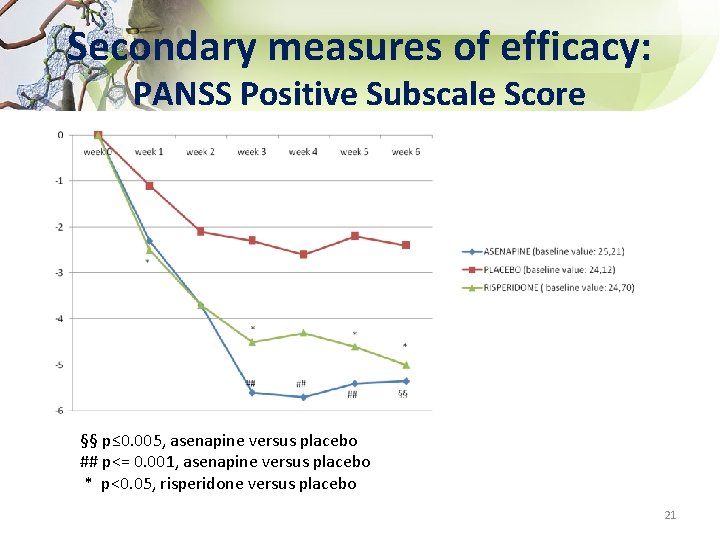
Secondary measures of efficacy: PANSS Positive Subscale Score §§ p≤ 0. 005, asenapine versus placebo ## p<= 0. 001, asenapine versus placebo * p<0. 05, risperidone versus placebo 21
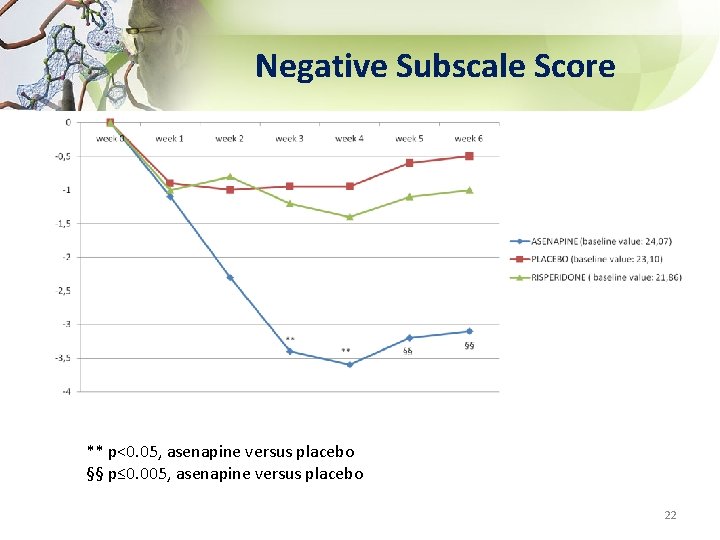
Negative Subscale Score ** p<0. 05, asenapine versus placebo §§ p≤ 0. 005, asenapine versus placebo 22
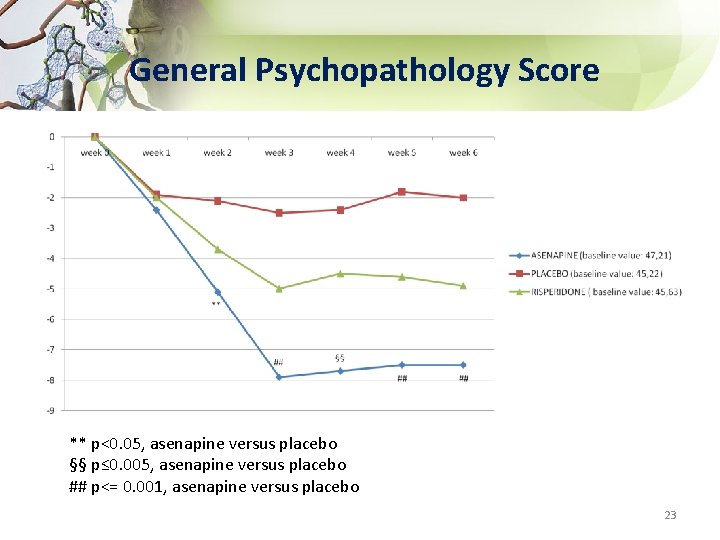
General Psychopathology Score ** p<0. 05, asenapine versus placebo §§ p≤ 0. 005, asenapine versus placebo ## p<= 0. 001, asenapine versus placebo 23
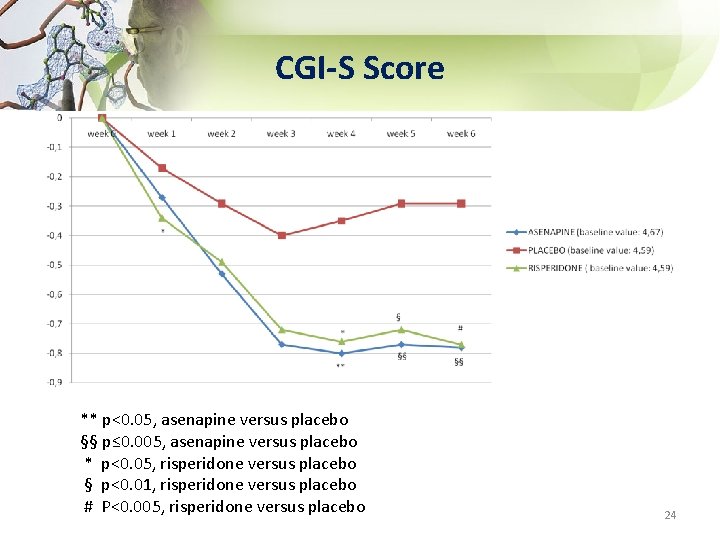
CGI-S Score ** p<0. 05, asenapine versus placebo §§ p≤ 0. 005, asenapine versus placebo * p<0. 05, risperidone versus placebo § p<0. 01, risperidone versus placebo # P<0. 005, risperidone versus placebo 24
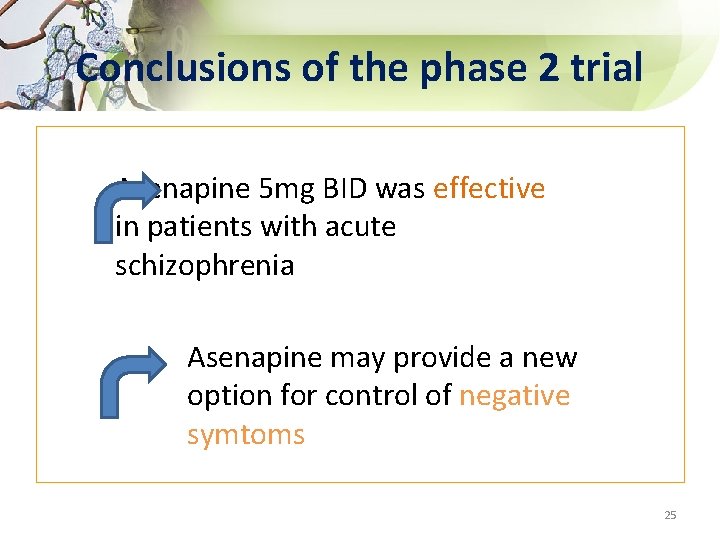
Conclusions of the phase 2 trial Asenapine 5 mg BID was effective in patients with acute schizophrenia Asenapine may provide a new option for control of negative symtoms 25
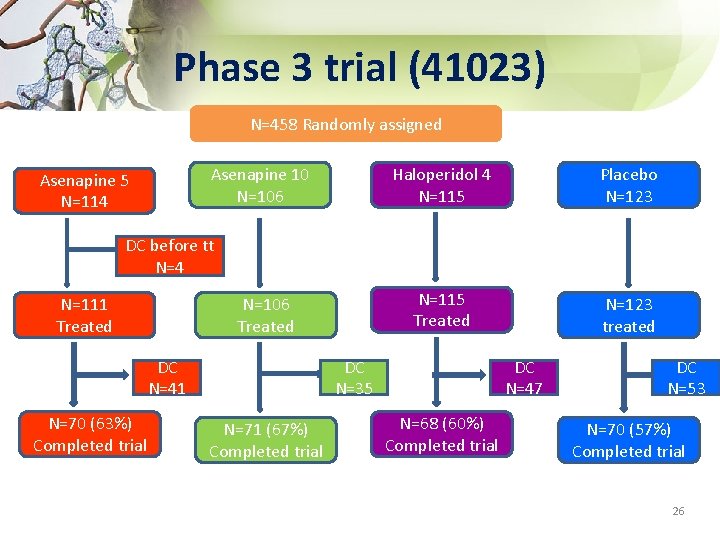
Phase 3 trial (41023) N=458 Randomly assigned Asenapine 10 N=106 Asenapine 5 N=114 Haloperidol 4 N=115 Placebo N=123 N=115 Treated N=123 treated DC before tt N=4 N=111 Treated N=106 Treated DC N=41 N=70 (63%) Completed trial DC N=35 N=71 (67%) Completed trial DC N=47 N=68 (60%) Completed trial DC N=53 N=70 (57%) Completed trial 26
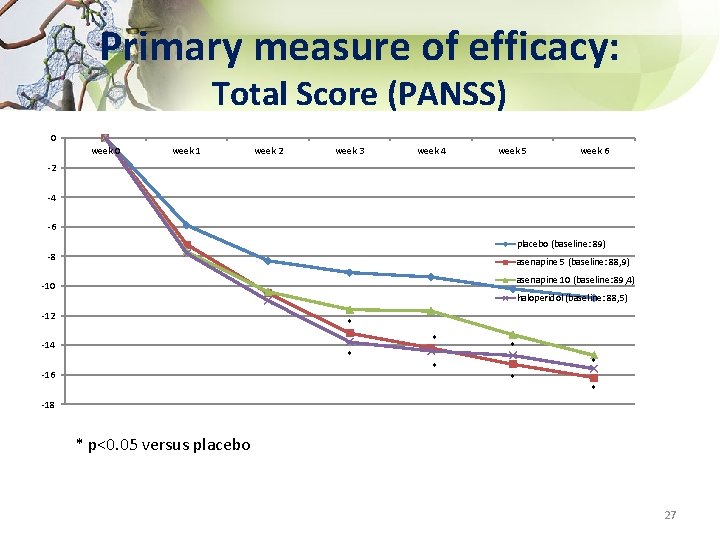
Primary measure of efficacy: Total Score (PANSS) 0 week 1 week 2 week 3 week 4 week 5 week 6 -2 -4 -6 placebo (baseline: 89) -8 asenapine 5 (baseline: 88, 9) asenapine 10 (baseline: 89, 4) -10 haloperidol (baseline: 88, 5) -12 * * -14 * -16 * * * -18 * p<0. 05 versus placebo 27
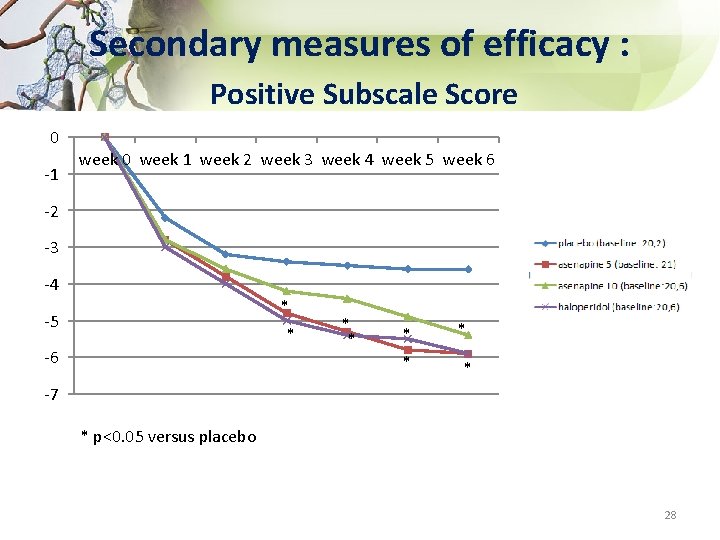
Secondary measures of efficacy : Positive Subscale Score 0 -1 week 0 week 1 week 2 week 3 week 4 week 5 week 6 -2 -3 -4 * -5 * -6 * * * -7 * p<0. 05 versus placebo 28
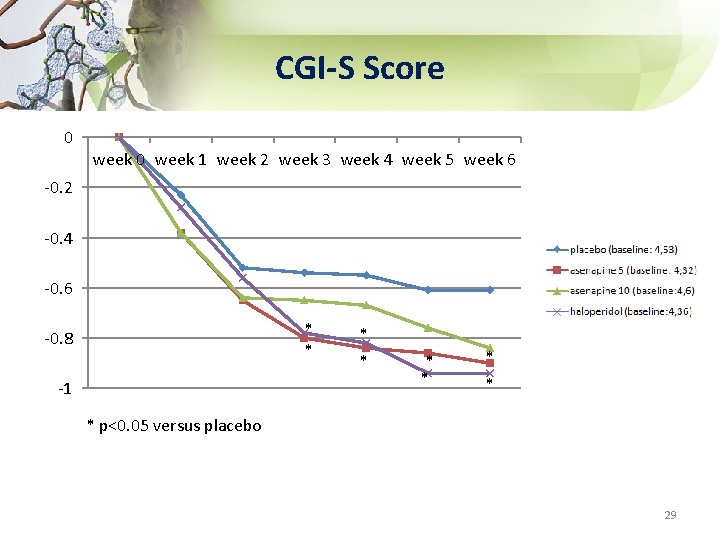
CGI-S Score 0 week 1 week 2 week 3 week 4 week 5 week 6 -0. 2 -0. 4 -0. 6 * * -0. 8 -1 * * * * p<0. 05 versus placebo 29
Conclusion of the phase 3 trial Asenapine at the 5 mg twice daily dose level was effective in the treatment of subjects with schizophrenia 30
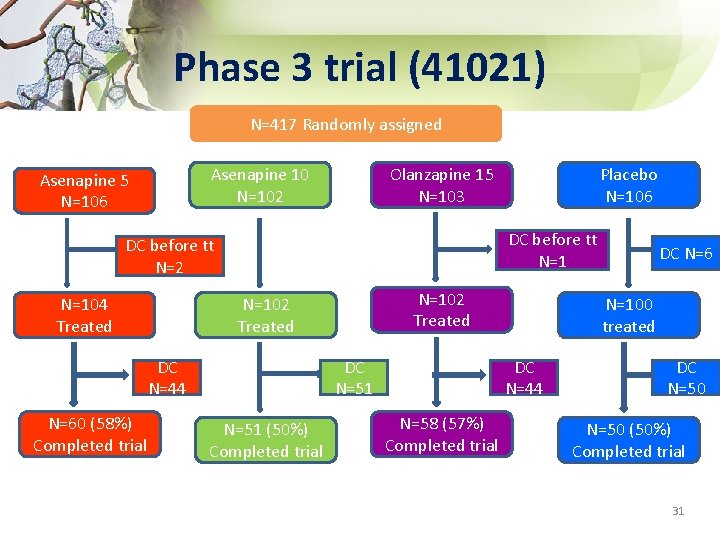
Phase 3 trial (41021) N=417 Randomly assigned Asenapine 10 N=102 Asenapine 5 N=106 Olanzapine 15 N=103 DC before tt N=1 DC before tt N=2 N=104 Treated N=102 Treated DC N=44 N=60 (58%) Completed trial Placebo N=106 DC N=51 (50%) Completed trial N=100 treated DC N=44 N=58 (57%) Completed trial DC N=6 DC N=50 (50%) Completed trial 31
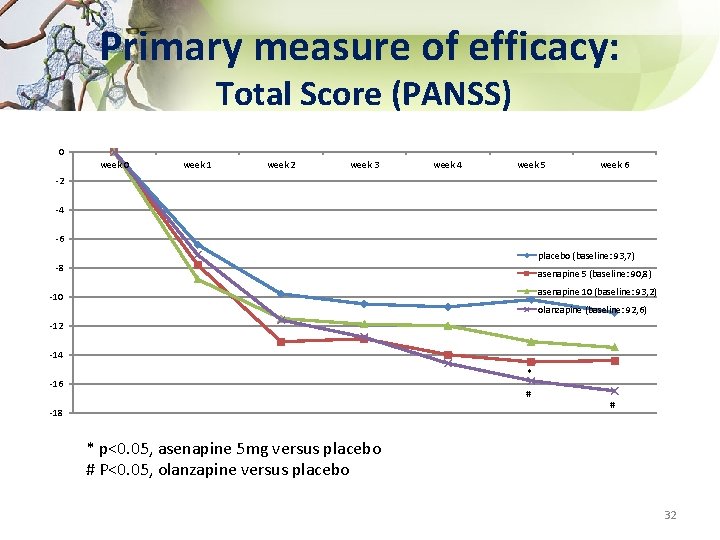
Primary measure of efficacy: Total Score (PANSS) 0 week 1 week 2 week 3 week 4 week 5 week 6 -2 -4 -6 placebo (baseline: 93, 7) -8 asenapine 5 (baseline: 90, 8) asenapine 10 (baseline: 93, 2) -10 olanzapine (baseline: 92, 6) -12 -14 * -16 # -18 # * p<0. 05, asenapine 5 mg versus placebo # P<0. 05, olanzapine versus placebo 32
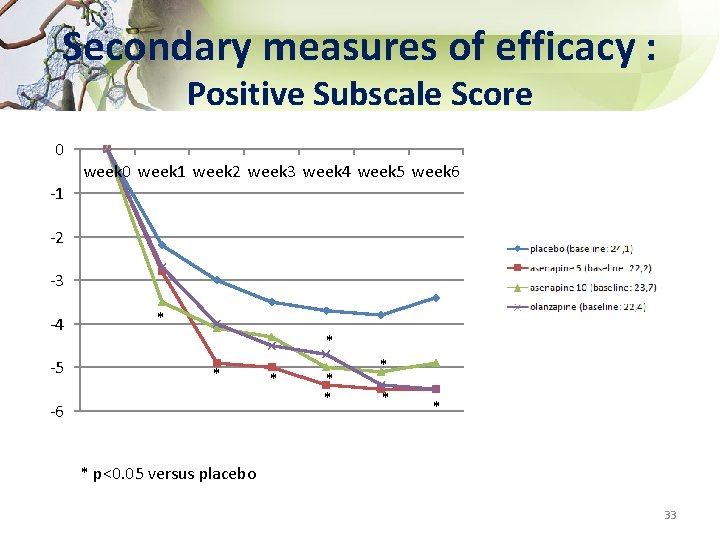
Secondary measures of efficacy : Positive Subscale Score 0 -1 week 0 week 1 week 2 week 3 week 4 week 5 week 6 -2 -3 -4 -5 * * * -6 * * * * p<0. 05 versus placebo 33
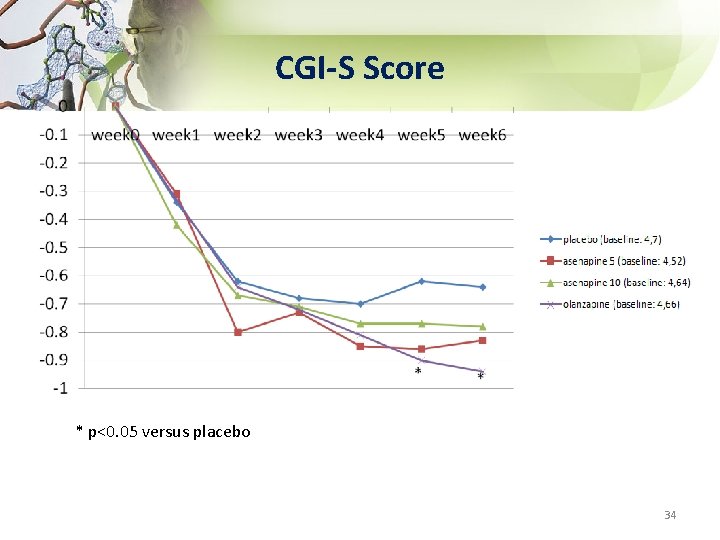
CGI-S Score * p<0. 05 versus placebo 34
Conclusions of the phase 3 trial Asenapine at the 5 mg twice daily and 10 mg twice daily dose levels did not achieve statistical significance on the primary endpoint negative study! 35
Summary of efficacy Asenapine 5 mg twice daily efficacious in the acute treatment of schizophrenia in two adequate and well-controled short-term trials Very interesting results concerning negative symptoms 36
General Safety Data 37
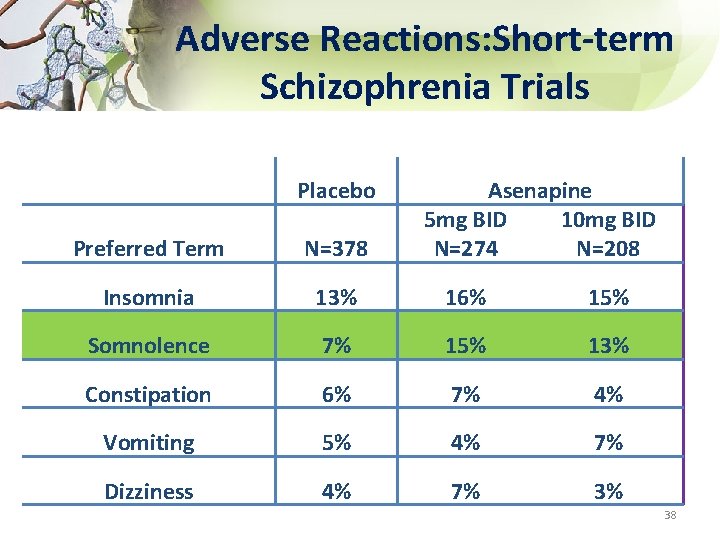
Adverse Reactions: Short-term Schizophrenia Trials Placebo Asenapine 5 mg BID 10 mg BID N=274 N=208 Preferred Term N=378 Insomnia 13% 16% 15% Somnolence 7% 15% 13% Constipation 6% 7% 4% Vomiting 5% 4% 7% Dizziness 4% 7% 3% 38
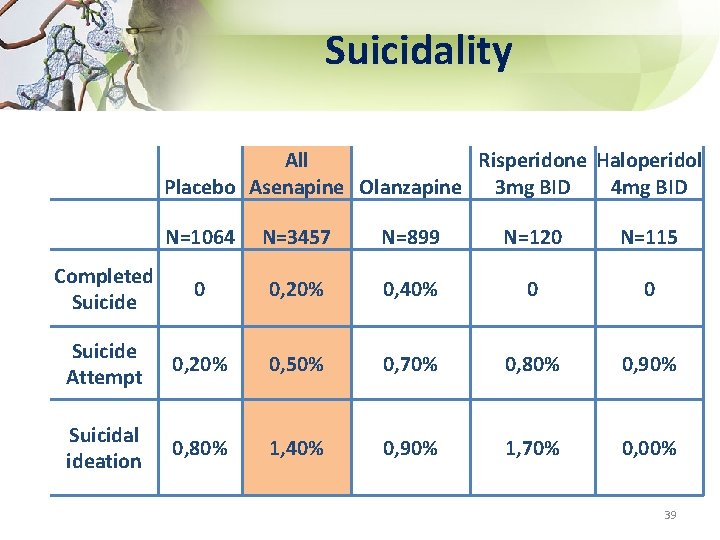
Suicidality All Risperidone Haloperidol Placebo Asenapine Olanzapine 3 mg BID 4 mg BID N=1064 N=3457 N=899 N=120 N=115 Completed Suicide 0 0, 20% 0, 40% 0 0 Suicide Attempt 0, 20% 0, 50% 0, 70% 0, 80% 0, 90% Suicidal ideation 0, 80% 1, 40% 0, 90% 1, 70% 0, 00% 39
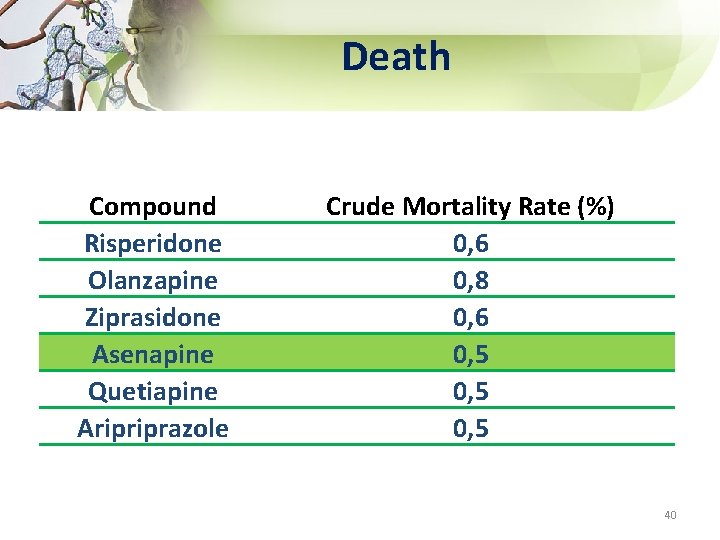
Death Compound Risperidone Olanzapine Ziprasidone Asenapine Quetiapine Aripriprazole Crude Mortality Rate (%) 0, 6 0, 8 0, 6 0, 5 40
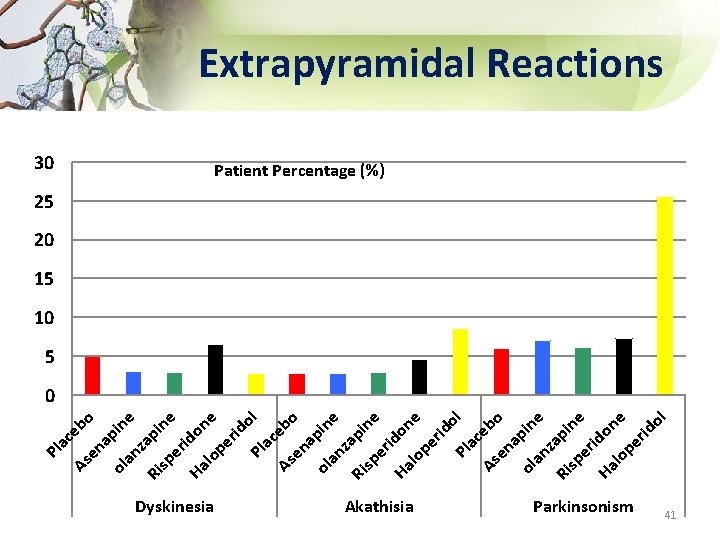
p Ri sp ine er i Ha don lo e pe rid ol Pl ac As ebo en a ol pin an e za p Ri sp ine er i Ha don lo e pe rid ol e in o eb ap za an ol en As Pl ac Extrapyramidal Reactions 30 Patient Percentage (%) 25 20 15 10 5 0 Dyskinesia Akathisia Parkinsonism 41
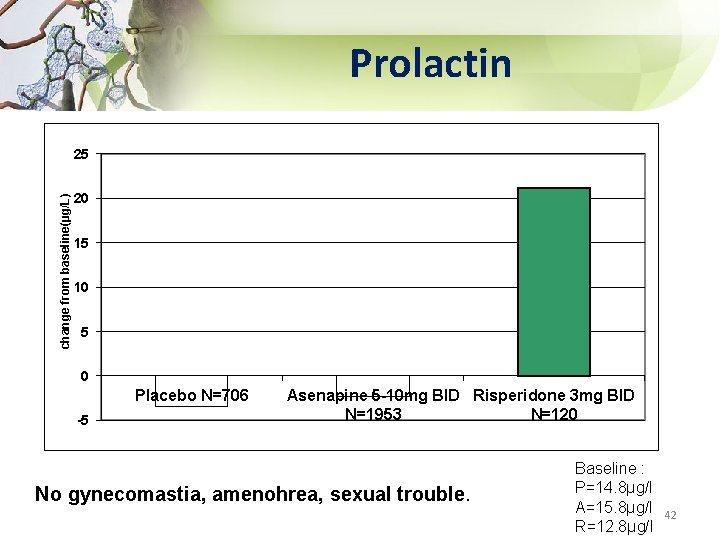
Prolactin change from baseline(µg/L) 25 20 15 10 5 0 Placebo N=706 -5 Asenapine 5 -10 mg BID Risperidone 3 mg BID N=1953 N=120 No gynecomastia, amenohrea, sexual trouble. Baseline : P=14. 8µg/l A=15. 8µg/l R=12. 8µg/l 42
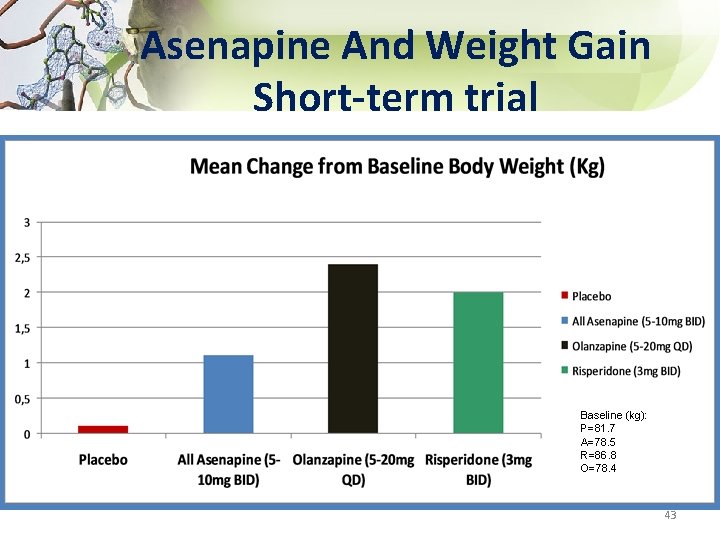
Asenapine And Weight Gain Short-term trial Baseline (kg): P=81. 7 A=78. 5 R=86. 8 O=78. 4 43
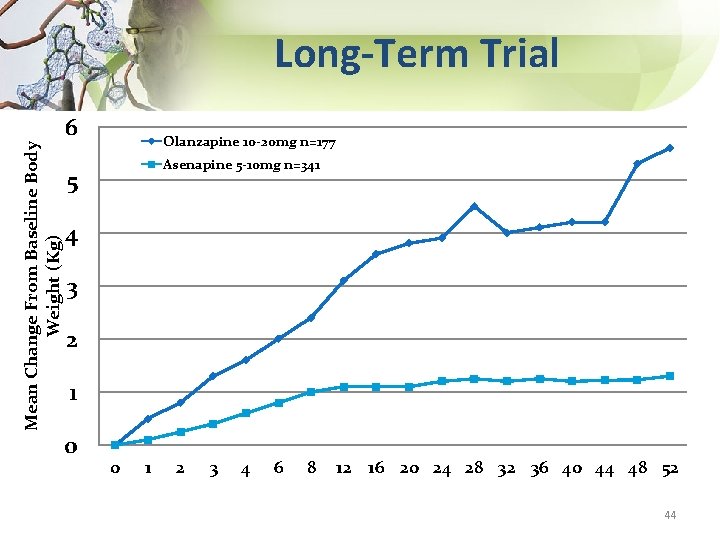
Mean Change From Baseline Body Weight (Kg) Long-Term Trial 6 Olanzapine 10 -20 mg n=177 Asenapine 5 -10 mg n=341 5 4 3 2 1 0 0 1 2 3 4 6 8 12 16 20 24 28 32 36 40 44 48 52 44
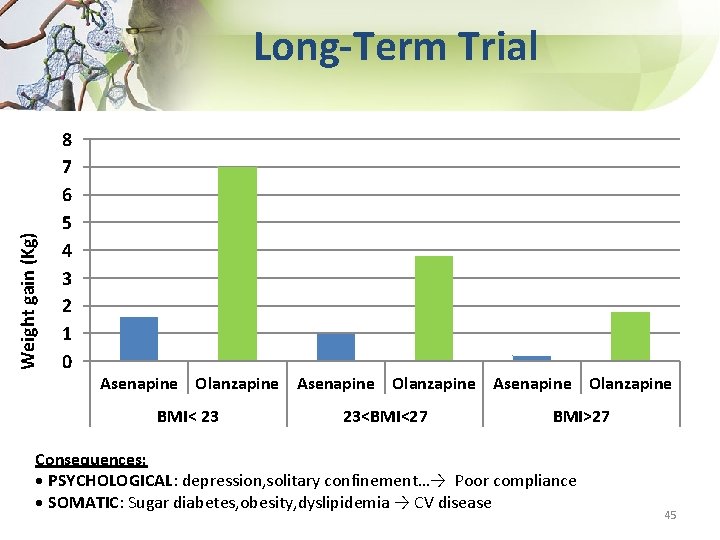
Weight gain (Kg) Long-Term Trial 8 7 6 5 4 3 2 1 0 Asenapine Olanzapine BMI< 23 23<BMI<27 BMI>27 Consequences: • PSYCHOLOGICAL: depression, solitary confinement…→ Poor compliance • SOMATIC: Sugar diabetes, obesity, dyslipidemia → CV disease 45
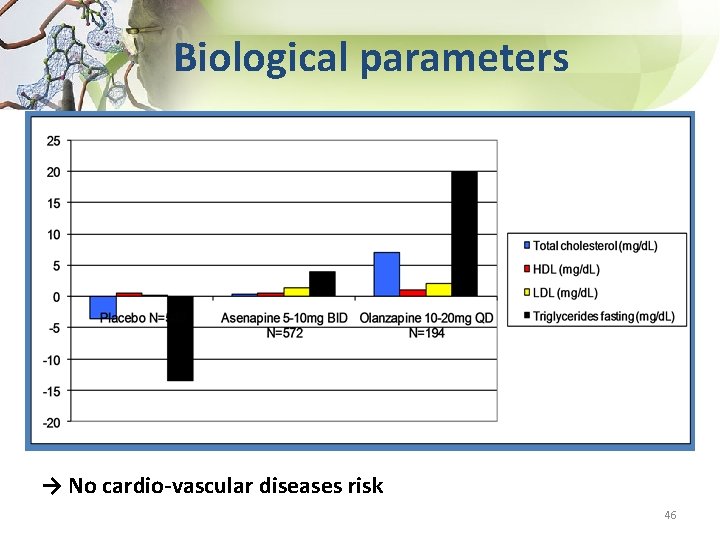
Biological parameters → No cardio-vascular diseases risk 46
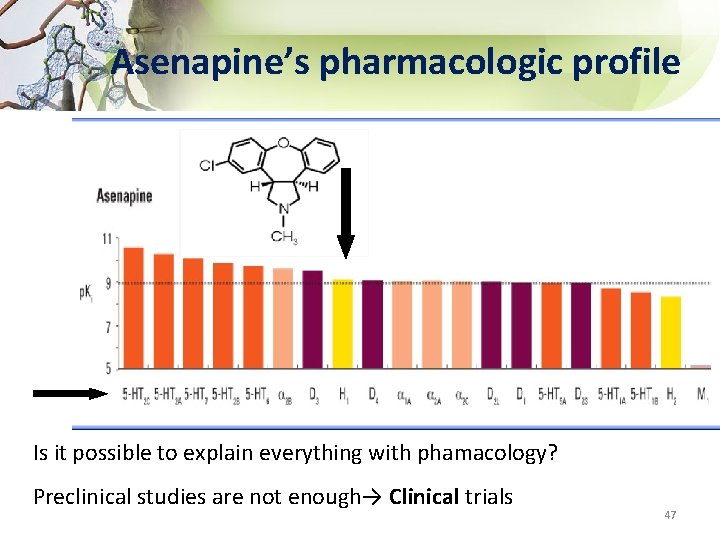
Asenapine’s pharmacologic profile Is it possible to explain everything with phamacology? Preclinical studies are not enough→ Clinical trials 47
Many possible reasons • Lipophilic molecule → mb + RE • Settled way of life: unemployed, sedation… • Food behavior • Modification of leptine and ghreline rate. • Genetic factors 48
Safety Conclusions : • Asenapine is safe and well tolerated • EPS profile comparable to other SGAs • No new or unexpected AEs compared to other atypical antipsychotics • Minimal impact on metabolic parameters – Weight gain – Lipids – Prolactin 49
Threat for Asenapine • Threat with price : – Genericization of the market • Threat with rival molecules – Long-acting injection could increase patient compliance and also demand price premium – New approaches 50
Threat for Asenapine • Threat with price : – Genericization of the market • Threat with rival molecules – Long-acting injection could increase patient compliance and also demand price premium – New approaches 51
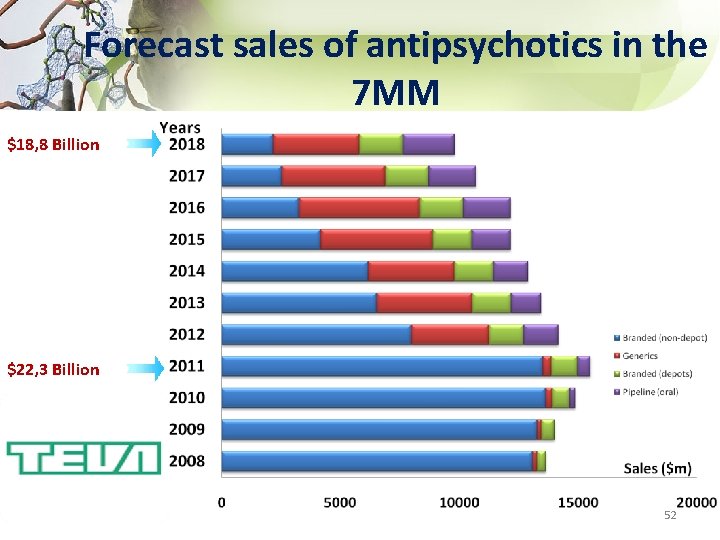
Forecast sales of antipsychotics in the 7 MM $18, 8 Billion $22, 3 Billion $18, 2 Billion 52
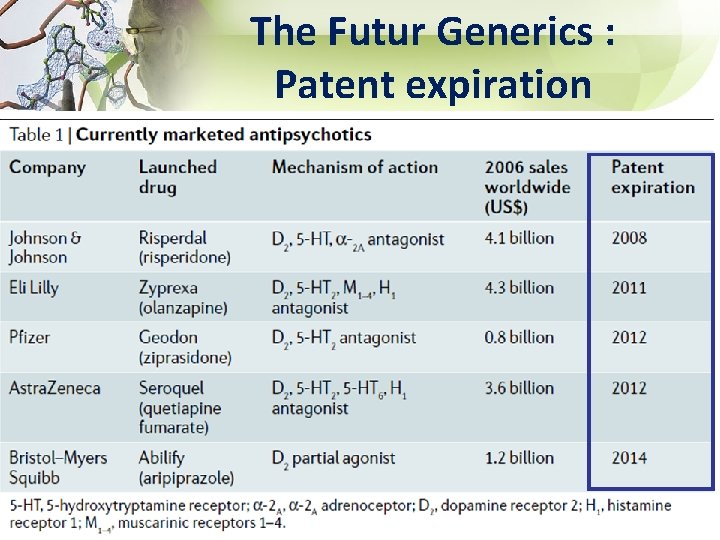
The Futur Generics : Patent expiration 53
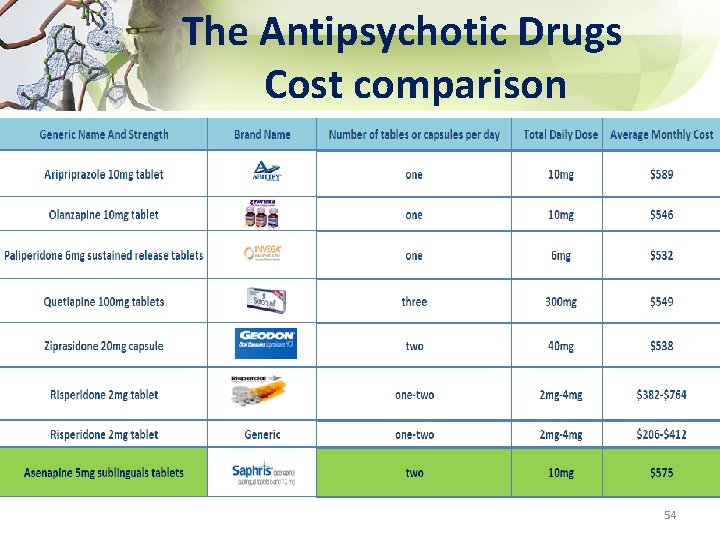
The Antipsychotic Drugs Cost comparison 54
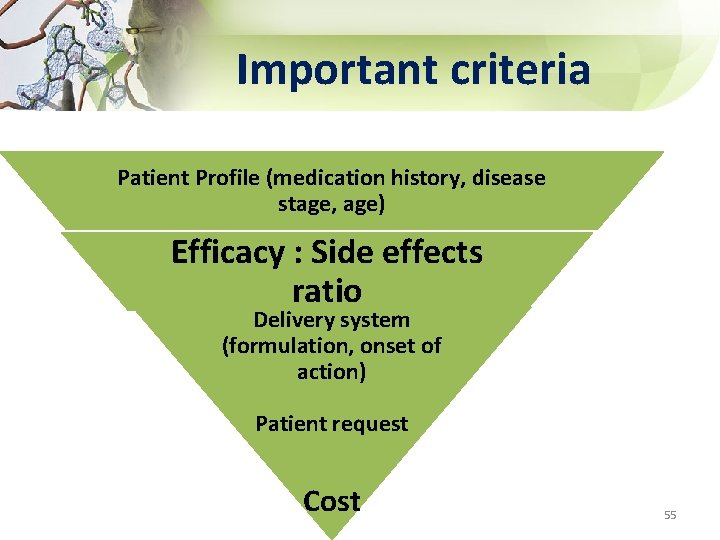
Important criteria Patient Profile (medication history, disease stage, age) Efficacy : Side effects ratio Delivery system (formulation, onset of action) Patient request Cost 55
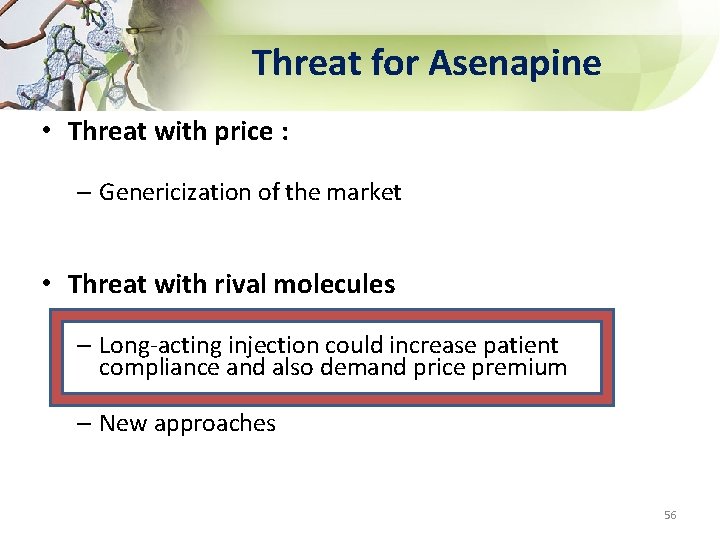
Threat for Asenapine • Threat with price : – Genericization of the market • Threat with rival molecules – Long-acting injection could increase patient compliance and also demand price premium – New approaches 56

Improvement of compliance • : Invega sustenna®(Paliperidone palmitate) • : Zypadhera® (Olanzapine) • Both approved by FDA and EMEA • Long acting IM depot( every 4 weeks) • Launch in 2009 US; 2010 Eu 57

Comparison • Invega sustenna ® • Switch from Risperdal® Consta® to Paliperidone Palmitate. (Same molecule) • No need to be kept refrigirated • Zypadhera® • Problem: PIDSS =Post Injection Delirium Sedation Symptom(1. 4%) 58
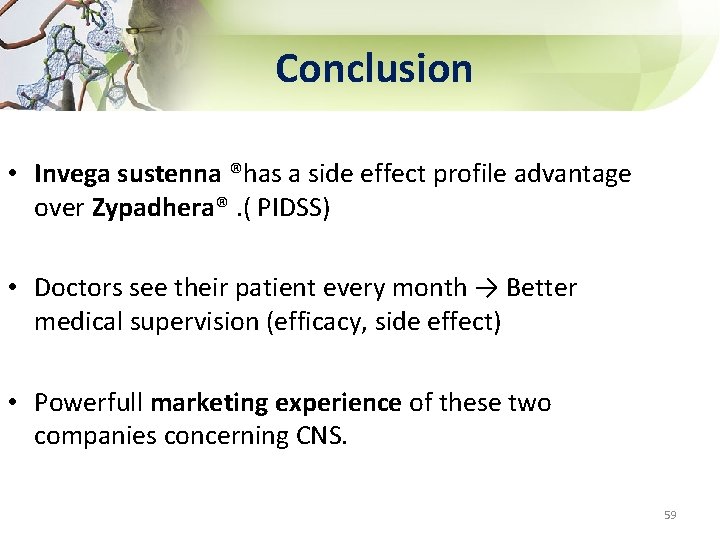
Conclusion • Invega sustenna ®has a side effect profile advantage over Zypadhera®. ( PIDSS) • Doctors see their patient every month → Better medical supervision (efficacy, side effect) • Powerfull marketing experience of these two companies concerning CNS. 59
Threat for Asenapine • Threat with price : – Genericization of the market • Threat with rival molecules – Long-acting injection could increase patient compliance and also demand price premium – New approaches 60
Other mechanisms of action • » We’ve been looking under the lamp because that’s where the light shines… » • We do really need : • much research to understand the underlying pathophysiology of the disease. • Tools to improve stratification of patient. • Develop better animal models • Future: polypharmacy treating multiple symptom domains of schizophrenia. 61
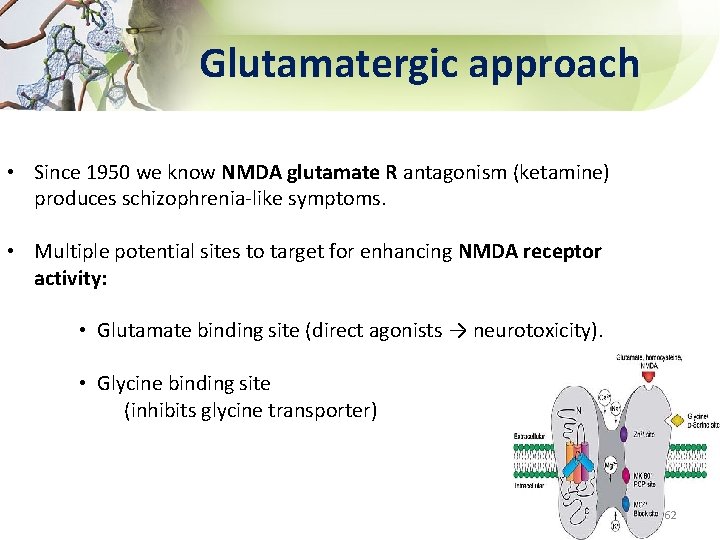
Glutamatergic approach • Since 1950 we know NMDA glutamate R antagonism (ketamine) produces schizophrenia-like symptoms. • Multiple potential sites to target for enhancing NMDA receptor activity: • Glutamate binding site (direct agonists → neurotoxicity). • Glycine binding site (inhibits glycine transporter) 62
Metabotropic Glutamate Receptor • LY 2140023 by • mglu. R 2/3 agonist • Possible target concerning positive symptoms and cognitive deficit. • Phase II development in Europe drug showed: • → slihtly weaker efficacity compared to Zyprexa® (olanzapine). • → Better side effect profile(weight increase; EPS; prolactin) • → Refractory patient? ? Cognitive symptom? ? (Need more clinical trial) 63
Glutamatergic approach • If approved, Eli Lilly drug may be launch in 2014 US/ 2015 EU. • Certainly high marketing potential: • Current clinical trial data • Lilly’s marketing experience • Novel mechanism • Possible apparition of serious adverse effect. • Efficacity might be insufficient to replace 2 nd generation atypical antipsychotic in severe and acute schyzophrenia • Threat for drugs like asenapine 64
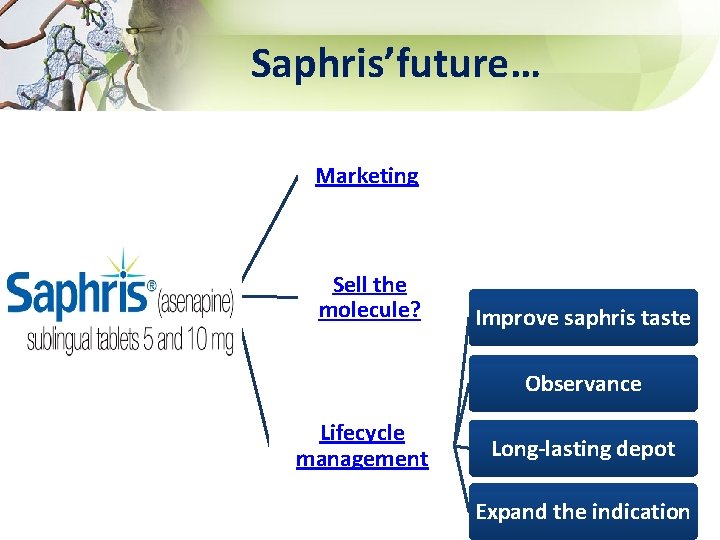
Saphris’future… Marketing Saphris Sell the molecule? Improve saphris taste Observance Lifecycle management Long-lasting depot 65 Expand the indication
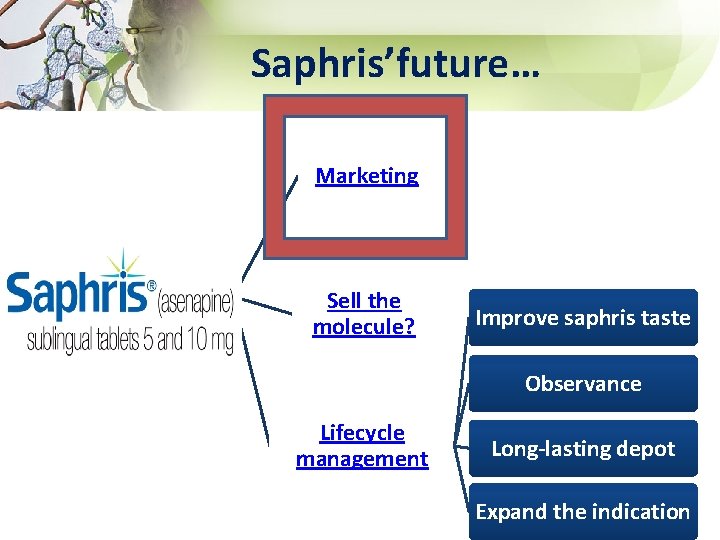
Saphris’future… Marketing Saphris Sell the molecule? Improve saphris taste Observance Lifecycle management Long-lasting depot 66 Expand the indication
Saphris’future… • Marketing – Arguments: • safety and efficacy 67
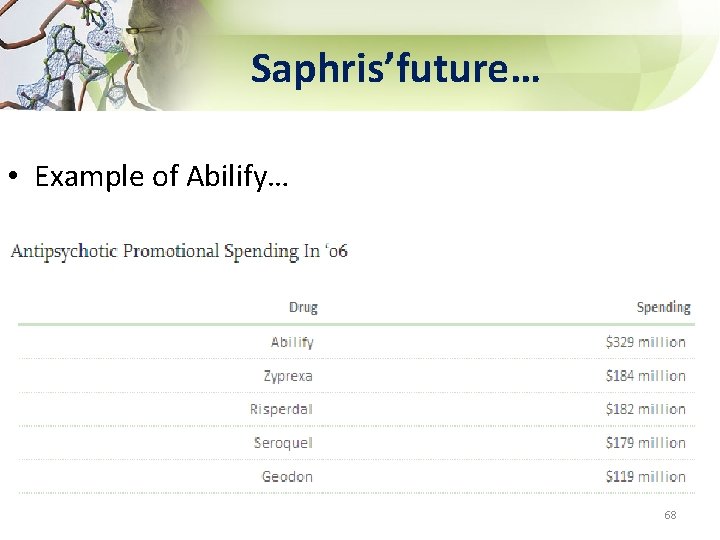
Saphris’future… • Example of Abilify… 68
Saphris’future… • Marketing – Arguments: • safety and efficacy • Regulatory submissions accepted in Nov 07 for Schizophrenia and bipolar disorder 69
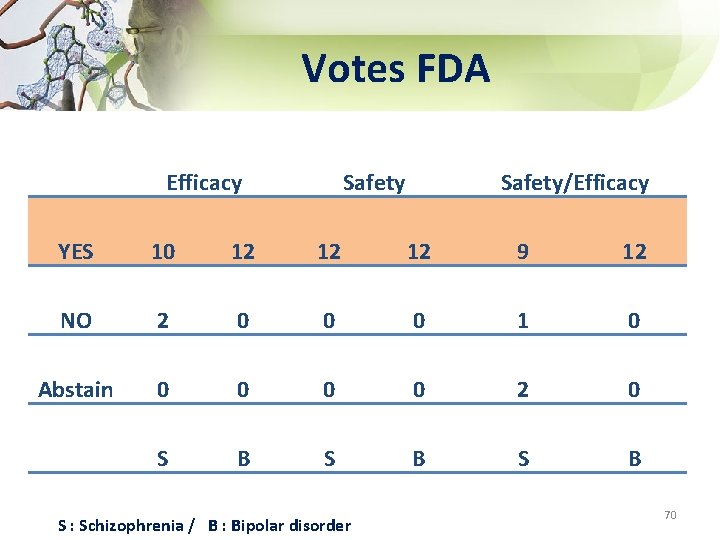
Votes FDA Efficacy Safety/Efficacy YES 10 12 12 12 9 12 NO 2 0 0 0 1 0 Abstain 0 0 2 0 S B S B S : Schizophrenia / B : Bipolar disorder 70
Saphris’future… • Marketing – Arguments: • safety and efficacy • Regulatory submissions accepted in Nov 07 for Schizophrenia and bipolar disorder • Sublingual Form 71
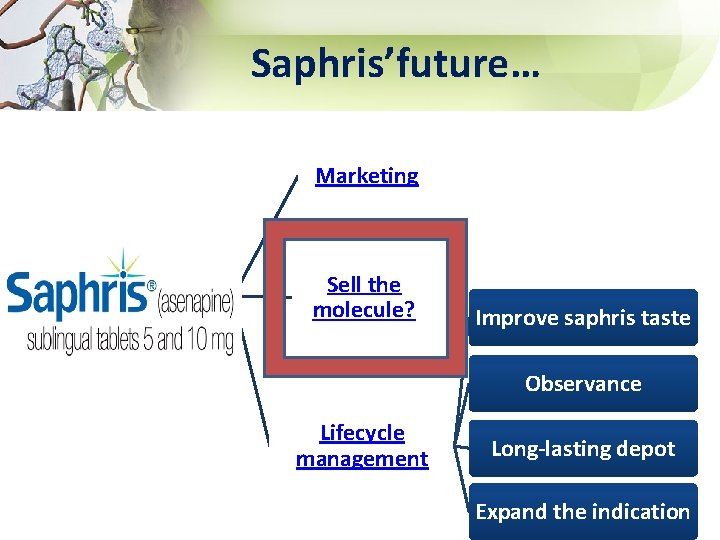
Saphris’future… Marketing Saphris Sell the molecule? Improve saphris taste Observance Lifecycle management Long-lasting depot 72 Expand the indication
Saphris’future… • Sell Saphris? – Why? No marketing experience in CNS – To whom? J&J or Lilly • Keep Saphris – Patent cliff : (Cozaar/Hyzaar) in february: $ 3. 4 to 3. 7 millions /year – Introduce theirselves in CNS market – Life cycle management 73
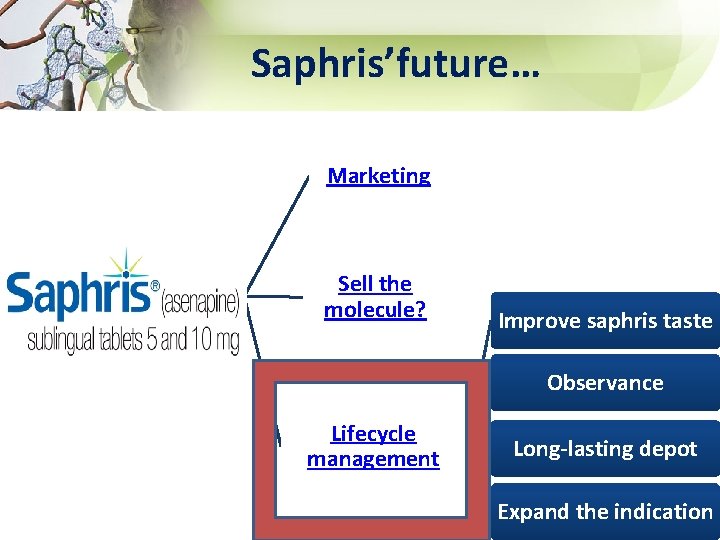
Saphris’future… Marketing Saphris Sell the molecule? Improve saphris taste Observance Lifecycle management Long-lasting depot 74 Expand the indication
Saphris’future… • Lifecycle management – Improve saphris taste. – Make a once daily medication to improve observance – Develop long lasting depot – Expand the indication Forum, blog: disgusting taste, fool sensation, burning taste… 75
Targeted population: children and adolescents • study SATIETY: cardiometabolic risk of second generation antipsychotics during first time use • results: significant gain weight in each medication - olanzapine: 8, 3 kg - quetiapine: 6, 1 kg - risperidone: 5, 3 kg - aripiprazole: 4, 4 kg - asenapine: ? ? 76
Targeted population: the ederly people • increased risk of cerebral vascular accident with antipsychotics for elderly people • associated cardiovascular diseases in this population • risk of sudden cardiac stroke with antipsychotics (increasing QTc) asenapine = good solution for this population 77
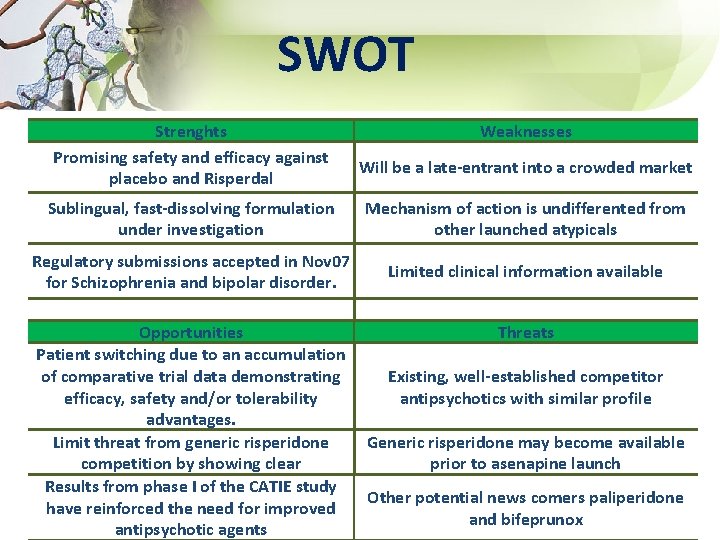
SWOT Strenghts Promising safety and efficacy against placebo and Risperdal Weaknesses Will be a late-entrant into a crowded market Sublingual, fast-dissolving formulation under investigation Mechanism of action is undifferented from other launched atypicals Regulatory submissions accepted in Nov 07 for Schizophrenia and bipolar disorder. Limited clinical information available Opportunities Threats Patient switching due to an accumulation of comparative trial data demonstrating Existing, well-established competitor efficacy, safety and/or tolerability antipsychotics with similar profile advantages. Limit threat from generic risperidone Generic risperidone may become available competition by showing clear prior to asenapine launch Results from phase I of the CATIE study Other potential news comers paliperidone have reinforced the need for improved and bifeprunox antipsychotic agents
79

Thanks for your attention
81
Discontinuations during treatment Asenapine Risperidone Placebo Total dicontinuations 32 34 41 Lack of efficacy 9 (15%) 16 (27%) 18 (29%) Adverse events 6 (10%) 4 (7%) 7 (11%) Other 17 14 16
- Slides: 83