
A Note on Dynamic Data Driven Wildfire Modeling
- Slides: 29
A Note on Dynamic Data Driven Wildfire Modeling Jan Mandel University of Colorado at Denver Janice L. Coen, Craig C. Douglas, Leopoldo P. Franca, Craig Johns, Robert Kremens, Anatolii Puhalskii, Anthony Vodacek, Wei Zhao ICCS ‘ 04 June 7, 2004 Krakow, Poland Supported by NSF under grants ACI-0325314, ACI-0324989, ACI- 0324988, ACI-0324876, and ACI-0324910
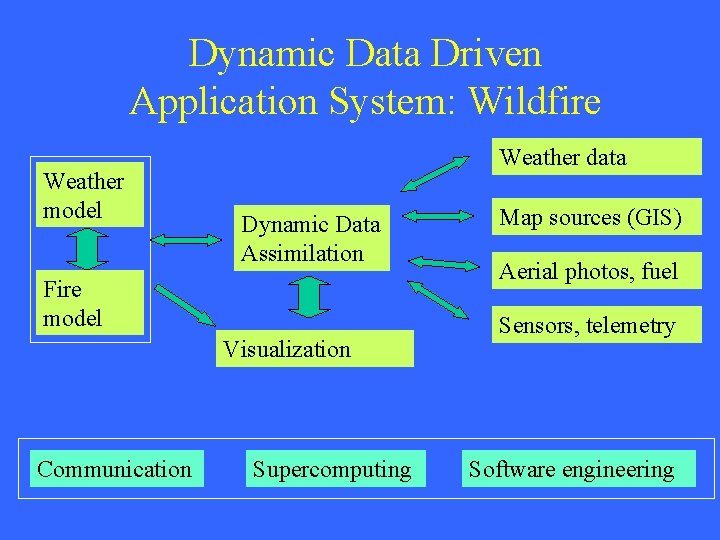
Dynamic Data Driven Application System: Wildfire Weather model Weather data Dynamic Data Assimilation Fire model Visualization Communication Supercomputing Map sources (GIS) Aerial photos, fuel Sensors, telemetry Software engineering
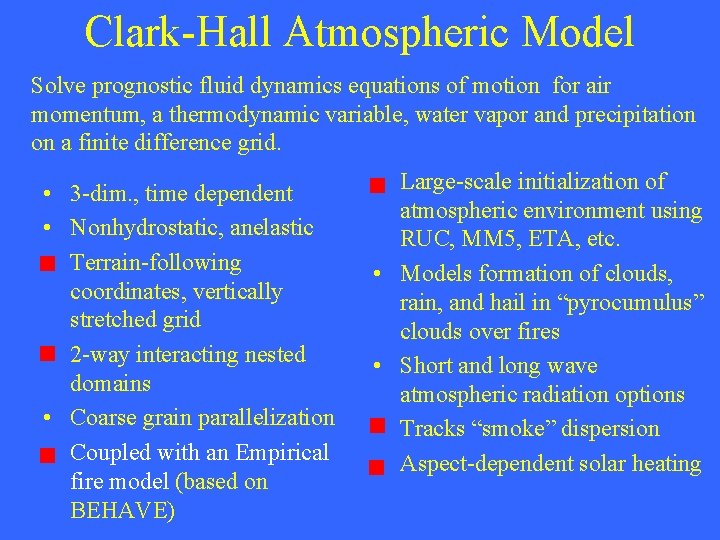
Clark-Hall Atmospheric Model Solve prognostic fluid dynamics equations of motion for air momentum, a thermodynamic variable, water vapor and precipitation on a finite difference grid. • 3 -dim. , time dependent • Nonhydrostatic, anelastic • Terrain-following coordinates, vertically stretched grid • 2 -way interacting nested domains • Coarse grain parallelization • Coupled with an Empirical fire model (based on BEHAVE) • Large-scale initialization of atmospheric environment using RUC, MM 5, ETA, etc. • Models formation of clouds, rain, and hail in “pyrocumulus” clouds over fires • Short and long wave atmospheric radiation options • Tracks “smoke” dispersion • Aspect-dependent solar heating
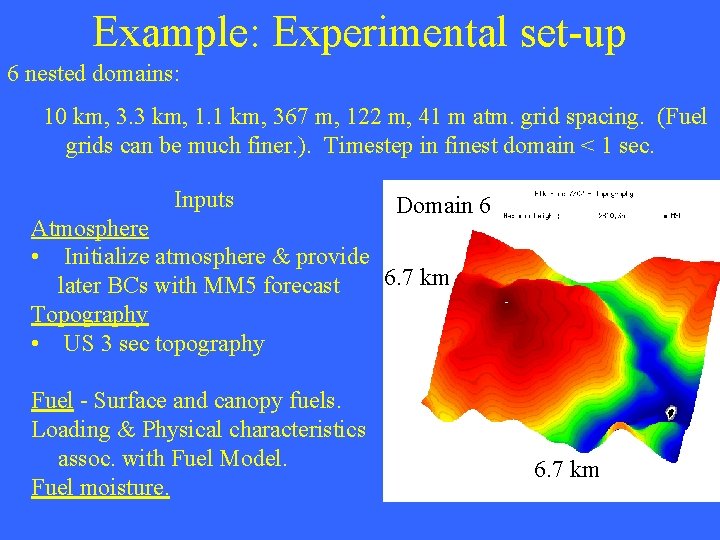
Example: Experimental set-up 6 nested domains: 10 km, 3. 3 km, 1. 1 km, 367 m, 122 m, 41 m atm. grid spacing. (Fuel grids can be much finer. ). Timestep in finest domain < 1 sec. Inputs Domain 6 Atmosphere • Initialize atmosphere & provide 6. 7 km later BCs with MM 5 forecast Topography • US 3 sec topography Fuel - Surface and canopy fuels. Loading & Physical characteristics assoc. with Fuel Model. Fuel moisture. 6. 7 km
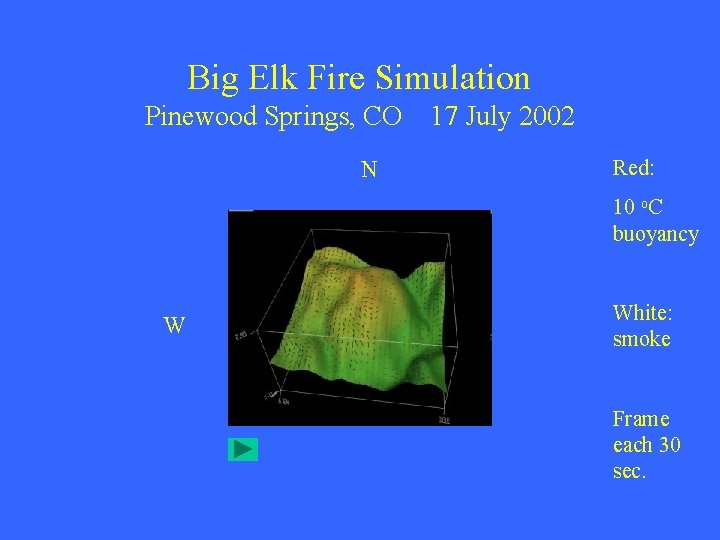
Big Elk Fire Simulation Pinewood Springs, CO N 17 July 2002 Red: 10 o. C buoyancy W White: smoke Frame each 30 sec.
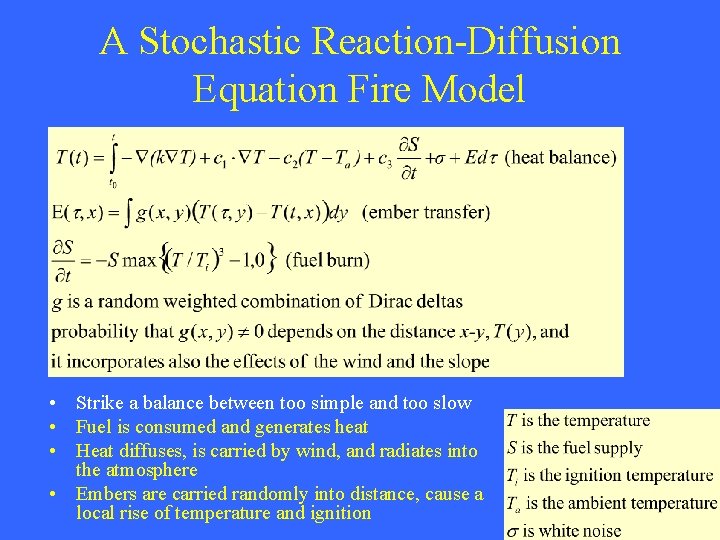
A Stochastic Reaction-Diffusion Equation Fire Model • Strike a balance between too simple and too slow • Fuel is consumed and generates heat • Heat diffuses, is carried by wind, and radiates into the atmosphere • Embers are carried randomly into distance, cause a local rise of temperature and ignition
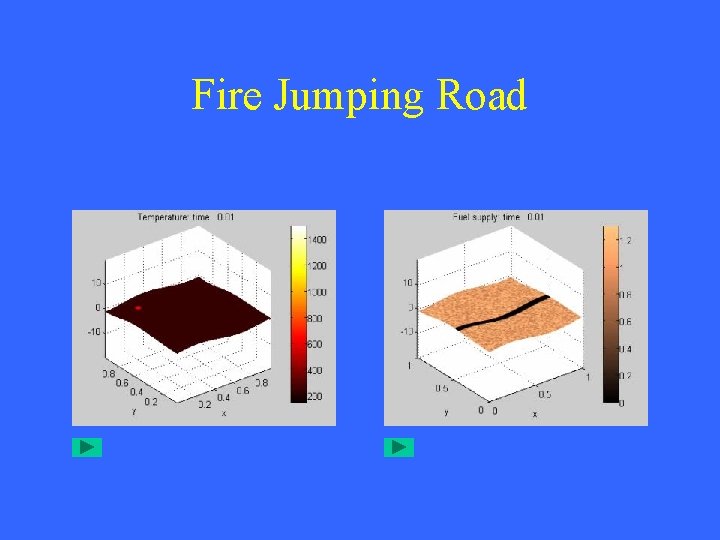
Fire Jumping Road
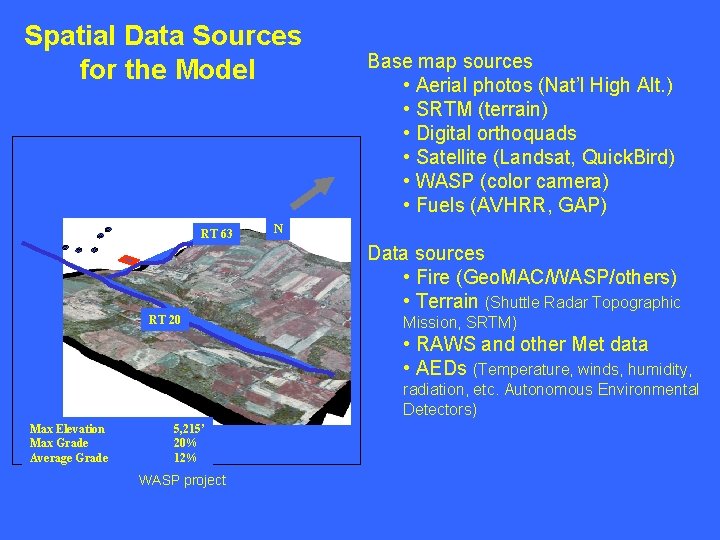
Spatial Data Sources for the Model RT 63 Base map sources • Aerial photos (Nat’l High Alt. ) • SRTM (terrain) • Digital orthoquads • Satellite (Landsat, Quick. Bird) • WASP (color camera) • Fuels (AVHRR, GAP) N Data sources • Fire (Geo. MAC/WASP/others) • Terrain (Shuttle Radar Topographic RT 20 Mission, SRTM) • RAWS and other Met data • AEDs (Temperature, winds, humidity, radiation, etc. Autonomous Environmental Detectors) Max Elevation Max Grade Average Grade 5, 215’ 20% 12% WASP project
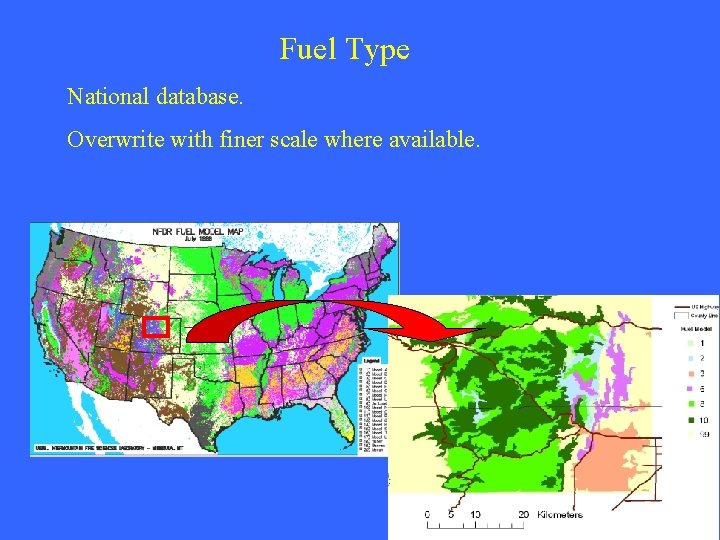
Fuel Type National database. Overwrite with finer scale where available.
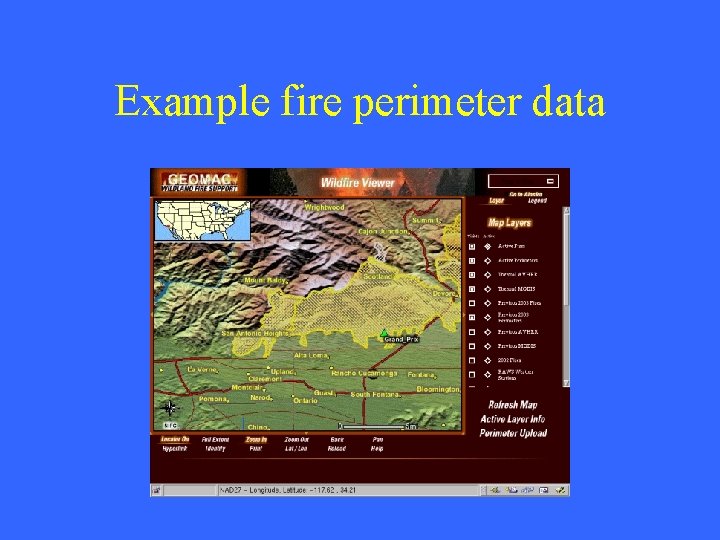
Example fire perimeter data
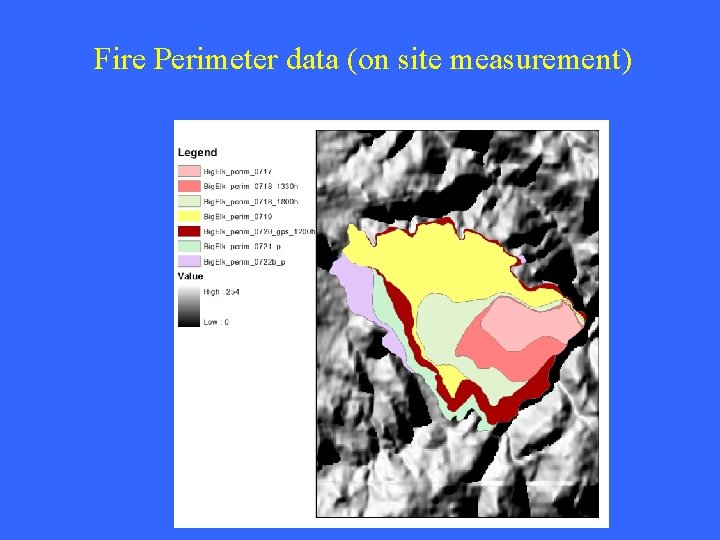
Fire Perimeter data (on site measurement)
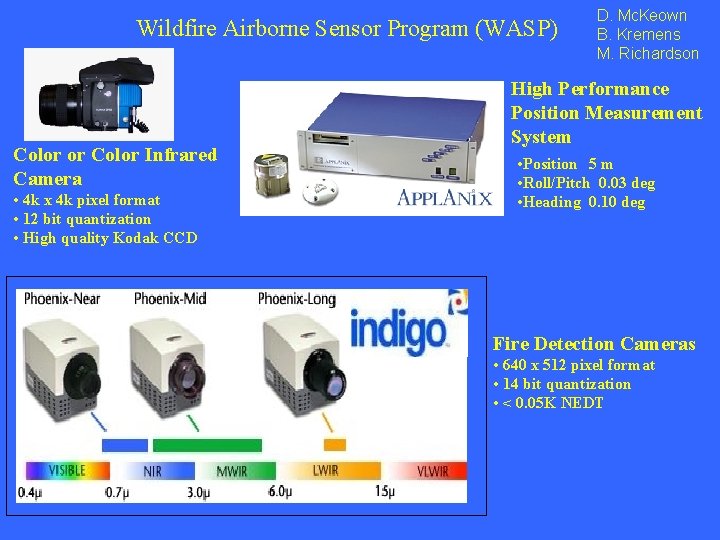
Wildfire Airborne Sensor Program (WASP) Color or Color Infrared Camera • 4 k x 4 k pixel format • 12 bit quantization • High quality Kodak CCD D. Mc. Keown B. Kremens M. Richardson High Performance Position Measurement System • Position 5 m • Roll/Pitch 0. 03 deg • Heading 0. 10 deg Fire Detection Cameras • 640 x 512 pixel format • 14 bit quantization • < 0. 05 K NEDT
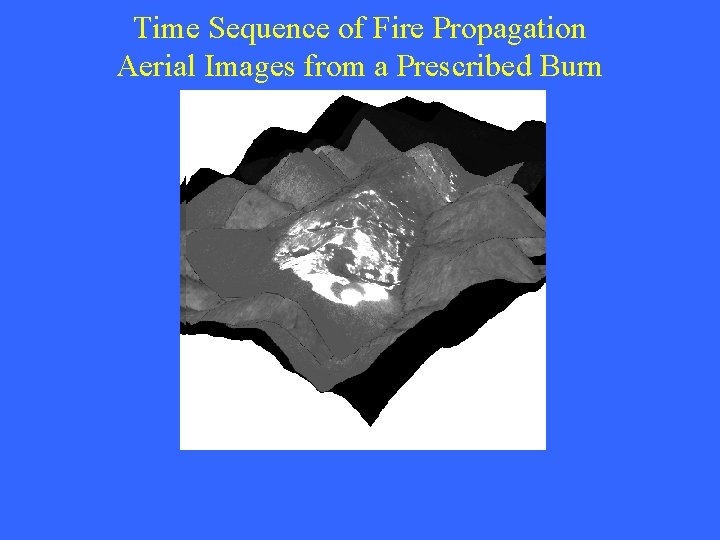
Time Sequence of Fire Propagation Aerial Images from a Prescribed Burn
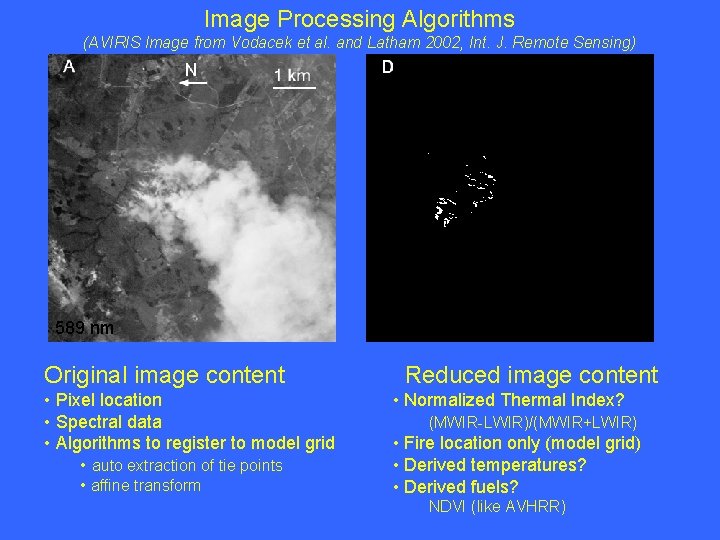
Image Processing Algorithms (AVIRIS Image from Vodacek et al. and Latham 2002, Int. J. Remote Sensing) 589 nm Original image content • Pixel location • Spectral data • Algorithms to register to model grid • auto extraction of tie points • affine transform 770 nm/779 nm Reduced image content • Normalized Thermal Index? (MWIR-LWIR)/(MWIR+LWIR) • Fire location only (model grid) • Derived temperatures? • Derived fuels? NDVI (like AVHRR)
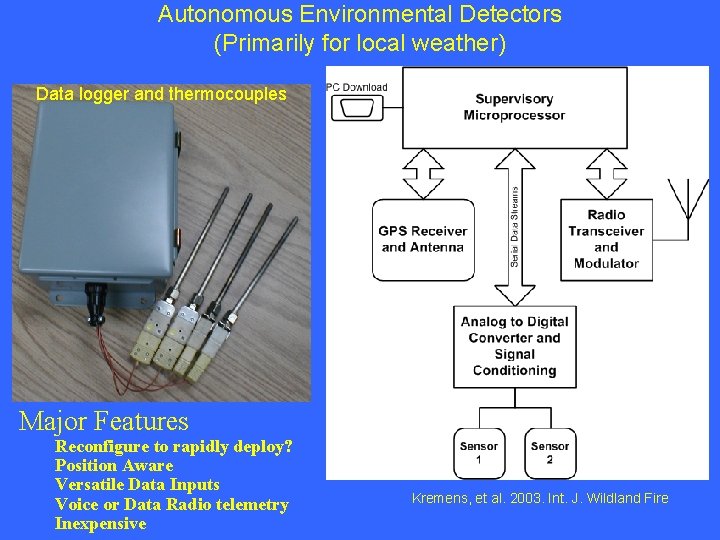
Autonomous Environmental Detectors (Primarily for local weather) Data logger and thermocouples electronic Weideally have developed suited acquisition to field a versatile package data collection Major Features Reconfigure to rapidly deploy? Position Aware Versatile Data Inputs Voice or Data Radio telemetry Inexpensive Kremens, et al. 2003. Int. J. Wildland Fire
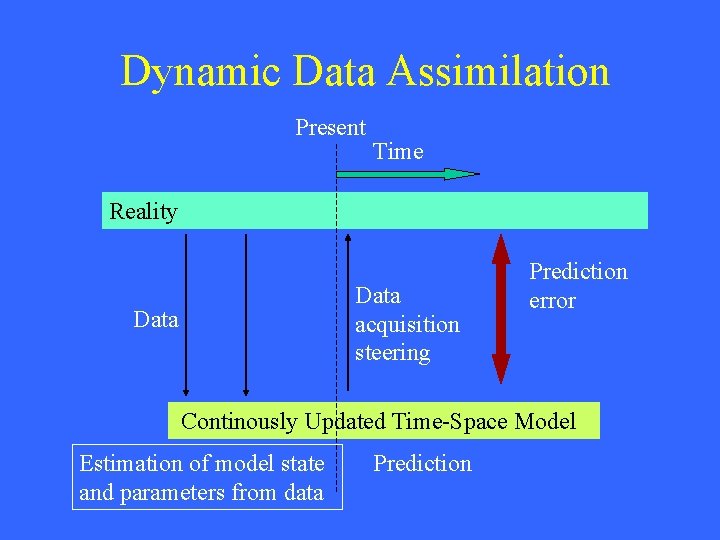
Dynamic Data Assimilation Present Time Reality Data acquisition steering Data Prediction error Continously Updated Time-Space Model Estimation of model state and parameters from data Prediction
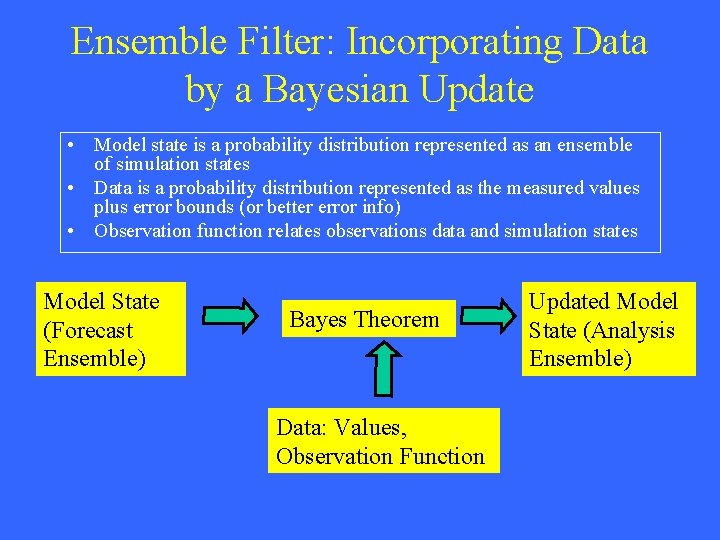
Ensemble Filter: Incorporating Data by a Bayesian Update • Model state is a probability distribution represented as an ensemble of simulation states • Data is a probability distribution represented as the measured values plus error bounds (or better error info) • Observation function relates observations data and simulation states Model State (Forecast Ensemble) Bayes Theorem Data: Values, Observation Function Updated Model State (Analysis Ensemble)
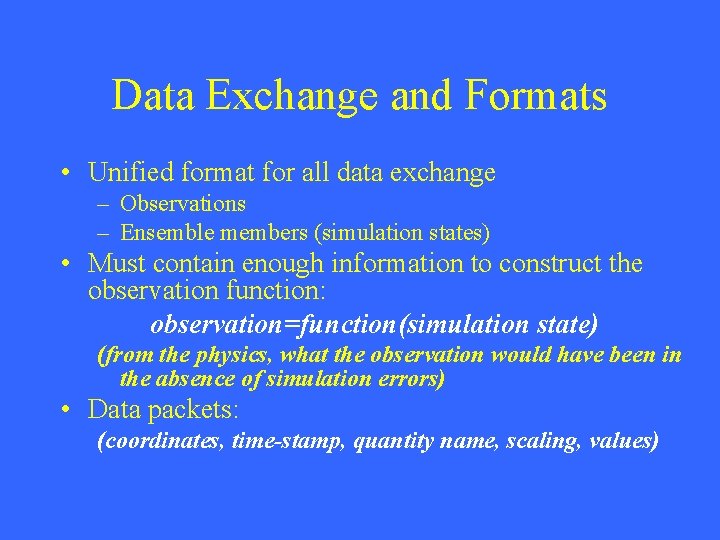
Data Exchange and Formats • Unified format for all data exchange – Observations – Ensemble members (simulation states) • Must contain enough information to construct the observation function: observation=function(simulation state) (from the physics, what the observation would have been in the absence of simulation errors) • Data packets: (coordinates, time-stamp, quantity name, scaling, values)
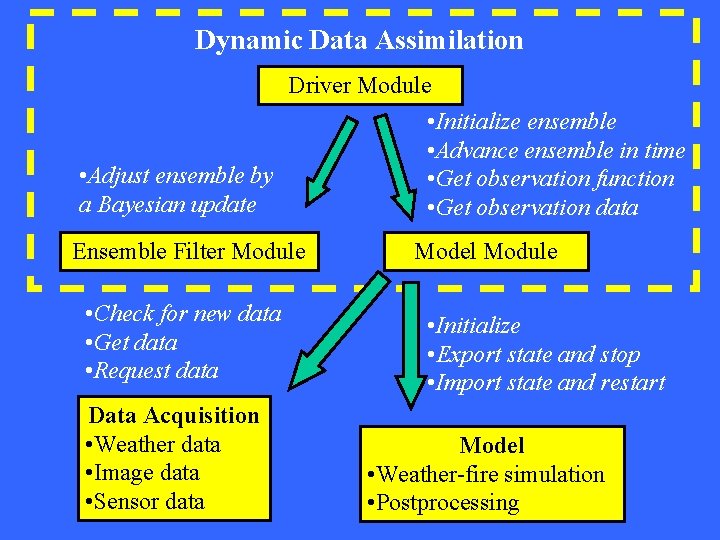
Dynamic Data Assimilation Driver Module • Initialize ensemble • Advance ensemble in time • Adjust ensemble by • Get observation function a Bayesian update • Get observation data Ensemble Filter Module • Check for new data • Get data • Request data Data Acquisition • Weather data • Image data • Sensor data Model Module • Initialize • Export state and stop • Import state and restart Model • Weather-fire simulation • Postprocessing
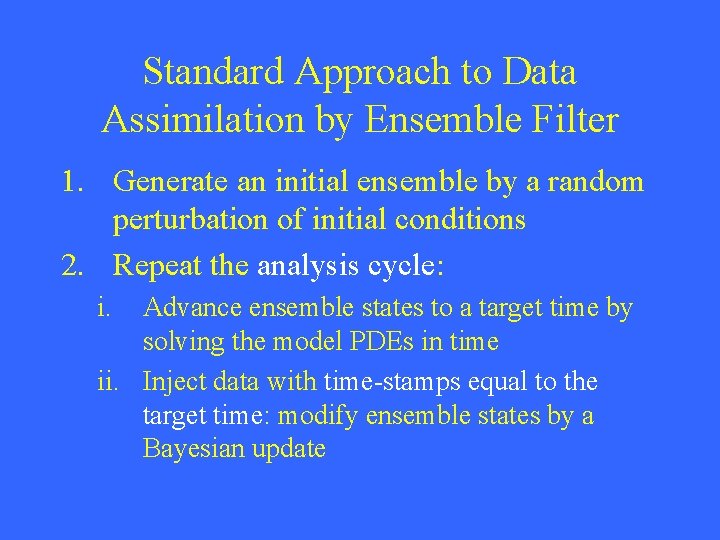
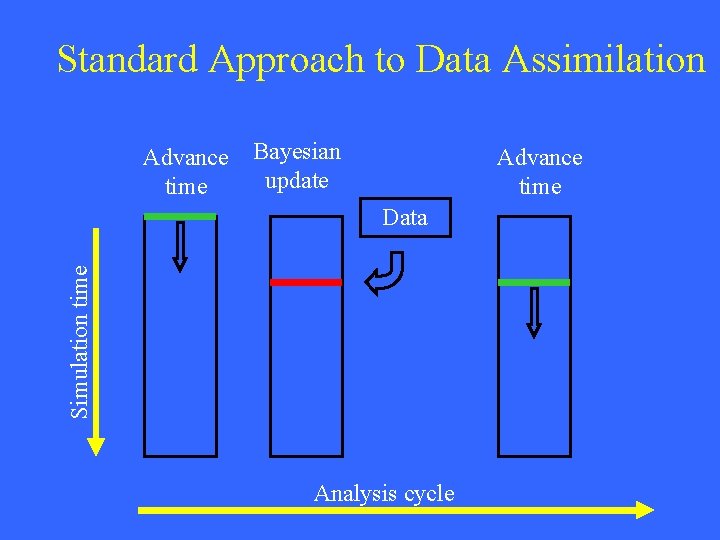
Standard Approach to Data Assimilation by Ensemble Filter 1. Generate an initial ensemble by a random perturbation of initial conditions 2. Repeat the analysis cycle: i. Advance ensemble states to a target time by solving the model PDEs in time ii. Inject data with time-stamps equal to the target time: modify ensemble states by a Bayesian update
Standard Approach to Data Assimilation Advance time Bayesian update Advance time Simulation time Data Analysis cycle
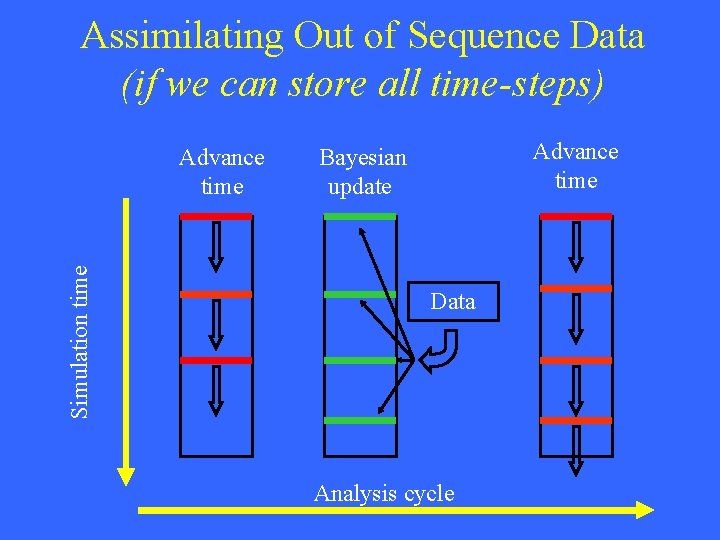
Assimilating Out of Sequence Data (if we can store all time-steps) 1. Generate initial ensemble by a random perturbation of initial conditions 2. Repeat the analysis cycle: i. Clone the ensemble at the initial time and advance the ensembles except the clone to the next time-step ii. Inject data into all time-steps: modify the ensemble with states at all time-steps as a single big state, by a Bayesian update
Assimilating Out of Sequence Data (if we can store all time-steps) Simulation time Advance time Bayesian update Data Analysis cycle
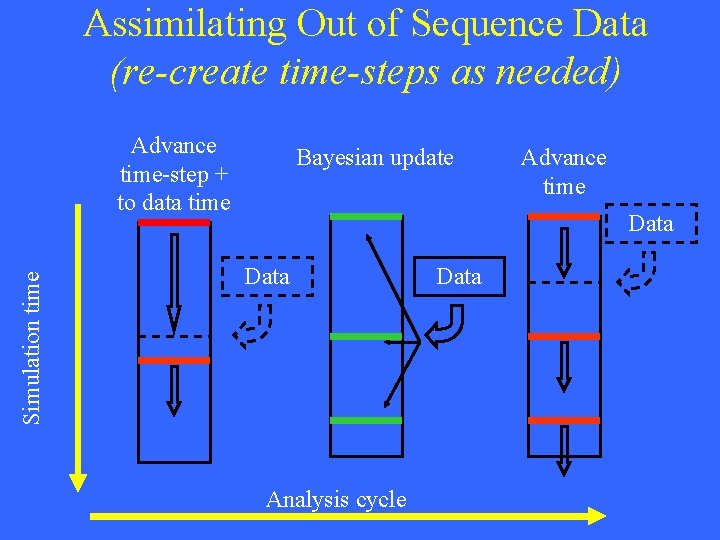
Assimilating Out of Sequence Data (re-create time-steps as needed) 1. Generate initial ensemble by a random perturbation of initial conditions 2. Repeat the analysis cycle: i. Clone the ensemble at the initial time and other times as needed, advance all ensembles except the clones to their target times, which should include the time-stamp(s) of the data ii. Inject data into all time-steps: modify the ensemble of states for all stored time-steps as a single big state, by the Bayesian update
Assimilating Out of Sequence Data (re-create time-steps as needed) Simulation time Advance time-step + to data time Bayesian update Advance time Data Analysis cycle Data
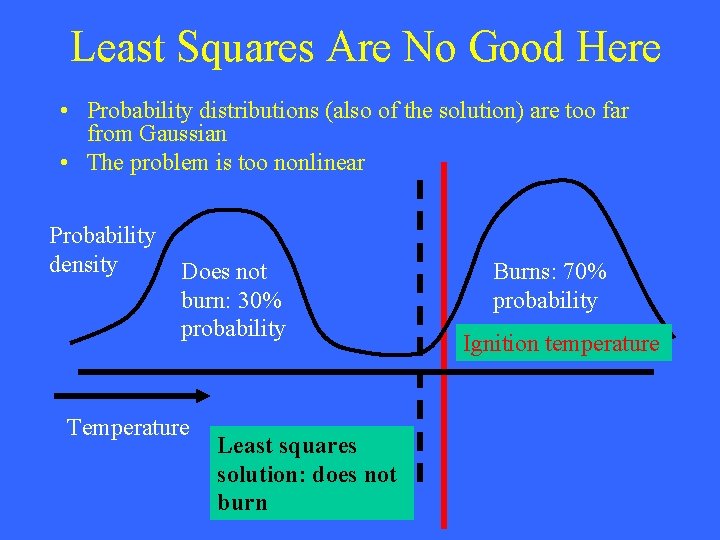
Least Squares Are No Good Here • Probability distributions (also of the solution) are too far from Gaussian • The problem is too nonlinear Probability density Does not burn: 30% probability Temperature Least squares solution: does not burn Burns: 70% probability Ignition temperature
Visualization • Platform independent: – Web, java based – Browsing from anywhere: PDAs, cell phones, … • • • Map or 3 d terrain, flames Scenario movies Maps overlaid with various scenarios Local outcome probabilities (burn or not) Input of firefighting scenarios
Supercomputing Resources • What resources needed – Multiple simulations (ensemble 50 -500) – Multiple time steps (time-space 10 -500) • Actual time step 0. 5 s, f consists of multiple steps – Multiple interactive firefighting scenarios (1 -3) – Mesh sizes • Innermost, finest 200 by 60 • Outermost, coarsest 50 by 60 • Total grid point approx. innermost times 2 • 12 fields
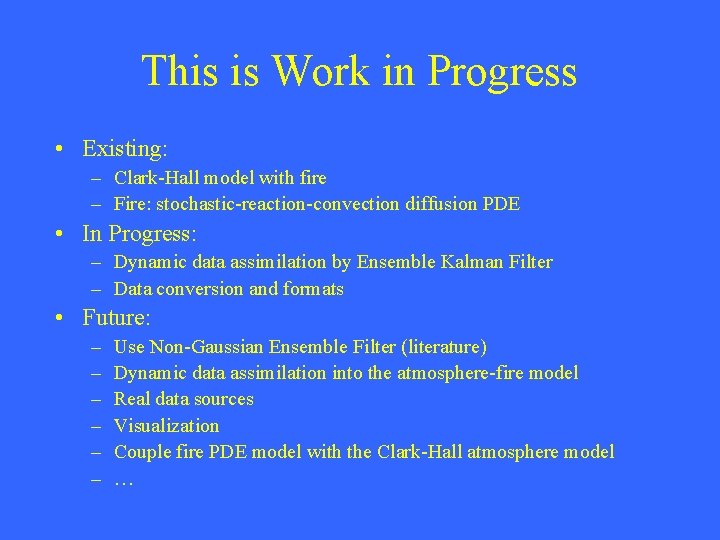
This is Work in Progress • Existing: – Clark-Hall model with fire – Fire: stochastic-reaction-convection diffusion PDE • In Progress: – Dynamic data assimilation by Ensemble Kalman Filter – Data conversion and formats • Future: – – – Use Non-Gaussian Ensemble Filter (literature) Dynamic data assimilation into the atmosphere-fire model Real data sources Visualization Couple fire PDE model with the Clark-Hall atmosphere model …