
A NonChronological Report By Myles Farley Introduction I
A Non-Chronological Report By Myles Farley
Introduction I have chosen to do a Power. Point on the country Spain. I have been to this country. I think Spain has lots of interesting facts.
Facts about Spain • Population: 48 million people live in Spain (2019) • Capital: Madrid, with 3. 3 million inhabitants, is Spain's biggest city. • Name: Reino de España (Kingdom of Spain), short form: España • Government: Parliamentary Monarchy • Languages: Castilian Spanish 74%, Catalan 17%, Galician, Basque • Literacy: More than 98% can read and write. • Religion: mainly Christians (Roman Catholics 94%) • Currency: 1 Euro=100 cents, before 2001 Spanish peseta • National Symbol: National flag and coat of arms, the short-toed eagle (national bird), red carnation (national flower), the bull (national animal).
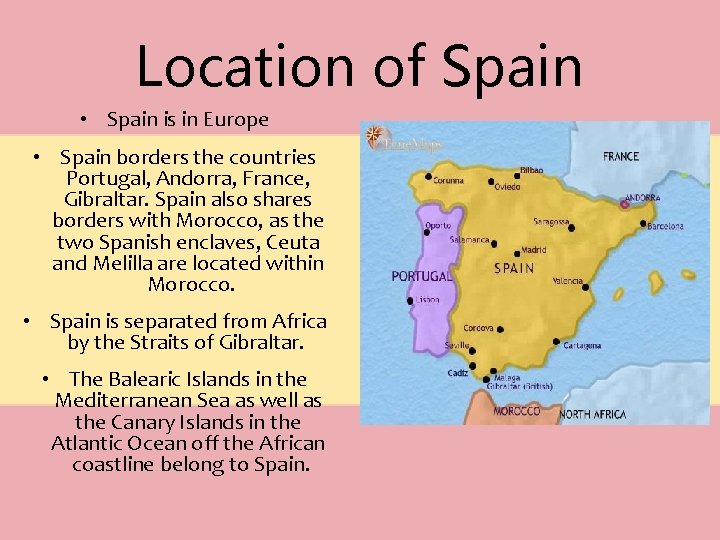
Location of Spain • Spain is in Europe • Spain borders the countries Portugal, Andorra, France, Gibraltar. Spain also shares borders with Morocco, as the two Spanish enclaves, Ceuta and Melilla are located within Morocco. • Spain is separated from Africa by the Straits of Gibraltar. • The Balearic Islands in the Mediterranean Sea as well as the Canary Islands in the Atlantic Ocean off the African coastline belong to Spain.
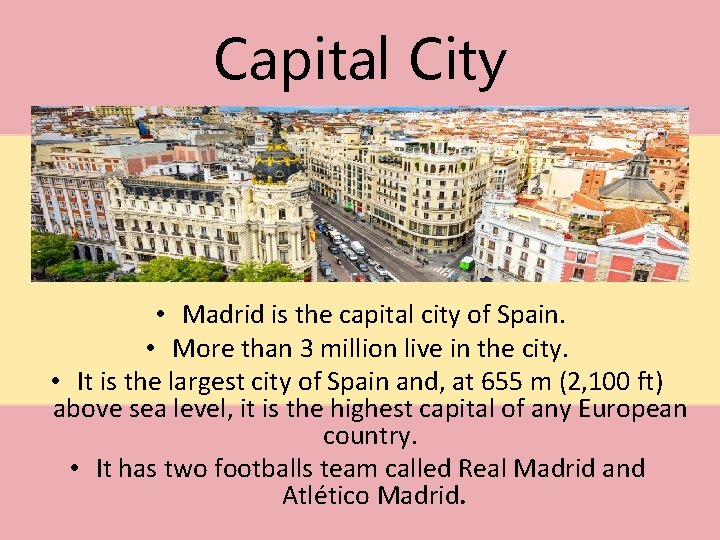
Capital City • Madrid is the capital city of Spain. • More than 3 million live in the city. • It is the largest city of Spain and, at 655 m (2, 100 ft) above sea level, it is the highest capital of any European country. • It has two footballs team called Real Madrid and Atlético Madrid.
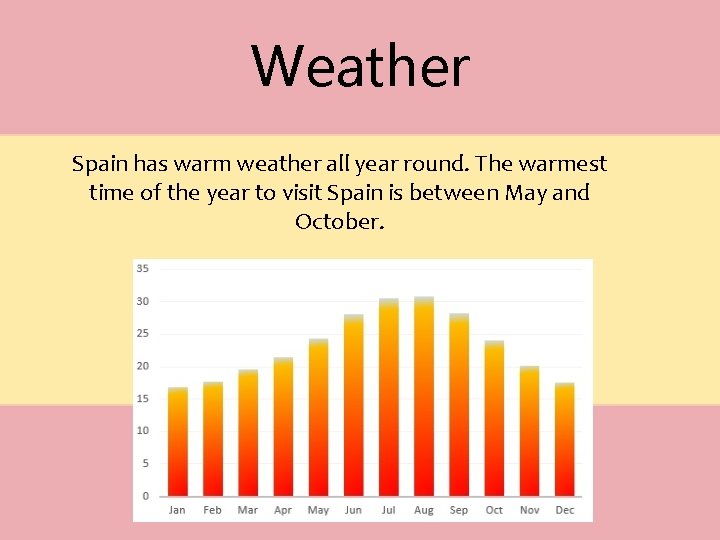
Weather Spain has warm weather all year round. The warmest time of the year to visit Spain is between May and October.
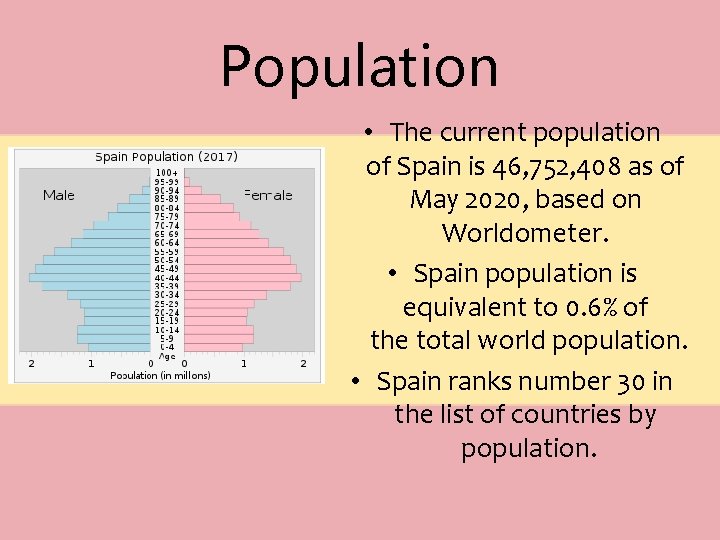
Population • The current population of Spain is 46, 752, 408 as of May 2020, based on Worldometer. • Spain population is equivalent to 0. 6% of the total world population. • Spain ranks number 30 in the list of countries by population.
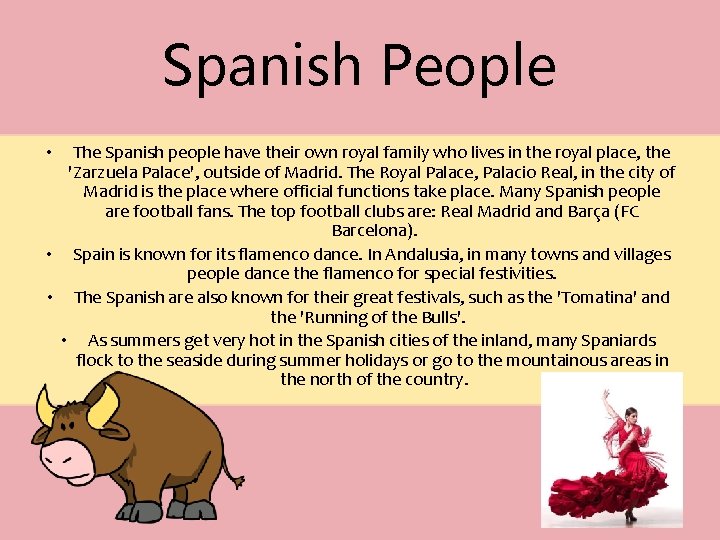
Spanish People The Spanish people have their own royal family who lives in the royal place, the 'Zarzuela Palace', outside of Madrid. The Royal Palace, Palacio Real, in the city of Madrid is the place where official functions take place. Many Spanish people are football fans. The top football clubs are: Real Madrid and Barça (FC Barcelona). • Spain is known for its flamenco dance. In Andalusia, in many towns and villages people dance the flamenco for special festivities. • The Spanish are also known for their great festivals, such as the 'Tomatina' and the 'Running of the Bulls'. • As summers get very hot in the Spanish cities of the inland, many Spaniards flock to the seaside during summer holidays or go to the mountainous areas in the north of the country. •
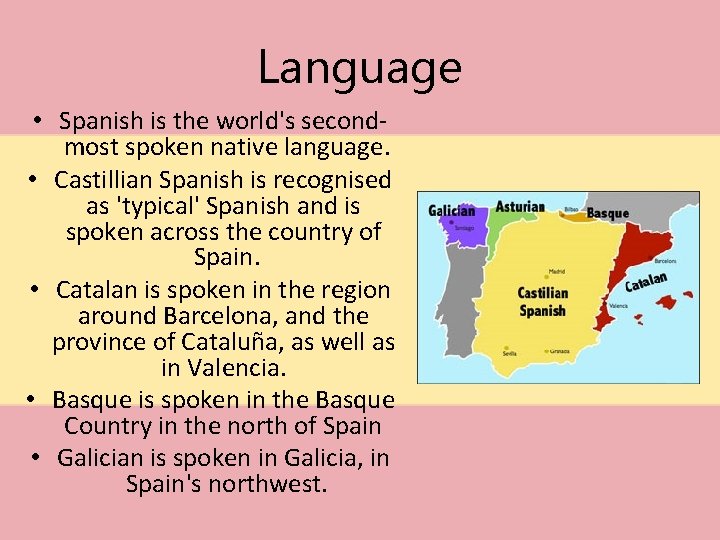
Language • Spanish is the world's secondmost spoken native language. • Castillian Spanish is recognised as 'typical' Spanish and is spoken across the country of Spain. • Catalan is spoken in the region around Barcelona, and the province of Cataluña, as well as in Valencia. • Basque is spoken in the Basque Country in the north of Spain • Galician is spoken in Galicia, in Spain's northwest.
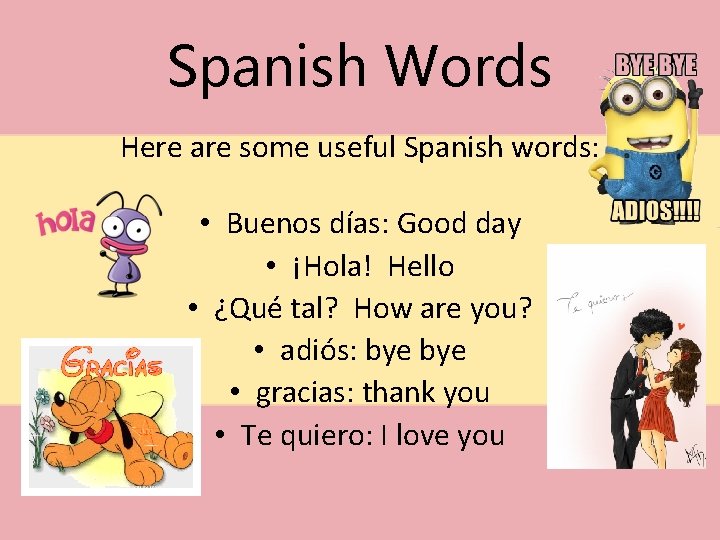
Spanish Words Here are some useful Spanish words: • Buenos días: Good day • ¡Hola! Hello • ¿Qué tal? How are you? • adiós: bye • gracias: thank you • Te quiero: I love you
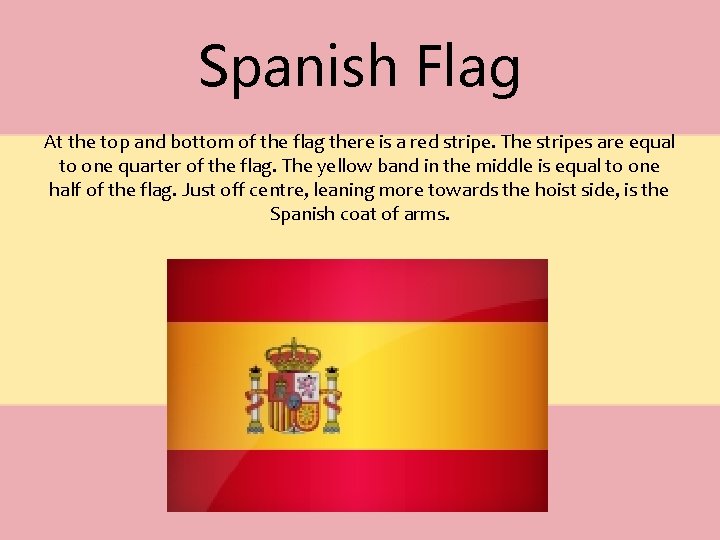
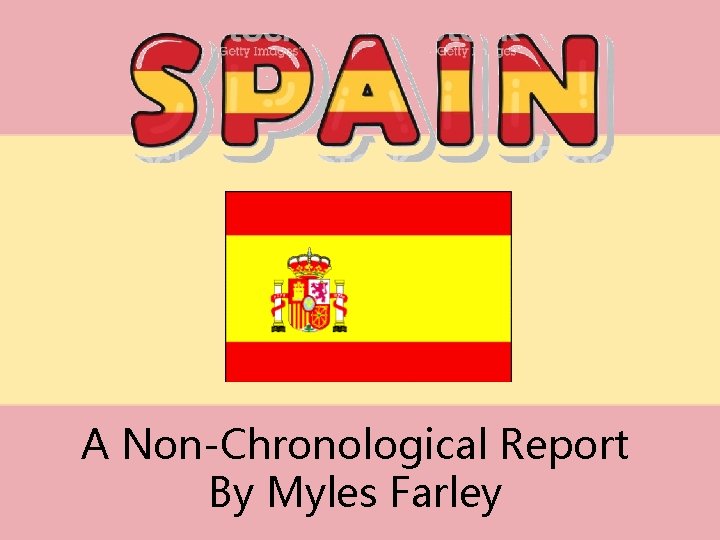
Spanish Flag At the top and bottom of the flag there is a red stripe. The stripes are equal to one quarter of the flag. The yellow band in the middle is equal to one half of the flag. Just off centre, leaning more towards the hoist side, is the Spanish coat of arms.
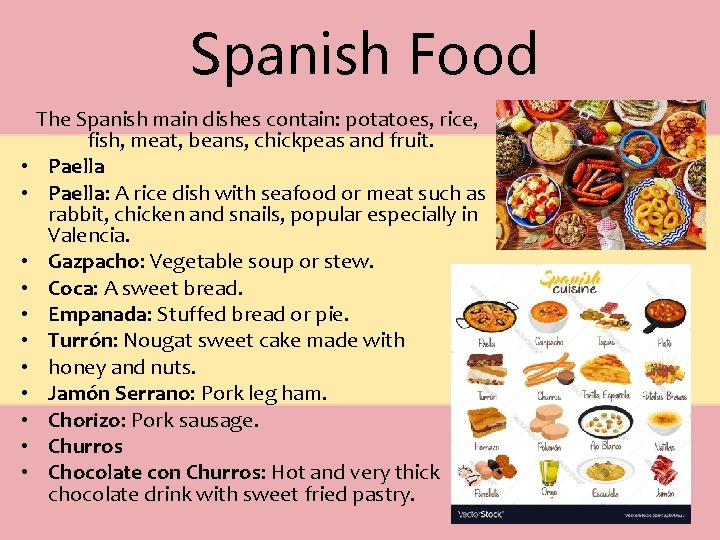
Spanish Food • • • The Spanish main dishes contain: potatoes, rice, fish, meat, beans, chickpeas and fruit. Paella: A rice dish with seafood or meat such as rabbit, chicken and snails, popular especially in Valencia. Gazpacho: Vegetable soup or stew. Coca: A sweet bread. Empanada: Stuffed bread or pie. Turrón: Nougat sweet cake made with honey and nuts. Jamón Serrano: Pork leg ham. Chorizo: Pork sausage. Churros Chocolate con Churros: Hot and very thick chocolate drink with sweet fried pastry.
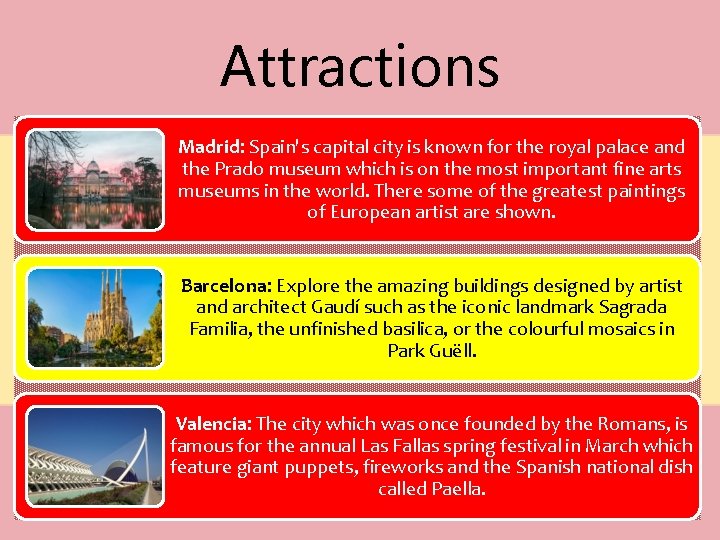
Attractions Madrid: Spain's capital city is known for the royal palace and the Prado museum which is on the most important fine arts museums in the world. There some of the greatest paintings of European artist are shown. Barcelona: Explore the amazing buildings designed by artist and architect Gaudí such as the iconic landmark Sagrada Familia, the unfinished basilica, or the colourful mosaics in Park Guëll. Valencia: The city which was once founded by the Romans, is famous for the annual Las Fallas spring festival in March which feature giant puppets, fireworks and the Spanish national dish called Paella.
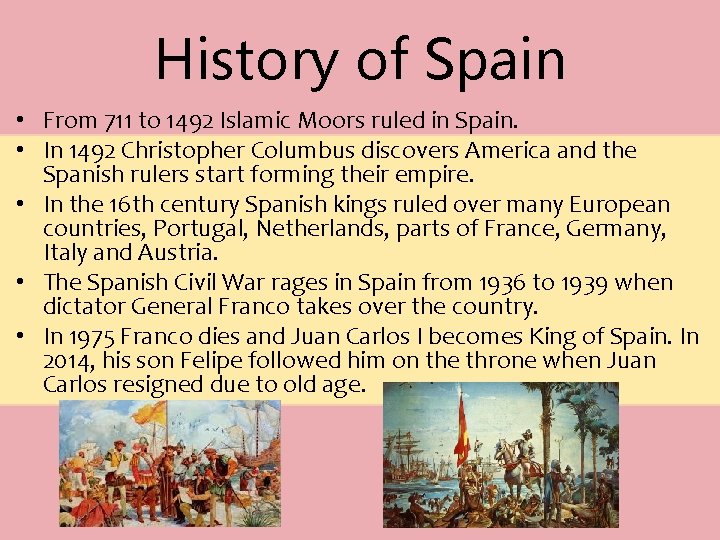
History of Spain • From 711 to 1492 Islamic Moors ruled in Spain. • In 1492 Christopher Columbus discovers America and the Spanish rulers start forming their empire. • In the 16 th century Spanish kings ruled over many European countries, Portugal, Netherlands, parts of France, Germany, Italy and Austria. • The Spanish Civil War rages in Spain from 1936 to 1939 when dictator General Franco takes over the country. • In 1975 Franco dies and Juan Carlos I becomes King of Spain. In 2014, his son Felipe followed him on the throne when Juan Carlos resigned due to old age.
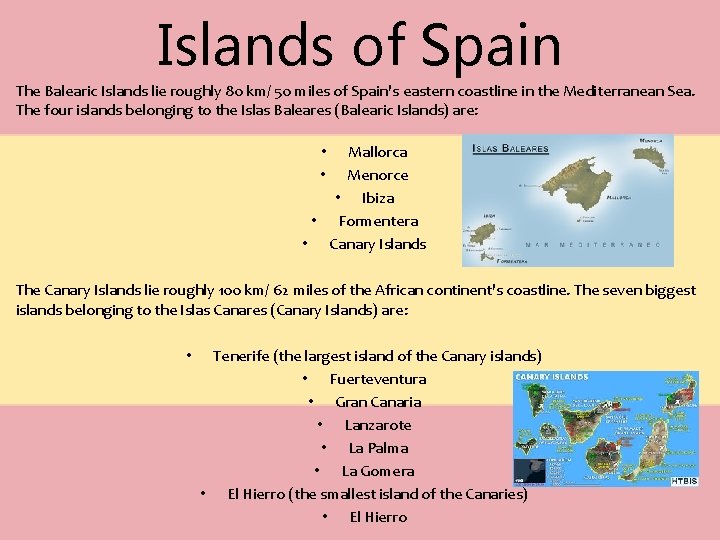
Islands of Spain The Balearic Islands lie roughly 80 km/ 50 miles of Spain's eastern coastline in the Mediterranean Sea. The four islands belonging to the Islas Baleares (Balearic Islands) are: Mallorca Menorce • Ibiza • Formentera • Canary Islands • • The Canary Islands lie roughly 100 km/ 62 miles of the African continent's coastline. The seven biggest islands belonging to the Islas Canares (Canary Islands) are: • Tenerife (the largest island of the Canary islands) • Fuerteventura • Gran Canaria • Lanzarote • La Palma • La Gomera • El Hierro (the smallest island of the Canaries) • El Hierro
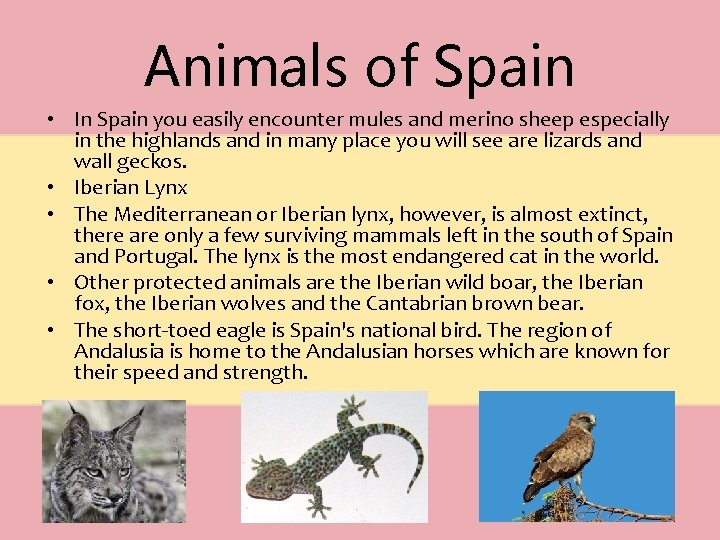
Animals of Spain • In Spain you easily encounter mules and merino sheep especially in the highlands and in many place you will see are lizards and wall geckos. • Iberian Lynx • The Mediterranean or Iberian lynx, however, is almost extinct, there are only a few surviving mammals left in the south of Spain and Portugal. The lynx is the most endangered cat in the world. • Other protected animals are the Iberian wild boar, the Iberian fox, the Iberian wolves and the Cantabrian brown bear. • The short-toed eagle is Spain's national bird. The region of Andalusia is home to the Andalusian horses which are known for their speed and strength.
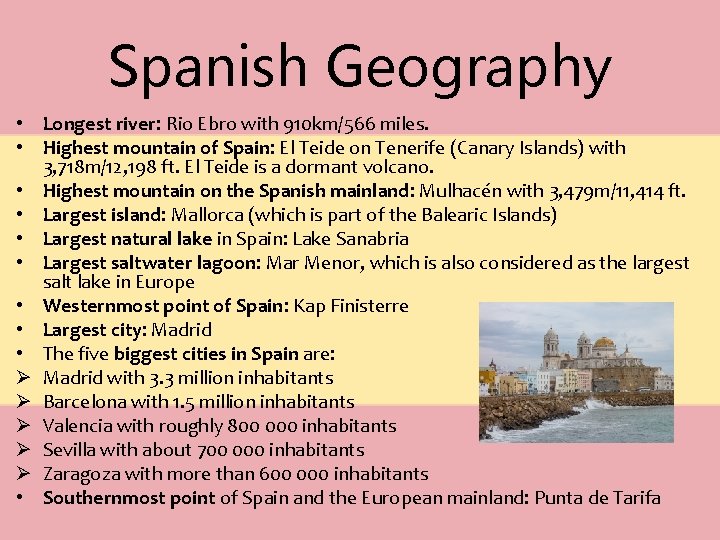
Spanish Geography • Longest river: Rio Ebro with 910 km/566 miles. • Highest mountain of Spain: El Teide on Tenerife (Canary Islands) with 3, 718 m/12, 198 ft. El Teide is a dormant volcano. • Highest mountain on the Spanish mainland: Mulhacén with 3, 479 m/11, 414 ft. • Largest island: Mallorca (which is part of the Balearic Islands) • Largest natural lake in Spain: Lake Sanabria • Largest saltwater lagoon: Mar Menor, which is also considered as the largest salt lake in Europe • Westernmost point of Spain: Kap Finisterre • Largest city: Madrid • The five biggest cities in Spain are: Ø Madrid with 3. 3 million inhabitants Ø Barcelona with 1. 5 million inhabitants Ø Valencia with roughly 800 000 inhabitants Ø Sevilla with about 700 000 inhabitants Ø Zaragoza with more than 600 000 inhabitants • Southernmost point of Spain and the European mainland: Punta de Tarifa
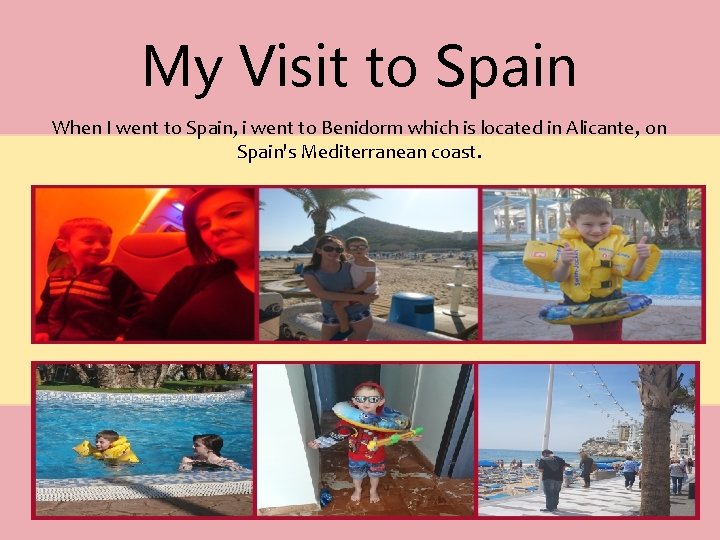
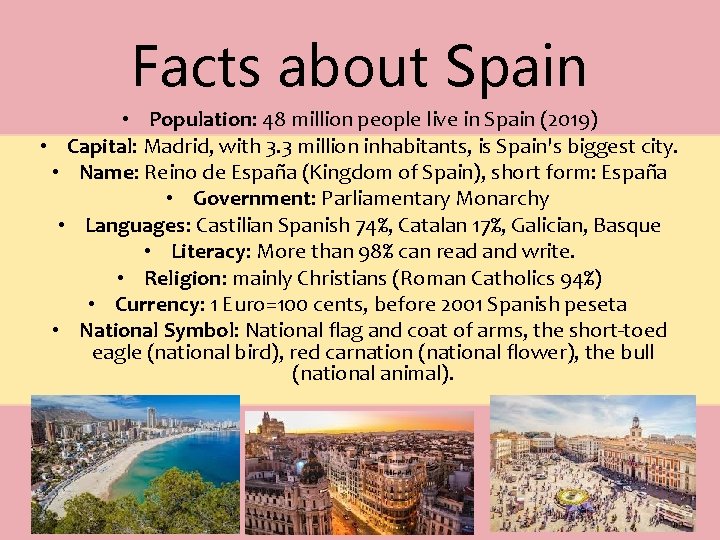
My Visit to Spain When I went to Spain, i went to Benidorm which is located in Alicante, on Spain's Mediterranean coast.
- Slides: 18