
A New Technology for Hydrogen Safety Glass Structures


- Slides: 29
A New Technology for Hydrogen Safety: Glass Structures as a Storage System Ronald Meyer BAM Federal Institute for Materials Research and Testing Division II. 1 “Gases, Gas Plants” 12205 Berlin, Germany C. En Ltd. , 3 Sonnhaldenstrasse Postfach CH-8032 Zurich, Switzerland Ronald Meyer 4 th ICHS – International Conference on Hydrogen Safety 2011 -09 -14
Contents 1. Idea 2. Safety aspects 3. Storage principles 4. Conclusion/Perspectives Ronald Meyer 4 th ICHS – International Conference on Hydrogen Safety 2011 -09 -14 2
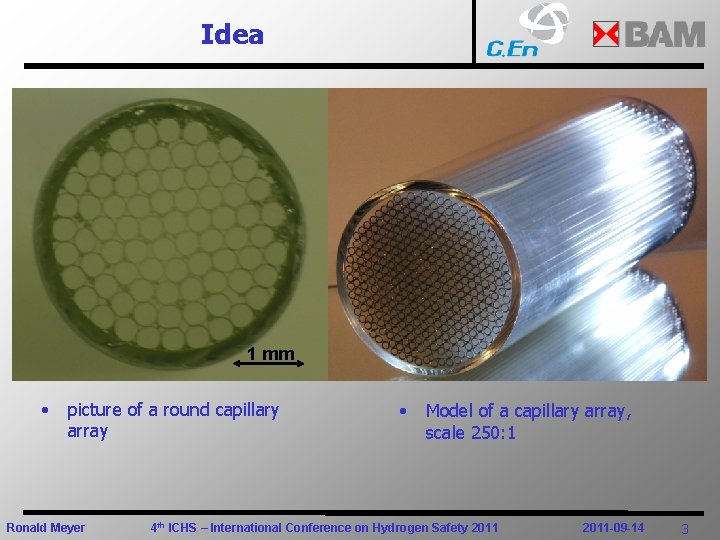
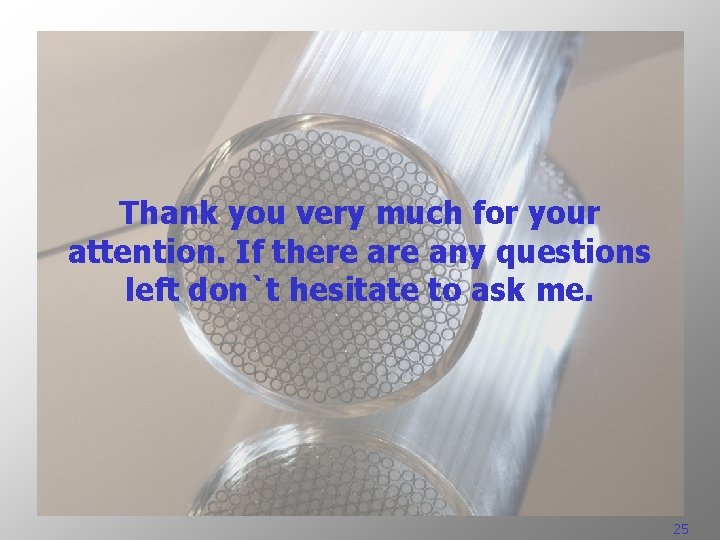
Idea 1 mm • picture of a round capillary array Ronald Meyer • Model of a capillary array, scale 250: 1 4 th ICHS – International Conference on Hydrogen Safety 2011 -09 -14 3
Why Use Multi-Capillary Arrays? Material Tensile Strength MPa Density g/cm 3 Aluminum 49 2. 9 900 4. 51 1900 3. 9 -4. 1 Steel 310 -2482 7. 8 Carbon fiber 3530 - 4560 1. 8 S-Glass (fiber) 4710 2. 48 Quartz (fiber) 6000 2. 2 Titanium Alloy Sapphire (Al 2 O 3) Ronald Meyer 4 th ICHS – International Conference on Hydrogen Safety 2011 -09 -14 4
Why Use Multi-Capillary Arrays? Multi-Capillary Arrays have a number of outstanding characteristics: characteristics • Mechanically strong • Crash safety • Environmentally friendly • Reusable • Chemically durable • Low hydrogen diffusion • Light weight Ronald Meyer 4 th ICHS – International Conference on Hydrogen Safety 2011 -09 -14 5
Contents 1. Idea 2. Safety aspects 3. Storage principles 4. Conclusion/Perspectives Ronald Meyer 4 th ICHS – International Conference on Hydrogen Safety 2011 -09 -14 6
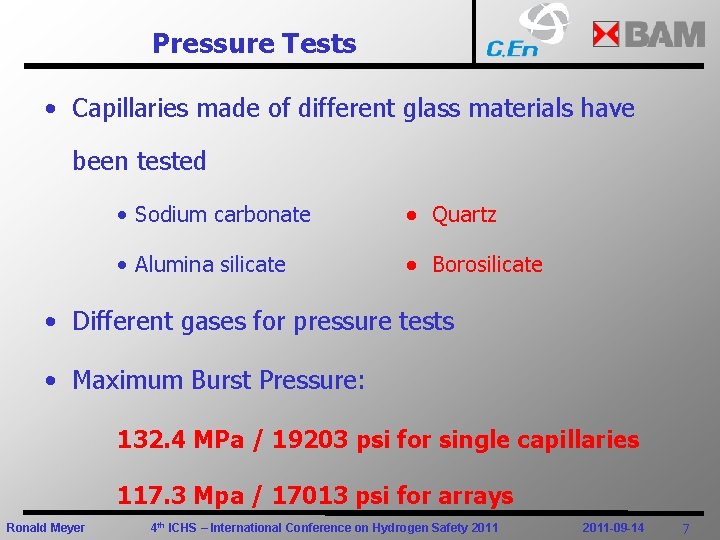
Pressure Tests • Capillaries made of different glass materials have been tested • Sodium carbonate ● Quartz • Alumina silicate ● Borosilicate • Different gases for pressure tests • Maximum Burst Pressure: 132. 4 MPa / 19203 psi for single capillaries 117. 3 Mpa / 17013 psi for arrays Ronald Meyer 4 th ICHS – International Conference on Hydrogen Safety 2011 -09 -14 7
Pressure Tests • Parameters varied: • Inner diameters from 120 µm up to 3 mm • Wall thicknesses from 10 µm up to 290 µm • Different lengths from 100 mm up to 300 mm • Different diameter-wall thickness-ratios Ronald Meyer 4 th ICHS – International Conference on Hydrogen Safety 2011 -09 -14 8
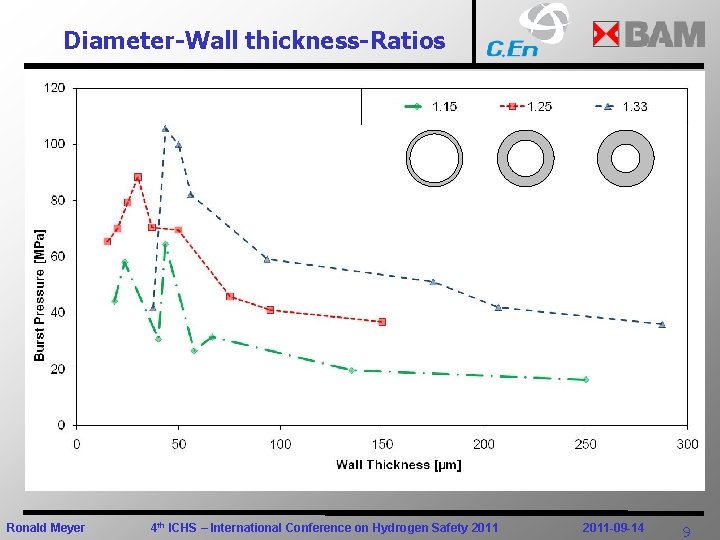
Diameter-Wall thickness-Ratios Ronald Meyer 4 th ICHS – International Conference on Hydrogen Safety 2011 -09 -14 9
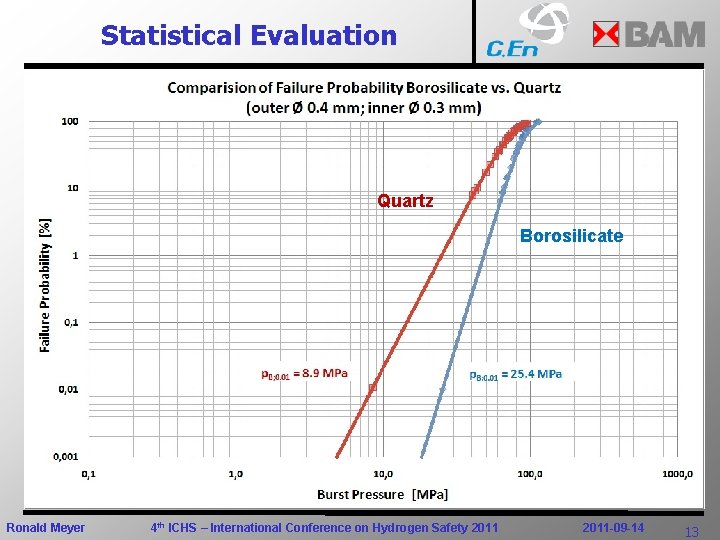
Statistical Evaluation • Burst pressure of single capillaries are important basic information • Information about the reliability of complex bundled systems • Failure probability statistics of capillaries Ronald Meyer 4 th ICHS – International Conference on Hydrogen Safety 2011 -09 -14 10
Weibull-Distribution • It is a statistical distribution which is used for determination of durability in quality management • Especially used at material fatigue of brittle materials • Different number of samples of the same design and construction have to be tested at defined conditions till a collapse eventuates Ronald Meyer 4 th ICHS – International Conference on Hydrogen Safety 2011 -09 -14 11
Statistical Evaluation Quartz Borosilicate Ronald Meyer 4 th ICHS – International Conference on Hydrogen Safety 2011 -09 -14 12
Statistical Evaluation Quartz Borosilicate Ronald Meyer 4 th ICHS – International Conference on Hydrogen Safety 2011 -09 -14 13
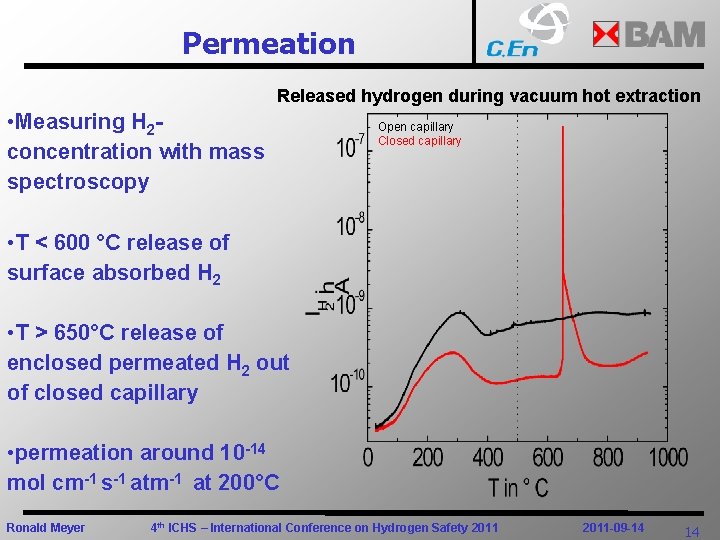
Permeation Released hydrogen during vacuum hot extraction • Measuring H 2 concentration with mass spectroscopy Open capillary Closed capillary • T < 600 °C release of surface absorbed H 2 • T > 650°C release of enclosed permeated H 2 out of closed capillary • permeation around 10 -14 mol cm-1 s-1 atm-1 at 200°C Ronald Meyer 4 th ICHS – International Conference on Hydrogen Safety 2011 -09 -14 14
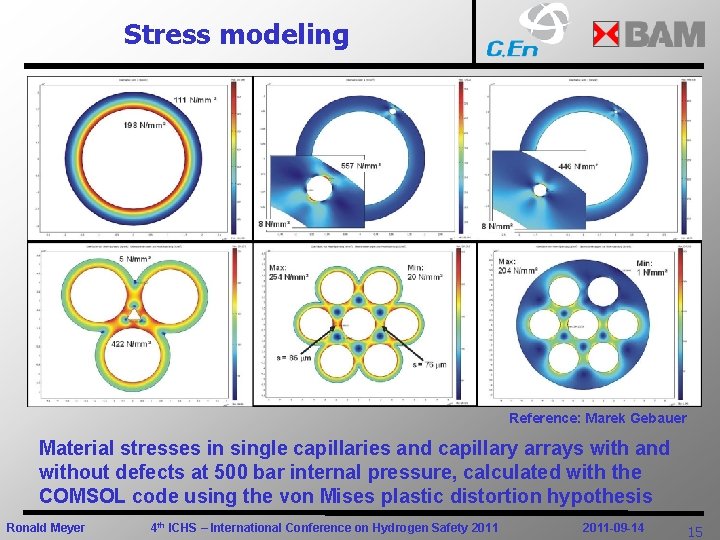
Stress modeling Reference: Marek Gebauer Material stresses in single capillaries and capillary arrays with and without defects at 500 bar internal pressure, calculated with the COMSOL code using the von Mises plastic distortion hypothesis Ronald Meyer 4 th ICHS – International Conference on Hydrogen Safety 2011 -09 -14 15
Contents 1. Idea 2. Safety aspects 3. Storage principles 4. Conclusion/Perspectives Ronald Meyer 4 th ICHS – International Conference on Hydrogen Safety 2011 -09 -14 16
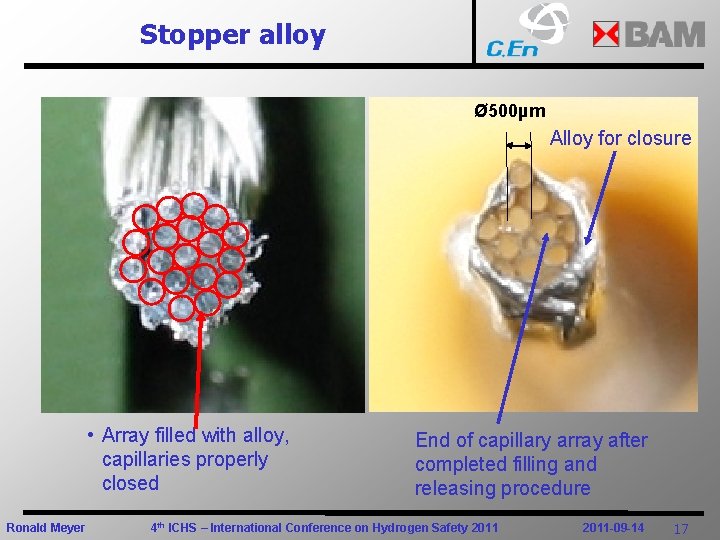
Stopper alloy Ø 500µm Alloy for closure • Array filled with alloy, capillaries properly closed Ronald Meyer End of capillary array after completed filling and releasing procedure 4 th ICHS – International Conference on Hydrogen Safety 2011 -09 -14 17
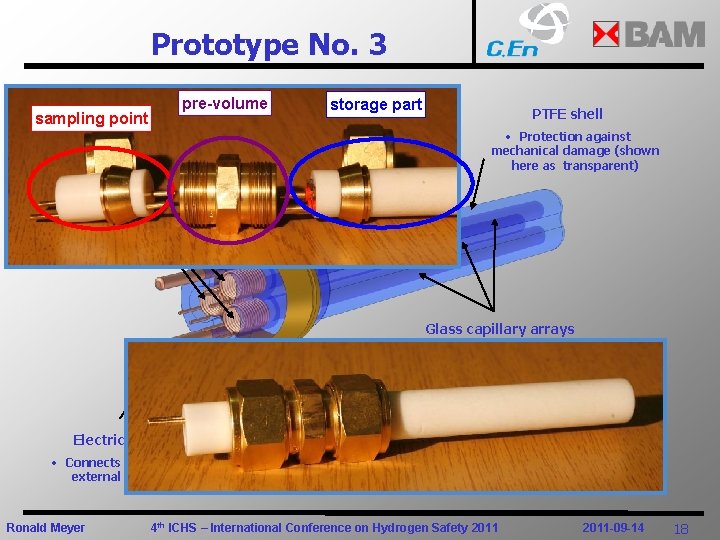
Prototype No. 3 Heating coil sampling point pre-volume • Coil made of insulated electric wire storage part PTFE shell Sealing system • Protection against mechanical damage (shown here as transparent) • Connects storage unit to application Glass capillary arrays • Main storage device Ø 16 mm 130 mm Electric contacts • Connects heating coil to external power supply Ronald Meyer 4 th ICHS – International Conference on Hydrogen Safety 2011 -09 -14 18
Storage Principles Stopper Alloy • Long time storage • Low-melting alloy as closing system for every single capillary • Cheap solution without high constructional afford • Heat energy for closing and for opening • Electronic control unit for heating needed • Special setup for filling necessary, no in-situ possible Ronald Meyer 4 th ICHS – International Conference on Hydrogen Safety 2011 -09 -14 19
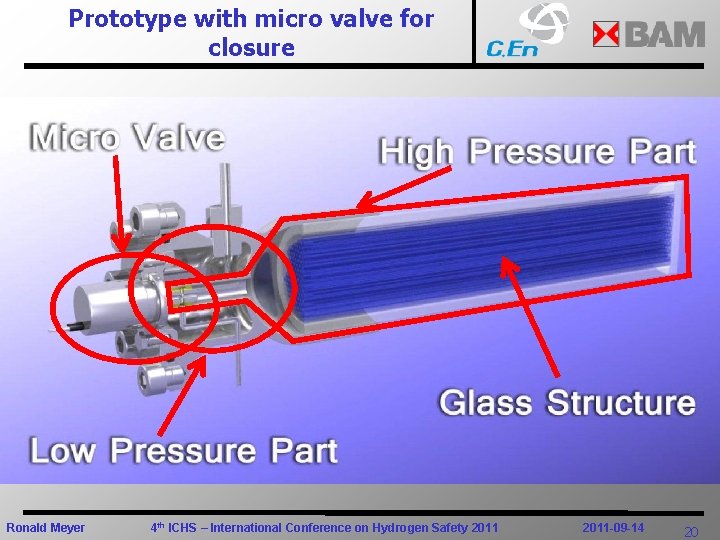
Prototype with micro valve for closure Ronald Meyer 4 th ICHS – International Conference on Hydrogen Safety 2011 -09 -14 20
Storage Principles Valve • Short time storage • Alterning demand or quick providing • Short release-period with different flows and pressure ratios • In-situ filling is possible • No or low energy-supply necessary Ronald Meyer 4 th ICHS – International Conference on Hydrogen Safety 2011 -09 -14 21
Contents 1. Idea 2. Safety aspects 3. Storage principles 4. Conclusion/Perspectives Ronald Meyer 4 th ICHS – International Conference on Hydrogen Safety 2011 -09 -14 22
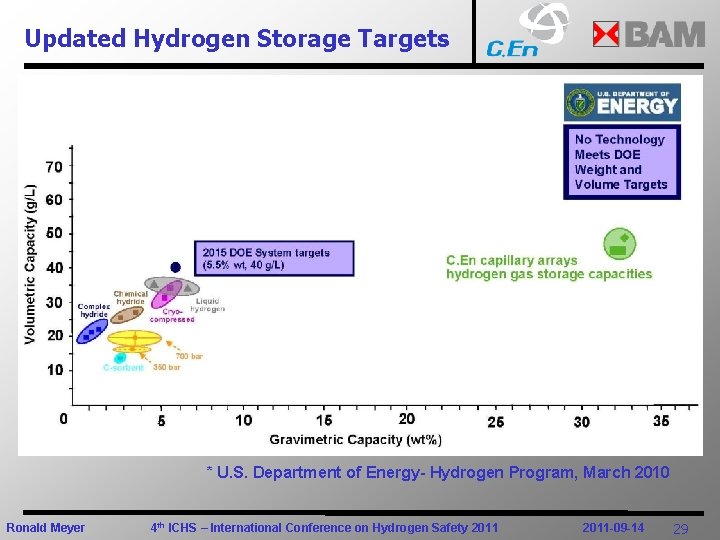
Conclusions/Perspectives • Capillaries are able to withstand high pressures • Glass capillaries systems demonstrate the possibility of lightweight storage systems in every shape and volume • In tests for single capillary gravimetric capacity of 33 wt% and vol. capacity of 45 g/l • Usage over a wide range of applications, up- and down scaling for adaption possible • Long time as well as short time storage systems are realizable Ronald Meyer 4 th ICHS – International Conference on Hydrogen Safety 2011 -09 -14 23
Conclusions/Perspectives • System is split into several modules, in case of leakage or impact only the damaged module will release the amount of stored hydrogen • Possibility of hazardous situations much lower than of a single-tank-solution • Safety evaluation only for a complete system possible Ronald Meyer 4 th ICHS – International Conference on Hydrogen Safety 2011 -09 -14 24
Thank you very much for your attention. If there any questions left don`t hesitate to ask me. 25
Backup Ronald Meyer 4 th ICHS – International Conference on Hydrogen Safety 2011 -09 -14 26
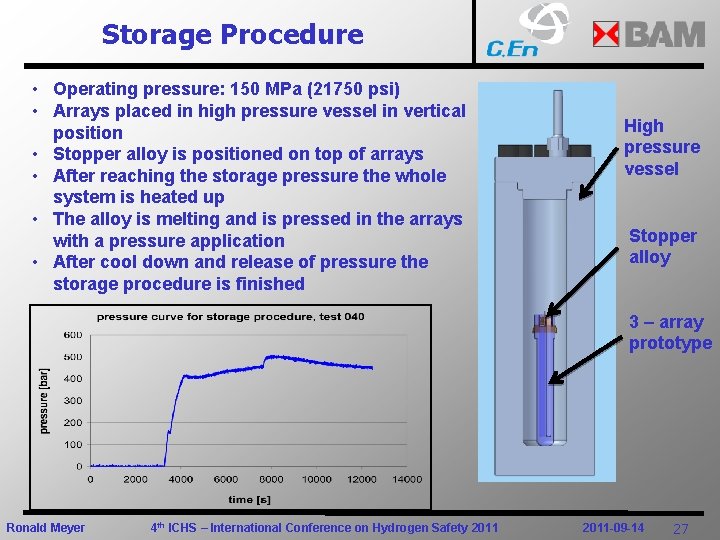
Storage Procedure • Operating pressure: 150 MPa (21750 psi) • Arrays placed in high pressure vessel in vertical position • Stopper alloy is positioned on top of arrays • After reaching the storage pressure the whole system is heated up • The alloy is melting and is pressed in the arrays with a pressure application • After cool down and release of pressure the storage procedure is finished High pressure vessel Stopper alloy 3 – array prototype Ronald Meyer 4 th ICHS – International Conference on Hydrogen Safety 2011 -09 -14 27
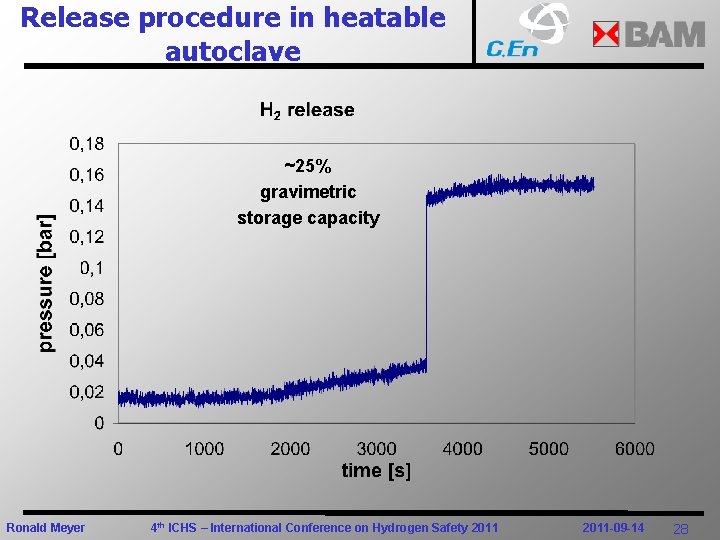
Release procedure in heatable autoclave ~25% gravimetric storage capacity Ronald Meyer 4 th ICHS – International Conference on Hydrogen Safety 2011 -09 -14 28
Updated Hydrogen Storage Targets * U. S. Department of Energy- Hydrogen Program, March 2010 Ronald Meyer 4 th ICHS – International Conference on Hydrogen Safety 2011 -09 -14 29