
A new technique to address CID and IFF



- Slides: 24
A new technique to address CID and IFF studies David Dean, Kathryn Hynd, Beejal Mistry, Alasdair Vincent and Paul Syms Dstl IMD and LSD 22 ISMOR, September 2005 Dstl/CP 16723
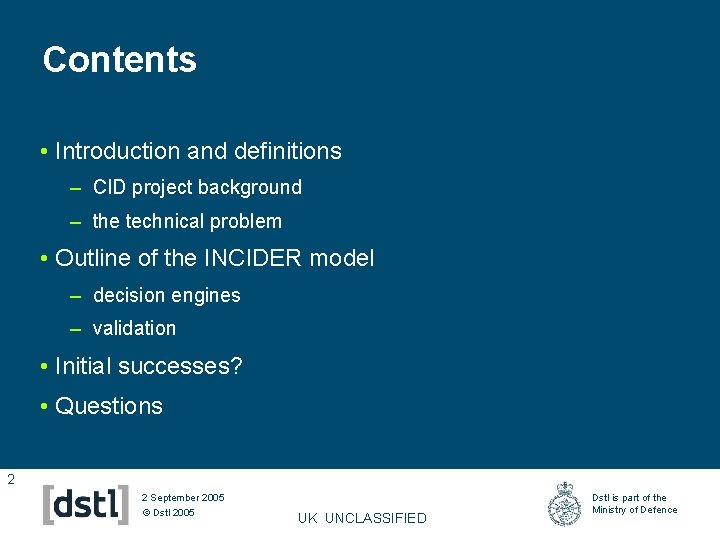
Contents • Introduction and definitions – CID project background – the technical problem • Outline of the INCIDER model – decision engines – validation • Initial successes? • Questions 2 2 September 2005 © Dstl 2005 UK UNCLASSIFIED Dstl is part of the Ministry of Defence
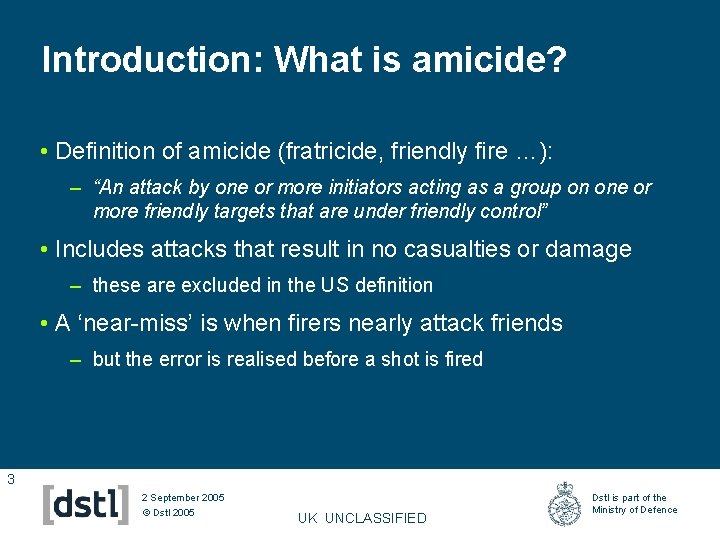
Introduction: What is amicide? • Definition of amicide (fratricide, friendly fire …): – “An attack by one or more initiators acting as a group on one or more friendly targets that are under friendly control” • Includes attacks that result in no casualties or damage – these are excluded in the US definition • A ‘near-miss’ is when firers nearly attack friends – but the error is realised before a shot is fired 3 2 September 2005 © Dstl 2005 UK UNCLASSIFIED Dstl is part of the Ministry of Defence
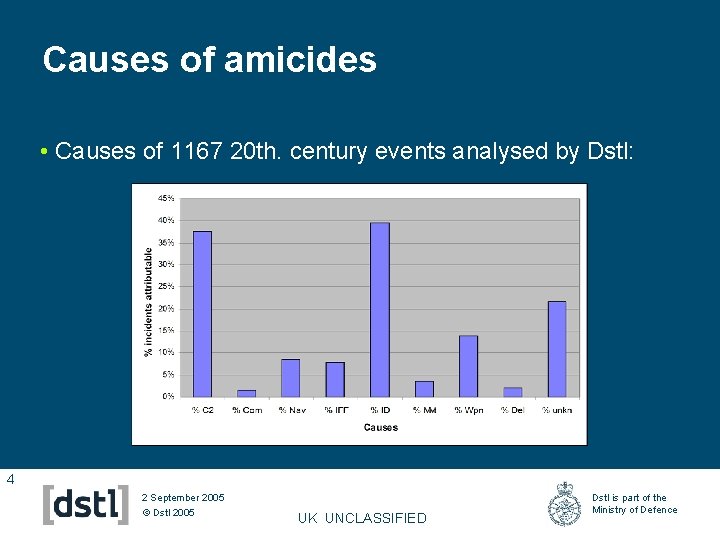
Causes of amicides • Causes of 1167 20 th. century events analysed by Dstl: 4 2 September 2005 © Dstl 2005 UK UNCLASSIFIED Dstl is part of the Ministry of Defence
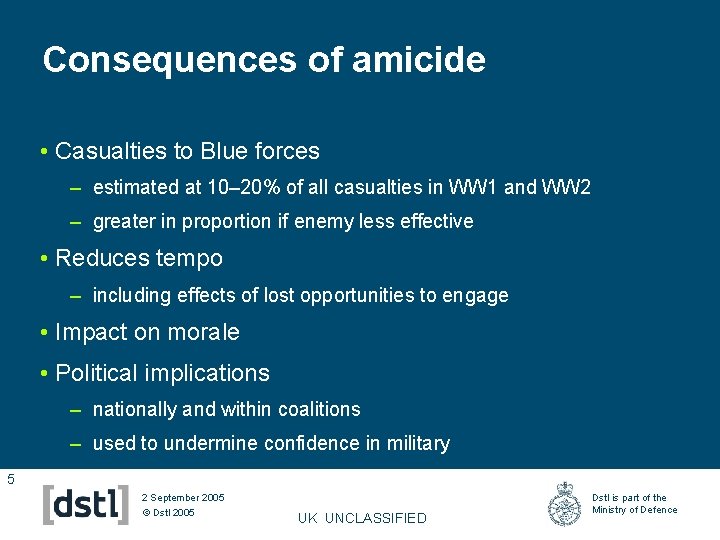
Consequences of amicide • Casualties to Blue forces – estimated at 10– 20% of all casualties in WW 1 and WW 2 – greater in proportion if enemy less effective • Reduces tempo – including effects of lost opportunities to engage • Impact on morale • Political implications – nationally and within coalitions – used to undermine confidence in military 5 2 September 2005 © Dstl 2005 UK UNCLASSIFIED Dstl is part of the Ministry of Defence
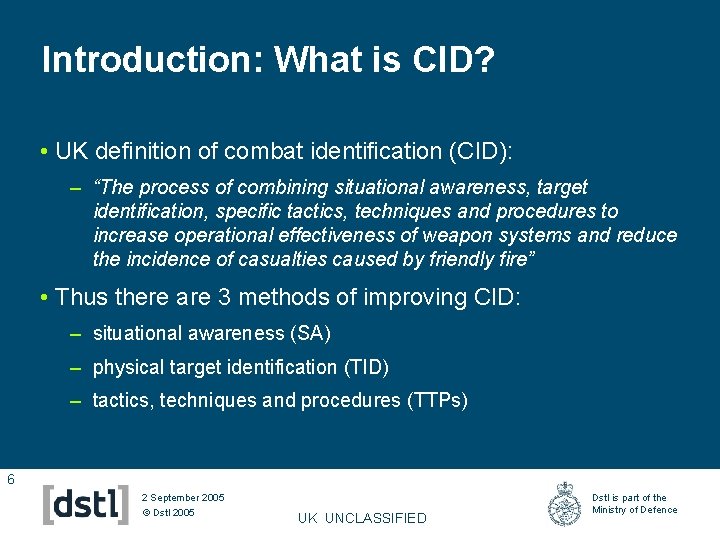
Introduction: What is CID? • UK definition of combat identification (CID): – “The process of combining situational awareness, target identification, specific tactics, techniques and procedures to increase operational effectiveness of weapon systems and reduce the incidence of casualties caused by friendly fire” • Thus there are 3 methods of improving CID: – situational awareness (SA) – physical target identification (TID) – tactics, techniques and procedures (TTPs) 6 2 September 2005 © Dstl 2005 UK UNCLASSIFIED Dstl is part of the Ministry of Defence
The CID OA problem • Mo. D requires advice on CID cost-effective CID solutions – Bo. I across SA, TID and TTPs – across all environments – sea, land, air … joint and combined – spans the physical, information and cognitive domains • Cost-effectiveness implies quantitative modelling – cognitive domain usually addressed using ‘soft OA’ methods • No quantitative ‘off-the-shelf’ assessment tools available • Dstl understood all domains to a sufficient extent … – and was aware sufficient data existed to support modelling … 7 2 September 2005 © Dstl 2005 UK UNCLASSIFIED Dstl is part of the Ministry of Defence
The INCIDER model
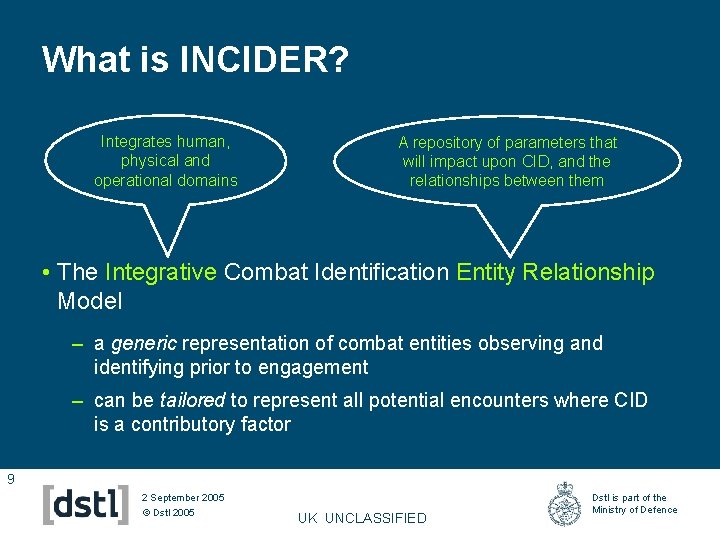
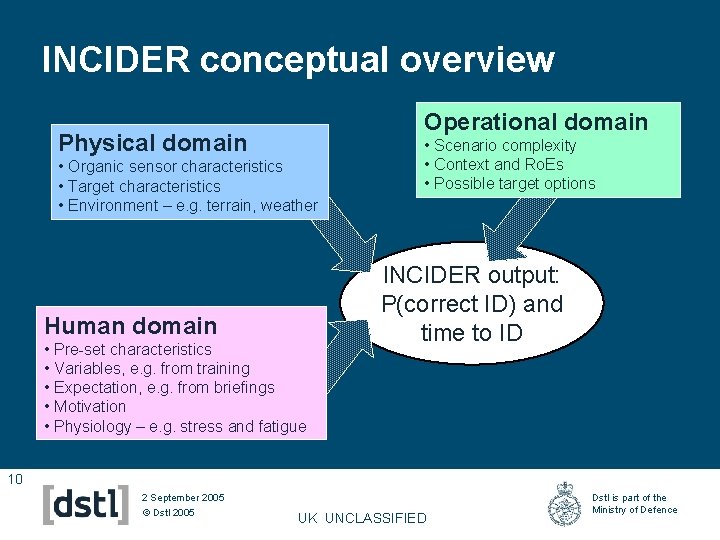
What is INCIDER? Integrates human, physical and operational domains A repository of parameters that will impact upon CID, and the relationships between them • The Integrative Combat Identification Entity Relationship Model – a generic representation of combat entities observing and identifying prior to engagement – can be tailored to represent all potential encounters where CID is a contributory factor 9 2 September 2005 © Dstl 2005 UK UNCLASSIFIED Dstl is part of the Ministry of Defence
INCIDER conceptual overview Operational domain Physical domain • Organic sensor characteristics • Target characteristics • Environment – e. g. terrain, weather Human domain • Pre-set characteristics • Variables, e. g. from training • Expectation, e. g. from briefings • Motivation • Physiology – e. g. stress and fatigue • Scenario complexity • Context and Ro. Es • Possible target options INCIDER output: P(correct ID) and time to ID 10 2 September 2005 © Dstl 2005 UK UNCLASSIFIED Dstl is part of the Ministry of Defence
CID decision-making scope Memory Decision process Perception Comprehension Projection Decision Absolute truth about identity Retrieved information, reports Compiled view Fusion process Decision output categories Detection Is it a military object? Identification What sort of tank is it? Recognition Is it a tank? Action Should I kill it, report it, hide from it or ignore it? Aggregated information available to observer Total information available for decision “Picture” Organic and 3 rd. party information Maximum information available to observer Battlespace Entity Maximum information available to sensors 11 2 September 2005 © Dstl 2005 UK UNCLASSIFIED Dstl is part of the Ministry of Defence
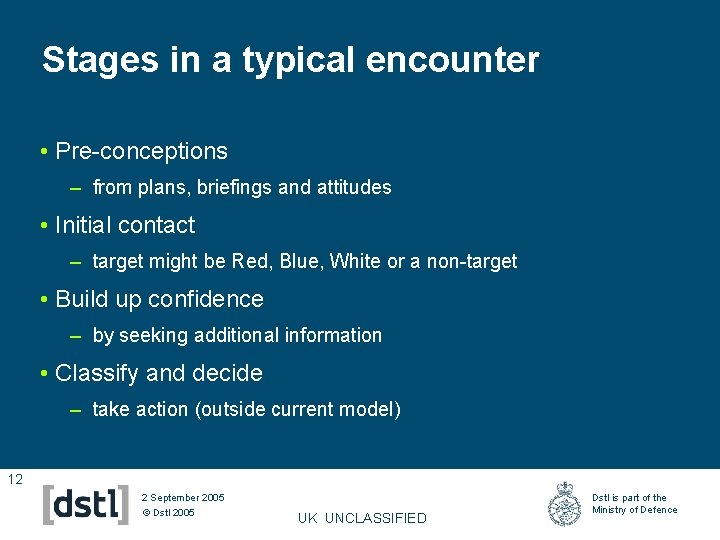
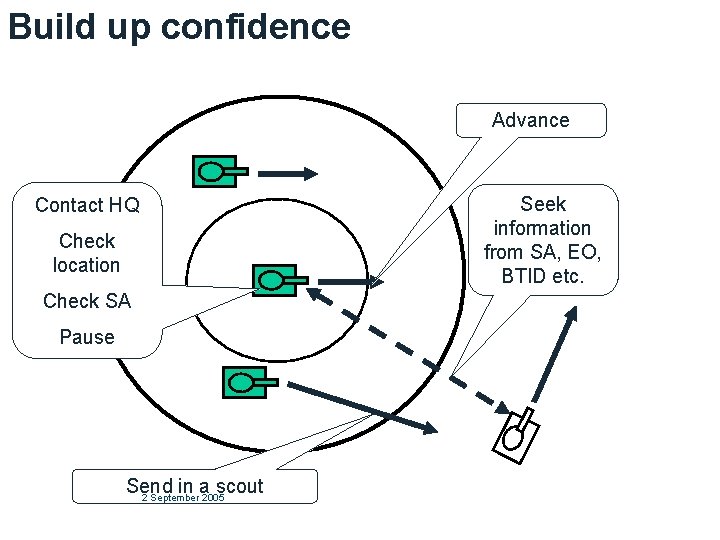
Stages in a typical encounter • Pre-conceptions – from plans, briefings and attitudes • Initial contact – target might be Red, Blue, White or a non-target • Build up confidence – by seeking additional information • Classify and decide – take action (outside current model) 12 2 September 2005 © Dstl 2005 UK UNCLASSIFIED Dstl is part of the Ministry of Defence
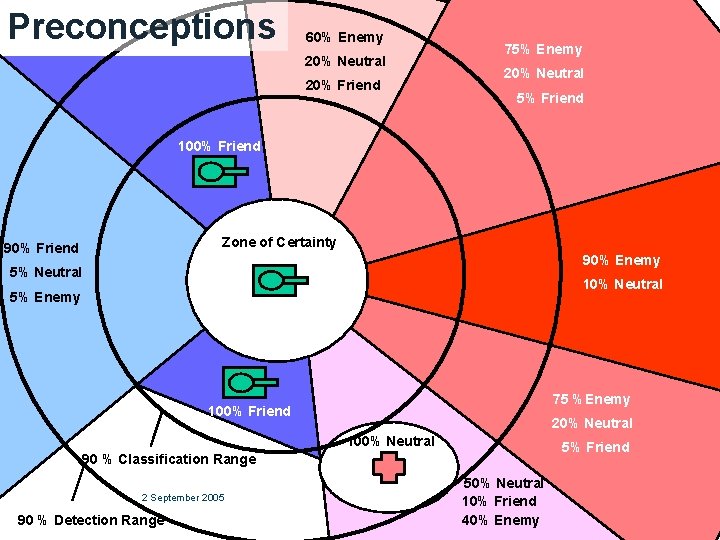
Preconceptions 60% Enemy 20% Neutral 20% Friend 75% Enemy 20% Neutral 5% Friend 100% Friend Zone of Certainty 90% Friend 90% Enemy 5% Neutral 10% Neutral 5% Enemy 75 %Enemy 100% Friend 20% Neutral 100% Neutral 5% Friend 90 % Classification Range 13 2 September 2005 © Dstl 2005 90 % Detection Range UK UNCLASSIFIED 50% Neutral 10% Friend 40% Enemy Dstl is part of the Ministry of Defence
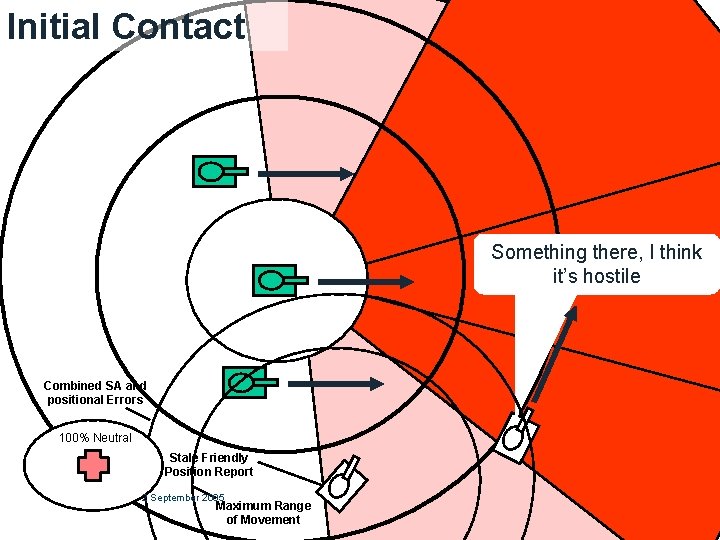
Initial Contact Something there, I think it’s hostile Combined SA and positional Errors 100% Neutral 14 Stale Friendly Position Report 2 September 2005 Maximum © Dstl 2005 Range of Movement. UK UNCLASSIFIED Dstl is part of the Ministry of Defence
Build up confidence Advance Seek information from SA, EO, BTID etc. Contact HQ Check location Check SA Pause 15 Send in a scout 2 September 2005 © Dstl 2005 UK UNCLASSIFIED Dstl is part of the Ministry of Defence
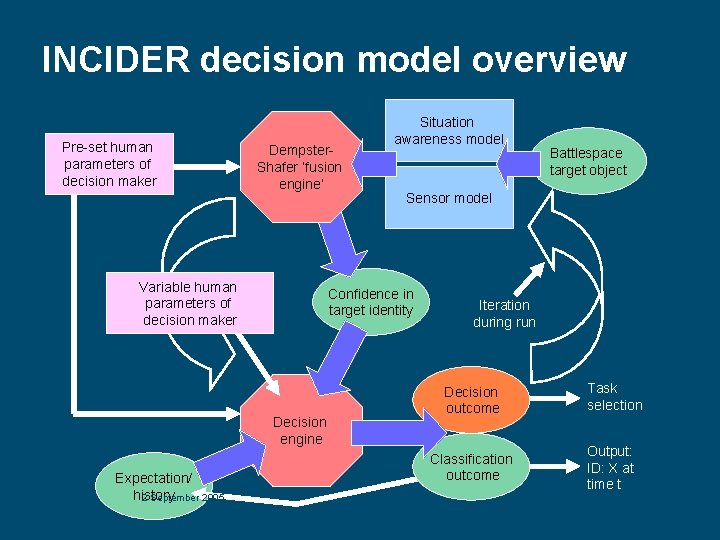
Cognitive engines • Fusion engine tracks likely target identity – uses the Dempster-Shafer method – similar to Bayesian inference, but using ‘confidence masses’ – starts with target ID pre-conceptions – updated as new information received • Decision engine has two functions: – decides on further action before CID decision reached – decides on target identity when confidence threshold reached • INCIDER iterates loop until a CID decision is made 16 2 September 2005 © Dstl 2005 UK UNCLASSIFIED Dstl is part of the Ministry of Defence
INCIDER decision model overview Pre-set human parameters of decision maker Dempster. Shafer ‘fusion engine’ Variable human parameters of decision maker Situation awareness model Sensor model Confidence in target identity Decision engine 17 Iteration during run Decision outcome Classification outcome Expectation/ history 2 September 2005 © Dstl 2005 Battlespace target object UK UNCLASSIFIED Task selection Output: ID: X at time t Dstl is part of the Ministry of Defence
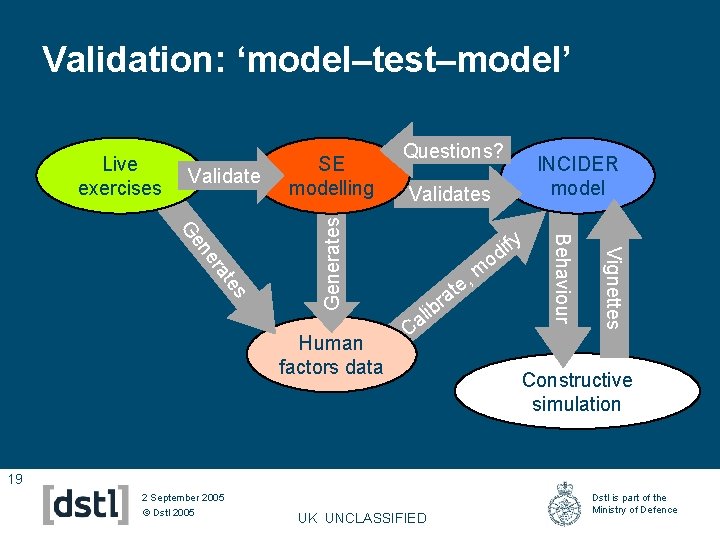
Way ahead for INCIDER • Validation using synthetic environment – with psychometric testing of participants – collaborating with Qineti. Q CHS and Land Division • Better modelling of possible errors – in physical, informational and cognitive domains • Aim to embed INCIDER in combat simulation – possibly Dstl’s Close Action Environment (CAEn) – will improve context, but may encounter interface problems 18 2 September 2005 © Dstl 2005 UK UNCLASSIFIED Dstl is part of the Ministry of Defence
Validation: ‘model–test–model’ Validate SE modelling INCIDER model Validates o fy i d , m Ca e at r lib Vignettes s te ra ne Human factors data Questions? Behaviour Ge Generates Live exercises Constructive simulation 19 2 September 2005 © Dstl 2005 UK UNCLASSIFIED Dstl is part of the Ministry of Defence
Initial impressions and summary
Initial results • Results were intuitively ‘sensible’ – sensitive to different scenario vignettes – sensitive to physical, informational and cognitive factors – sensitive to interventions in SA, TID and TTPs • Different CID interventions helped in different vignettes – sometimes ‘binary’, other times more subtle influences • Interactions between some CID interventions seen – e. g. training and provision of specific TID equipments – statistically significant using ANOVAR 21 2 September 2005 © Dstl 2005 UK UNCLASSIFIED Dstl is part of the Ministry of Defence
Initial successes • Quantitative assessment across three domains – enabling equitable comparison of different Lo. Ds – contributes to understanding human factors in warfare • High levels of cross-disciplinary collaboration – technologists and engineers – military SMEs – psychologists – mathematicians … and to include cost forecasters – brought together by operational analysts 22 2 September 2005 © Dstl 2005 UK UNCLASSIFIED Dstl is part of the Ministry of Defence
Summary • Dstl required to assess CID interventions quantitatively – sensitive to parameters in SA, TID and TTPs – sensitive to physical, informational and cognitive factors • Built the INCIDER model – and managed to provide acceptable ‘first cut’ data set • Substantial success from first results – sensitive to changes in scenarios and CID parameters • Contributes to understanding human factors in warfare – potential for application to other ‘fusion’ problems 23 2 September 2005 © Dstl 2005 UK UNCLASSIFIED Dstl is part of the Ministry of Defence
Questions? Always keen to hear of amicide events for catalogue – compilation of V 2. 0 is ongoing – please e-mail me on prsyms@dstl. gov. uk 24 2 September 2005 © Dstl 2005 UK UNCLASSIFIED Dstl is part of the Ministry of Defence