
A New TABE for a New Era NRS
A New TABE for a New Era
NRS Changes n Public comment period for WIOA draft regulations is closed n Final NRS Descriptors released March 2016 n Final NRS Regulations released August 2016 – Rules for all parts of NRS testing/reporting and AEFLA funding n October 1, 2016, was the first application date for publishers – TABE 11&12 application submitted for NRS approval n September 7, 2017 TABE 11&12 received 7 year NRS approval 2

TABE Current Status n TABE 9&10 is approved until February 2019 n TABE 9&10 released on new DRC INSIGHT platform n TABE 11&12 Online released January 8, 2018 on DRC INSIGHT n TABE 11&12 Paper/Pencil to be released April 1 st n Date that states will allow use of TABE 11&12 to be announced – TABE 9&10 cut off date to be announced later n TABE CLAS-E approved in 20 states – New College and Career-Readiness (CCR) 3
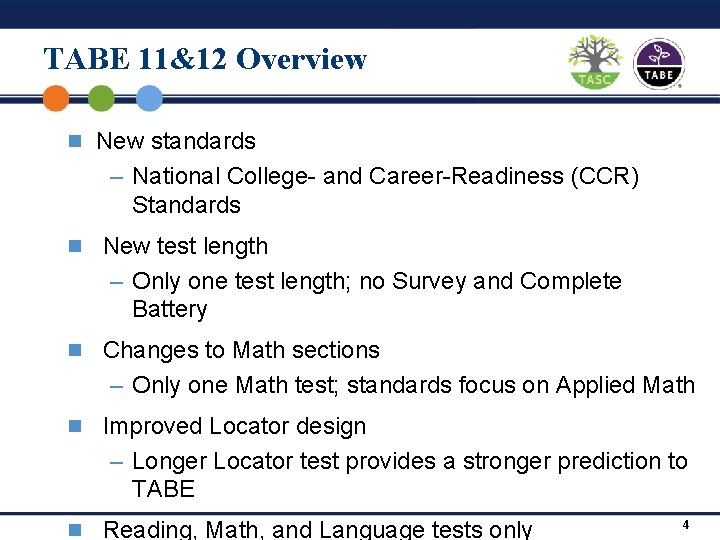
TABE 11&12 Overview n New standards – National College- and Career-Readiness (CCR) Standards n New test length – Only one test length; no Survey and Complete Battery n Changes to Math sections – Only one Math test; standards focus on Applied Math n Improved Locator design – Longer Locator test provides a stronger prediction to TABE n Reading, Math, and Language tests only 4

NRS Changes Example: NRS Level 1 Math Old: New: Individual has little or no recognition of numbers or simple counting skills or may have only minimal skills, such as the ability to add or subtract single digit numbers. Students prepared to exit this level are able to decipher a simple problem presented in a context and reason about and apply correct units to the results. They can visualize a situation using manipulatives or drawings and explain their processes and results using mathematical terms and symbols appropriate for the level. They recognize errors in the work and reasoning of others. They are able to strategically select and use appropriate tools to aid in their work, such as pencil/paper, measuring devices, and/or manipulatives. They can see patterns and structure in sets of numbers and geometric shapes and use those insights to work more efficiently. Number Sense and Operations: Students prepared to exit this level have an understanding of whole number place value for tens and ones and are able to use their understanding of place value to compare two-digit numbers. They are able to add whole numbers within 100 and explain their reasoning, e. g. , using concrete models or drawings and strategies based on place value and/or properties of operations. They are able to apply their knowledge of whole number addition and subtraction to represent and solve word problems that call for addition of three whole numbers whose sum is less than 20 by using such problem-solving tools as objects, drawings, and/or simple equations. Algebraic Thinking: Students prepared to exit this level understand apply the properties of operations to addition and subtraction problems. They understand the relationship between the two operations and can determine the unknown number in addition or subtraction equations. Geometry and Measurement: Students prepared to exit this level can analyze and compare 2 -dimensional and 3 -dimensional shapes based on their attributes, such as their shape, size, orientation, the number of sides and/or vertices (angles), or the lengths of their sides. They can reason with two-dimensional shapes (e. g. , quadrilaterals and half- and quarter-circles) and with three-dimensional shapes (e. g. , right prisms, cones, and cylinders) to create composite shapes. They are able to measure the length of an object as a whole number of units, which are not necessarily standard units, for example measuring the length of a pencil using a paper clip as the length unit. Data Analysis: Students prepared to exit this level are able to organize, represent, and interpret simple data sets (e. g. , lists of numbers, shapes, or items) using up to three categories. They can answer basic questions related to the total number of data points in a set and the number of data points in each category, and can compare the number of data points in the different categories. 5

How to Use TABE Enter Locator Test Instruct Pre-test Post-test HSE Eligibility Career HSE Post-sec Placement Yes Ready to to exit? Exit No

TABE 11&12: Item Types Level EBSR TE Total Passages Math (Calculator & Non-Calculator Parts) L 0 0 35 0 E 0 0 40 0 M 0 4 40 0 D 0 2 40 0 A 0 4 40 0 Reading (Part 1 & Part 2) L 0 0 40 4 E 3 2 47 7 M 7 0 47 8 D 9 1 47 9 A 15 1 47 9 Language L 0 0 35 0 E 0 7 40 2 M 0 4 40 3 D 0 5 40 6 A 0 8 40 4 7
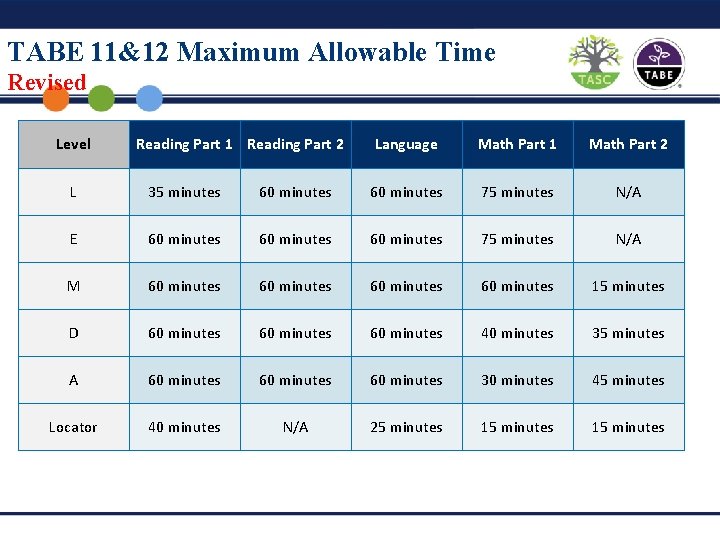
TABE 11&12 Maximum Allowable Time Revised Level Reading Part 1 Reading Part 2 Language Math Part 1 Math Part 2 L 35 minutes 60 minutes 75 minutes N/A E 60 minutes 75 minutes N/A M 60 minutes 15 minutes D 60 minutes 40 minutes 35 minutes A 60 minutes 30 minutes 45 minutes Locator 40 minutes N/A 25 minutes 15 minutes
TABE 11&12: Objectives by Level 9
TABE 11&12 Blueprints 10
TABE 11&12 Blueprints 11
TABE 11&12: Levels E/M/D/A Reading n TABE 11&12 Reading content reflects mature, life- and work-related situations and highlights overlapping objectives, from word-meaning skills to critical-thinking skills – These are measured using texts and forms familiar to everyday adult lives, as well as through excerpts that reflect our cultural diversity – Based on OCTAE CCR standards focused largely on informational texts (e. g. research, scientific, historical information) – The previous focus on literary text (e. g. fiction, memoir, poetry) is significantly decreased 12
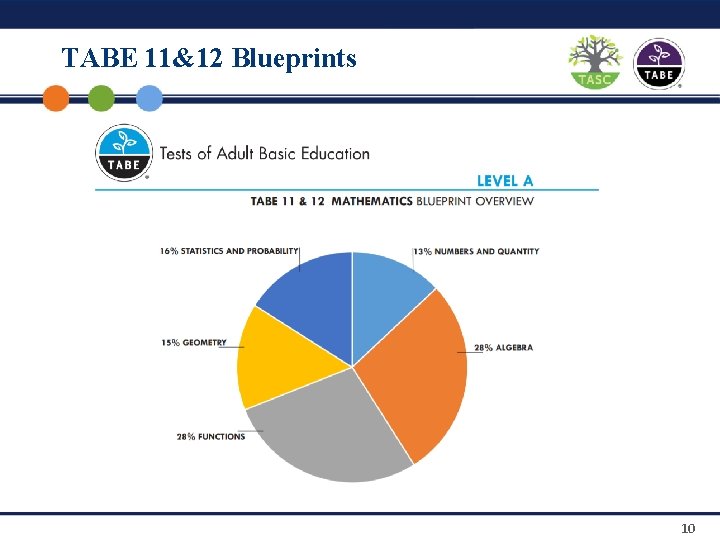
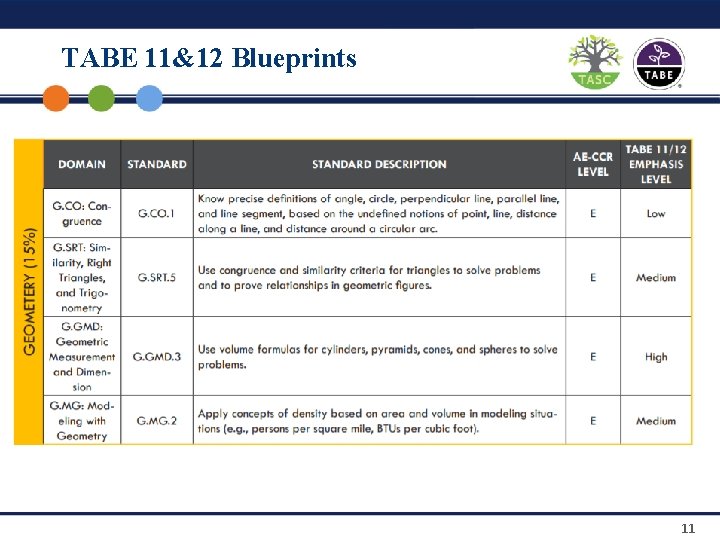
TABE 11&12: Levels E/M/D/A Mathematics n TABE 11&12 Mathematics reflects math application, particularly routine tasks such as estimating quantities and making computations involving time, distance, weight, etc. – Standards have more emphasis on applied versus computation skills – Item sets are integrated by mathematical contexts appropriate for adults – The objective distribution at Level A is very closely aligned with the content distribution of the TASC/HSE Mathematics test 13
TABE 11&12: Levels E/M/D/A Language n The goal of adult language instruction is to build communication skills necessary for functioning effectively on the job and in daily life – TABE Language assesses skills in grammar, usage, mechanics, sentence formation, and paragraph development. Understanding of word meaning and relationships, context, spelling, capitalization and punctuation in sentences, phrases, and clauses is included – Items are presented in meaningful contexts that reflect the writing process as it is applied in life 14

Example of how CCRS changes test items 15
TABE Scanning and Scoring • Web-based; no Test. Mate software required • Scanning can be done on plain-paper scanners (examples) – – – Epson Work. Force ES-200 Epson Work. Force ES-300 Epson Work. Force ES-400 Epson Work. Force ES-500 FUJITSU Document Scanner fi-7160 Brother Image. Cente ADS-2800 W • Dual read, Continuous feed, TWAIN compliant – Future enhancement: Office Copy Machines – Future enhancement: Cell phone captured pictures • All Data stored in the TABE Database also used by TABE Online

DRC INSIGHT Test Engine
DRC INSIGHT Test Engine n Intuitive, universally designed testing interface that is accessible for all students n Consistent and reliable performance on a range of testing devices – INSIGHT Runs on Windows, Mac, i. OS, Chrome, Linux – More than 32 million tests delivered in 2016– 2017 n Same platform for TABE, TASC Test, TASC Readiness and TABE CLAS-E (pending). n Since Sept 2017, 3. 15 million TABE Sub-tests have been scheduled and 2. 1 million of those completed 18
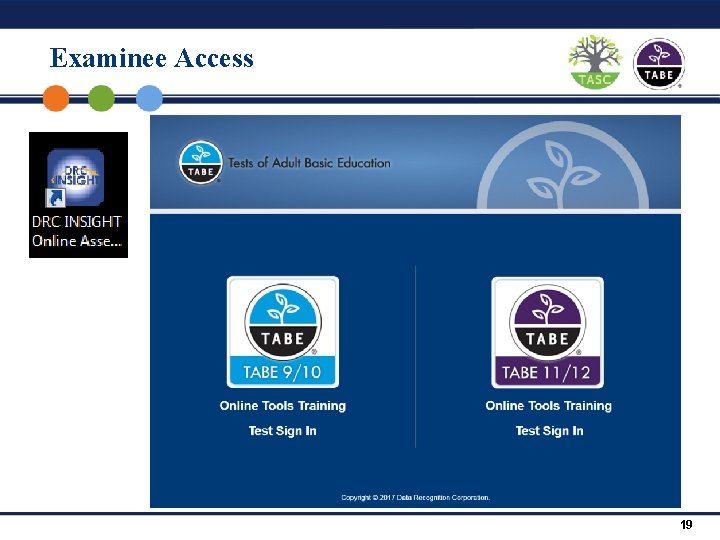
Examinee Access 19
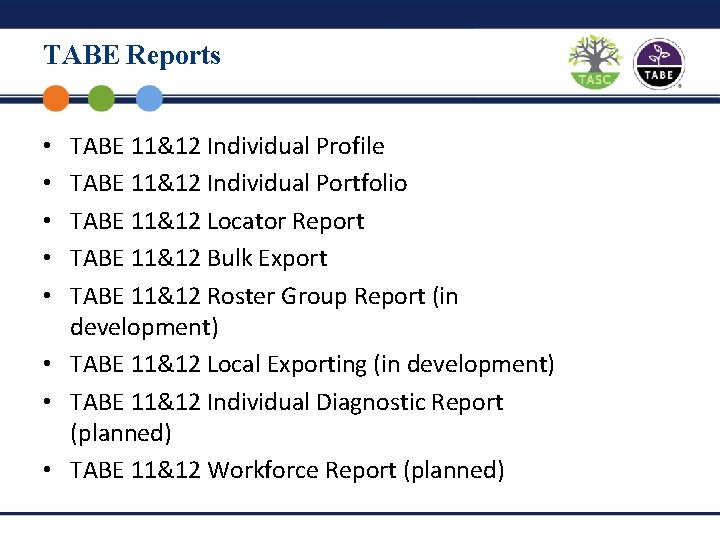
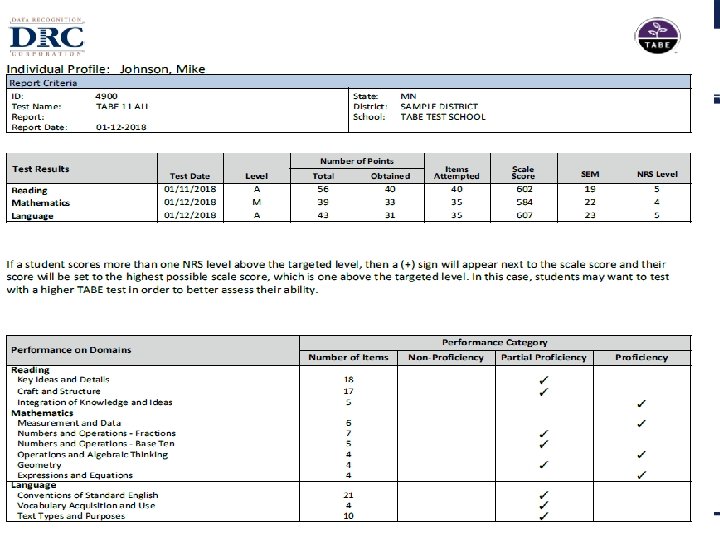
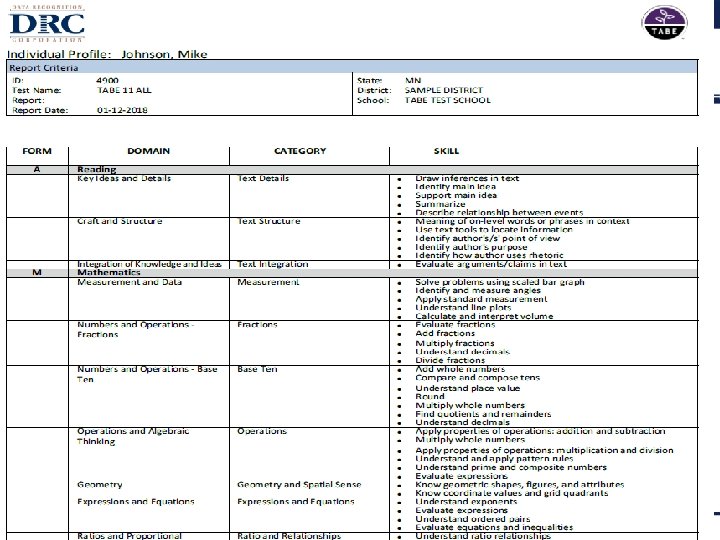
TABE Reports TABE 11&12 Individual Profile TABE 11&12 Individual Portfolio TABE 11&12 Locator Report TABE 11&12 Bulk Export TABE 11&12 Roster Group Report (in development) • TABE 11&12 Local Exporting (in development) • TABE 11&12 Individual Diagnostic Report (planned) • TABE 11&12 Workforce Report (planned) • • •
21
22
TABE 11&12 Resources Now available on tabetest. com: n TABE 11&12 Blueprints – www. tabetest. com/resources-2/testinginformation/blue-prints/ n TABE 11&12 Sample Practice Items – www. tabetest. com/resources-2/testinginformation/tabe-1112 -practice/ n TABE 11&12 Online Tools Training – www. tabetest. com/resources-2/testinginformation/online-tools-training/ 23
Thank You! Mike Johnson National Director 630 -995 -6712 mjohnson@datarecognitioncorp. com Christine Kirk Assessment Solutions Representative 904 -864 -0699 ckirk@datarecognitioncorp. com TABETest. com 24
- Slides: 24