
A new singular spectrum analysis SSA approach for

- Slides: 21
A new singular spectrum analysis (SSA) approach for processing incomplete time series polluted by multiplicative noise Yunzhong Shen 1, Fengwei Wang 1, Qiujie Chen 1, 2 1. College of Survey and Geo-informatics, Tongji University, Shanghai, China 2. Institute of Geodesy and Geo-information, University of Bonn, Germany May 07, 2020
Outline Ø Introduction Ø Improved SSA for Incomplete Time Series Ø Heuristic SSA for Multiplicative Noise Series Ø Real SSC Time Series Analysis Ø Simulation Experiments Analysis Ø Summary Ø References 2
Introduction: Singular Spectrum Analysis (SSA) l SSA is a powerful, nonparametric and model free technique for time series analysis, derived from the Karhunen–Loeve decomposition theory, which is a principle component analysis method. l SSA has obvious advantages: Unrestricted sine wave assumption, no prior information is required, stable identification, and an enhanced periodic signal. l It outperforms Fourier Transform, Wavelet Transform and Empirical Mode Decomposition in extracting signals from heterogeneous time series(Barrios-Muriel et al. , 2016; Kumar et al. , 2017).
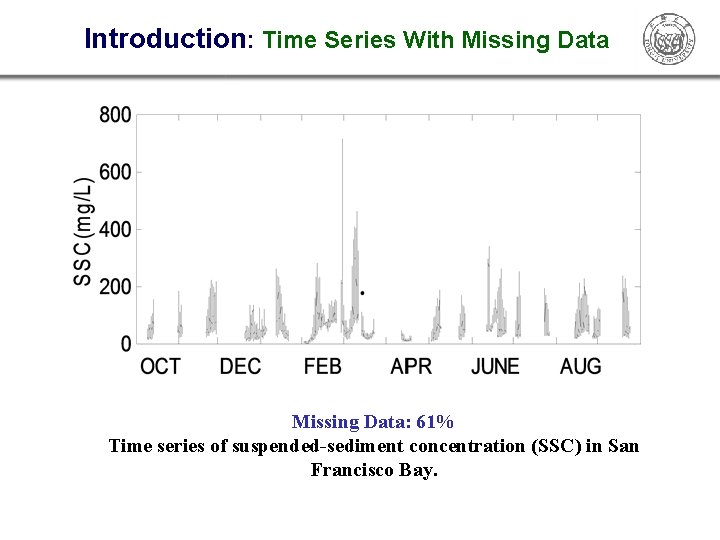
Introduction: Time Series With Missing Data: 61% Time series of suspended-sediment concentration (SSC) in San Francisco Bay.
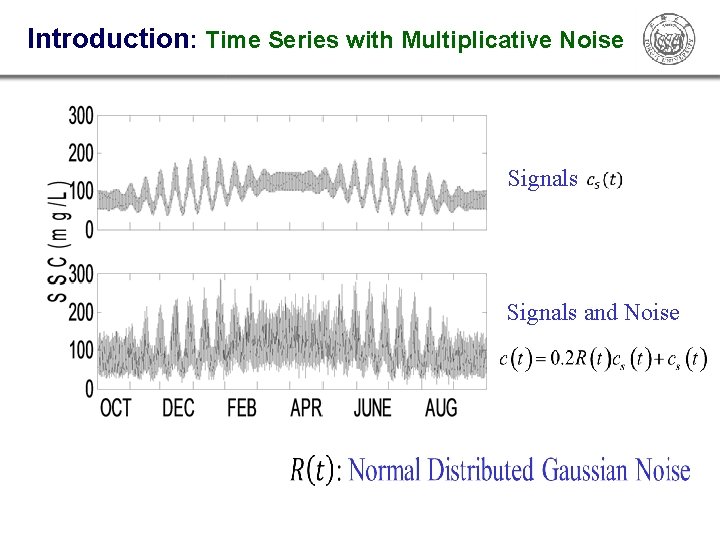
Introduction: Time Series with Multiplicative Noise Signals and Noise
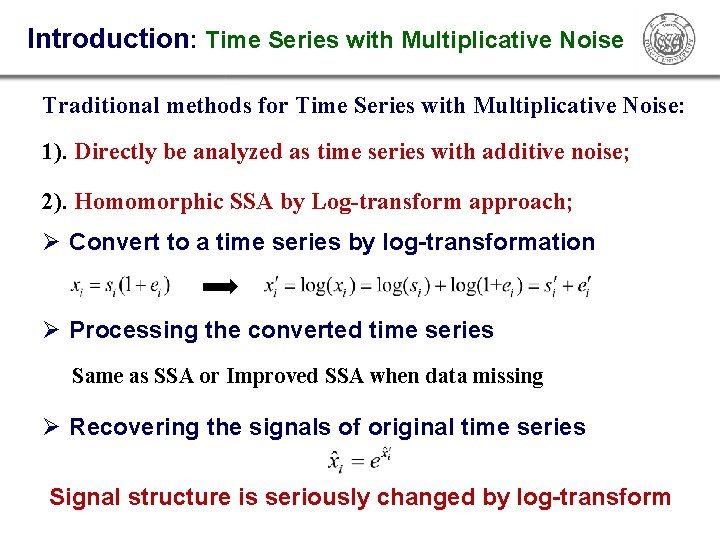
Introduction: Time Series with Multiplicative Noise Traditional methods for Time Series with Multiplicative Noise: 1). Directly be analyzed as time series with additive noise; 2). Homomorphic SSA by Log-transform approach; Ø Convert to a time series by log-transformation Ø Processing the converted time series Same as SSA or Improved SSA when data missing Ø Recovering the signals of original time series Signal structure is seriously changed by log-transform
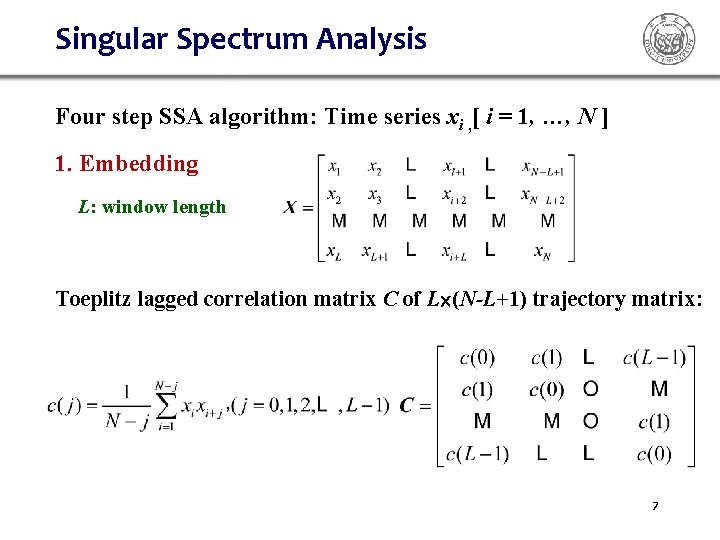
Singular Spectrum Analysis Four step SSA algorithm: Time series xi , [ i = 1, …, N ] 1. Embedding L: window length Toeplitz lagged correlation matrix C of L (N-L+1) trajectory matrix: 7
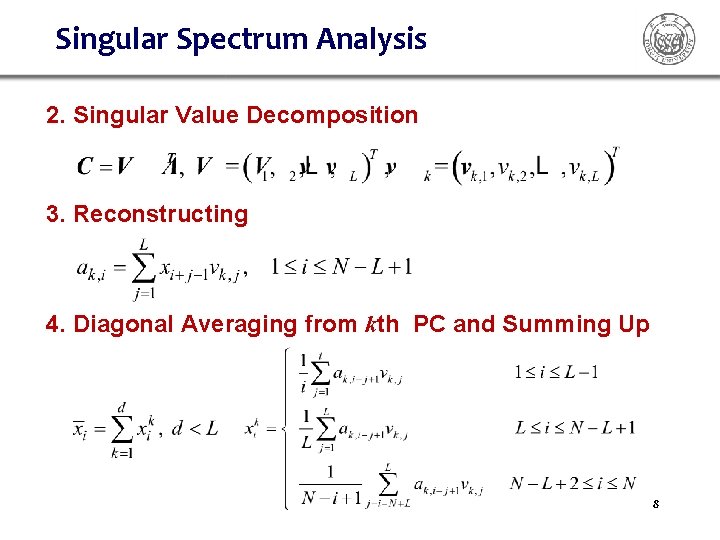
Singular Spectrum Analysis 2. Singular Value Decomposition 3. Reconstructing 4. Diagonal Averaging from kth PC and Summing Up 8
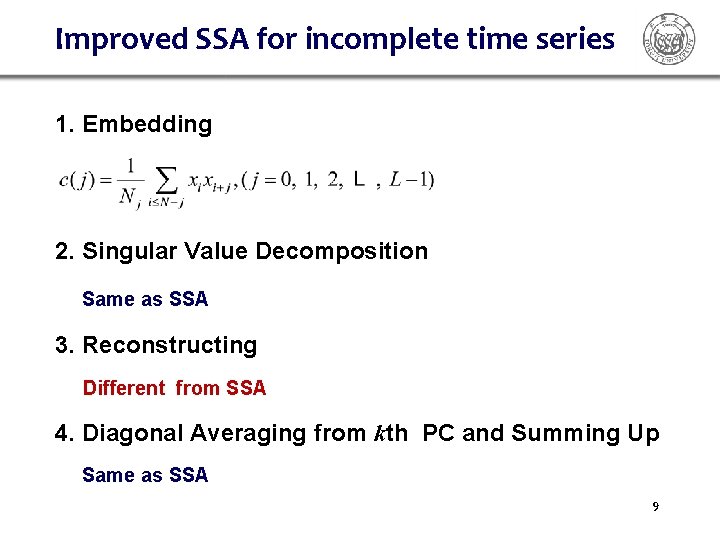
Improved SSA for incomplete time series 1. Embedding 2. Singular Value Decomposition Same as SSA 3. Reconstructing Different from SSA 4. Diagonal Averaging from kth PC and Summing Up Same as SSA 9
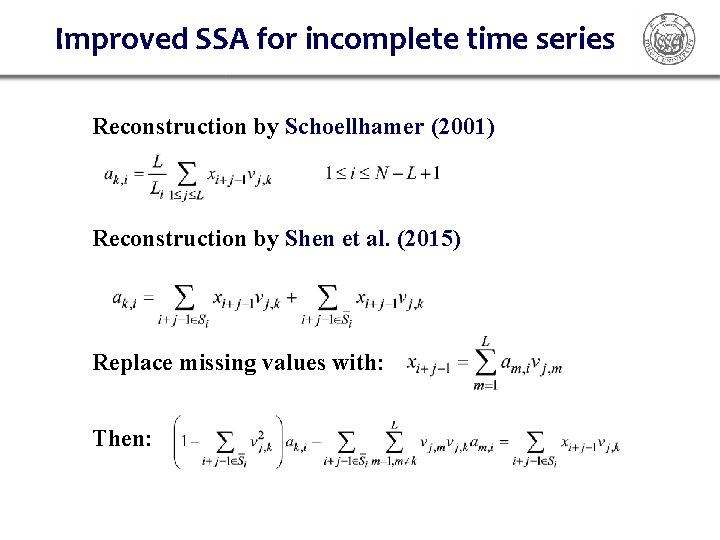
Improved SSA for incomplete time series Reconstruction by Schoellhamer (2001) Reconstruction by Shen et al. (2015) Replace missing values with: Then:
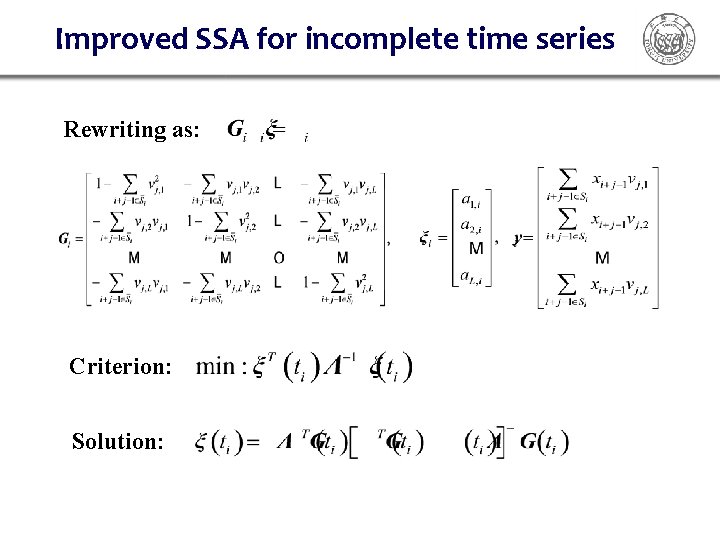
Improved SSA for incomplete time series Rewriting as: Criterion: Solution:
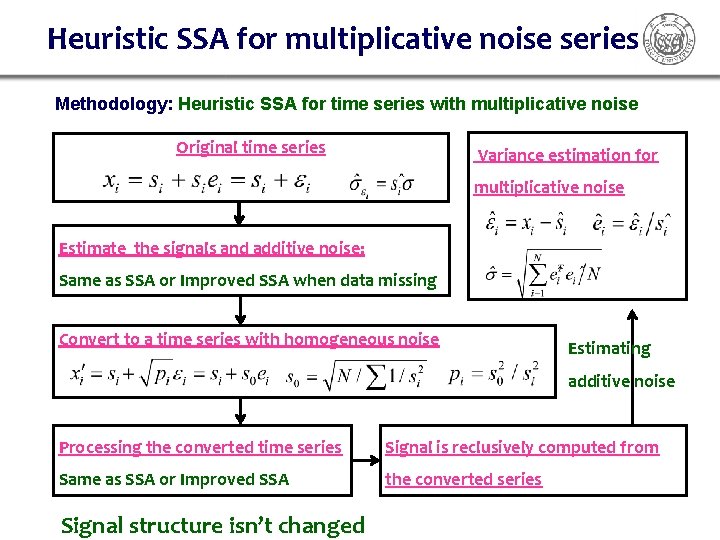
Heuristic SSA for multiplicative noise series Methodology: Heuristic SSA for time series with multiplicative noise Original time series Variance estimation for multiplicative noise Estimate the signals and additive noise: Same as SSA or Improved SSA when data missing Convert to a time series with homogeneous noise Estimating additive noise Processing the converted time series Signal is reclusively computed from Same as SSA or Improved SSA the converted series Signal structure isn’t changed
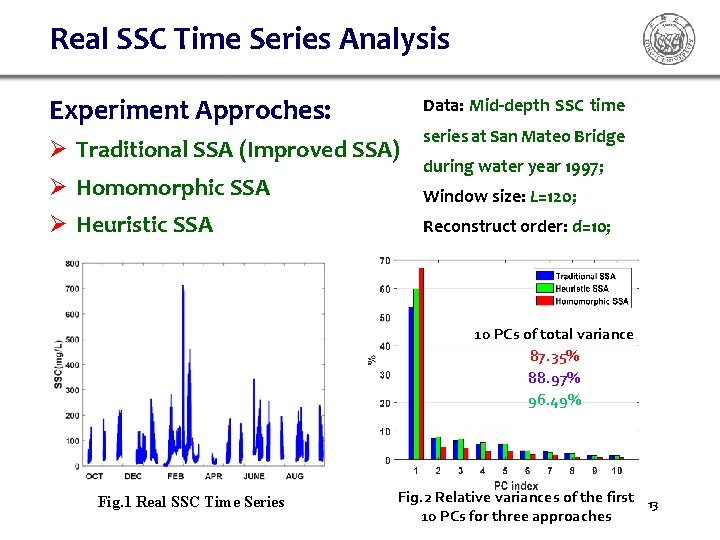
Real SSC Time Series Analysis Experiment Approches: Data: Mid-depth SSC time Ø Traditional SSA (Improved SSA) Ø Homomorphic SSA Ø Heuristic SSA series at San Mateo Bridge during water year 1997; Window size: L=120; Reconstruct order: d=10; 10 PCs of total variance 87. 35% 88. 97% 96. 49% Fig. 1 Real SSC Time Series Fig. 2 Relative variances of the first 13 10 PCs for three approaches
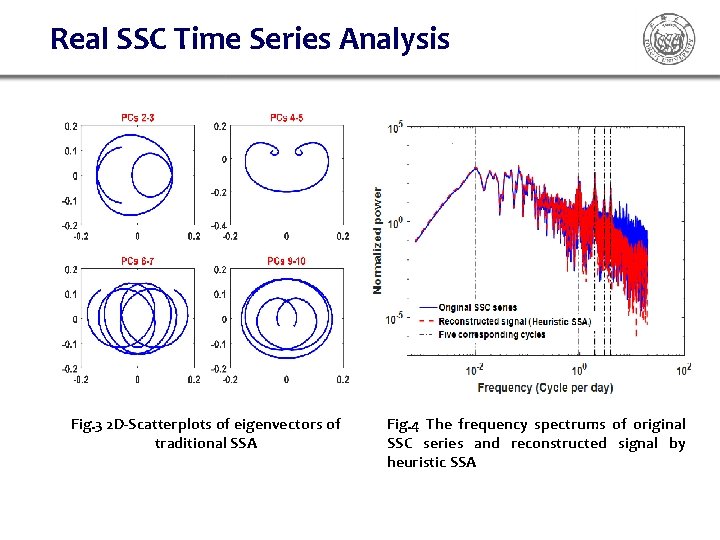
Real SSC Time Series Analysis Fig. 3 2 D-Scatterplots of eigenvectors of traditional SSA Fig. 4 The frequency spectrums of original SSC series and reconstructed signal by heuristic SSA
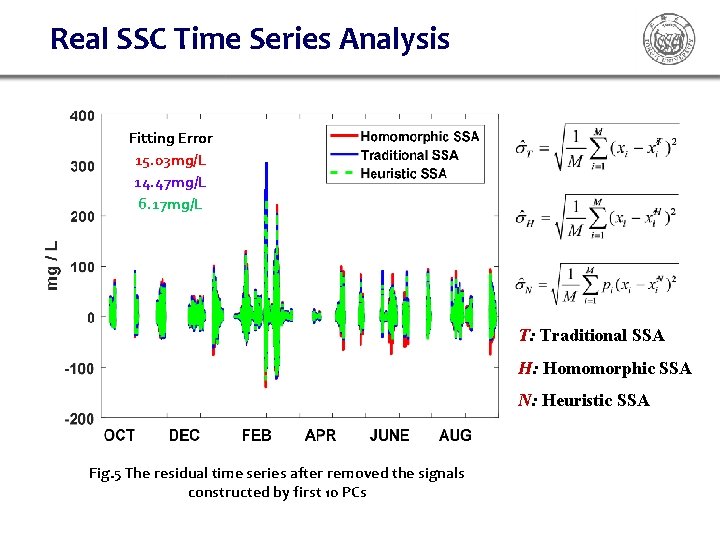
Real SSC Time Series Analysis Fitting Error 15. 03 mg/L 14. 47 mg/L 6. 17 mg/L T: Traditional SSA H: Homomorphic SSA N: Heuristic SSA Fig. 5 The residual time series after removed the signals constructed by first 10 PCs
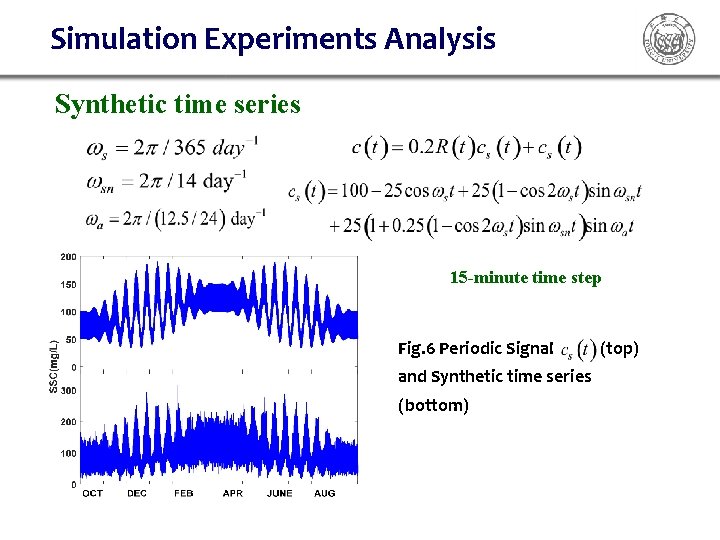
Simulation Experiments Analysis Synthetic time series 15 -minute time step Fig. 6 Periodic Signal and Synthetic time series (bottom) (top)
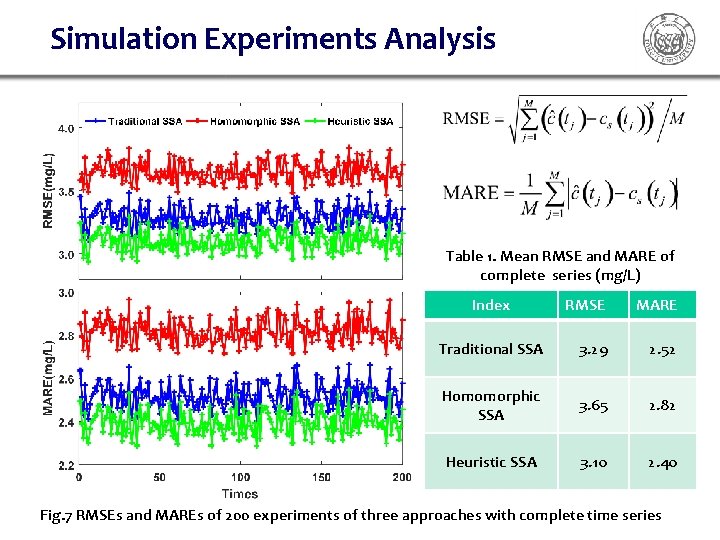
Simulation Experiments Analysis Table 1. Mean RMSE and MARE of complete series (mg/L) Index RMSE MARE Traditional SSA 3. 29 2. 52 Homomorphic SSA 3. 65 2. 82 Heuristic SSA 3. 10 2. 40 Fig. 7 RMSEs and MAREs of 200 experiments of three approaches with complete time series
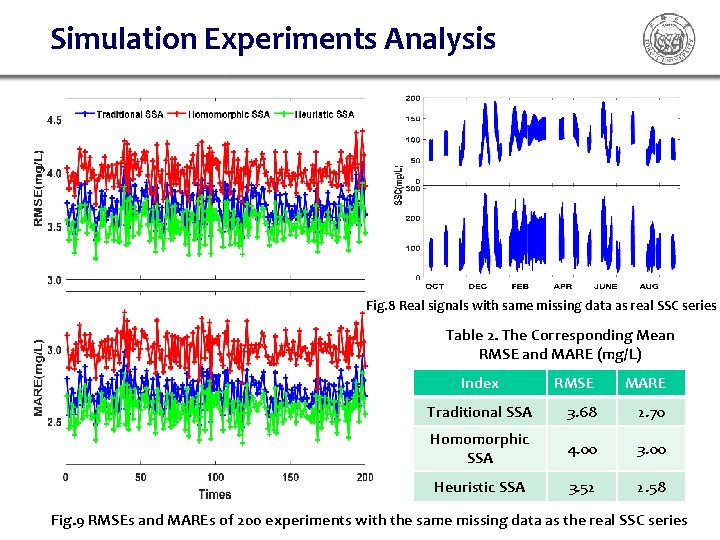
Simulation Experiments Analysis Fig. 8 Real signals with same missing data as real SSC series Table 2. The Corresponding Mean RMSE and MARE (mg/L) Index RMSE MARE Traditional SSA 3. 68 2. 70 Homomorphic SSA 4. 00 3. 00 Heuristic SSA 3. 52 2. 58 Fig. 9 RMSEs and MAREs of 200 experiments with the same missing data as the real SSC series
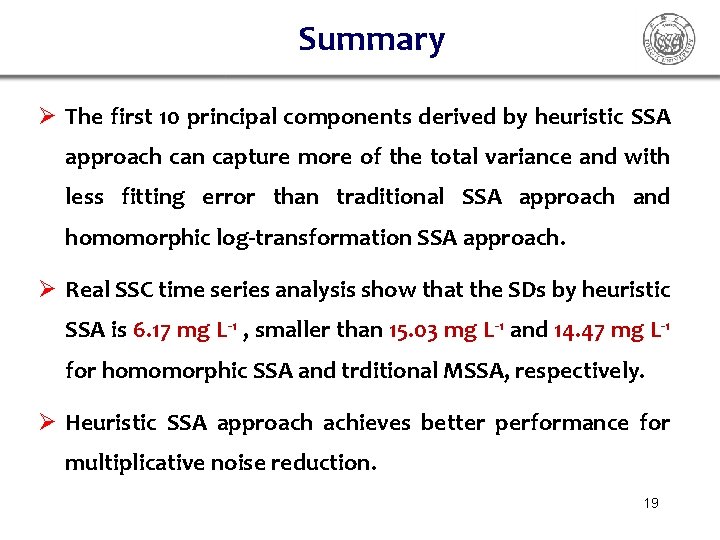
Summary Ø The first 10 principal components derived by heuristic SSA approach can capture more of the total variance and with less fitting error than traditional SSA approach and homomorphic log-transformation SSA approach. Ø Real SSC time series analysis show that the SDs by heuristic SSA is 6. 17 mg L-1 , smaller than 15. 03 mg L-1 and 14. 47 mg L-1 for homomorphic SSA and trditional MSSA, respectively. Ø Heuristic SSA approach achieves better performance for multiplicative noise reduction. 19
References Ø Schoellhamer D. H. , Singular spectrum analysis for time series with missing data, Geophys. Res. Lett. , 2001, 28(16): 3187 -3190. Ø Y. Shen, F. Peng, B. Li. Improved singular spectrum analysis for time series with missing data, Nonlinear Process of Geophysics, 2015, doi: 10. 5194/npgd 21 -1 -2014. Ø Wang F, Shen Y, Chen Q, Li W. A heuristic singular spectrum analysis method for suspended sediment concentration time series contaminated with multiplicative noise. Acta Geodaetica et Geophysic, 2019, DOI: 10. 1007/s 40328 -019 -00269 -1. Ø Kumar K, Rajesh R, Tiwari R. Regional and residual gravity anomaly separation using the singular spectrum analysis-based low pass filtering: a case study from Nagpur, Maharashtra, India. Explor Geophys, 2017, 49(3): 398 -408. doi: 10. 1071/EG 16115. Ø Barrios-Muriel J, Romero F, Alonso FJ et al. , A simple SSA-based de-noising technique to remove ECG interference in EMG signals. Biomed. Signal Proces Control, 2016, 30: 117 -126.
Thank you for your Attention !