
A new particle acceleration mechanism and the emission


- Slides: 28
A new particle acceleration mechanism and the emission from relativistic jets Juri Poutanen University of Oulu, Finland (Stern, Poutanen, 2006, MNRAS, 372, 1217; Stern, Poutanen, 2007, MNRAS, submitted, astroph/0709. 3043) 1
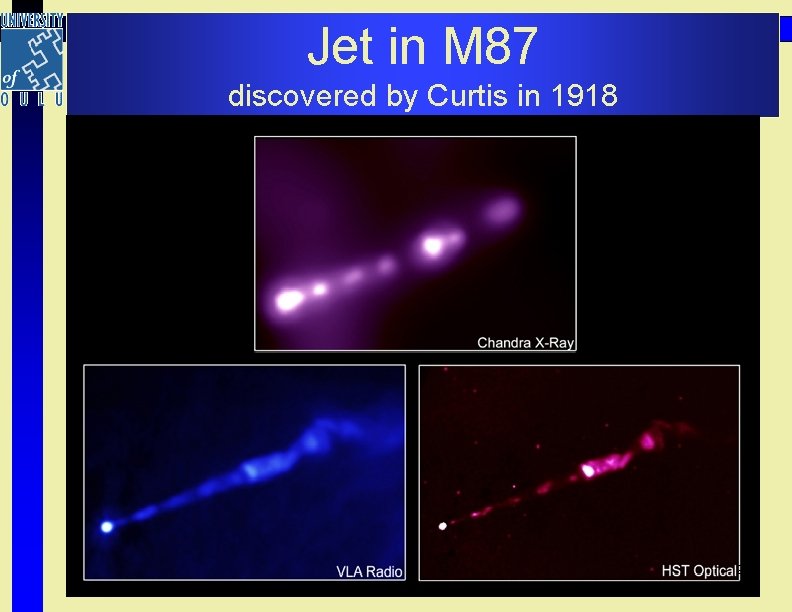
Jet in M 87 discovered by Curtis in 1918 2
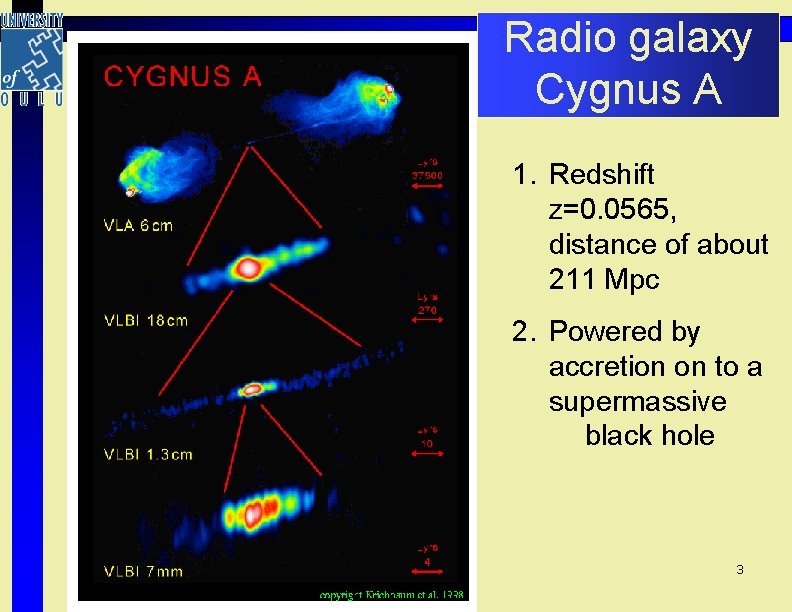
Radio galaxy Cygnus A 1. Redshift z=0. 0565, distance of about 211 Mpc 2. Powered by accretion on to a supermassive black hole 3
Blazar 3 C 120 2 -20 ke. V X-rays Marscher A. et al. , 2002 4
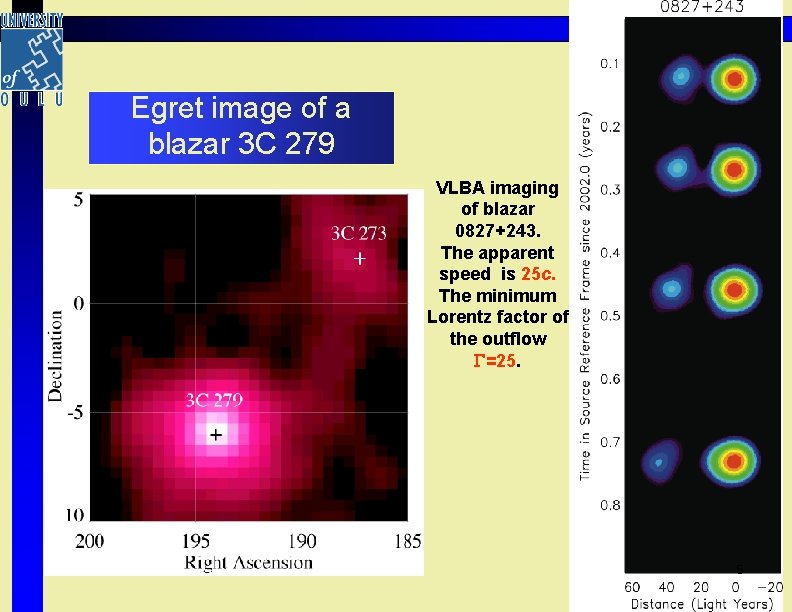
Egret image of a blazar 3 C 279 VLBA imaging of blazar 0827+243. The apparent speed is 25 c. The minimum Lorentz factor of the outflow =25. 5
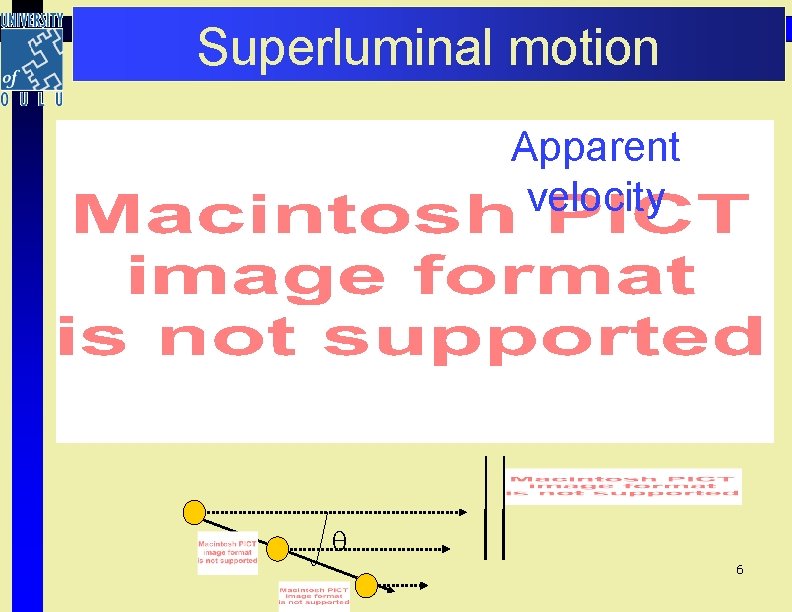
Superluminal motion Apparent velocity 6
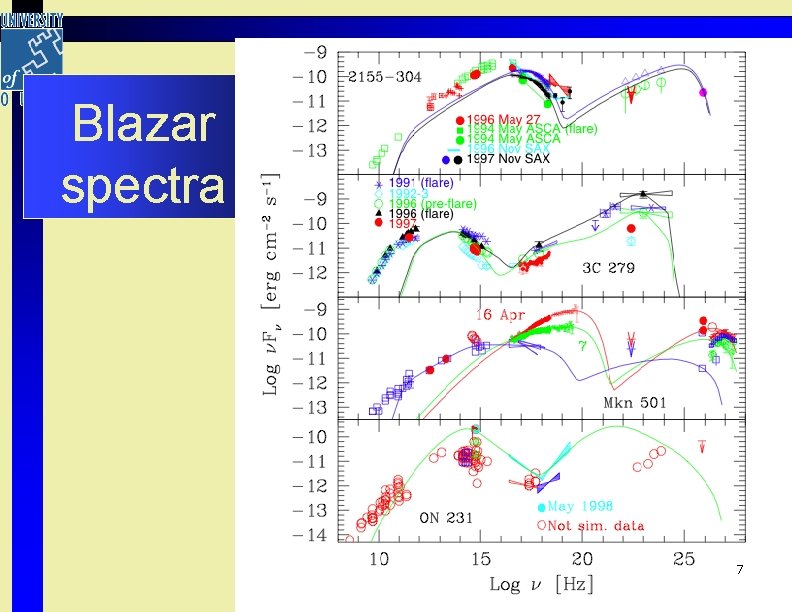
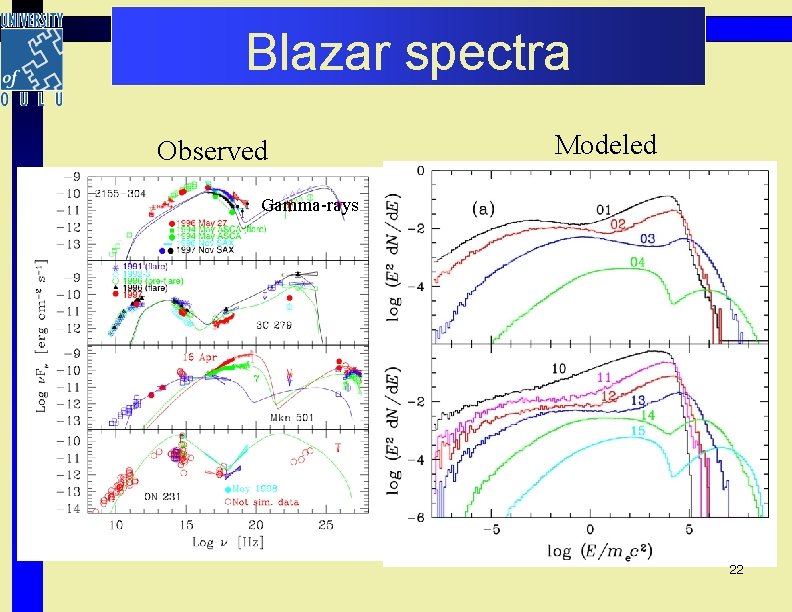
Blazar spectra 7
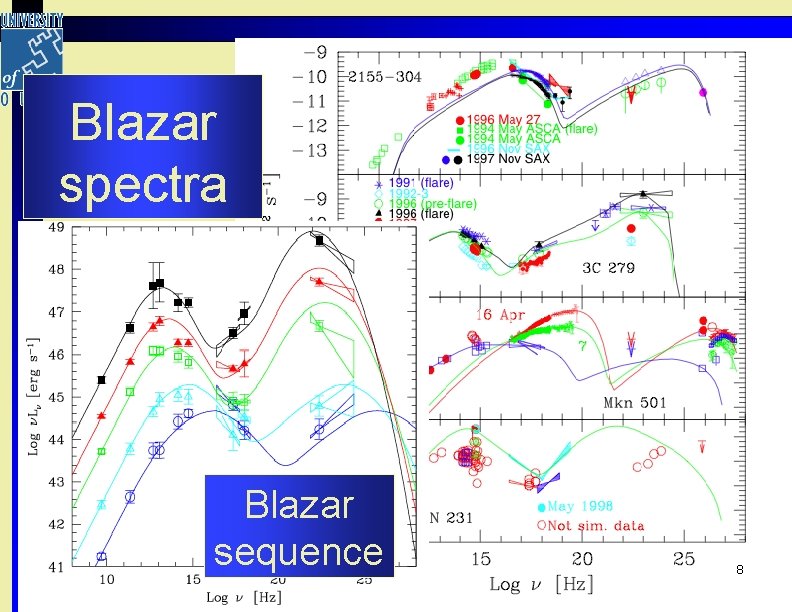
Blazar spectra Blazar sequence 8
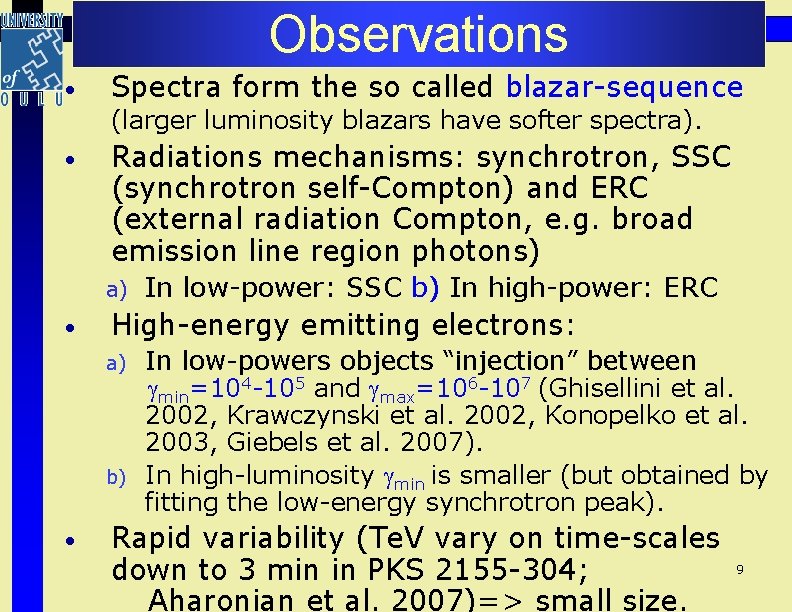
Observations • Spectra form the so called blazar-sequence (larger luminosity blazars have softer spectra). • Radiations mechanisms: synchrotron, SSC (synchrotron self-Compton) and ERC (external radiation Compton, e. g. broad emission line region photons) a) • High-energy emitting electrons: a) b) • In low-power: SSC b) In high-power: ERC In low-powers objects “injection” between min=104 -105 and max=106 -107 (Ghisellini et al. 2002, Krawczynski et al. 2002, Konopelko et al. 2003, Giebels et al. 2007). In high-luminosity min is smaller (but obtained by fitting the low-energy synchrotron peak). Rapid variability (Te. V vary on time-scales down to 3 min in PKS 2155 -304; Aharonian et al. 2007)=> small size. 9
Questions • Energy dissipation site? Broad-line region? Dusty torus? Vicinity of the accretion disk? • • • What is the initial jet composition: Poynting flux, e–-p, or e–-e+ ? What is the composition in the active region? Energy dissipation mechanism? Jet power? Dissipation efficiency? Acceleration mechanism of high-energy electrons emitting gamma-rays? 10
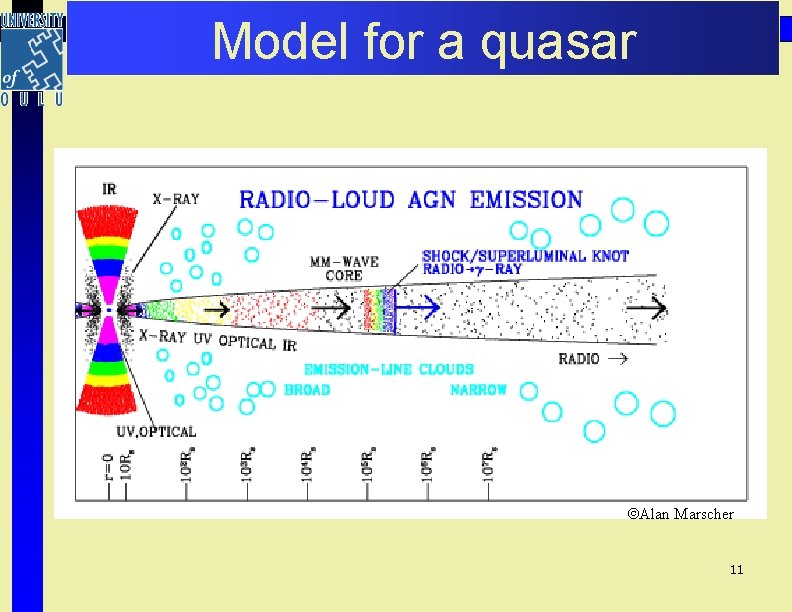
Model for a quasar Alan Marscher 11
Models • • Internal shocks within the outflow: low efficiency (dissipation of internal energy), unless large amplitude oscillations of Lorentz factors are invoked (Beloborodov 2000). Shear flow/relativistic shock models: a) b) c) • assume some particle scattering law particle acceleration If instead reasonable magnetic fluctuation are assumed there is no particle acceleration (Niemiec & Ostrowski 2006). Self-consistent computations of magnetic fields in relativistic magnetized flows no particle acceleration (Spitkovsky). Magnetic reconnection in magnetically dominated flow? No viable model from first principles yet. 12
Doppler factor (Delta)-crisis • • • Doppler factors determined from Te. V blazars ~20 -50. Apparent velocities at parsec scales in Mrk 421, Mrk 501 are other Te. V blazars are mildly relativistic (Marscher 1999; Piner & Edwards 2004, 2005). Unification (source statistics and luminosity ratio) of FR I with BL Lacs requires ~4÷ 6 (for the blob and steady jet, respectively). Te. V emission observed in (off-axis) radio galaxy M 87 contradicts strong beaming models (predicts huge beamed luminosity). SOLUTIONS: o o o Assume decelerating jet (Georganopoulos & Kazanas 2003) Assume structured jet (fast spine - slow sheath) (Chiaberge et al. 2000, Ghisellini et al. 2005) Assume large opening angle jet (Gopal-Krishna et al. 2004). 13
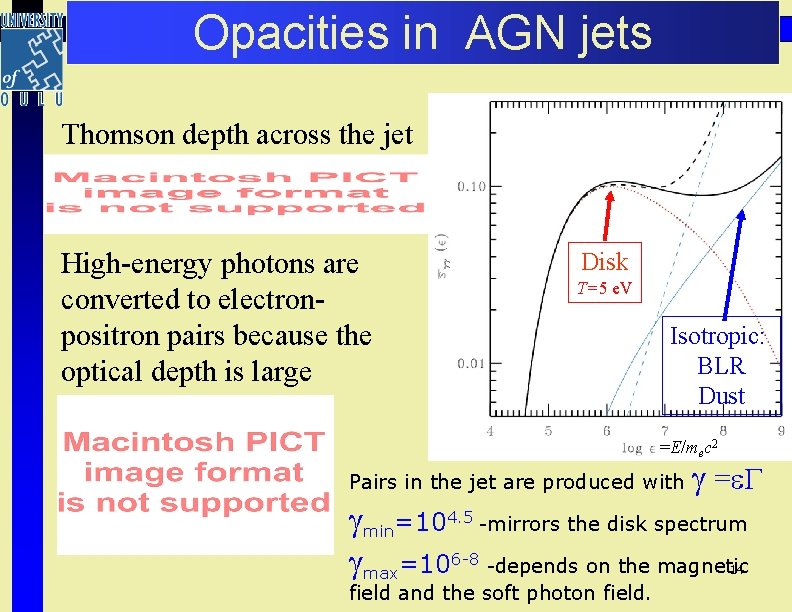
Opacities in AGN jets Thomson depth across the jet is High-energy photons are converted to electronpositron pairs because the optical depth is large Disk T=5 e. V Isotropic: BLR Dust =E/mec 2 Pairs in the jet are produced with = min=104. 5 -mirrors the disk spectrum max=106 -8 -depends on the magnetic 14 field and the soft photon field.
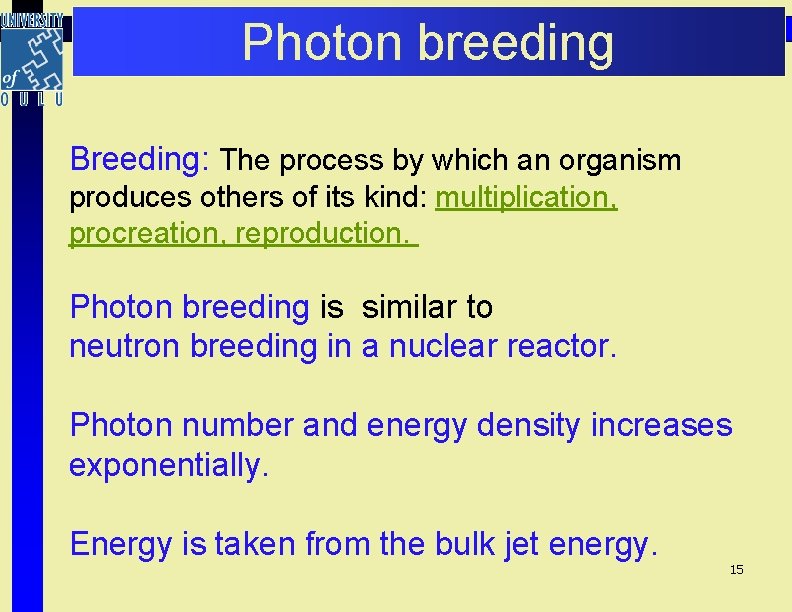
Photon breeding Breeding: The process by which an organism produces others of its kind: multiplication, procreation, reproduction. Photon breeding is similar to neutron breeding in a nuclear reactor. Photon number and energy density increases exponentially. Energy is taken from the bulk jet energy. 15
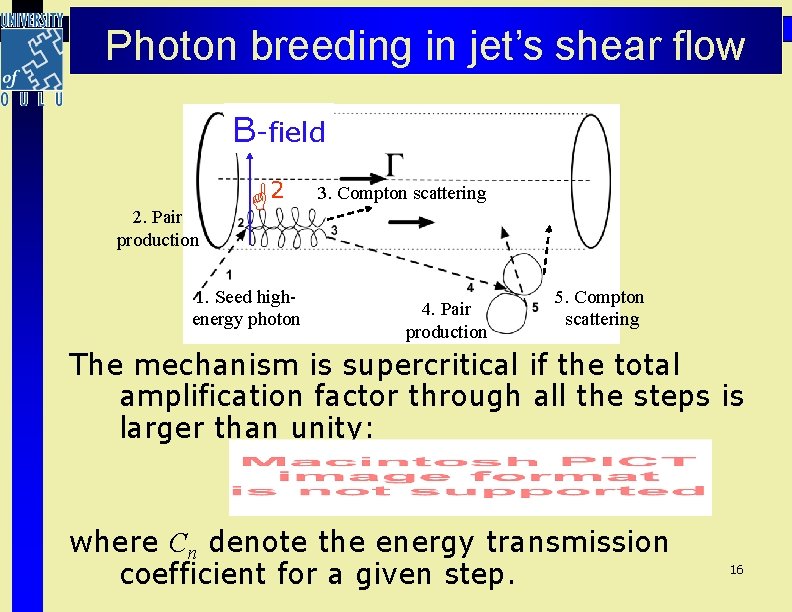
Photon breeding in jet’s shear flow B-field 2. Pair production 2 1. Seed highenergy photon 3. Compton scattering 4. Pair production 5. Compton scattering The mechanism is supercritical if the total amplification factor through all the steps is larger than unity: where Cn denote the energy transmission coefficient for a given step. 16
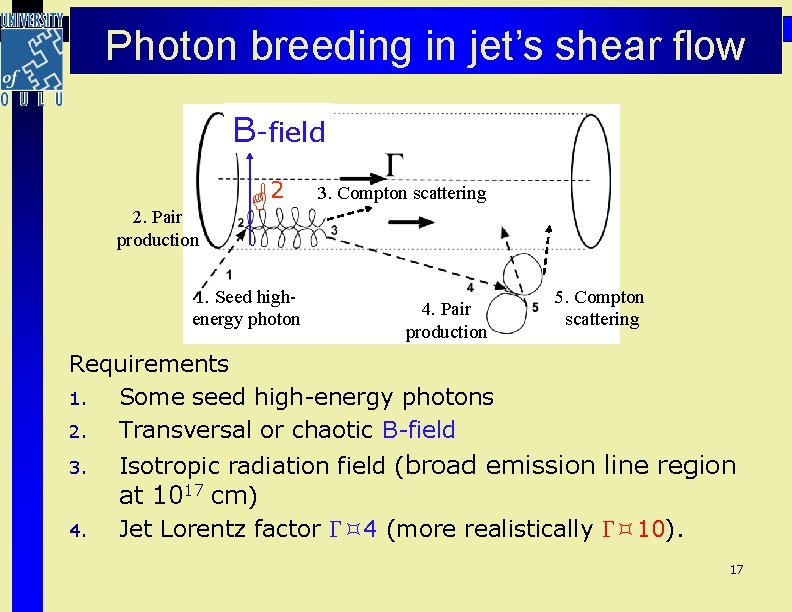
Photon breeding in jet’s shear flow B-field 2. Pair production 2 1. Seed highenergy photon 3. Compton scattering 4. Pair production 5. Compton scattering Requirements 1. Some seed high-energy photons 2. Transversal or chaotic B-field 3. 4. Isotropic radiation field (broad emission line region at 1017 cm) Jet Lorentz factor 4 (more realistically 10). 17
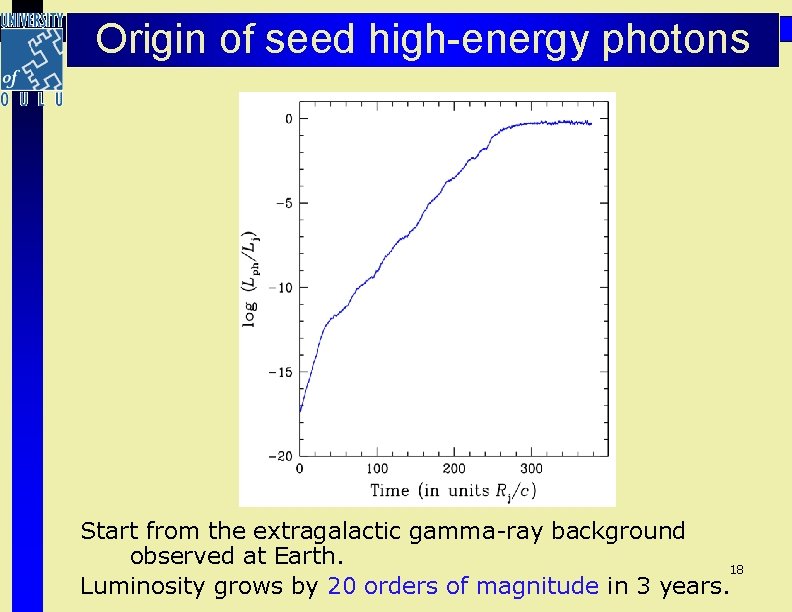
Origin of seed high-energy photons Start from the extragalactic gamma-ray background observed at Earth. 18 Luminosity grows by 20 orders of magnitude in 3 years.
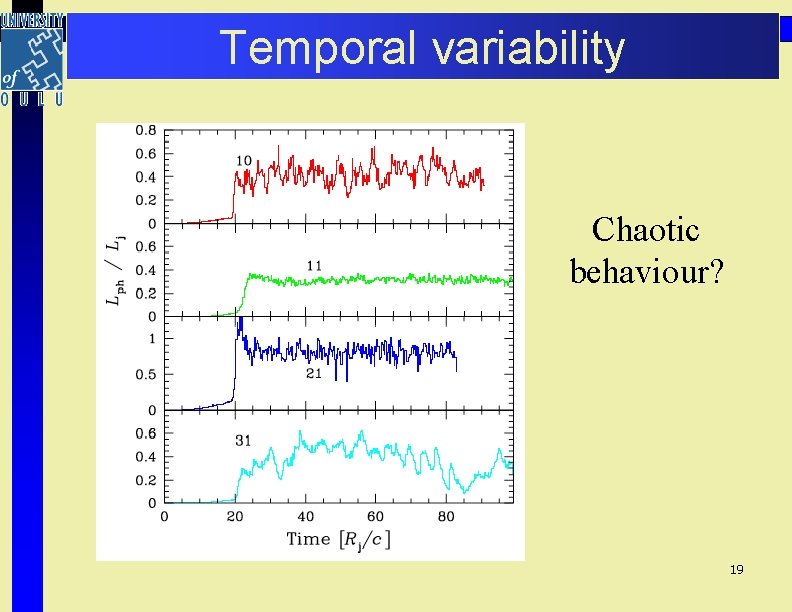
Temporal variability Chaotic behaviour? 19
Gamma-ray emission sites • Internal shock model “predicts” distances How to predict R 0? • 1. 2. 3. 4. 5. Photon breeding needs soft (isotropic) photon background. Near the accretion disk (if the jet is already accelerated with 10) Broad emission line region at 1017 cm. Dusty torus at parsec scale (if still 10). Stellar radiation at kpc scale (if 10). Cosmic microwave background at 100 kpc scale (if 10). 20
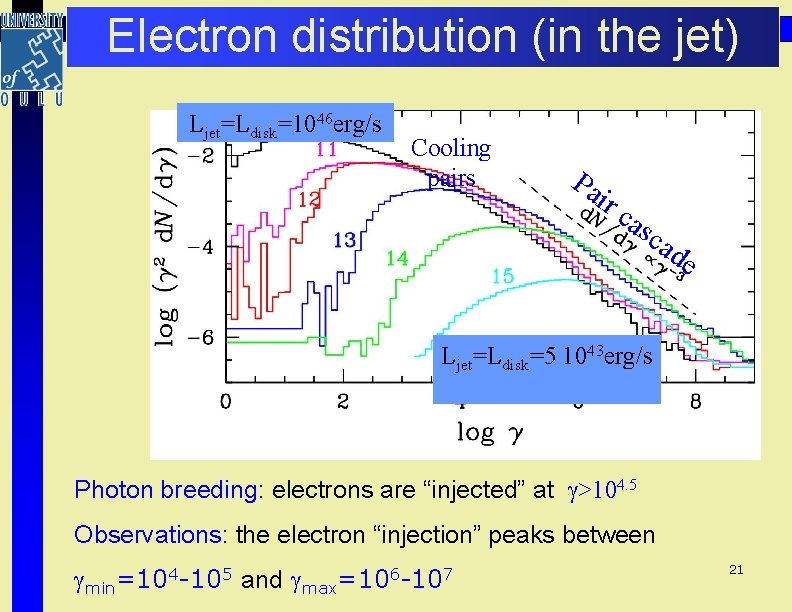
Electron distribution (in the jet) Ljet=Ldisk=1046 erg/s Cooling pairs Ldisk=1044 erg/s Pa ir ca sc ad e Ljet=Ldisk=5 1043 erg/s Photon breeding: electrons are “injected” at >104. 5 Observations: the electron “injection” peaks between min=104 -105 and max=106 -107 21
Blazar spectra Observed Modeled Gamma-rays 22
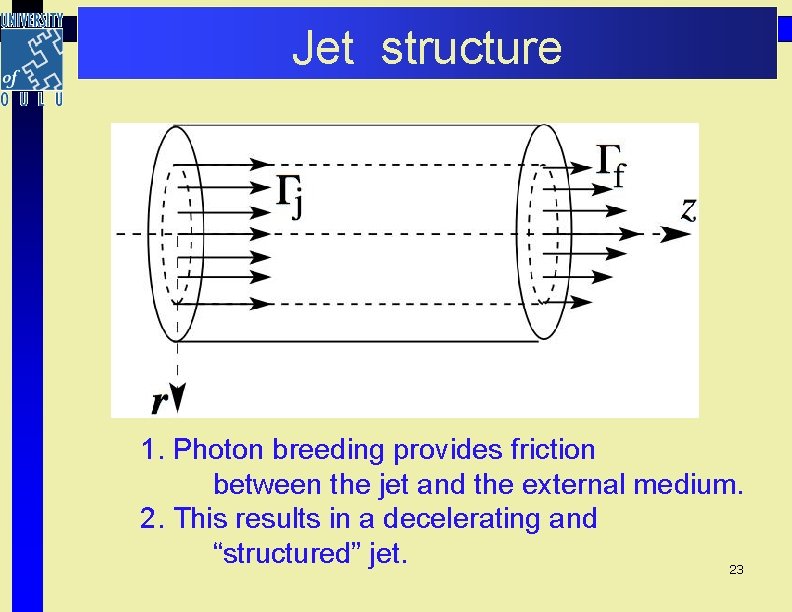
Jet structure 1. Photon breeding provides friction between the jet and the external medium. 2. This results in a decelerating and “structured” jet. 23
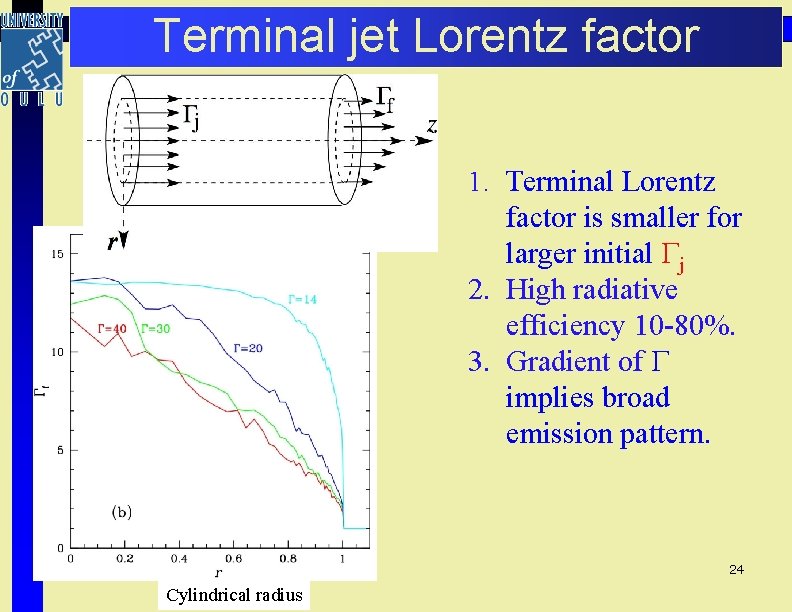
Terminal jet Lorentz factor 1. Terminal Lorentz factor is smaller for larger initial j 2. High radiative efficiency 10 -80%. 3. Gradient of implies broad emission pattern. 24 Cylindrical radius
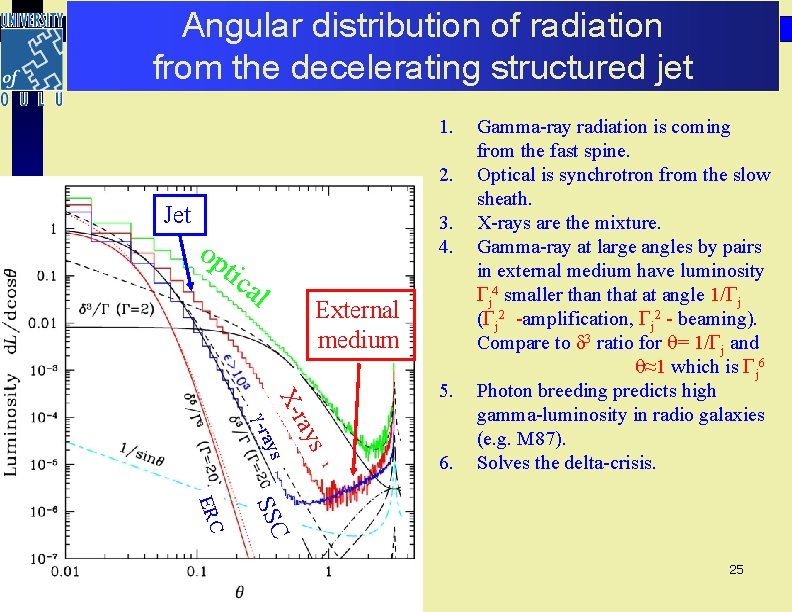
Angular distribution of radiation from the decelerating structured jet 1. 2. Jet op 3. 4. tic al External medium s ray ys -ra X- 5. 6. Gamma-ray radiation is coming from the fast spine. Optical is synchrotron from the slow sheath. X-rays are the mixture. Gamma-ray at large angles by pairs in external medium have luminosity j 4 smaller than that at angle 1/ j ( j 2 -amplification, j 2 - beaming). Compare to 3 ratio for = 1/ j and ≈1 which is j 6 Photon breeding predicts high gamma-luminosity in radio galaxies (e. g. M 87). Solves the delta-crisis. SSC ERC 25
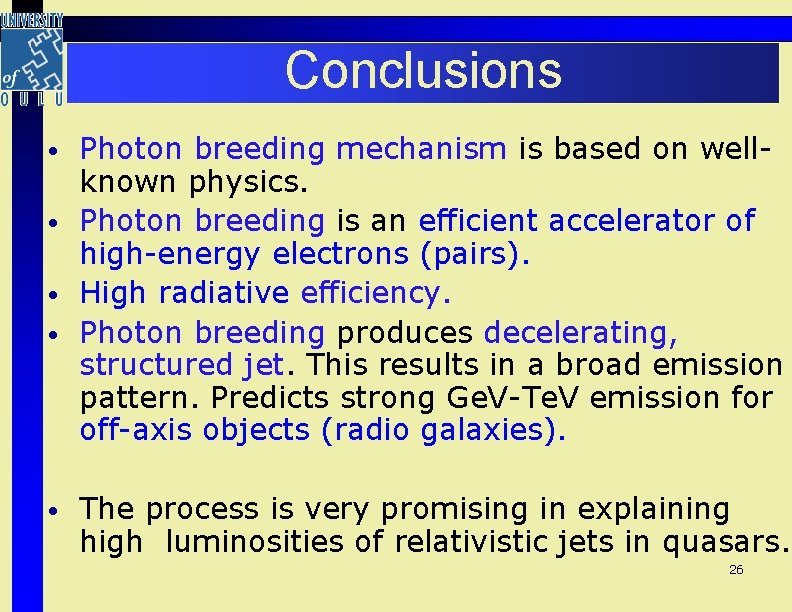
Conclusions • • • Photon breeding mechanism is based on wellknown physics. Photon breeding is an efficient accelerator of high-energy electrons (pairs). High radiative efficiency. Photon breeding produces decelerating, structured jet. This results in a broad emission pattern. Predicts strong Ge. V-Te. V emission for off-axis objects (radio galaxies). The process is very promising in explaining high luminosities of relativistic jets in quasars. 26
Future Self-consistent MHD simulations of the jet acceleration by the magnetic fields near a supermassive black hole together with the jet emission. 27
Jet and accretion disk 28