
A New MultiMoment Cloud Microphysics Package for the
![1 m 3 (unit volume) [e. g. Cloud droplets] (not to scale)](https://slidetodoc.com/presentation_image_h/37842d45973ec82bdc495289f536afd0/image-13.jpg "1 m 3 (unit volume) [e. g. Cloud droplets] (not to scale)")
![101 N (D) 100 [m-3 m-1] 10 -1 10 -2 0 1 m 3](https://slidetodoc.com/presentation_image_h/37842d45973ec82bdc495289f536afd0/image-14.jpg "101 N (D) 100 [m-3 m-1] 10 -1 10 -2 0 1 m 3")
![101 N (D) 100 [m-3 m-1] 10 -1 10 -2 0 1 m 3](https://slidetodoc.com/presentation_image_h/37842d45973ec82bdc495289f536afd0/image-15.jpg "101 N (D) 100 [m-3 m-1] 10 -1 10 -2 0 1 m 3")
![Representing the size spectrum DISCRETE SIZE BINS 101 N (D) 100 [m-3 m-1] 10](https://slidetodoc.com/presentation_image_h/37842d45973ec82bdc495289f536afd0/image-16.jpg "Representing the size spectrum DISCRETE SIZE BINS 101 N (D) 100 [m-3 m-1] 10")
![Representing the size spectrum ANAYLTICAL FUNCTION 101 N (D) 100 [m-3 m-1] 10 -1](https://slidetodoc.com/presentation_image_h/37842d45973ec82bdc495289f536afd0/image-17.jpg "Representing the size spectrum ANAYLTICAL FUNCTION 101 N (D) 100 [m-3 m-1] 10 -1")
![Gamma Distribution Function: Varying l: Varying N 0: D [mm] Varying a: (l and](https://slidetodoc.com/presentation_image_h/37842d45973ec82bdc495289f536afd0/image-18.jpg "Gamma Distribution Function: Varying l: Varying N 0: D [mm] Varying a: (l and")
![Advantages of multi-moment approach: RAIN m e[ mi n] CLOUD Ti Mass Density [g](https://slidetodoc.com/presentation_image_h/37842d45973ec82bdc495289f536afd0/image-39.jpg "Advantages of multi-moment approach: RAIN m e[ mi n] CLOUD Ti Mass Density [g")
![Advantages of multi-moment approach: DRIZZLE vs. RAIN Qr Mass Content [g m-3] RAIN 0.](https://slidetodoc.com/presentation_image_h/37842d45973ec82bdc495289f536afd0/image-40.jpg "Advantages of multi-moment approach: DRIZZLE vs. RAIN Qr Mass Content [g m-3] RAIN 0.")
![SINGLE-moment scheme (SM): z [km] Q [g m-3] NT [m-3] Ze [d. BZ] Dm](https://slidetodoc.com/presentation_image_h/37842d45973ec82bdc495289f536afd0/image-43.jpg "SINGLE-moment scheme (SM): z [km] Q [g m-3] NT [m-3] Ze [d. BZ] Dm")
![DOUBLE-moment scheme, FIXED DISPERSION (a = 0): z [km] Q [g m-3] NT [m-3]](https://slidetodoc.com/presentation_image_h/37842d45973ec82bdc495289f536afd0/image-44.jpg "DOUBLE-moment scheme, FIXED DISPERSION (a = 0): z [km] Q [g m-3] NT [m-3]")
![DOUBLE-moment scheme, DIAGNOSTIC DISPERSION, a = f (Dm): z [km] Q [g m-3] NT](https://slidetodoc.com/presentation_image_h/37842d45973ec82bdc495289f536afd0/image-45.jpg "DOUBLE-moment scheme, DIAGNOSTIC DISPERSION, a = f (Dm): z [km] Q [g m-3] NT")
![TRIPLE-moment scheme: z [km] Q [g m-3] NT [m-3] Ze [d. BZ] Dm [mm]](https://slidetodoc.com/presentation_image_h/37842d45973ec82bdc495289f536afd0/image-46.jpg "TRIPLE-moment scheme: z [km] Q [g m-3] NT [m-3] Ze [d. BZ] Dm [mm]")
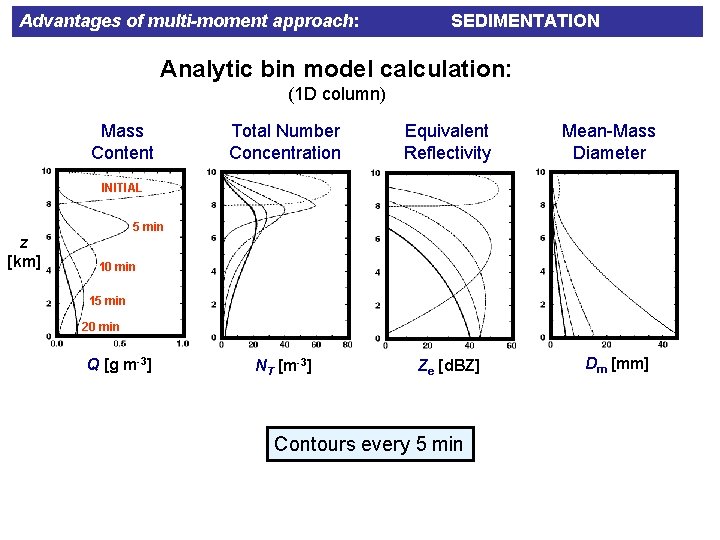
![Advantages of multi-moment approach: SEDIMENTATION INITIAL Analytic model: Mass Content 5 min z [km]](https://slidetodoc.com/presentation_image_h/37842d45973ec82bdc495289f536afd0/image-47.jpg "Advantages of multi-moment approach: SEDIMENTATION INITIAL Analytic model: Mass Content 5 min z [km]")

- Slides: 50
A New Multi-Moment Cloud Microphysics Package for the GEM-LAM Jason Milbrandt Recherche en Prévision Numérique [RPN] Meteorological Research Division, Environment Canada GEM Workshop, June 12, 2007
Why develop a new cloud scheme for GEM? • Computer resources increasing • High-resolution NWP grids are becoming mainstream • Important to predict cloud processes as well as possible • GEM-LAM-2. 5 has systematic problems with the precipitation forecasts
OUTLINE 1. Background on bulk schemes 2. Description of the new microphysics package 3. Some advantages of the multi-moment approach
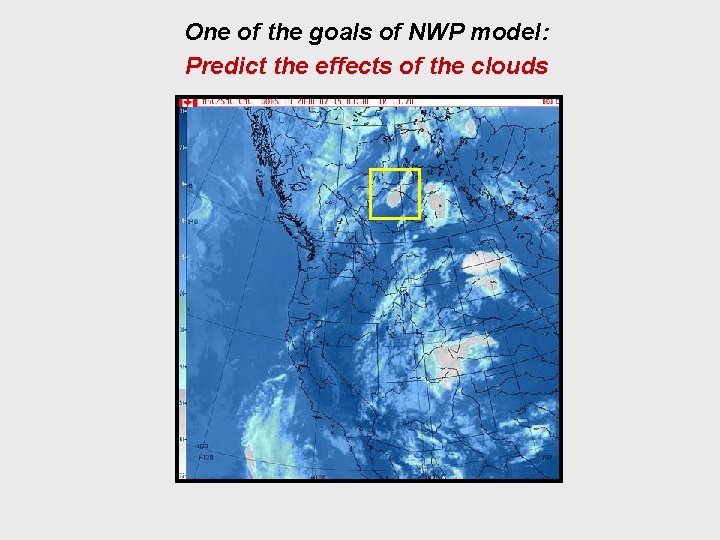
One of the goals of NWP model: Predict the effects of the clouds
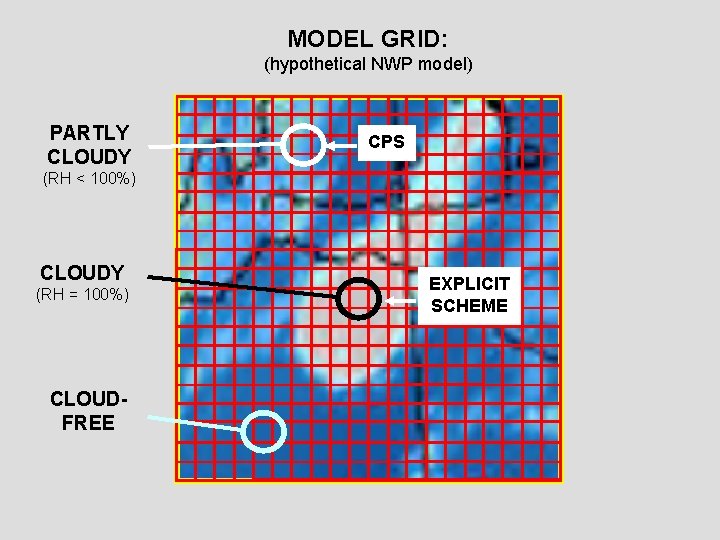
MODEL GRID: (hypothetical NWP model) PARTLY CLOUDY CPS (RH < 100%) CLOUDY (RH = 100%) CLOUDFREE EXPLICIT SCHEME
Single cloudy grid element: CLOUDY (RH = 100%) EXPLICIT SCHEME
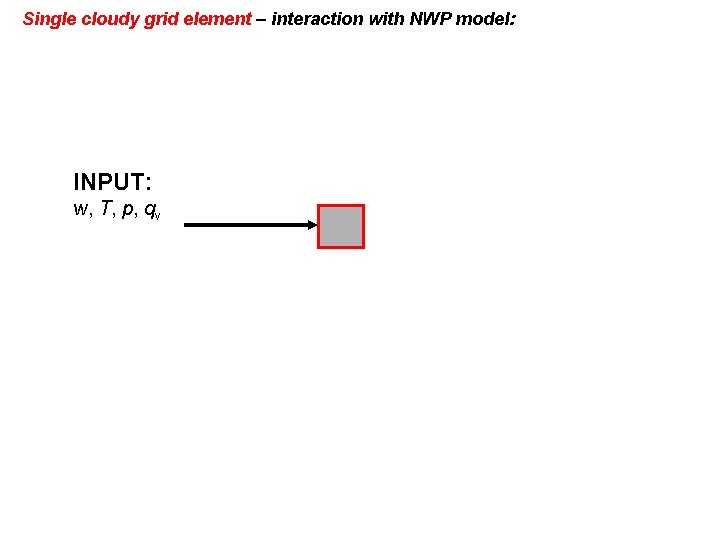
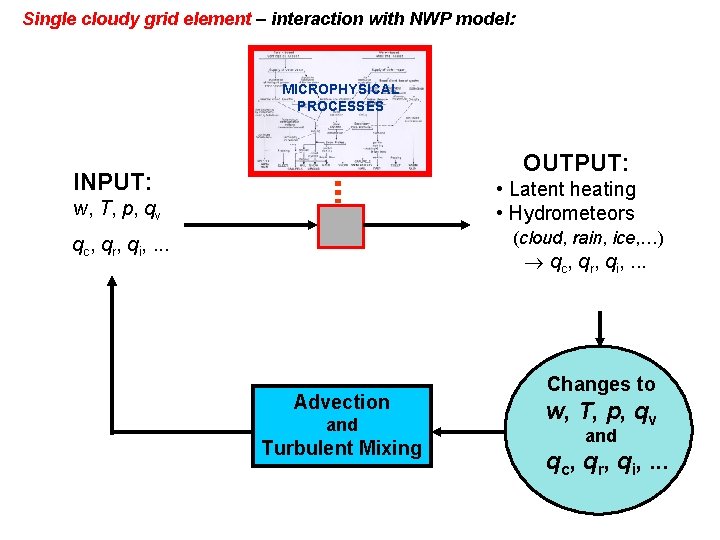
Single cloudy grid element – interaction with NWP model: INPUT: w, T, p, qv
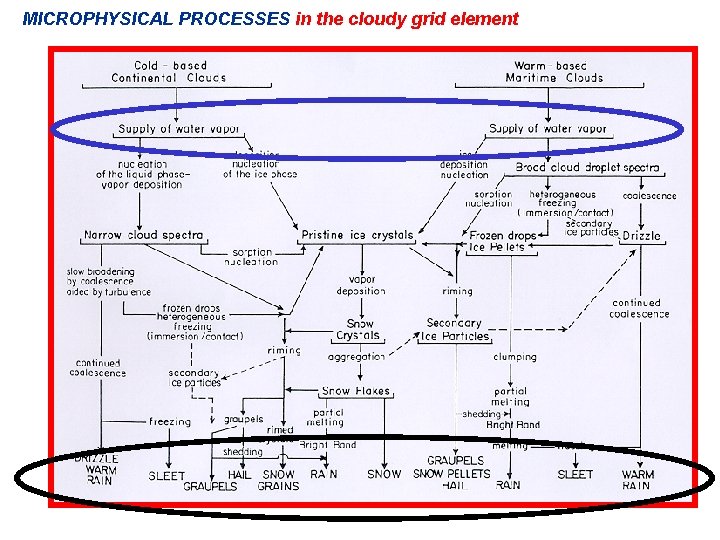
MICROPHYSICAL PROCESSES in the cloudy grid element
Single cloudy grid element – interaction with NWP model: MICROPHYSICAL PROCESSES OUTPUT: INPUT: • Latent heating • Hydrometeors w, T, p, qv (cloud, rain, ice, …) qc, qr, qi, . . . Advection and Turbulent Mixing Changes to w, T, p, qv and qc, qr, qi, . . .
Single cloudy grid element: Slight magnification = cloudy (saturated) air
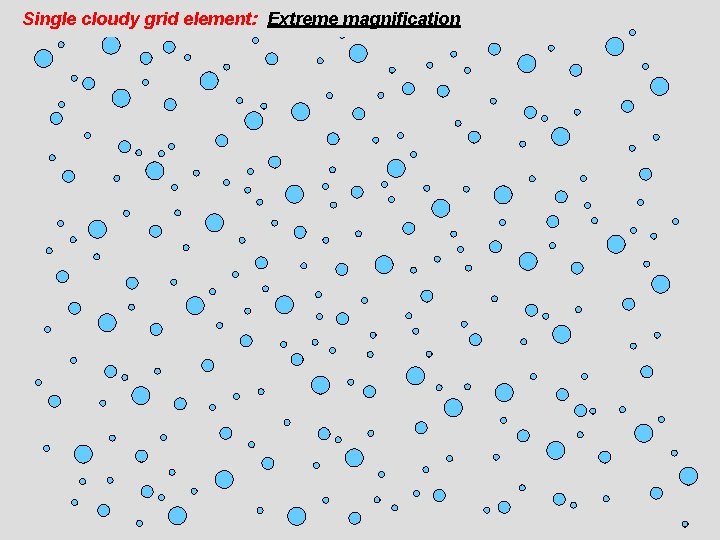
Single cloudy grid element: Extreme magnification
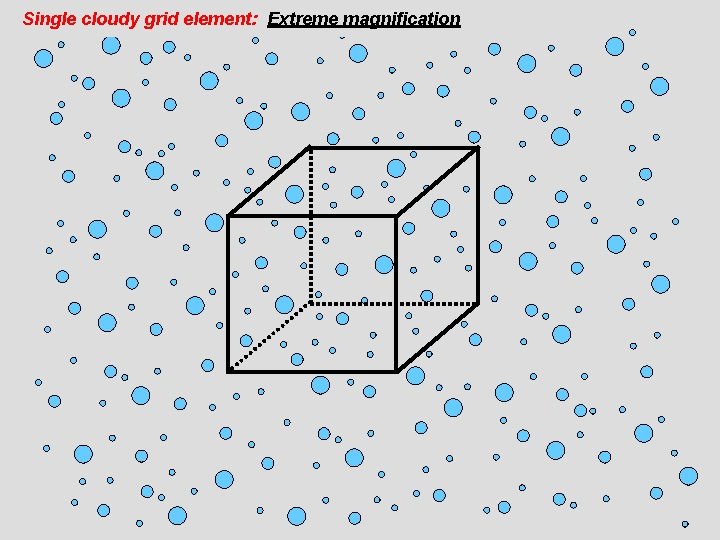
Single cloudy grid element: Extreme magnification
1 m 3 (unit volume) [e. g. Cloud droplets] (not to scale)
101 N (D) 100 [m-3 m-1] 10 -1 10 -2 0 1 m 3 (unit volume) [e. g. Cloud droplets] (not to scale) 20 40 60 D [ m] 80 100
101 N (D) 100 [m-3 m-1] 10 -1 10 -2 0 1 m 3 20 40 60 80 D [ m] (unit volume) (Example of observed [e. g. Cloud droplets] (not to scale) cloud droplet spectrum) 100
Representing the size spectrum DISCRETE SIZE BINS 101 N (D) 100 [m-3 m-1] 10 -1 10 -2 0 1 m 3 20 40 60 80 D [ m] (unit volume) [e. g. Cloud droplets] (not to scale) SPECTRAL METHOD 100
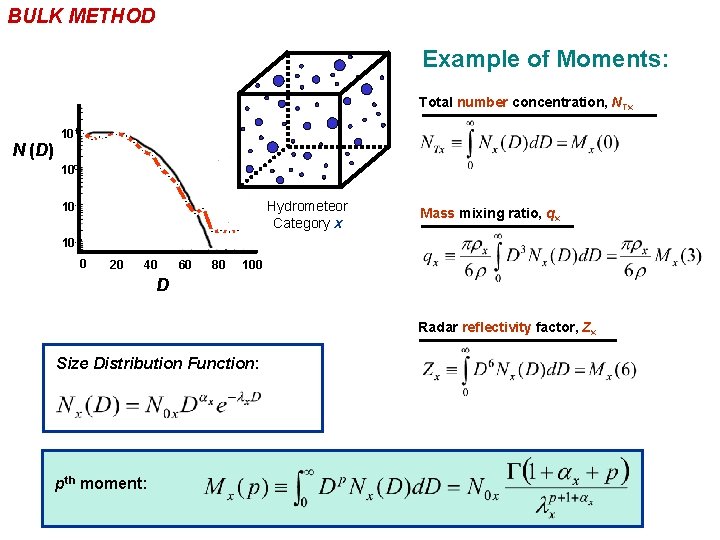
Representing the size spectrum ANAYLTICAL FUNCTION 101 N (D) 100 [m-3 m-1] 10 -1 10 -2 0 1 m 3 20 40 60 80 D [ m] (unit volume) [e. g. Cloud droplets] (not to scale) BULK METHOD 100
Gamma Distribution Function: Varying l: Varying N 0: D [mm] Varying a: (l and a constant) (Q* and N 0 constant) log N(D) (N 0 and a constant) D [mm] INCREASING VALUES (of l, N 0 and a) * Q = r q (mass content)
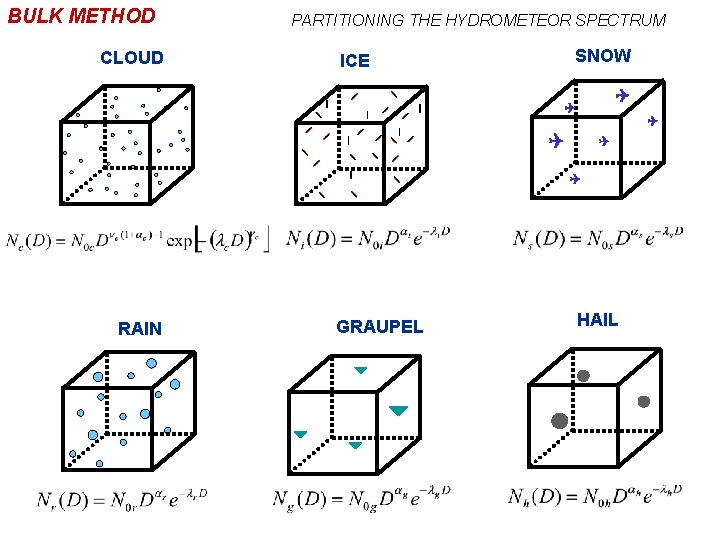
BULK METHOD Example of Moments: Total number concentration, NTx 101 N (D) 100 Hydrometeor Category x 10 -1 Mass mixing ratio, qx 10 -2 0 20 40 60 80 100 D Radar reflectivity factor, Zx Size Distribution Function: pth moment:
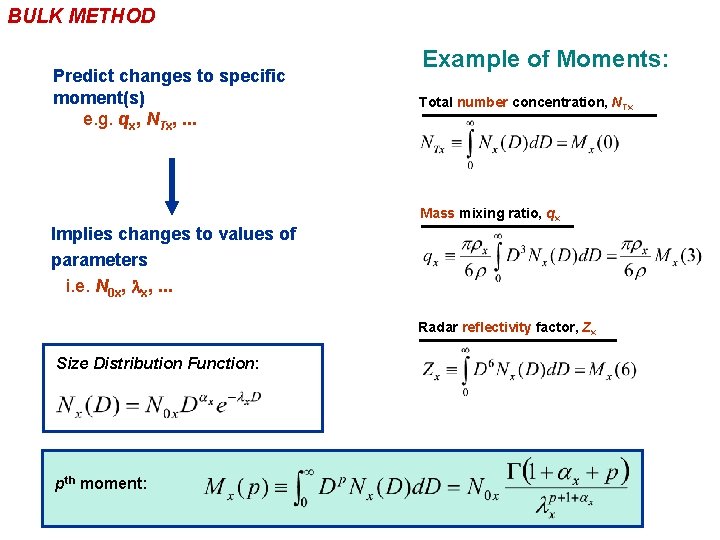
BULK METHOD Predict changes to specific moment(s) e. g. qx, NTx, . . . Example of Moments: Total number concentration, NTx Mass mixing ratio, qx Implies changes to values of parameters i. e. N 0 x, lx, . . . Radar reflectivity factor, Zx Size Distribution Function: pth moment:
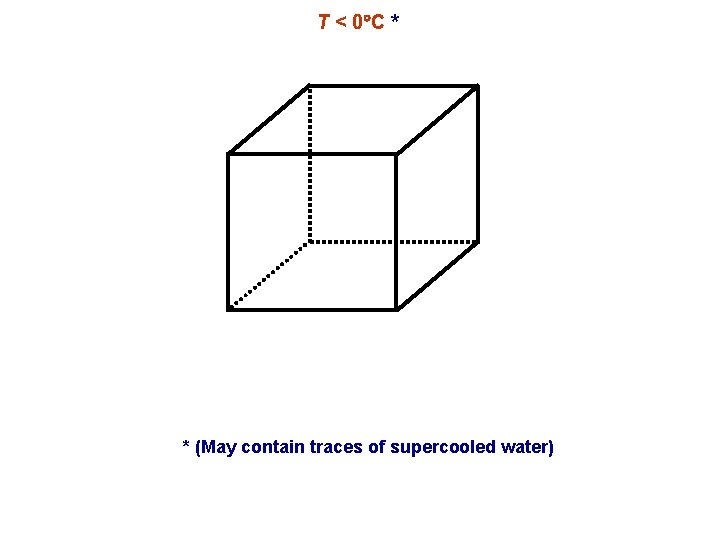
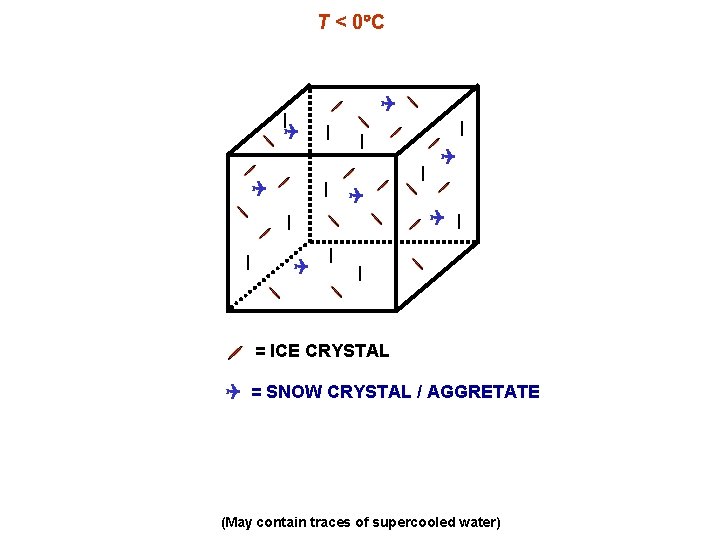
T < 0 C * * (May contain traces of supercooled water)
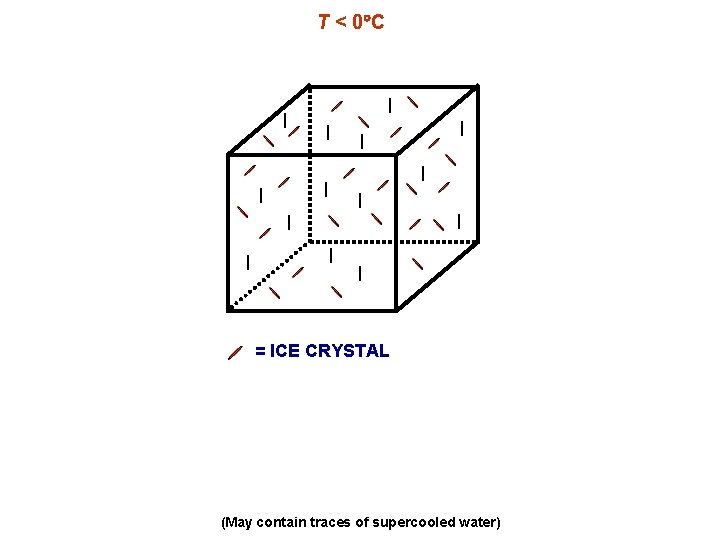
T < 0 C = ICE CRYSTAL (May contain traces of supercooled water)
T < 0 C = ICE CRYSTAL = SNOW CRYSTAL / AGGRETATE (May contain traces of supercooled water)
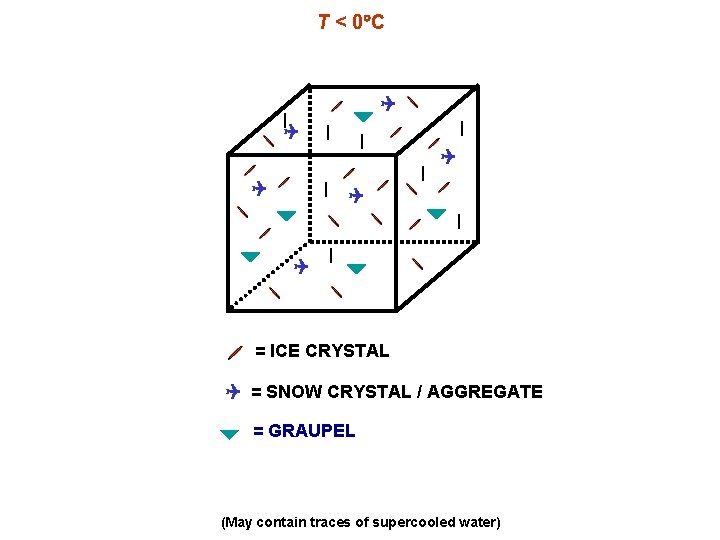
T < 0 C = ICE CRYSTAL = SNOW CRYSTAL / AGGREGATE = GRAUPEL (May contain traces of supercooled water)
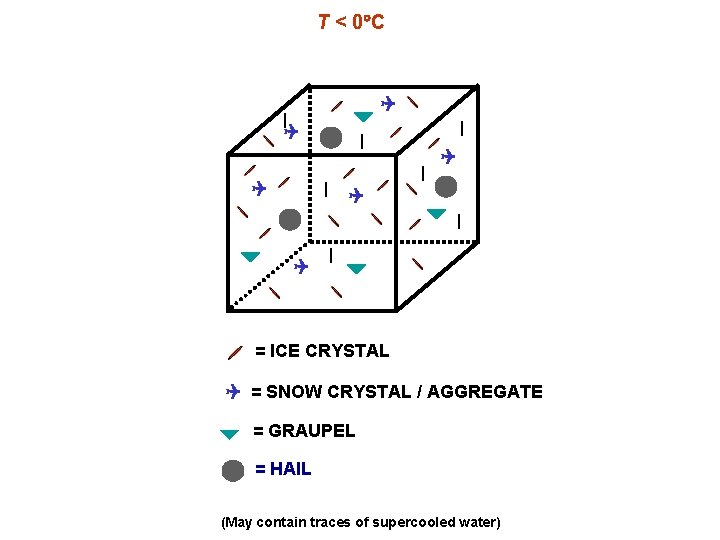
T < 0 C = ICE CRYSTAL = SNOW CRYSTAL / AGGREGATE = GRAUPEL = HAIL (May contain traces of supercooled water)
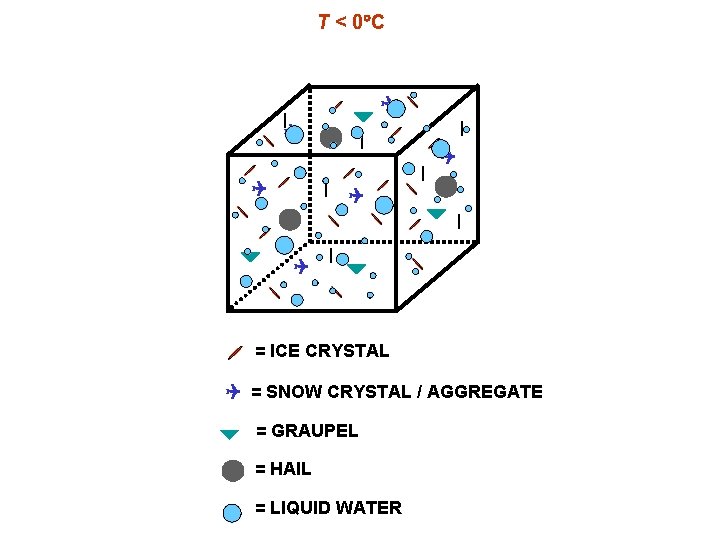
T < 0 C = ICE CRYSTAL = SNOW CRYSTAL / AGGREGATE = GRAUPEL = HAIL = LIQUID WATER
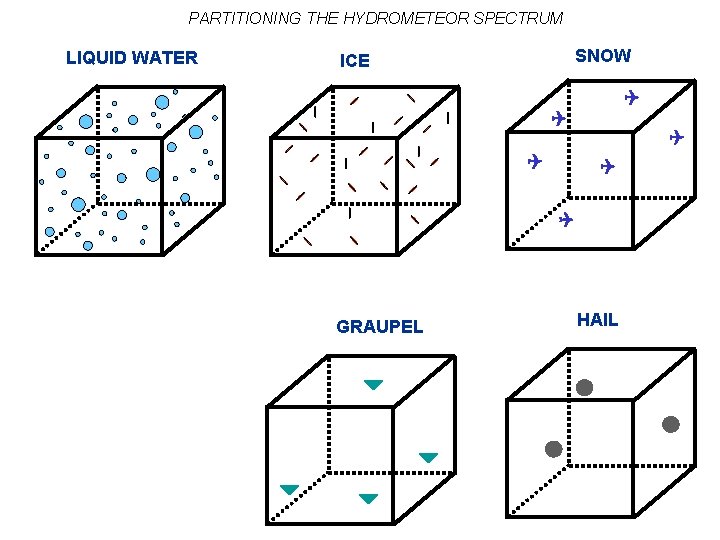
PARTITIONING THE HYDROMETEOR SPECTRUM LIQUID WATER SNOW ICE GRAUPEL HAIL
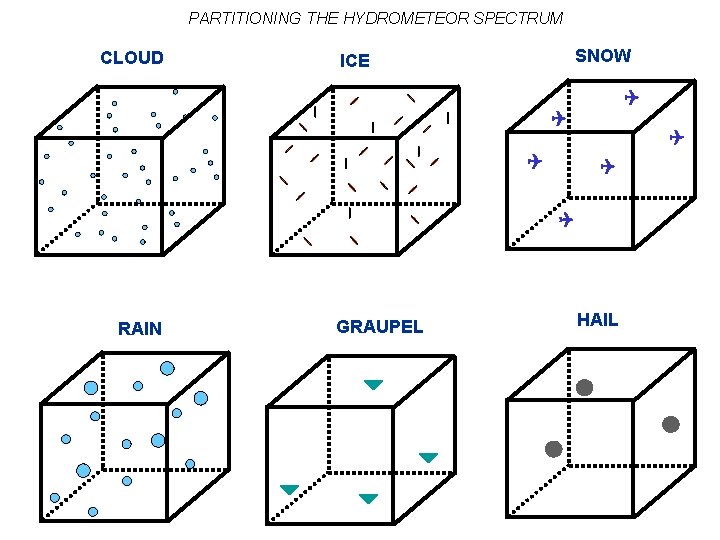
PARTITIONING THE HYDROMETEOR SPECTRUM CLOUD SNOW ICE GRAUPEL RAIN HAIL
BULK METHOD PARTITIONING THE HYDROMETEOR SPECTRUM CLOUD SNOW ICE GRAUPEL RAIN HAIL
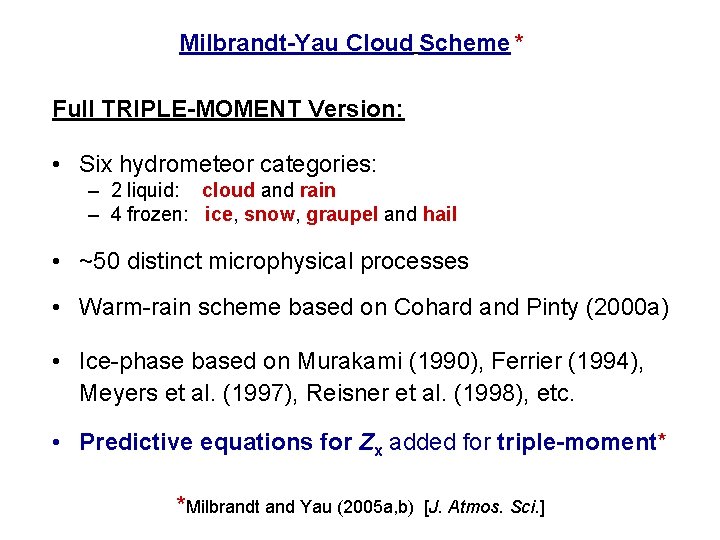
Milbrandt-Yau Cloud Scheme * Full TRIPLE-MOMENT Version: • Six hydrometeor categories: – 2 liquid: cloud and rain – 4 frozen: ice, snow, graupel and hail • ~50 distinct microphysical processes • Warm-rain scheme based on Cohard and Pinty (2000 a) • Ice-phase based on Murakami (1990), Ferrier (1994), Meyers et al. (1997), Reisner et al. (1998), etc. • Predictive equations for Zx added for triple-moment* *Milbrandt and Yau (2005 a, b) [J. Atmos. Sci. ]
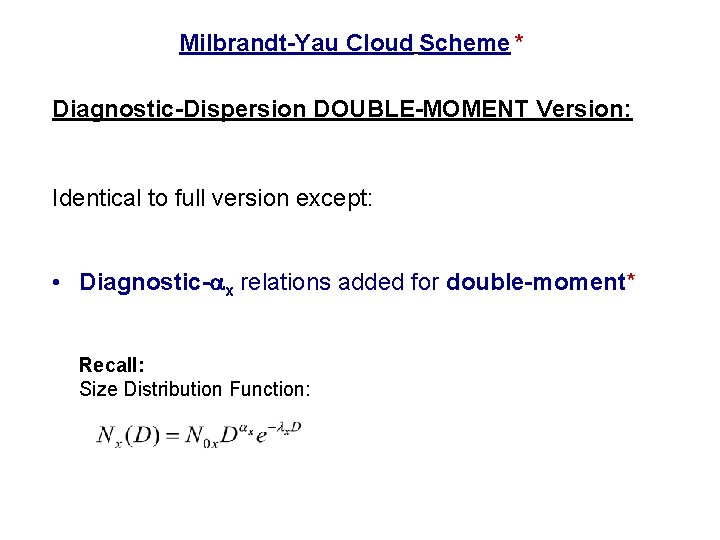
Milbrandt-Yau Cloud Scheme * Diagnostic-Dispersion DOUBLE-MOMENT Version: Identical to full version except: • Diagnostic-ax relations added for double-moment* Recall: Size Distribution Function:
Milbrandt-Yau Cloud Scheme CURRENT VERSIONS AVAILABLE FOR GEM: GEM_v 3. 2. 2 / PHY_4. 4 available upon request** GEM_v 3. 3. 0 / PHY_4. 5 part of official RPN/CMC library Single-moment version – Six hydrometeor categories – Single-moment (Qx) for each Double-moment version – Six hydrometeor categories – double-moment (Qx, , Nx) for each – fixed-ax **(also available for MC 2_v 4. 9. 8)
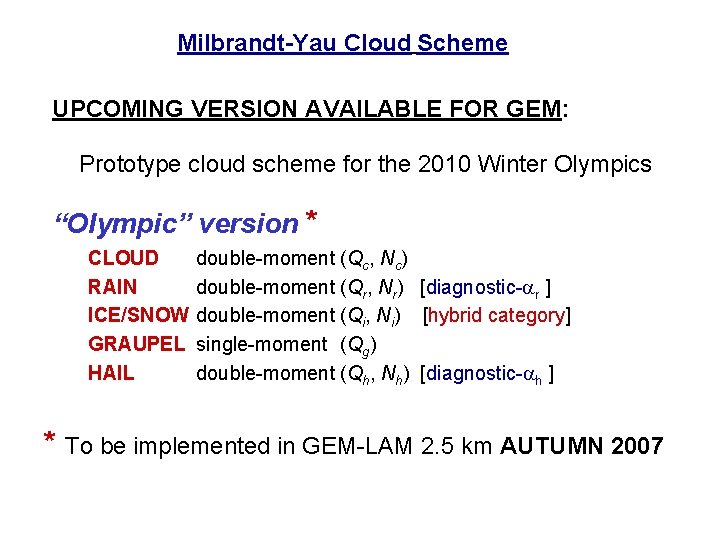
Milbrandt-Yau Cloud Scheme UPCOMING VERSION AVAILABLE FOR GEM: Prototype cloud scheme for the 2010 Winter Olympics “Olympic” version * CLOUD RAIN ICE/SNOW GRAUPEL HAIL double-moment (Qc, Nc) double-moment (Qr, Nr) [diagnostic-ar ] double-moment (Qi, Ni) [hybrid category] single-moment (Qg) double-moment (Qh, Nh) [diagnostic-ah ] * To be implemented in GEM-LAM 2. 5 km AUTUMN 2007
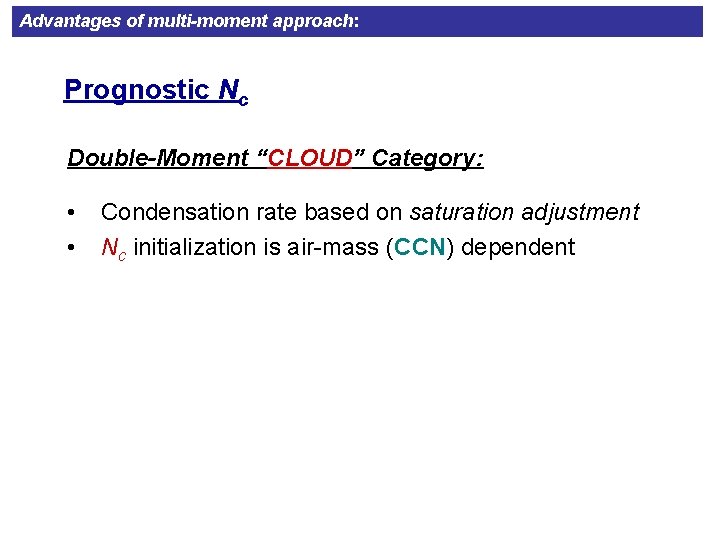
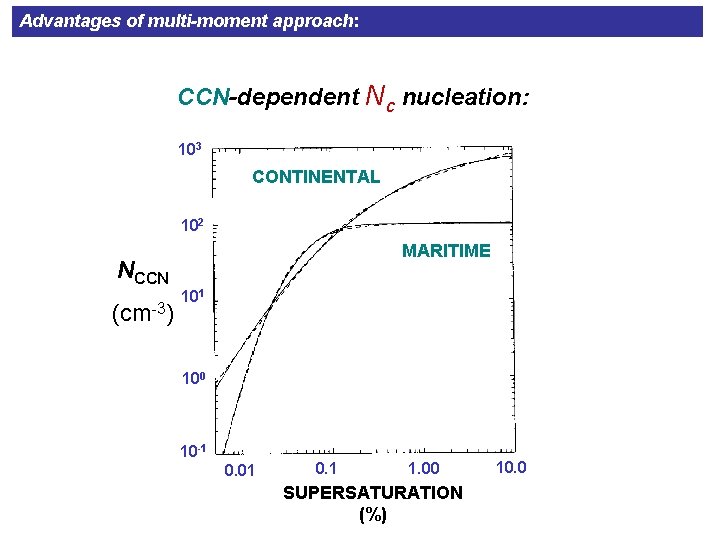
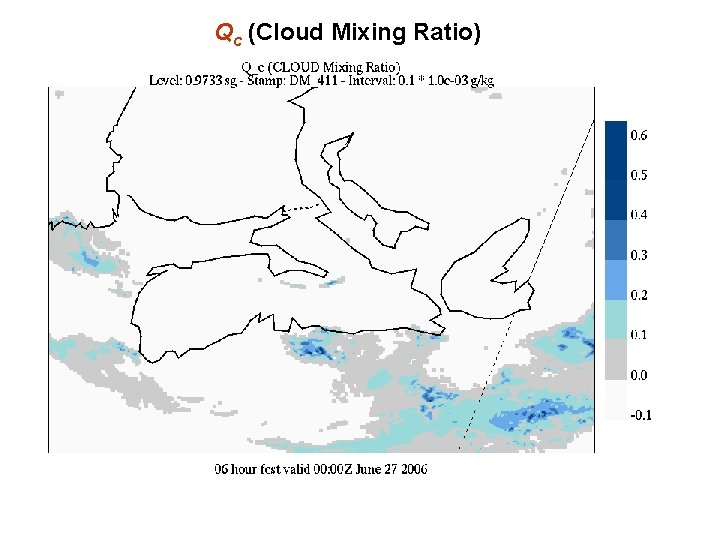
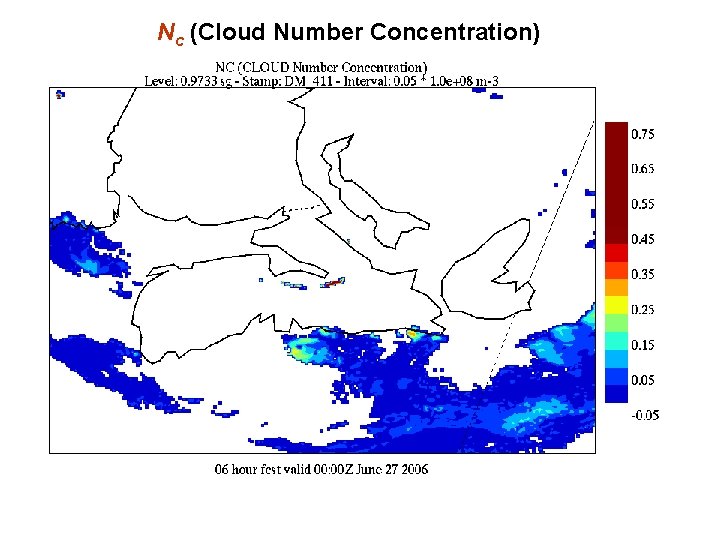
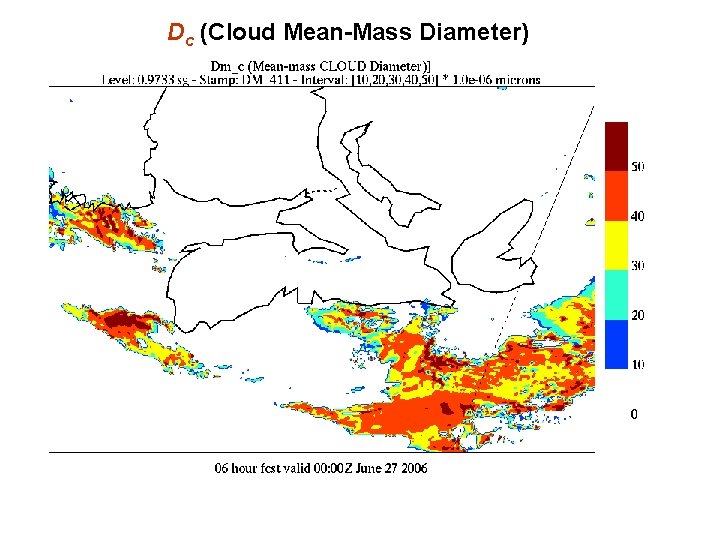
Advantages of multi-moment approach: Prognostic Nc Double-Moment “CLOUD” Category: • • Condensation rate based on saturation adjustment Nc initialization is air-mass (CCN) dependent
Advantages of multi-moment approach: CCN-dependent Nc nucleation: 103 CONTINENTAL 102 MARITIME NCCN (cm-3) 101 100 10 -1 0. 01 0. 1 1. 00 SUPERSATURATION (%) 10. 0
Qc (Cloud Mixing Ratio)
Nc (Cloud Number Concentration)
Dc (Cloud Mean-Mass Diameter)
Advantages of multi-moment approach: RAIN m e[ mi n] CLOUD Ti Mass Density [g m-3 (lnr)-1] The warm-rain coalescence process DRIZZLE Radius [cm] Bin-resolving coalescence model SOURCE: Berry and Reinhardt (1974)
Advantages of multi-moment approach: DRIZZLE vs. RAIN Qr Mass Content [g m-3] RAIN 0. 1– 1 mm Dr Mean Diameter [mm] STRATIFORM RAIN DRIZZLE
Advantages of multi-moment approach: SEDIMENTATION Analytic bin model calculation: (1 D column) Mass Content Total Number Concentration Equivalent Reflectivity NT [m-3] Ze [d. BZ] Mean-Mass Diameter INITIAL 5 min z [km] 10 min 15 min 20 min Q [g m-3] Contours every 5 min Dm [mm]
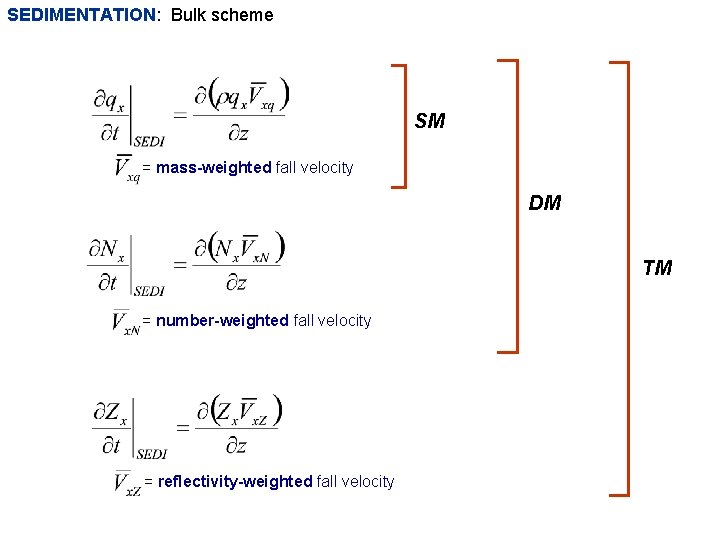
SEDIMENTATION: Bulk scheme SM = mass-weighted fall velocity DM TM = number-weighted fall velocity = reflectivity-weighted fall velocity
SINGLE-moment scheme (SM): z [km] Q [g m-3] NT [m-3] Ze [d. BZ] Dm [mm] ANALYTIC BIN model (ANA): INITIAL 5 min z [km] 10 min 15 min 20 min Q [g m-3] NT [m-3]
DOUBLE-moment scheme, FIXED DISPERSION (a = 0): z [km] Q [g m-3] NT [m-3] Ze [d. BZ] Dm [mm] ANALYTIC BIN model (ANA): INITIAL 5 min z [km] 10 min 15 min 20 min Q [g m-3] NT [m-3]
DOUBLE-moment scheme, DIAGNOSTIC DISPERSION, a = f (Dm): z [km] Q [g m-3] NT [m-3] Ze [d. BZ] Dm [mm] ANALYTIC BIN model (ANA): INITIAL 5 min z [km] 10 min 15 min 20 min Q [g m-3] NT [m-3]
TRIPLE-moment scheme: z [km] Q [g m-3] NT [m-3] Ze [d. BZ] Dm [mm] ANALYTIC BIN model (ANA): INITIAL 5 min z [km] 10 min 15 min 20 min Q [g m-3] NT [m-3]
Advantages of multi-moment approach: SEDIMENTATION INITIAL Analytic model: Mass Content 5 min z [km] 10 min 15 min 20 min Bulk schemes: Q [g m-3] z [km] SINGLEMOMENT Q [g m-3] DOUBLEMOMENT Fixed a = 0 Q [g m-3] DOUBLEMOMENT Diagnosed a Q [g m-3] TRIPLEMOMENT Prognosed a Q [g m-3]
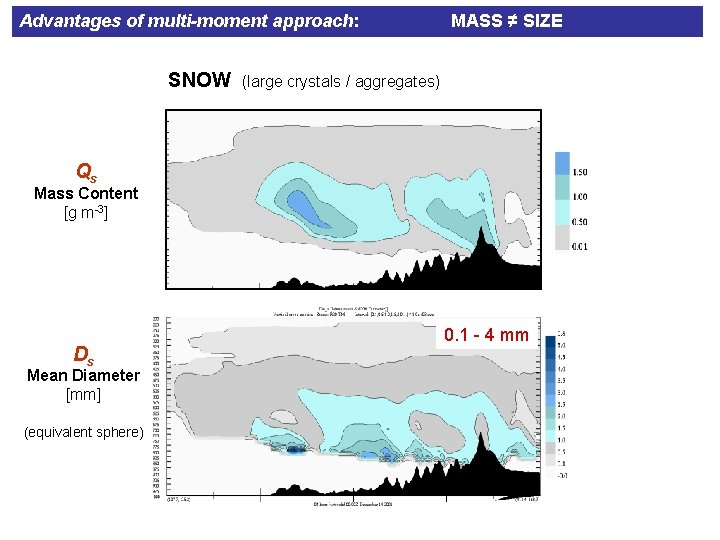
Advantages of multi-moment approach: SNOW MASS ≠ SIZE (large crystals / aggregates) Qs Mass Content [g m-3] Ds Mean Diameter [mm] (equivalent sphere) 0. 1 - 4 mm
SUMMARY • Efficient single-moment and double-moment versions of the Milbrandt-Yau scheme are available for GEM-LAM • Single-moment version will be proposed as the operational scheme for GEM-LAM_2. 5 by fall 2007 • New version (“semi-double-moment”) will be developed and tested for implementation by spring 2007 • Large-scale version (diagostic cloud-fraction; fewer prognostic variables) to be developed soon • For code, support, bug reports, or question: Jason. Milbrandt@ec. gc. ca
MERCI