
A New Model for Image Distribution Docker Registry
A New Model for Image Distribution Docker Registry 2. 0

Stephen Day Distribution, Tech Lead Docker, Inc. stephen@docker. com @stevvooe github. com/stevvooe
Overview • • 3 What is Docker? What is an Image? What is the Docker Registry? History Docker Registry API V 2 Implementation The Future

What is Docker? https: //www. docker. com/whatisdocker/
What is an Image? A runnable component with a filesystem
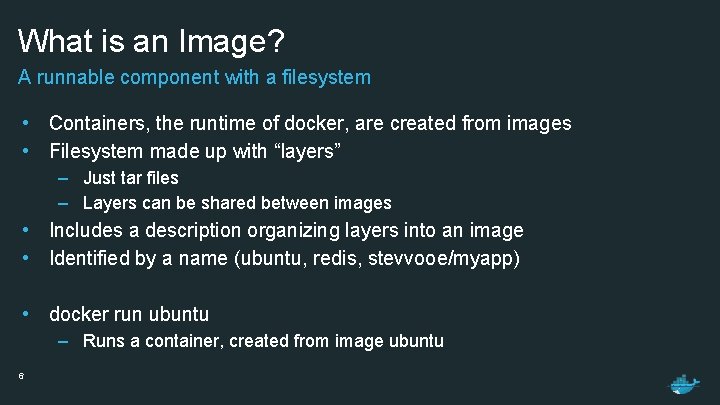
What is an Image? A runnable component with a filesystem • Containers, the runtime of docker, are created from images • Filesystem made up with “layers” – Just tar files – Layers can be shared between images • Includes a description organizing layers into an image • Identified by a name (ubuntu, redis, stevvooe/myapp) • docker run ubuntu – Runs a container, created from image ubuntu 6
What is the Docker Registry? A central place to store and distribute docker images
What is the Docker Registry? A central place to store and distribute docker images • Stores the layers and the description of how they make up an image • Implements a common API agreed upon by Docker clients • Several Implementations – A simple web server to make images available – A complete web application – Services like the Docker Hub contain a registry • Documentation: https: //docs. docker. com/registry/ 8
History Docker Registry API V 1
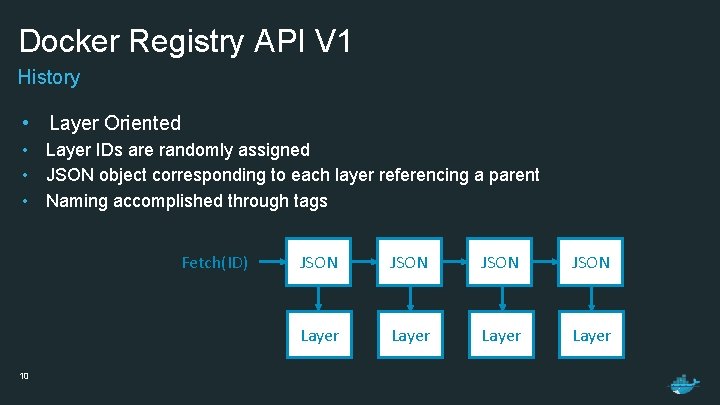
Docker Registry API V 1 History • Layer Oriented • Layer IDs are randomly assigned • JSON object corresponding to each layer referencing a parent • Naming accomplished through tags Fetch(ID) 10 JSON Layer
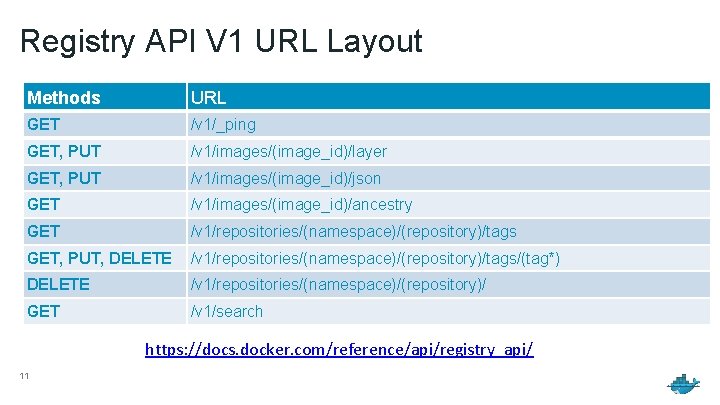
Registry API V 1 URL Layout Methods URL GET /v 1/_ping GET, PUT /v 1/images/(image_id)/layer GET, PUT /v 1/images/(image_id)/json GET /v 1/images/(image_id)/ancestry GET /v 1/repositories/(namespace)/(repository)/tags GET, PUT, DELETE /v 1/repositories/(namespace)/(repository)/tags/(tag*) DELETE /v 1/repositories/(namespace)/(repository)/ GET /v 1/search https: //docs. docker. com/reference/api/registry_api/ 11
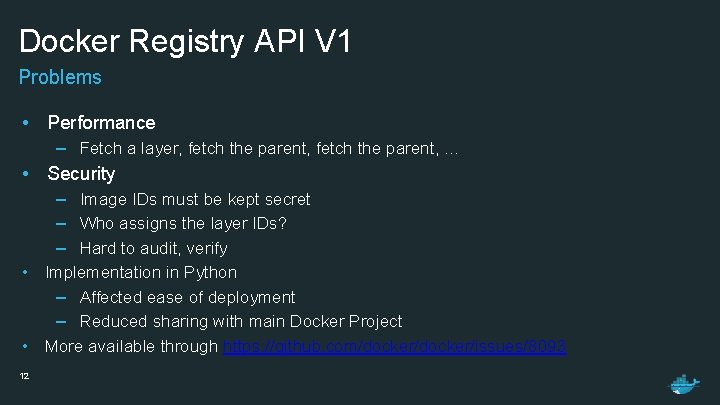
Docker Registry API V 1 Problems • Performance – Fetch a layer, fetch the parent, … • Security – Image IDs must be kept secret – Who assigns the layer IDs? – Hard to audit, verify • Implementation in Python – Affected ease of deployment – Reduced sharing with main Docker Project • More available through https: //github. com/docker/issues/8093 12
Docker Registry API V 2 Design
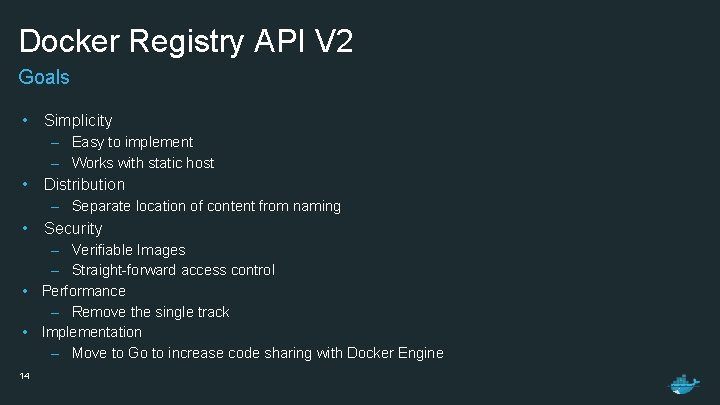
Docker Registry API V 2 Goals • Simplicity – Easy to implement – Works with static host • Distribution – Separate location of content from naming • Security – Verifiable Images – Straight-forward access control • Performance – Remove the single track • Implementation – Move to Go to increase code sharing with Docker Engine 14
Docker Registry API V 2 Content-Addressable • Layers are treated as content-addressable blobs – Much better for security – Permits safe-distribution through untrusted channels • All data can be verified – Improved cache-ability • Content address is known as the “digest” 15
Docker Registry API V 2 What is a digest? • Uniquely identifies content • A cryptographically strong hash – Chose a name, digest, that does not conflict with other concepts (map, dict, crc, etc. ) • For Registry V 2, simply using sha 256(bytes) – Easy to implement – Easy to verify • Independently Verifiable – If you and I agree on a common algorithm, we can choose IDs for content without coordinating • Strongly-typed with tools to parse and verify – http: //godoc. org/github. com/docker/distribution/digest 16
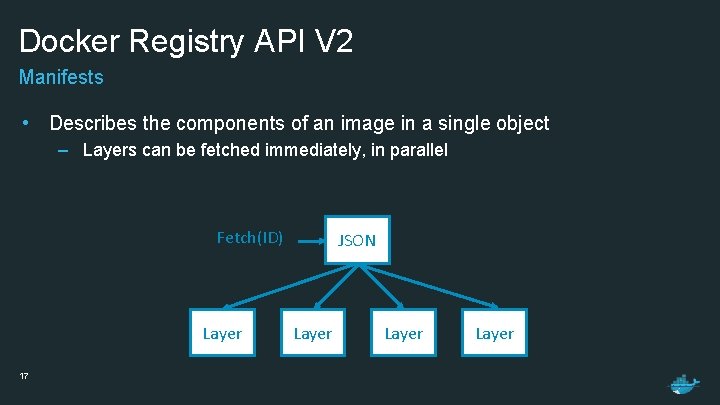
Docker Registry API V 2 Manifests • Describes the components of an image in a single object – Layers can be fetched immediately, in parallel Fetch(ID) Layer 17 JSON Layer
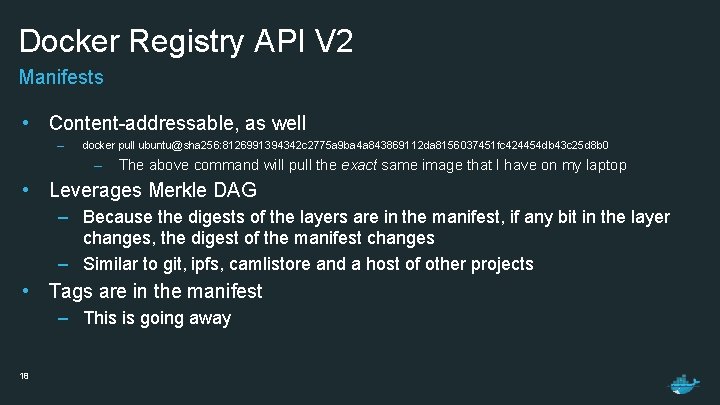
Docker Registry API V 2 Manifests • Content-addressable, as well – docker pull ubuntu@sha 256: 8126991394342 c 2775 a 9 ba 4 a 843869112 da 8156037451 fc 424454 db 43 c 25 d 8 b 0 – The above command will pull the exact same image that I have on my laptop • Leverages Merkle DAG – Because the digests of the layers are in the manifest, if any bit in the layer changes, the digest of the manifest changes – Similar to git, ipfs, camlistore and a host of other projects • Tags are in the manifest – This is going away 18
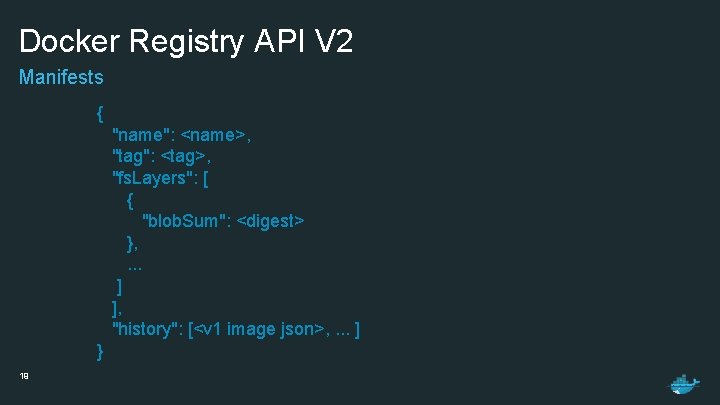
Docker Registry API V 2 Manifests { "name": <name>, "tag": <tag>, "fs. Layers": [ { "blob. Sum": <digest> }, . . . ] ], "history": [<v 1 image json>, . . . ] } 19
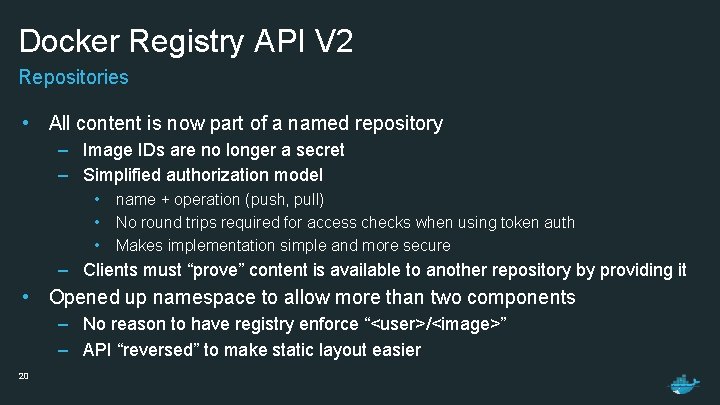
Docker Registry API V 2 Repositories • All content is now part of a named repository – Image IDs are no longer a secret – Simplified authorization model • • • name + operation (push, pull) No round trips required for access checks when using token auth Makes implementation simple and more secure – Clients must “prove” content is available to another repository by providing it • Opened up namespace to allow more than two components – No reason to have registry enforce “<user>/<image>” – API “reversed” to make static layout easier 20
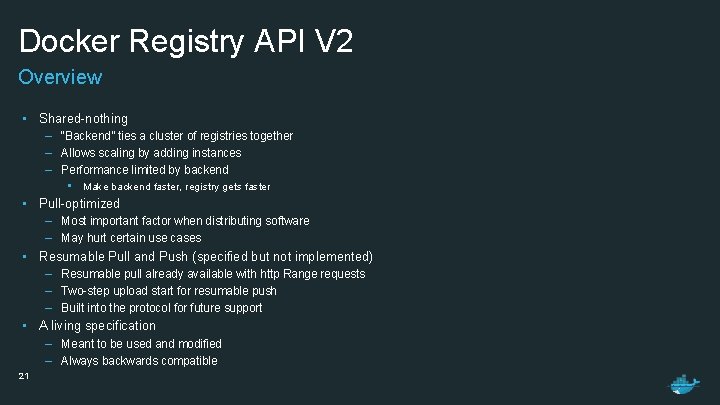
Docker Registry API V 2 Overview • Shared-nothing – “Backend” ties a cluster of registries together – Allows scaling by adding instances – Performance limited by backend • Make backend faster, registry gets faster • Pull-optimized – Most important factor when distributing software – May hurt certain use cases • Resumable Pull and Push (specified but not implemented) – Resumable pull already available with http Range requests – Two-step upload start for resumable push – Built into the protocol for future support • A living specification – Meant to be used and modified – Always backwards compatible 21
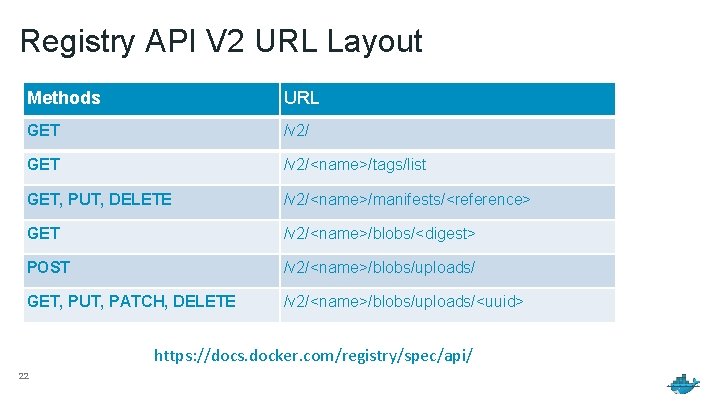
Registry API V 2 URL Layout Methods URL GET /v 2/<name>/tags/list GET, PUT, DELETE /v 2/<name>/manifests/<reference> GET /v 2/<name>/blobs/<digest> POST /v 2/<name>/blobs/uploads/ GET, PUT, PATCH, DELETE /v 2/<name>/blobs/uploads/<uuid> https: //docs. docker. com/registry/spec/api/ 22
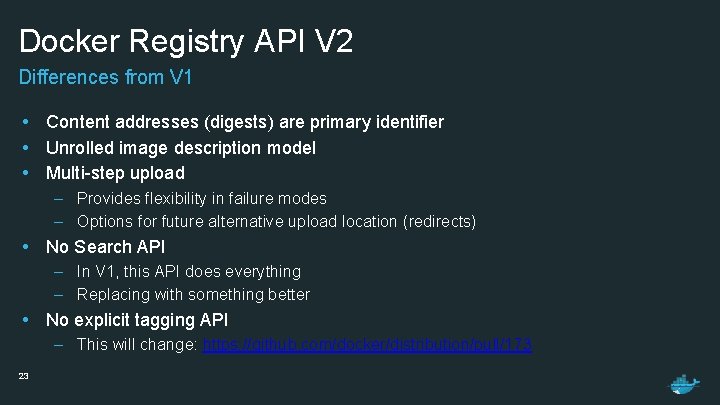
Docker Registry API V 2 Differences from V 1 • Content addresses (digests) are primary identifier • Unrolled image description model • Multi-step upload – Provides flexibility in failure modes – Options for future alternative upload location (redirects) • No Search API – In V 1, this API does everything – Replacing with something better • No explicit tagging API – This will change: https: //github. com/docker/distribution/pull/173 23
Docker Registry 2. 0 Implementation
Docker Registry 2. 0 Status • Registry 2. 0 released with Docker 1. 6 – Mostly a success – https: //github. com/docker/distribution • Running the Hub – S 3 backend • Having some trouble with round trips to s 3 : ( – Decent performance with very little caching • 25 A lot of low hanging fruit left to tackle
Docker Registry 2. 0 Does it work? • Full support release with Docker 1. 6 – Minimal bugs – Most problems are common to version upgrades • Header required to declare support for 2. 0 API • Validated most concepts in 1. 3, 1. 4 with V 2 preview – Much faster pull performance – You’ve probably already used it • There are some edge cases – push-heavy workflows – disk io when verifying large images – We are mitigating these 26
Docker Registry 2. 0 Should you be using it? • Are you on Docker 1. 6+? – Yes. • • Evaluate it Test it Break it (and file bugs https: //github. com/docker/distribution/issues) Deploy it • Are you on Docker <1. 6? – Are you entrenched in v 1? • Perhaps, hold off – Run dual stack v 1, v 2 • • 27 https: //docs. docker. com/registry/deploying/#configure-nginx-with-a-v 1 -and-v 2 -registry Not recommended to auto-port images between v 1 and v 2
Docker Registry 2. 0 Deploying • Internal deployments – Use the filesystem driver — it is really fast – Backup with rsync • Scale storage – Use S 3 driver • Make sure you are “close” since round trip times can have an effect • Scale Reads – Use round robin DNS • Do not use this for HA – Rsync to followers on read-only filesystem – Add machines to taste • https: //docs. docker. com/registry/deploying/ 28
Docker Registry 2. 0 Future • Feature parity with V 1 – Maturity – Building collective operational knowledge • Hard to break some bad practices from v 1 • Proxy Caching • Catalog API – What’s in my registry? • Deletes – Diverse backend support makes this hard – https: //github. com/docker/distribution/issues/461 – https: //github. com/docker/distribution/issues/462 • Search – See the goals of Distribution to see why this is interesting 29

Docker Distribution A project to improve packing, shipping, storing, and delivering content
Docker Distribution Overview • Goals – Improve the state of image distribution in Docker • Focus – Security – Reliability – Performance • Build a solid and secure foundation • Unlock new distribution models – Moving images around no longer requires a registry – Peer to Peer for large deployments 31
Docker Distribution Future • Clean up the docker daemon code base – Defined new APIs for working with docker content – Increase feature velocity – Generalize around strong base • Current Manifest format is provisional – Still includes v 1 layer JSON – Content-addressability + mediatypes make support new formats trivial – https: //github. com/docker/distribution/pull/62 • Road Map: https: //github. com/docker/distribution/wiki 32

Docker Distribution Google Group: distribution@dockerproject. org Git. Hub: https: //github. com/docker/distribution IRC on Freenode: #docker-distribution

Join us at Docker. Con June 22 -23, 2015 in San Francisco, CA Register now: dockercon. com Save 10% on registration with code: containyourself @dockercon | dockercon. com

Q&A

THANK YOU
- Slides: 36