
A New Microscopic Look at Steadystate Enzyme Kinetics


![Three types of available initial rate data 1. Vary [NAD+] and [IMP] 2. Vary](https://slidetodoc.com/presentation_image_h2/dbd9fb486f4bfaabe0fb5b04cee0e073/image-18.jpg "Three types of available initial rate data 1. Vary [NAD+] and [IMP] 2. Vary")
![Simultaneous variation of [NAD+] and [IMP] ADDED A NEW STEP – BINDING OF IMP](https://slidetodoc.com/presentation_image_h2/dbd9fb486f4bfaabe0fb5b04cee0e073/image-19.jpg "Simultaneous variation of [NAD+] and [IMP] ADDED A NEW STEP – BINDING OF IMP")
![Simultaneous variation of [NAD+] and [NADH] THIS CONFIRMS THAT NADH IS REBINDING TO THE](https://slidetodoc.com/presentation_image_h2/dbd9fb486f4bfaabe0fb5b04cee0e073/image-20.jpg "Simultaneous variation of [NAD+] and [NADH] THIS CONFIRMS THAT NADH IS REBINDING TO THE")
![Simultaneous variation of [NAD+] and inhibitor [A 110] [Inh], µM 0. 13 Steady-State Enzyme](https://slidetodoc.com/presentation_image_h2/dbd9fb486f4bfaabe0fb5b04cee0e073/image-21.jpg "Simultaneous variation of [NAD+] and inhibitor [A 110] [Inh], µM 0. 13 Steady-State Enzyme")
- Slides: 36
A New 'Microscopic' Look at Steady-state Enzyme Kinetics Petr Kuzmič Bio. Kin Ltd. http: //www. biokin. com SEMINAR: University of Massachusetts Medical School Worcester, MA April 6, 2015 Steady-State Enzyme Kinetics
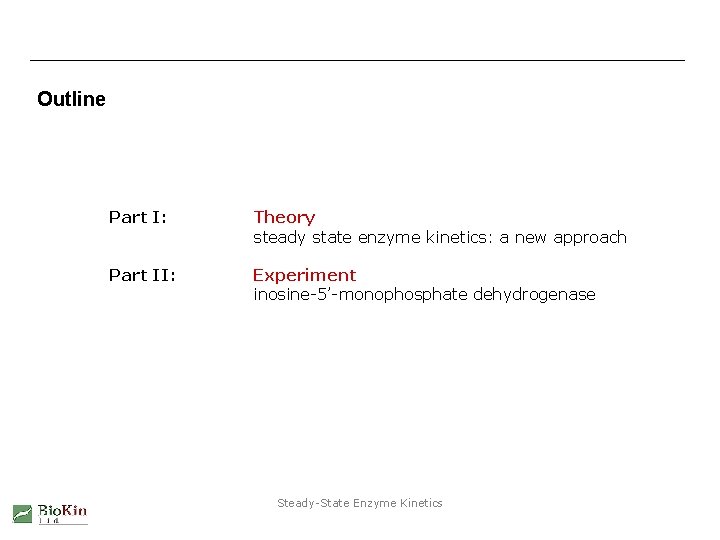
Outline Part I: Theory steady state enzyme kinetics: a new approach Part II: Experiment inosine-5’-monophosphate dehydrogenase Steady-State Enzyme Kinetics
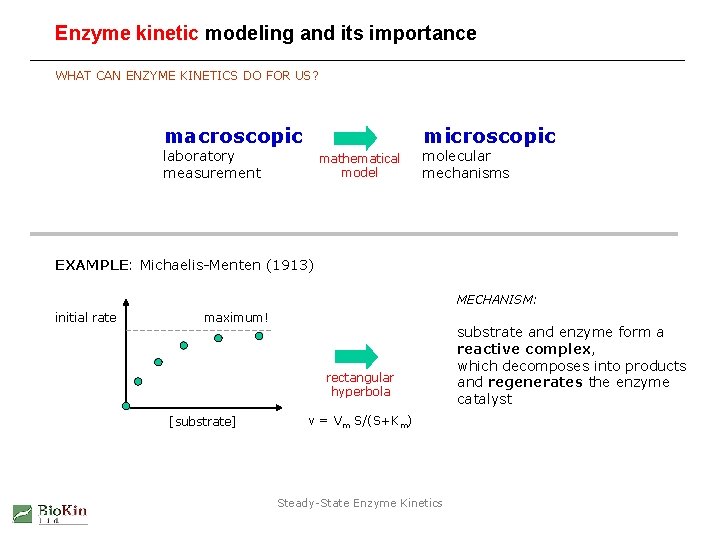
Enzyme kinetic modeling and its importance WHAT CAN ENZYME KINETICS DO FOR US? macroscopic microscopic laboratory measurement mathematical model molecular mechanisms EXAMPLE: Michaelis-Menten (1913) MECHANISM: initial rate maximum! rectangular hyperbola [substrate] v = Vm S/(S+Km) Steady-State Enzyme Kinetics substrate and enzyme form a reactive complex, which decomposes into products and regenerates the enzyme catalyst
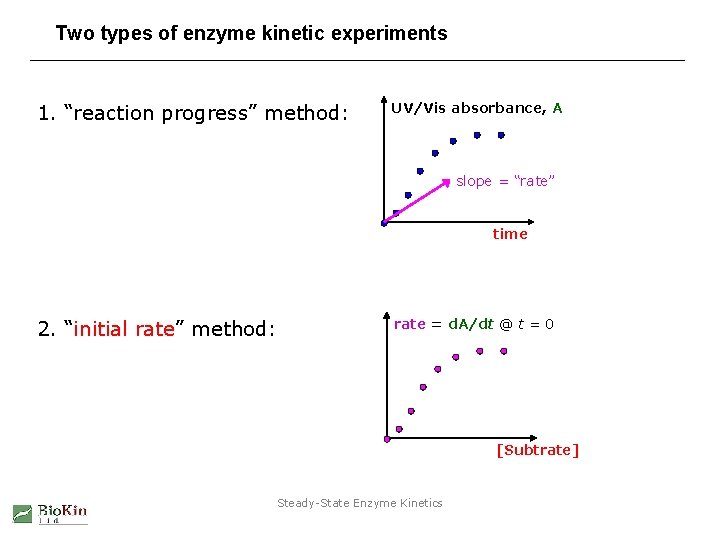
Two types of enzyme kinetic experiments 1. “reaction progress” method: UV/Vis absorbance, A slope = “rate” time 2. “initial rate” method: rate = d. A/dt @ t = 0 [Subtrate] Steady-State Enzyme Kinetics
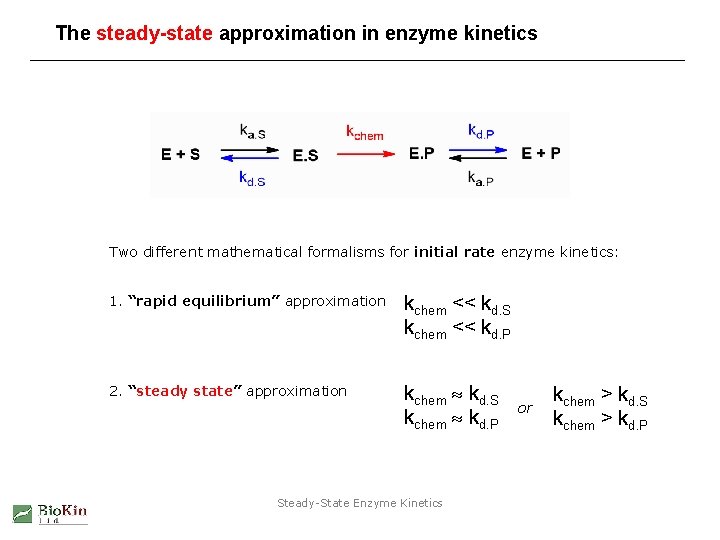
The steady-state approximation in enzyme kinetics Two different mathematical formalisms for initial rate enzyme kinetics: 1. “rapid equilibrium” approximation kchem << kd. S kchem << kd. P 2. “steady state” approximation kchem kd. S kchem kd. P Steady-State Enzyme Kinetics or kchem > kd. S kchem > kd. P
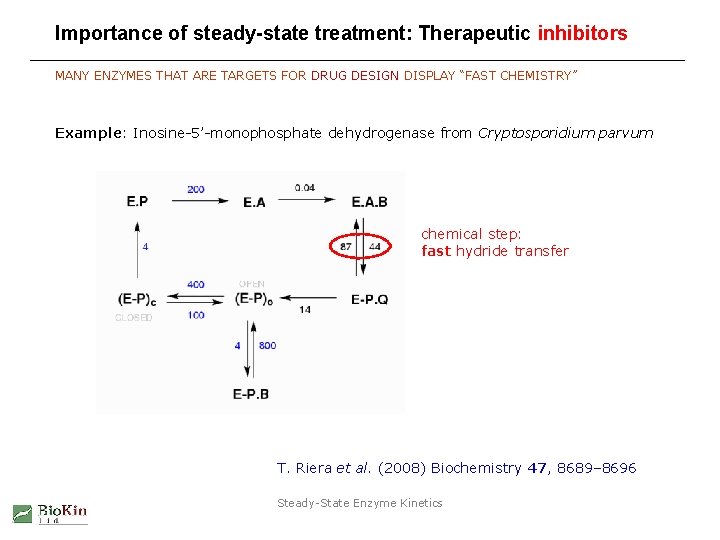
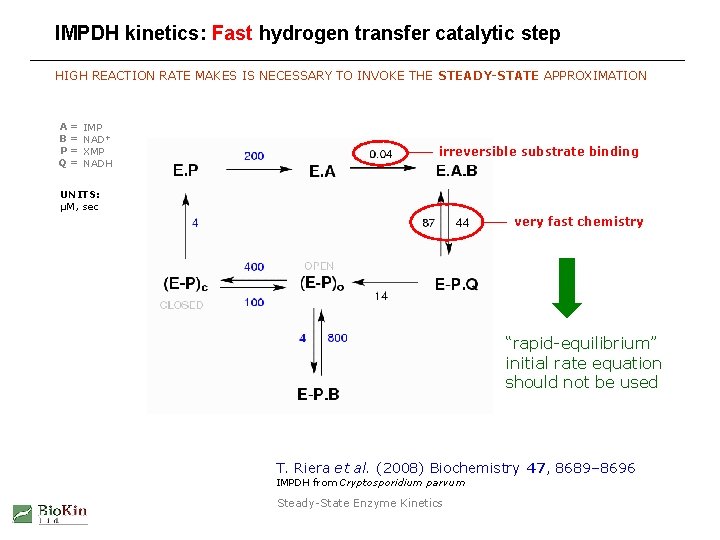
Importance of steady-state treatment: Therapeutic inhibitors MANY ENZYMES THAT ARE TARGETS FOR DRUG DESIGN DISPLAY “FAST CHEMISTRY” Example: Inosine-5’-monophosphate dehydrogenase from Cryptosporidium parvum chemical step: fast hydride transfer T. Riera et al. (2008) Biochemistry 47, 8689– 8696 Steady-State Enzyme Kinetics
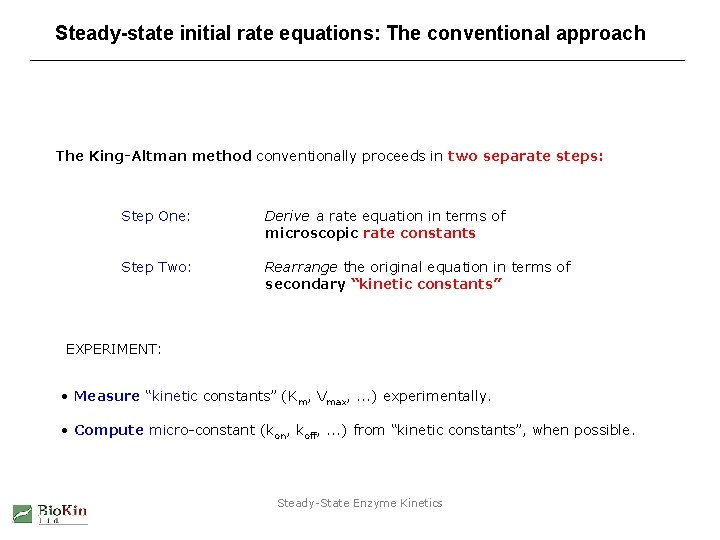
Steady-state initial rate equations: The conventional approach The King-Altman method conventionally proceeds in two separate steps: Step One: Derive a rate equation in terms of microscopic rate constants Step Two: Rearrange the original equation in terms of secondary “kinetic constants” EXPERIMENT: • Measure “kinetic constants” (Km, Vmax, . . . ) experimentally. • Compute micro-constant (kon, koff, . . . ) from “kinetic constants”, when possible. Steady-State Enzyme Kinetics
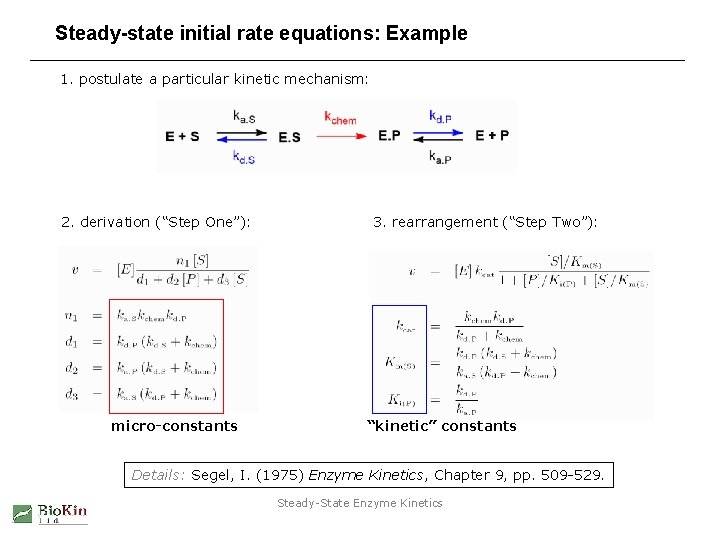
Steady-state initial rate equations: Example 1. postulate a particular kinetic mechanism: 2. derivation (“Step One”): micro-constants 3. rearrangement (“Step Two”): “kinetic” constants Details: Segel, I. (1975) Enzyme Kinetics, Chapter 9, pp. 509 -529. Steady-State Enzyme Kinetics
Several problems with the conventional approach 1. Fundamental problem: Step 2 (deriving “Km” etc. ) is in principle impossible for branched mechanisms. 2. Technical problem: Even when Step 2 is possible in principle, it is tedious and error prone. 3. Resource problem: Measuring “kinetic constants” (Km, Ki, . . . ) consumes a lot of time and materials. Steady-State Enzyme Kinetics
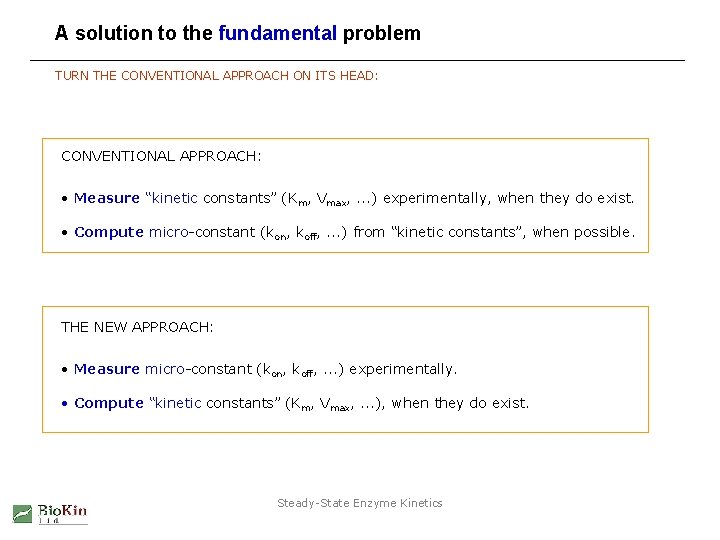
A solution to the fundamental problem TURN THE CONVENTIONAL APPROACH ON ITS HEAD: CONVENTIONAL APPROACH: • Measure “kinetic constants” (Km, Vmax, . . . ) experimentally, when they do exist. • Compute micro-constant (kon, koff, . . . ) from “kinetic constants”, when possible. THE NEW APPROACH: • Measure micro-constant (kon, koff, . . . ) experimentally. • Compute “kinetic constants” (Km, Vmax, . . . ), when they do exist. Steady-State Enzyme Kinetics
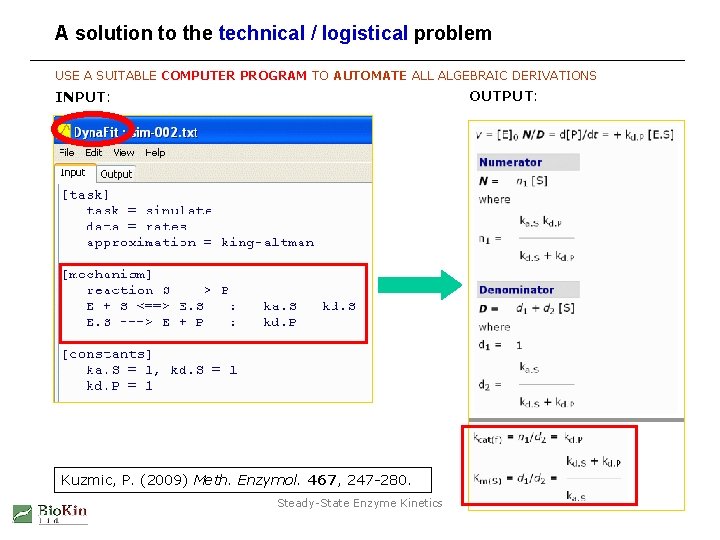
A solution to the technical / logistical problem USE A SUITABLE COMPUTER PROGRAM TO AUTOMATE ALL ALGEBRAIC DERIVATIONS OUTPUT: INPUT: Kuzmic, P. (2009) Meth. Enzymol. 467, 247 -280. Steady-State Enzyme Kinetics
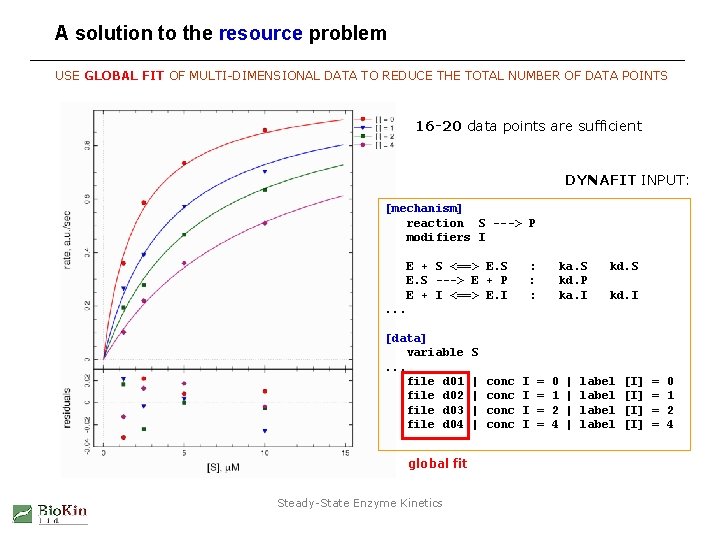
A solution to the resource problem USE GLOBAL FIT OF MULTI-DIMENSIONAL DATA TO REDUCE THE TOTAL NUMBER OF DATA POINTS 16 -20 data points are sufficient DYNAFIT INPUT: [mechanism] reaction S ---> P modifiers I E + S <==> E. S ---> E + P E + I <==> E. I : : : ka. S kd. P ka. I kd. S kd. I . . . [data] variable. . . file d 01 file d 02 file d 03 file d 04 global fit Steady-State Enzyme Kinetics S | | conc I I = = 0 1 2 4 | | label [I] [I] = = 0 1 2 4
Part II: Experiment 1. Background Inosine-5’-monophosphate dehydrogenase (IMPDH) and its importance 2. “Microscopic” kinetic model from stopped-flow data A complex “microscopic” model of IMPHD inhibition kinetics 3. Validating the transient kinetic model by initial rates Is our complex model sufficiently supported by initial-rate data? Data: Dr. Yang Wei (Hedstrom Group, Brandeis University) Steady-State Enzyme Kinetics
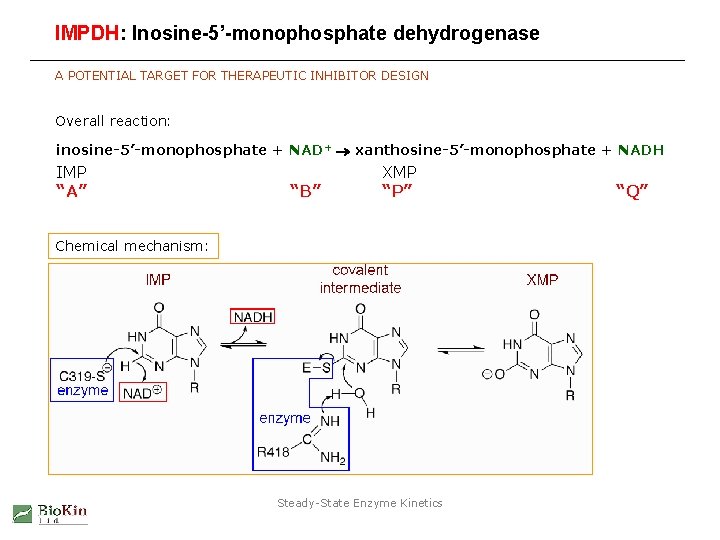
IMPDH: Inosine-5’-monophosphate dehydrogenase A POTENTIAL TARGET FOR THERAPEUTIC INHIBITOR DESIGN Overall reaction: inosine-5’-monophosphate + NAD+ xanthosine-5’-monophosphate + NADH IMP “A” “B” XMP “P” Chemical mechanism: Steady-State Enzyme Kinetics “Q”
IMPDH kinetics: Fast hydrogen transfer catalytic step HIGH REACTION RATE MAKES IS NECESSARY TO INVOKE THE STEADY-STATE APPROXIMATION A B P Q = = IMP NAD+ XMP NADH irreversible substrate binding UNITS: µM, sec very fast chemistry “rapid-equilibrium” initial rate equation should not be used T. Riera et al. (2008) Biochemistry 47, 8689– 8696 IMPDH from Cryptosporidium parvum Steady-State Enzyme Kinetics
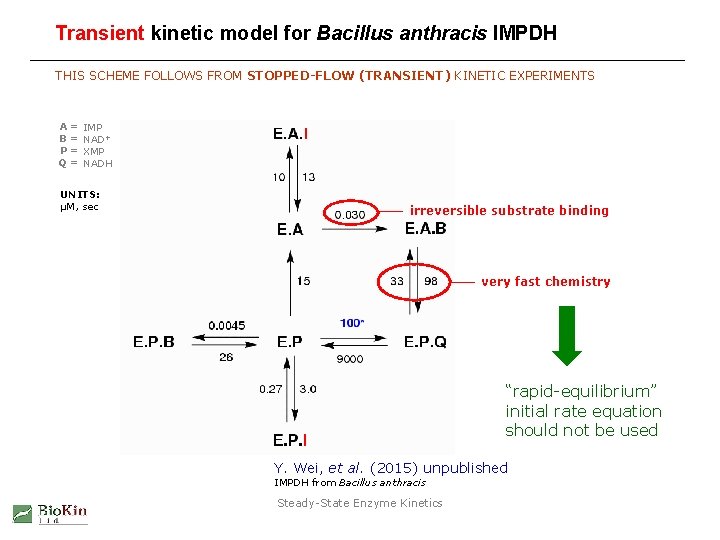
Transient kinetic model for Bacillus anthracis IMPDH THIS SCHEME FOLLOWS FROM STOPPED-FLOW (TRANSIENT) KINETIC EXPERIMENTS A B P Q = = IMP NAD+ XMP NADH UNITS: µM, sec irreversible substrate binding very fast chemistry “rapid-equilibrium” initial rate equation should not be used Y. Wei, et al. (2015) unpublished IMPDH from Bacillus anthracis Steady-State Enzyme Kinetics
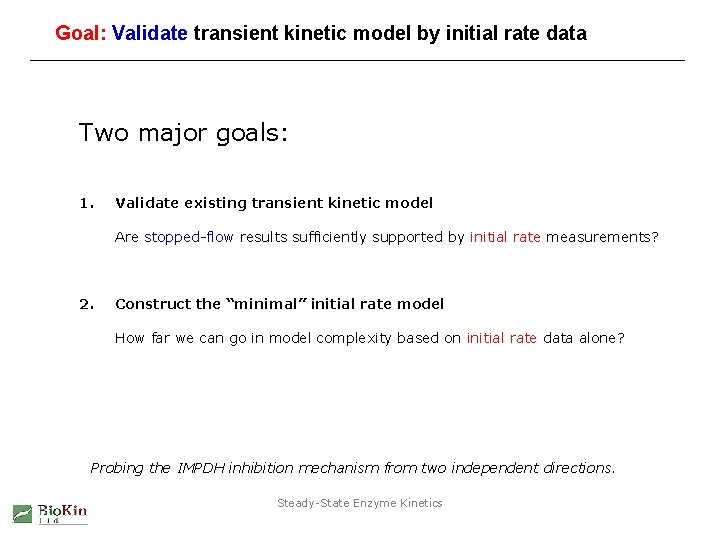
Goal: Validate transient kinetic model by initial rate data Two major goals: 1. Validate existing transient kinetic model Are stopped-flow results sufficiently supported by initial rate measurements? 2. Construct the “minimal” initial rate model How far we can go in model complexity based on initial rate data alone? Probing the IMPDH inhibition mechanism from two independent directions. Steady-State Enzyme Kinetics
Three types of available initial rate data 1. Vary [NAD+] and [IMP] 2. Vary [NAD+] and [NADH] at saturating [IMP] 3. Vary [NAD+] and [Inhibitor] at saturating [IMP] substrate “B” and substrate “A” substrate “B” and product “Q” at constant substrate “A” substrate “B” and inhibitor “I” at constant substrate “A” Steady-State Enzyme Kinetics
Simultaneous variation of [NAD+] and [IMP] ADDED A NEW STEP – BINDING OF IMP (substrate “A”) TO THE ENZYME [IMP], µM UNITS: µM, sec the only fitted rate constants Steady-State Enzyme Kinetics A B P Q = = IMP NAD+ XMP NADH
Simultaneous variation of [NAD+] and [NADH] THIS CONFIRMS THAT NADH IS REBINDING TO THE E. P COMPLEX (“PRODUCT INHIBITION”) [NADH], µM UNITS: µM, sec A B P Q = = IMP NAD+ XMP NADH Kd(NADH) = 90 µM Steady-State Enzyme Kinetics
Simultaneous variation of [NAD+] and inhibitor [A 110] [Inh], µM 0. 13 Steady-State Enzyme Kinetics
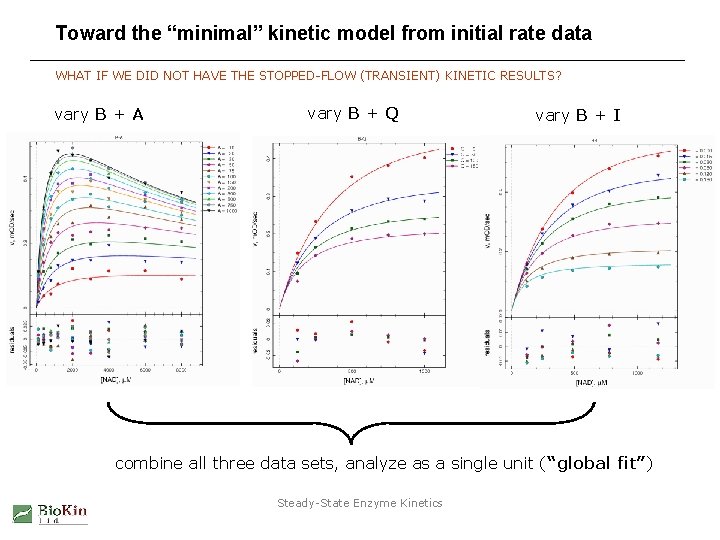
Toward the “minimal” kinetic model from initial rate data WHAT IF WE DID NOT HAVE THE STOPPED-FLOW (TRANSIENT) KINETIC RESULTS? vary B + A vary B + Q vary B + I combine all three data sets, analyze as a single unit (“global fit”) Steady-State Enzyme Kinetics
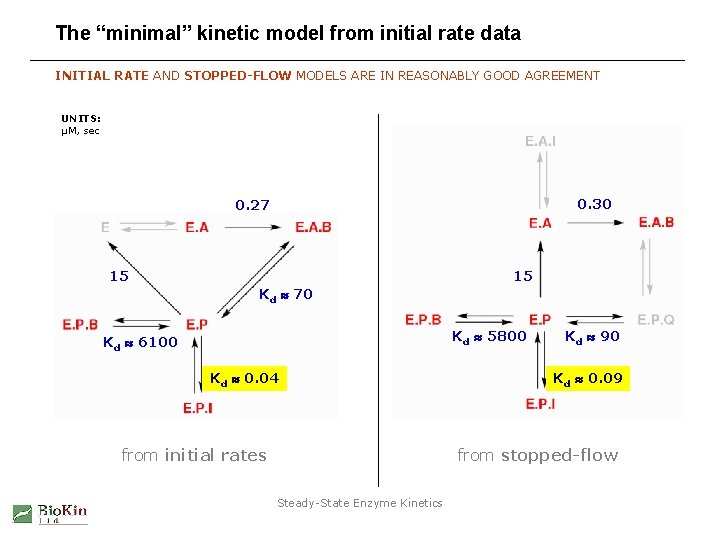
The “minimal” kinetic model from initial rate data INITIAL RATE AND STOPPED-FLOW MODELS ARE IN REASONABLY GOOD AGREEMENT UNITS: µM, sec 0. 30 0. 27 15 15 Kd 70 Kd 5800 Kd 6100 Kd 0. 04 from initial rates Kd 90 Kd 0. 09 from stopped-flow Steady-State Enzyme Kinetics
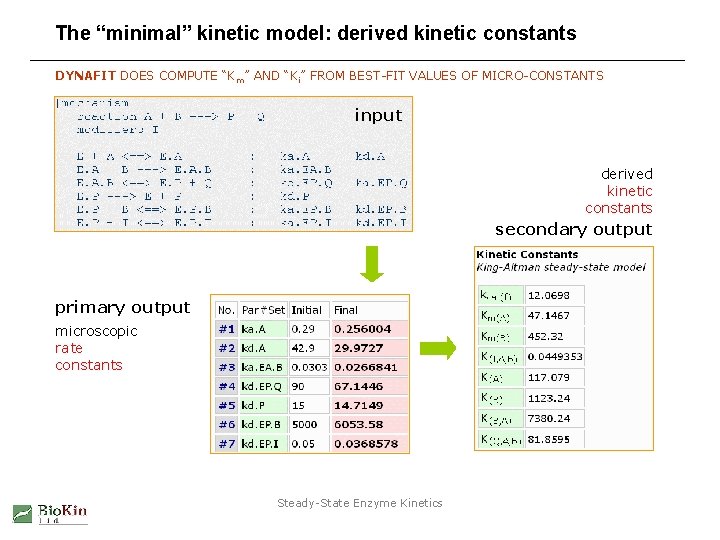
The “minimal” kinetic model: derived kinetic constants DYNAFIT DOES COMPUTE “K m” AND “Ki” FROM BEST-FIT VALUES OF MICRO-CONSTANTS input derived kinetic constants secondary output primary output microscopic rate constants Steady-State Enzyme Kinetics
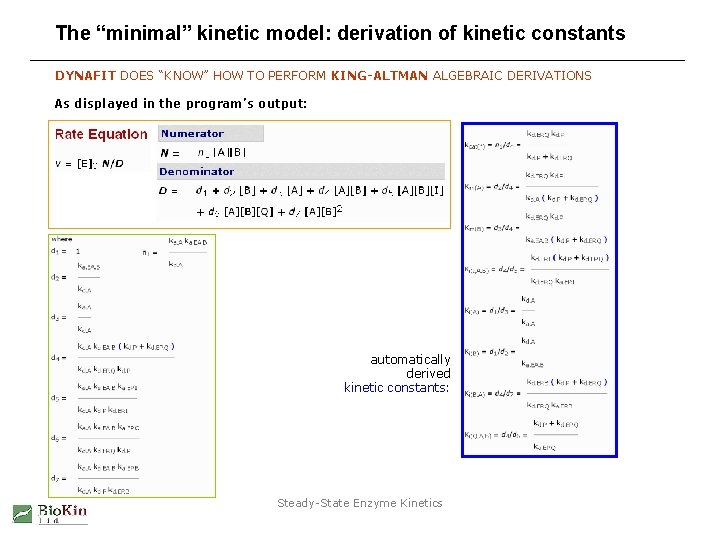
The “minimal” kinetic model: derivation of kinetic constants DYNAFIT DOES “KNOW” HOW TO PERFORM KING-ALTMAN ALGEBRAIC DERIVATIONS As displayed in the program’s output: automatically derived kinetic constants: Steady-State Enzyme Kinetics
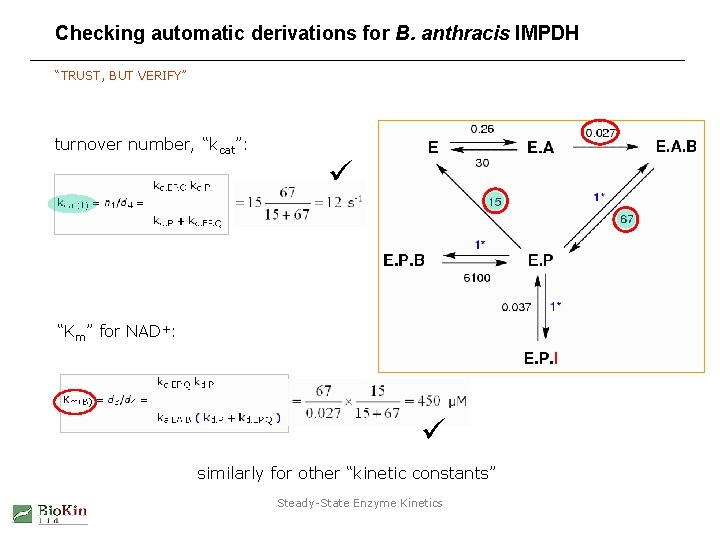
Checking automatic derivations for B. anthracis IMPDH “TRUST, BUT VERIFY” turnover number, “kcat”: “Km” for NAD+: similarly for other “kinetic constants” Steady-State Enzyme Kinetics
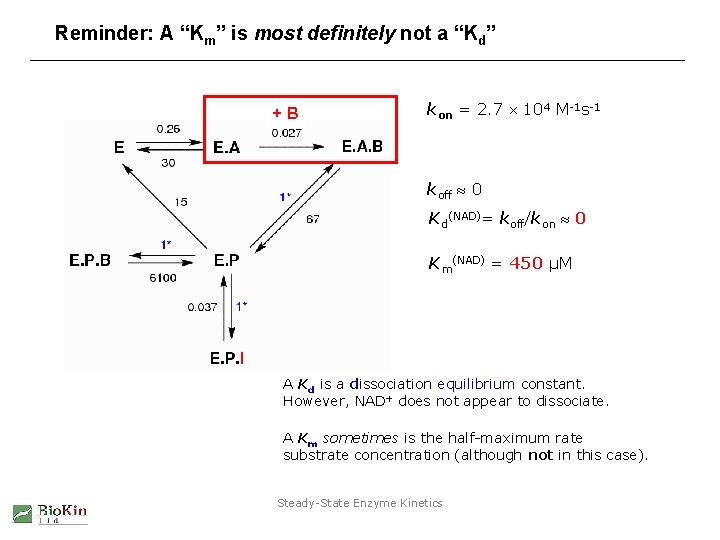
Reminder: A “Km” is most definitely not a “Kd” +B kon = 2. 7 104 M-1 s-1 koff 0 Kd(NAD)= koff/kon 0 Km(NAD) = 450 µM A Kd is a dissociation equilibrium constant. However, NAD+ does not appear to dissociate. A Km sometimes is the half-maximum rate substrate concentration (although not in this case). Steady-State Enzyme Kinetics
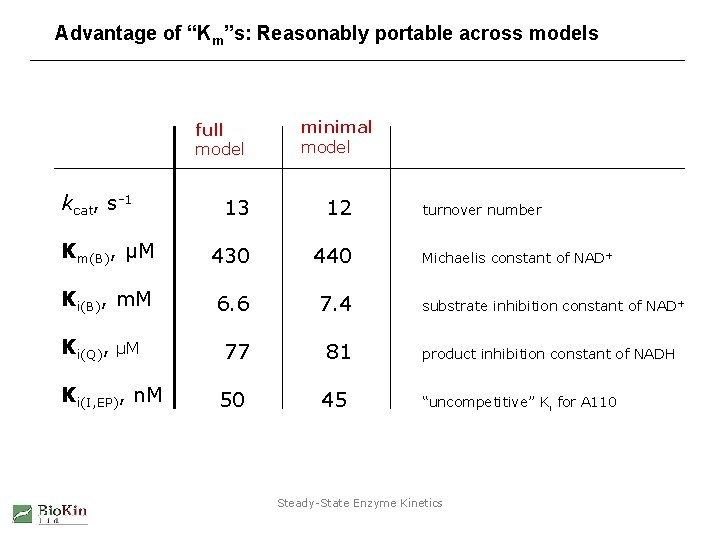
Advantage of “Km”s: Reasonably portable across models full model kcat, s-1 minimal model 13 12 Km(B), µM 430 440 Ki(B), m. M 6. 6 7. 4 Ki(Q), µM 77 81 Ki(I, EP), n. M 50 45 turnover number Michaelis constant of NAD+ substrate inhibition constant of NAD+ product inhibition constant of NADH “uncompetitive” Ki for A 110 Steady-State Enzyme Kinetics
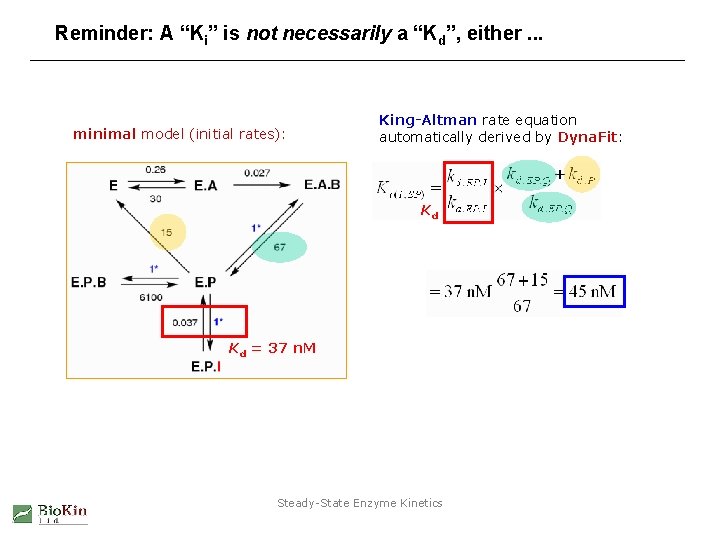
Reminder: A “Ki” is not necessarily a “Kd”, either. . . minimal model (initial rates): King-Altman rate equation automatically derived by Dyna. Fit: Kd Kd = 37 n. M Steady-State Enzyme Kinetics
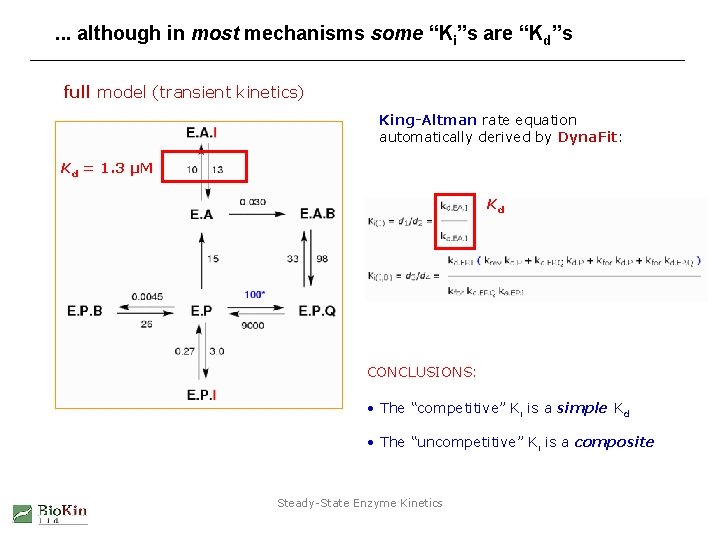
. . . although in most mechanisms some “Ki”s are “Kd”s full model (transient kinetics) King-Altman rate equation automatically derived by Dyna. Fit: Kd = 1. 3 µM Kd CONCLUSIONS: • The “competitive” Ki is a simple Kd • The “uncompetitive” Ki is a composite Steady-State Enzyme Kinetics
Part III: Summary and Conclusions Steady-State Enzyme Kinetics
Importance of steady-state approximation • “Fast” enzymes require the use of steady-state formalism. • The usual rapid-equilibrium approximation cannot be used. • The same applies to mechanisms involving slow release of products. • The meaning of some (but not all) inhibition constants depends on this. Steady-State Enzyme Kinetics
A “microscopic” approach to steady-state kinetics • Many enzyme mechanisms (e. g. Random Bi Bi) cannot have “Km” derived for them. • However a rate equation formulated in terms of micro-constants always exists. • Thus, we can always fit initial rate data to the micro-constant rate equation. • If a “Km”, “Vmax” etc. do actually exist, they can be recomputed after the fact. • This is a reversal of the usual approach to the analysis of initial rate data. • This approach combined with global fit can produce savings in time and materials. Steady-State Enzyme Kinetics
Computer automation of all algebraic derivations • The Dyna. Fit software package performs derivations by the King-Altman method. • The newest version (4. 06. 027 or later) derives “kinetic constants” (K m, etc. ) if possible. • Dyna. Fit is available from www. biokin. com, free of charge to all academic researchers. Steady-State Enzyme Kinetics
IMPDH kinetic mechanism • IMPDH from B. anthracis follows a mechanism that includes NADH rebinding. • This “product inhibition” can only be revealed if excess NADH is present in the assay. • The inhibitor “A 110” binds almost exclusively to the covalent intermediate. • The observed inhibition pattern is “uncompetitive” or “mixed-type” depending on the exact conditions of the assay. • Thus a proper interpretation of the observed inhibition constant depends on microscopic details of the catalytic mechanism. Note: • Crystal structures of inhibitor complexes are all ternary: E·IMP·Inhibitor • Therefore X-ray data may not show the relevant interaction. Steady-State Enzyme Kinetics
Acknowledgments • Yang Wei • Liz Hedstrom post-doc, Hedstrom group @ Brandeis All experimental data on IMPDH from Bacillus anthracis Brandeis University Departments of Biology and Chemistry Steady-State Enzyme Kinetics