
A new method to measure amino sugar isomers
- Slides: 1
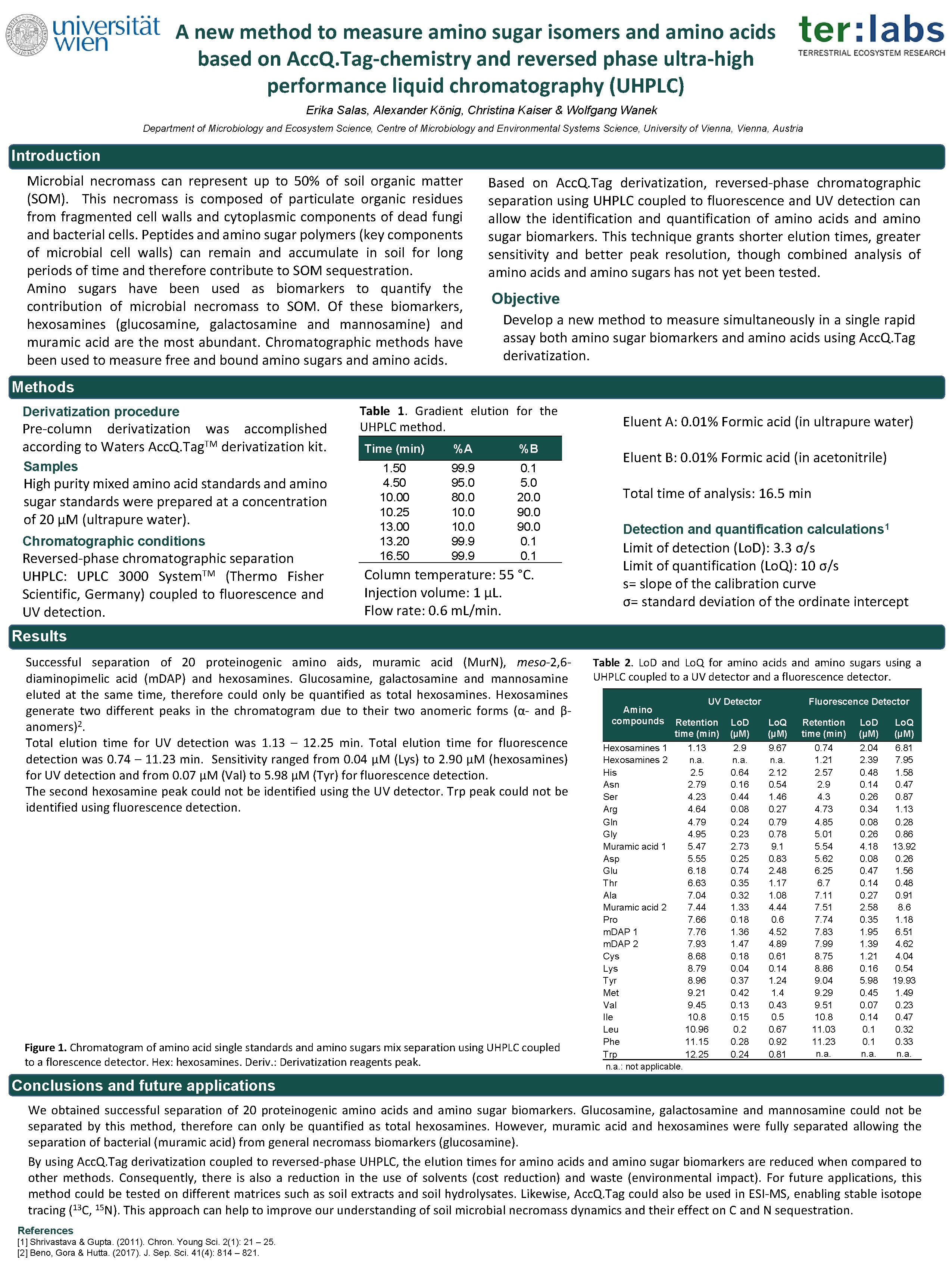
A new method to measure amino sugar isomers and amino acids based on Acc. Q. Tag-chemistry and reversed phase ultra-high performance liquid chromatography (UHPLC) Erika Salas, Alexander König, Christina Kaiser & Wolfgang Wanek Department of Microbiology and Ecosystem Science, Centre of Microbiology and Environmental Systems Science, University of Vienna, Austria Introduction Microbial necromass can represent up to 50% of soil organic matter (SOM). This necromass is composed of particulate organic residues from fragmented cell walls and cytoplasmic components of dead fungi and bacterial cells. Peptides and amino sugar polymers (key components of microbial cell walls) can remain and accumulate in soil for long periods of time and therefore contribute to SOM sequestration. Amino sugars have been used as biomarkers to quantify the contribution of microbial necromass to SOM. Of these biomarkers, hexosamines (glucosamine, galactosamine and mannosamine) and muramic acid are the most abundant. Chromatographic methods have been used to measure free and bound amino sugars and amino acids. Based on Acc. Q. Tag derivatization, reversed-phase chromatographic separation using UHPLC coupled to fluorescence and UV detection can allow the identification and quantification of amino acids and amino sugar biomarkers. This technique grants shorter elution times, greater sensitivity and better peak resolution, though combined analysis of amino acids and amino sugars has not yet been tested. Objective Develop a new method to measure simultaneously in a single rapid assay both amino sugar biomarkers and amino acids using Acc. Q. Tag derivatization. Methods Derivatization procedure Pre-column derivatization was accomplished according to Waters Acc. Q. Tag. TM derivatization kit. Samples High purity mixed amino acid standards and amino sugar standards were prepared at a concentration of 20 μM (ultrapure water). Chromatographic conditions Reversed-phase chromatographic separation UHPLC: UPLC 3000 System. TM (Thermo Fisher Scientific, Germany) coupled to fluorescence and UV detection. Table 1. Gradient elution for the UHPLC method. Time (min) %A %B 1. 50 4. 50 10. 00 10. 25 13. 00 13. 20 16. 50 99. 9 95. 0 80. 0 10. 0 99. 9 0. 1 5. 0 20. 0 90. 0 0. 1 Column temperature: 55 °C. Injection volume: 1 µL. Flow rate: 0. 6 m. L/min. Eluent A: 0. 01% Formic acid (in ultrapure water) Eluent B: 0. 01% Formic acid (in acetonitrile) Total time of analysis: 16. 5 min Detection and quantification calculations 1 Limit of detection (Lo. D): 3. 3 σ/s Limit of quantification (Lo. Q): 10 σ/s s= slope of the calibration curve σ= standard deviation of the ordinate intercept Results Successful separation of 20 proteinogenic amino aids, muramic acid (Mur. N), meso-2, 6 diaminopimelic acid (m. DAP) and hexosamines. Glucosamine, galactosamine and mannosamine eluted at the same time, therefore could only be quantified as total hexosamines. Hexosamines generate two different peaks in the chromatogram due to their two anomeric forms (α- and βanomers)2. Total elution time for UV detection was 1. 13 – 12. 25 min. Total elution time for fluorescence detection was 0. 74 – 11. 23 min. Sensitivity ranged from 0. 04 μM (Lys) to 2. 90 μM (hexosamines) for UV detection and from 0. 07 μM (Val) to 5. 98 μM (Tyr) for fluorescence detection. The second hexosamine peak could not be identified using the UV detector. Trp peak could not be identified using fluorescence detection. Figure 1. Chromatogram of amino acid single standards and amino sugars mix separation using UHPLC coupled to a florescence detector. Hex: hexosamines. Deriv. : Derivatization reagents peak. Table 2. Lo. D and Lo. Q for amino acids and amino sugars using a UHPLC coupled to a UV detector and a fluorescence detector. Amino compounds UV Detector Retention time (min) Hexosamines 1 1. 13 Hexosamines 2 n. a. His 2. 5 Asn 2. 79 Ser 4. 23 Arg 4. 64 Gln 4. 79 Gly 4. 95 Muramic acid 1 5. 47 Asp 5. 55 Glu 6. 18 Thr 6. 63 Ala 7. 04 Muramic acid 2 7. 44 Pro 7. 66 m. DAP 1 7. 76 m. DAP 2 7. 93 Cys 8. 68 Lys 8. 79 Tyr 8. 96 Met 9. 21 Val 9. 45 Ile 10. 8 Leu 10. 96 Phe 11. 15 Trp 12. 25 n. a. : not applicable. Fluorescence Detector Lo. D (µM) Lo. Q (µM) Retention time (min) Lo. D (µM) Lo. Q (µM) 2. 9 n. a. 0. 64 0. 16 0. 44 0. 08 0. 24 0. 23 2. 73 0. 25 0. 74 0. 35 0. 32 1. 33 0. 18 1. 36 1. 47 0. 18 0. 04 0. 37 0. 42 0. 13 0. 15 0. 28 0. 24 9. 67 n. a. 2. 12 0. 54 1. 46 0. 27 0. 79 0. 78 9. 1 0. 83 2. 48 1. 17 1. 08 4. 44 0. 6 4. 52 4. 89 0. 61 0. 14 1. 24 1. 4 0. 43 0. 5 0. 67 0. 92 0. 81 0. 74 1. 21 2. 57 2. 9 4. 3 4. 73 4. 85 5. 01 5. 54 5. 62 6. 25 6. 7 7. 11 7. 51 7. 74 7. 83 7. 99 8. 75 8. 86 9. 04 9. 29 9. 51 10. 8 11. 03 11. 23 n. a. 2. 04 2. 39 0. 48 0. 14 0. 26 0. 34 0. 08 0. 26 4. 18 0. 08 0. 47 0. 14 0. 27 2. 58 0. 35 1. 95 1. 39 1. 21 0. 16 5. 98 0. 45 0. 07 0. 14 0. 1 n. a. 6. 81 7. 95 1. 58 0. 47 0. 87 1. 13 0. 28 0. 86 13. 92 0. 26 1. 56 0. 48 0. 91 8. 6 1. 18 6. 51 4. 62 4. 04 0. 54 19. 93 1. 49 0. 23 0. 47 0. 32 0. 33 n. a. Conclusions and future applications We obtained successful separation of 20 proteinogenic amino acids and amino sugar biomarkers. Glucosamine, galactosamine and mannosamine could not be separated by this method, therefore can only be quantified as total hexosamines. However, muramic acid and hexosamines were fully separated allowing the separation of bacterial (muramic acid) from general necromass biomarkers (glucosamine). By using Acc. Q. Tag derivatization coupled to reversed-phase UHPLC, the elution times for amino acids and amino sugar biomarkers are reduced when compared to other methods. Consequently, there is also a reduction in the use of solvents (cost reduction) and waste (environmental impact). For future applications, this method could be tested on different matrices such as soil extracts and soil hydrolysates. Likewise, Acc. Q. Tag could also be used in ESI-MS, enabling stable isotope tracing (13 C, 15 N). This approach can help to improve our understanding of soil microbial necromass dynamics and their effect on C and N sequestration. References [1] Shrivastava & Gupta. (2011). Chron. Young Sci. 2(1): 21 – 25. [2] Beno, Gora & Hutta. (2017). J. Sep. Sci. 41(4): 814 – 821.