
A New Method For Numerical Constrained Optimization Ronald



- Slides: 25
A New Method For Numerical Constrained Optimization Ronald N. Perry Mitsubishi Electric Research Laboratories
Motivation • The applicability of optimization methods is widespread, reaching into almost every activity in which numerical information is processed • For a summary of applications and theory F See Fletcher “Practical Methods of Optimization” • For numerous applications in computer graphics F See Goldsmith and Barr “Applying constrained optimization to computer graphics” • In this sketch, we describe a method and not its application MERL
Informal Problem Statement • An ideal problem for constrained optimization F has a single measure defining the quality of a solution (called the objective function F) F plus some requirements upon that solution that must not be violated (called the constraints Ci) • A constrained optimization method maximizes (or minimizes) F while satisfying the Ci’s • Both F and Ci’s are functions of x RN, the input parameters to be determined MERL
Informal Problem Statement • Many flavors of optimization Fx can be real-valued, integer, mixed F F and Ci’s can be linear, quadratic, nonlinear F F and Ci’s can be smooth (i. e. , differentiable) or nonsmooth F F and Ci’s can be noisy or noise-free F methods can be globally convergent or global • Our focus F globally convergent methods F real-valued, nonlinear, potentially nonsmooth, potentially noisy, constrained problems MERL
Our Contribution • A new method for constraint handling, called partitioned performances, that F can be applied to established optimization algorithms F can improve their ability to traverse constrained space • A new optimization method, called SPIDER, that F applies partitioned performances to a new variation of the Nelder and Mead polytope algorithm MERL
An observation leads to an idea • Observation F Many constrained problems have optima that lie near constraint boundaries F Consequently, avoidance (or approximations) of constraints can hinder an algorithm’s path to the answer • Idea F By allowing (and even encouraging) an optimization algorithm to move its vertices into constrained space, a more efficient and robust algorithm emerges MERL
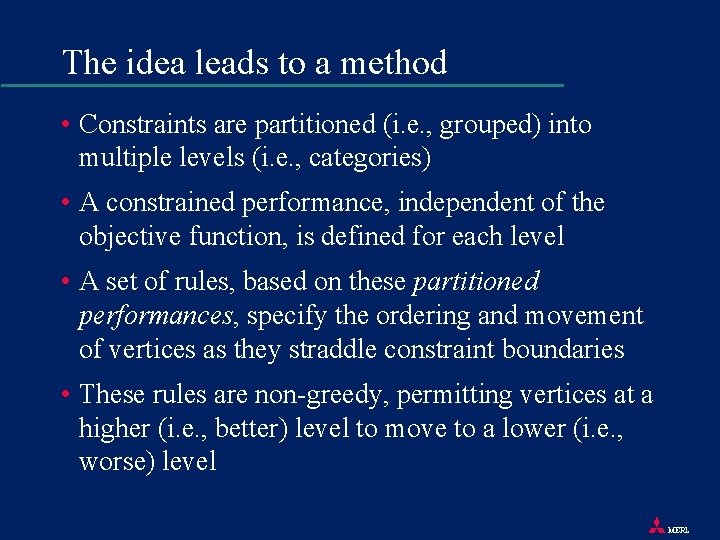
The idea leads to a method • Constraints are partitioned (i. e. , grouped) into multiple levels (i. e. , categories) • A constrained performance, independent of the objective function, is defined for each level • A set of rules, based on these partitioned performances, specify the ordering and movement of vertices as they straddle constraint boundaries • These rules are non-greedy, permitting vertices at a higher (i. e. , better) level to move to a lower (i. e. , worse) level MERL
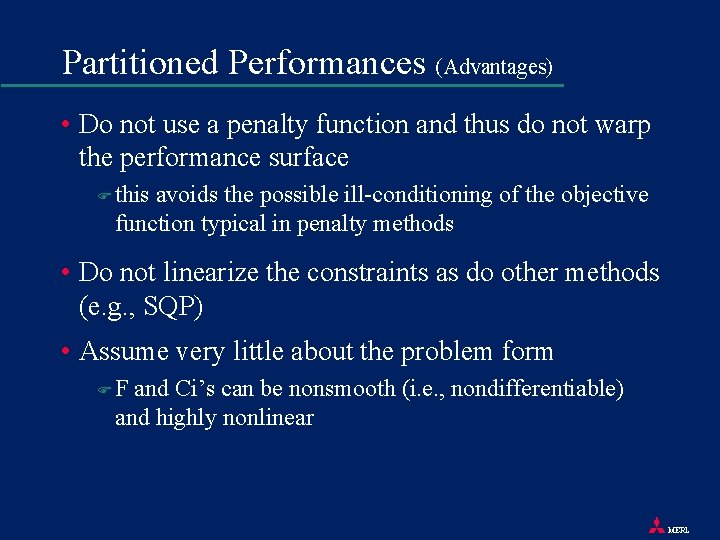
Partitioned Performances (Advantages) • Do not use a penalty function and thus do not warp the performance surface F this avoids the possible ill-conditioning of the objective function typical in penalty methods • Do not linearize the constraints as do other methods (e. g. , SQP) • Assume very little about the problem form FF and Ci’s can be nonsmooth (i. e. , nondifferentiable) and highly nonlinear MERL
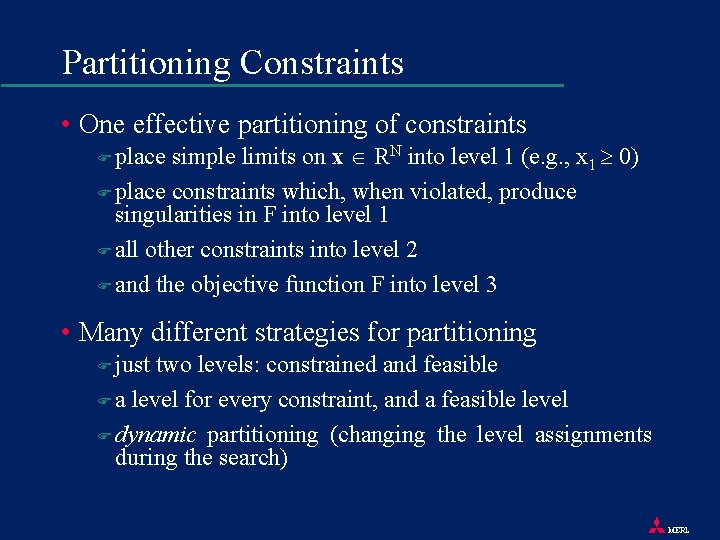
Partitioning Constraints • One effective partitioning of constraints simple limits on x RN into level 1 (e. g. , x 1 0) F place constraints which, when violated, produce singularities in F into level 1 F all other constraints into level 2 F and the objective function F into level 3 F place • Many different strategies for partitioning F just two levels: constrained and feasible F a level for every constraint, and a feasible level F dynamic partitioning (changing the level assignments during the search) MERL
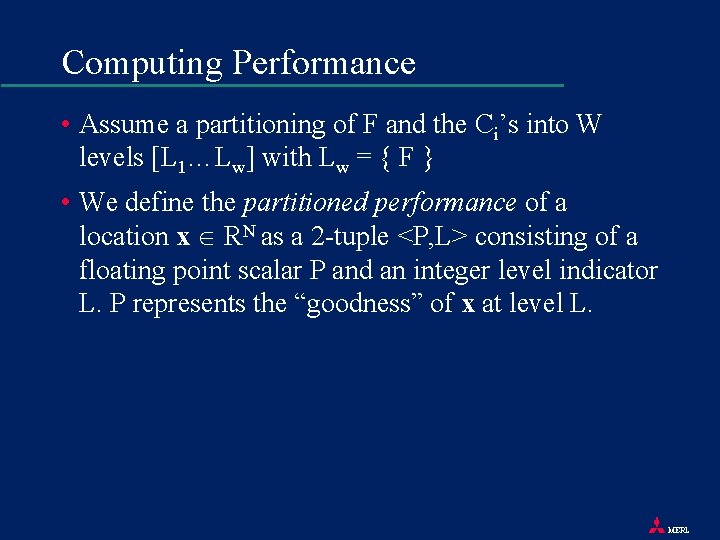
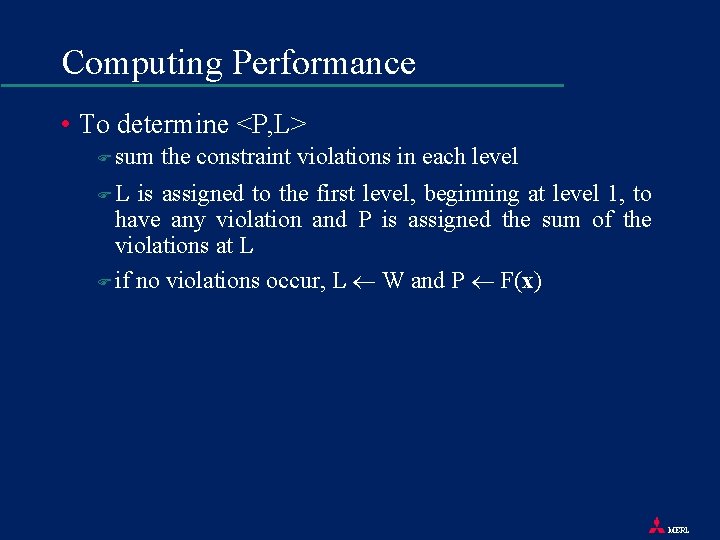
Computing Performance • Assume a partitioning of F and the Ci’s into W levels [L 1…Lw] with Lw = { F } • We define the partitioned performance of a location x RN as a 2 -tuple <P, L> consisting of a floating point scalar P and an integer level indicator L. P represents the “goodness” of x at level L. MERL
Computing Performance • To determine <P, L> F sum the constraint violations in each level FL is assigned to the first level, beginning at level 1, to have any violation and P is assigned the sum of the violations at L F if no violations occur, L W and P F(x) MERL
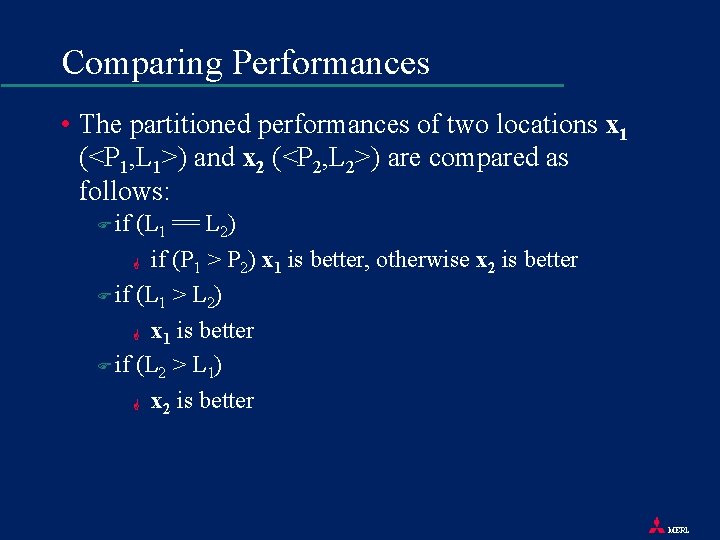
Comparing Performances • The partitioned performances of two locations x 1 (<P 1, L 1>) and x 2 (<P 2, L 2>) are compared as follows: F if (L 1 == L 2) G if (P 1 > P 2) x 1 is better, otherwise x 2 is better F if (L 1 > L 2) G x 1 is better F if (L 2 > L 1) G x 2 is better MERL
SPIDER Method • Applies partitioned performances to a new variation of the Nelder and Mead polytope algorithm • Rules for ordering and movement using partitioned performances are demonstrated MERL
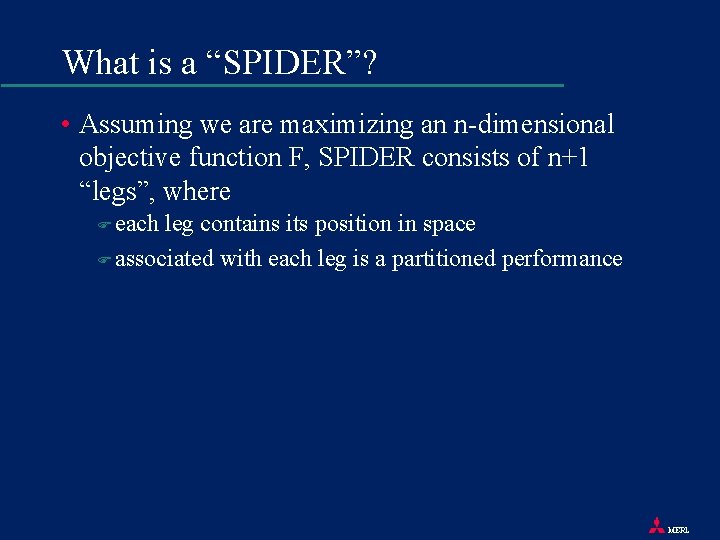
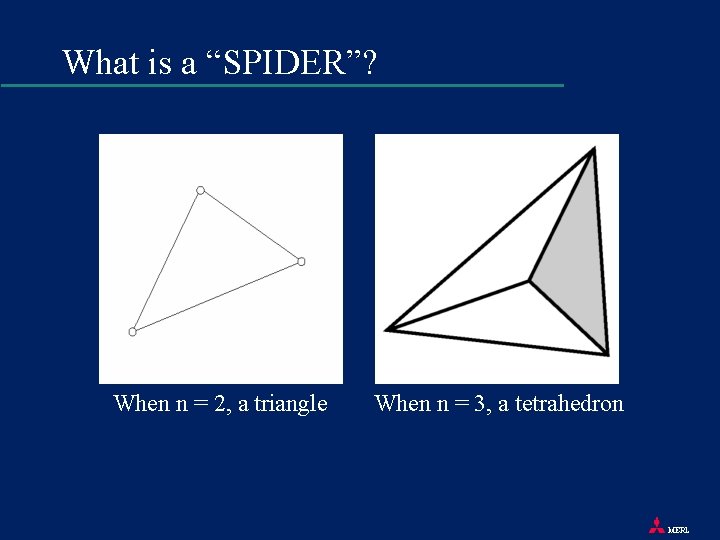
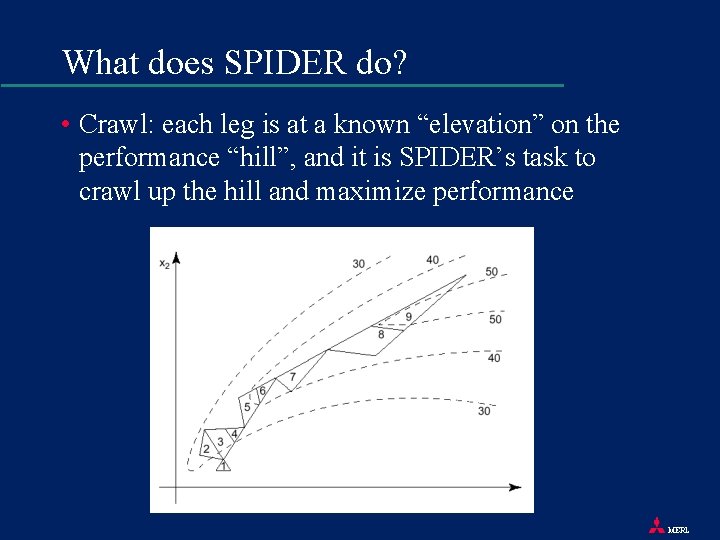
What is a “SPIDER”? • Assuming we are maximizing an n-dimensional objective function F, SPIDER consists of n+1 “legs”, where F each leg contains its position in space F associated with each leg is a partitioned performance MERL
What is a “SPIDER”? When n = 2, a triangle When n = 3, a tetrahedron MERL
What does SPIDER do? • Crawl: each leg is at a known “elevation” on the performance “hill”, and it is SPIDER’s task to crawl up the hill and maximize performance MERL
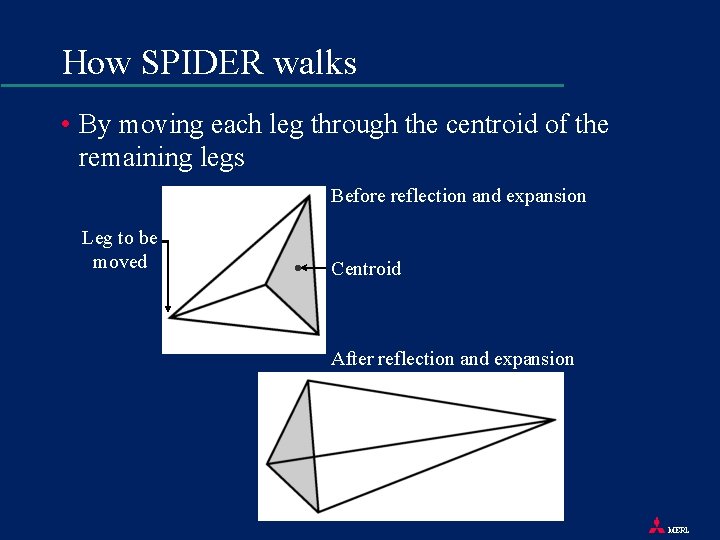
How SPIDER walks • By moving each leg through the centroid of the remaining legs Before reflection and expansion Leg to be moved Centroid After reflection and expansion MERL
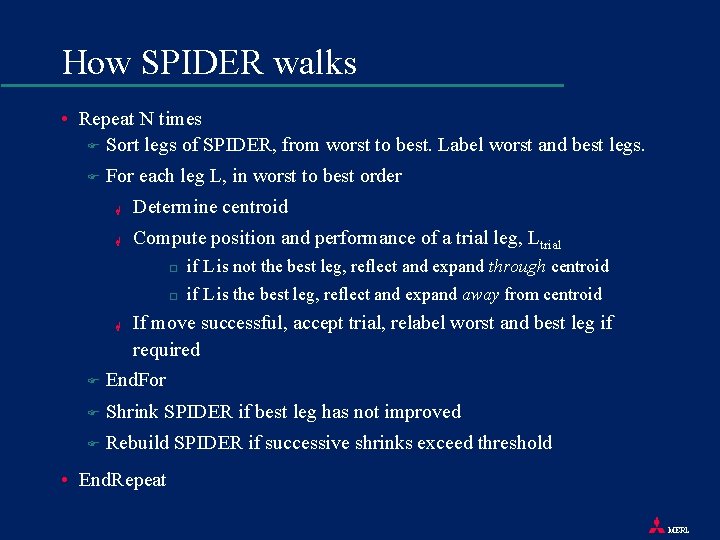
How SPIDER walks • Repeat N times F Sort legs of SPIDER, from worst to best. Label worst and best legs. F For each leg L, in worst to best order G Determine centroid G Compute position and performance of a trial leg, Ltrial G o if L is not the best leg, reflect and expand through centroid o if L is the best leg, reflect and expand away from centroid If move successful, accept trial, relabel worst and best leg if required F End. For F Shrink SPIDER if best leg has not improved F Rebuild SPIDER if successive shrinks exceed threshold • End. Repeat MERL
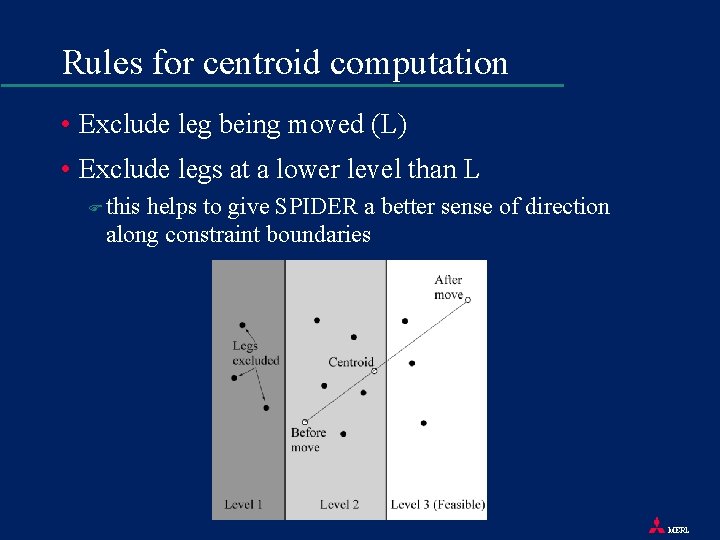
Rules for centroid computation • Exclude leg being moved (L) • Exclude legs at a lower level than L F this helps to give SPIDER a better sense of direction along constraint boundaries MERL
Rules for moving a non-best leg • Same level (level of Ltrial = = level of L) F accept G trial leg if P value of Ltrial > P value of L • Going down levels (level of Ltrial < level of L) F accept trial leg if its better than the worst leg • Going up levels (level of Ltrial > level of L) F accept trial leg if its better than the best leg MERL
Rules for moving the best leg • It must improve in performance in order to move • This gives SPIDER the ability to “straddle” and thus track along a constraint boundary MERL
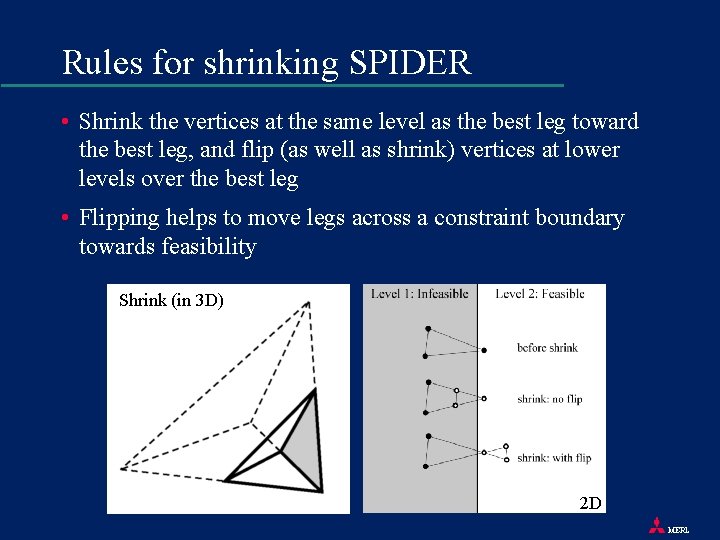
Rules for shrinking SPIDER • Shrink the vertices at the same level as the best leg toward the best leg, and flip (as well as shrink) vertices at lower levels over the best leg • Flipping helps to move legs across a constraint boundary towards feasibility Shrink (in 3 D) 2 D MERL
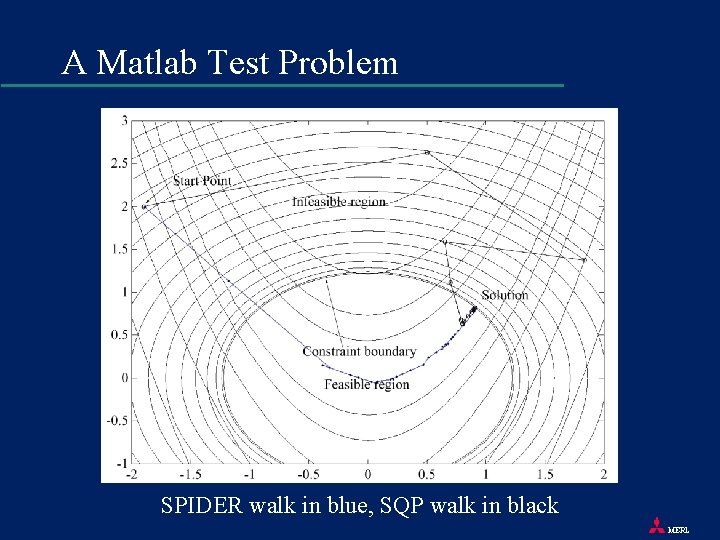
A Matlab Test Problem • Sequential Quadratic Programming (SQP) methods represent the state-of-the-art in nonlinear constrained optimization • SQP methods out perform every other tested method in terms of efficiency, accuracy, and percentage of successful solutions, over a large number of test problems • On a Matlab test problem F Matlab SQP Implementation, 96 function calls F SPIDER, 108 function calls MERL
A Matlab Test Problem SPIDER walk in blue, SQP walk in black MERL
The End #include <stdio. h> #include <string. h> #define MAX_DIMS 20 #define MAX_LEGS 25 #define MAX_CONS 20 #define MAX_LEVELS 20 #define DFT_SHRINK_FACTOR 0. 5 f #define DFT_EXP_FACTOR 1. 5 f #define DFT_SHRINK_REB 7 #define DFT_BUILD_MFACTOR 0. 0 f #define DFT_LOG_PATH 0 #define DFT_VERBOSE 1 typedef float (*opt. Obj. Func) (float *p); typedef float (*opt. Cons. Func) (float *p); typedef struct { int level; float perf; } Perf; typedef struct { int dim; opt. Obj. Func obj. Func; int num. Levels; int num. Cons. In. Level[MAX_LEVELS]; opt. Cons. Func cons. Func[MAX_LEVELS] [MAX_CONS]; int num. Legs; float legs[MAX_LEGS][MAX_DIMS]; Perf perf[MAX_LEGS]; int order[MAX_LEGS]; int best. Leg; int worst. Leg; int cur. Leg; float start. Pt[MAX_DIMS]; float size. Of. Space[MAX_DIMS]; float centroid[MAX_DIMS]; float trial[MAX_DIMS]; float exp. Factor; float shrink. Factor; int num. Shrinks. Before. Rebuild ; int num. Shrinks; float build. Mult. Factor; int log. Path; int verbose; int num. Func. Calls; } SPIDER; float Rosenbrocks (float *p) { float x 1 = p[0]; float x 2 = p[1]; float t 1 = (x 2 - x 1 * x 1); float t 2 = (1. 0 f - x 1); float fx = 100. 0 f * t 1 + t 2 * t 2; return(- fx); } float Ellip. Cons (float *p) { float x 1 = p[0]; float x 2 = p[1]; float cx = x 1 * x 1 + x 2 * x 2 1. 5 f; return(-cx); } void SPIDERCycle (SPIDER *S, int cycle. Count); void SPIDERBuild (SPIDER *S); void SPIDERScore (SPIDER *S); Perf SPIDERLeg. Perf (SPIDER *S, float *leg); int SPIDERPerf. Better (Perf P 1, Perf P 2); int SPIDERPerf. Worse (Perf P 1, Perf P 2); void SPIDERSet. Worst. Leg (SPIDER *S); void SPIDERCentroid (SPIDER *S); void SPIDERSort (SPIDER *S); void SPIDERShrink (SPIDER *S); void SPIDERRebuild (SPIDER *S); void SPIDERPrint (SPIDER *S); void SPIDERCycle (SPIDER *S, int cycle. Count) { Perf PTrial; Perf PCurrent; Perf PBest; Perf PWorst; int i, j, n; int best. Leg. Better; FILE *fd = 0; if (S->log. Path) { fd = fopen("log. txt", "wt"); for (j = 0; j < S->dim; ++j) fprintf(fd, "%. 4 f ", S>start. Pt[j]); fprintf(fd, "n"); } S->num. Shrinks = 0; for (n = 0; n < cycle. Count; ++n) { best. Leg. Better = 0; SPIDERSort(S); for (i = 0; i < S->num. Legs; ++i) { S->cur. Leg = S>order[i]; SPIDERCentroid(S); if (S->cur. Leg == S->best. Leg) { for (j = 0; j < S->dim; ++j) { float span = S->centroid[j] - S->legs[S-> cur. Leg][j]; S->trial[j] = S->centroid[j] span * S->exp. Factor; } PBest = S->perf[S->best. Leg]; PTrial = SPIDERLeg. Perf(S, S->trial); if (SPIDERPerf. Better(PTrial, PBest)) { for (j = 0; j < S->dim; ++j) S->legs[S>cur. Leg][j] = S->trial[j]; S->perf[S->cur. Leg] = PTrial; best. Leg. Better = 1; continue; } } else { for (j = 0; j < S->dim; ++j) { float span = S->centroid[j] - S->legs[S>cur. Leg][j]; S->trial[j] = S->centroid[j] + span * S-> exp. Factor; } PCurrent = S->perf[S->cur. Leg]; PBest = S->perf[S->best. Leg]; PWorst = S->perf[S->worst. Leg]; PTrial = SPIDERLeg. Perf(S, S->trial); if ((PTrial. level == PCurrent. level && PTrial. perf > PCurrent. perf) || (PTrial. level > PCurrent. level && SPIDERPerf. Better (PTrial, PBest)) || (PTrial. level < PCurrent. level && SPIDERPerf. Better(PTrial, PWorst))) { for (j = 0; j < S->dim; ++j) S->legs[S-> cur. Leg][j] = S->trial[j]; S->perf[S->cur. Leg] = PTrial; SPIDERSet. Worst. Leg(S); if (SPIDERPerf. Better(PTrial, PBest)) { S->best. Leg = S->cur. Leg; best. Leg. Better = 1; } } if (!best. Leg. Better) { if (S->num. Shrinks < S>num. Shrinks. Before. Rebuild) { if (S->verbose) printf("Cycle: %. 2 d < ----- Shrink Required >n", n + 1); SPIDERShrink(S); ++S->num. Shrinks; } else { if (S->verbose) printf("Cycle: %. 2 d < ----- Rebuild Required >n", n + 1); SPIDERRebuild(S); S->num. Shrinks = 0; } } else { S->num. Shrinks = 0; } if (S->verbose) { int leg. Idx = S->best. Leg; printf("Cycle: %. 2 d ", n + 1); printf("< Func. Calls %d, Level %d, Perf %. 4 f: ", S->num. Func. Calls, S->perf[leg. Idx]. level, S->perf[leg. Idx]. perf); for (j = 0; j < S->dim; ++j) printf("%. 4 f ", S>legs[leg. Idx][j]); printf(">n"); } if (S->log. Path) { int leg. Idx = S->best. Leg; for (j = 0; j < S->dim; ++j) fprintf(fd, "%. 4 f ", S->legs[leg. Idx][j]); fprintf(fd, "n"); } } if (S->log. Path) fclose(fd); SPIDERSort(S); } void SPIDERBuild (SPIDER *S) { int use. Rand = (S->build. Mult. Factor == 0. 0 f ? 1 : 0); if (S-> num. Legs == S->dim + 1) { int i, j; for (i = 0; i < S->num. Legs; ++i) { for (j = 0; j < S->dim; ++j) { S->legs[i][j] = S-> start. Pt[j]; if (i == j) { float r = ( use. Rand ? (((float) rand()) / ((float) RAND_MAX)) : S>build. Mult. Factor); S->legs[i][j] += r * S-> size. Of. Space[j]; } } else { int i, j; for (i = 0; i < S-> num. Legs; ++i) { for (j = 0; j < S->dim; ++j) { S->legs[i][j] = S>start. Pt[j]; if (i != 0) { float r = ( use. Rand ? (((float) rand()) / ((float) RAND_MAX)) : S-> build. Mult. Factor); S->legs[i][j] += r * S-> size. Of. Space[j]; } } SPIDERScore(S); SPIDERSort(S); } void SPIDERScore (SPIDER *S) { int n; for (n = 0; n < S->num. Legs; ++n) S->perf[n] = SPIDERLeg. Perf(S, &S->legs[n][0]); } Perf SPIDERLeg. Perf (SPIDER *S, float *leg) { ++S->num. Func. Calls; if (S->num. Levels == 0) { Perf P; P. level = 0; P. perf = (*S->obj. Func)(leg); return(P); } else { Perf P; int i, n; for (n = 0; n < S-> num. Levels; ++n) { float level. Sum = 0. 0 f; for (i = 0; i < S-> num. Cons. In. Level[n]; ++i) { float cons. Val = (*S->cons. Func[n][i])(leg); if (cons. Val < 0. 0 f) level. Sum += cons. Val; } if (level. Sum < 0. 0 f) { P. level = n; P. perf = level. Sum; return(P); } } P. level = S-> num. Levels; P. perf = (*S->obj. Func)(leg); return(P); } } int SPIDERPerf. Better (Perf P 1, Perf P 2) { if (P 1. level > P 2. level) return(1); if (P 1. level < P 2. level) return(0); if (P 1. perf > P 2. perf) return(1); return(0); } int SPIDERPerf. Worse (Perf P 1, Perf P 2) { if (P 1. level < P 2. level) return(1); if (P 1. level > P 2. level) return(0); if (P 1. perf < P 2. perf) return(1); return(0); } void SPIDERSet. Worst. Leg (SPIDER *S) { int n; Perf worst. Leg. Perf = S->perf[0]; S>worst. Leg = 0; for (n = 1; n < S-> num. Legs; ++n) { if (SPIDERPerf. Worse(S->perf[n], worst. Leg. Perf)) { S->worst. Leg = n; worst. Leg. Perf = S->perf[n]; } } } void SPIDERCentroid (SPIDER *S) { int i, n; int num. Valid. Legs = 0; int num. Centroid. Legs = 0; int cur. Leg = S->cur. Leg; for (i = 0; i < S->dim; ++i) S->centroid[i] = 0. 0 f; for (n = 0; n < S-> num. Legs; ++n) { if (n == cur. Leg) continue; if (S->perf[n]. level < S->perf[cur. Leg]. level) continue; ++num. Valid. Legs; } if (num. Valid. Legs <= (S->num. Legs / 2)) { for (n = 0; n < S-> num. Legs; ++n) { if (n == cur. Leg) continue; for (i = 0; i < S->dim; ++i) S->centroid[i] += S->legs[n][i]; ++ num. Centroid. Legs; } } else { for (n = 0; n < S-> num. Legs; ++n) { if (n == cur. Leg) continue; if (S->perf[n]. level < S->perf[cur. Leg]. level) continue; for (i = 0; i < S->dim; ++i) S->centroid[i] += S->legs[n][i]; ++ num. Centroid. Legs; } } for (i = 0; i < S->dim; ++i) S->centroid[i] /= (float) num. Centroid. Legs; } void SPIDERSort (SPIDER *S) { int i, j; for (i = 0; i < S-> num. Legs; i++) S->order[i] = i; for (i = 0; i < S-> num. Legs; i++) { for (j = 1; j < (S->num. Legs - i); j++) { Perf P 1 = S->perf[S->order[j - 1]]; Perf P 2 = S->perf[S->order[j]]; if (P 1. level > P 2. level || (P 1. level == P 2. level && P 1. perf > P 2. perf)) { int t; t = S->order[j - 1]; S->order[j - 1] = S->order[j]; S->order[j] = t; } } } S-> worst. Leg = S->order[0]; S->best. Leg = S->order[S->num. Legs - 1]; } void SPIDERShrink (SPIDER *S) { int i, j; int best. Leg = S->best. Leg; int best. Leg. Level = S->perf[best. Leg]. level; float shrink. Factor = S->shrink. Factor; for (i = 0; i < S->num. Legs; ++i) { if (i == best. Leg) continue; if (S->perf[i]. level == best. Leg. Level) { for (j = 0; j < S->dim; ++j) { S->legs[i][j] = shrink. Factor * S->legs[i][j] + (1. 0 f - shrink. Factor) * S>legs[best. Leg][j]; } } else { for (j = 0; j < S->dim; ++j) { float coord = S->legs[i][j]; S->legs[i][j] = coord + (S->legs[best. Leg][j] - coord) * (1. 0 f + shrink. Factor); } } } SPIDERScore(S); } void SPIDERRebuild (SPIDER *S) { int n; float start. Pt[MAX_DIMS]; for (n = 0; n < S->dim; ++n) { start. Pt[n] = S->start. Pt[n]; S->start. Pt[n] = S->legs[S>best. Leg][n]; } SPIDERBuild(S); for (n = 0; n < S->dim; ++n) S-> start. Pt[n] = start. Pt[n]; } void SPIDERPrint (SPIDER *S) { int i, j; printf("Func calls: %dn", S->num. Func. Calls); printf("Exp Factor: %. 2 fn", S->exp. Factor); printf("Srk Factor: %. 2 fn", S->shrink. Factor); printf("Bld Factor: %. 2 fn", S->build. Mult. Factor); SPIDERSort(S); for (i = 0; i < S>num. Legs; ++i) { int leg. Idx = S->order[i]; printf("Leg %d, Level %d, Perf %. 4 f: ", leg. Idx + 1, S->perf[leg. Idx]. level, S->perf[leg. Idx]. perf); for (j = 0; j < S->dim; ++j) printf("%. 4 f ", S->legs[leg. Idx][j]); printf("n"); } } void main (void) { SPIDER S; S. dim = 2; S. obj. Func = Rosenbrocks; S. num. Levels = 1; S. num. Cons. In. Level[0] = 1; S. cons. Func[0][0] = Ellip. Cons; S. num. Legs = 3; S. start. Pt[0] = -1. 9 f; S. start. Pt[1] = +2. 0 f; S. size. Of. Space[0] = 1. 0 f; S. size. Of. Space[1] = 1. 0 f; S. exp. Factor = DFT_EXP_FACTOR; S. shrink. Factor = DFT_SHRINK_FACTOR; S. num. Shrinks. Before. Rebuild = DFT_SHRINK_REB; S. build. Mult. Factor = DFT_BUILD_MFACTOR; S. log. Path = DFT_LOG_PATH; S. verbose = DFT_VERBOSE; S. num. Func. Calls = 0; SPIDERBuild(&S); SPIDERCycle(&S, 50); } MERL