
A new mechanism of mercury Hg uptake and
- Slides: 2
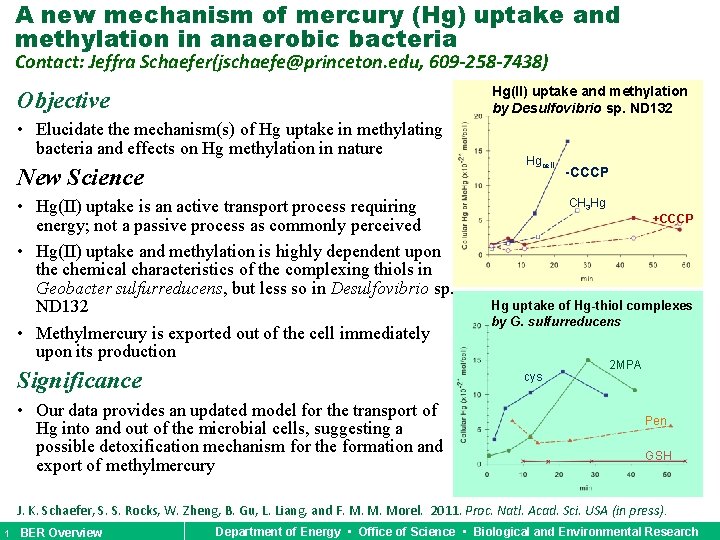
A new mechanism of mercury (Hg) uptake and methylation in anaerobic bacteria Contact: Jeffra Schaefer(jschaefe@princeton. edu, 609 -258 -7438) Hg(II) uptake and methylation by Desulfovibrio sp. ND 132 Objective • Elucidate the mechanism(s) of Hg uptake in methylating bacteria and effects on Hg methylation in nature New Science • Hg(II) uptake is an active transport process requiring energy; not a passive process as commonly perceived • Hg(II) uptake and methylation is highly dependent upon the chemical characteristics of the complexing thiols in Geobacter sulfurreducens, but less so in Desulfovibrio sp. ND 132 • Methylmercury is exported out of the cell immediately upon its production Significance Hgcell CH 3 Hg +CCCP Hg uptake of Hg-thiol complexes by G. sulfurreducens cys • Our data provides an updated model for the transport of Hg into and out of the microbial cells, suggesting a possible detoxification mechanism for the formation and export of methylmercury -CCCP 2 MPA Pen GSH J. K. Schaefer, S. S. Rocks, W. Zheng, B. Gu, L. Liang, and F. M. M. Morel. 2011. Proc. Natl. Acad. Sci. USA (in press). 1 BER Overview Department of Energy • Office of Science • Biological and Environmental Research
Active Transport, Substrate Specificity, and Methylation of Hg(II) in Anaerobic Bacteria Contact: Jeffra Schaefer(jschaefe@princeton. edu, 609 -258 -7438) 2 The formation of methylmercury (Me. Hg), which is biomagnified in aquatic food chains and poses a risk to human health, is effected by some iron and sulfate reducing bacteria (Fe. RB and SRB) in anaerobic environments. But very little is known regarding the mechanism of uptake of inorganic Hg by these organisms, in part because of the inherent difficulty in measuring the intracellular Hg concentration. Using the Fe. RB Geobacter sulfurreducens and the SRB Desulfovibrio desulfuricans ND 132 as model organisms, we demonstrate that Hg(II) uptake occurs by active transport. We also establish that Hg(II) uptake by G. sulfurreducens is highly dependent on the characteristics of the thiols that bind Hg(II) in the external medium, with some thiols promoting uptake and methylation and others inhibiting both. The Hg(II) uptake system of D. desulfuricans has a higher affinity than that of G. sulfurreducens and promotes Hg methylation in the presence of stronger complexing thiols. We observed a tight coupling between Hg methylation and Me. Hg export from the cell, suggesting that these two processes may serve to avoid the build up and toxicity of cellular Hg. Our results bring up the question of whether cellular Hg uptake is specific for Hg(II), or accidental, occurring via Schaefer, J. K. , S. S. Rocks, W. Zheng, B. Gu, L. Liang, F. M. also M. Morel. 2011. Active transport, substrate specificity, some essential metal importer. Ourand data point at Hg(II) complexation by and methylation of Hg(II) in anaerobic bacteria. Proc. Natl. Acad. Sci. USA (in press). thiols as an important factor controlling Hg methylation in anaerobic environments. Department of Energy • Office of Science • Biological and Environmental Research BER Overview