
A New Inspection Process for Ontario LTC Homes
- Slides: 23
A New Inspection Process for Ontario LTC Homes ~ Introduction and Overview April 27, 2010 Karen Slater, Senior Manager Karin Fairchild, Business Lead, Compliance Transformation Project Performance Improvement and Compliance Branch Ministry of Health and Long-Term Care
Compliance Transformation Making a quality difference for Ontario LTC Home residents 2
Compliance Transformation Why change now? We are transforming the inspection process to: • Align with requirements of the Long-Term Care Homes Act, 2007 (LTCHA) and any regulations thereunder. The LTCHA is to be proclaimed on July 1, 2010. • Ensure that the over 75, 000 residents in LTC homes continue to be protected and cared for, and their dignity and rights respected. • Assure the public that our first priority is the care and safety of residents. 3
Compliance Transformation What are the goals? • Provide confidence in our inspection process to: - Residents - Family - The public - LTC home staff - Compliance staff • • Support the sector in their efforts to deliver quality care • Where there are risks, ensure risks are mitigated Through clear communications ensure all stakeholders are aware of and understand expectations 4
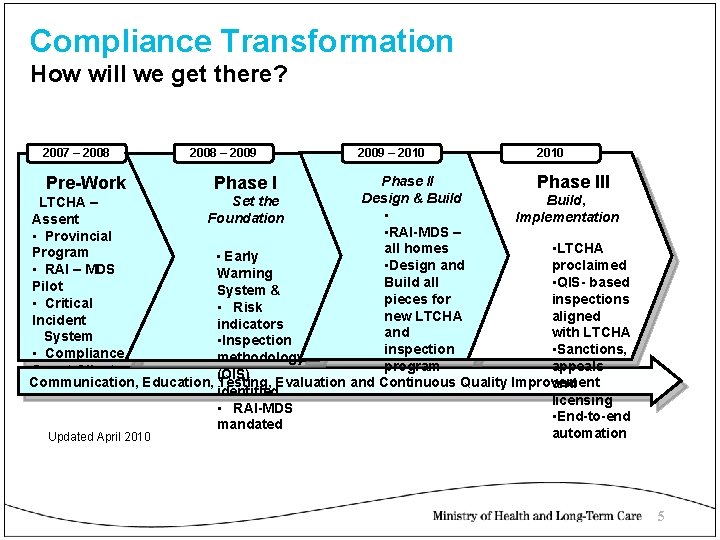
Compliance Transformation How will we get there? 2007 – 2008 – 2009 – 2010 Phase III Design & Build, Set the LTCHA – • Implementation Foundation Assent • RAI-MDS – • Provincial • LTCHA all homes Program • Early proclaimed • Design and • RAI – MDS Warning • QIS- based Build all Pilot System & inspections pieces for • Critical • Risk aligned new LTCHA Incident indicators with LTCHA and System • Inspection • Sanctions, inspection • Compliance methodology appeals program Smart Client (QIS) Communication, Education, Testing, Evaluation and Continuous Quality Improvement and Development identified licensing • RAI-MDS • End-to-end mandated automation Updated April 2010 Pre-Work Phase I 5
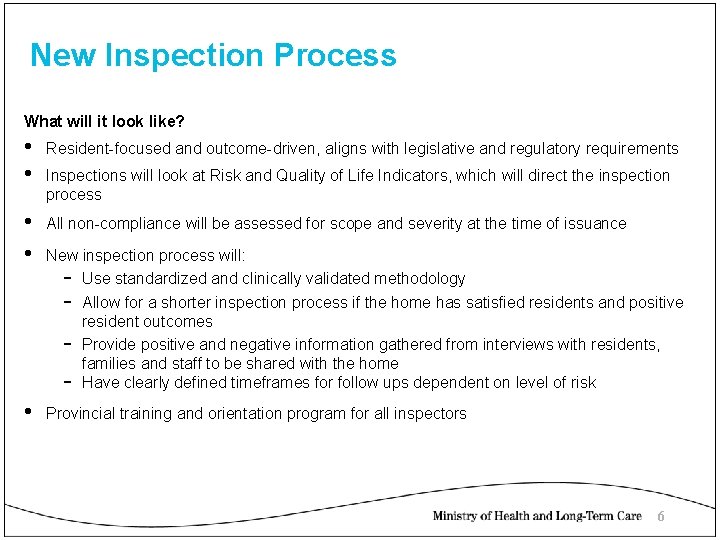
New Inspection Process What will it look like? • • Resident-focused and outcome-driven, aligns with legislative and regulatory requirements • • All non-compliance will be assessed for scope and severity at the time of issuance • Provincial training and orientation program for all inspectors Inspections will look at Risk and Quality of Life Indicators, which will direct the inspection process New inspection process will: - Use standardized and clinically validated methodology - Allow for a shorter inspection process if the home has satisfied residents and positive resident outcomes - Provide positive and negative information gathered from interviews with residents, families and staff to be shared with the home - Have clearly defined timeframes for follow ups dependent on level of risk 6
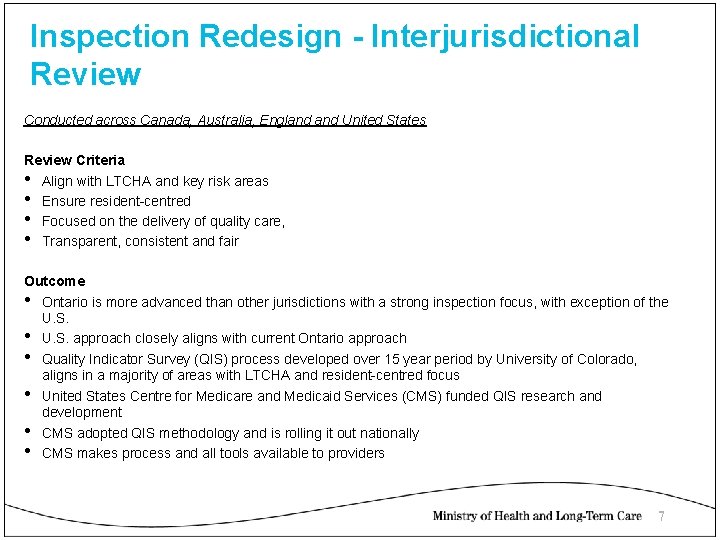
Inspection Redesign - Interjurisdictional Review Conducted across Canada, Australia, England United States Review Criteria • Align with LTCHA and key risk areas • Ensure resident-centred • Focused on the delivery of quality care, • Transparent, consistent and fair Outcome • Ontario is more advanced than other jurisdictions with a strong inspection focus, with exception of the U. S. • U. S. approach closely aligns with current Ontario approach • Quality Indicator Survey (QIS) process developed over 15 year period by University of Colorado, aligns in a majority of areas with LTCHA and resident-centred focus • United States Centre for Medicare and Medicaid Services (CMS) funded QIS research and development • CMS adopted QIS methodology and is rolling it out nationally • CMS makes process and all tools available to providers 7
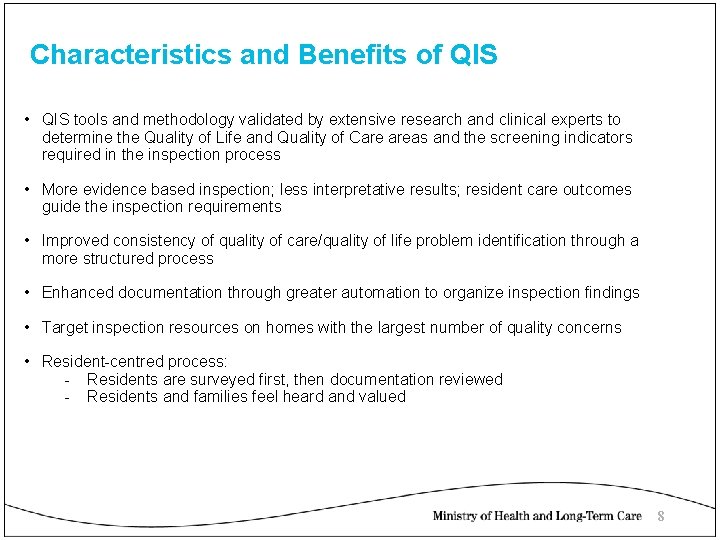
Characteristics and Benefits of QIS • QIS tools and methodology validated by extensive research and clinical experts to determine the Quality of Life and Quality of Care areas and the screening indicators required in the inspection process • More evidence based inspection; less interpretative results; resident care outcomes guide the inspection requirements • Improved consistency of quality of care/quality of life problem identification through a more structured process • Enhanced documentation through greater automation to organize inspection findings • Target inspection resources on homes with the largest number of quality concerns • Resident-centred process: - Residents are surveyed first, then documentation reviewed - Residents and families feel heard and valued 8
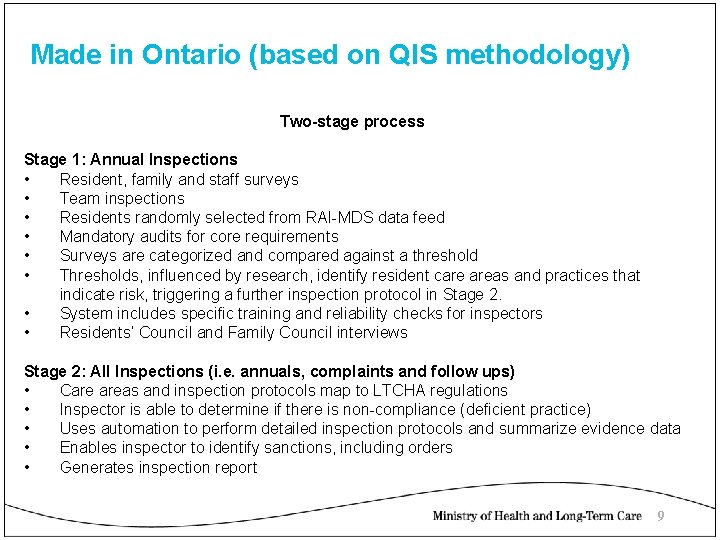
Made in Ontario (based on QIS methodology) Two-stage process Stage 1: Annual Inspections • Resident, family and staff surveys • Team inspections • Residents randomly selected from RAI-MDS data feed • Mandatory audits for core requirements • Surveys are categorized and compared against a threshold • Thresholds, influenced by research, identify resident care areas and practices that indicate risk, triggering a further inspection protocol in Stage 2. • System includes specific training and reliability checks for inspectors • Residents’ Council and Family Council interviews Stage 2: All Inspections (i. e. annuals, complaints and follow ups) • Care areas and inspection protocols map to LTCHA regulations • Inspector is able to determine if there is non-compliance (deficient practice) • Uses automation to perform detailed inspection protocols and summarize evidence data • Enables inspector to identify sanctions, including orders • Generates inspection report 9
Compliance Transformation: Vision for the Inspection Process 10
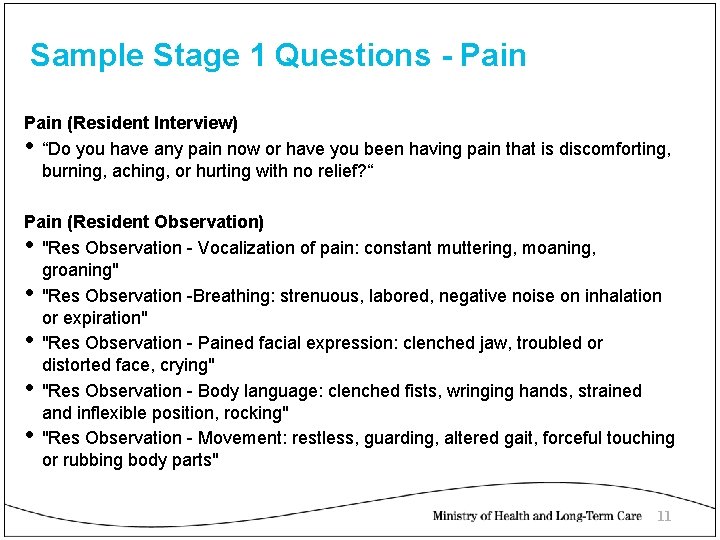
Sample Stage 1 Questions - Pain (Resident Interview) • “Do you have any pain now or have you been having pain that is discomforting, burning, aching, or hurting with no relief? “ Pain (Resident Observation) • "Res Observation - Vocalization of pain: constant muttering, moaning, groaning" • "Res Observation -Breathing: strenuous, labored, negative noise on inhalation or expiration" • "Res Observation - Pained facial expression: clenched jaw, troubled or distorted face, crying" • "Res Observation - Body language: clenched fists, wringing hands, strained and inflexible position, rocking" • "Res Observation - Movement: restless, guarding, altered gait, forceful touching or rubbing body parts" 11
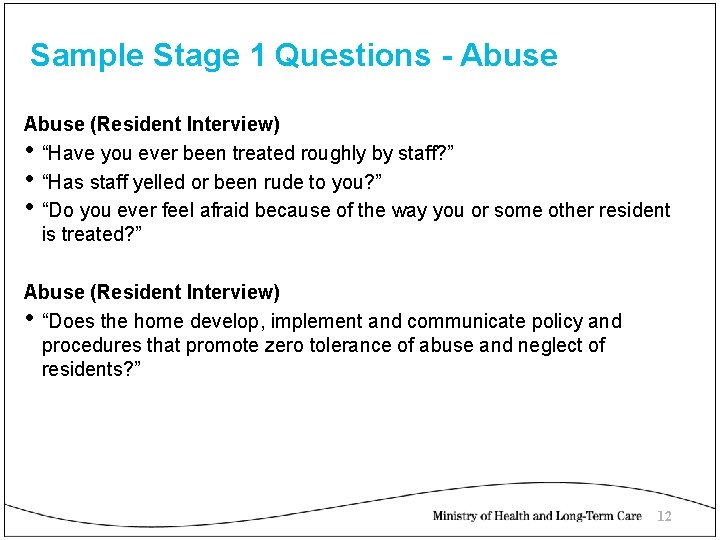
Sample Stage 1 Questions - Abuse (Resident Interview) • “Have you ever been treated roughly by staff? ” • “Has staff yelled or been rude to you? ” • “Do you ever feel afraid because of the way you or some other resident is treated? ” Abuse (Resident Interview) • “Does the home develop, implement and communicate policy and procedures that promote zero tolerance of abuse and neglect of residents? ” 12
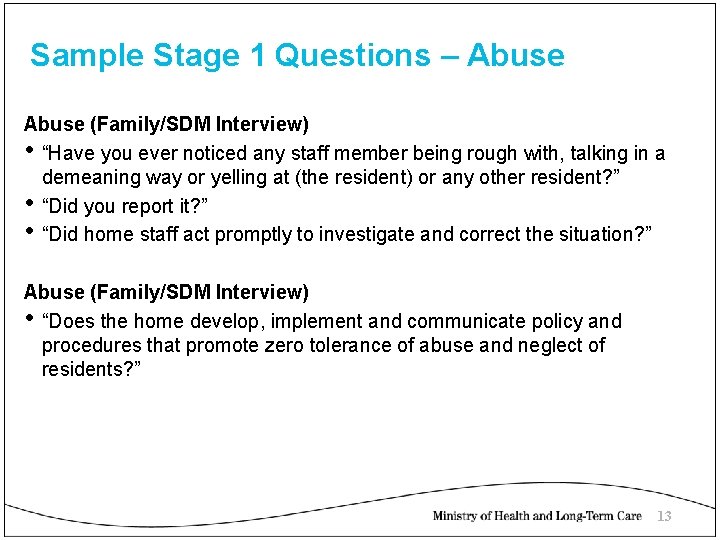
Sample Stage 1 Questions – Abuse (Family/SDM Interview) • “Have you ever noticed any staff member being rough with, talking in a demeaning way or yelling at (the resident) or any other resident? ” • “Did you report it? ” • “Did home staff act promptly to investigate and correct the situation? ” Abuse (Family/SDM Interview) • “Does the home develop, implement and communicate policy and procedures that promote zero tolerance of abuse and neglect of residents? ” 13
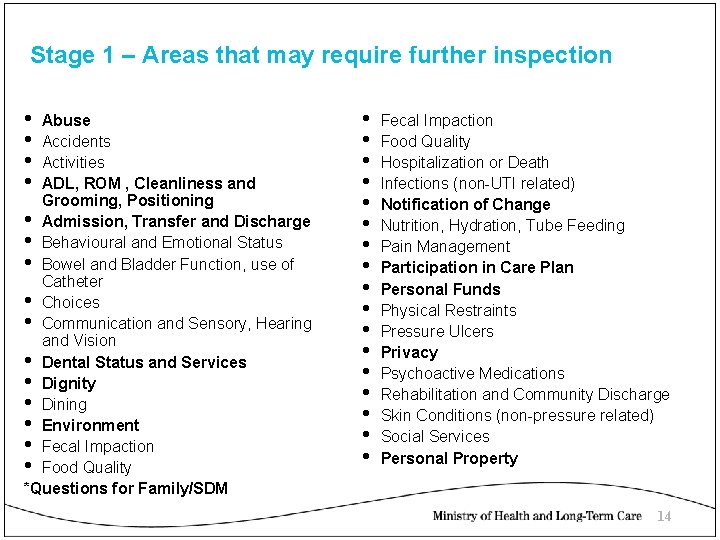
Stage 1 – Areas that may require further inspection • • Abuse Accidents Activities ADL, ROM , Cleanliness and Grooming, Positioning • Admission, Transfer and Discharge • Behavioural and Emotional Status • Bowel and Bladder Function, use of Catheter • Choices • Communication and Sensory, Hearing and Vision • Dental Status and Services • Dignity • Dining • Environment • Fecal Impaction • Food Quality *Questions for Family/SDM • • • • • Fecal Impaction Food Quality Hospitalization or Death Infections (non-UTI related) Notification of Change Nutrition, Hydration, Tube Feeding Pain Management Participation in Care Plan Personal Funds Physical Restraints Pressure Ulcers Privacy Psychoactive Medications Rehabilitation and Community Discharge Skin Conditions (non-pressure related) Social Services Personal Property 14
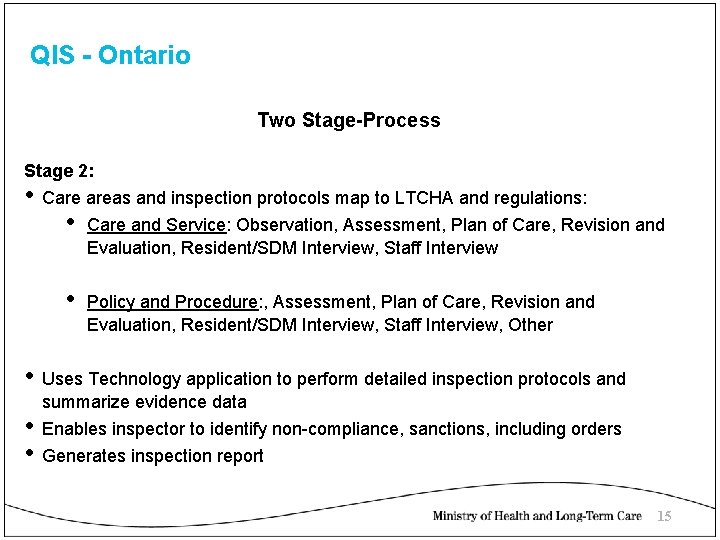
QIS - Ontario Two Stage-Process Stage 2: • Care areas and inspection protocols map to LTCHA and regulations: • Care and Service: Observation, Assessment, Plan of Care, Revision and Evaluation, Resident/SDM Interview, Staff Interview • • Policy and Procedure: , Assessment, Plan of Care, Revision and Evaluation, Resident/SDM Interview, Staff Interview, Other Uses Technology application to perform detailed inspection protocols and summarize evidence data Enables inspector to identify non-compliance, sanctions, including orders Generates inspection report 15
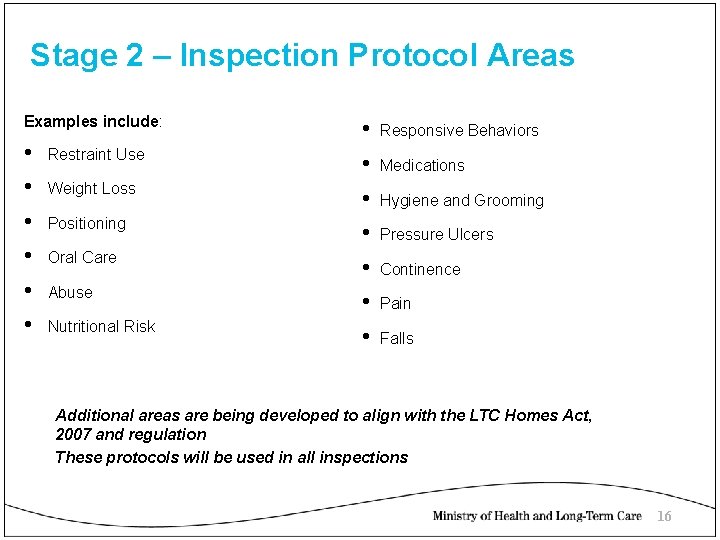
Stage 2 – Inspection Protocol Areas Examples include: • • • Restraint Use Weight Loss Positioning Oral Care Abuse Nutritional Risk • • Responsive Behaviors Medications Hygiene and Grooming Pressure Ulcers Continence Pain Falls Additional areas are being developed to align with the LTC Homes Act, 2007 and regulation These protocols will be used in all inspections 16
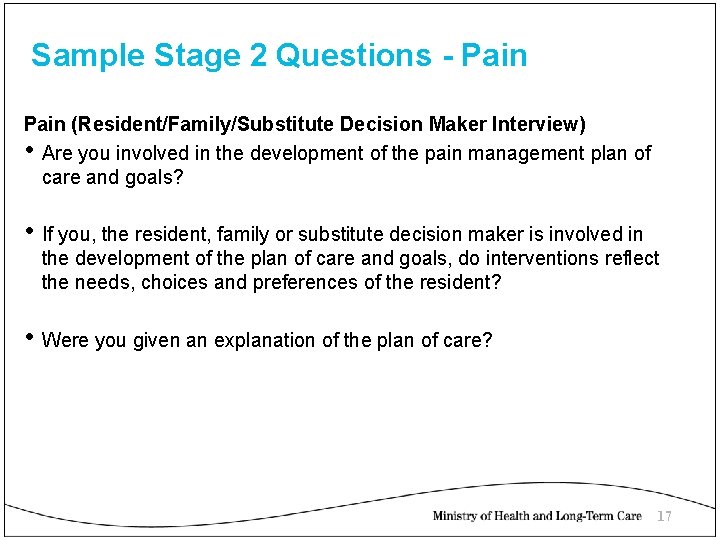
Sample Stage 2 Questions - Pain (Resident/Family/Substitute Decision Maker Interview) • Are you involved in the development of the pain management plan of care and goals? • If you, the resident, family or substitute decision maker is involved in the development of the plan of care and goals, do interventions reflect the needs, choices and preferences of the resident? • Were you given an explanation of the plan of care? 17
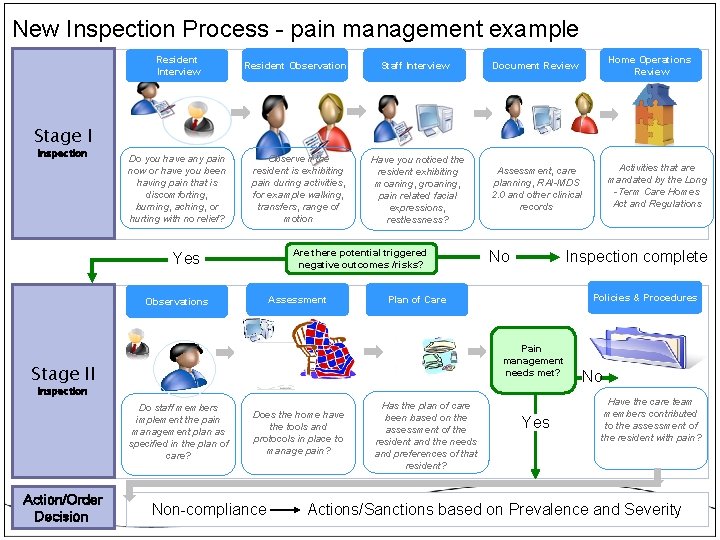
New Inspection Process - pain management example Resident Interview Resident Observation Staff Interview Document Review Home Operations Review Assessment, care planning, RAI-MDS 2. 0 and other clinical records Activities that are mandated by the Long -Term Care Homes Act and Regulations Stage I inspection Do you have any pain now or have you been having pain that is discomforting, burning, aching, or hurting with no relief? Yes Observations Observe if the resident is exhibiting pain during activities, for example walking, transfers, range of motion Have you noticed the resident exhibiting moaning, groaning, pain related facial expressions, restlessness? Are there potential triggered negative outcomes /risks? Assessment Inspection complete No Policies & Procedures Plan of Care Pain management needs met? Stage II inspection Do staff members implement the pain management plan as specified in the plan of care? Action/Order Decision Does the home have the tools and protocols in place to manage pain? Has the plan of care been based on the assessment of the resident and the needs and preferences of that resident? Yes No Have the care team members contributed to the assessment of the resident with pain? Non-compliance Actions/Sanctions based on Prevalence and Severity 18
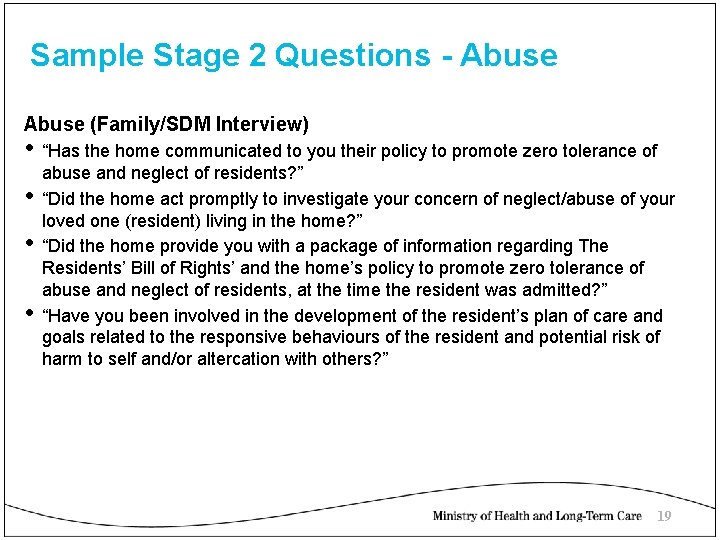
Sample Stage 2 Questions - Abuse (Family/SDM Interview) • • “Has the home communicated to you their policy to promote zero tolerance of abuse and neglect of residents? ” “Did the home act promptly to investigate your concern of neglect/abuse of your loved one (resident) living in the home? ” “Did the home provide you with a package of information regarding The Residents’ Bill of Rights’ and the home’s policy to promote zero tolerance of abuse and neglect of residents, at the time the resident was admitted? ” “Have you been involved in the development of the resident’s plan of care and goals related to the responsive behaviours of the resident and potential risk of harm to self and/or altercation with others? ” 19
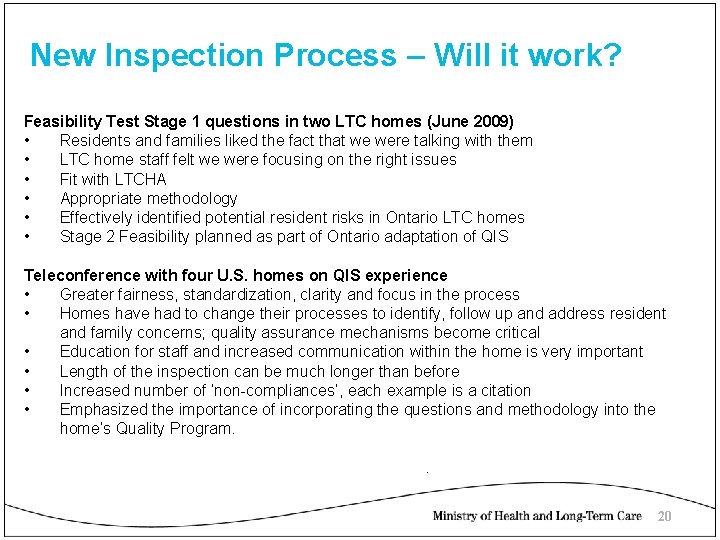
New Inspection Process – Will it work? Feasibility Test Stage 1 questions in two LTC homes (June 2009) • Residents and families liked the fact that we were talking with them • LTC home staff felt we were focusing on the right issues • Fit with LTCHA • Appropriate methodology • Effectively identified potential resident risks in Ontario LTC homes • Stage 2 Feasibility planned as part of Ontario adaptation of QIS Teleconference with four U. S. homes on QIS experience • Greater fairness, standardization, clarity and focus in the process • Homes have had to change their processes to identify, follow up and address resident and family concerns; quality assurance mechanisms become critical • Education for staff and increased communication within the home is very important • Length of the inspection can be much longer than before • Increased number of ‘non-compliances’, each example is a citation • Emphasized the importance of incorporating the questions and methodology into the home’s Quality Program. . 20
New Inspection Process - Stakeholder Consultations Spring/Summer 2009 • Residents’ Councils’ Board of Directors • Family Councils • Long-term Care homes • Labour Organizations • Advocacy Centre for Elderly Winter 2010 • Residents’ Councils • Family Councils • Long-Term Care homes • Labour Organizations • LHINs Ongoing • Compliance Transformation Advisory Group • OLTCA, OAHNSS, Concerned Friends, Ontario Residents’ Councils, Association of Family Councils, ACE and ministry staff 21
LTCHA Opportunity - Culture Shift The new Inspection model will support the Quality Agenda in LTC Homes in a number of ways: • Inspections will refocus attention in homes on the residents and their quality of life and quality of care thereby supporting the Quality Agenda in homes • Ministry resources focus on homes demonstrating highest risk to residents • Validated methodology provides consistent, structured and evidence based approach • Detailed evidence to support non-compliance and new Appeals mechanisms • Detailed data to identify trends, monitor and improve performance across the system 22
Questions 23