
A New Hypothesis for Interpreting the Sedimentary Cerium
- Slides: 1
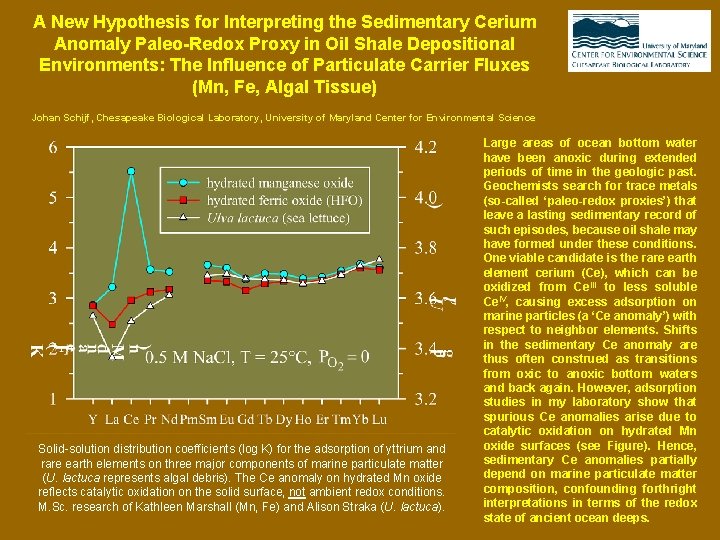
A New Hypothesis for Interpreting the Sedimentary Cerium Anomaly Paleo-Redox Proxy in Oil Shale Depositional Environments: The Influence of Particulate Carrier Fluxes (Mn, Fe, Algal Tissue) Johan Schijf, Chesapeake Biological Laboratory, University of Maryland Center for Environmental Science Solid-solution distribution coefficients (log K) for the adsorption of yttrium and rare earth elements on three major components of marine particulate matter (U. lactuca represents algal debris). The Ce anomaly on hydrated Mn oxide reflects catalytic oxidation on the solid surface, not ambient redox conditions. M. Sc. research of Kathleen Marshall (Mn, Fe) and Alison Straka (U. lactuca). Large areas of ocean bottom water have been anoxic during extended periods of time in the geologic past. Geochemists search for trace metals (so-called ‘paleo-redox proxies’) that leave a lasting sedimentary record of such episodes, because oil shale may have formed under these conditions. One viable candidate is the rare earth element cerium (Ce), which can be oxidized from Ce. III to less soluble Ce. IV, causing excess adsorption on marine particles (a ‘Ce anomaly’) with respect to neighbor elements. Shifts in the sedimentary Ce anomaly are thus often construed as transitions from oxic to anoxic bottom waters and back again. However, adsorption studies in my laboratory show that spurious Ce anomalies arise due to catalytic oxidation on hydrated Mn oxide surfaces (see Figure). Hence, sedimentary Ce anomalies partially depend on marine particulate matter composition, confounding forthright interpretations in terms of the redox state of ancient ocean deeps.