
A New Construction of the Ricardian Trade Theory


- Slides: 31
A New Construction of the Ricardian Trade Theory KOSIME 2006. 6. 22 At Pusan Y. Shiozawa (Osaka City University)
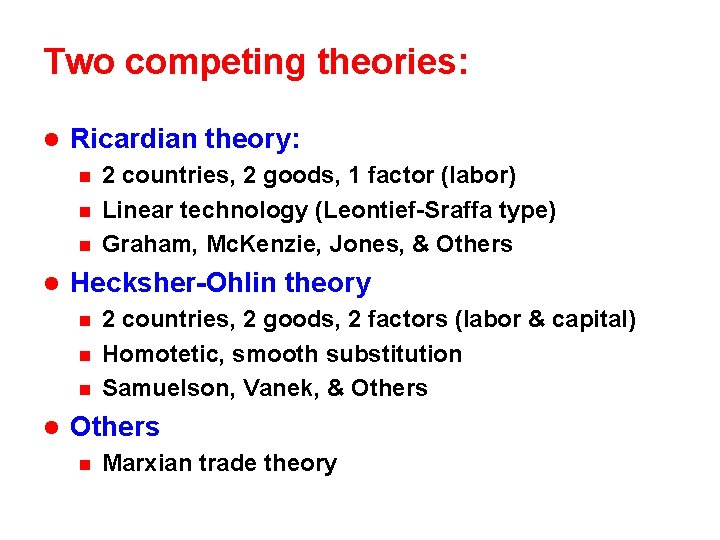
Two competing theories: l Ricardian theory: n n n l Hecksher-Ohlin theory n n n l 2 countries, 2 goods, 1 factor (labor) Linear technology (Leontief-Sraffa type) Graham, Mc. Kenzie, Jones, & Others 2 countries, 2 goods, 2 factors (labor & capital) Homotetic, smooth substitution Samuelson, Vanek, & Others n Marxian trade theory
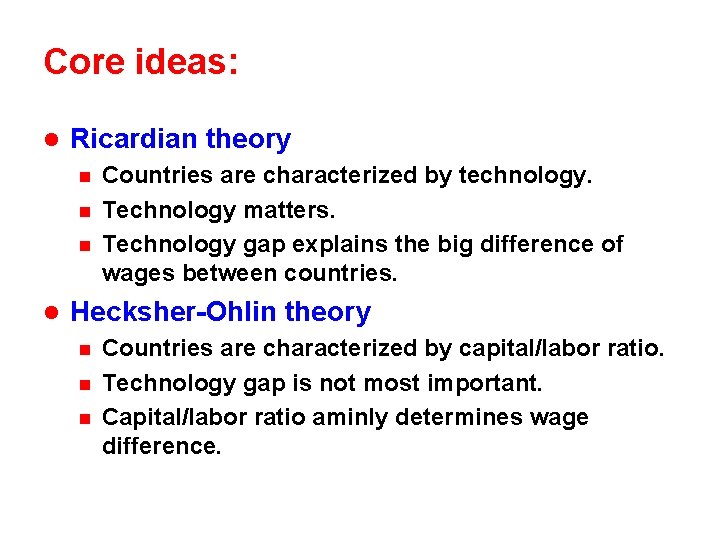
Core ideas: l Ricardian theory n n n l Countries are characterized by technology. Technology matters. Technology gap explains the big difference of wages between countries. Hecksher-Ohlin theory n n n Countries are characterized by capital/labor ratio. Technology gap is not most important. Capital/labor ratio aminly determines wage difference.
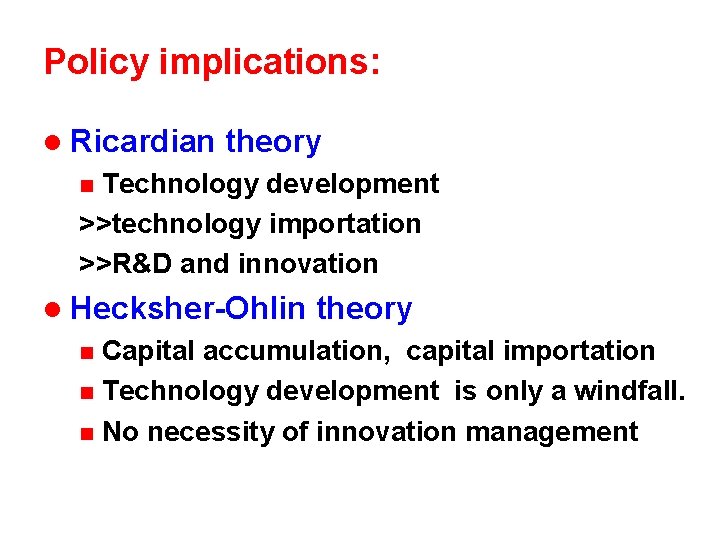
Policy implications: l Ricardian theory Technology development >>technology importation >>R&D and innovation n l Hecksher-Ohlin theory Capital accumulation, capital importation n Technology development is only a windfall. n No necessity of innovation management n
Provisional conclusion l Those who knows the crucial role of technology and innovation must feel unhappy with the base vision which underlies the main stream trade theory. l Unfortunately, Ricardian trade theory stayed so far in a very crude level. l It is necessary to re-activate Ricardian tradition and develop general theory in such a way that the new theory can supersede HO theory and its varieties.
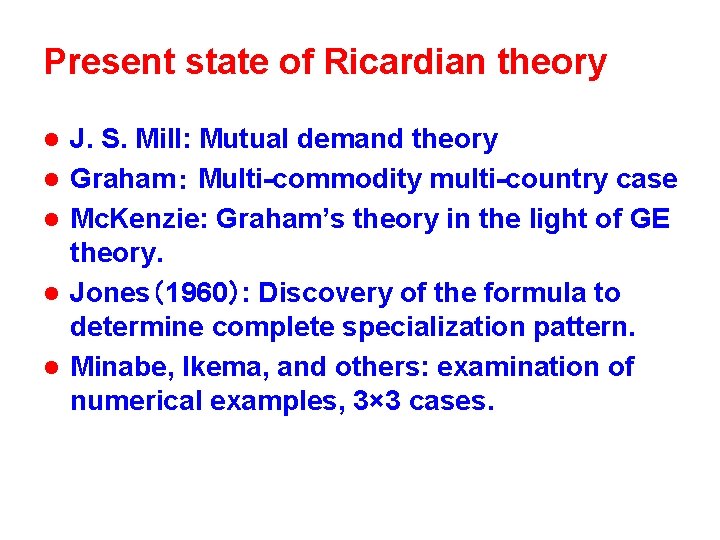
Present state of Ricardian theory l l l J. S. Mill: Mutual demand theory Graham: Multi-commodity multi-country case Mc. Kenzie: Graham’s theory in the light of GE theory. Jones(1960): Discovery of the formula to determine complete specialization pattern. Minabe, Ikema, and others: examination of numerical examples, 3× 3 cases.
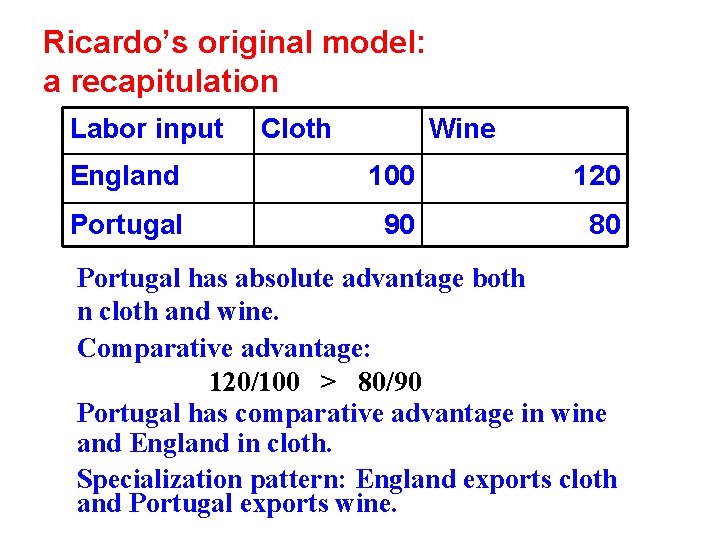
Ricardo’s original model: a recapitulation Labor input Cloth Wine England 100 120 Portugal 90 80 Portugal has absolute advantage both n cloth and wine. Comparative advantage: 120/100 > 80/90 Portugal has comparative advantage in wine and England in cloth. Specialization pattern: England exports cloth and Portugal exports wine.
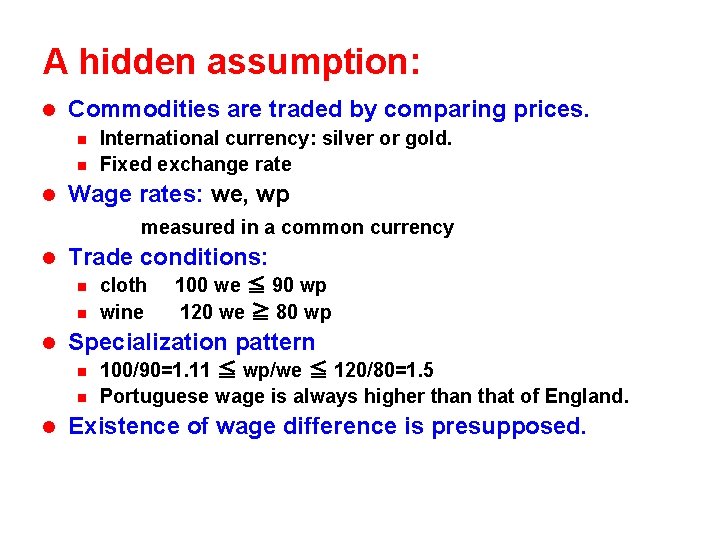
A hidden assumption: l Commodities are traded by comparing prices. n n l International currency: silver or gold. Fixed exchange rate Wage rates: we, wp measured in a common currency l Trade conditions: n n l Specialization pattern n n l cloth 100 we ≦ 90 wp wine 120 we ≧ 80 wp 100/90=1. 11 ≦ wp/we ≦ 120/80=1. 5 Portuguese wage is always higher than that of England. Existence of wage difference is presupposed.
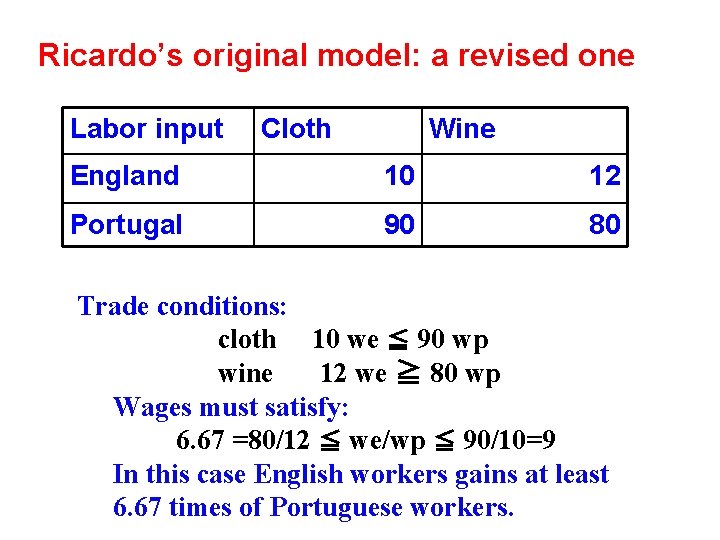
Ricardo’s original model: a revised one Labor input Cloth Wine England 10 12 Portugal 90 80 Trade conditions: cloth 10 we ≦ 90 wp wine 12 we ≧ 80 wp Wages must satisfy: 6. 67 =80/12 ≦ we/wp ≦ 90/10=9 In this case English workers gains at least 6. 67 times of Portuguese workers.
Problems to break through l Extensions to M country N commodity case l Choice of techniques l Intermediate input goods l The new construction satisfies all these three requirements. l A substantial step up since 40 years.
3 -country 3 -commodity case 1 No intermediate goods: Wage simplex:
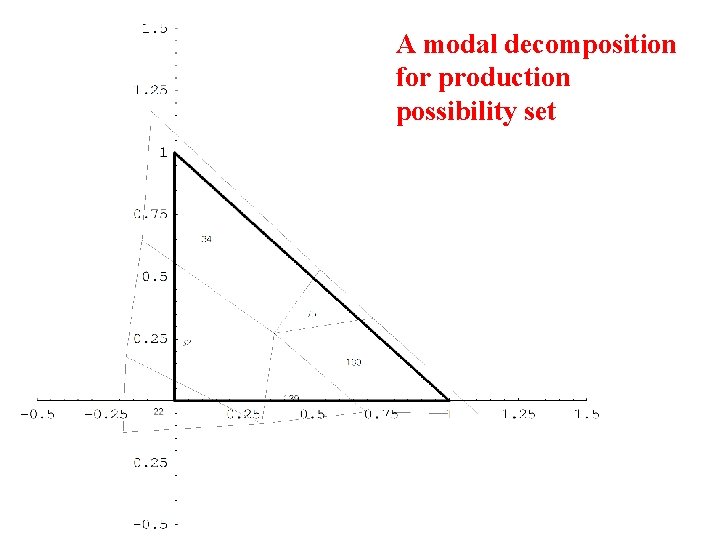
3 -country 3 -commodity case 2 No intermediate goods. A modal decomposition of production possibility set. Seen from the origin.
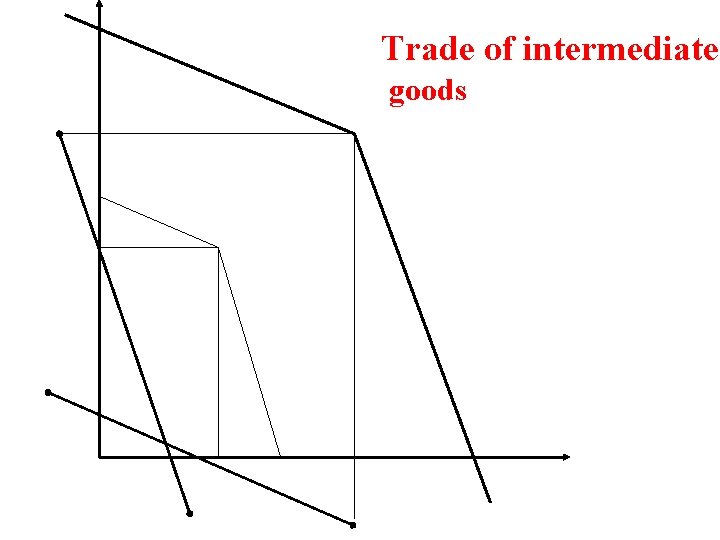
Importance of intermediate goods: l Materials are traded widely and extensively. l Capital goods can be treated as intermediate goods. l Greater profit from trade. n See the next sheet.
Trade of intermediate goods
3 -country 3 -commodity case 3 With intermediate goods
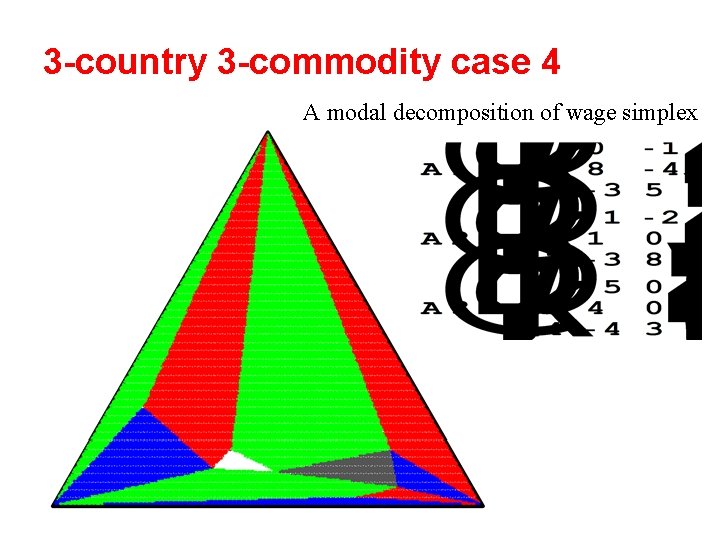
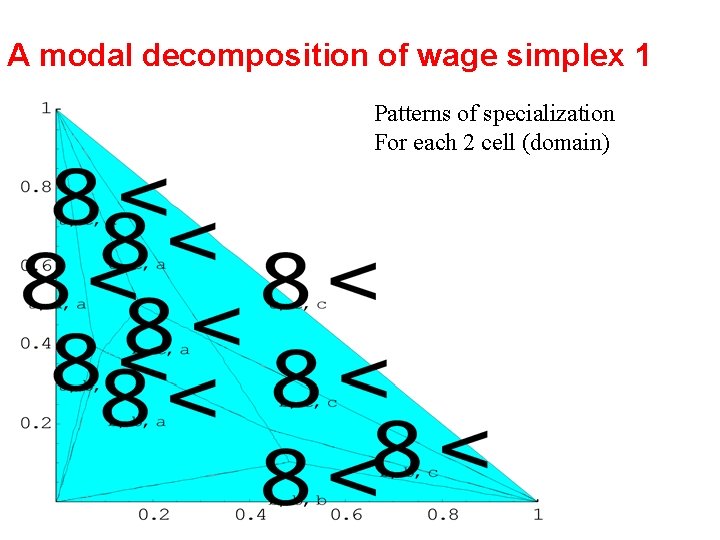
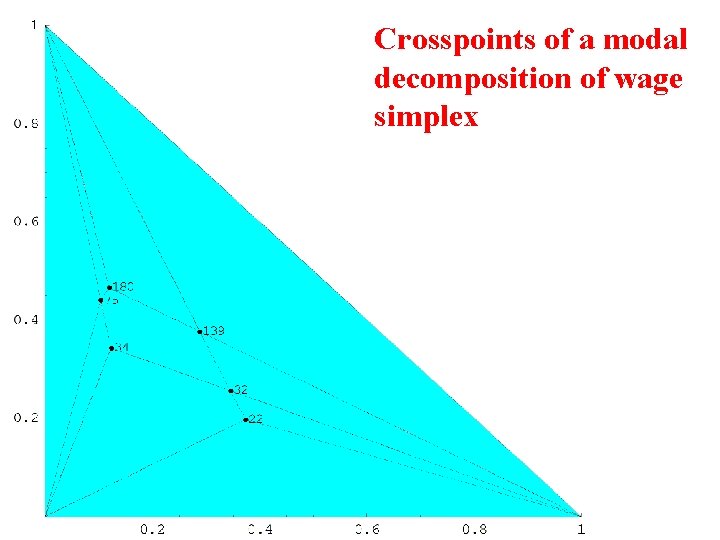
3 -country 3 -commodity case 4 A modal decomposition of wage simplex
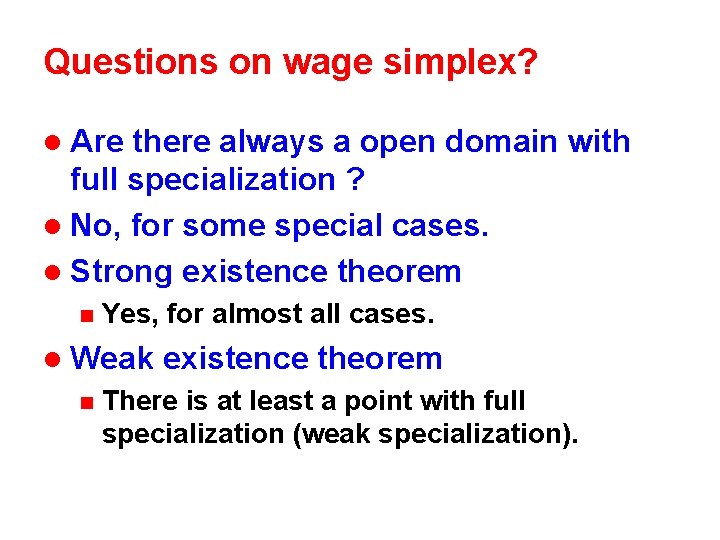
Questions on wage simplex? l Are there always a open domain with full specialization ? l No, for some special cases. l Strong existence theorem n Yes, for almost all cases. l Weak n existence theorem There is at least a point with full specialization (weak specialization).
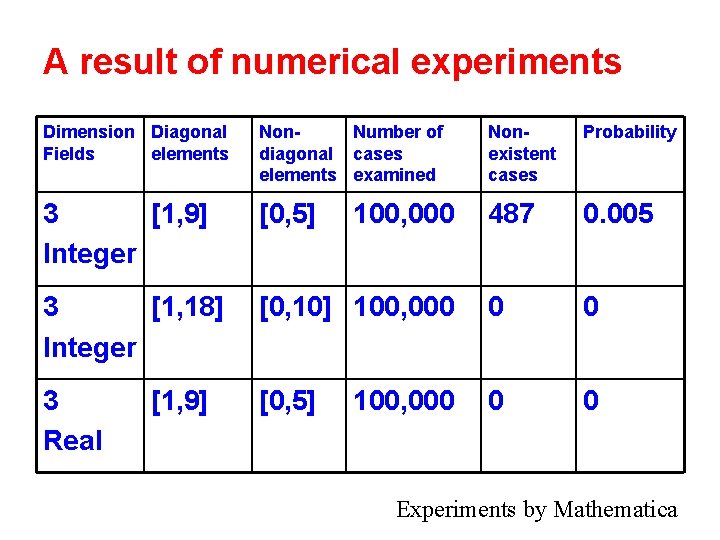
A result of numerical experiments Dimension Diagonal Fields elements Non. Number of diagonal cases elements examined Nonexistent cases Probability 3 [1, 9] Integer [0, 5] 487 0. 005 3 [1, 18] Integer [0, 10] 100, 000 0 0 3 Real [0, 5] 0 0 [1, 9] 100, 000 Experiments by Mathematica
A modal decomposition of wage simplex 1 Patterns of specialization For each 2 cell (domain)
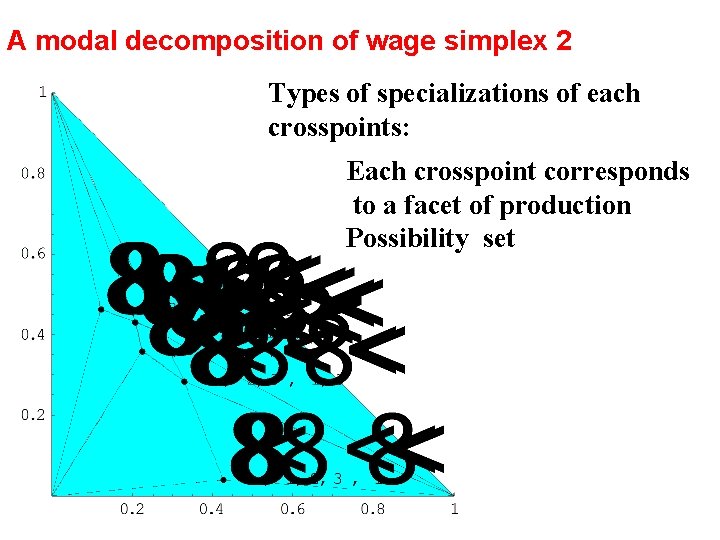
A modal decomposition of wage simplex 2 Types of specializations of each crosspoints: Each crosspoint corresponds to a facet of production Possibility set
Crosspoints of a modal decomposition of wage simplex
A modal decomposition for production possibility set
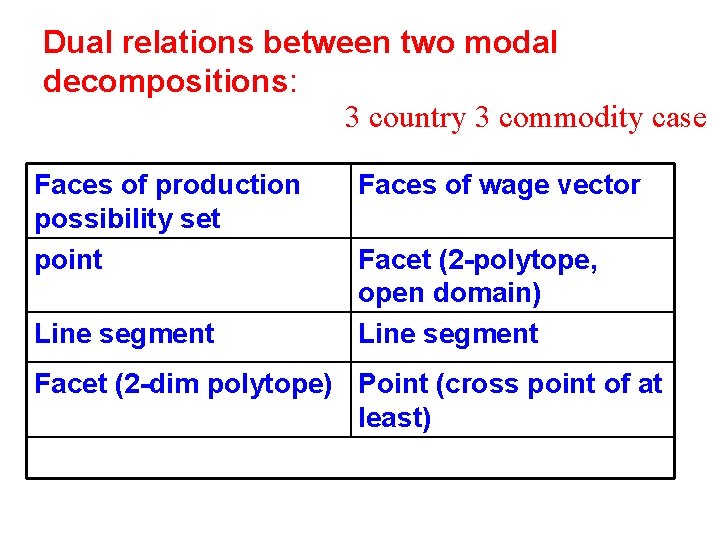
Dual relations between two modal decompositions: 3 country 3 commodity case Faces of production possibility set point Line segment Faces of wage vector Facet (2 -polytope, open domain) Line segment Facet (2 -dim polytope) Point (cross point of at least)
Supply conditions or demand conditions: a good question? l Mill n Mutual demand theory l Graham n Supply conditions predominate. l Demand vs. supply conditions >>Price adjustment or quantity adjustment
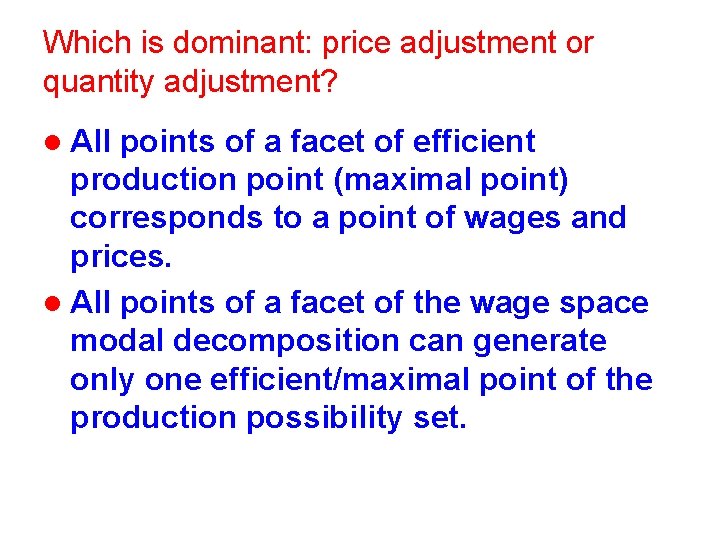
Which is dominant: price adjustment or quantity adjustment? l All points of a facet of efficient production point (maximal point) corresponds to a point of wages and prices. l All points of a facet of the wage space modal decomposition can generate only one efficient/maximal point of the production possibility set.
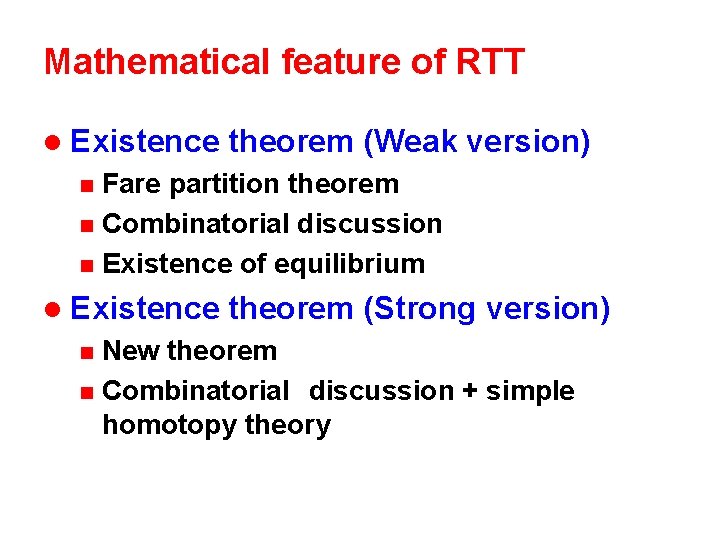
Mathematical feature of RTT l Existence theorem (Weak version) Fare partition theorem n Combinatorial discussion n Existence of equilibrium n l Existence theorem (Strong version) New theorem n Combinatorial discussion + simple homotopy theory n
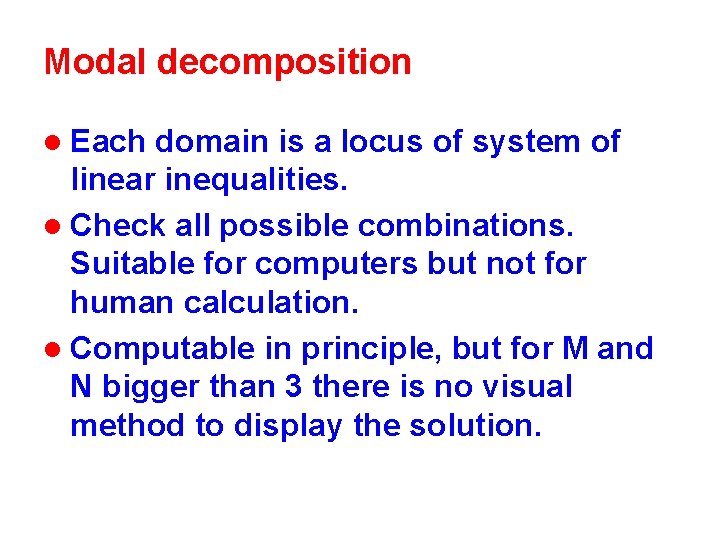
Modal decomposition l Each domain is a locus of system of linear inequalities. l Check all possible combinations. Suitable for computers but not for human calculation. l Computable in principle, but for M and N bigger than 3 there is no visual method to display the solution.
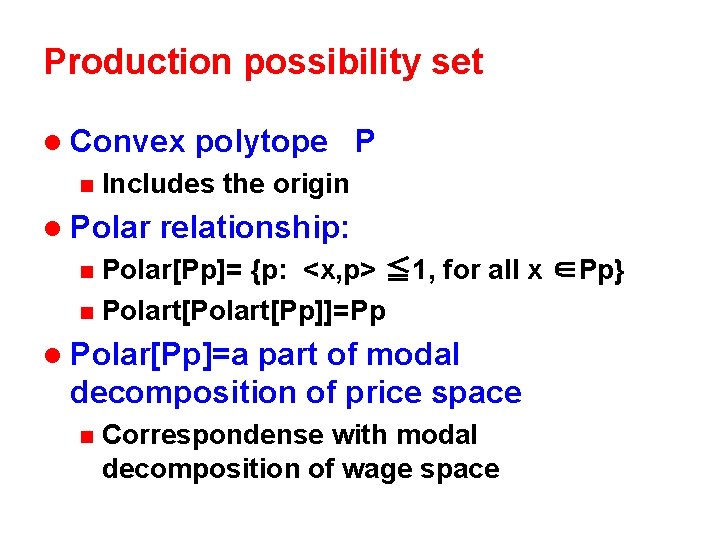
Production possibility set l Convex n polytope P Includes the origin l Polar relationship: Polar[Pp]= {p: <x, p> ≦ 1, for all x ∈Pp} n Polart[Pp]]=Pp n l Polar[Pp]=a part of modal decomposition of price space n Correspondense with modal decomposition of wage space
Topics to be treated: l Financial flow (trade balance) n Balance is not a simple function of exchange rate. Non-equilibrium state can be analysed. l Profit from trade l n l Different interest: consumers benefit from trade, but not unemployed. Trade conflict n n Unemployed people cannot enjoy the profit from trade. The same is true for industrials who have lost their market by the increase of trade.
Some concluding remarks: l Ricardian trade theory can be generalized to a real size economy, with many countries and many commodities. l Some new features appear by the generalization. l New approach to dis-equilibrium state becomes possible.
References: l. A summery: in English l A paper (preprint version) : in Japanese n Very preliminary draft. Do not quote from these papers. Please wait the following papers now in preparation. l To appear Japanese paper: 『経済学雑誌』(大阪市立大) n English paper: Evolutionary and Institutionary Economics Review (JAEE) n