
A new assessment method for masonry arch bridges
A new assessment method for masonry arch bridges (SMART) Clive Melbourne, Adrienn Tomor School of Computing, Science and Engineering, University of Salford

Masonry arch bridge assessment methods but … Semi-empirical Methods: MEXE • Experience needed • No analytical input Limit Analysis Methods • Only considers ULS • No indication of SLS or residual life Solid Mechanics Methods • Only considers ULS • No indication of SLS or residual life • Highly dependent on parameters and boundary conditions that are difficult to quantify • Careful validation is essential.
ULS and SLS definitions The ultimate limit state (ULS) for masonry arch bridges can be defined as the condition at which a collapse mechanism forms in the structure or its supports. The serviceability limit state (SLS) for masonry arch bridges can be defined as the condition at which there is a loss of structural integrity which will measurably affect the ability of the bridge to carry its working loads for the expected life of the bridge.

New assessment method: Sustainable Masonry Arch Resistance Technique (SMART) • Determining the residual life of the bridge • Taking the effects of historical damage and repair methods into account on the long-term performance of the bridge
SMART method • Prior to reaching the ULS, the structure will achieve a statically determinate state. • Endurance limit states can be determined for at least the statically determined state with the help of interactive S-N curves • S-N curves are proposed
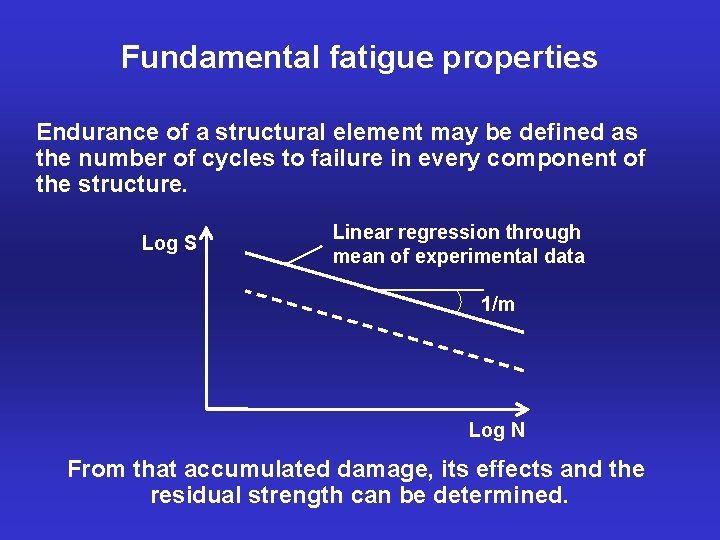
Fundamental fatigue properties Endurance of a structural element may be defined as the number of cycles to failure in every component of the structure. Log S Linear regression through mean of experimental data 1/m Log N From that accumulated damage, its effects and the residual strength can be determined.

Limit states ULS SLS (Serviceability Limit State) FLS (Fatigue Limit State) DLS (Durability Limit State) PLS (Permissible Limit State)
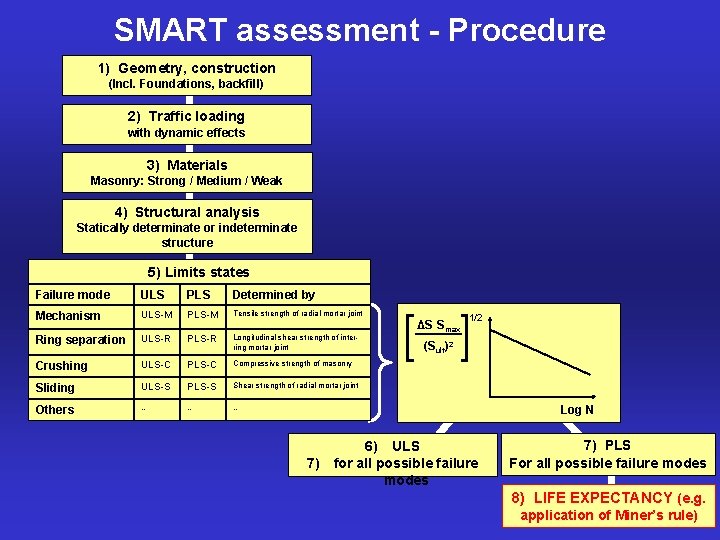
SMART assessment - Procedure 1) Geometry, construction (Incl. Foundations, backfill) 2) Traffic loading with dynamic effects 3) Materials Masonry: Strong / Medium / Weak 4) Structural analysis Statically determinate or indeterminate structure 5) Limits states Failure mode ULS PLS Determined by Mechanism ULS-M PLS-M Tensile strength of radial mortar joint Ring separation ULS-R PLS-R Longitudinal shear strength of interring mortar joint Crushing ULS-C PLS-C Compressive strength of masonry Sliding ULS-S PLS-S Shear strength of radial mortar joint Others … … … ΔS Smax 1/2 (Sult)2 Log N 6) ULS 7) for all possible failure modes 7) PLS For all possible failure modes 8) LIFE EXPECTANCY (e. g. application of Miner’s rule)
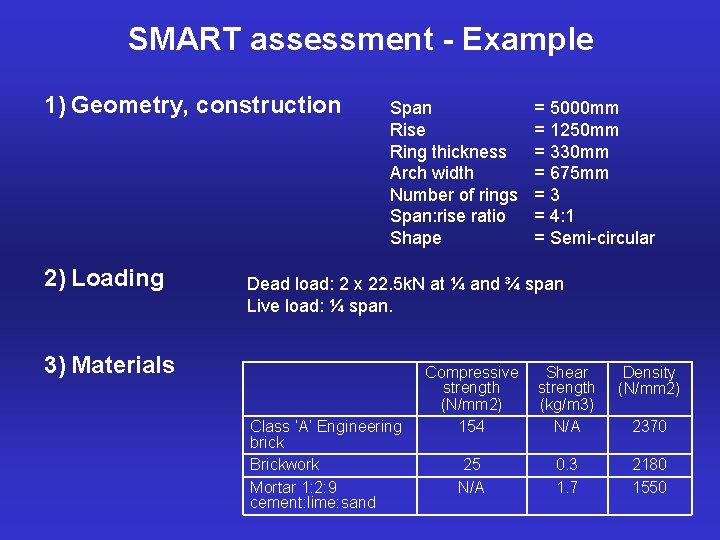
SMART assessment - Example 1) Geometry, construction 2) Loading Span Rise Ring thickness Arch width Number of rings Span: rise ratio Shape = 5000 mm = 1250 mm = 330 mm = 675 mm =3 = 4: 1 = Semi-circular Dead load: 2 x 22. 5 k. N at ¼ and ¾ span Live load: ¼ span. 3) Materials Class ‘A’ Engineering brick Brickwork Mortar 1: 2: 9 cement: lime: sand Compressive strength (N/mm 2) 154 Shear strength (kg/m 3) N/A Density (N/mm 2) 25 N/A 0. 3 1. 7 2180 1550 2370
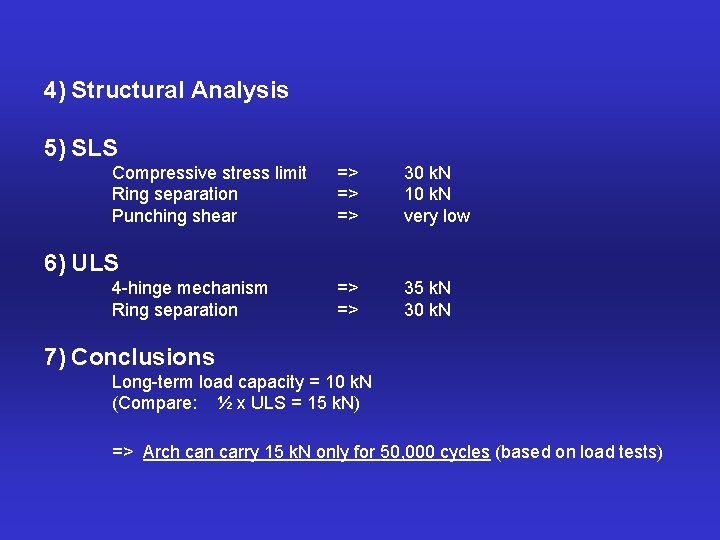
4) Structural Analysis 5) SLS Compressive stress limit Ring separation Punching shear => => => 30 k. N 10 k. N very low => => 35 k. N 30 k. N 6) ULS 4 -hinge mechanism Ring separation 7) Conclusions Long-term load capacity = 10 k. N (Compare: ½ x ULS = 15 k. N) => Arch can carry 15 k. N only for 50, 000 cycles (based on load tests)
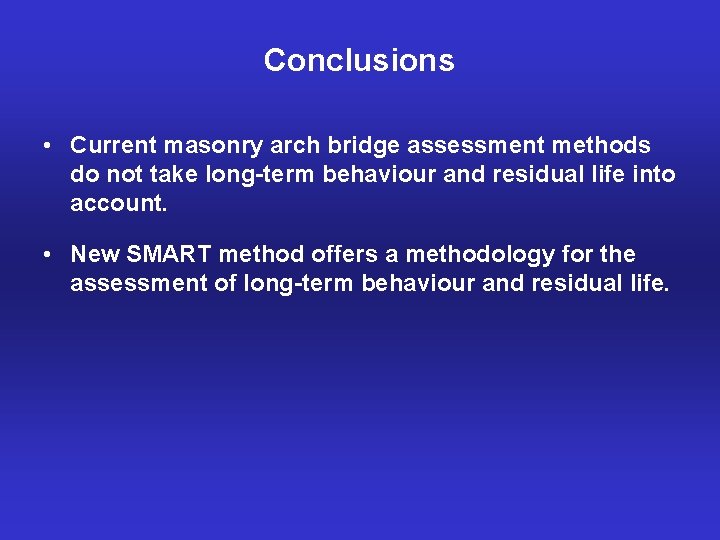
Conclusions • Current masonry arch bridge assessment methods do not take long-term behaviour and residual life into account. • New SMART method offers a methodology for the assessment of long-term behaviour and residual life.
- Slides: 11