
A new approach of course development for higher

- Slides: 32
A new approach of course development for higher education Apply the Design approach as followed in technical design Jan Nedermeijer, MSc Concept 2020 copyright © 2020 attribution-noncommercial 4. 0 international (cc by-nc 4. 0) please refer to jannedermeijer@hotmail. com February, 2020
2 Why follow the approach of technical design? In the literature of course or instructional development the authors, often, consider these developments as a design processes. For example the ADDIE-procedure. When you study technical design as taught for example in TUDelft (Delft Design Approach), it is clear that they teach technical design in far more detail compared with the various course development approaches. In this power point I try the apply the basic ideas from the technical design approach in course or instructional development. My challenge is to apply the affordances available in technical design in course design in order to solve the educational design problems at a more sophisticated level. A crucial quality of such DD-procedure is that the design activities have a clear an functional place in the description. Jan Nedermeijer January 2020
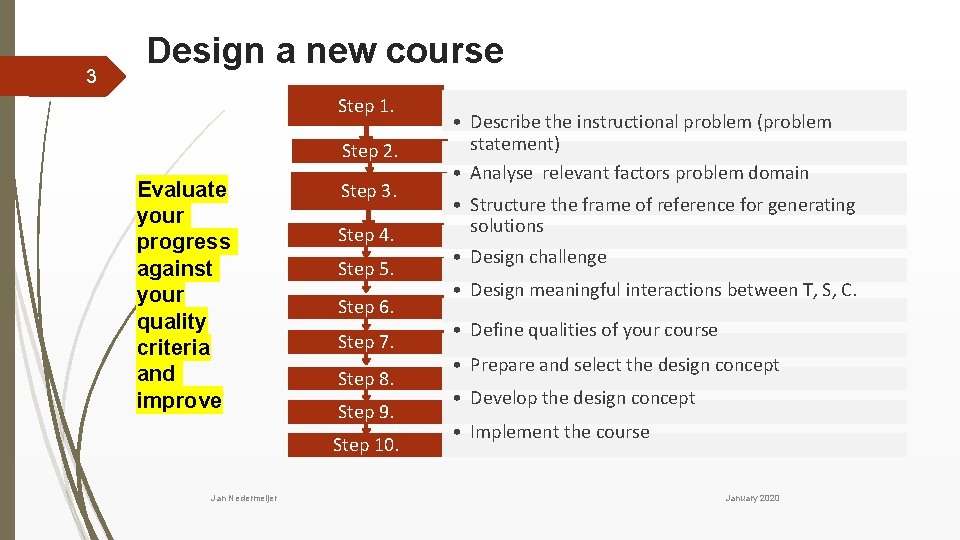
3 Design a new course Step 1. Step 2. Evaluate your progress against your quality criteria and improve Step 3. Step 4. Step 5. Step 6. Step 7. Step 8. Step 9. Step 10. Jan Nedermeijer • Describe the instructional problem (problem statement) • Analyse relevant factors problem domain • Structure the frame of reference for generating solutions • Design challenge • Design meaningful interactions between T, S, C. • Define qualities of your course • Prepare and select the design concept • Develop the design concept • Implement the course January 2020
4 Some principles concerning design in course development It is a problem solving process: so …. . Wait with the formulation of solutions. (But if you have one: make a clear notice!). Prevent a narrow view, clamping to one solution. These are new ideas, you should acquaint yourself with it, so you can see the positive points. Take your decisions with care, but wait not too long and check the practical execution Evaluate the results in your D/D-process regularly. Content and didactics are important. Jan Nedermeijer January 2020
Step 1. Describe the instructional problem 5 You decide what you want to achieve and how you plan the (problem solving) process of the design, development and implementation. Your problem description should meet several requirements in order to give you a proper support. It should: 1. Be rather broad, but not too broad. If you make the domain too small there is the chance that you will miss some interesting new possibilities. If you formulate the problem domain too broad you should study more constituents which will take more time. 2. Not be based on a too limited amount of information or on preconceptions. 3. Not suggest a detailed solution. If so, you should not start with this design oriented procedure. 4. Be realistic, the description should be clear and convincing for you and your colleagues) Jan Nedermeijer 2020 January
6 Step 1 Main activities 1. 1. Prepare a clear description of the instructional problem you want to solve and /or your wishes you want to implement in your course. 1. 2. Use (if possible) the results of the deconstruction of the former version of the course. 1. 3. Suggest which constituents or factors in the context of your instructional problem you like to study. 1. 4. Prepare your version of the 10 -steps procedure to design, develop and implement the new course. 1. 5. Evaluate the problem description. Jan Nedermeijer January 2020
Step 2 Analyse relevant factors in the context of the problem 7 The context (or problem domain) of your instructional problem includes a great number of possible constituents (or factors) which could influence your design. In Step 2 you study the selected constituents you need to understand your instructional problem and to be able to formulate possible solutions. Remark: During the D/D-process your insight in your design problem will increase and you might decide you have to examine extra constituents. Constituents might be observations, thoughts, theories, laws, considerations, beliefs or opinions. Constituents are not describing how the new course will look like. Crucial in course design are the didactical factors/constituents which describe the students’ learning, the learning environment and the teachers’ activities. Do not adopt a constituent too easily and uncritically. It might costs a lot of time. Jan Nedermeijer January 2020
8 Examples of possible constituents (check with text ‘information!!! And learning environment) 1. The elements of the Diamond: learning objectives, educational and testing methods/media, course content, learning activities and materials, requirements or constraints. 2. The entree level of the students. 3. The didactical vision in your Institute and yourself and the evidences behind it. 4. Useful ICTedu-tools. 5. Future developments in your discipline and education and their consequences. 6. Sometimes an analysis of the professional field is necessary. 7. Available good practices and possibilities shown o apply these in your new course. 8. Deconstruction of the former version of your course: the design, the teaching-learning activities and the experiences of the teachers and the students and the context in which the course was prepared. 9. ……. 10. ……. Jan Nedermeijer January 2020
Step 2 Main activities 9 Learning environment: a) Describe the didactical elements of the learning environment in the Diamond. b) Select relevant design principles with examples of possible learning situations and –materials. c) Select and describe the elements of good practices which you like to apply and explain your expectations. d) Analyse how you support the student to master he competences that exceed the individual course. Other constituents a) Analyse the possibilities and constraints in the external environment (faculty policies, entrylevel of the students, the demands from the professional field et cetera). b) Study and describe the other selected constituents. c) Describe the changes you think are necessary in your existing course. d) Check the coherence of the described basic didactical elements of the course (constructive alignment). e) Make a systematic analysis of the problems you still have to be solved to be able to design a good course. What is the problem, who has a problem, what are relevant context constituents, what are the learning goals, what are the side effects to be avoided and which actions are not admissible. Jan Nedermeijer January 2020
Necessary information 10 To make decisions in a curriculum project you should have insight in various types of information: About the context: The results of quality assurance system and the possible consequences, Opinions of the students Opinion of the management and the teachers and possible other groups involved, Other educational programmes and experiences Expected entry level of the students Possibilities of ICT in HE. Research conclusions about design principles in the literature and explained in BLOGs. Quality criteria to be achieved (NVAO, University, Faculty, program) Description of relevant jobs (tasks, critical events, competences, trends/developments Programs of other Educational Institutes Same of related discipline Interesting ideas from other programs Jan Nedermeijer January 2020
11 Some sources of information In the serious game Modern Higher Education an overview is given of the main design principles used in the design of MHE E-course Evidence based suggestions as to how apply ICT in Higher Education. Websites: (T)E-Learning Blog Rubens Digitale Didaktiek & Moodle Hog. Zuyd 3 star learning experiences LDE-studentsuccess Adulet: examples use of ICT Jan Nedermeijer January 2020
12 Evaluation is a crucial activity during the D/Dprocess An formulated requirements. Where necessary your change the design. This means that during the D/D-process the remark this is not possible because. . will not be made. important characteristic of the D/D-process is that you formulate the requirements and adapt the formulation when necessary. You keep these in the back of your head. The D/D-process is not focused on these requirements you are not including these requirements in your thinking process. Only in the Step eight and nine you check your design with the In every step and for every product you check if the result is according your expectations. If it’s not okay you have to decide if you try again or to change your expectations. During the design process, you have formulated requirements quality criteria. Jan Nedermeijer January 2020
Step 3 Structure the context of your instructional problem 13 The constituents will be structured according the elements of the learning environment and the mains steps in the learning process of the students. You are ready when you can decide the context is described clearly and consistently. This structure helps you to decide if You have enough ideas how to design your course. If so, you can follow a less intensive procedure. or You have clear ideas about the main lines of the design of your course, but there still some elements for which you do not have a clear solution. The design process will focus on how to elaborate the main lines into a complete course. If so, you can follow a less intensive procedure – situation 5. or You do not have a clear idea about the main lines of your course. The design process will focus on solving this complex design problem. If so, you can follow the steps in procedure 6. Jan Nedermeijer January 2020
Activities step 3 14 3. 1. Describe the elements of the learning environment. 3. 2. Design your first version of the learning process the students should follow in order to master the learning objectives. Try to visualise the learning process in a scheme, a spider web, a story-board of in the outline of the topics. . 3. 4. Decide how you will continue in th D/D-process: Most elements can be used in the D/D-process without further study. You can follow the procedure as described for situation 5. The main structure of the course is clear, but some important elements are still problematic. You continue with the process 6, but with a less complex design problem. The main structure and also the main elements are not yet clear. You continue with the process 6, but with a serious and challenging design problem. 3. 5. Formulate the requirements and constraints. Jan Nedermeijer January 2020
15 Suggestion If the design of the learning process is complex, you can start with describing the learning process to master each learning objective separately. Try to combine the different learning processes of each learning objective into one learning process for your complete course. Jan Nedermeijer January 2020
16 Examples Requirements and constraints Examples of types of requirements are: Concerns of the teachers, constraints because of the buildings, organizations, …. , do-ability for students and teachers, characteristics of the field of discipline, the alignment between the content, education methods and learning objectives. Jan Nedermeijer January 2020
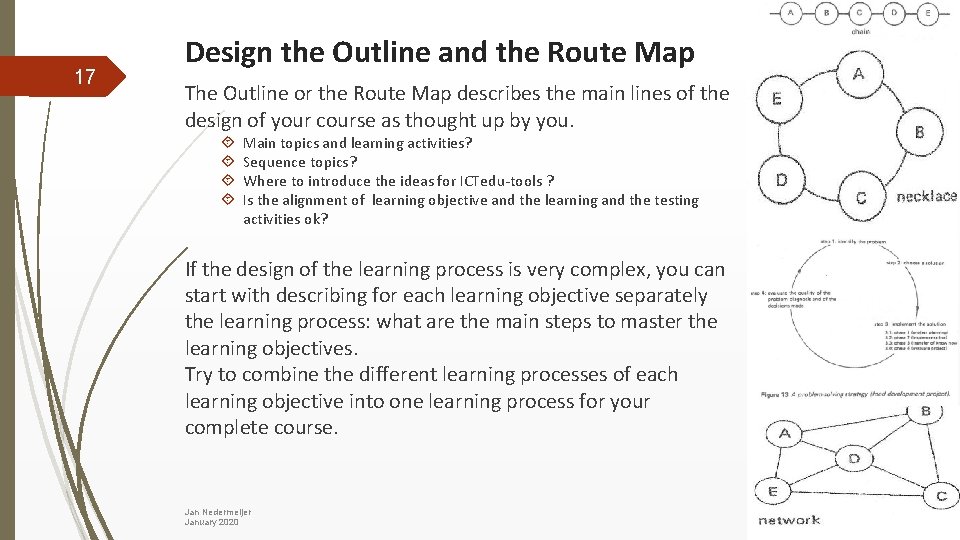
17 Design the Outline and the Route Map The Outline or the Route Map describes the main lines of the design of your course as thought up by you. Main topics and learning activities? Sequence topics? Where to introduce the ideas for ICTedu-tools ? Is the alignment of learning objective and the learning and the testing activities ok? If the design of the learning process is very complex, you can start with describing for each learning objective separately the learning process: what are the main steps to master the learning objectives. Try to combine the different learning processes of each learning objective into one learning process for your complete course. Jan Nedermeijer January 2020
Step 4 Design challenge 18 This is the first element of your design-vision. The design challenge make clear what you would like to achieve when solving your instructional problem. It is a challenge because you don’t have a good idea, yet, of how you could solve the instructional problem. . When is your design challenge ready? The formulation should motivate you to look for relevant and interesting concept ideas. You check if the formulation of the design statement is not too open or too detailed, realistic et cetera. And you check if the Management and your colleagues understand appreciate the challenge. Jan Nedermeijer January 2020
19 Activities step 4 4. 1. Formulate the design challenge: I will that the students and the teachers: ……… (the results that you want to achieve with both target groups) because ………. . (the reasons why these results are is relevant for the users). Remark: You still have no real possible solution in your mind. First, you analyse the crucial interactions in the course (step 5) and the quality criteria (step 6) you want to achieve. Jan Nedermeijer January 2020
20 Step 5. Design meaningful interactions between T, S, C. This is the second and crucial step in the formulation of your desugn vision (Hekkert and van Dijk). You define what kind of meaningful interactions you want to bring about between the new course and the students and the teachers. The main function of a course is to support the learning process of the students and to support the teachers’ work in a meaningful way. You can describe the meaningful interactions (or uses) with help of the design principles which are common in Modern Higher Education. By doing this you envision the future use of your new course. The interactions are the ‘bridge or hinge’ between the frame of reference (Step 3) and your new course (Step 8). When are you ready with Step 5? This is when you have a good feeling about the solution. The key criterium is appropriateness with your vision. Jan Nedermeijer January 2020
21 Activities step 5 5. 1. Select the most relevant didactical principles and the components which you will use in the (re)design of the course. Your selection should envision your vision what you want to achieve. 5. 2. Elaborate the didactical components in such a way that it describes possible learning activities and learning materials which can be used in the new course. The choices you made have to be translated to the learning environment and the learning process of your new course. Let your unconscious work, using analogies, look for and analyse good practices, verbalization or description of your ideas to stimulate your creativity. 5. 3. Try to visualise the necessary interactions. Jan Nedermeijer January 2020
Step 6 Define product qualities 22 The quality criteria of the course are third element of your vision. The new course should meet certain characteristics or qualities to realise the designed interactions between the course and the students and the teachers. The quality criteria are used to stimulate your thinking and to evaluate the concept ideas you have thought up in Step 7) and the final design of the new course (in Step 8). General quality criteria for a course in higher education are: efficiency, effectivity, valued, feasible and well-liked by the students and the teachers. The didactical design principles were used in Step 5 to formulate the interactions between the course, the students and the teachers. You should describe which is quality criteria you use to assess if the design principles have been realised according your ideas. Another source you use to formulate quality criteria are the requirements or constraints. The first version of the requirements (or constraints) are formulated in step 2 and 3. During the D/D- process the requirements will be adapted by using the growing insights in the design task of the new course. Jan Nedermeijer January 2020
23 Activities 6. 1. Prepare a list of all important decisions (waarom) which have to be taken. Use this to check of you have all the necessary qualities. The list of requirements is transformed in a list of qualities of the final design 6. 2. Reformulate and adjust the list of requirements which have to be fulfilled to be able to organise a proper course. 6. 3. Analyse if the frame of reference to evaluate if special qualities are needed. Jan Nedermeijer January 2020
24 Step 7 Prepare and select the design concept In Step 7 you translate your design-vision formulated in Step 4, 5 and 6 following the Frame of Reference (Step 3) into a new learning environment (the plan, structure is and strategy) of your new course. With this you describe what kind of course you want to design and how it , in principle, will be used by the teachers and students. If you can visualise these ideas and concepts this will you (and colleagues) give a good insight in the product of the D/D-process. In this ideating and concepting step the focus is on divergent, convergent and creative thinking. You create as much as possible concept ideas (divergent thinking). By making a short list and selecting the final design concept you converge the possible solutions of the design problem first must three option and then to one option (the final design concept). The frame of reference can be the format of de learning environment of your design task is to design and develop a course. For other design task the Frame of reference will have a different format/structure. Jan Nedermeijer January 2020
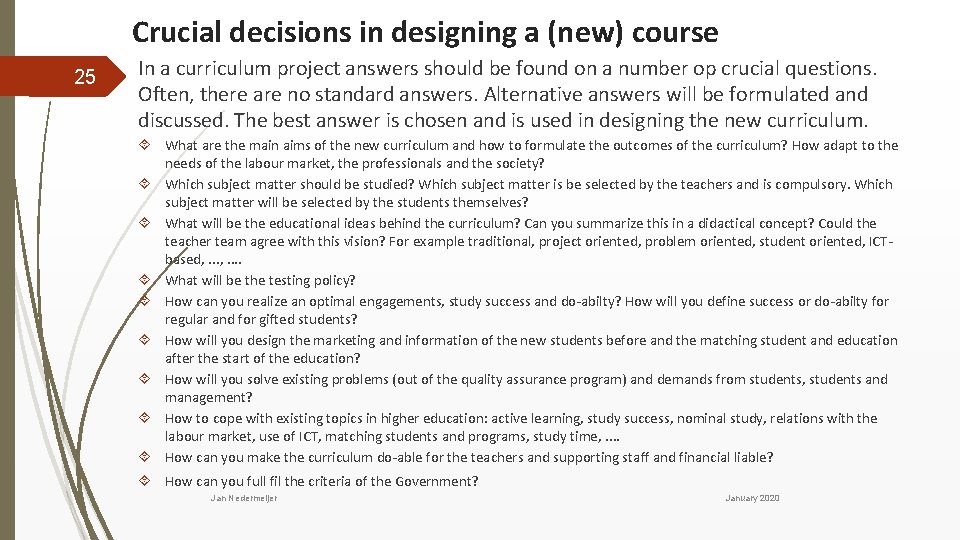
Crucial decisions in designing a (new) course 25 In a curriculum project answers should be found on a number op crucial questions. Often, there are no standard answers. Alternative answers will be formulated and discussed. The best answer is chosen and is used in designing the new curriculum. What are the main aims of the new curriculum and how to formulate the outcomes of the curriculum? How adapt to the needs of the labour market, the professionals and the society? Which subject matter should be studied? Which subject matter is be selected by the teachers and is compulsory. Which subject matter will be selected by the students themselves? What will be the educational ideas behind the curriculum? Can you summarize this in a didactical concept? Could the teacher team agree with this vision? For example traditional, project oriented, problem oriented, student oriented, ICTbased, . . . . What will be the testing policy? How can you realize an optimal engagements, study success and do-abilty? How will you define success or do-abilty for regular and for gifted students? How will you design the marketing and information of the new students before and the matching student and education after the start of the education? How will you solve existing problems (out of the quality assurance program) and demands from students, students and management? How to cope with existing topics in higher education: active learning, study success, nominal study, relations with the labour market, use of ICT, matching students and programs, study time, . . How can you make the curriculum do-able for the teachers and supporting staff and financial liable? How can you full fil the criteria of the Government? Jan Nedermeijer January 2020
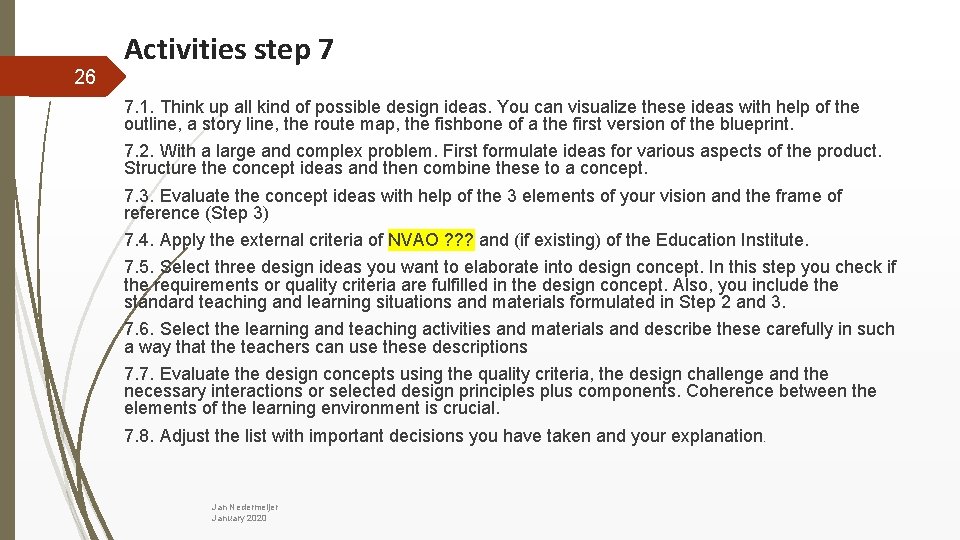
26 Activities step 7 7. 1. Think up all kind of possible design ideas. You can visualize these ideas with help of the outline, a story line, the route map, the fishbone of a the first version of the blueprint. 7. 2. With a large and complex problem. First formulate ideas for various aspects of the product. Structure the concept ideas and then combine these to a concept. 7. 3. Evaluate the concept ideas with help of the 3 elements of your vision and the frame of reference (Step 3) 7. 4. Apply the external criteria of NVAO ? ? ? and (if existing) of the Education Institute. 7. 5. Select three design ideas you want to elaborate into design concept. In this step you check if the requirements or quality criteria are fulfilled in the design concept. Also, you include the standard teaching and learning situations and materials formulated in Step 2 and 3. 7. 6. Select the learning and teaching activities and materials and describe these carefully in such a way that the teachers can use these descriptions 7. 7. Evaluate the design concepts using the quality criteria, the design challenge and the necessary interactions or selected design principles plus components. Coherence between the elements of the learning environment is crucial. 7. 8. Adjust the list with important decisions you have taken and your explanation. Jan Nedermeijer January 2020
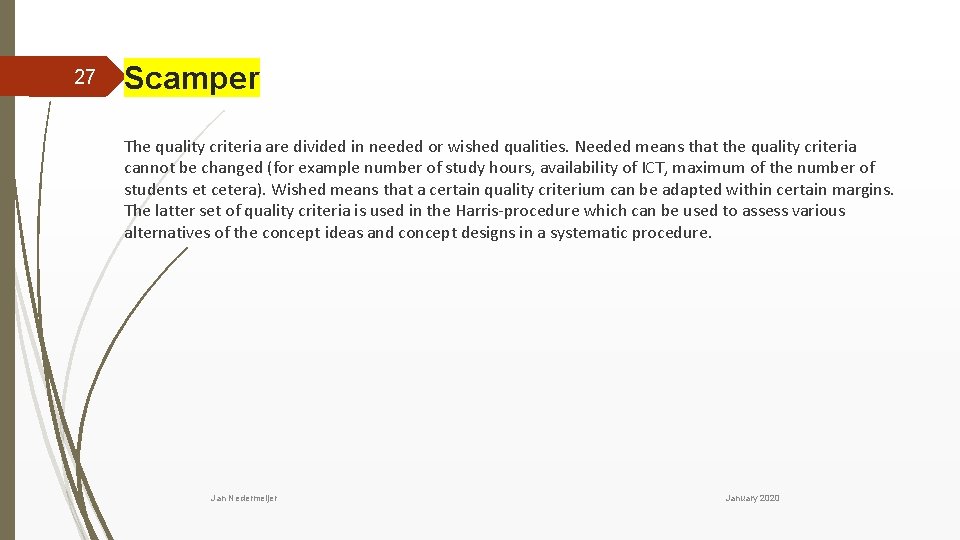
27 Scamper The quality criteria are divided in needed or wished qualities. Needed means that the quality criteria cannot be changed (for example number of study hours, availability of ICT, maximum of the number of students et cetera). Wished means that a certain quality criterium can be adapted within certain margins. The latter set of quality criteria is used in the Harris-procedure which can be used to assess various alternatives of the concept ideas and concept designs in a systematic procedure. Jan Nedermeijer January 2020
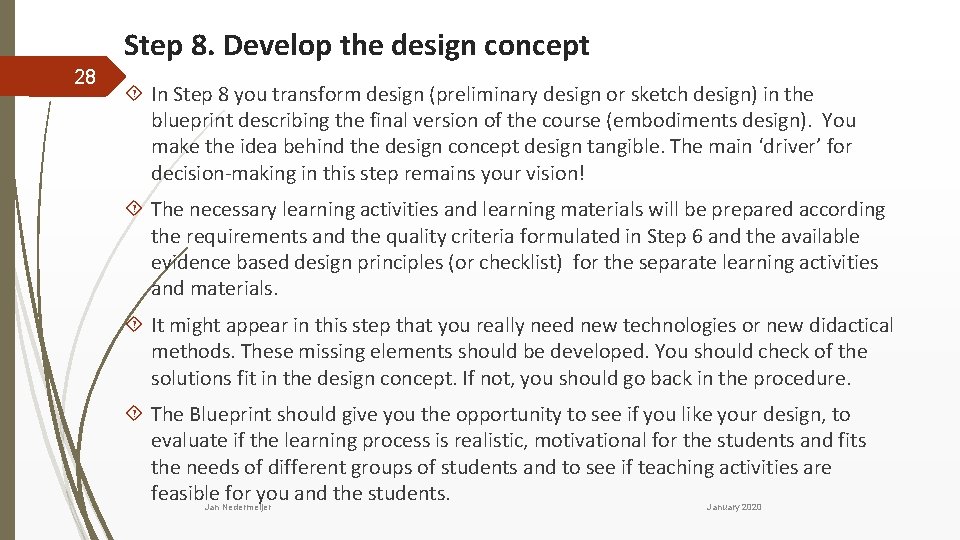
Step 8. Develop the design concept 28 In Step 8 you transform design (preliminary design or sketch design) in the blueprint describing the final version of the course (embodiments design). You make the idea behind the design concept design tangible. The main ‘driver’ for decision-making in this step remains your vision! The necessary learning activities and learning materials will be prepared according the requirements and the quality criteria formulated in Step 6 and the available evidence based design principles (or checklist) for the separate learning activities and materials. It might appear in this step that you really need new technologies or new didactical methods. These missing elements should be developed. You should check of the solutions fit in the design concept. If not, you should go back in the procedure. The Blueprint should give you the opportunity to see if you like your design, to evaluate if the learning process is realistic, motivational for the students and fits the needs of different groups of students and to see if teaching activities are feasible for you and the students. Jan Nedermeijer January 2020
29 Activities step 8 8. 1. Update the descriptions of the diamond and the learning environment using the new insights collected until now. These instruments help you to achieve a good coherence in the blueprint and in the final design of your new course. 8. 2. Develop meaningful learning activities and learning materials following the relevant design principles. 8. 3. Prepare the course description in the course book for the students plus a teacher’s manual. 8. 4. Prepare a course description to be used for the quality assurance committee. 8. 5. Formulate and explain the decisions you have taken. Jan Nedermeijer January 2020
30 Step 9. Implement the course The implementation of your new course starts direct in Step 1: you discuss the problem description and your action plan which with students, your colleagues and the management. Also, during the process, the various stakeholders will be informed. (see xxx) Three important reasons: You can learn a lot from them. The management should have a possibility to discuss the new ideas: do these ideas fit in curriculum, is it possible to realise the concept/ ideas because of the equipment or availability of classrooms, et cetera. You can influence the acceptability of your ‘new’ ideas. In this Step 9 you have to make a detailed plan what should be done by whom and when. Activities 9. 1. Make a course description for the institutes’ website and for the accreditation procedure. 9. 2. Make a list of the activities you have to perform in order to finalize your course and to be able to make a good start with all the students. Jan Nedermeijer January 2020
31 Step 10. Evaluate the implementation and effectuation of your the course Evaluation is a crucial activity in the D/D-process. During the design process, you have formulated a set of requirements, your expectations and the quality criteria which should be realized in the final design. These are used in step 2, 8 , 9 and 10 to evaluate the design ideas, design concept, the blueprint and the final learning materials. After you have implemented the new course you evaluate the functioning of the learning environment in the real situation. Maybe first in a pilot project. In this evaluation you can use the requirements and the quality criteria you formulated. Jan Nedermeijer January 2020
32 Activities step 10 10. 1. Prepare an evaluation plan. You might evaluate your course with a simple questionnaire, the discussion about the test- and evaluation results with the students and colleagues et cetera. And of course, the evaluation by yourself: did I achieve all my expectations, what are the positive and negative experiences, et cetera. 10. 2. Compare the results with your requirements and quality criteria. 10. 3. Improve the learning environment where necessary. 10. 4. Sharpen the descriptions of your course. Jan Nedermeijer January 2020