
A neutron microscope for nanoscale motion in new

- Slides: 3
A “neutron microscope” for nano-scale motion in new materials Collin Broholm, Johns Hopkins University, DMR 0116585 MACS will open a new window on atomic scale structure and dynamics at the early stages of materials development. Located at the NIST center for neutron research, the instrument employs a bold new configuration to probe minute crystals and man-made nano-structures. 20 channel detection system Sample position Aperture Attenuator Monitor Shielding Focusing supermirror Helium Cold neutron source Cooled filters Shutter 20 ft Variable Aperture Radial Collimators Focusing monochromator on translation stage
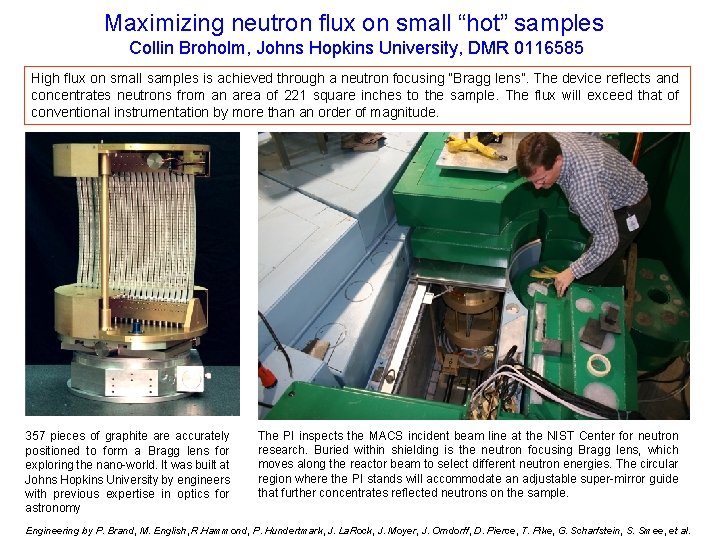
Maximizing neutron flux on small “hot” samples Collin Broholm, Johns Hopkins University, DMR 0116585 High flux on small samples is achieved through a neutron focusing “Bragg lens”. The device reflects and concentrates neutrons from an area of 221 square inches to the sample. The flux will exceed that of conventional instrumentation by more than an order of magnitude. 357 pieces of graphite are accurately positioned to form a Bragg lens for exploring the nano-world. It was built at Johns Hopkins University by engineers with previous expertise in optics for astronomy The PI inspects the MACS incident beam line at the NIST Center for neutron research. Buried within shielding is the neutron focusing Bragg lens, which moves along the reactor beam to select different neutron energies. The circular region where the PI stands will accommodate an adjustable super-mirror guide that further concentrates reflected neutrons on the sample. Engineering by P. Brand, M. English, R. Hammond, P. Hundertmark, J. La. Rock, J. Moyer, J. Orndorff, D. Pierce, T. Pike, G. Scharfstein, S. Smee, et al.
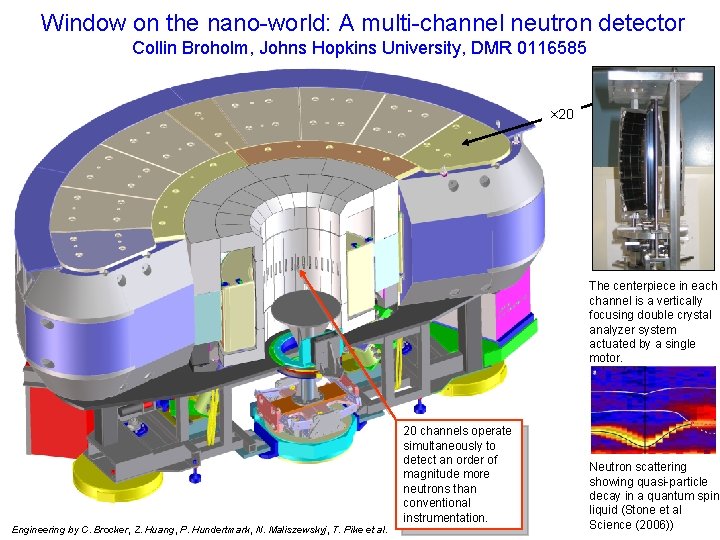
Window on the nano-world: A multi-channel neutron detector Collin Broholm, Johns Hopkins University, DMR 0116585 × 20 The centerpiece in each channel is a vertically focusing double crystal analyzer system actuated by a single motor. Engineering by C. Brocker, Z. Huang, P. Hundertmark, N. Maliszewskyj, T. Pike et al. 20 channels operate simultaneously to detect an order of magnitude more neutrons than conventional instrumentation. Neutron scattering showing quasi-particle decay in a quantum spin liquid (Stone et al Science (2006))