
A NetworkBased Compartmental Model For The Spread Of
A Network-Based Compartmental Model For The Spread Of Whooping Cough In Nebraska KIMIA AMERI
Learning Objectives After participating in this session the learner should be better able to: ◦ Use scale-free network to find a better estimation for the number of infected individuals in epidemiology diseases. ◦ This information can be used to quickly inform public health preparedness and prevention in states with low adherence to recommended vaccine schedules.
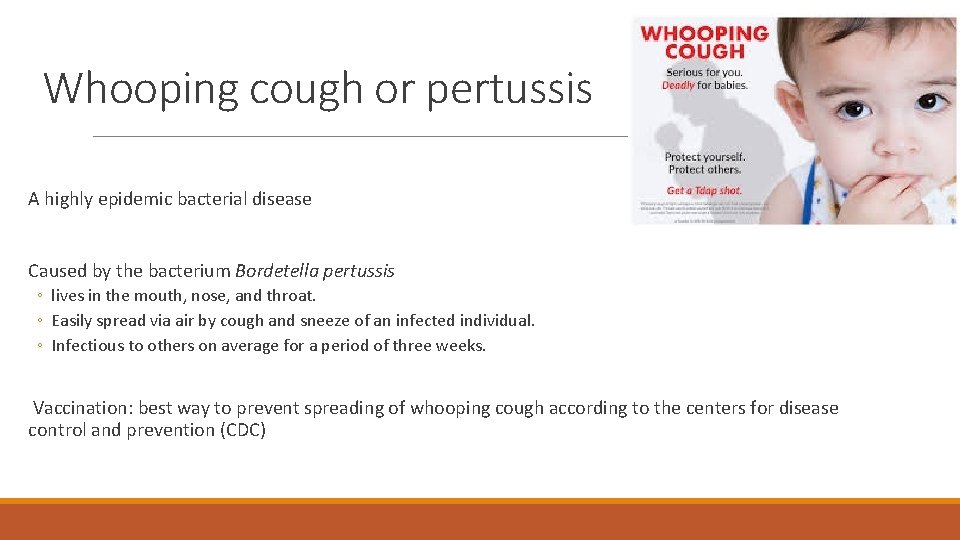
Whooping cough or pertussis A highly epidemic bacterial disease Caused by the bacterium Bordetella pertussis ◦ lives in the mouth, nose, and throat. ◦ Easily spread via air by cough and sneeze of an infected individual. ◦ Infectious to others on average for a period of three weeks. Vaccination: best way to prevent spreading of whooping cough according to the centers for disease control and prevention (CDC)
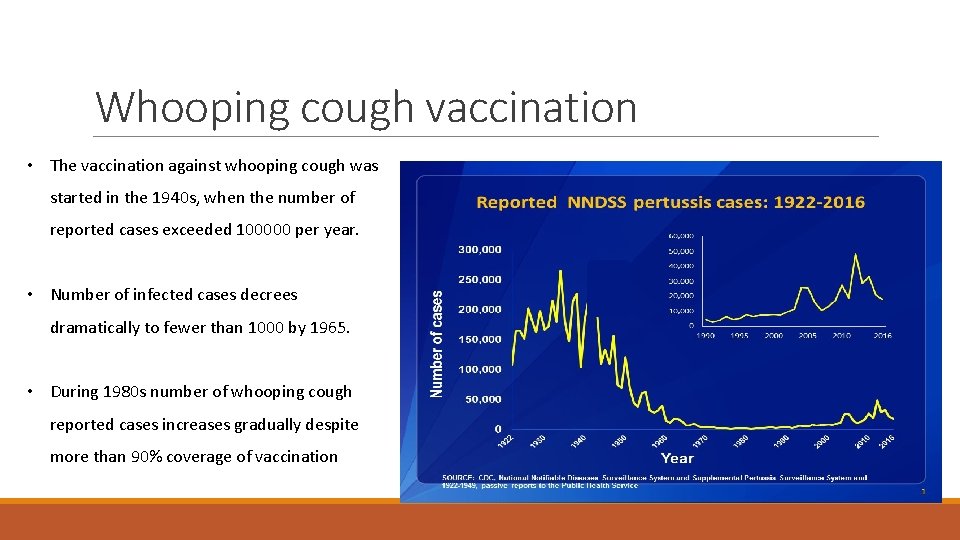
Whooping cough vaccination • The vaccination against whooping cough was started in the 1940 s, when the number of reported cases exceeded 100000 per year. • Number of infected cases decrees dramatically to fewer than 1000 by 1965. • During 1980 s number of whooping cough reported cases increases gradually despite more than 90% coverage of vaccination
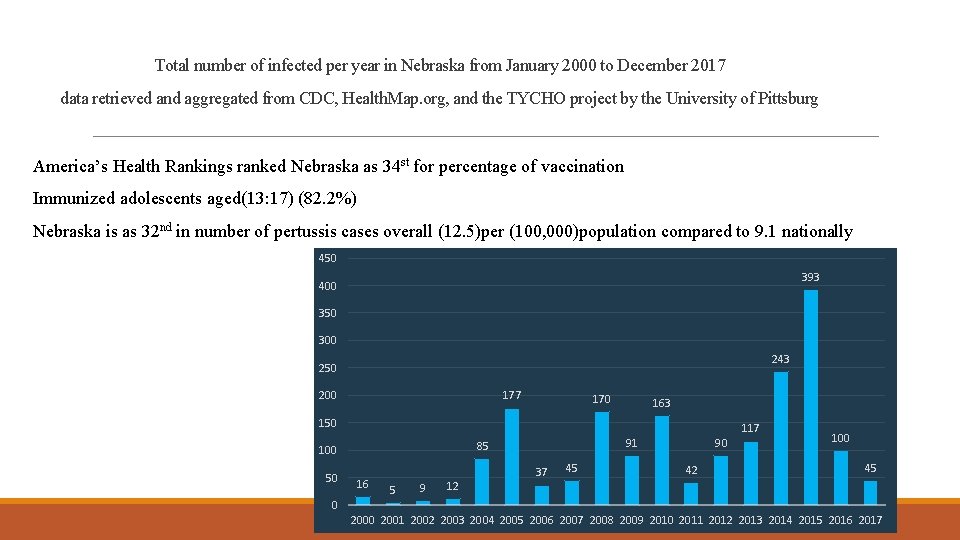
Total number of infected per year in Nebraska from January 2000 to December 2017 data retrieved and aggregated from CDC, Health. Map. org, and the TYCHO project by the University of Pittsburg America’s Health Rankings ranked Nebraska as 34 st for percentage of vaccination Immunized adolescents aged(13: 17) (82. 2%) Nebraska is as 32 nd in number of pertussis cases overall (12. 5)per (100, 000)population compared to 9. 1 nationally 450 393 400 350 300 243 250 177 200 170 163 150 85 100 50 16 5 9 12 117 91 37 45 90 42 100 45 0 2001 2002 2003 2004 2005 2006 2007 2008 2009 2010 2011 2012 2013 2014 2015 2016 2017
Contagious disease epidemiology Pathogen and host environment ◦ Bordetella pertussis evolution is Considered as a possible cause of resurgence of pertussis ◦ Burns, D. L. , Meade, B. D. and Messionnier, N. E. , 2014. Pertussis resurgence: perspectives from the Working Group Meeting on pertussis on the causes, possible paths forward, and gaps in our knowledge. The Journal of infectious diseases, 209(suppl_1), pp. S 32 -S 35. ◦ Belcher, T. and Preston, A. , 2015. Bordetella pertussis evolution in the (functional)genomics era. Pathogens and disease, 73(8). [7] Warfel, J. M. and Edwards, K. M. , 2015. Pertussis vaccines and the challenge of inducing durable immunity. Current opinion inimmunology, 35, pp. 48 -54. ◦ Weigand, Michael R. , Yanhui Peng, Vladimir Loparev, Dhwani Batra, Katherine E. Bowden, Mark Burroughs, Pamela K. Cassiday et al. "The history of Bordetella pertussis genome evolution includes structural rearrangement. " Journal of bacteriology 199, no. 8(2017): e 00806 -16. Exposed population and their social activities
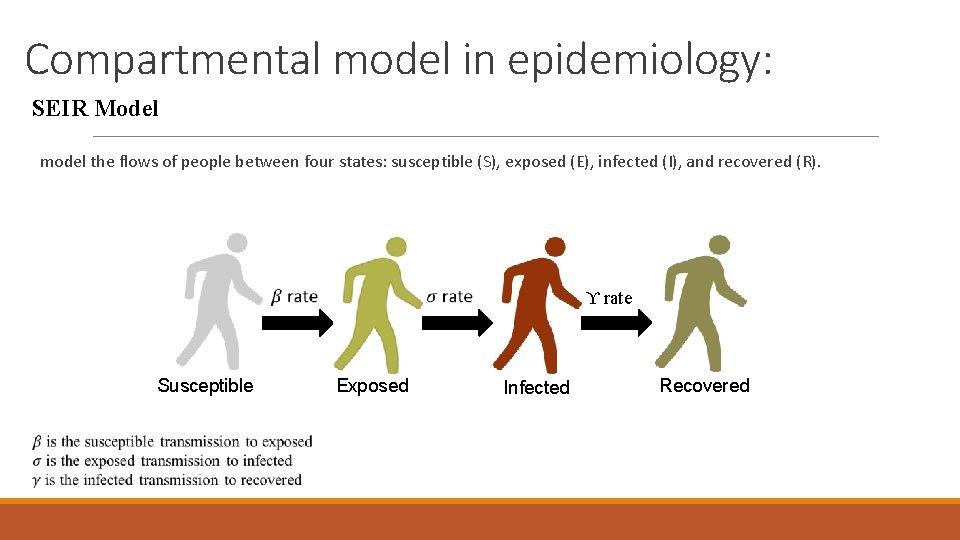
Compartmental model in epidemiology: SEIR Model model the flows of people between four states: susceptible (S), exposed (E), infected (I), and recovered (R). ϒ rate Susceptible Exposed Infected Recovered

Standard SEIR model equation ϒ=2. 2 Magpantay FM, De Cellès MD, Rohani P, King AA. Pertussis immunity and epidemiology: mode and duration of vaccine-induced immunity. Parasitology. 2016 Jun; 143(7): 835 -49. Forgoston E, Schwartz IB. Predicting unobserved exposures from seasonal epidemic data. Bulletin of mathematical biology. 2013 Sep 1; 75(9): 1450 -71. Althouse BM, Scarpino SV. Asymptomatic transmission and the resurgence of Bordetella pertussis. BMC medicine. 2015 Dec; 13(1): 146.
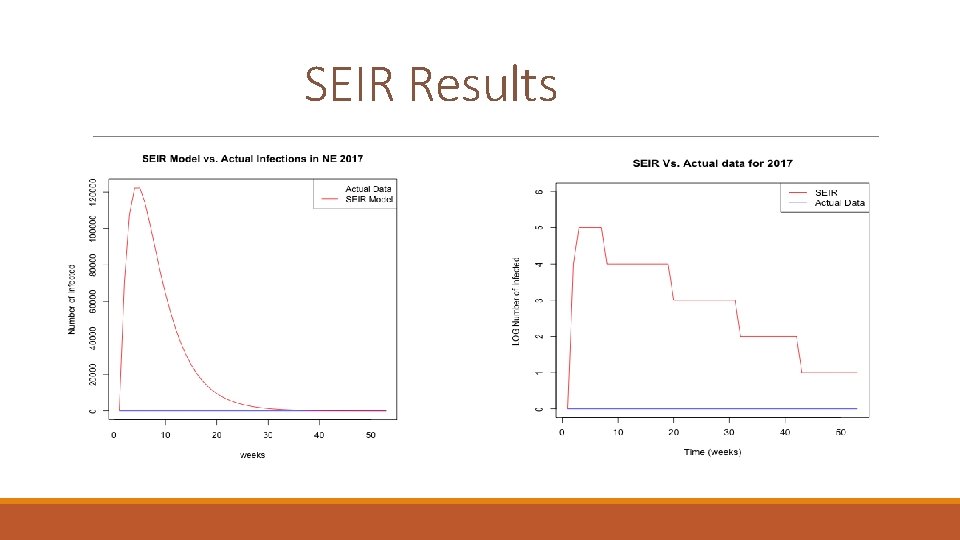
SEIR Results
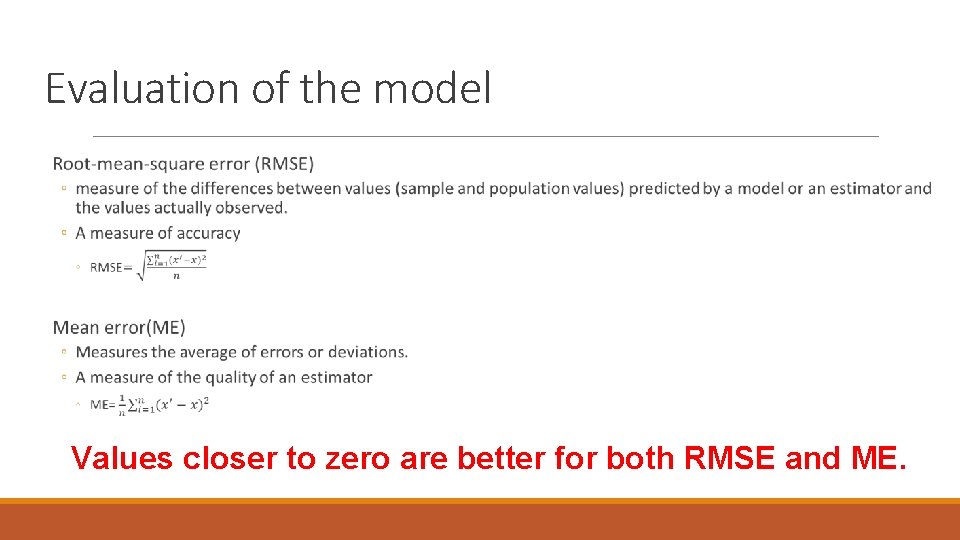
Evaluation of the model Values closer to zero are better for both RMSE and ME.
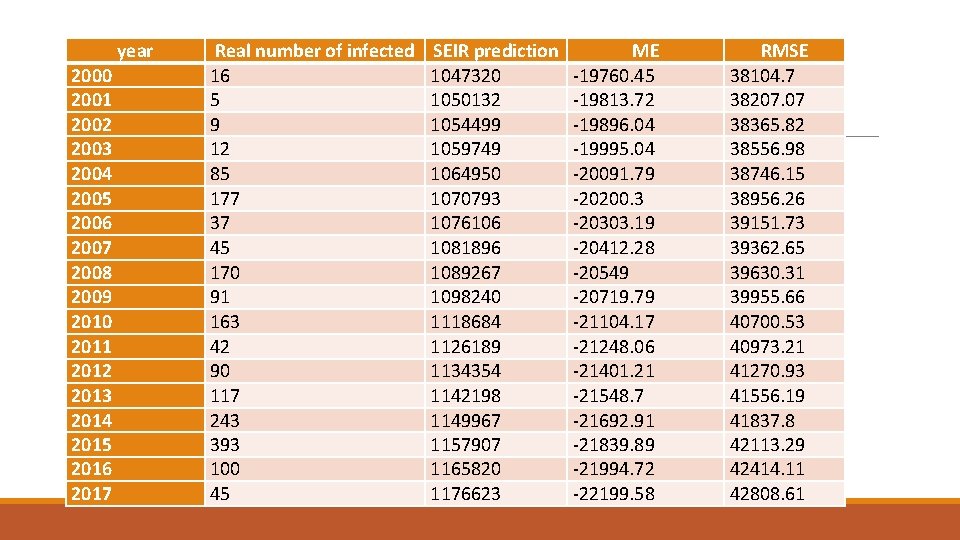
year 2000 2001 2002 2003 2004 2005 2006 2007 2008 2009 2010 2011 2012 2013 2014 2015 2016 2017 Real number of infected 16 5 9 12 85 177 37 45 170 91 163 42 90 117 243 393 100 45 SEIR prediction 1047320 1050132 1054499 1059749 1064950 1070793 1076106 1081896 1089267 1098240 1118684 1126189 1134354 1142198 1149967 1157907 1165820 1176623 ME -19760. 45 -19813. 72 -19896. 04 -19995. 04 -20091. 79 -20200. 3 -20303. 19 -20412. 28 -20549 -20719. 79 -21104. 17 -21248. 06 -21401. 21 -21548. 7 -21692. 91 -21839. 89 -21994. 72 -22199. 58 RMSE 38104. 7 38207. 07 38365. 82 38556. 98 38746. 15 38956. 26 39151. 73 39362. 65 39630. 31 39955. 66 40700. 53 40973. 21 41270. 93 41556. 19 41837. 8 42113. 29 42414. 11 42808. 61
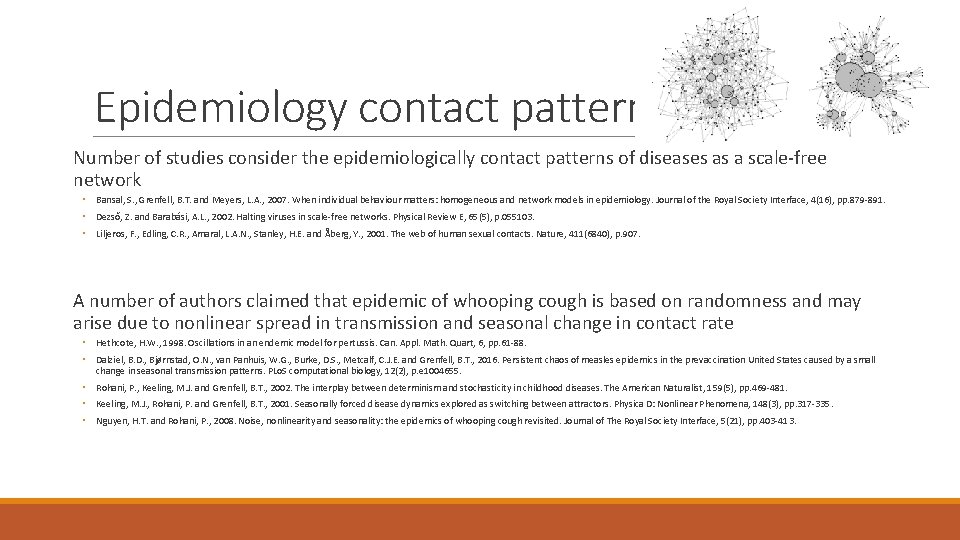
Epidemiology contact patterns Number of studies consider the epidemiologically contact patterns of diseases as a scale-free network ◦ Bansal, S. , Grenfell, B. T. and Meyers, L. A. , 2007. When individual behaviour matters: homogeneous and network models in epidemiology. Journal of the Royal Society Interface, 4(16), pp. 879 -891. ◦ Dezső, Z. and Barabási, A. L. , 2002. Halting viruses in scale-free networks. Physical Review E, 65(5), p. 055103. ◦ Liljeros, F. , Edling, C. R. , Amaral, L. A. N. , Stanley, H. E. and Åberg, Y. , 2001. The web of human sexual contacts. Nature, 411(6840), p. 907. A number of authors claimed that epidemic of whooping cough is based on randomness and may arise due to nonlinear spread in transmission and seasonal change in contact rate ◦ Hethcote, H. W. , 1998. Oscillations in an endemic model for pertussis. Can. Appl. Math. Quart, 6, pp. 61 -88. ◦ Dalziel, B. D. , Bjørnstad, O. N. , van Panhuis, W. G. , Burke, D. S. , Metcalf, C. J. E. and Grenfell, B. T. , 2016. Persistent chaos of measles epidemics in the prevaccination United States caused by a small change in seasonal transmission patterns. PLo. S computational biology, 12(2), p. e 1004655. ◦ Rohani, P. , Keeling, M. J. and Grenfell, B. T. , 2002. The interplay between determinism and stochasticity in childhood diseases. The American Naturalist, 159(5), pp. 469 -481. ◦ Keeling, M. J. , Rohani, P. and Grenfell, B. T. , 2001. Seasonally forced disease dynamics explored as switching between attractors. Physica D: Nonlinear Phenomena, 148(3), pp. 317 -335. ◦ Nguyen, H. T. and Rohani, P. , 2008. Noise, nonlinearity and seasonality: the epidemics of whooping cough revisited. Journal of The Royal Society Interface, 5(21), pp. 403 -413.
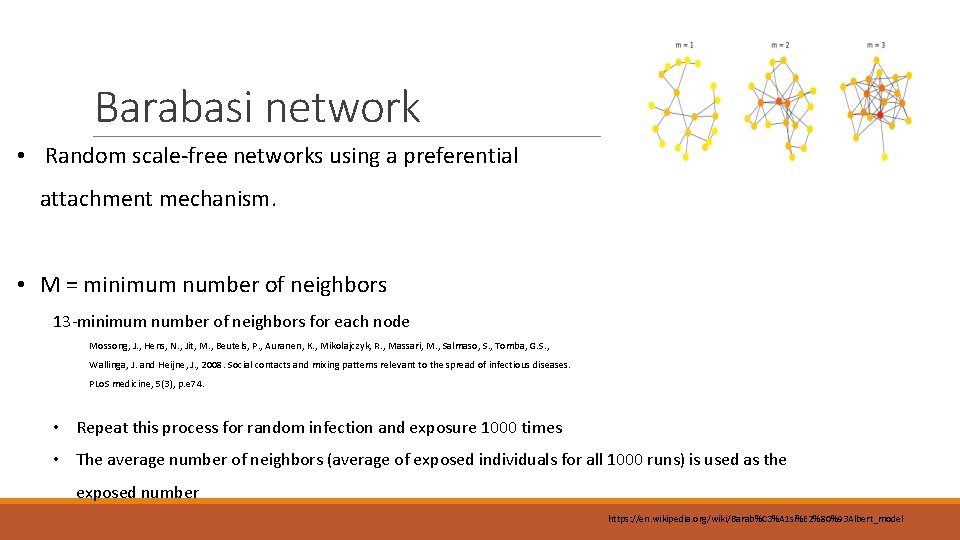
Barabasi network • Random scale-free networks using a preferential attachment mechanism. • M = minimum number of neighbors 13 -minimum number of neighbors for each node Mossong, J. , Hens, N. , Jit, M. , Beutels, P. , Auranen, K. , Mikolajczyk, R. , Massari, M. , Salmaso, S. , Tomba, G. S. , Wallinga, J. and Heijne, J. , 2008. Social contacts and mixing patterns relevant to the spread of infectious diseases. PLo. S medicine, 5(3), p. e 74. • Repeat this process for random infection and exposure 1000 times • The average number of neighbors (average of exposed individuals for all 1000 runs) is used as the exposed number https: //en. wikipedia. org/wiki/Barab%C 3%A 1 si%E 2%80%93 Albert_model
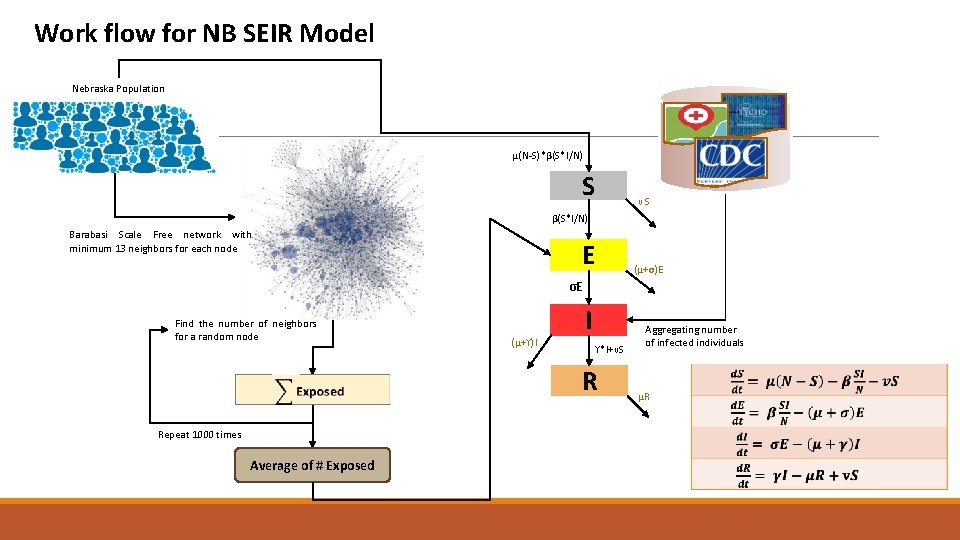
Work flow for NB SEIR Model Nebraska Population µ(N-S)*β(S*I/N) S νS β(S*I/N) Barabasi Scale Free network with minimum 13 neighbors for each node E (µ+σ)E σE Find the number of neighbors for a random node (µ+ϒ)I I ϒ*I+νS R Repeat 1000 times Average of # Exposed Aggregating number of infected individuals µR β: Infection rate γ: Recovery rate σ: Incubation rate µ: Mortality rate ν: Vaccination rate
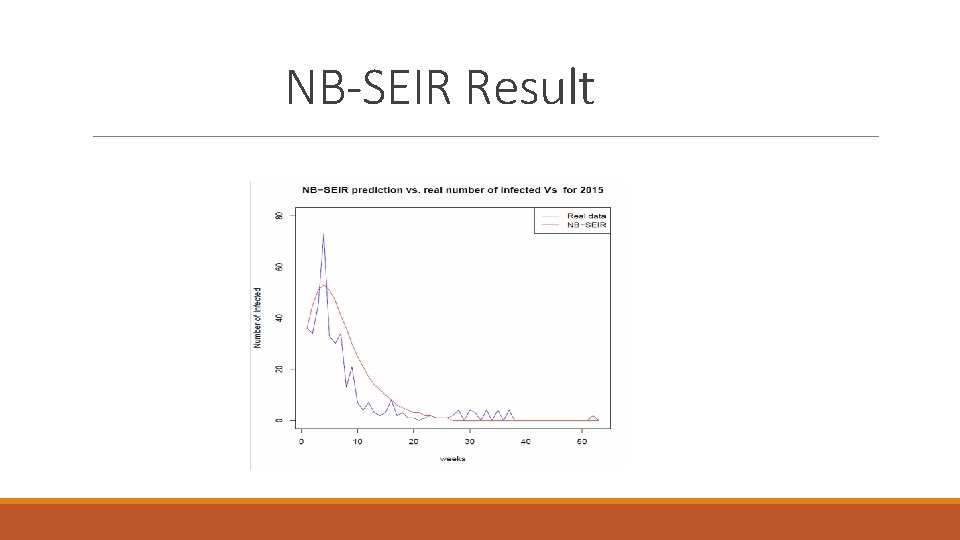
NB-SEIR Result
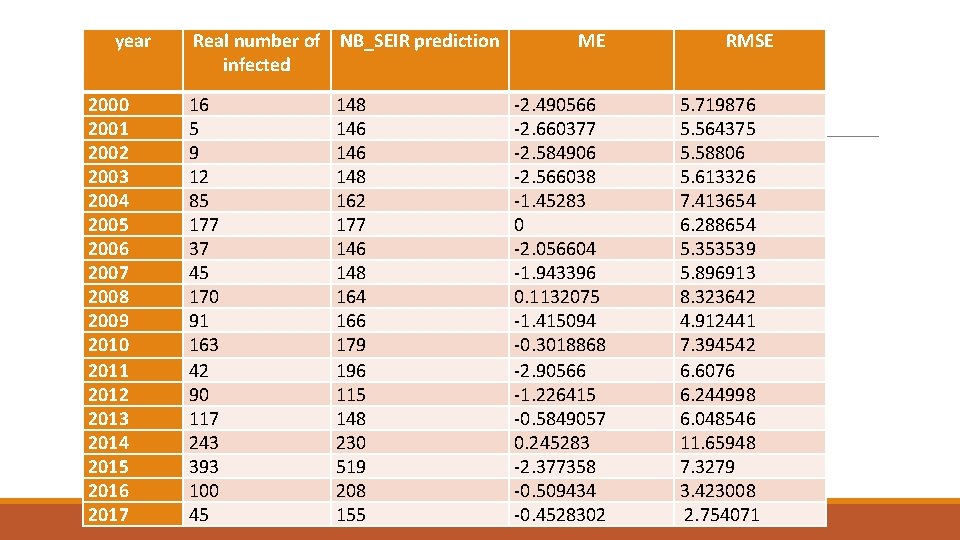
year 2000 2001 2002 2003 2004 2005 2006 2007 2008 2009 2010 2011 2012 2013 2014 2015 2016 2017 Real number of NB_SEIR prediction infected 16 5 9 12 85 177 37 45 170 91 163 42 90 117 243 393 100 45 148 146 148 162 177 146 148 164 166 179 196 115 148 230 519 208 155 ME -2. 490566 -2. 660377 -2. 584906 -2. 566038 -1. 45283 0 -2. 056604 -1. 943396 0. 1132075 -1. 415094 -0. 3018868 -2. 90566 -1. 226415 -0. 5849057 0. 245283 -2. 377358 -0. 509434 -0. 4528302 RMSE 5. 719876 5. 564375 5. 58806 5. 613326 7. 413654 6. 288654 5. 353539 5. 896913 8. 323642 4. 912441 7. 394542 6. 6076 6. 244998 6. 048546 11. 65948 7. 3279 3. 423008 2. 754071
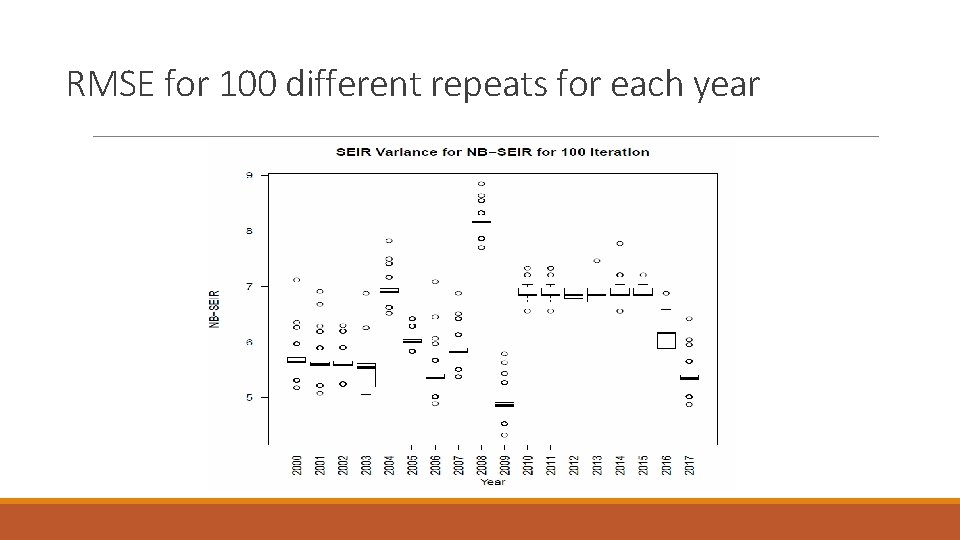
RMSE for 100 different repeats for each year
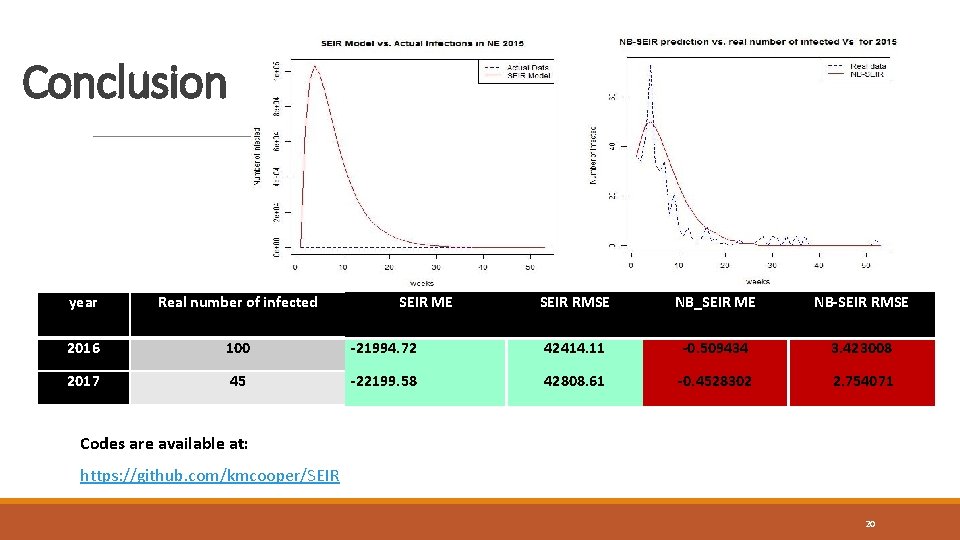
Conclusion year Real number of infected 2016 100 2017 45 SEIR RMSE NB_SEIR ME NB_SEIR prediction NB-SEIR RMSE -21994. 72 1165820 42414. 11 -0. 509434 208 3. 423008 -22199. 58 1176623 42808. 61 -0. 4528302 155 2. 754071 ME SEIR prediction Codes are available at: https: //github. com/kmcooper/SEIR 20
Future work How networks (social networks) changes over time Evaluate our model based on the changes of networks and therefore exposed individuals.


Thank you! Special thanks to my supervisor Dr. Kate Cooper Question?
- Slides: 21