
A nervous system develops from neural plate B
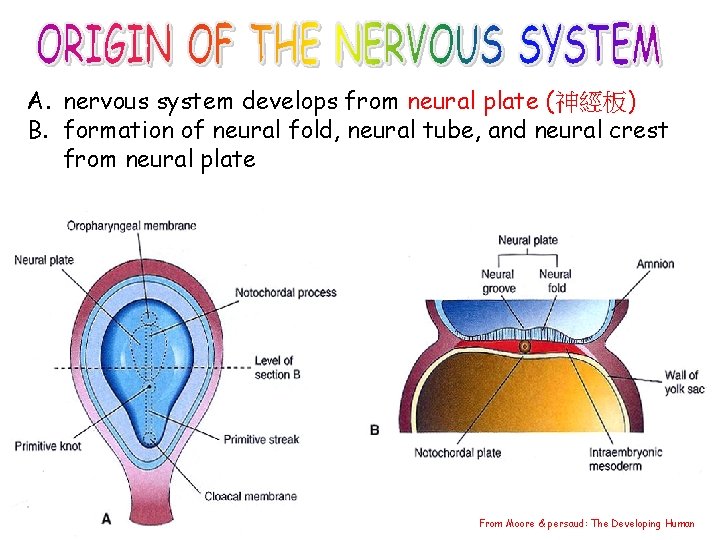
A. nervous system develops from neural plate (神經板) B. formation of neural fold, neural tube, and neural crest from neural plate From Moore & persaud: The Developing Human
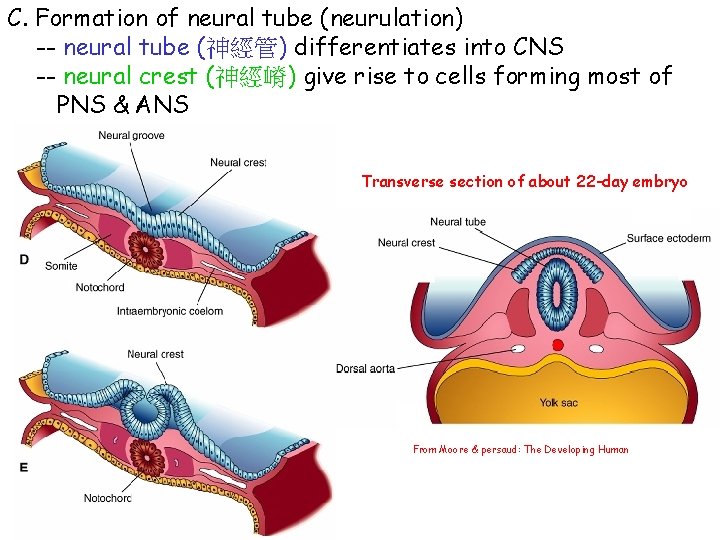
C. Formation of neural tube (neurulation) -- neural tube (神經管) differentiates into CNS -- neural crest (神經嵴) give rise to cells forming most of PNS & ANS Transverse section of about 22 -day embryo From Moore & persaud: The Developing Human
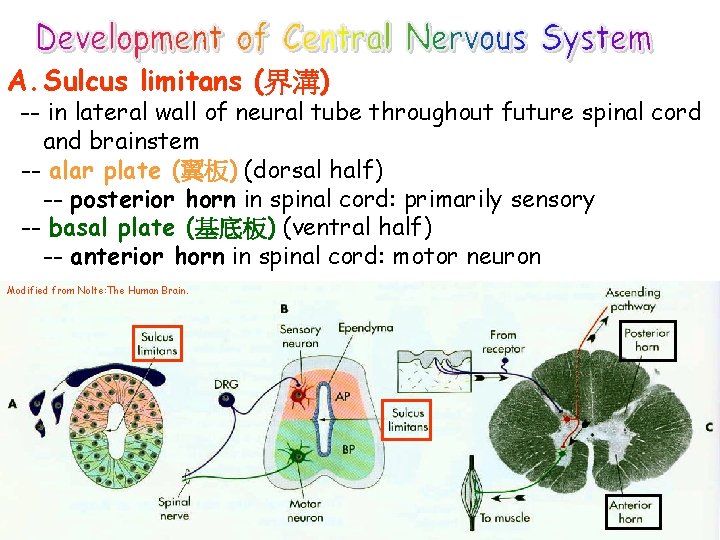
A. Sulcus limitans (界溝) -- in lateral wall of neural tube throughout future spinal cord and brainstem -- alar plate (翼板) (dorsal half) -- posterior horn in spinal cord: primarily sensory -- basal plate (基底板) (ventral half) -- anterior horn in spinal cord: motor neuron Modified from Nolte: The Human Brain.
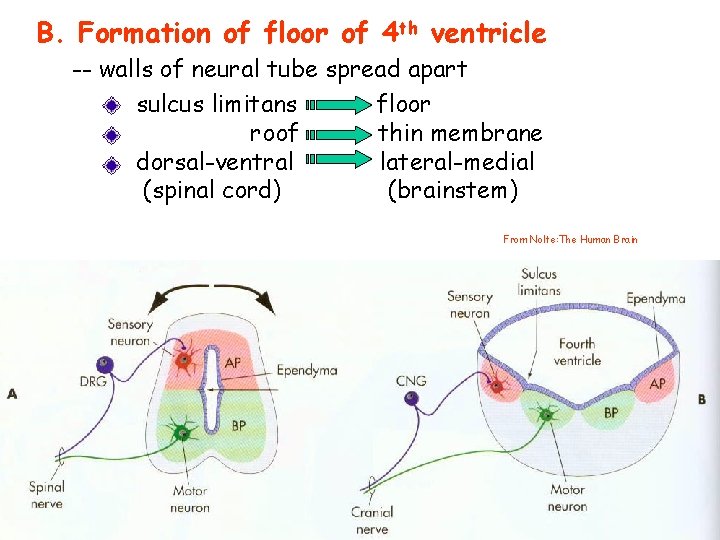
B. Formation of floor of 4 th ventricle -- walls of neural tube spread apart sulcus limitans floor roof thin membrane dorsal-ventral lateral-medial (spinal cord) (brainstem) From Nolte: The Human Brain
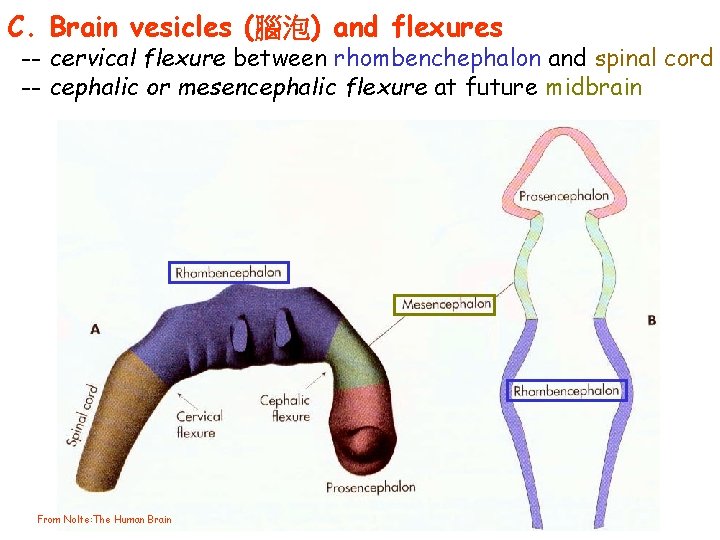
C. Brain vesicles (腦泡) and flexures -- cervical flexure between rhombenchephalon and spinal cord -- cephalic or mesencephalic flexure at future midbrain From Nolte: The Human Brain
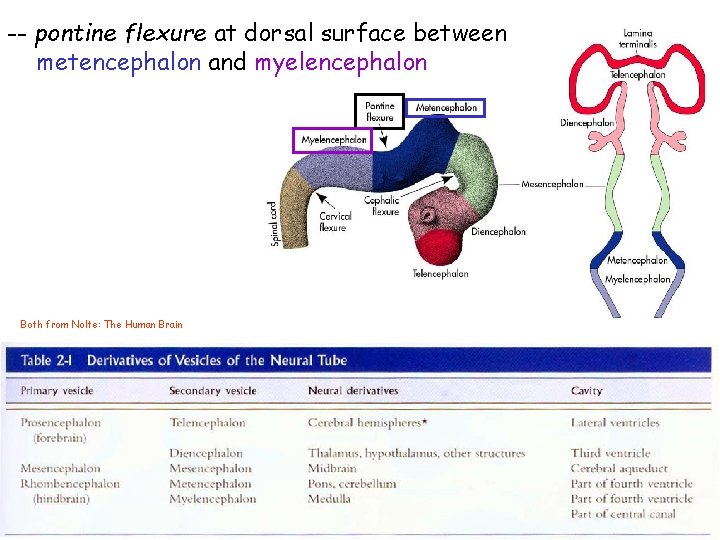
-- pontine flexure at dorsal surface between metencephalon and myelencephalon Both from Nolte: The Human Brain
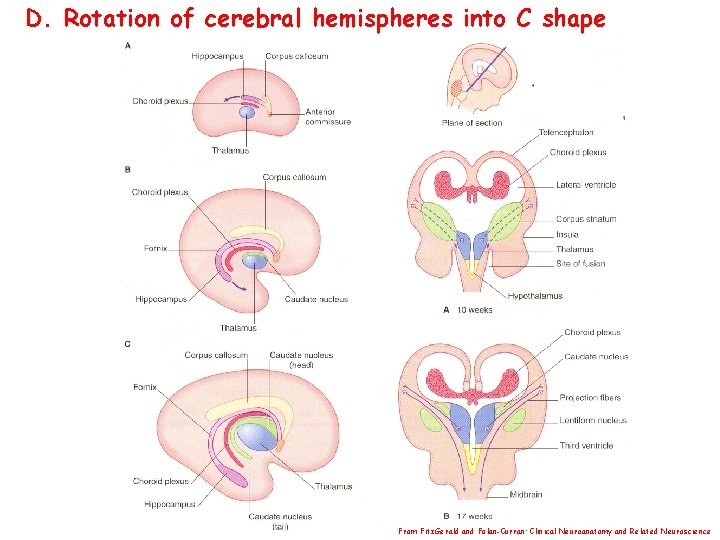
D. Rotation of cerebral hemispheres into C shape From Fitz. Gerald and Folan-Curran: Clinical Neuroanatomy and Related Neuroscience
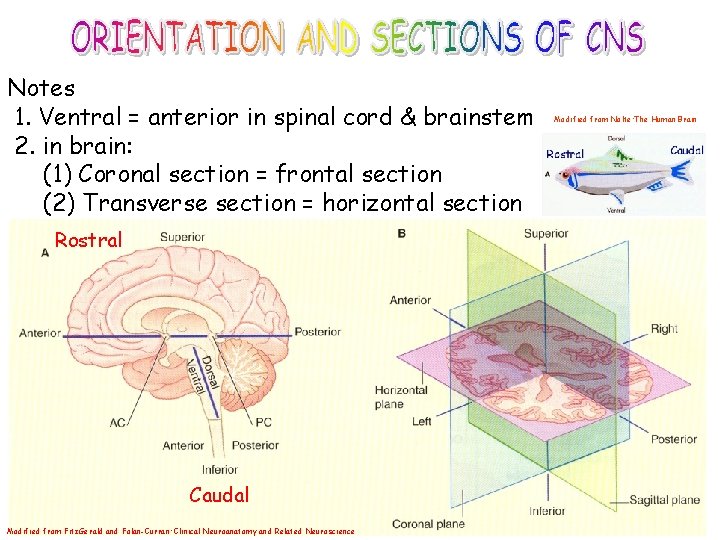
Notes 1. Ventral = anterior in spinal cord & brainstem 2. in brain: (1) Coronal section = frontal section (2) Transverse section = horizontal section Rostral Caudal Modified from Fitz. Gerald and Folan-Curran: Clinical Neuroanatomy and Related Neuroscience Modified from Nolte: The Human Brain
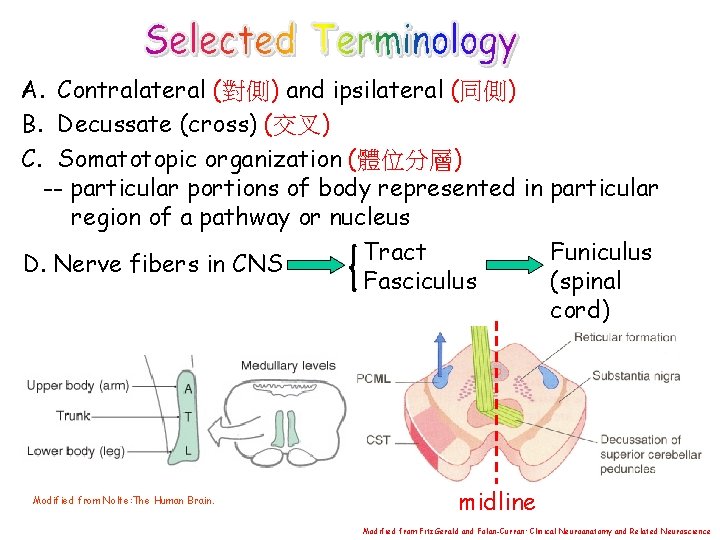
A. Contralateral (對側) and ipsilateral (同側) B. Decussate (cross) (交叉) C. Somatotopic organization (體位分層) -- particular portions of body represented in particular region of a pathway or nucleus Tract Funiculus D. Nerve fibers in CNS Fasciculus (spinal cord) Modified from Nolte: The Human Brain. midline Modified from Fitz. Gerald and Folan-Curran: Clinical Neuroanatomy and Related Neuroscience
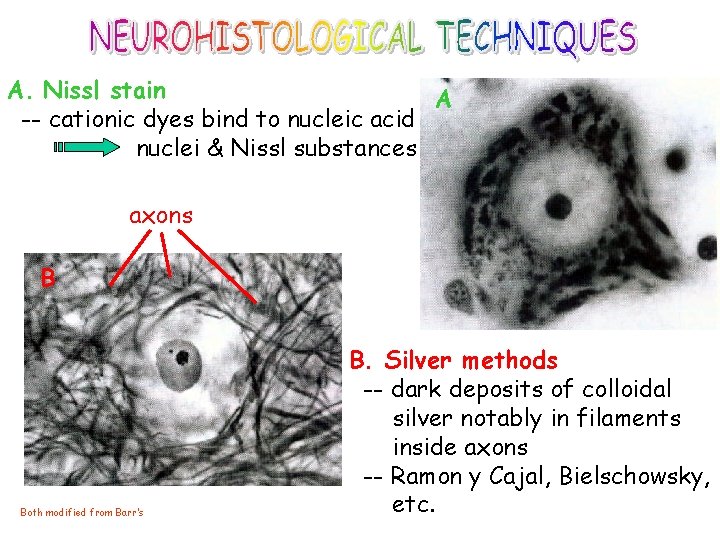
A. Nissl stain A -- cationic dyes bind to nucleic acid nuclei & Nissl substances axons B Both modified from Barr’s B. Silver methods -- dark deposits of colloidal silver notably in filaments inside axons -- Ramon y Cajal, Bielschowsky, etc.
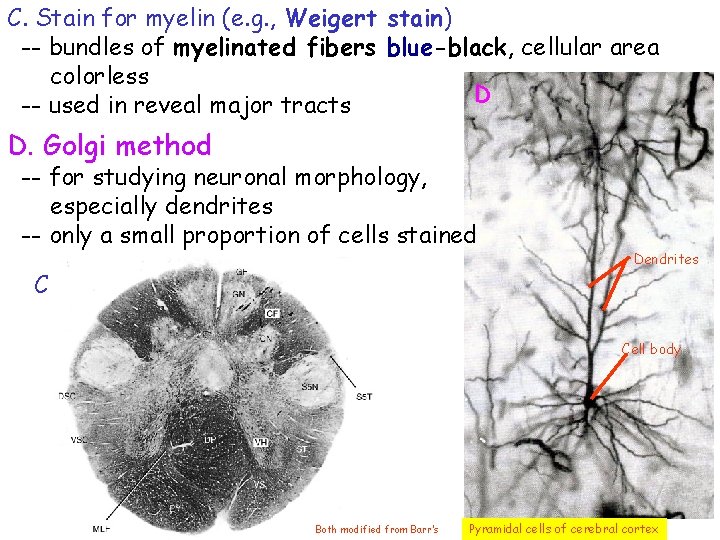
C. Stain for myelin (e. g. , Weigert stain) -- bundles of myelinated fibers blue-black, cellular area colorless D -- used in reveal major tracts D. Golgi method -- for studying neuronal morphology, especially dendrites -- only a small proportion of cells stained C Dendrites Cell body Both modified from Barr’s Pyramidal cells of cerebral cortex
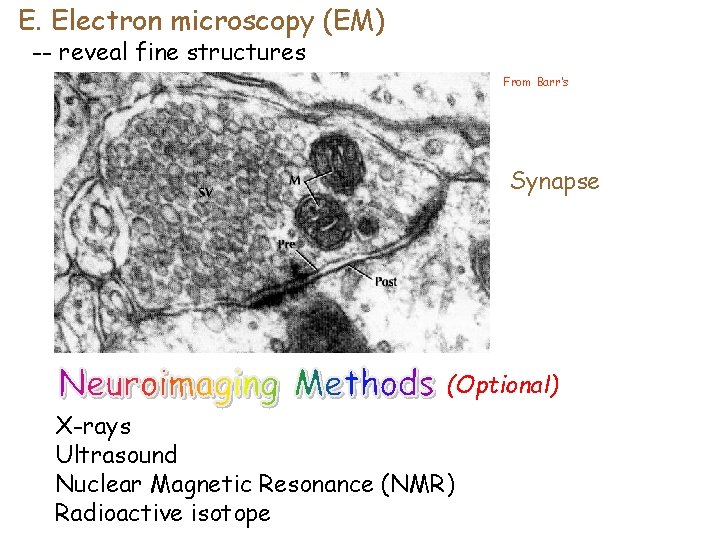
E. Electron microscopy (EM) -- reveal fine structures From Barr’s Synapse (Optional) X-rays Ultrasound Nuclear Magnetic Resonance (NMR) Radioactive isotope
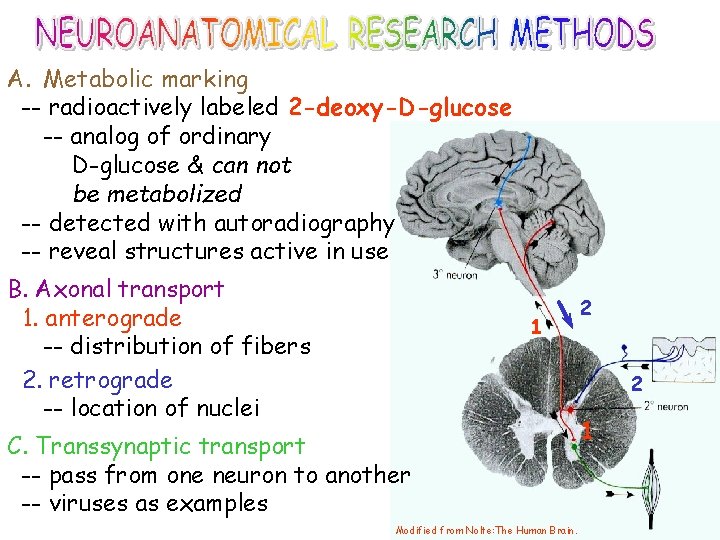
A. Metabolic marking -- radioactively labeled 2 -deoxy-D-glucose -- analog of ordinary D-glucose & can not be metabolized -- detected with autoradiography -- reveal structures active in use B. Axonal transport 1. anterograde -- distribution of fibers 2. retrograde -- location of nuclei 1 2 2 C. Transsynaptic transport -- pass from one neuron to another -- viruses as examples Modified from Nolte: The Human Brain. 1
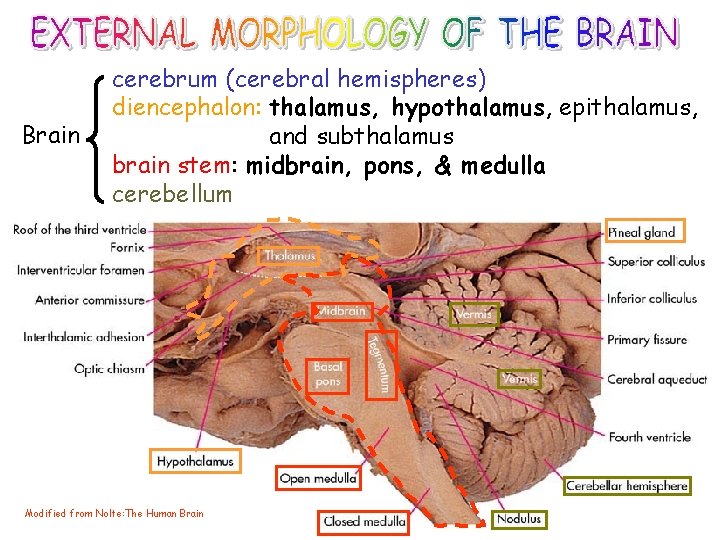
Brain cerebrum (cerebral hemispheres) diencephalon: thalamus, hypothalamus, epithalamus, and subthalamus brain stem: midbrain, pons, & medulla cerebellum Modified from Nolte: The Human Brain
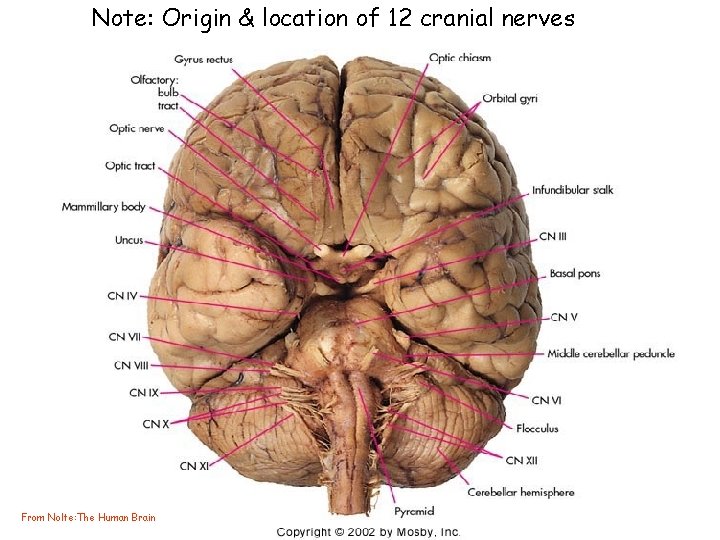
Note: Origin & location of 12 cranial nerves From Nolte: The Human Brain
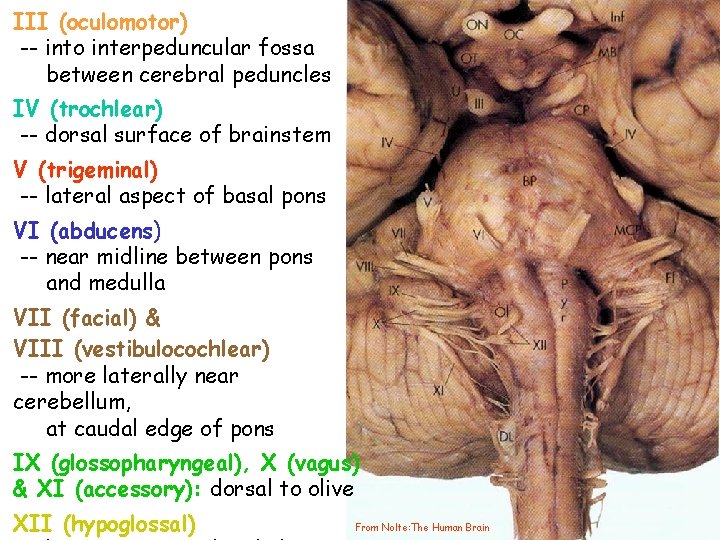
III (oculomotor) -- into interpeduncular fossa between cerebral peduncles IV (trochlear) -- dorsal surface of brainstem V (trigeminal) -- lateral aspect of basal pons VI (abducens) -- near midline between pons and medulla VII (facial) & VIII (vestibulocochlear) -- more laterally near cerebellum, at caudal edge of pons IX (glossopharyngeal), X (vagus) & XI (accessory): dorsal to olive XII (hypoglossal) From Nolte: The Human Brain
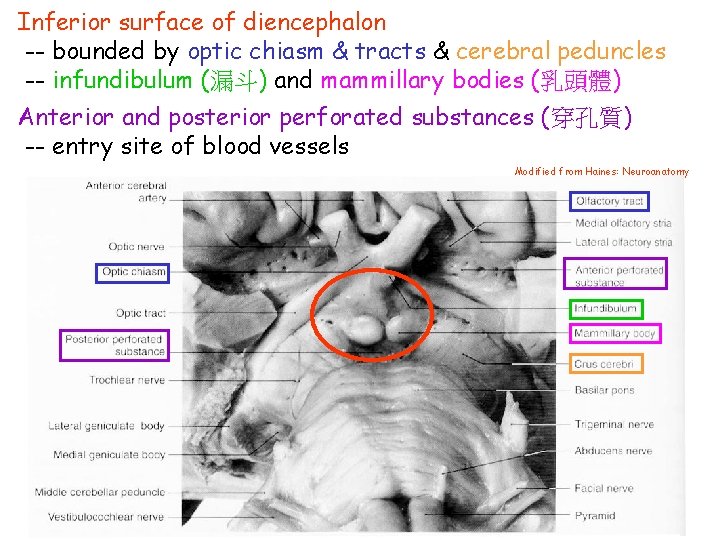
Inferior surface of diencephalon -- bounded by optic chiasm & tracts & cerebral peduncles -- infundibulum (漏斗) and mammillary bodies (乳頭體) Anterior and posterior perforated substances (穿孔質) -- entry site of blood vessels Modified from Haines: Neuroanatomy
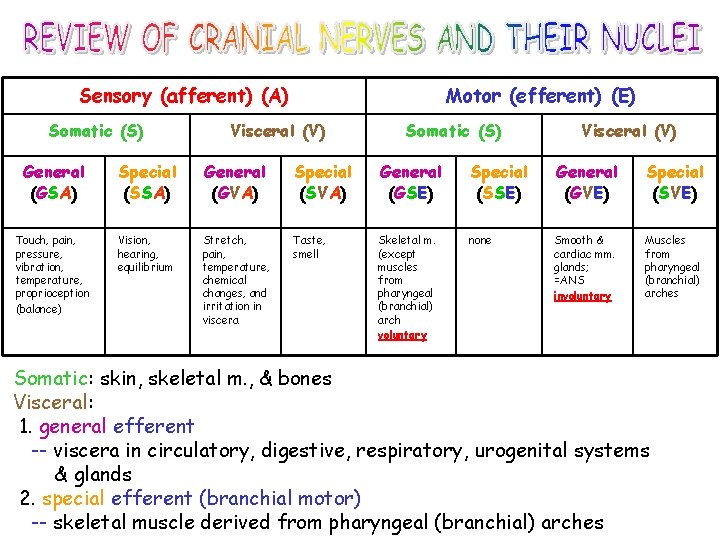
Sensory (afferent) (A) Somatic (S) Motor (efferent) (E) Visceral (V) Somatic (S) Visceral (V) General (GSA) Special (SSA) General (GVA) Special (SVA) General (GSE) Special (SSE) General (GVE) Special (SVE) Touch, pain, pressure, vibration, temperature, proprioception (balance) Vision, hearing, equilibrium Stretch, pain, temperature, chemical changes, and irritation in viscera Taste, smell Skeletal m. (except muscles from pharyngeal (branchial) arch voluntary none Smooth & cardiac mm. glands; =ANS involuntary Muscles from pharyngeal (branchial) arches Somatic: skin, skeletal m. , & bones Visceral: 1. general efferent -- viscera in circulatory, digestive, respiratory, urogenital systems & glands 2. special efferent (branchial motor) -- skeletal muscle derived from pharyngeal (branchial) arches
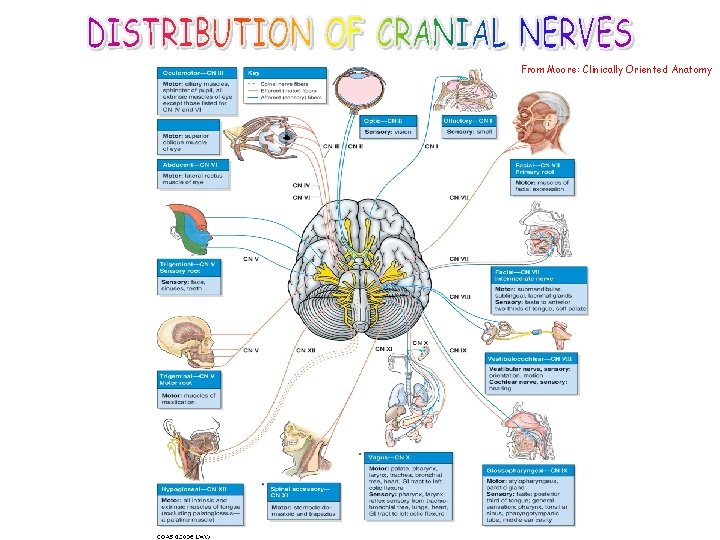
From Moore: Clinically Oriented Anatomy
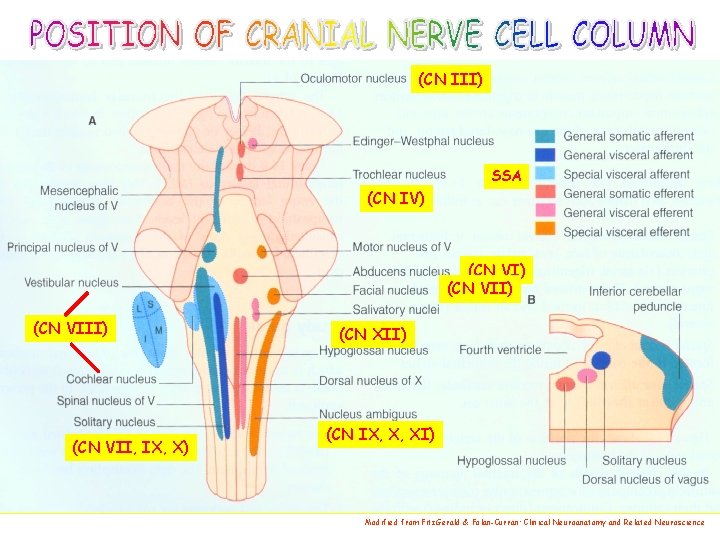
(CN III) SSA (CN IV) (CN VII) (CN VII, IX, X) (CN XII) (CN IX, X, XI) Modified from Fitz. Gerald & Folan-Curran: Clinical Neuroanatomy and Related Neuroscience
www. wretch. cc/blog/cjs 570407
- Slides: 25