
A Multisensory Language Approach Wendy Phillips M S

- Slides: 50
A Multisensory Language Approach Wendy Phillips, M. S. Coordinator or Reading/Literacy Specialist Virginia Department of Education’s Training & Technical Assistance Center (T/TAC) @ Virginia Tech wphillips@vt. edu
https: //www. ttac. vt. edu
What is T/TAC? The mission of the Training & Technical Assistance Center (T/TAC) is to: ➔ improve educational opportunities and contribute to the success of children and youth with disabilities (birth– 22 years) ➔ increase the capacity of schools, school personnel, service providers, and families to meet the needs of children and youth with disabilities ➔ foster the state improvement goals for personnel development, which address improving the performance of children and youth with disabilities
So How Do We Meet Our Mission? Professional Development Regional Trainings Individual Consultation Library Loans Information Services Referral Services Free of Charge
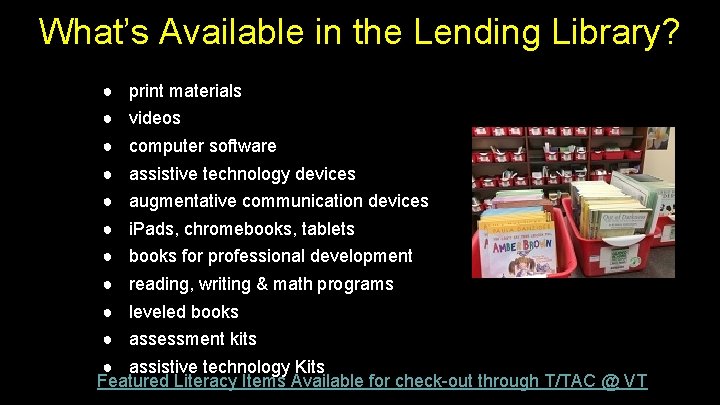
What’s Available in the Lending Library? ● print materials ● videos ● computer software ● assistive technology devices ● augmentative communication devices ● i. Pads, chromebooks, tablets ● books for professional development ● reading, writing & math programs ● leveled books ● assessment kits ● assistive technology Kits Featured Literacy Items Available for check-out through T/TAC @ VT
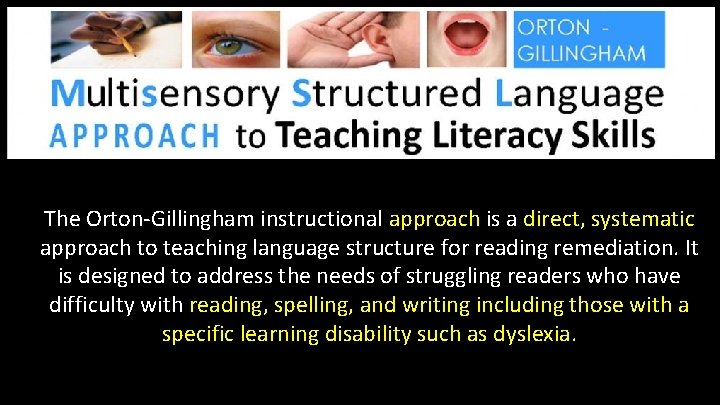
The Orton-Gillingham instructional approach is a direct, systematic approach to teaching language structure for reading remediation. It is designed to address the needs of struggling readers who have difficulty with reading, spelling, and writing including those with a specific learning disability such as dyslexia.
How does it feel to be dyslexic?
How is dyslexia defined in Virginia? "Specific learning disability" means a disorder in one or more of the basic psychological processes involved in understanding or in using language, spoken or written, that may manifest itself in the imperfect ability to listen, think, speak, read, write, spell or to do mathematical calculations, including conditions such as perceptual disabilities, brain injury, minimal brain dysfunction, dyslexia, and developmental aphasia. From the Virginia Administrative Code: http: //leg 1. state. va. us/cgi- bin/legp 504. exe? 000+reg+8 VAC 20 -81 -10
These difficulties typically result from a deficit in the phonological component of language that is often unexpected in relation to other cognitive abilities and the provision of effective classroom instruction. Secondary consequences may include problems in reading comprehension and reduced reading experience that can impede growth of vocabulary and background knowledge. (§ 22. 1 -213 of the Code of Virginia; 34 CFR 300. 8(c)(10))
Dyslexia is distinguished from other learning disabilities due to its weakness occurring at the phonological level. Dyslexia is a specific learning disability that is neurobiological in origin. It is characterized by difficulties with accurate and/or fluent word recognition and by poor spelling and decoding abilities.
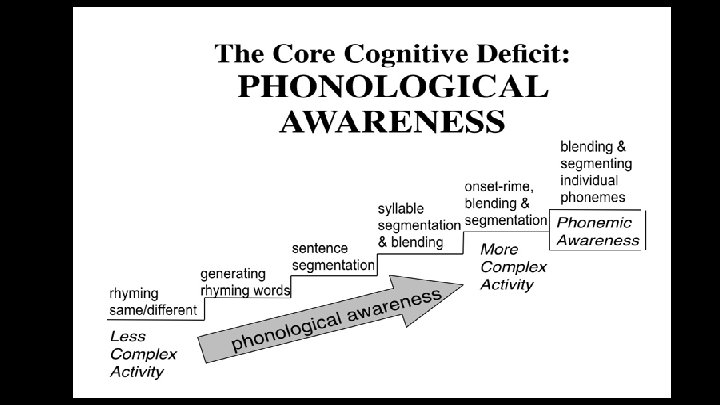
Those with dyslexia experience difficulty at the phonological processing level. Phonological processing involves the taking in, manipulating, and storing of phonemes. Phonological awareness is the ability to identify, think about, and manipulate the parts of words, including syllables, onsets and rimes, and phonemes. Phoneme segmentation is at the heart of reading and spelling (Moats, 2009).
SLD is the highest incidence of students receiving special education services (42 percent of the 5. 7 million school-age children with all kinds of disabilities). There are 2. 4 million American public school students (approximately 5 percent of the total public school enrollment) identified with SLD under the Individuals with Disabilities Education Act. Two-thirds (66 percent) of students identified with SLD are male, while overall public school enrollment is evenly split between males and females. https: //www. ncld. org/reports-and-studies/2014 -state-of-ld/
The International Dyslexia Association (IDA) indicates that 5 to 20% of the population have some of the symptoms of dyslexia. Further, IDA indicates that of those eligible for special education services as having a learning disability, 85% have primary learning disability in reading or language processing. (Moats and Dakin, 2012) http: //eida. org/dyslexia-basics)
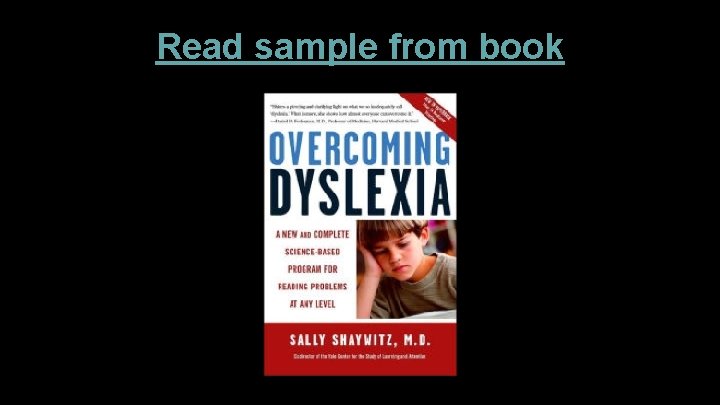
Read sample from book
Red Flags of Dyslexia Family history Never learned nursery rhymes Never crawled Late in speaking/speech problems Delayed potty training Can not rhyme Can not tie their shoe Can only SING the alphabet Difficulty following directions Frequent ear infections Auto-immune deficiency disorders Reversals after 1 st grade
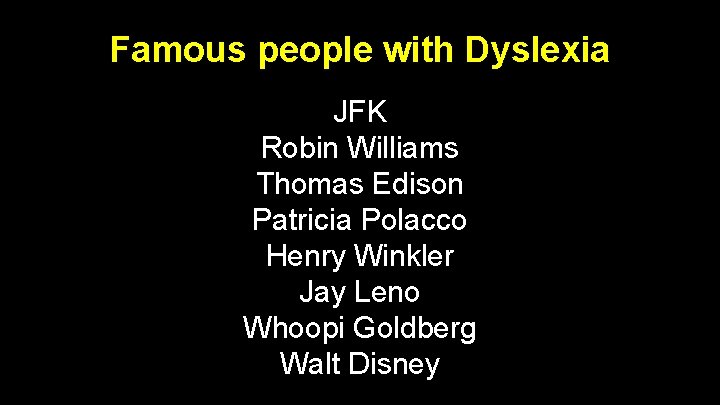
Famous people with Dyslexia JFK Robin Williams Thomas Edison Patricia Polacco Henry Winkler Jay Leno Whoopi Goldberg Walt Disney
Reading instruction must contain the five components of reading (Phonemic Awareness, Phonics, Fluency, Vocabulary, and Comprehension) as outlined in the National Reading Panel’s report (National Institute of Child Health and Human Development, 2000) to meet the standards set out in IDEA 2004, ESEA 2001 and the USED waivers of 2012.
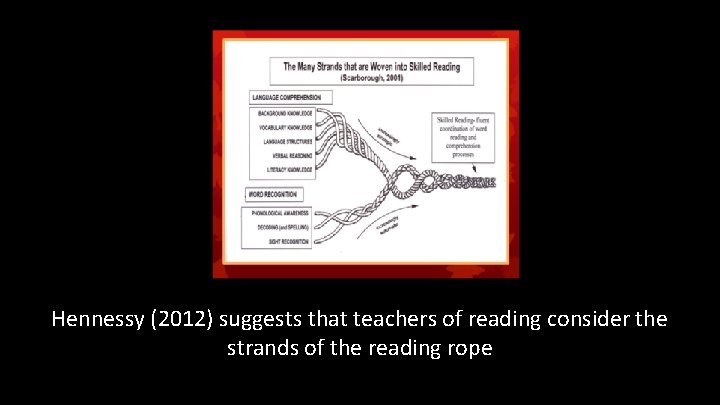
Hennessy (2012) suggests that teachers of reading consider the strands of the reading rope
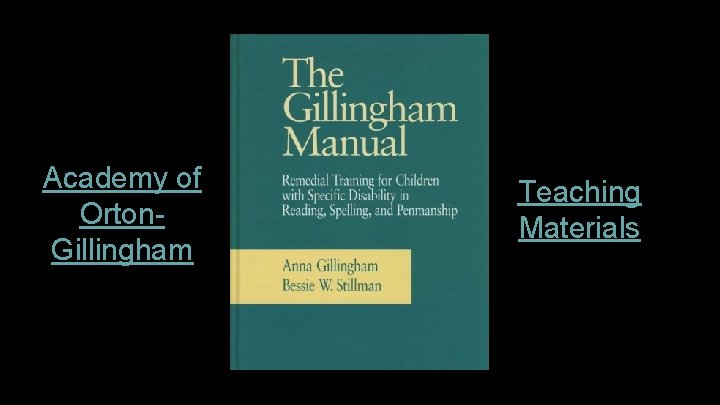
Academy of Orton. Gillingham Teaching Materials
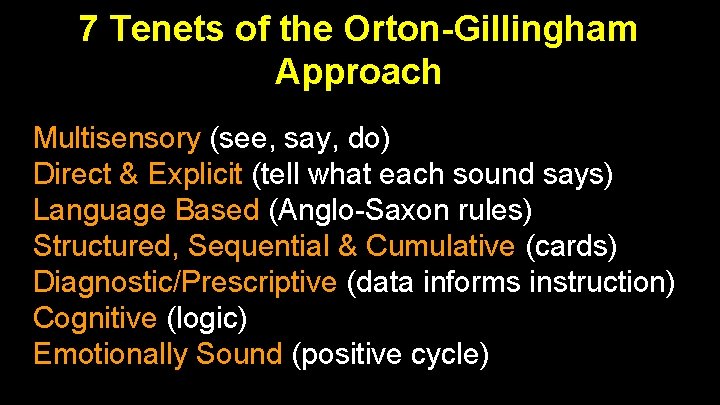
7 Tenets of the Orton-Gillingham Approach Multisensory (see, say, do) Direct & Explicit (tell what each sound says) Language Based (Anglo-Saxon rules) Structured, Sequential & Cumulative (cards) Diagnostic/Prescriptive (data informs instruction) Cognitive (logic) Emotionally Sound (positive cycle)
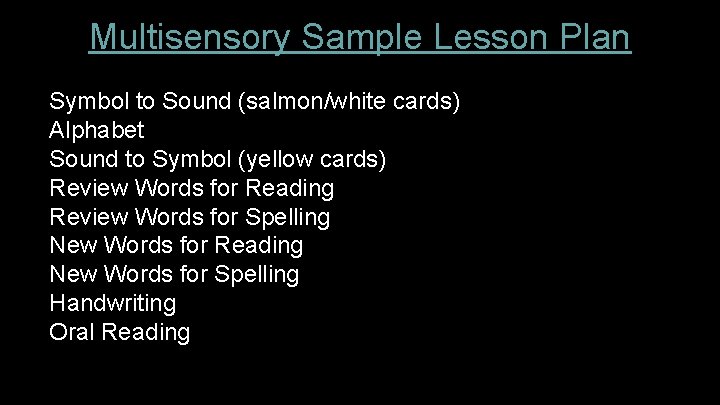
Multisensory Sample Lesson Plan Symbol to Sound (salmon/white cards) Alphabet Sound to Symbol (yellow cards) Review Words for Reading Review Words for Spelling New Words for Reading New Words for Spelling Handwriting Oral Reading
Plans should be cognitive: Lessons should teach students the various rules of our language & how to apply those rules to reading, writing & spelling.
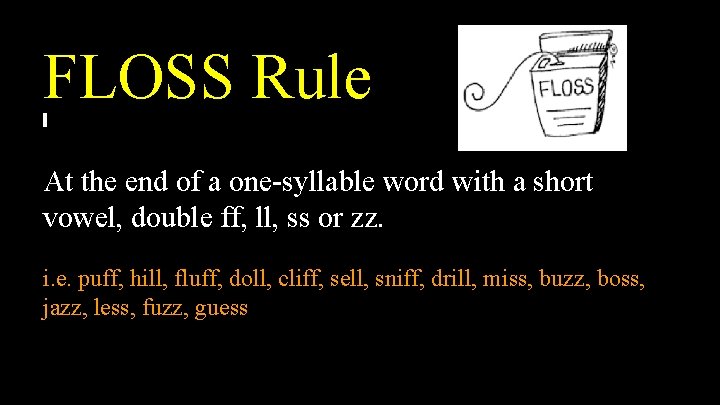
FLOSS Rule At the end of a one-syllable word with a short vowel, double ff, ll, ss or zz. i. e. puff, hill, fluff, doll, cliff, sell, sniff, drill, miss, buzz, boss, jazz, less, fuzz, guess
Symbol to Sound Salmon & White cards Video
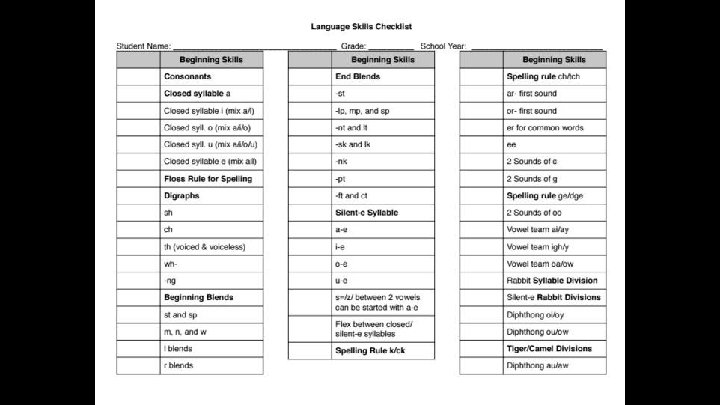
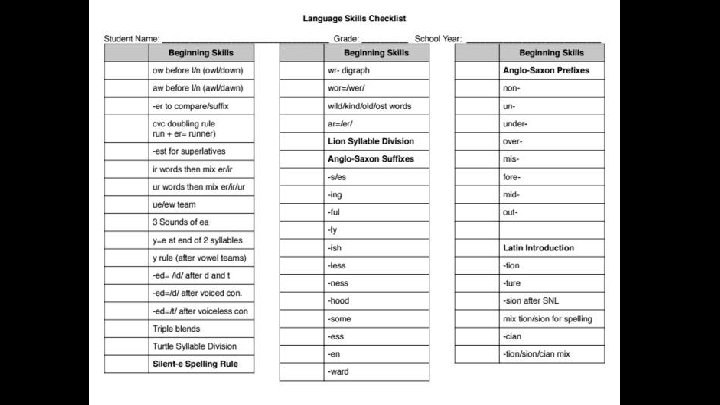
Language Skills Checklist
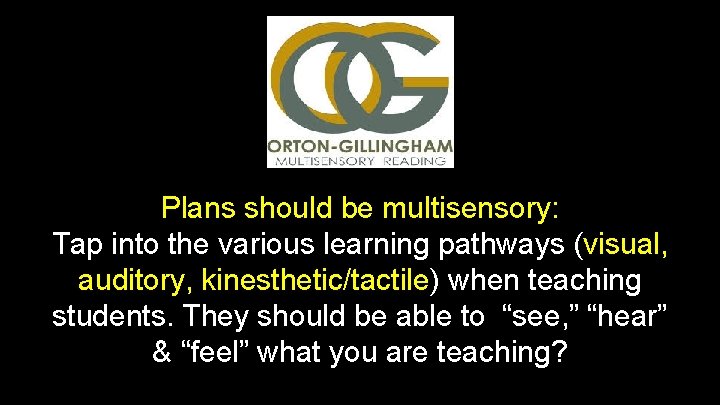
Plans should be multisensory: Tap into the various learning pathways (visual, auditory, kinesthetic/tactile) when teaching students. They should be able to “see, ” “hear” & “feel” what you are teaching?
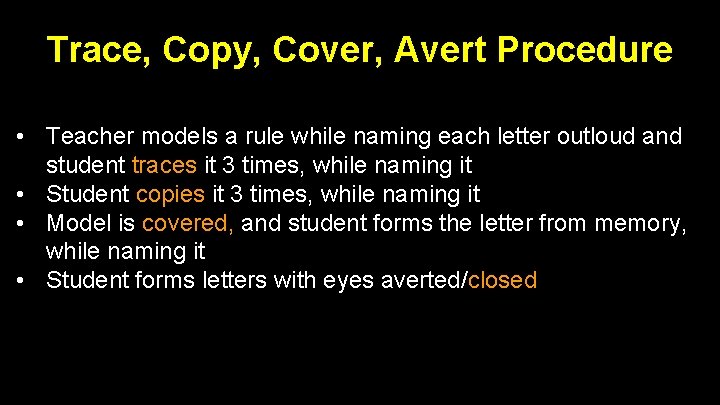
Trace, Copy, Cover, Avert Procedure • Teacher models a rule while naming each letter outloud and student traces it 3 times, while naming it • Student copies it 3 times, while naming it • Model is covered, and student forms the letter from memory, while naming it • Student forms letters with eyes averted/closed
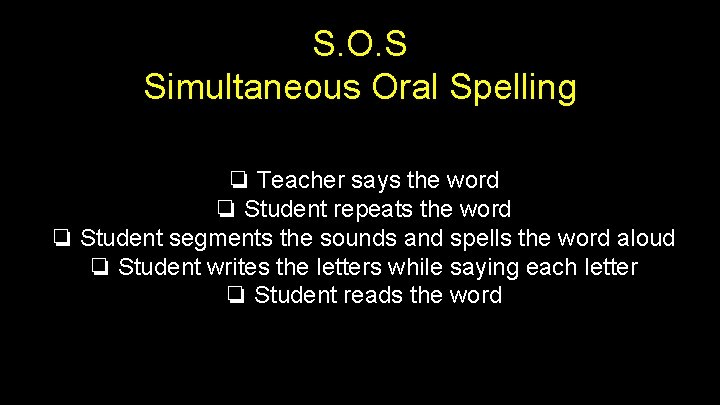
S. O. S Simultaneous Oral Spelling ❏ Teacher says the word ❏ Student repeats the word ❏ Student segments the sounds and spells the word aloud ❏ Student writes the letters while saying each letter ❏ Student reads the word
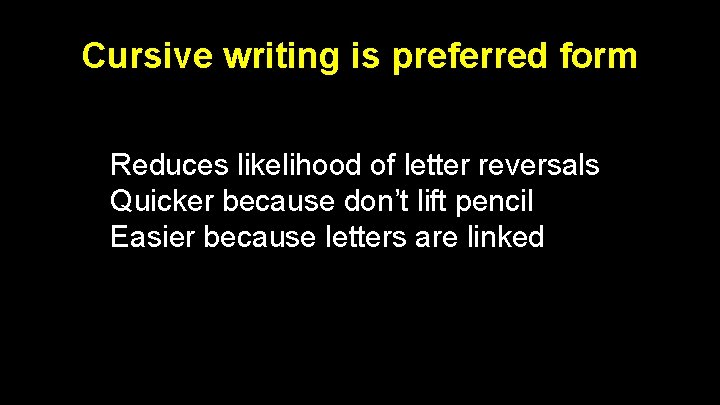
Cursive writing is preferred form Reduces likelihood of letter reversals Quicker because don’t lift pencil Easier because letters are linked
Multisensory Apps
Plans should be diagnostic: Teachers should consistently progress monitoring student's performance to assess areas of need & responsiveness to intervention?
Spelling Assessments PALS Quick Checks Words Their Way Ganske
Orton-Gillingham Video
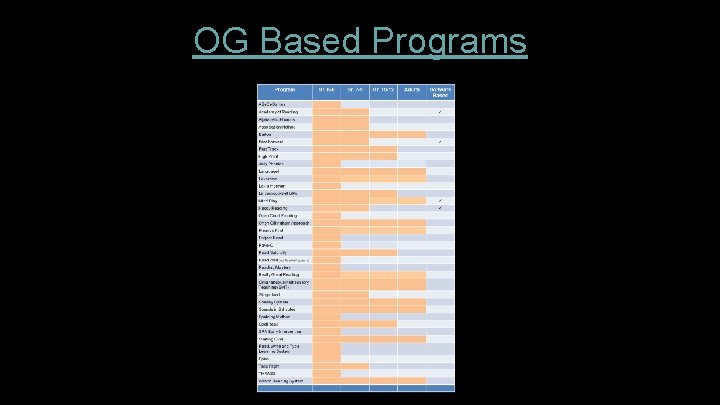
OG Based Programs
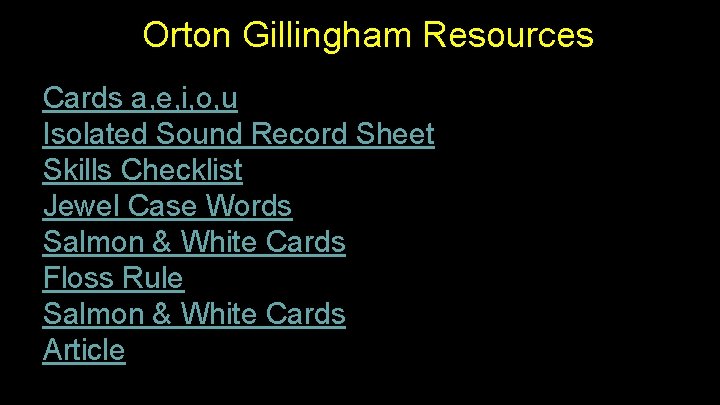
Orton Gillingham Resources Cards a, e, i, o, u Isolated Sound Record Sheet Skills Checklist Jewel Case Words Salmon & White Cards Floss Rule Salmon & White Cards Article
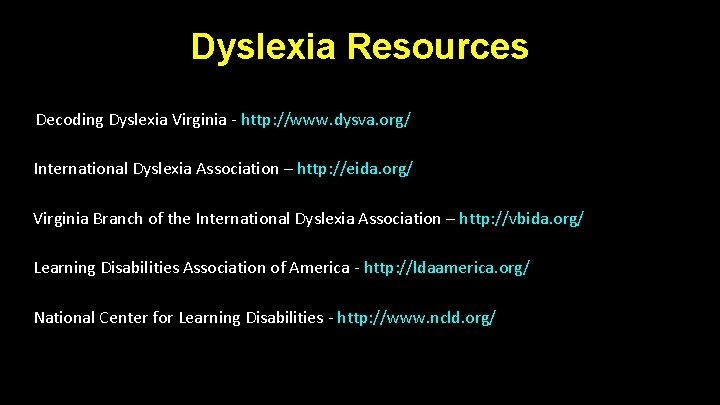
Dyslexia Resources Decoding Dyslexia Virginia - http: //www. dysva. org/ International Dyslexia Association – http: //eida. org/ Virginia Branch of the International Dyslexia Association – http: //vbida. org/ Learning Disabilities Association of America - http: //ldaamerica. org/ National Center for Learning Disabilities - http: //www. ncld. org/
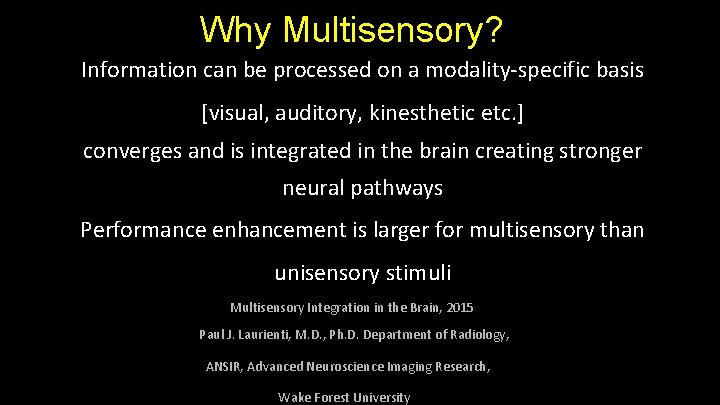
Why Multisensory? Information can be processed on a modality-specific basis [visual, auditory, kinesthetic etc. ] converges and is integrated in the brain creating stronger neural pathways Performance enhancement is larger for multisensory than unisensory stimuli Multisensory Integration in the Brain, 2015 Paul J. Laurienti, M. D. , Ph. D. Department of Radiology, ANSIR, Advanced Neuroscience Imaging Research, Wake Forest University
“What else can I do? ”
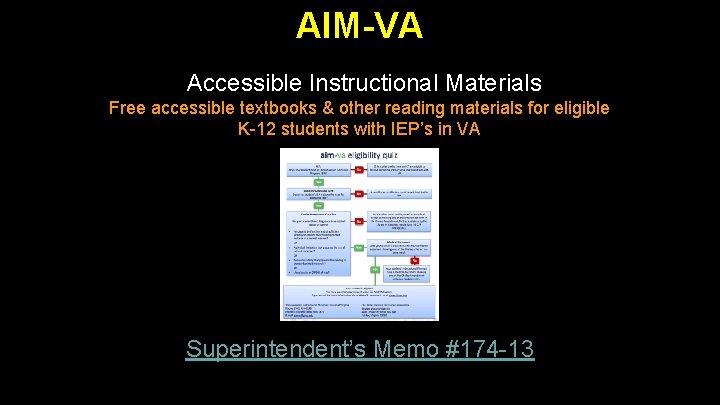
AIM-VA Accessible Instructional Materials Free accessible textbooks & other reading materials for eligible K-12 students with IEP’s in VA AIM-VA Superintendent’s Memo #174 -13
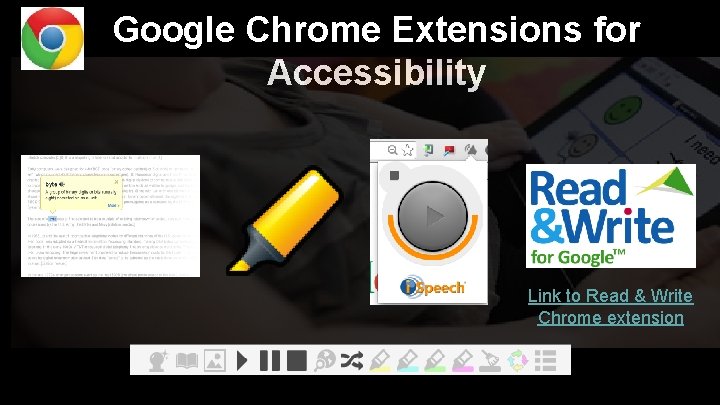
Google Chrome Extensions for Accessibility Link to Read & Write Chrome extension
Accessibility Software
Google Accessibility Products & Features
● Chromebook Accessibility features How to turn on accessibility features on chromebook
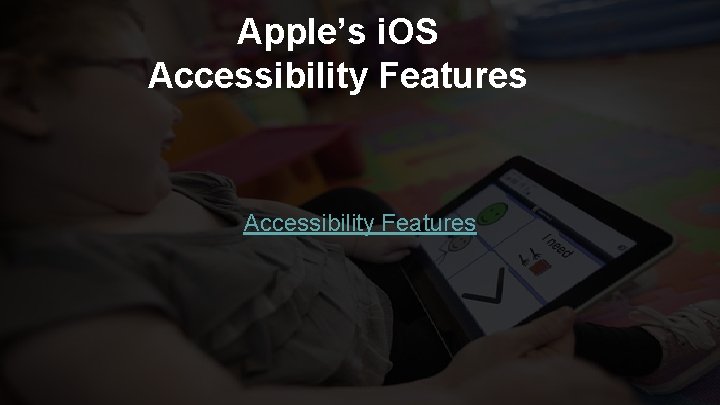
Apple’s i. OS Accessibility Features
Universal Design for Learning (UDL) A Placemat of Core Apps Serving Learning for All
Leveled Passages ● Read. Works ● Tween. Tribune ● Newsela
Exit Ticket Turn & Talk How can a multisensory approach to language structure support students with a specific learning disability in reading?