
A MultipleMeasures Approach to Mathematics Placement Joanna Pruden



- Slides: 23
A Multiple-Measures Approach to Mathematics Placement Joanna Pruden (jpruden@pct. edu) Ed Owens (eowens@pct. edu) Diana Kuhns (dkuhns@pct. edu) Pennsylvania College of Technology Williamsport, PA
Philosophy of Placement Testing �Penn College evaluates students' skills to ensure that they have the entry-level skills necessary for their majors and college-level coursework. �The placement process should determine the highest level at which a student has the prerequisite knowledge to be successful.
Philosophy, continued �The goal of the mathematics placement process is to identify the appropriate initial placement into the mathematics curriculum so that each student can succeed in college mathematics. �This placement level will determine a student’s initial mathematics course-selection options.
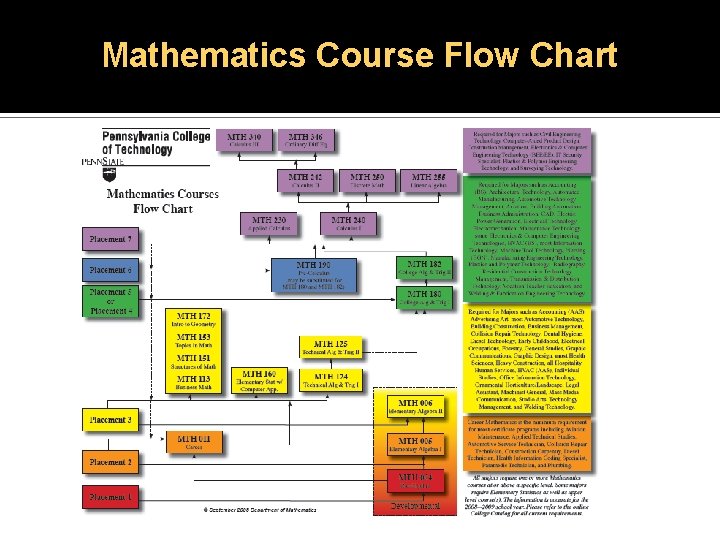
Mathematics Course Flow Chart
Descriptions of Placement Levels �Provides a detailed description of a typical student for each placement level �Used to inform faculty, students, and parents
Past Placement Process Prior to Spring 2008 Used standardized (paper and pencil) tests prepared by ETS Did not permit calculators Assigned placement levels based solely on placement test scores
Past Placement Process, continued A committee of math faculty was able to adjust the placement level upward based on a student’s math background and results of an affective survey. The committee was not able to adjust a student’s placement level downward.
Goals for New Placement Process �Develop new placement tests that more closely aligned with our course goals and student outcomes �Expand the depth of questioning at the elementary algebra level �Allow for the use of a calculator
Goals, continued �Implement a new process for assigning placement levels that includes examining multiple measures �Establish sub-scores that provide critical information beyond content topics ØBasic (Algorithmic) ØApplications ØConcepts
Components of the New Placement Exam Pre-Algebra/Elementary Algebra • pre-algebra and elementary algebra skills and concepts • 58 questions (20 PA/38 EA)/45 -minute test � Intermediate Algebra • intermediate algebra and geometry skills and concepts • 25 questions/30 -minute test � Functions and Graphs • algebraic, trigonometric, exponential, and logarithmic functions and graphs • 37 questions/45 -minute test
Components Students Take Every student begins the placement process by taking two components of the exam. � Students with Math SAT scores greater than or equal to 550: Intermediate Algebra and Function and Graphs components SAT scores must not be older than 2 years � Students without Math SAT scores or with Math SAT scores less than 550 or older than 2 years old: Pre-Algebra/Elementary Algebra and Intermediate Algebra components For students who do well, the committee may recommend that they take the Functions and Graphs component online at a later date.
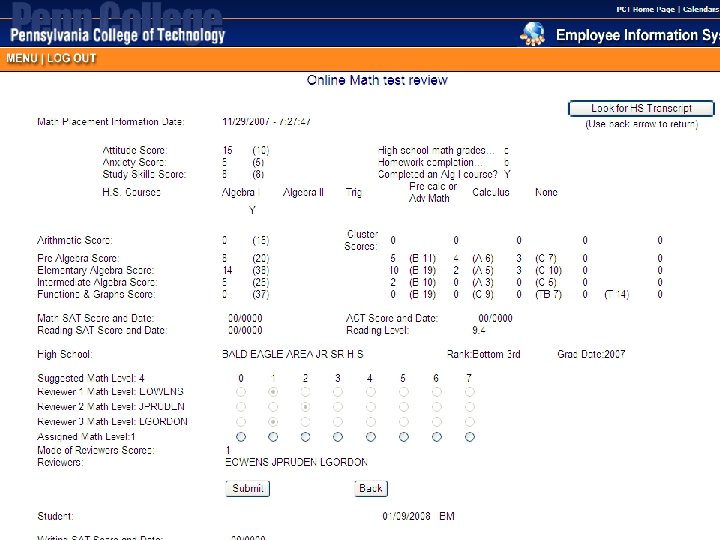
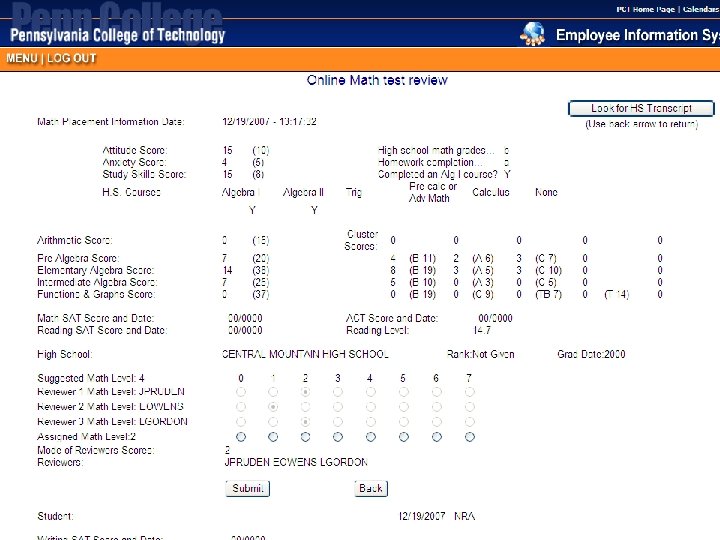
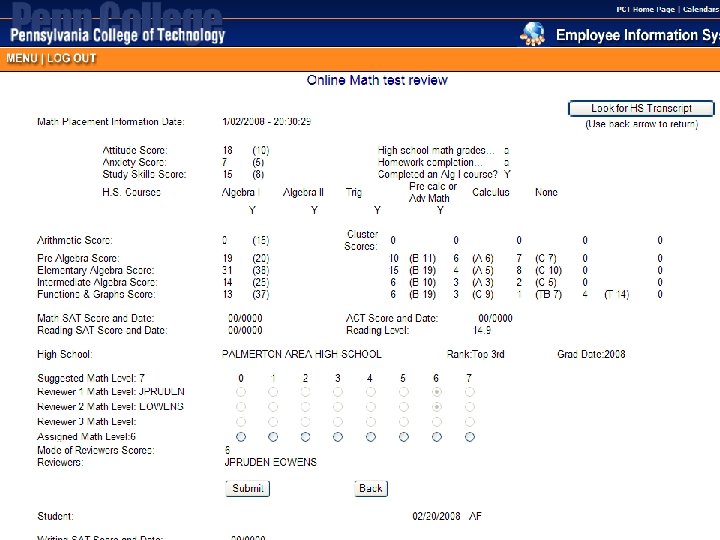
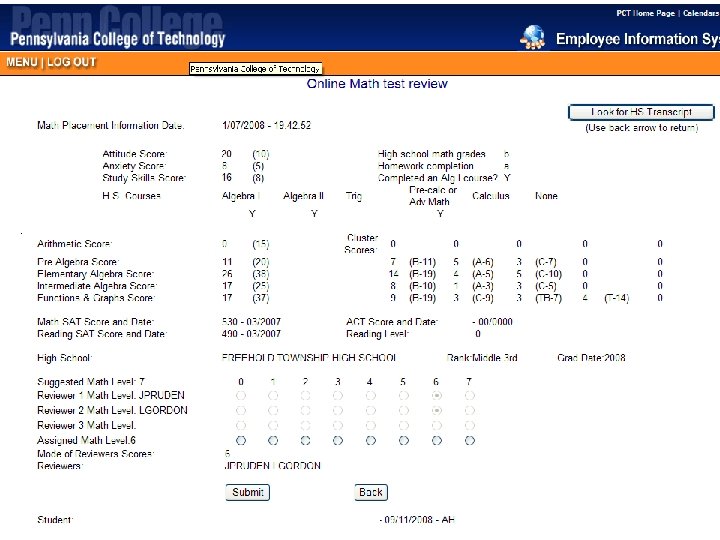
Factors Used to Assign Placement Levels Ø Scores on mathematics and reading placement exams, including cluster scores Ø High school math courses and the level of success in those classes Ø SAT and ACT scores, if available Ø PSSA (Pennsylvania System of School Assessment) math scores, if available Ø Amount of time that has passed since the student completed his/her last math course Ø Study skills, anxiety, and attitude scores, as determined by an affective survey Ø High school rank
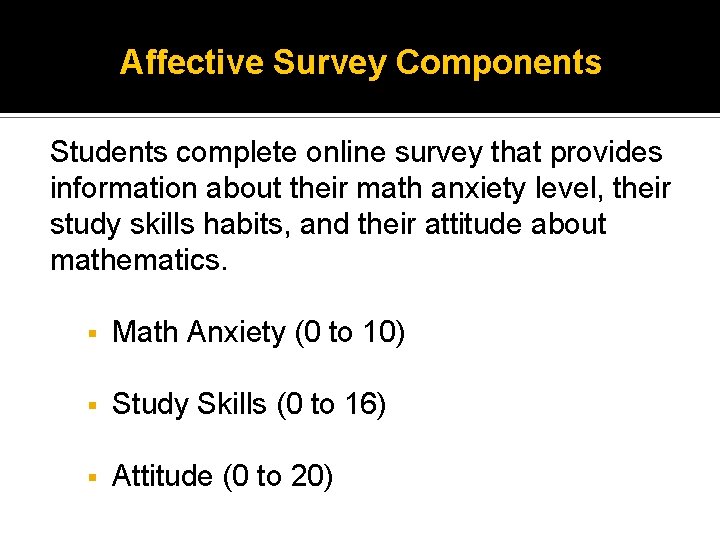
Affective Survey Components Students complete online survey that provides information about their math anxiety level, their study skills habits, and their attitude about mathematics. Math Anxiety (0 to 10) Study Skills (0 to 16) Attitude (0 to 20)
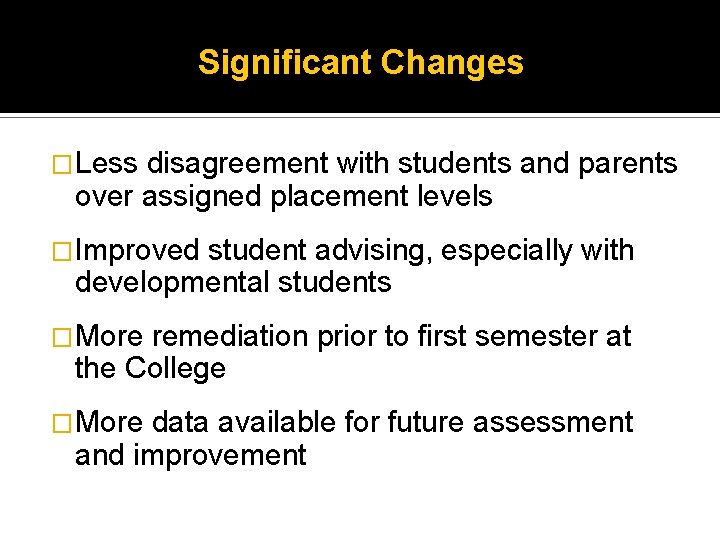
Significant Changes �Less disagreement with students and parents over assigned placement levels �Improved student advising, especially with developmental students �More remediation prior to first semester at the College �More data available for future assessment and improvement
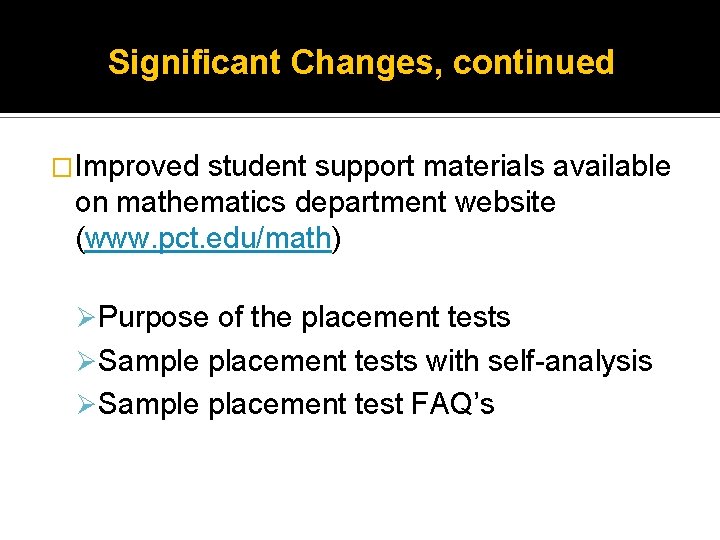
Significant Changes, continued �Improved student support materials available on mathematics department website (www. pct. edu/math) ØPurpose of the placement tests ØSample placement tests with self-analysis ØSample placement test FAQ’s
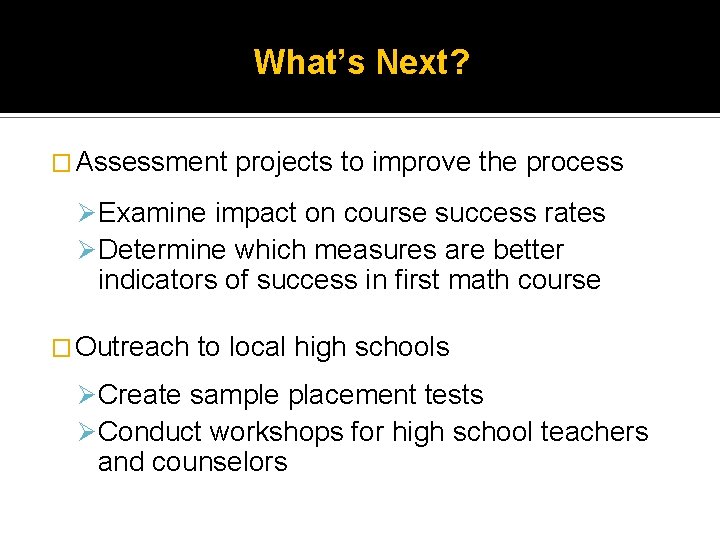
What’s Next? � Assessment projects to improve the process Ø Examine impact on course success rates Ø Determine which measures are better indicators of success in first math course � Outreach to local high schools Ø Create sample placement tests Ø Conduct workshops for high school teachers and counselors
Questions?