
A MultiPeriod OPF Approach to Improve Voltage Stability
A Multi-Period OPF Approach to Improve Voltage Stability using Demand Response Dan Molzahn 1 Mengqi Yao 2 Johanna L. Mathieu 2 1 Argonne National Laboratory 2 University INFORMS 2017 October 22, 2017 of Michigan
Power System Stability • Frequency instability ‒ Associated with an imbalance between load and generation ‒ Demand response based on temporal shifting of load [Short, Infield, & Freris ‘ 07], [Molina-Garcia, Bouffard, & Kirschen ‘ 10], [Mathieu, Koch, & Callaway ‘ 12], [Zhang, Lian, Chang, & Kalsi ‘ 13] , etc. • Voltage instability ‒ Associated with operation that nears the limits of the network’s power transfer capability ‒ Demand response based on spatial shifting of load How to control flexible loads in order to improve voltage stability after a disturbance? Introduction 1 / 23
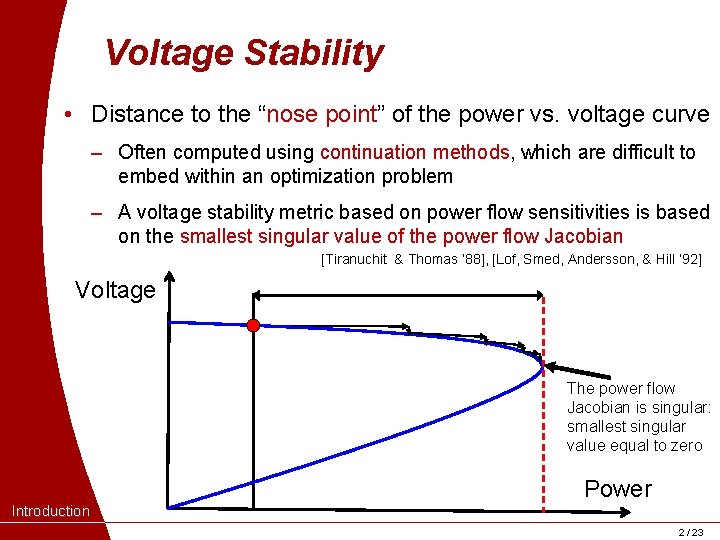
Voltage Stability • Distance to the “nose point” of the power vs. voltage curve ‒ Often computed using continuation methods, which are difficult to embed within an optimization problem ‒ A voltage stability metric based on power flow sensitivities is based on the smallest singular value of the power flow Jacobian [Tiranuchit & Thomas ‘ 88], [Lof, Smed, Andersson, & Hill ‘ 92] Voltage The power flow Jacobian is singular: smallest singular value equal to zero Power Introduction 2 / 23
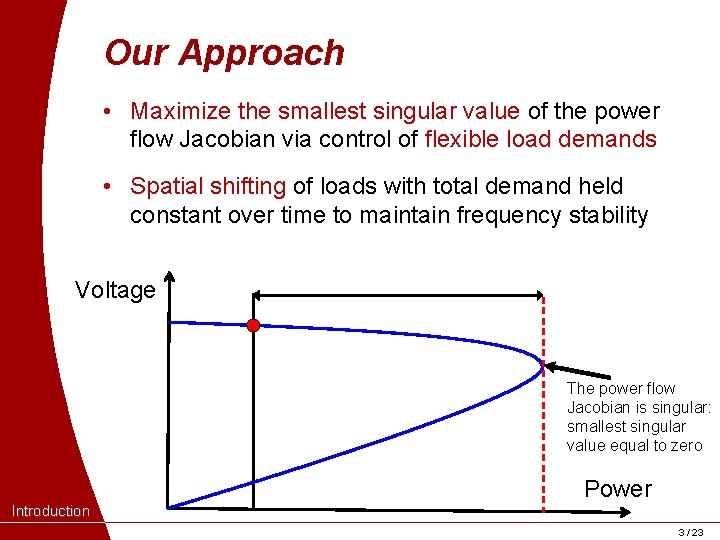
Our Approach • Maximize the smallest singular value of the power flow Jacobian via control of flexible load demands • Spatial shifting of loads with total demand held constant over time to maintain frequency stability Voltage The power flow Jacobian is singular: smallest singular value equal to zero Power Introduction 3 / 23

Multi-Period Approach Initial operating point Post-disturbance operating point After reallocating flexible load Power flow solvability boundary (singular Jacobian) Generation redispatch, energy payback Introduction 4 / 23

Problem Formulation 5 / 23
Assumptions • Load models ‒ Constant power factor ‒ Flexible loads at some or all buses ‒ Total demand from flexible loads held constant at each period • Generator models ‒ Modeled as PV buses immediately after the disturbance ‒ Active power generation redispatched in subsequent periods We first show the single-period formulation, and then extend to a multi-period setting. Formulation 6 / 23
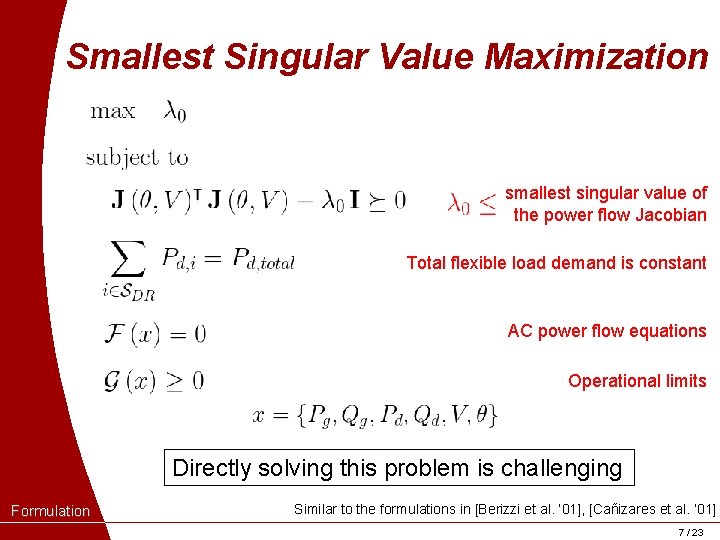
Smallest Singular Value Maximization smallest singular value of the power flow Jacobian Total flexible load demand is constant AC power flow equations Operational limits Directly solving this problem is challenging Formulation Similar to the formulations in [Berizzi et al. ‘ 01], [Cañizares et al. ‘ 01] 7 / 23
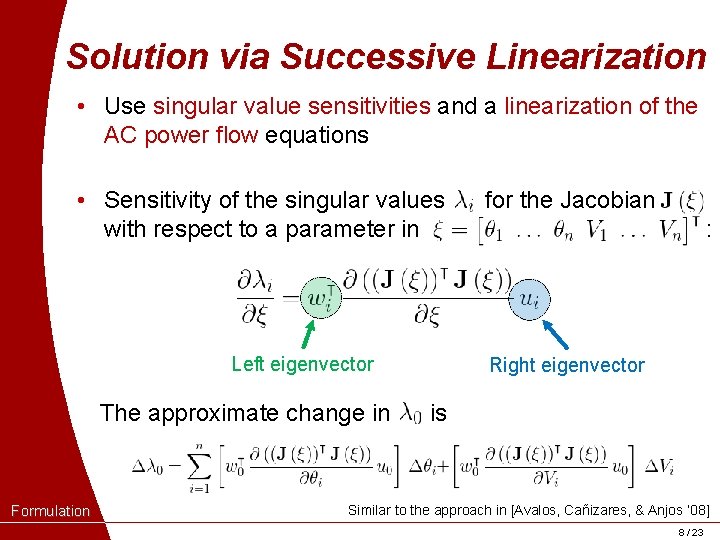
Solution via Successive Linearization • Use singular value sensitivities and a linearization of the AC power flow equations • Sensitivity of the singular values with respect to a parameter in Left eigenvector The approximate change in Formulation for the Jacobian : Right eigenvector is Similar to the approach in [Avalos, Cañizares, & Anjos ‘ 08] 8 / 23
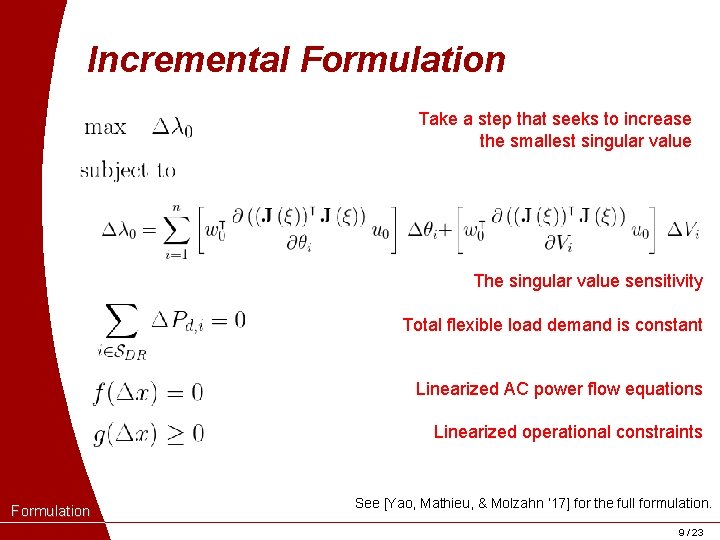
Incremental Formulation Take a step that seeks to increase the smallest singular value The singular value sensitivity Total flexible load demand is constant Linearized AC power flow equations Linearized operational constraints Formulation See [Yao, Mathieu, & Molzahn ‘ 17] for the full formulation. 9 / 23
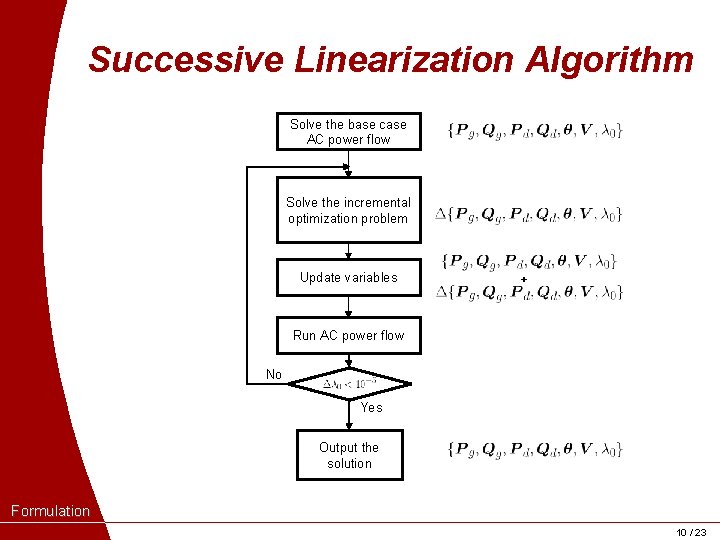
Successive Linearization Algorithm Solve the base case AC power flow Solve the incremental optimization problem Update variables + Run AC power flow No Yes Output the solution Formulation 10 / 23
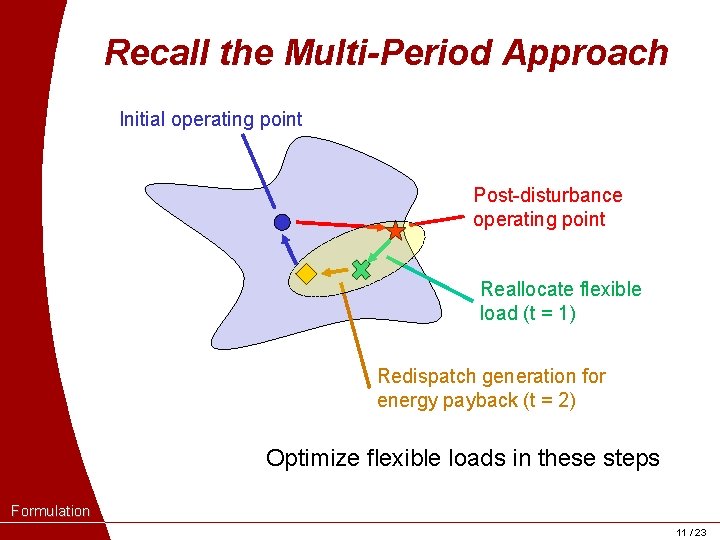
Recall the Multi-Period Approach Initial operating point Post-disturbance operating point Reallocate flexible load (t = 1) Redispatch generation for energy payback (t = 2) Optimize flexible loads in these steps Formulation 11 / 23
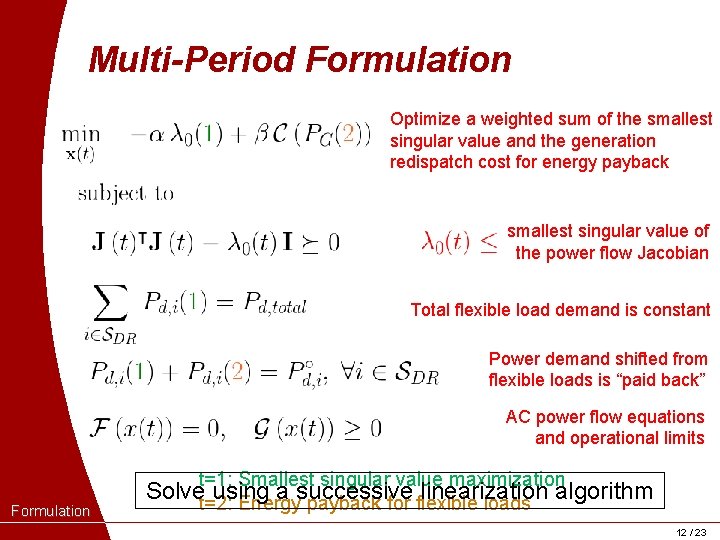
Multi-Period Formulation Optimize a weighted sum of the smallest singular value and the generation redispatch cost for energy payback smallest singular value of the power flow Jacobian Total flexible load demand is constant Power demand shifted from flexible loads is “paid back” AC power flow equations and operational limits t=1: Smallest singular value maximization Formulation Solvet=2: using a successive linearization algorithm Energy payback for flexible loads 12 / 23

Test Cases 13 / 23
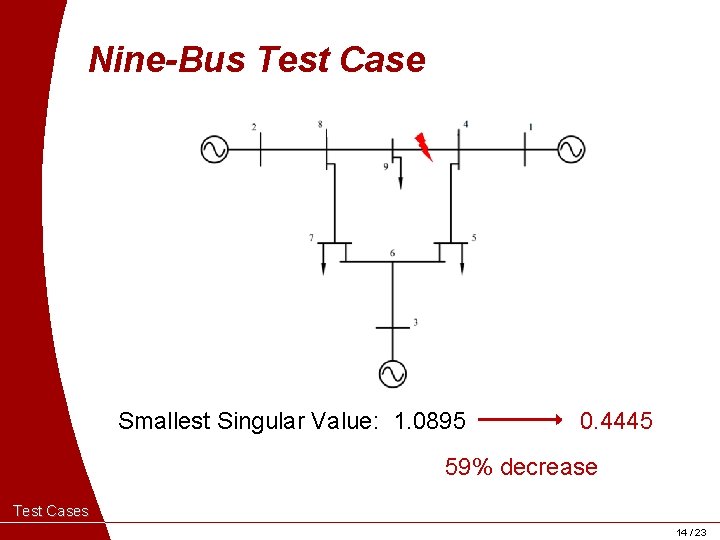
Nine-Bus Test Case Smallest Singular Value: 1. 0895 0. 4445 59% decrease Test Cases 14 / 23
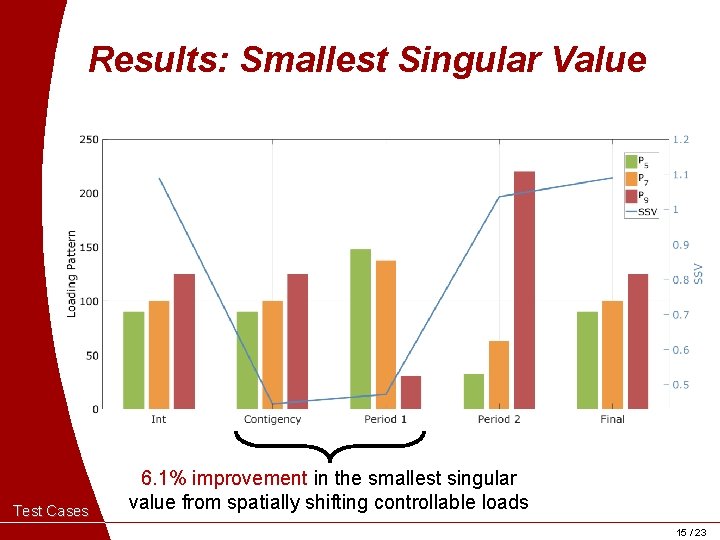
Results: Smallest Singular Value Test Cases 6. 1% improvement in the smallest singular value from spatially shifting controllable loads 15 / 23
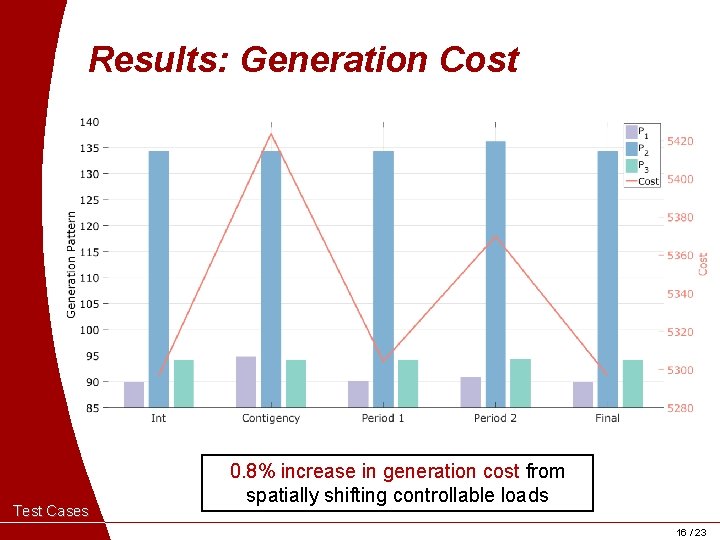
Results: Generation Cost Test Cases 0. 8% increase in generation cost from spatially shifting controllable loads 16 / 23
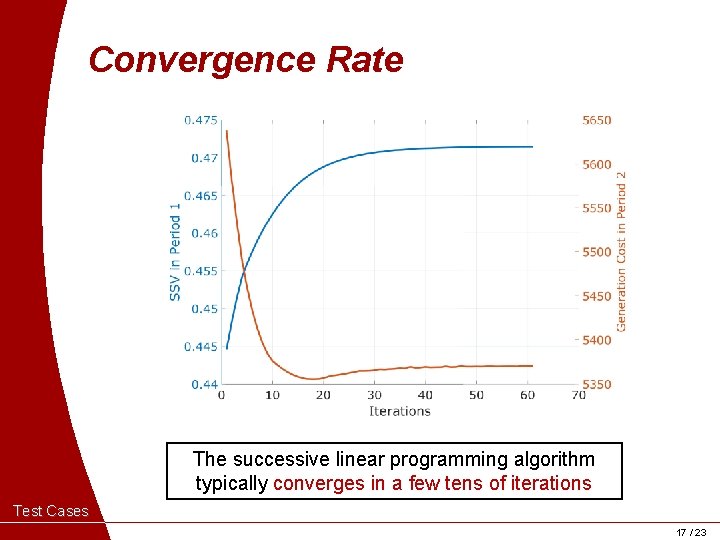
Convergence Rate The successive linear programming algorithm typically converges in a few tens of iterations Test Cases 17 / 23
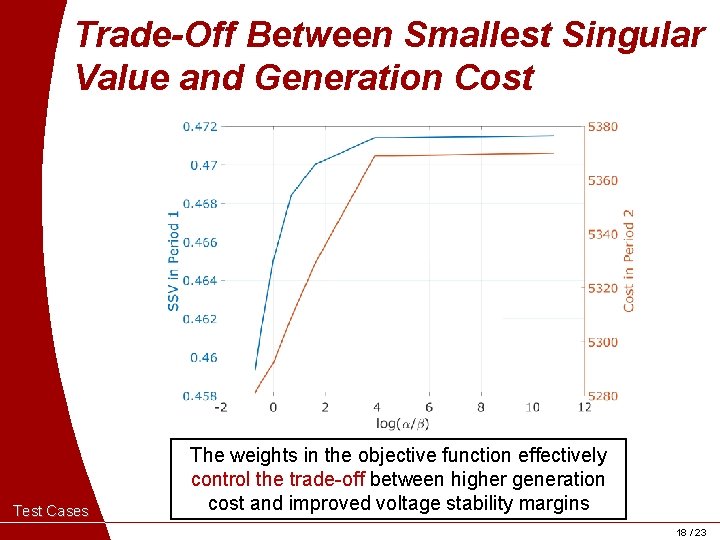
Trade-Off Between Smallest Singular Value and Generation Cost Test Cases The weights in the objective function effectively control the trade-off between higher generation cost and improved voltage stability margins 18 / 23
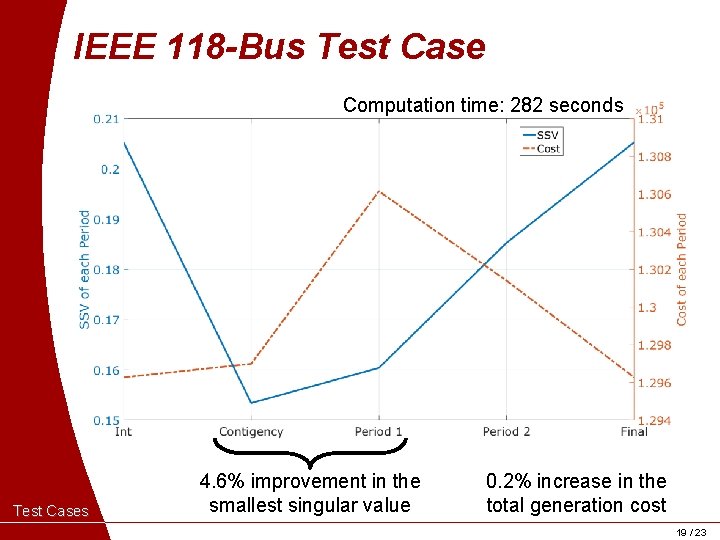
IEEE 118 -Bus Test Case Computation time: 282 seconds Test Cases 4. 6% improvement in the smallest singular value 0. 2% increase in the total generation cost 19 / 23

IEEE 118 -Bus Test Cases Visualization created using http: //immersive. erc. monash. edu. au/stac/ 20 / 23
Conclusion 21 / 23
Conclusion • Spatial shifting of load can improve voltage stability margins after a disturbance • To determine appropriate load control, we formulated a multi-period optimization problem and applied a successive linearization solution algorithm • Future work: ‒ Improving computational speed ‒ Characterizing closeness to global optimality using convex relaxation techniques Conclusion 22 / 23

Questions? Daniel K. Molzahn dmolzahn@anl. gov Mengqi Yao mqyao@umich. edu Johanna L. Mathieu jlmath@umich. edu Support from NSF Grant EECS-1549670 and the U. S. DOE, Office of Electricity Delivery and Energy Reliability under contract DE-AC 02 -06 CH 11357. 23 / 23

References A. Berizzi, C. Bovo, P. Marannino, and M. Innorta, “Multi-Objective Optimization Techniques Applied to Modern Power Systems, ” IEEE PES Winter Meeting, Columbus, OH, Jan. 2001. R. J. Avalos, C. A. Cañizares, and M. Anjos, “A Practical Voltage-Stability-Constrained Optimal Power Flow, ” IEEE-PES General Meeting, Pittsburgh, PA, July 2008. C. A. Cañizares, W. Rosehart A. Berizzi, and C. Bovo, “Comparison of Voltage Security Constrained Optimal Power Flow Techniques, ” EEE PES 2001 Summer Meeting, Vancouver, July 2001, pp. 1680 -1685. J. L. Mathieu, S. Koch and D. S. Callaway, "State Estimation and Control of Electric Loads to Manage Real-Time Energy Imbalance, " in IEEE Transactions on Power Systems, vol. 28, no. 1, pp. 430 -440, Feb. 2013. Molina-Garcia, F. Bouffard and D. S. Kirschen, "Decentralized Demand-Side Contribution to Primary Frequency Control, " in IEEE Transactions on Power Systems, vol. 26, no. 1, pp. 411 -419, Feb. 2011. W. Rosehart , C. A. Cañizares, and V. H. Quintana, “Optimal Power Flow Incorporating Voltage Collapse Constraints, ” IEEE PES Summer Meeting, Edmonton, Alberta, vol. 2, July 1999, pp. 820 -825. J. A. Short, D. G. Infield and L. L. Freris, "Stabilization of Grid Frequency Through Dynamic Demand Control, " in IEEE Transactions on Power Systems, vol. 22, no. 3, pp. 1284 -1293, Aug. 2007. A. Tiranuchit and R. J. Thomas, "A Posturing Strategy Against Voltage Instabilities in Electric Power Systems, " in IEEE Transactions on Power Systems, vol. 3, no. 1, pp. 87 -93, Feb 1988. M. Yao, J. L. Mathieu, and D. K. Molzahn, “Using Demand Response to Improve Power System Voltage Stability Margins, ” in IEEE Machester Power. Tech, June 2017. W. Zhang, J. Lian, C. Y. Chang, and K. Kalsi, "Aggregated Modeling and Control of Air Conditioning Loads for Demand Response, " in. IEEE Transactions on Power Systems, vol. 28, no. 4, pp. 4655 -4664, Nov. 2013. References 24 / 23
- Slides: 25