
A MultiFactor Binomial Interest Rate Model with State
A Multi-Factor Binomial Interest Rate Model with State Time Dependent Volatilities By Thomas S. Y. Ho And Sang Bin Lee May 2005
Applications of Multi-factor Interest Rate Models n n n Valuation of interest rate options, mortgagebacked, corporate/municipal bonds, … Balance sheet items: deposit accounts, annuities, pensions, … Corporate management: risk management, Va. R, asset/liability management… Regulations: marking to market, Sarbane. Oxley… Financial modeling of a firm: corporate finance
Interest Rate Models /Challenges n n n n Interest rate models: Cox, Ingersoll and Ross, Vasicek Binomial models: Ho-Lee, Black, Derman and Toy Extensions of normal model: Hull-White Generalized continuous time models: Heath, Jarrow, Morton approach Market models: Brace, Gatarek, and Musiela/Jamshidian Discrete time models: Das-Sundaram, Grant-Vora What is a practical model?
Requirements of Interest Rate Models n n Arbitrage-free conditions satisfied Can be calibrated to a broad range of securities, not just swaptions/caps/floors Multi-factor to capture the changing shape of the yield curve Consistent with historical observations: mean reversion, no unreasonably high interest rate, no negative interest rates
Outline of the Presentation n n n Motivations of the model Model assumptions: mathematical construct Key ideas of theory: Extending from Ho-Lee model (1986, 2004) Model theoretical and empirical results Practical applications of the model Conclusion: challenges to mathematical finance

Model Assumptions n n Binomial model: Cox Ross Rubinstein Arbitrage-free condition: n n Consistent with the spot curve Expected risk free return at each node for all bonds Recombining condition General solution: risk neutral probabilities and time/state dependent solutions
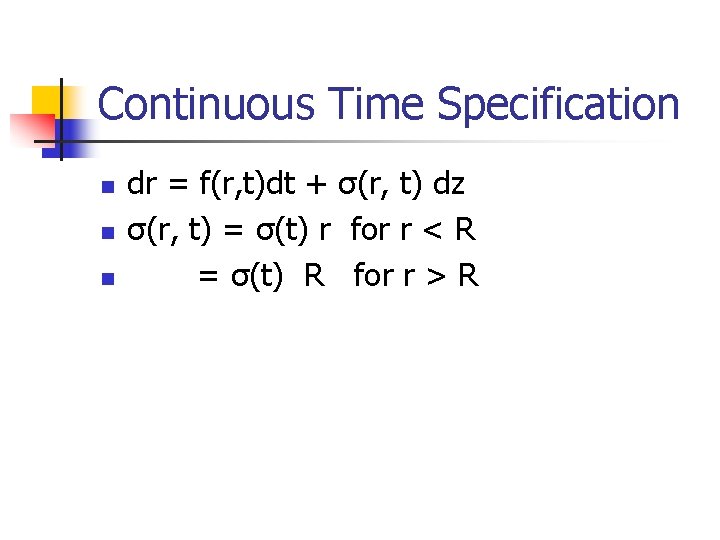
Continuous Time Specification n dr = f(r, t)dt + σ(r, t) dz σ(r, t) = σ(t) r for r < R = σ(t) R for r > R
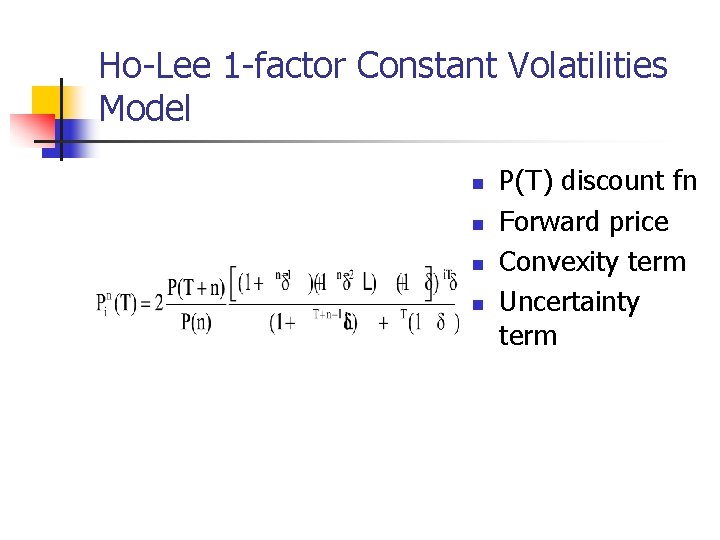
Ho-Lee 1 -factor Constant Volatilities Model n n P(T) discount fn Forward price Convexity term Uncertainty term
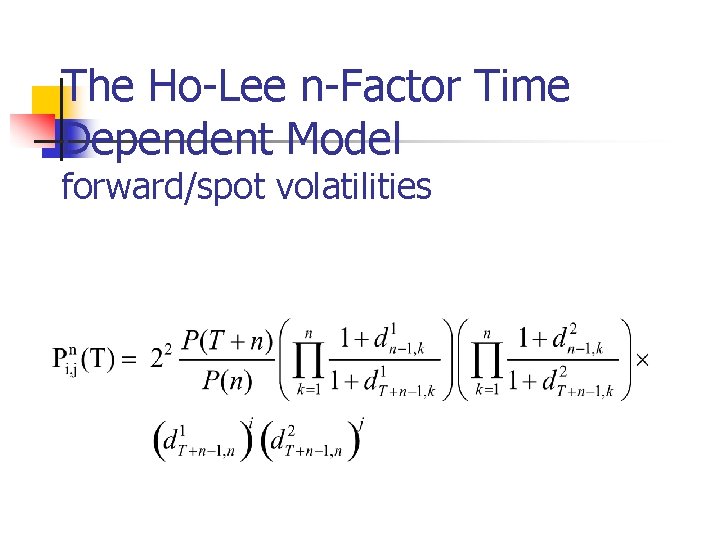
The Ho-Lee n-Factor Time Dependent Model forward/spot volatilities
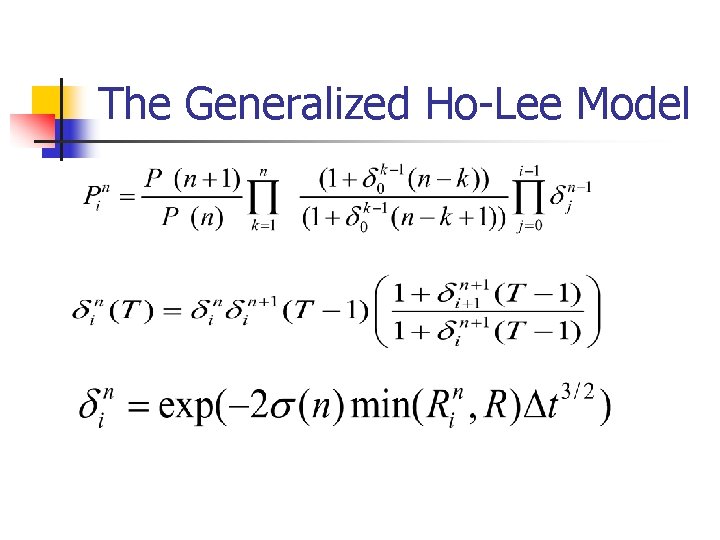
The Generalized Ho-Lee Model
Calibration Procedure n n n Forward looking approach: implied market expectations, no historical data used Specify the two term structures of volatilities by a set of parameters: a, b, …, e Non-linear estimate the parameters such that the sum of the mean squared % errors in estimating the benchmark securities is minimize
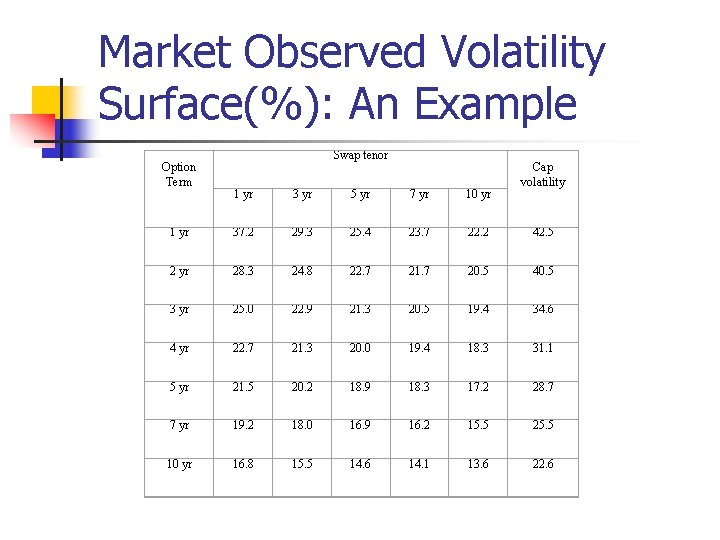
Market Observed Volatility Surface(%): An Example Option Term Swap tenor Cap volatility 1 yr 3 yr 5 yr 7 yr 10 yr 1 yr 37. 2 29. 3 25. 4 23. 7 22. 2 42. 5 2 yr 28. 3 24. 8 22. 7 21. 7 20. 5 40. 5 3 yr 25. 0 22. 9 21. 3 20. 5 19. 4 34. 6 4 yr 22. 7 21. 3 20. 0 19. 4 18. 3 31. 1 5 yr 21. 5 20. 2 18. 9 18. 3 17. 2 28. 7 7 yr 19. 2 18. 0 16. 9 16. 2 15. 5 25. 5 10 yr 16. 8 15. 5 14. 6 14. 1 13. 6 22. 6
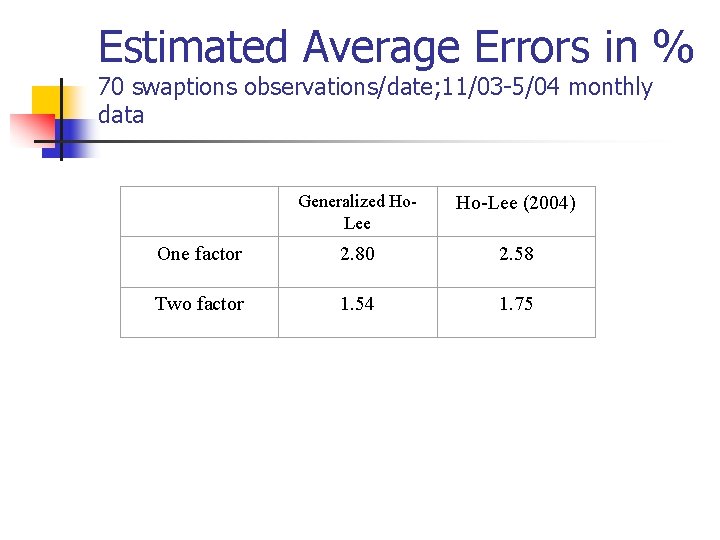
Estimated Average Errors in % 70 swaptions observations/date; 11/03 -5/04 monthly data Generalized Ho. Lee Ho-Lee (2004) One factor 2. 80 2. 58 Two factor 1. 54 1. 75
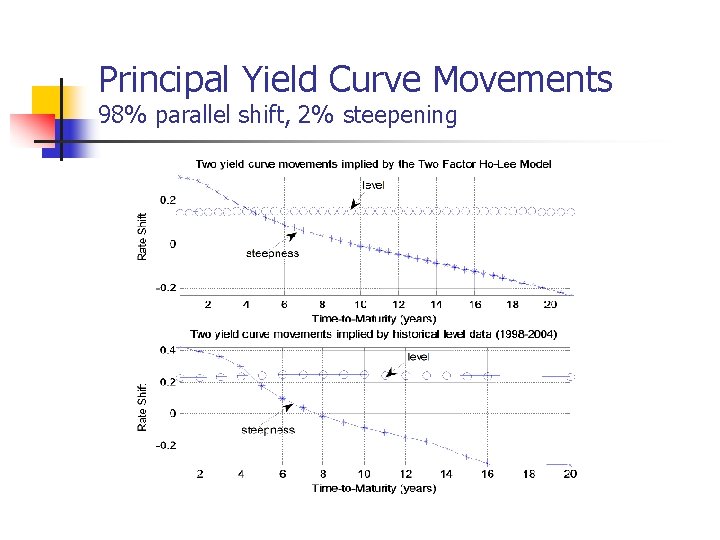
Principal Yield Curve Movements 98% parallel shift, 2% steepening
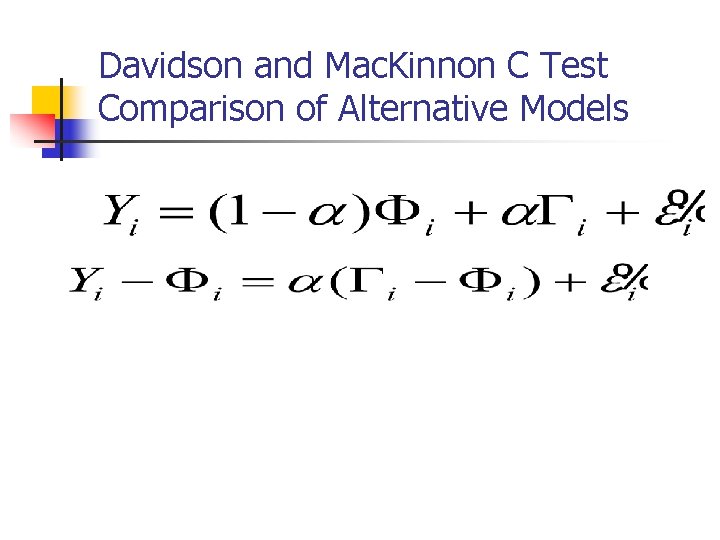
Davidson and Mac. Kinnon C Test Comparison of Alternative Models
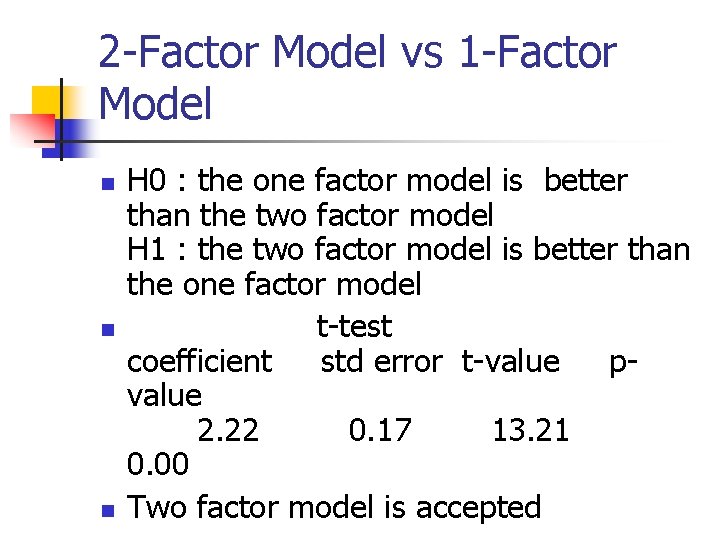
2 -Factor Model vs 1 -Factor Model n n n H 0 : the one factor model is better than the two factor model H 1 : the two factor model is better than the one factor model t-test coefficient std error t-value pvalue 2. 22 0. 17 13. 21 0. 00 Two factor model is accepted
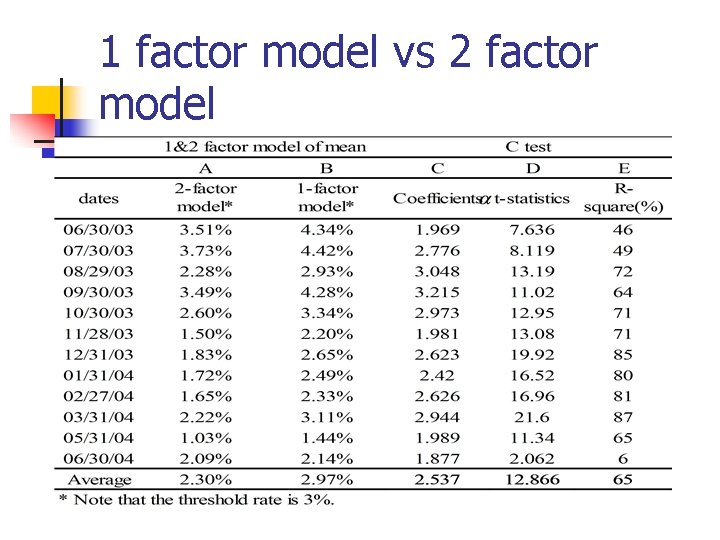
1 factor model vs 2 factor model
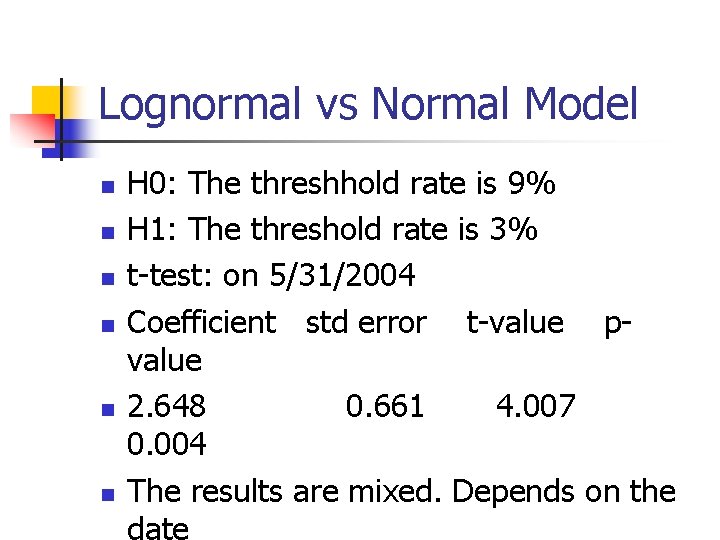
Lognormal vs Normal Model n n n H 0: The threshhold rate is 9% H 1: The threshold rate is 3% t-test: on 5/31/2004 Coefficient std error t-value pvalue 2. 648 0. 661 4. 007 0. 004 The results are mixed. Depends on the date
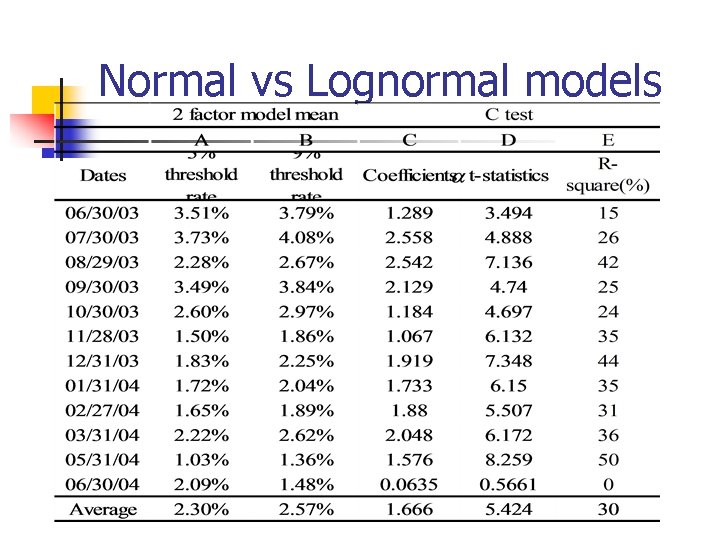
Normal vs Lognormal models
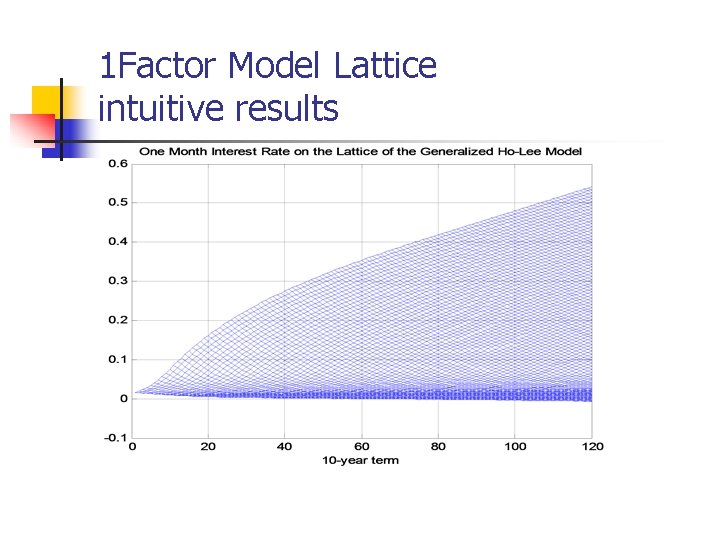
1 Factor Model Lattice intuitive results
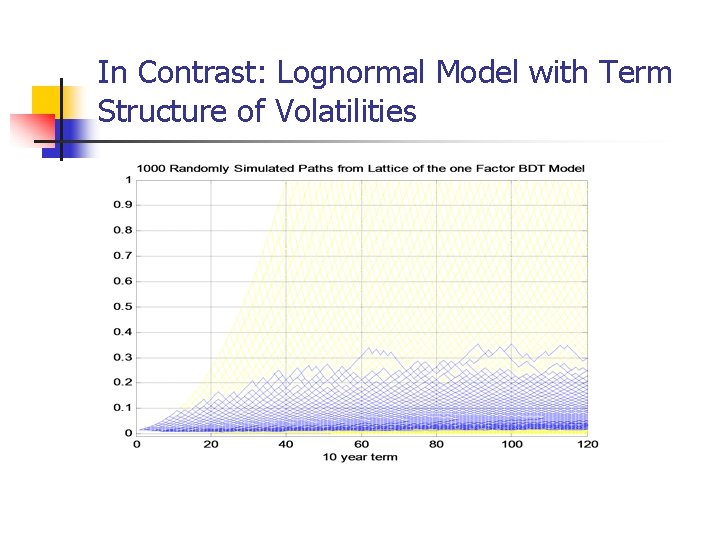
In Contrast: Lognormal Model with Term Structure of Volatilities
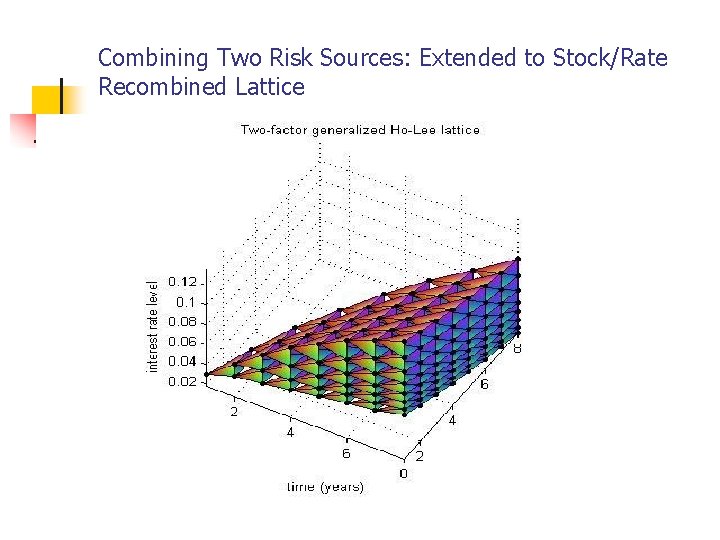
Combining Two Risk Sources: Extended to Stock/Rate Recombined Lattice
Advantages of the Model: a Comparison n n Arbitrage-free model: takes the market curve as given – relative valuation and use of key rate durations Accepts volatility surface, contrasts with market model Minimize model errors, contrasts with nonrecombining interest rate models Accurate calibration for a broad range of securities A comparison with the continuous time model: specification of the instantaneous volatility
Applications of the Model n A consistent framework for pricing an interest rate contingent claims portfolio n n Portfolio strategies: static hedging… n n Ho-Lee Journal of Investment Management 2004 Modeling a business: corporate finance n n Ho Journal of Investment Management 2004 Building structural models: credit risk n n Ho-Lee Financial Modeling Oxford University Press 2004 Balance sheet management: n n Ho-Lee Journal of Fixed-Income 2004 Ho-Lee working paper 2004 Use of efficient sampling methods in the path space of the lattice: n Ho Journal of Derivatives LPS
Applications to Modeling a Firm n Financial statements n n Primitive Firm n n n Fair value accounting, comprehensive income Revenues determine the risk class Correlations of revenues to the balance sheet risks Firm is a contingent claim on the market prices and the primitive firm value
Applications of the Corporate Model n n n A relative valuation of the firm A method to relative value equity and all debt claims Risk transform from all business risks to the net income Enterprise risk management An integration of financial statements to financial modeling
Applications to Mathematical Finance n n n Lattice model offers a “co-ordinate system” for efficient sampling and new approaches to modeling Information on each node is a fiber bundle Lattice is a vector space, “Bond” is a vector Arrow-Debreu securities defined at each node Embedding a Euclidean metric in the manifold to measure risks Can we approximate any derivatives by a set of benchmark securities? Replicate securities?
Conclusions n n N-factor models are important to some of the applications of interest rate models in recent years The model offers computational efficiency The model provides better fit in the calibrating to the volatility surface when compared with some standard models Avenues for future research
- Slides: 28