
A Multidisciplinary Leadership Model in a Community Health






- Slides: 23
A Multidisciplinary Leadership Model in a Community Health Center Greg Thesing, MD November 2014
Presentation Objectives • Illustrate an interdisciplinary leadership model through an interactive exercise • Outline advantages, benefits and challenges within this approach • Explore how this model might be applied in participants’ programs
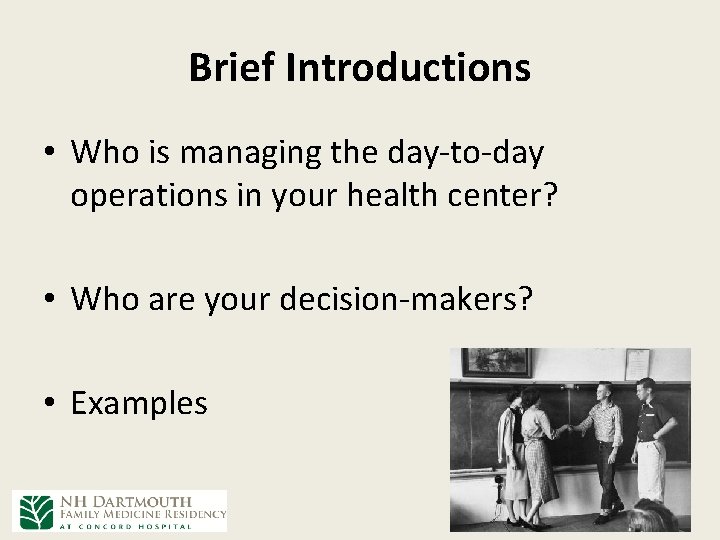
Brief Introductions • Who is managing the day-to-day operations in your health center? • Who are your decision-makers? • Examples
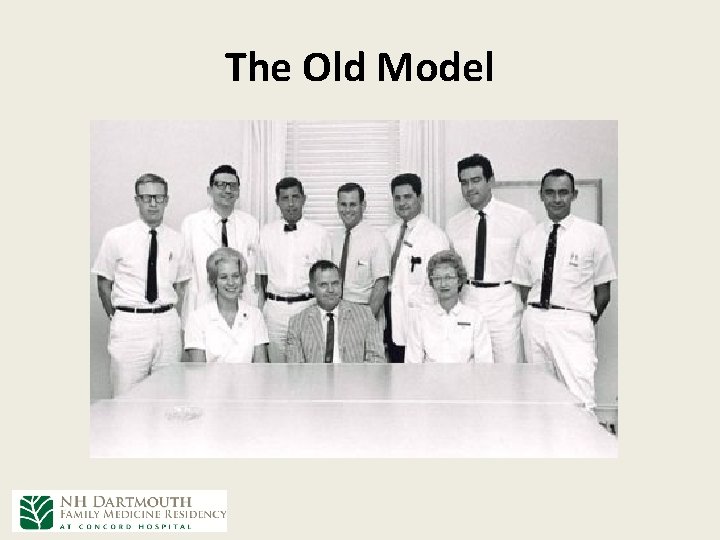
The Old Model
The Future of Family Medicine 2004 • “A cooperative effort among all clinicians will be the cultural norm, and it will be understood that the practice is more than the sum of its individual parts. Practice staff will share in decision making regarding patient care with explicit accountability for their performance to patients, to each other, and to each patient’s personal physician. ”
Patient-Centered Medical Home Principles 2007 • “Providing comprehensive care requires a team of care providers. This team might include physicians, advanced practice nurses, physician assistants, nurses, pharmacists, nutritionists, social workers, educators, and care coordinators. “
Health Center Structure • 3 primary care pods in our primary health center • 1 pod in our satellite office • 20 staff in each pod
The Pod Staff Structure 20 clinical staff in each pod including: • 3 Faculty Family Physicians • 6 Family Medicine residents • 1 -2 Advanced Practitioners • 1 Integrated Care Manager (ICM) • 1 -2 Behavioral Health interns • 3 -4 Nurses • 5 -6 Medical Assistants
How We Started • Medical Director • Clinical Staff Director • Administrative Director • Behavioral Director
Pod Leadership: Step 1 • ICM/Nurse/Physician and/or Advanced Practitioner from each pod became the default pod leaders • 1 hour meeting every other week with all pod leadership teams and the directors
Our Current Model • Physician + ICM + Nurse = Leadership Team (some pods include MAs and APs) • 1 hour meeting 3 -4 times a month for each pod leadership team
Our Current Model • 1 hour weekly Pod meeting with all clinical staff on the pod • Leadership team as facilitators
Our Current Model • Quarterly meeting for each Pod Leadership Team with the Directors • Quarterly meeting for all 4 Pod Leadership Teams and the Directors
What would your team do?
A Puzzle for You • Goal: to improve communication between care team members during patient care sessions • Design a seating configuration for team members to facilitate this • You have the physical space you have
Observations • How did the conversation go? • How did the decision-making go? • What else did you observe?
Challenges of this Leadership Model?
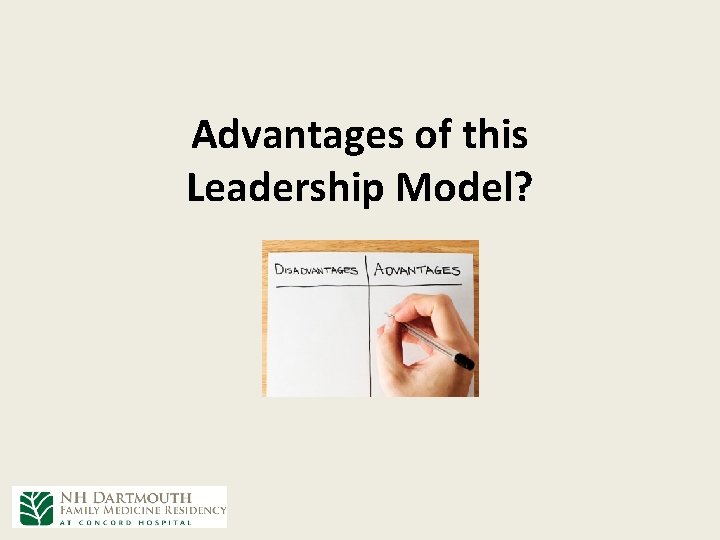
Advantages of this Leadership Model?
What Resources Do You Need?
Our Resources • Global and local organizational support • Organization Development expertise • Time for meetings • Strong, integrated Behavioral Health presence
Other Considerations • Willingness to change? – Behavior – Mental model • Selection of leadership team members • Prepare for growing pains …. with each other …. from your clinical staff
Summary • Interdisciplinary care is the ideal model of care we should be practicing and a larger mandate • Walk the talk - Interdisciplinary Team leadership role models this approach • If we can do it, you can do it!