
A multiCriteriabased Evaluation of Android Application Andrea Saracino
A multi-Criteria-based Evaluation of Android Application Andrea Saracino, G. Dini, F. Martinelli, I. Matteucci, M. Petrocchi, D. Sgandurra In. Trust 2012

Android • Largest Market Share. • Plethora of applications. • Several marketplace. – Official. – Unofficial. 61%
Can we trust them? ? • Android is the platform with the largest increase of malware attacks. • More than 37 malware families specific for Android. • Malware found even in official markets.
Android Security Native security mechanisms? • Sandboxing • Permissions

The Permission System • Access Control mechanism. • Declared by app developer in Manifest file.
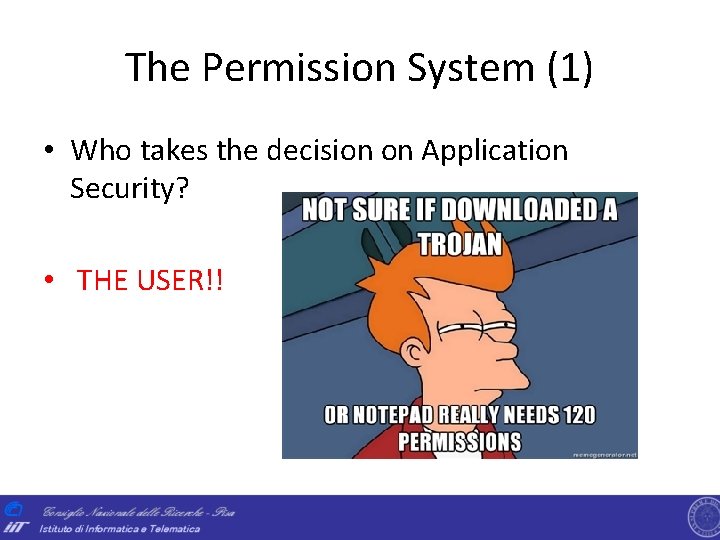
The Permission System (1) • Who takes the decision on Application Security? • THE USER!!
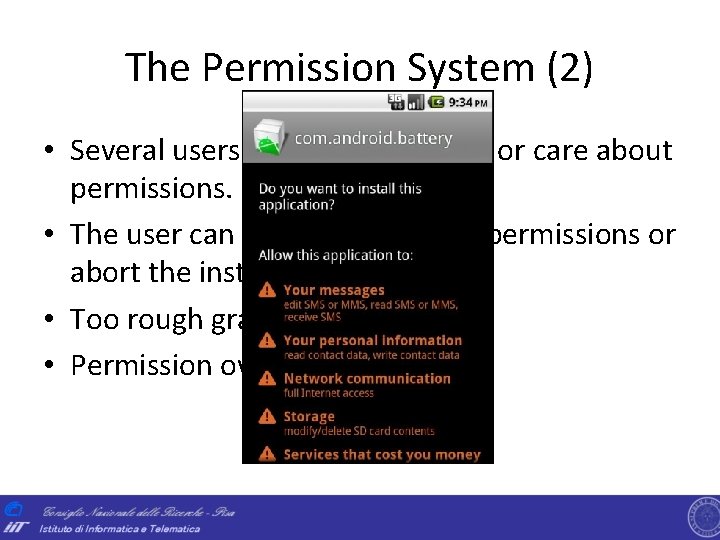
The Permission System (2) • Several users do not understand or care about permissions. • The user can only accept all the permissions or abort the installation. • Too rough grained permissions. • Permission overdeclaration.
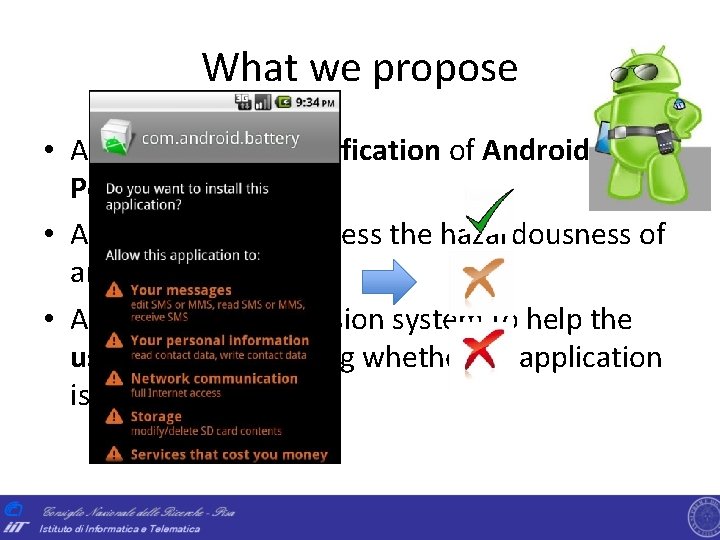
What we propose • A threat based classification of Android Permissions. • A threat index to assess the hazardousness of an application. • A multi-criteria decision system to help the user in understanding whether an application is secure or not.
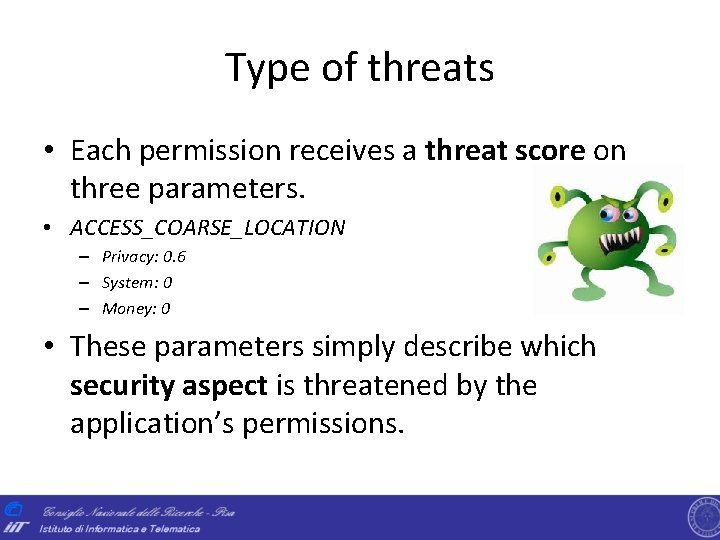
Type of threats • Each permission receives a threat score on three parameters. • ACCESS_COARSE_LOCATION – Privacy: 0. 6 – System: 0 – Money: 0 • These parameters simply describe which security aspect is threatened by the application’s permissions.
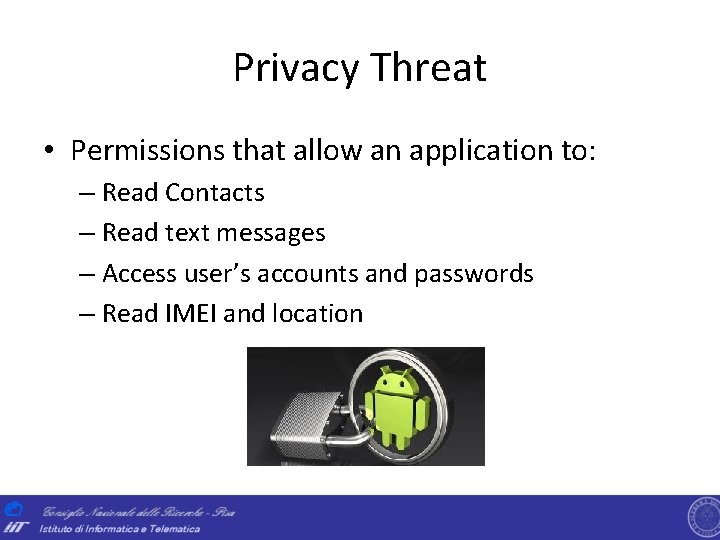
Privacy Threat • Permissions that allow an application to: – Read Contacts – Read text messages – Access user’s accounts and passwords – Read IMEI and location
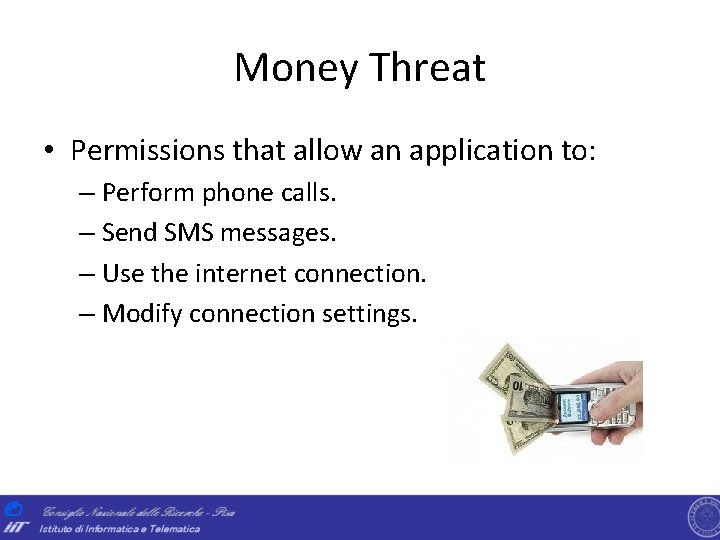
Money Threat • Permissions that allow an application to: – Perform phone calls. – Send SMS messages. – Use the internet connection. – Modify connection settings.
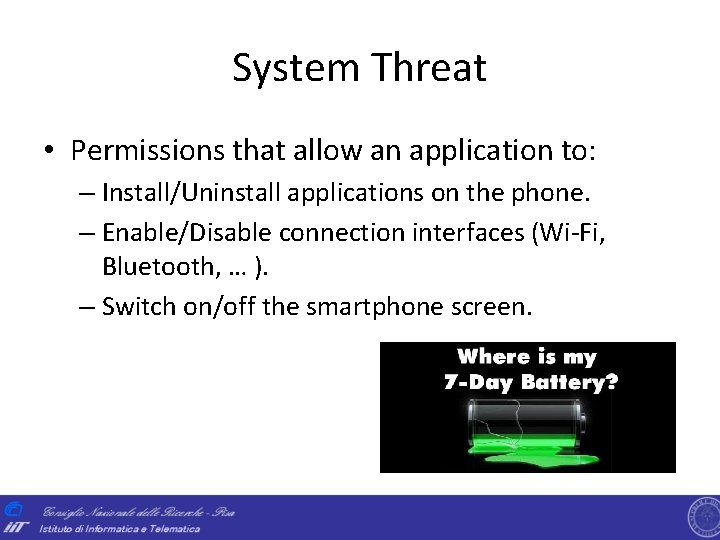
System Threat • Permissions that allow an application to: – Install/Uninstall applications on the phone. – Enable/Disable connection interfaces (Wi-Fi, Bluetooth, … ). – Switch on/off the smartphone screen.
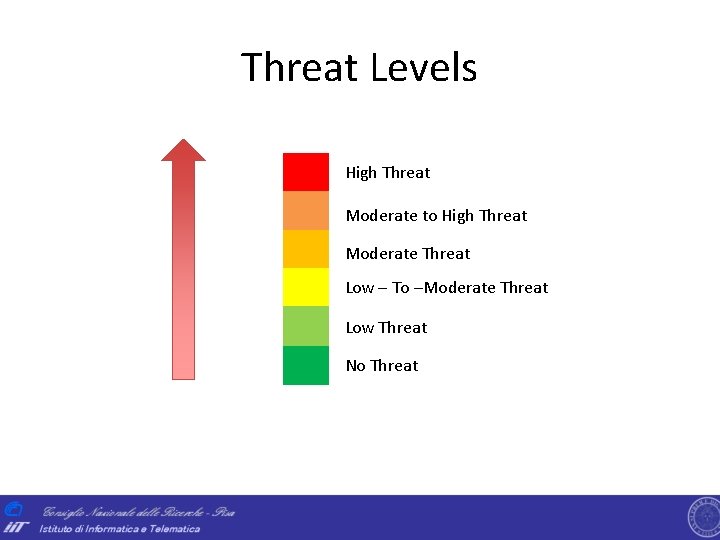
Threat Levels High Threat Moderate to High Threat Moderate Threat Low – To –Moderate Threat Low Threat No Threat
Threat Score • Extraction of permissions from the manifest for each application. • Computation of a global threat score. – Ranges from 1 - no permissions required - to 15 - all permissions required. – An application with a score higher than 7 is considered a very dangerous application. • Developer should declare only the necessaries permissions. (Contrast Overdeclaration).
Assessment of App Security • Permissions may not be sufficient to decide whether an application is secure or not. – Applications that really needs several permissions. – Malware that does not require dangerous permissions. • Add more criteria to assess the app quality. • Use of a Multi-Criteria decision System.
Multi-Criteria Decision (1) • Analytic Hierarchic Process (AHP) – Gives an objective decision using subjective criteria. – Highly flexible and customizable.
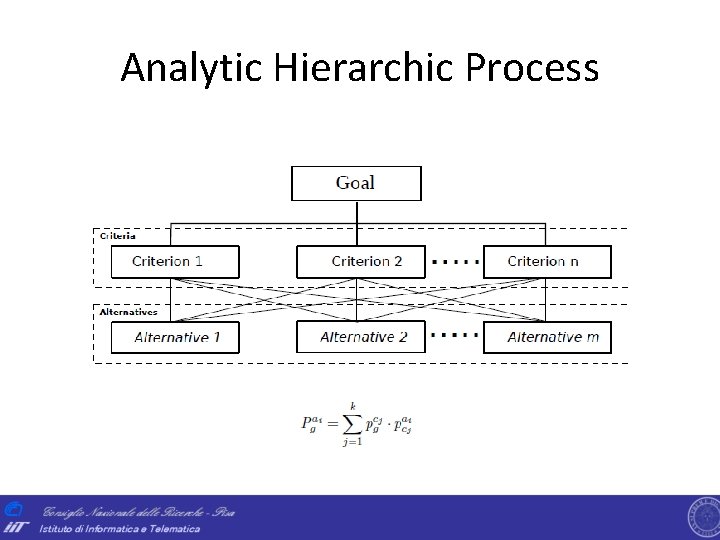
Analytic Hierarchic Process
Multi Criteria Decision (2) • Criteria – Global threat score – Developer Reputation – Marketplace – Number of downloads – User Rating
Final Decision • An application can be considered by AHP as: – Trusted: Secure and Reliable. – Deceptive: Bogus or generally low quality application. – Untrusted: Shows several security issues.
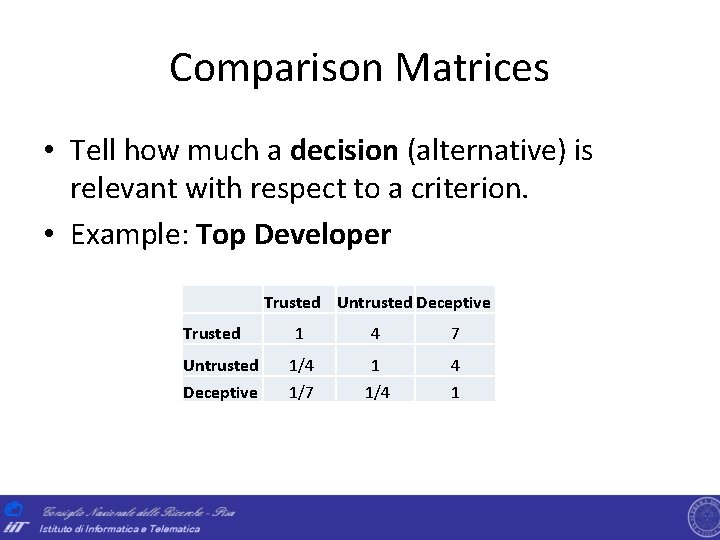
Comparison Matrices • Tell how much a decision (alternative) is relevant with respect to a criterion. • Example: Top Developer Trusted Untrusted Deceptive 1 4 7 1/4 1/7 1 1/4 4 1
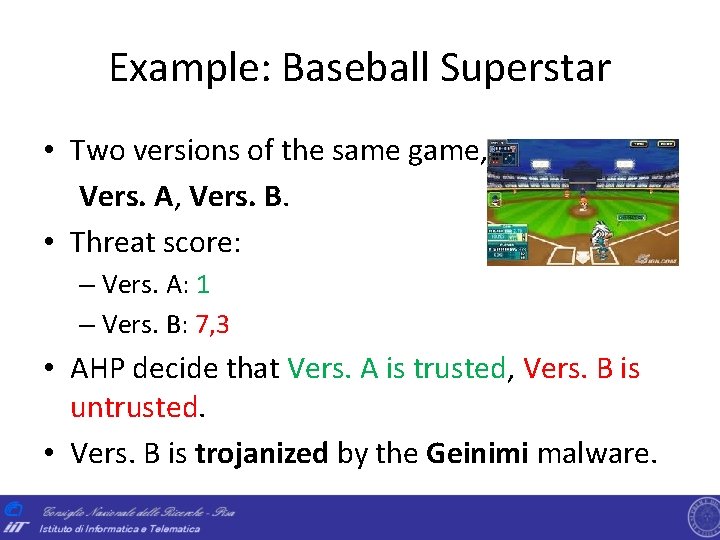
Example: Baseball Superstar • Two versions of the same game, Vers. A, Vers. B. • Threat score: – Vers. A: 1 – Vers. B: 7, 3 • AHP decide that Vers. A is trusted, Vers. B is untrusted. • Vers. B is trojanized by the Geinimi malware.
Example: Skype • Skype requires several permissions to work properly. (Threat Score: 6, 8). • Market: Official • Downloads: More than 10 millions. • Rating: 4 / 5 • AHP decision: Trusted!
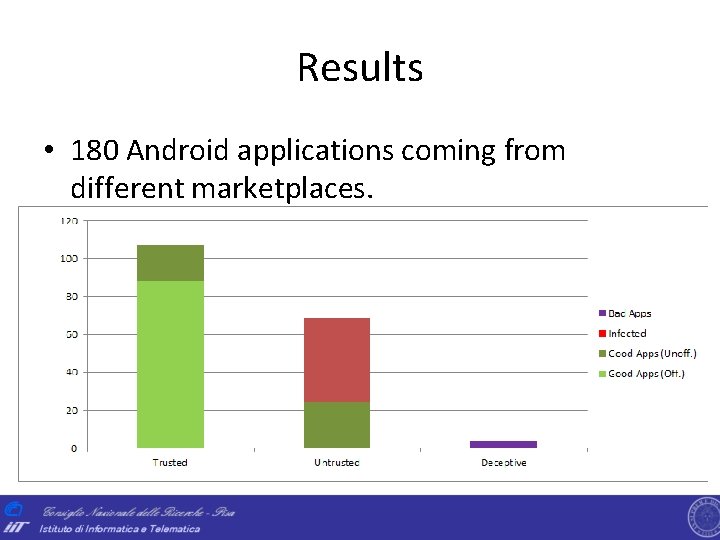
Results • 180 Android applications coming from different marketplaces.
Conclusions • We have defined a simple but effective permission classification system. • We provide the user with an app analysis tool: – Static (computation can be performed offline). – Easily understandable. – Force developers to carefully choose the required permissions.
Future Works • Inclusion of a reputation parameters based on user feedbacks. • Test the system on a larger application set, with different settings for AHP. • Inclusion of sub-criteria in the AHP decision system.
Thanks! andrea. saracino@iit. cnr. it
- Slides: 27