
A morphogenic framework for analyzing gene expression in
- Slides: 1
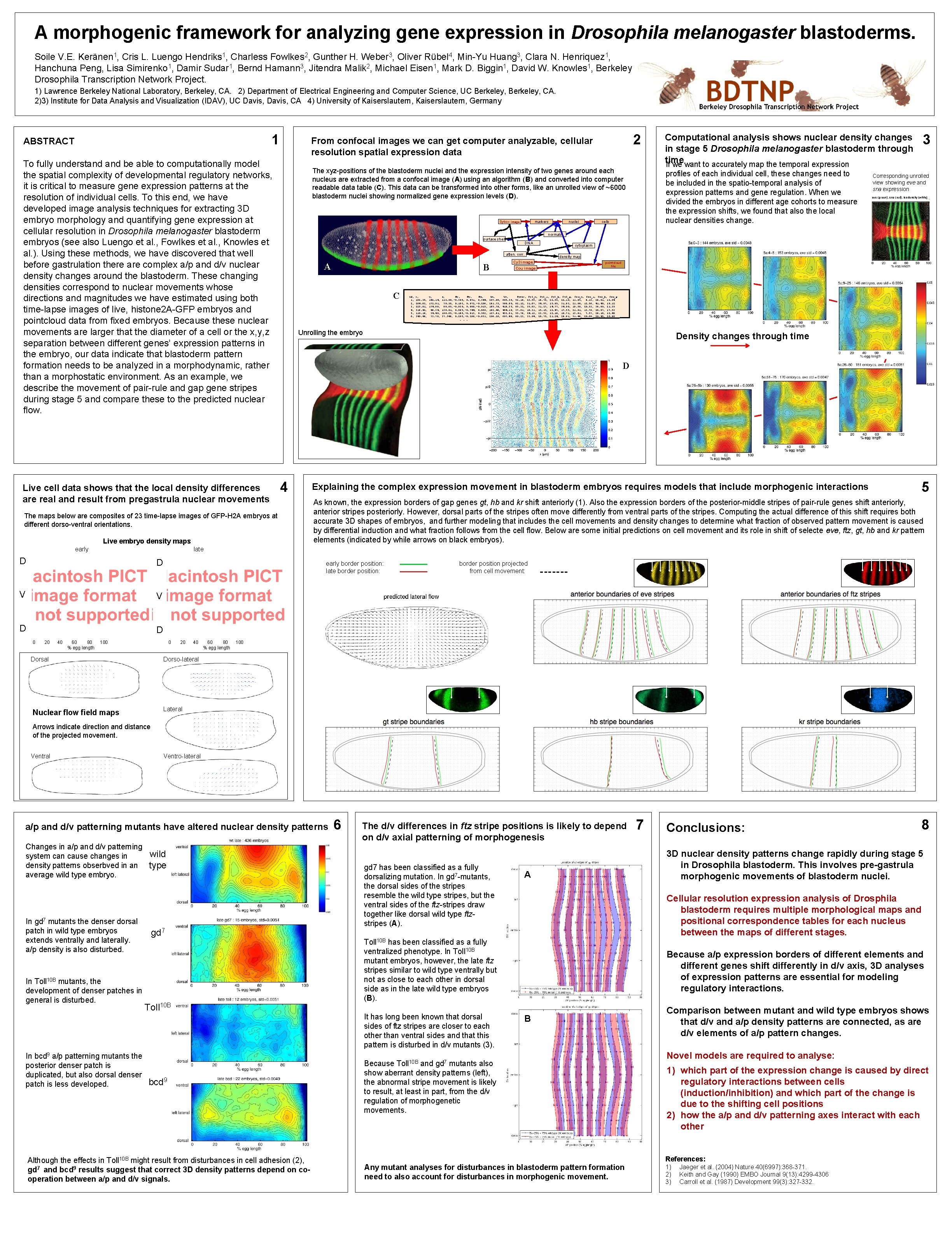
A morphogenic framework for analyzing gene expression in Drosophila melanogaster blastoderms. Soile V. E. Keränen 1, Cris L. Luengo Hendriks 1, Charless Fowlkes 2, Gunther H. Weber 3, Oliver Rübel 4, Min-Yu Huang 3, Clara N. Henriquez 1, Hanchuna Peng, Lisa Simirenko 1, Damir Sudar 1, Bernd Hamann 3, Jitendra Malik 2, Michael Eisen 1, Mark D. Biggin 1, David W. Knowles 1, Berkeley Drosophila Transcription Network Project. 1) Lawrence Berkeley National Laboratory, Berkeley, CA. 2) Department of Electrical Engineering and Computer Science, UC Berkeley, CA. 2)3) Institute for Data Analysis and Visualization (IDAV), UC Davis, CA 4) University of Kaiserslautern, Germany 1 ABSTRACT To fully understand be able to computationally model the spatial complexity of developmental regulatory networks, it is critical to measure gene expression patterns at the resolution of individual cells. To this end, we have developed image analysis techniques for extracting 3 D embryo morphology and quantifying gene expression at cellular resolution in Drosophila melanogaster blastoderm embryos (see also Luengo et al. , Fowlkes et al. , Knowles et al. ). Using these methods, we have discovered that well before gastrulation there are complex a/p and d/v nuclear density changes around the blastoderm. These changing densities correspond to nuclear movements whose directions and magnitudes we have estimated using both time-lapse images of live, histone 2 A-GFP embryos and pointcloud data from fixed embryos. Because these nuclear movements are larger that the diameter of a cell or the x, y, z separation between different genes’ expression patterns in the embryo, our data indicate that blastoderm pattern formation needs to be analyzed in a morphodynamic, rather than a morphostatic environment. As an example, we describe the movement of pair-rule and gap gene stripes during stage 5 and compare these to the predicted nuclear flow. Live cell data shows that the local density differences are real and result from pregastrula nuclear movements The xyz-positions of the blastoderm nuclei and the expression intensity of two genes around each nucleus are extracted from a confocal image (A) using an algorithm (B) and converted into computer readable data table (C). This data can be transformed into other forms, like an unrolled view of ~6000 blastoderm nuclei showing normalized gene expression levels (D). Sytox image D V V D D 40 60 80 % egg length profiles of each individual cell, these changes need to be included in the spatio-temporal analysis of expression patterns and gene regulation. When we divided the embryos in different age cohorts to measure the expression shifts, we found that also the local nuclear densities change. cells 3 Corresponding unrolled view showing eve and sna expression eve (green), sna (red), isodensity (white) DNA atten. corr. A Cy 3 image B C id, 1, 2, 3, 4, 5, 6, x, 102. 36, 264. 63, 225. 91, 318. 42, 110. 18, 340. 48, y, 142. 14, 172. 01, 174. 99, 48. 34, 34. 40, 73. 79, z, Nx, Ny, Nz, 112. 00, -0. 396, 0. 851, 0. 344, 79. 36, 0. 103, 0. 972, -0. 208, 88. 65, -0. 030, 0. 999, -0. 015, 138. 91, 0. 095, -0. 744, 0. 660, 109. 65, -0. 186, -0. 913, 0. 362, 37. 548, 0. 205, -0. 299, -0. 931, . . . Cou image Vn, 207. 96, 281. 73, 185. 79, 182. 46, 127. 81, 208. 26, Vc, 605. 36, 599. 90, 418. 35, 464. 19, 432. 01, 607. 49, cytoplasm density map pointcloud file Density maps Sytox, Cy 3_n, Cy 3_a, Cy 3_b, Cy 3_g, Cou_n, Cou_a, Cou_b, Cou_g 52. 18, 23. 55, 18. 76, 22. 55, 22. 10, 11. 95, 8. 13, 28. 01, 12. 04 82. 12, 31. 67, 34. 97, 15. 95, 31. 93, 21. 06, 12. 56, 41. 40, 19. 12 85. 32, 35. 63, 31. 27, 14. 77, 34. 00, 19. 59, 20. 53, 38. 80, 21. 35 37. 61, 19. 31, 15. 15, 12. 47, 17. 55, 21. 01, 13. 78, 26. 87, 17. 53 55. 78, 24. 12, 23. 53, 12. 19, 19. 71, 13. 81, 7. 57, 28. 16, 12. 40 80. 23, 33. 04, 26. 75, 21. 24, 28. 91, 31. 48, 20. 69, 50. 45, 26. 96 Unrolling the embryo Density changes through time D 4 Explaining the complex expression movement in blastoderm embryos requires models that include morphogenic interactions 5 As known, the expression borders of gap genes gt, hb and kr shift anteriorly (1). Also the expression borders of the posterior-middle stripes of pair-rule genes shift anteriorly, anterior stripes posteriorly. However, dorsal parts of the stripes often move differently from ventral parts of the stripes. Computing the actual difference of this shift requires both accurate 3 D shapes of embryos, and further modeling that includes the cell movements and density changes to determine what fraction of observed pattern movement is caused by differential induction and what fraction follows from the cell flow. Below are some initial predictions on cell movement and its role in shift of selecte eve, ftz, gt, hb and kr pattern elements (indicated by while arrows on black embryos). late D 20 nuclei Computational analysis shows nuclear density changes in stage 5 Drosophila melanogaster blastoderm through time If we want to accurately map the temporal expression normals Live embryo density maps 0 markers surface shell The maps below are composites of 23 time-lapse images of GFP-H 2 A embryos at different dorso-ventral orientations. early 2 From confocal images we can get computer analyzable, cellular resolution spatial expression data early border position: late border position: 100 0 Dorsal 20 40 60 80 % egg length border position projected from cell movement: Pattern shift 100 Dorso-lateral Lateral Nuclear flow field maps Arrows indicate direction and distance of the projected movement. Ventral Ventro-lateral a/p and d/v patterning mutants have altered nuclear density patterns Changes in a/p and d/v patterning system can cause changes in density patterns obserbved in an average wild type embryo. In gd 7 mutants the denser dorsal patch in wild type embryos extends ventrally and laterally. a/p density is also disturbed. In Toll 10 B mutants, the development of denser patches in general is disturbed. wild type gd 7 Toll 10 B 6 The d/v differences in ftz stripe positions is likely to depend on d/v axial patterning of morphogenesis gd 7 has been classified as a fully dorsalizing mutation. In gd 7 -mutants, the dorsal sides of the stripes resemble the wild type stripes, but the ventral sides of the ftz-stripes draw together like dorsal wild type ftzstripes (A). Toll 10 B bcd 9 Although the effects in Toll 10 B might result from disturbances in cell adhesion (2), gd 7 and bcd 9 results suggest that correct 3 D density patterns depend on cooperation between a/p and d/v signals. Conclusions: 8 3 D nuclear density patterns change rapidly during stage 5 in Drosophila blastoderm. This involves pre-gastrula morphogenic movements of blastoderm nuclei. Cellular resolution expression analysis of Drosphila blastoderm requires multiple morphological maps and positional correspondence tables for each nucleus between the maps of different stages. Toll 10 B has been classified as a fully ventralized phenotype. In Toll 10 B mutant embryos, however, the late ftz stripes similar to wild type ventrally but not as close to each other in dorsal side as in the late wild type embryos (B). It has long been known that dorsal sides of ftz stripes are closer to each other than ventral sides and that this pattern is disturbed in d/v mutants (3). In bcd 9 a/p patterning mutants the posterior denser patch is duplicated, but also dorsal denser patch is less developed. A 7 Because a/p expression borders of different elements and different genes shift differently in d/v axis, 3 D analyses of expression patterns are essential for modeling regulatory interactions. B gd 7 Because and mutants also show aberrant density patterns (left), the abnormal stripe movement is likely to result, at least in part, from the d/v regulation of morphogenetic movements. Any mutant analyses for disturbances in blastoderm pattern formation need to also account for disturbances in morphogenic movement. Comparison between mutant and wild type embryos shows that d/v and a/p density patterns are connected, as are d/v elements of a/p pattern changes. Novel models are required to analyse: 1) which part of the expression change is caused by direct regulatory interactions between cells (induction/inhibition) and which part of the change is due to the shifting cell positions 2) how the a/p and d/v patterning axes interact with each other References: 1) 2) 3) Jaeger et al. (2004) Nature 40(6997): 368 -371. Keith and Gay (1990) EMBO Journal 9(13): 4299 -4306 Carroll et al. (1987) Development 99(3): 327 -332.