
A more efficient DLMAP IE for MAPs Document


- Slides: 11
A more efficient DL-MAP IE for MAPs Document Number: IEEE S 802. 16 m-08/099 r 1 Date Submitted: 2008 -05 -14 Source: Kanchei (Ken) Loa, Tsung-Yu Tsai, Yi-Hsueh Tsai, Yung-Ting Lee, Hua-Chiang Yin Voice: E-mail: +886 -2 -6600 -0100 loa@iii. org. tw Institute for Information Industry (III) 7 F, No. 133, Sec. 4, Minsheng E. Rd. , Taipei City 105, Taiwan Re: IEEE 802. 16 j-08/020: “IEEE 802. 16 Working Group Letter Ballot Recirc #28 c: Announcement” Abstract: This contribution proposes the compressed DL-MAP IE Purpose: Text proposal for 802. 16 j Draft Document. Notice: This document does not represent the agreed views of the IEEE 802. 16 Working Group or any of its subgroups. It represents only the views of the participants listed in the “Source(s)” field above. It is offered as a basis for discussion. It is not binding on the contributor(s), who reserve(s) the right to add, amend or withdraw material contained herein Release: The contributor grants a free, irrevocable license to the IEEE to incorporate material contained in this contribution, and any modifications thereof, in the creation of an IEEE Standards publication; to copyright in the IEEE’s name any IEEE Standards publication even though it may include portions of this contribution; and at the IEEE’s sole discretion to permit others to reproduce in whole or in part the resulting IEEE Standards publication. The contributor also acknowledges and accepts that this contribution may be made public by IEEE 802. 16. Patent Policy: The contributor is familiar with the IEEE-SA Patent Policy and Procedures: <http: //standards. ieee. org/guides/bylaws/sect 6 -7. html#6> and <http: //standards. ieee. org/guides/opman/sect 6. html#6. 3>. Further information is located at <http: //standards. ieee. org/board/pat-material. html> and <http: //standards. ieee. org/board/pat>.
A More Efficient DL-MAP IE for MAPs Institute of Information Industry (III)
Introduction • Four parameters are included in the DL-MAP IE to describe a 2 D allocation – “OFDMA symbol offset”, “OFDMA sub-channel offset”, “number of OFDMA symbols”, and “number of OFDMA sub-channels” • The above approach is intuitive but not efficient since the MAP overhead is high • This contribution proposes a Compressed DL-MAP IE – Only two parameters: “number of OFDMA symbols” and “number of subchannels” are used to describe the 2 D allocation – The receiver can uniquely re-construct the 2 D allocations • The Compressed DL-MAP IE replace the original DL-MAP IE in RS_Access-MAP, RS_Relay-MAP, and R-MAP to reduce the MAP overheads on the relay link – Reduce the DL-MAP IE overhead of DL data burst description from 27 bits to 13 bits
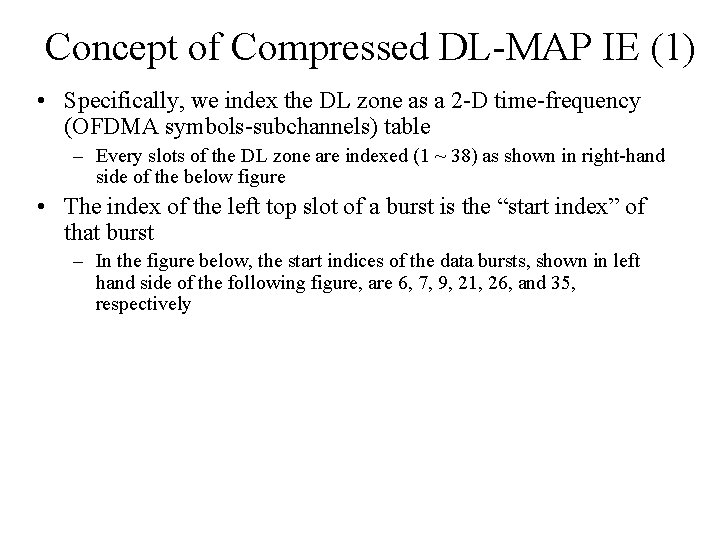
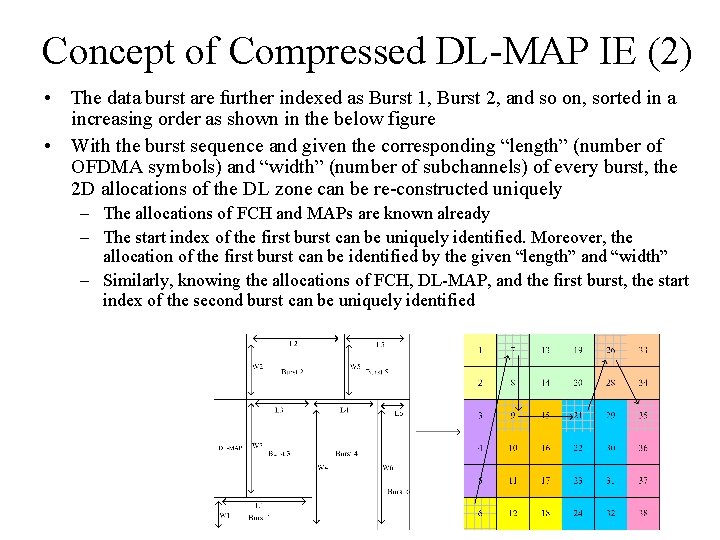
Concept of Compressed DL-MAP IE (1) • Specifically, we index the DL zone as a 2 -D time-frequency (OFDMA symbols-subchannels) table – Every slots of the DL zone are indexed (1 ~ 38) as shown in right-hand side of the below figure • The index of the left top slot of a burst is the “start index” of that burst – In the figure below, the start indices of the data bursts, shown in left hand side of the following figure, are 6, 7, 9, 21, 26, and 35, respectively
Concept of Compressed DL-MAP IE (2) • The data burst are further indexed as Burst 1, Burst 2, and so on, sorted in a increasing order as shown in the below figure • With the burst sequence and given the corresponding “length” (number of OFDMA symbols) and “width” (number of subchannels) of every burst, the 2 D allocations of the DL zone can be re-constructed uniquely – The allocations of FCH and MAPs are known already – The start index of the first burst can be uniquely identified. Moreover, the allocation of the first burst can be identified by the given “length” and “width” – Similarly, knowing the allocations of FCH, DL-MAP, and the first burst, the start index of the second burst can be uniquely identified
Example 1: Full Allocation Every slot is allocated
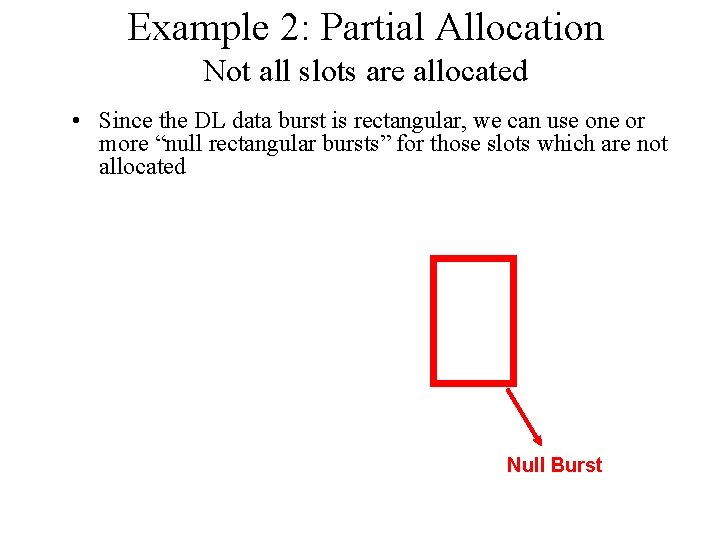
Example 2: Partial Allocation Not all slots are allocated • Since the DL data burst is rectangular, we can use one or more “null rectangular bursts” for those slots which are not allocated Null Burst
Proposed Compressed DL-MAP IE
RS_Access-MAP with Proposed Compressed DL-MAP IE
R-MAP with Proposed Compressed DLMAP IE
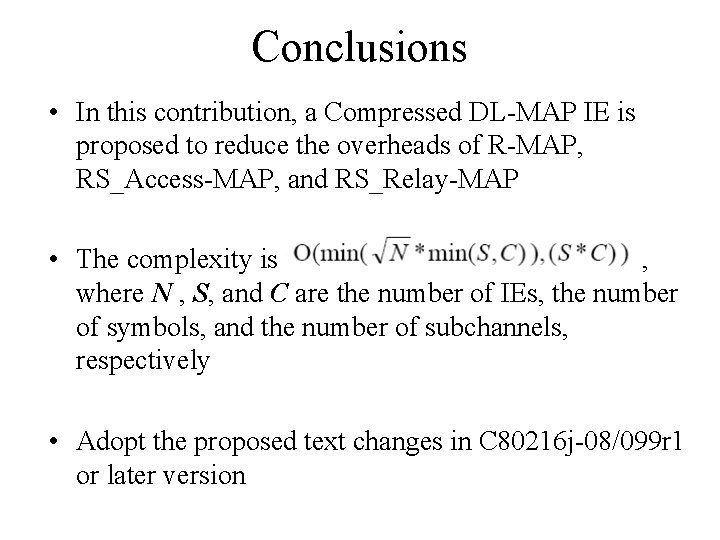
Conclusions • In this contribution, a Compressed DL-MAP IE is proposed to reduce the overheads of R-MAP, RS_Access-MAP, and RS_Relay-MAP • The complexity is , where N , S, and C are the number of IEs, the number of symbols, and the number of subchannels, respectively • Adopt the proposed text changes in C 80216 j-08/099 r 1 or later version