
A modification of the Fiduccia Mattheyses hypergraph bipartitioning

A modification of the Fiduccia. Mattheyses hypergraph bipartitioning algorithm Rusakov A. S. (IPPM RAS), Sheblaev M.
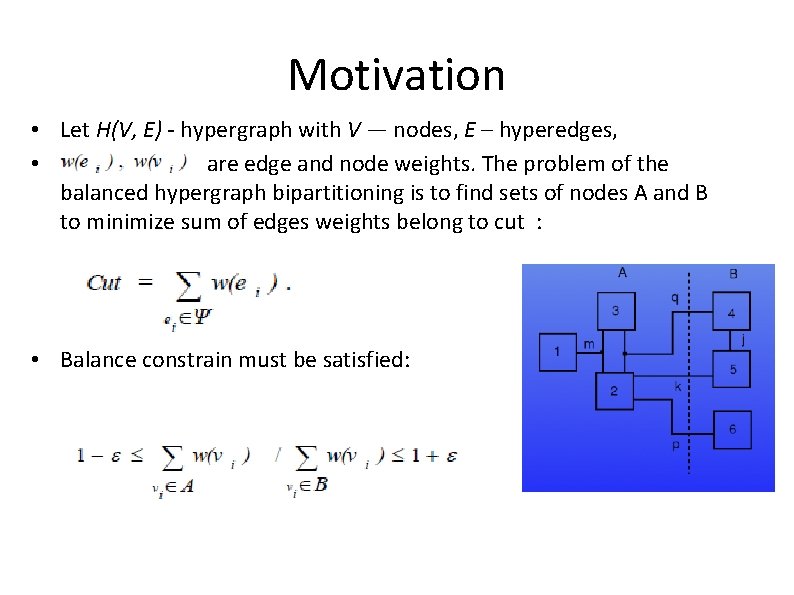
Motivation • Let H(V, E) - hypergraph with V — nodes, Е – hyperedges, • are edge and node weights. The problem of the balanced hypergraph bipartitioning is to find sets of nodes A and B to minimize sum of edges weights belong to cut : • Balance constrain must be satisfied:

Motivation Graph and hypergraph partitioning — wide application area. Spectral method, simulated annealing, genetic algorithms Iterative improvement. KL method. FM algorithm. State of the art: multilevel iterative improvement algorithms. – – Metis, Hmetis, Scotch, MLPART, Pa. To. H… FM algorithm does not perform well on graphs with largely varied node weights w(vi) or multiple node weight for node. We address FM algorithm weakness as part of multilevel bipartition algorithm.
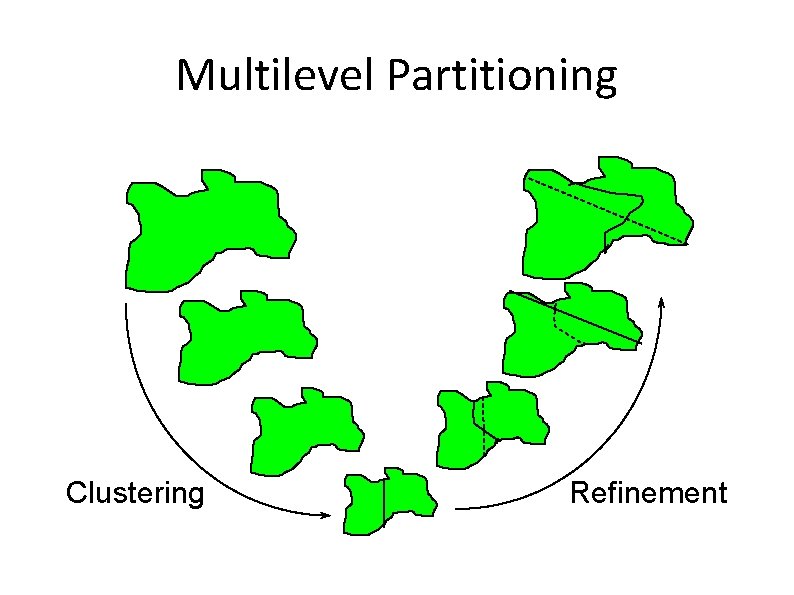
Multilevel Partitioning Clustering Refinement
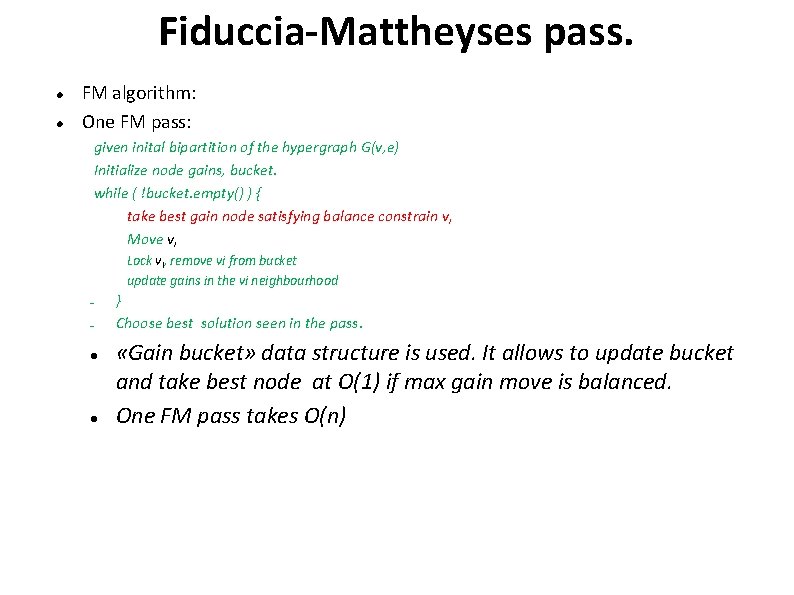
Fiduccia-Mattheyses pass. FM algorithm: One FM pass: given inital bipartition of the hypergraph G(v, e) Initialize node gains, bucket. while ( !bucket. empty() ) { take best gain node satisfying balance constrain vi Move vi Lock vi, remove vi from bucket update gains in the vi neighbourhood – } – Choose best solution seen in the pass. «Gain bucket» data structure is used. It allows to update bucket and take best node at O(1) if max gain move is balanced. One FM pass takes O(n)
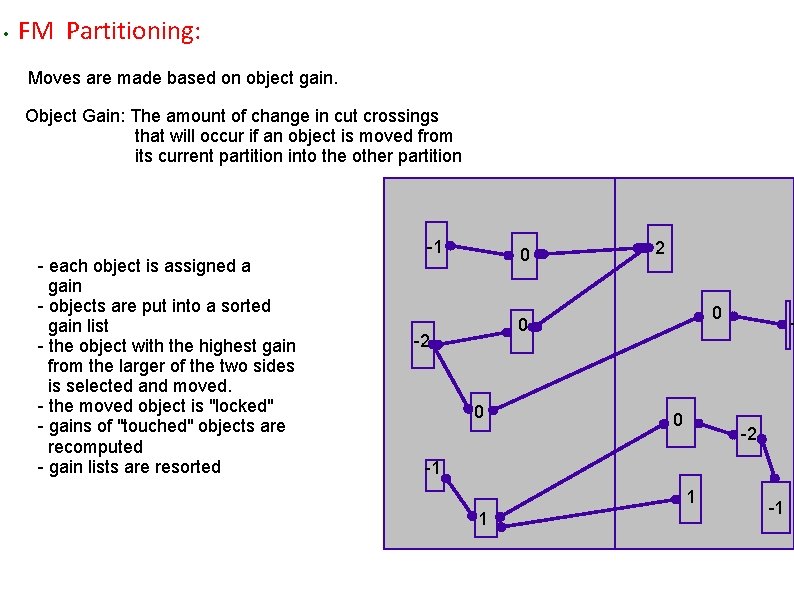
• FM Partitioning: Moves are made based on object gain. Object Gain: The amount of change in cut crossings that will occur if an object is moved from its current partition into the other partition - each object is assigned a gain - objects are put into a sorted gain list - the object with the highest gain from the larger of the two sides is selected and moved. - the moved object is "locked" - gains of "touched" objects are recomputed - gain lists are resorted -1 0 2 0 0 - -2 -1 1 1 -1
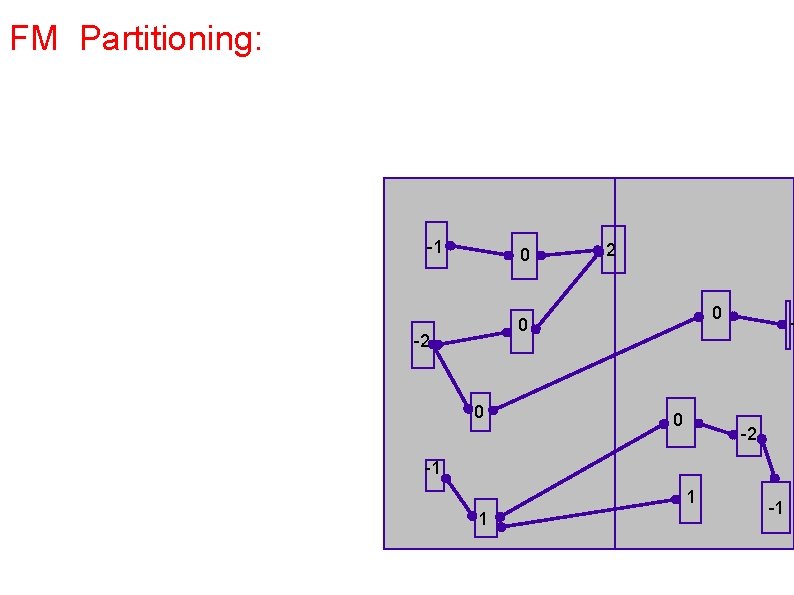
FM Partitioning: -1 0 2 0 0 - -2 -1 1 1 -1
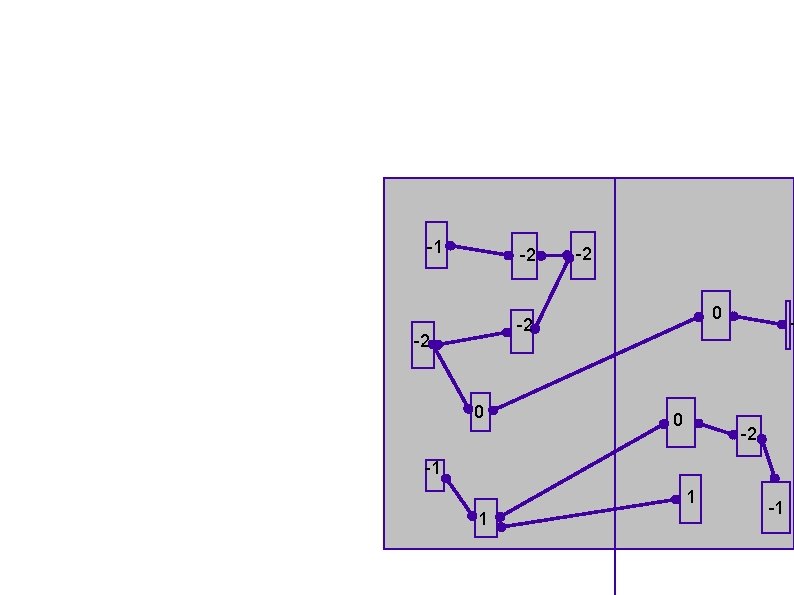
-1 -2 -2 0 0 - -2 -1 1 1 -1
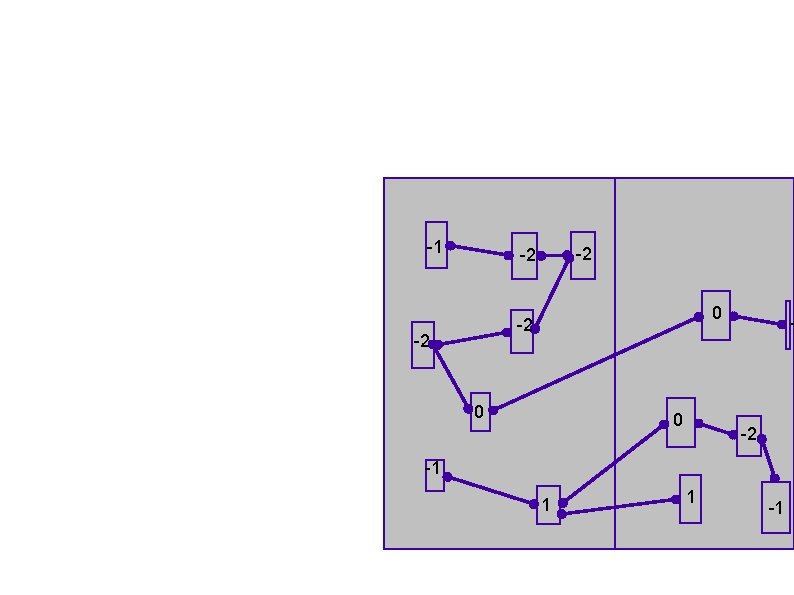
-1 -2 -2 0 0 - -2 -1 1 1 -1
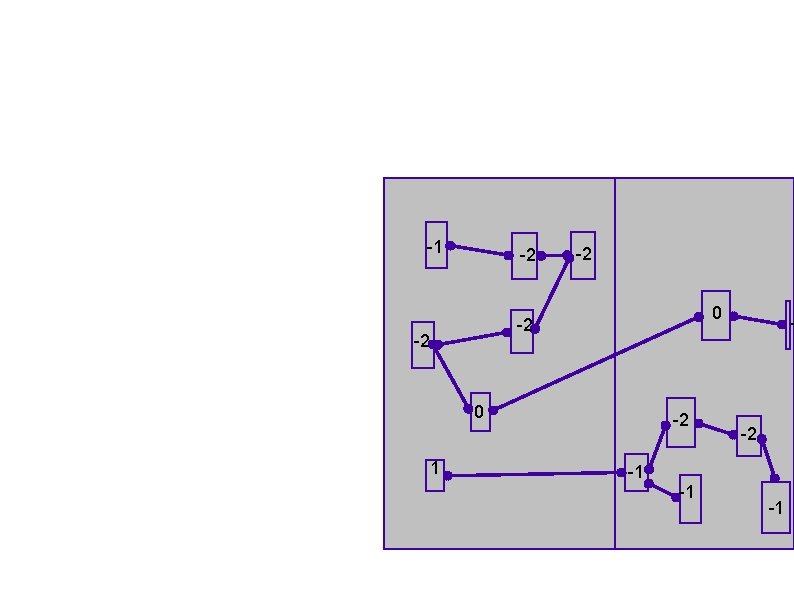
-1 -2 -2 0 1 -2 -1 -1 - -2 -1
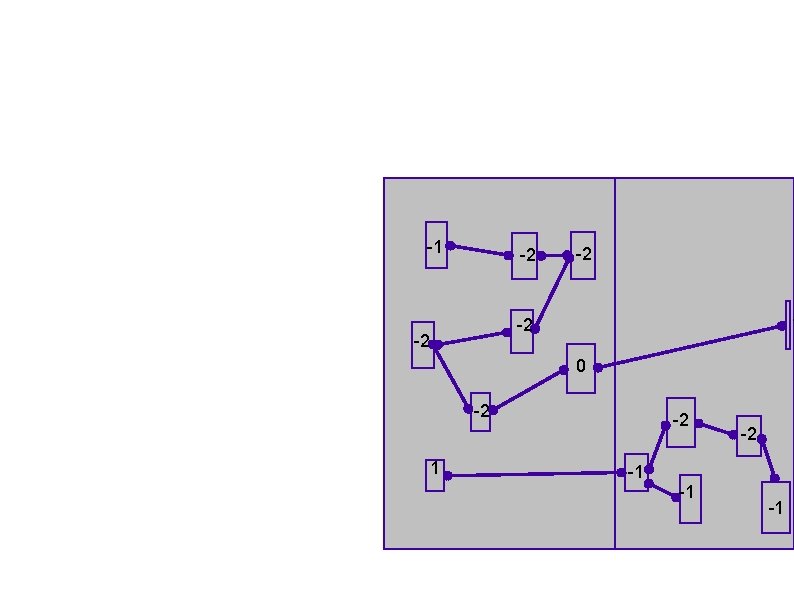
-1 -2 -2 0 -2 1 -2 -1 -1 -2 -1
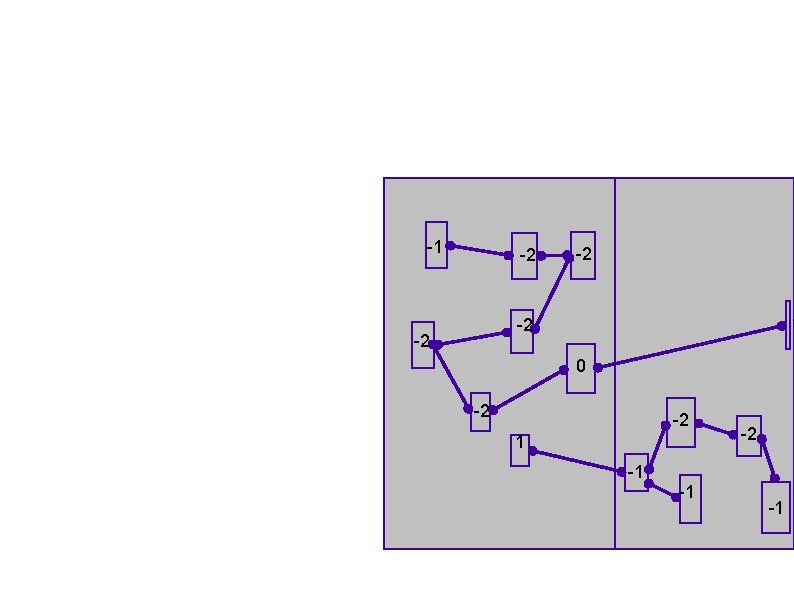
-1 -2 -2 0 -2 -2 1 -1 -1 -2 -1
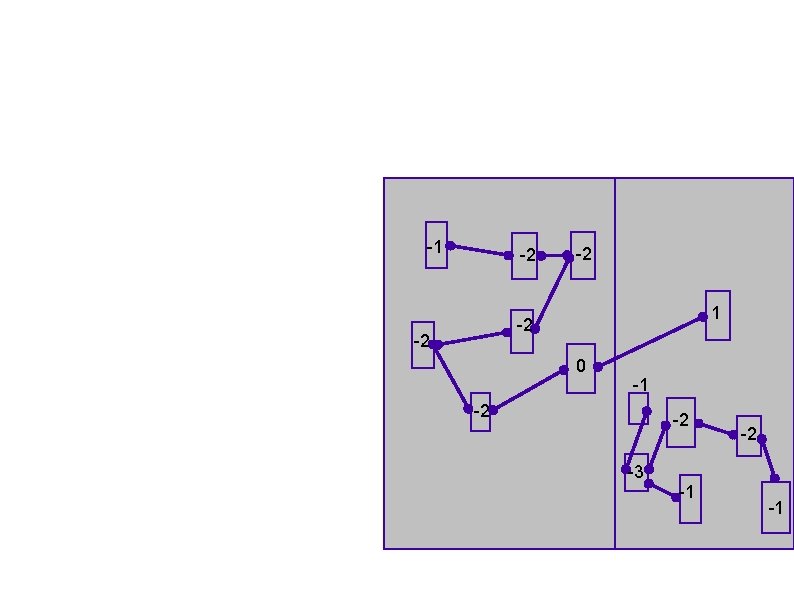
-1 -2 -2 0 -1 -2 -2 -3 -1 -2 -1
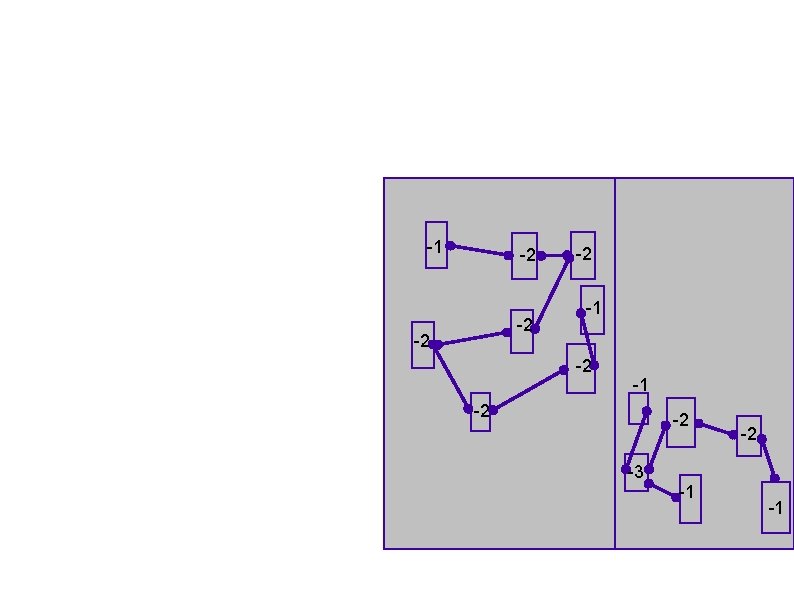
-1 -2 -2 -3 -1 -2 -1
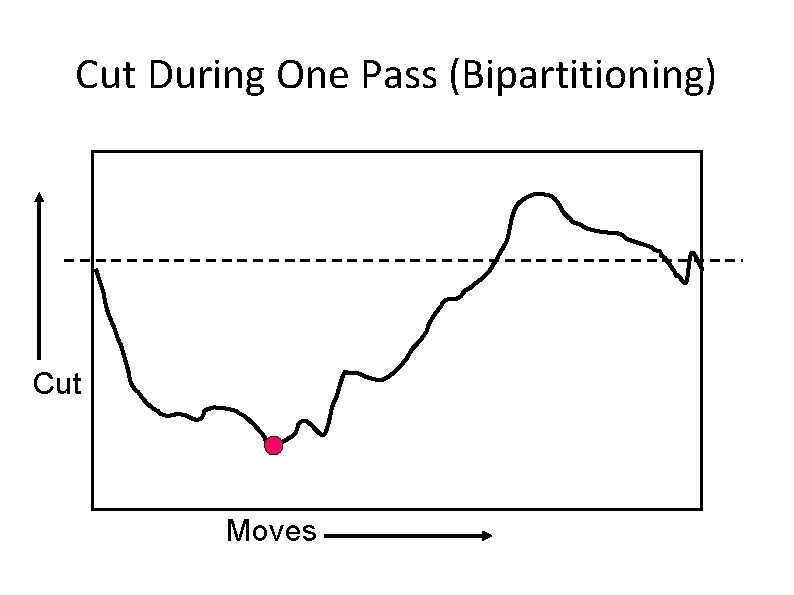
Cut During One Pass (Bipartitioning) Cut Moves
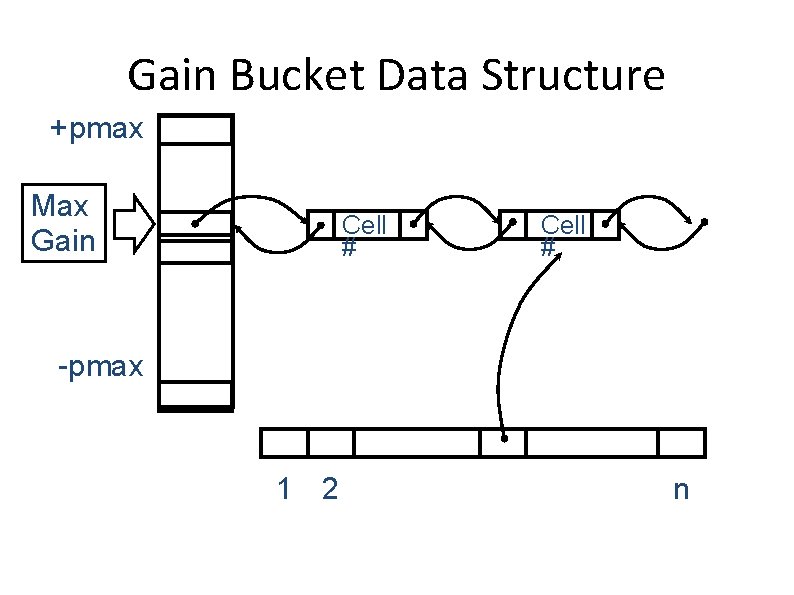
Gain Bucket Data Structure +pmax Max Gain Cell # -pmax 1 2 n
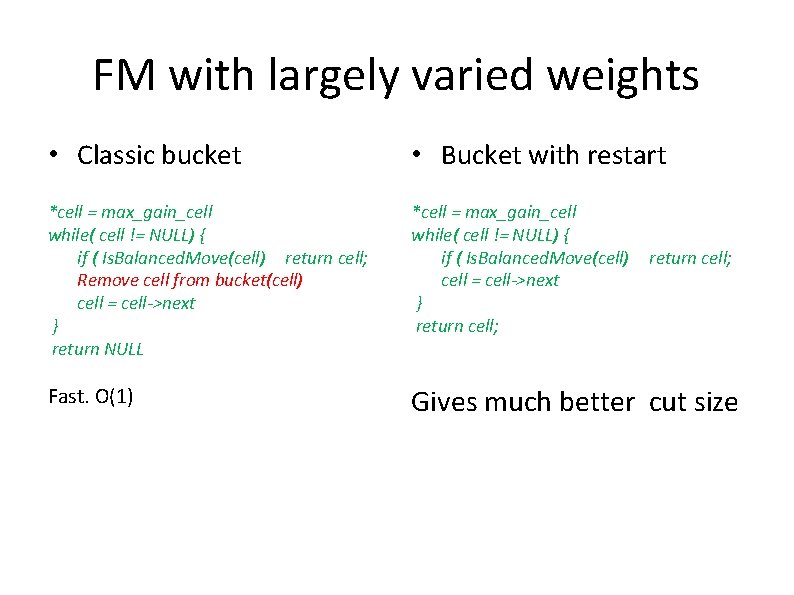
FM with largely varied weights • Classic bucket • Bucket with restart *cell = max_gain_cell while( cell != NULL) { if ( Is. Balanced. Move(cell) return cell; Remove cell from bucket(cell) cell = cell->next } return NULL *cell = max_gain_cell while( cell != NULL) { if ( Is. Balanced. Move(cell) cell = cell->next } return cell; Fast. O(1) Gives much better cut size return cell;
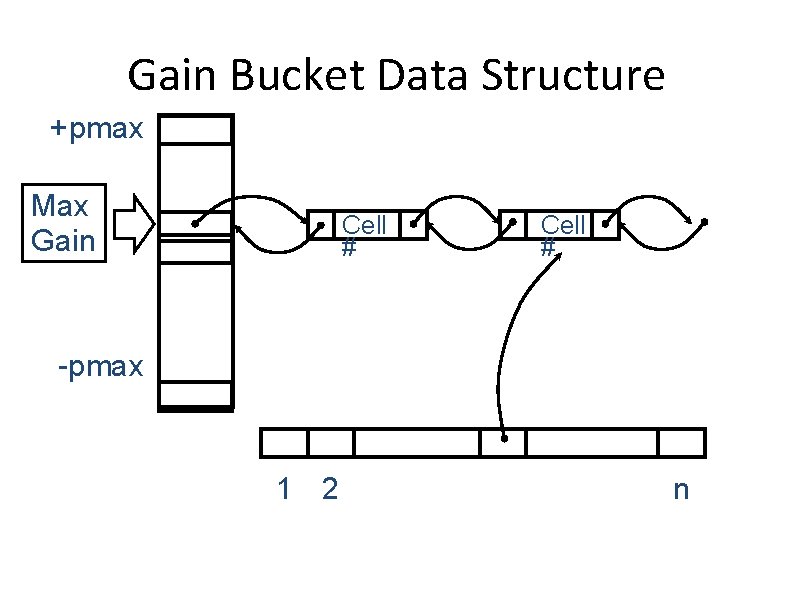
Gain Bucket Data Structure +pmax Max Gain Cell # -pmax 1 2 n
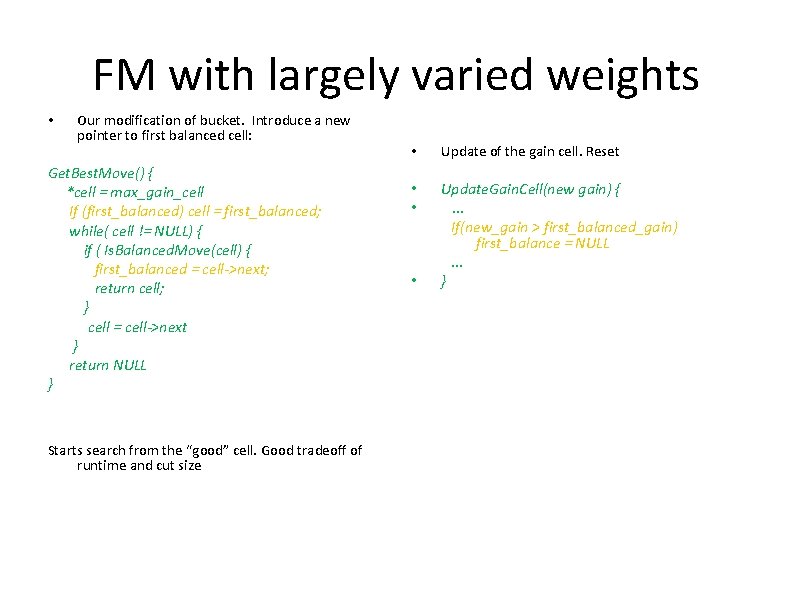
FM with largely varied weights • Our modification of bucket. Introduce a new pointer to first balanced cell: Get. Best. Move() { *cell = max_gain_cell If (first_balanced) cell = first_balanced; while( cell != NULL) { if ( Is. Balanced. Move(cell) { first_balanced = cell->next; return cell; } cell = cell->next } return NULL } Starts search from the “good” cell. Good tradeoff of runtime and cut size • Update of the gain cell. Reset • • Update. Gain. Cell(new gain) {. . . If(new_gain > first_balanced_gain) first_balance = NULL … } •
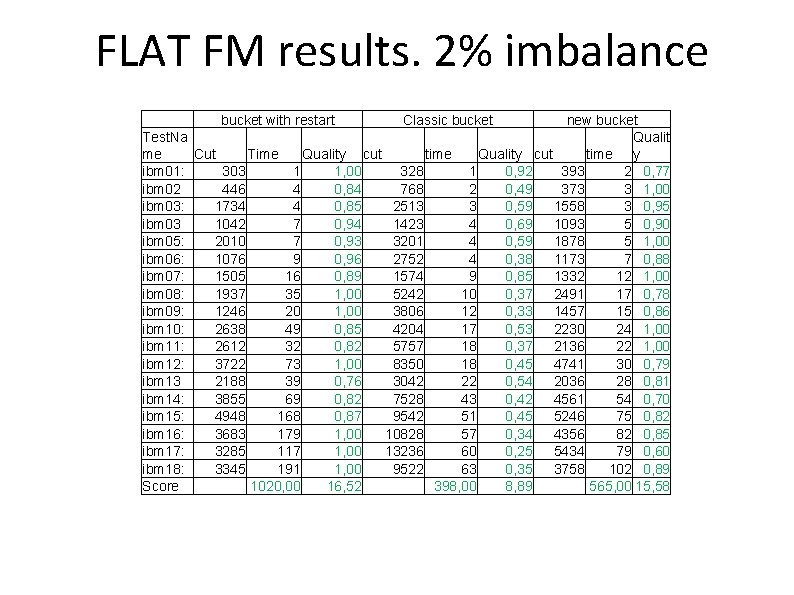
FLAT FM results. 2% imbalance bucket with restart Test. Na me ibm 01: ibm 02 ibm 03: ibm 03 ibm 05: ibm 06: ibm 07: ibm 08: ibm 09: ibm 10: ibm 11: ibm 12: ibm 13 ibm 14: ibm 15: ibm 16: ibm 17: ibm 18: Score Classic bucket new bucket Qualit Cut Time Quality cut time y 303 1 1, 00 328 1 0, 92 393 2 0, 77 446 4 0, 84 768 2 0, 49 373 3 1, 00 1734 4 0, 85 2513 3 0, 59 1558 3 0, 95 1042 7 0, 94 1423 4 0, 69 1093 5 0, 90 2010 7 0, 93 3201 4 0, 59 1878 5 1, 00 1076 9 0, 96 2752 4 0, 38 1173 7 0, 88 1505 16 0, 89 1574 9 0, 85 1332 12 1, 00 1937 35 1, 00 5242 10 0, 37 2491 17 0, 78 1246 20 1, 00 3806 12 0, 33 1457 15 0, 86 2638 49 0, 85 4204 17 0, 53 2230 24 1, 00 2612 32 0, 82 5757 18 0, 37 2136 22 1, 00 3722 73 1, 00 8350 18 0, 45 4741 30 0, 79 2188 39 0, 76 3042 22 0, 54 2036 28 0, 81 3855 69 0, 82 7528 43 0, 42 4561 54 0, 70 4948 168 0, 87 9542 51 0, 45 5246 75 0, 82 3683 179 1, 00 10828 57 0, 34 4356 82 0, 85 3285 117 1, 00 13236 60 0, 25 5434 79 0, 60 3345 191 1, 00 9522 63 0, 35 3758 102 0, 89 1020, 00 16, 52 398, 00 8, 89 565, 00 15, 58

Application to Multilevel Bipartitioning • runs with 5 clusterization scheme (FC, MHEC, HEM, HEC, Pin. HEM). Choose best • V cycle
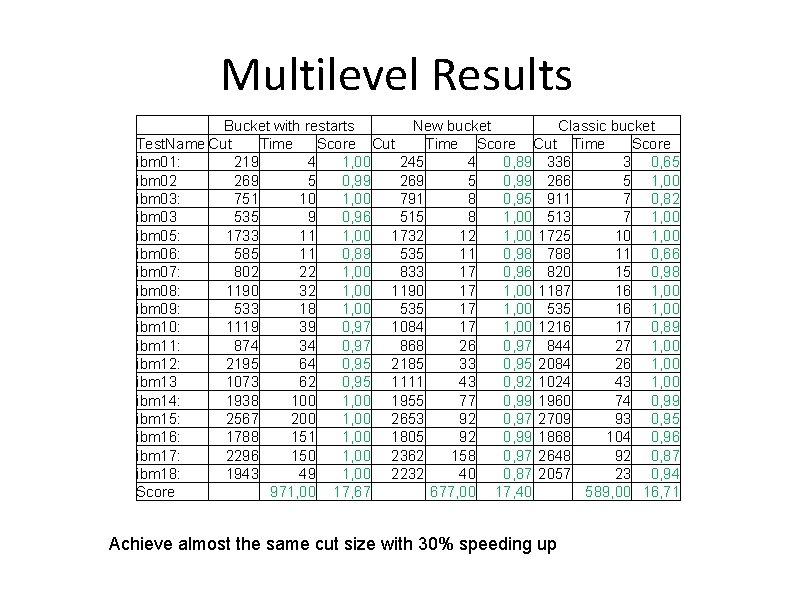
Multilevel Results Bucket with restarts New bucket Classic bucket Test. Name Cut Time Score ibm 01: 219 4 1, 00 245 4 0, 89 336 3 0, 65 ibm 02 269 5 0, 99 266 5 1, 00 ibm 03: 751 10 1, 00 791 8 0, 95 911 7 0, 82 ibm 03 535 9 0, 96 515 8 1, 00 513 7 1, 00 ibm 05: 1733 11 1, 00 1732 12 1, 00 1725 10 1, 00 ibm 06: 585 11 0, 89 535 11 0, 98 788 11 0, 66 ibm 07: 802 22 1, 00 833 17 0, 96 820 15 0, 98 ibm 08: 1190 32 1, 00 1190 17 1, 00 1187 16 1, 00 ibm 09: 533 18 1, 00 535 17 1, 00 535 16 1, 00 ibm 10: 1119 39 0, 97 1084 17 1, 00 1216 17 0, 89 ibm 11: 874 34 0, 97 868 26 0, 97 844 27 1, 00 ibm 12: 2195 64 0, 95 2185 33 0, 95 2084 26 1, 00 ibm 13 1073 62 0, 95 1111 43 0, 92 1024 43 1, 00 ibm 14: 1938 100 1, 00 1955 77 0, 99 1960 74 0, 99 ibm 15: 2567 200 1, 00 2653 92 0, 97 2709 93 0, 95 ibm 16: 1788 151 1, 00 1805 92 0, 99 1868 104 0, 96 ibm 17: 2296 150 1, 00 2362 158 0, 97 2648 92 0, 87 ibm 18: 1943 49 1, 00 2232 40 0, 87 2057 23 0, 94 Score 971, 00 17, 67 677, 00 17, 40 589, 00 16, 71 Achieve almost the same cut size with 30% speeding up
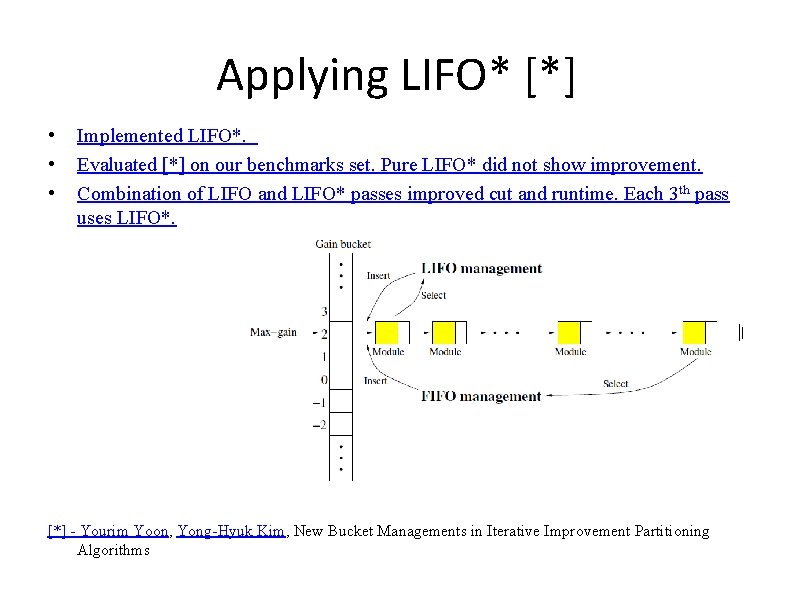
Applying LIFO* [*] • • • Implemented LIFO*. Evaluated [*] on our benchmarks set. Pure LIFO* did not show improvement. Combination of LIFO and LIFO* passes improved cut and runtime. Each 3 th pass uses LIFO*. [*] - Yourim Yoon, Yong-Hyuk Kim, New Bucket Managements in Iterative Improvement Partitioning Algorithms
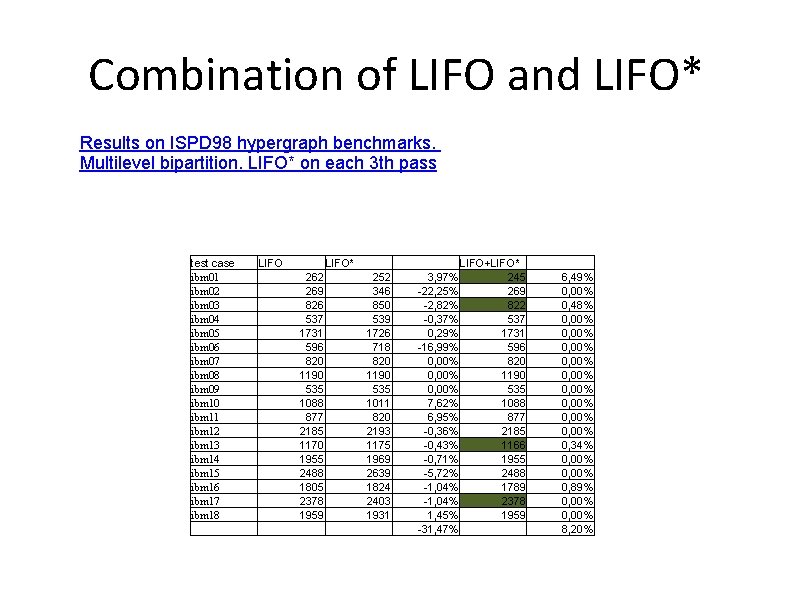
Combination of LIFO and LIFO* Results on ISPD 98 hypergraph benchmarks. Multilevel bipartition. LIFO* on each 3 th pass test case ibm 01 ibm 02 ibm 03 ibm 04 ibm 05 ibm 06 ibm 07 ibm 08 ibm 09 ibm 10 ibm 11 ibm 12 ibm 13 ibm 14 ibm 15 ibm 16 ibm 17 ibm 18 LIFO* 262 269 826 537 1731 596 820 1190 535 1088 877 2185 1170 1955 2488 1805 2378 1959 252 346 850 539 1726 718 820 1190 535 1011 820 2193 1175 1969 2639 1824 2403 1931 LIFO+LIFO* 3, 97% 245 -22, 25% 269 -2, 82% 822 -0, 37% 537 0, 29% 1731 -16, 99% 596 0, 00% 820 0, 00% 1190 0, 00% 535 7, 62% 1088 6, 95% 877 -0, 36% 2185 -0, 43% 1166 -0, 71% 1955 -5, 72% 2488 -1, 04% 1789 -1, 04% 2378 1, 45% 1959 -31, 47% 6, 49% 0, 00% 0, 48% 0, 00% 0, 00% 0, 00% 0, 34% 0, 00% 0, 89% 0, 00% 8, 20%
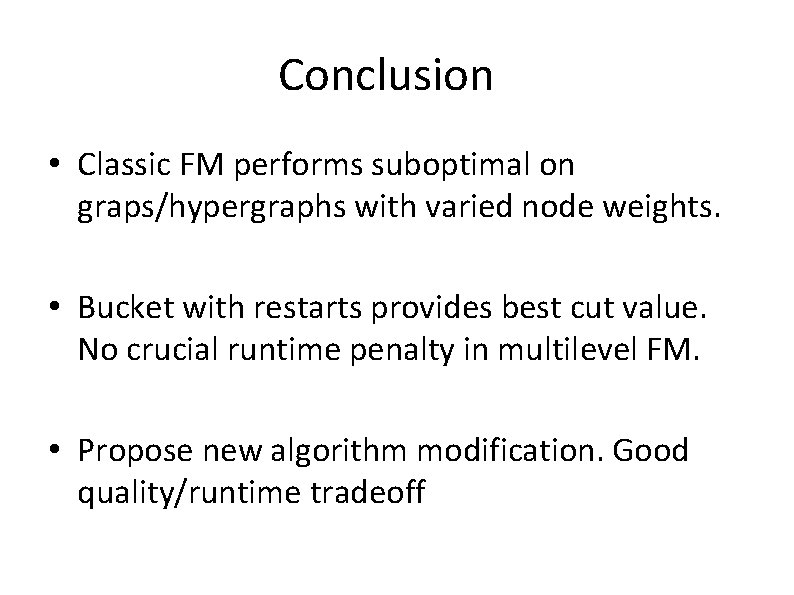
Conclusion • Classic FM performs suboptimal on graps/hypergraphs with varied node weights. • Bucket with restarts provides best cut value. No crucial runtime penalty in multilevel FM. • Propose new algorithm modification. Good quality/runtime tradeoff
- Slides: 25