
A Modeling Study on Typhoon Nari 2001 Landfall






- Slides: 45
A Modeling Study on Typhoon Nari (2001): Landfall Characteristics Ming-Jen Yang 1, 2, Hsiao-Ling Huang 1, Da-Lin Zhang 2 1 National Central University, Taiwan 2 University of Maryland, USA
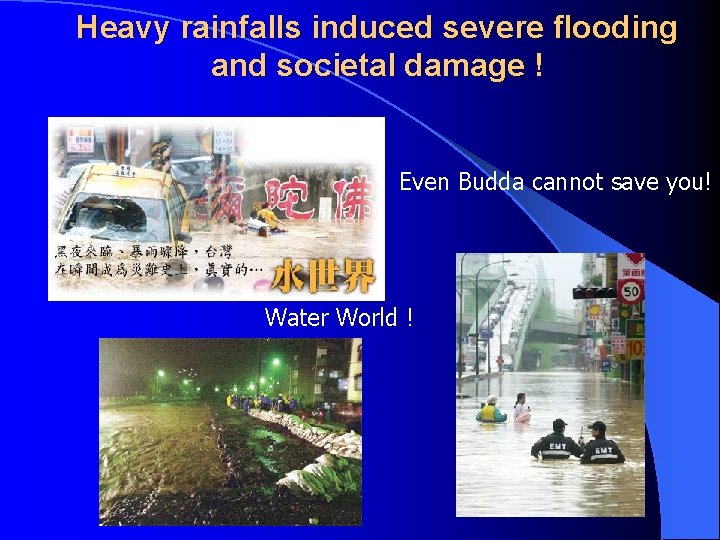
Heavy rainfalls induced severe flooding and societal damage ! Even Budda cannot save you! Water World !
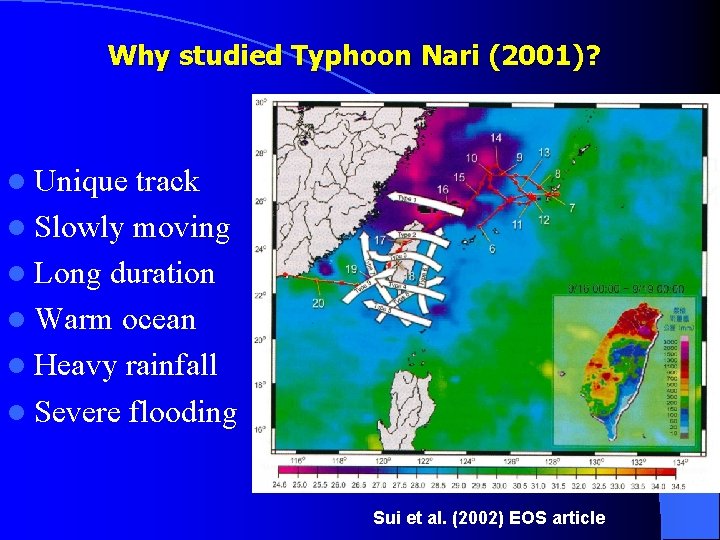
Why studied Typhoon Nari (2001)? l Unique track l Slowly moving l Long duration l Warm ocean l Heavy rainfall l Severe flooding Sui et al. (2002) EOS article
Content: Part I: Model Verification Part II: Terrain Sensitivity Part III: Coupling with Runoff Model
Part I: Model Verification
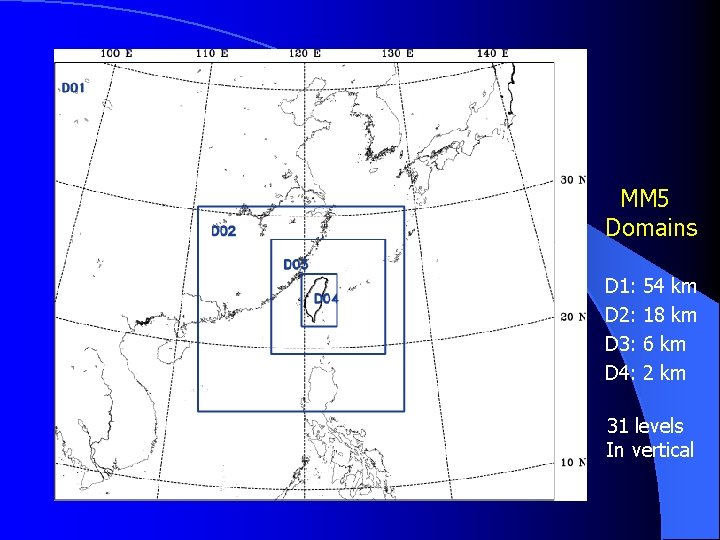
MM 5 Domains D 1: D 2: D 3: D 4: 54 km 18 km 6 km 2 km 31 levels In vertical
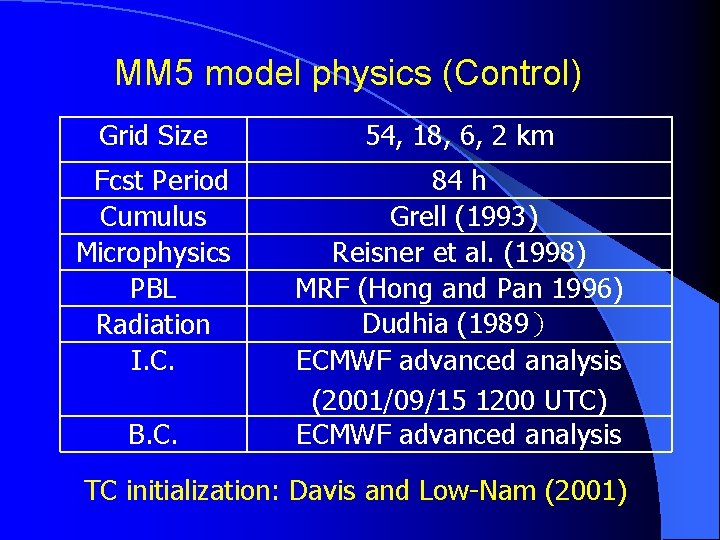
MM 5 model physics (Control) Grid Size 54, 18, 6, 2 km Fcst Period Cumulus Microphysics PBL Radiation I. C. 84 h Grell (1993) Reisner et al. (1998) MRF (Hong and Pan 1996) Dudhia (1989) ECMWF advanced analysis (2001/09/15 1200 UTC) ECMWF advanced analysis B. C. TC initialization: Davis and Low-Nam (2001)
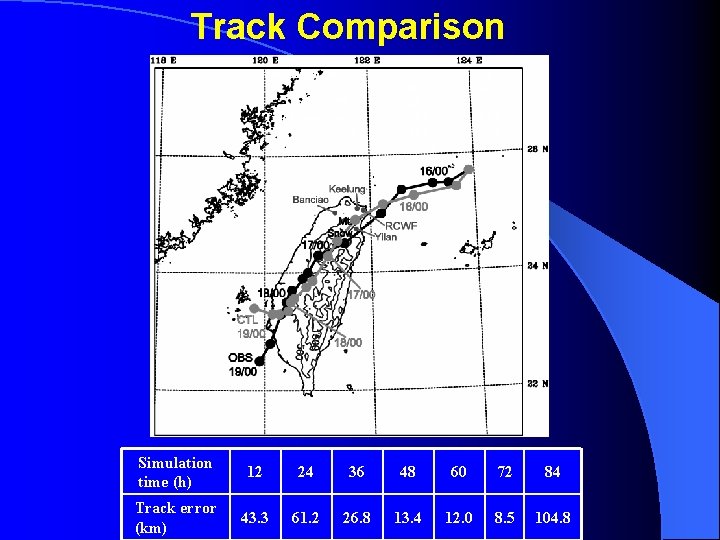
Track Comparison Simulation time (h) 36 72 Track error (km) 26. 8 8. 5 12 48 84 43. 3 13. 4 104. 8 24 60 61. 2 12. 0 Simulation time (h) 12 24 36 48 60 72 84 Track error (km) 43. 3 61. 2 26. 8 13. 4 12. 0 8. 5 104. 8
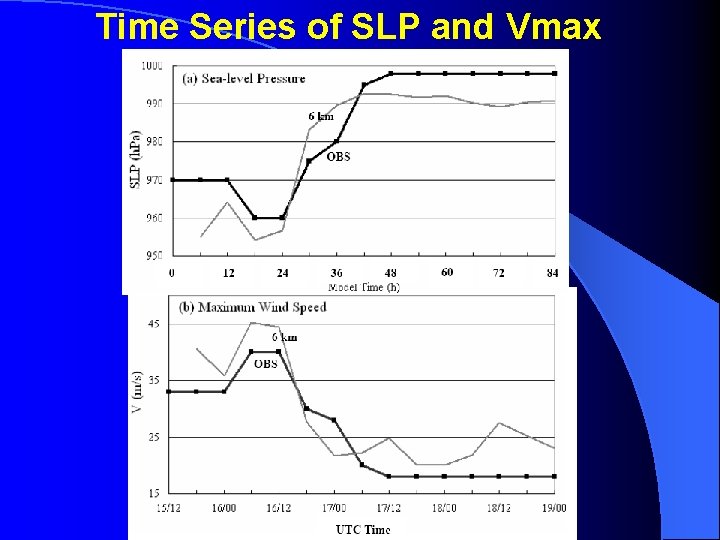
Time Series of SLP and Vmax
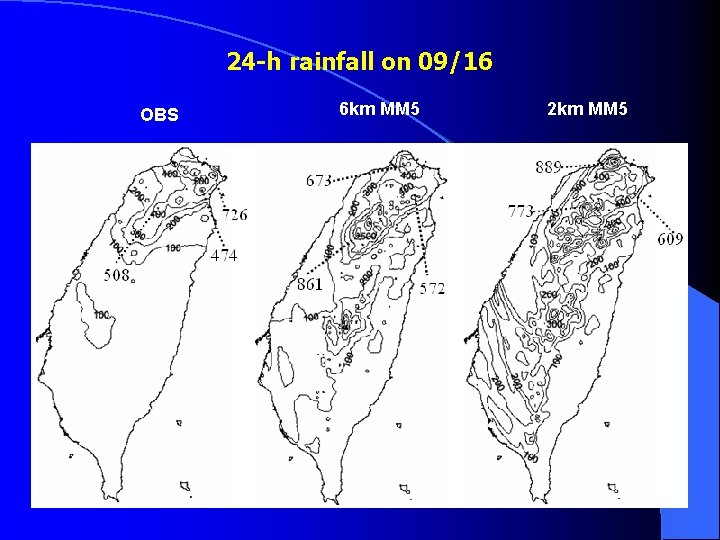
24 -h rainfall on 09/16 OBS 6 km MM 5 2 km MM 5
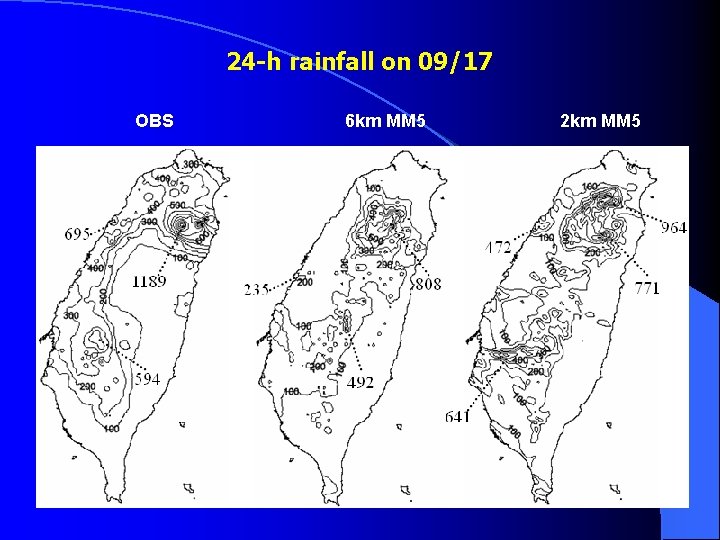
24 -h rainfall on 09/17 OBS 6 km MM 5 2 km MM 5
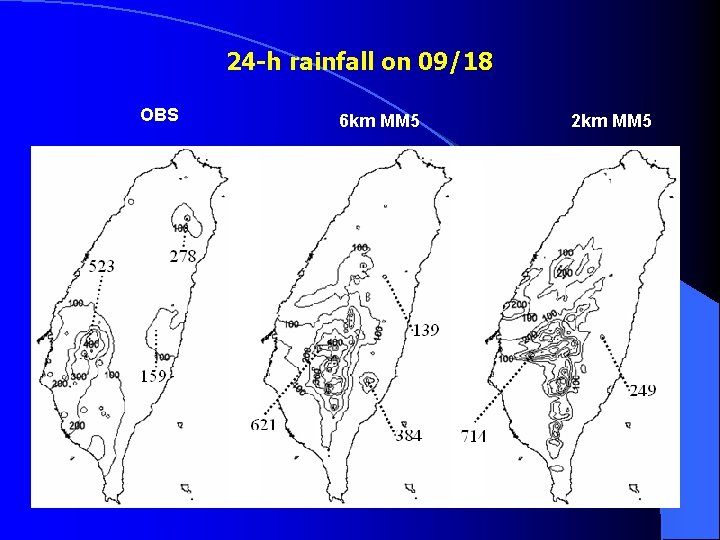
24 -h rainfall on 09/18 OBS 6 km MM 5 2 km MM 5
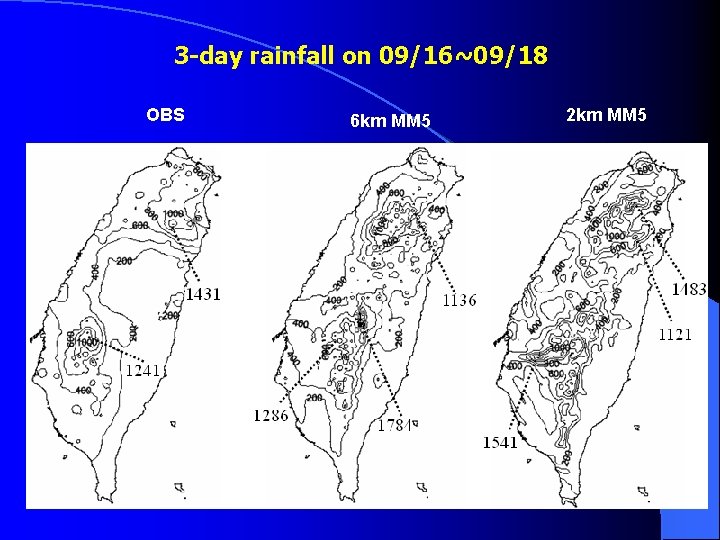
3 -day rainfall on 09/16~09/18 OBS 6 km MM 5 2 km MM 5
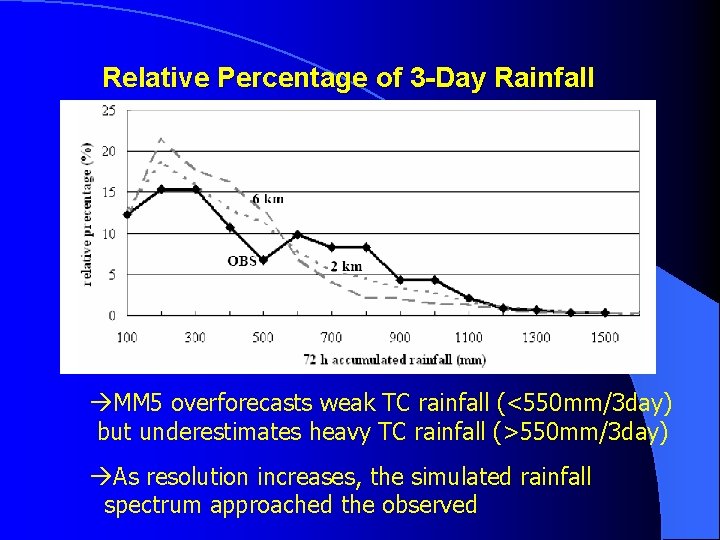
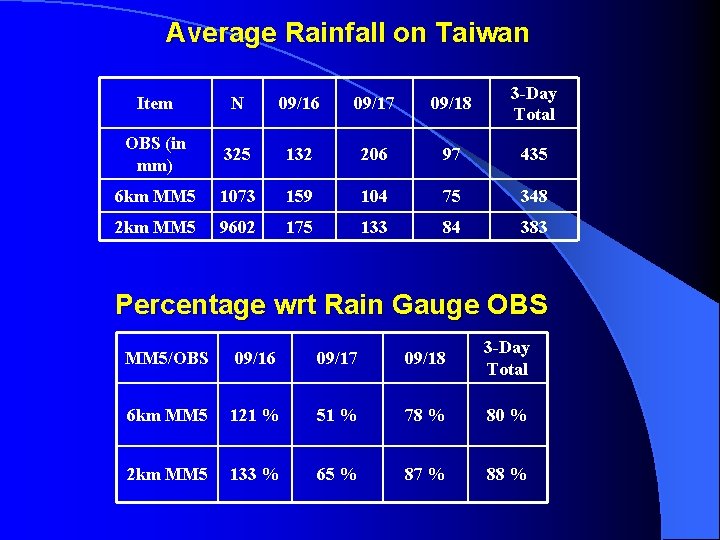
Relative Percentage of 3 -Day Rainfall àMM 5 overforecasts weak TC rainfall (<550 mm/3 day) but underestimates heavy TC rainfall (>550 mm/3 day) àAs resolution increases, the simulated rainfall spectrum approached the observed
Average Rainfall on Taiwan Item N 09/16 09/17 09/18 3 -Day Total OBS (in mm) 325 132 206 97 435 6 km MM 5 1073 159 104 75 348 2 km MM 5 9602 175 133 84 383 Percentage wrt Rain Gauge OBS MM 5/OBS 09/16 09/17 09/18 3 -Day Total 6 km MM 5 121 % 51 % 78 % 80 % 2 km MM 5 133 % 65 % 87 % 88 %
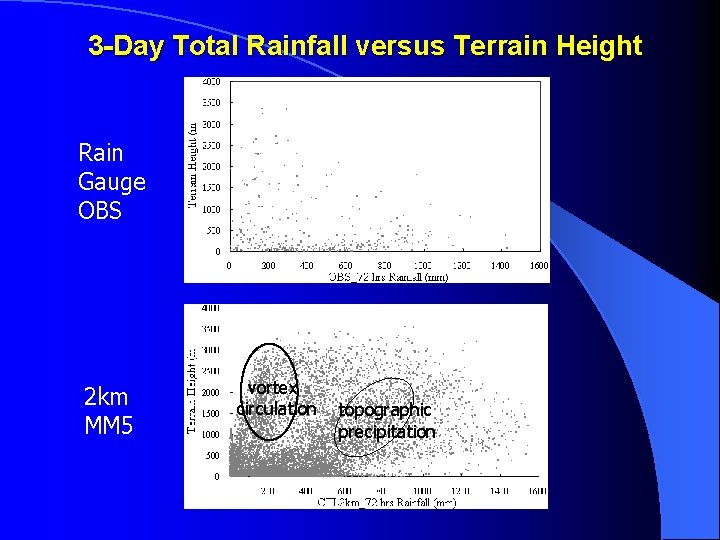
3 -Day Total Rainfall versus Terrain Height Rain Gauge OBS 2 km MM 5 vortex circulation topographic precipitation
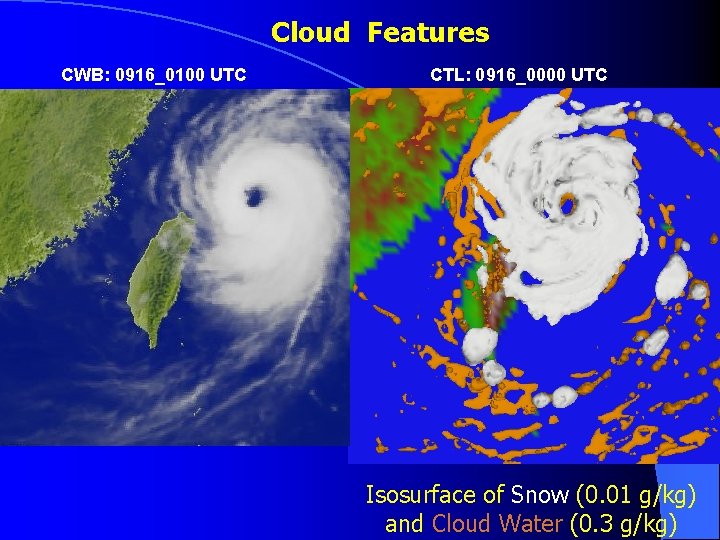
Cloud Features CWB: 0916_0100 UTC CTL: 0916_0000 UTC Isosurface of Snow (0. 01 g/kg) and Cloud Water (0. 3 g/kg)
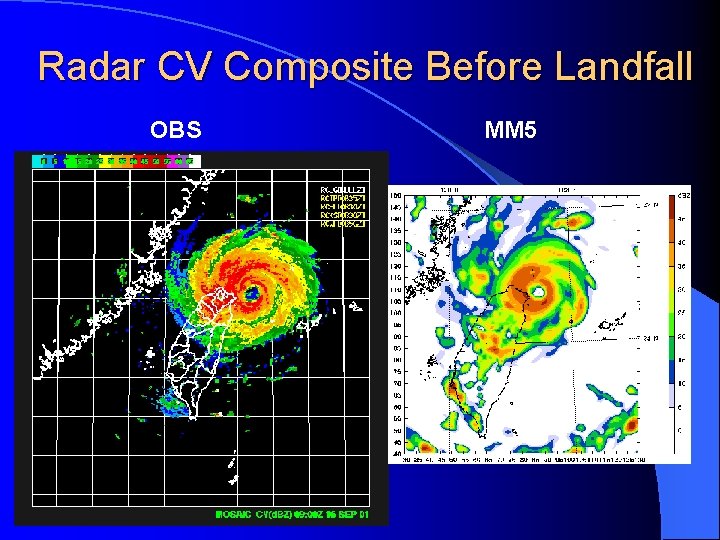
Radar CV Composite Before Landfall OBS MM 5
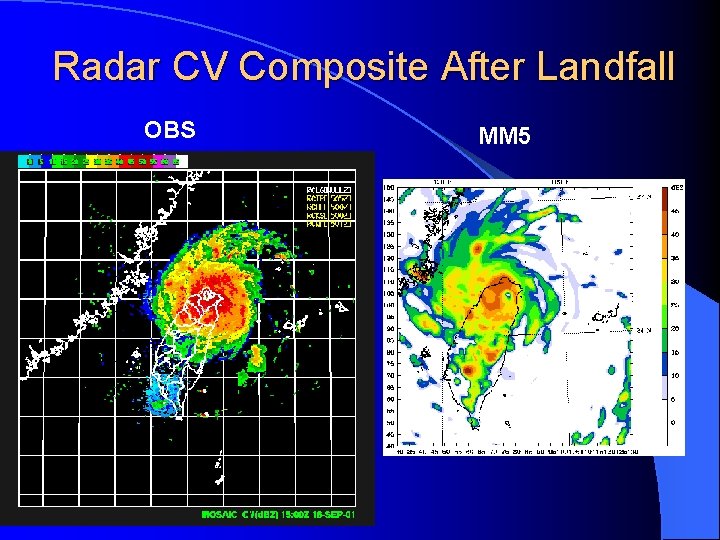
Radar CV Composite After Landfall OBS MM 5
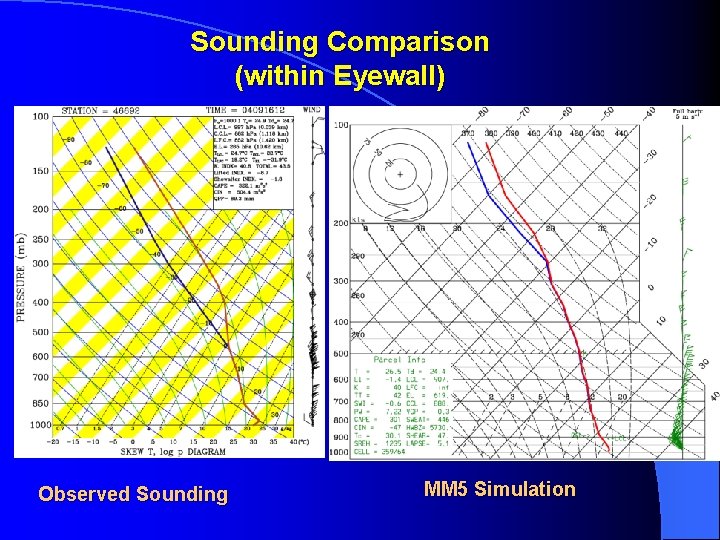
Sounding Comparison (within Eyewall) Observed Sounding MM 5 Simulation
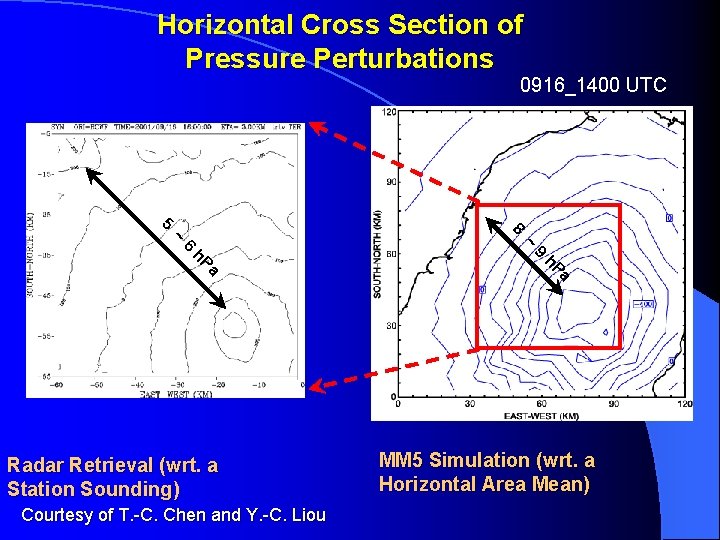
Horizontal Cross Section of Pressure Perturbations 0916_1400 UTC 8 5 a h. P Courtesy of T. -C. Chen and Y. -C. Liou 9 6 ~ ~ Radar Retrieval (wrt. a Station Sounding) MM 5 Simulation (wrt. a Horizontal Area Mean)
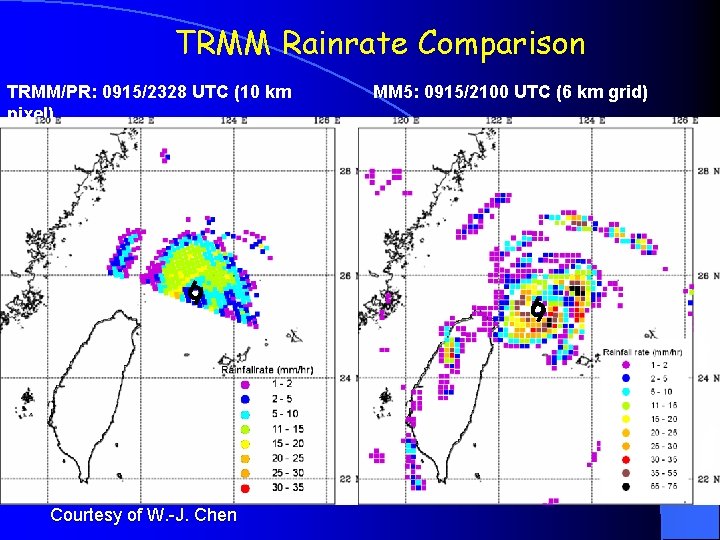
TRMM Rainrate Comparison TRMM/PR: 0915/2328 UTC (10 km pixel) Courtesy of W. -J. Chen MM 5: 0915/2100 UTC (6 km grid)
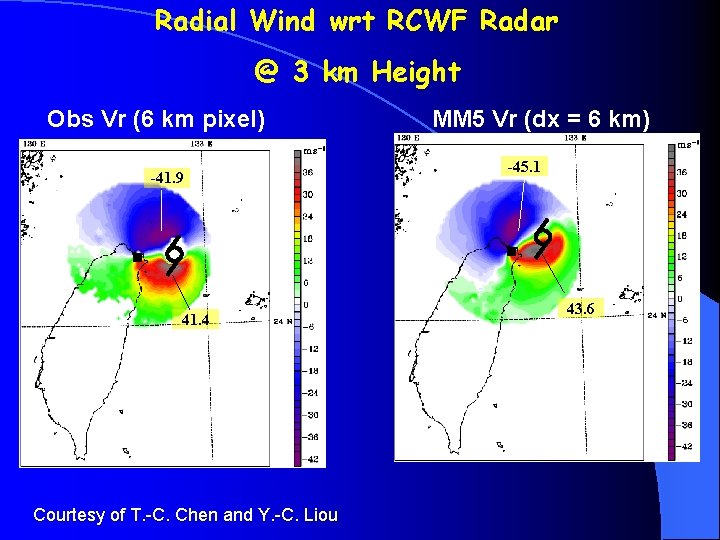
Radial Wind wrt RCWF Radar @ 3 km Height Obs Vr (6 km pixel) -41. 9 41. 4 Courtesy of T. -C. Chen and Y. -C. Liou MM 5 Vr (dx = 6 km) -45. 1 43. 6
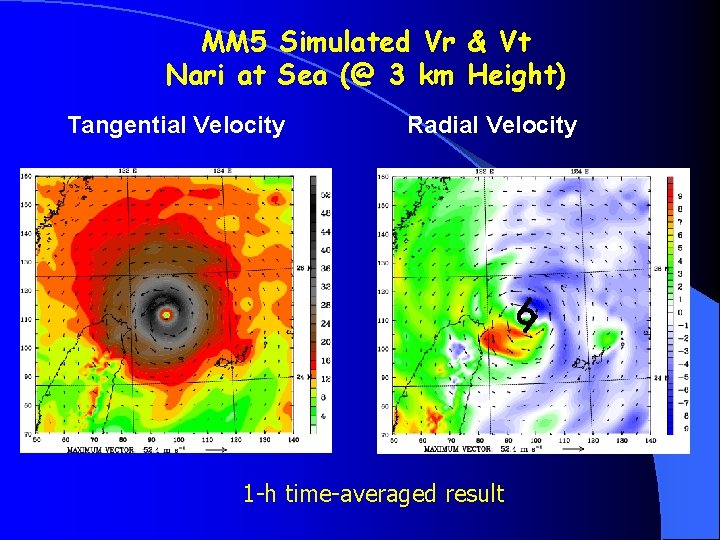
MM 5 Simulated Vr & Vt Nari at Sea (@ 3 km Height) Tangential Velocity Radial Velocity 1 -h time-averaged result
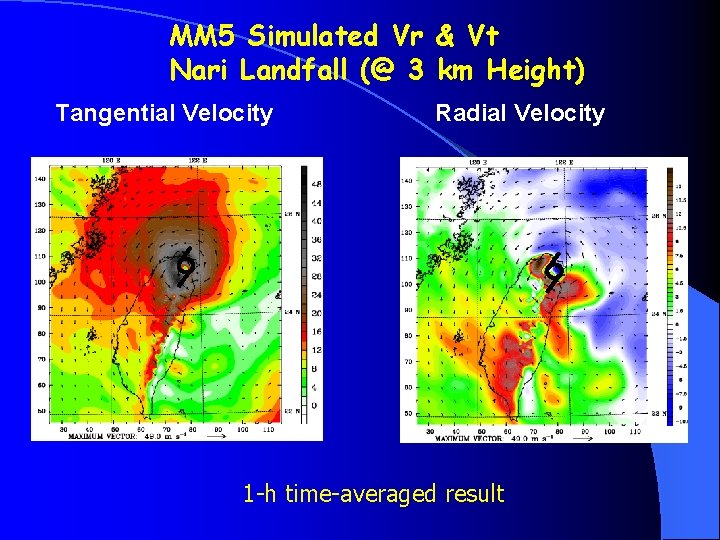
MM 5 Simulated Vr & Vt Nari Landfall (@ 3 km Height) Tangential Velocity Radial Velocity 1 -h time-averaged result
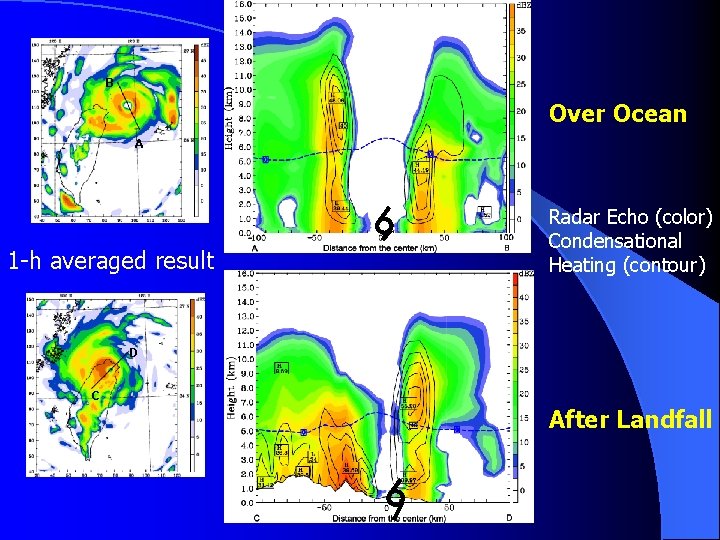
B Over Ocean A 1 -h averaged result Radar Echo (color) Condensational Heating (contour) D C After Landfall
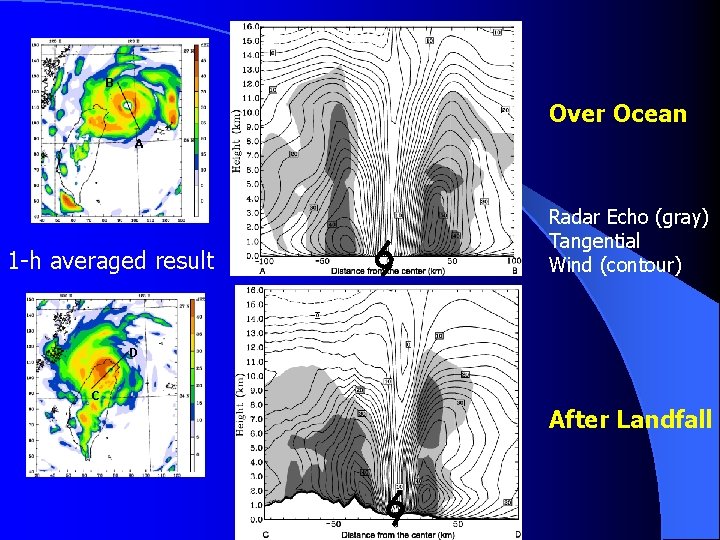
B Over Ocean A 1 -h averaged result Radar Echo (gray) Tangential Wind (contour) D C After Landfall
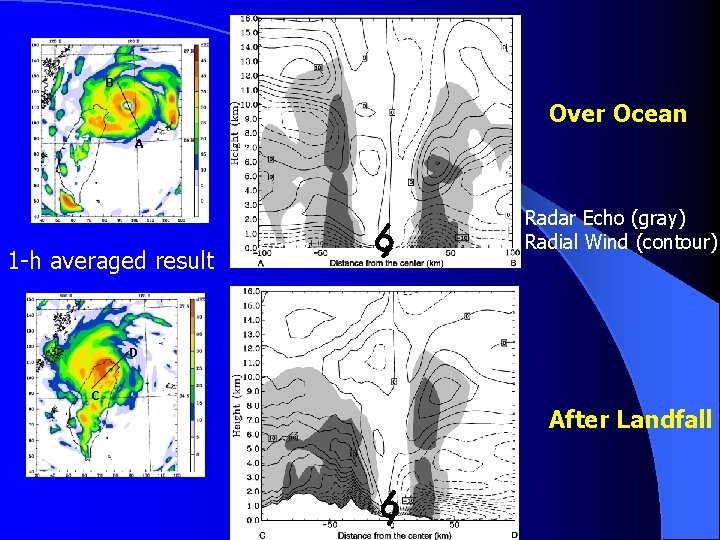
B Over Ocean A 1 -h averaged result Radar Echo (gray) Radial Wind (contour) D C After Landfall
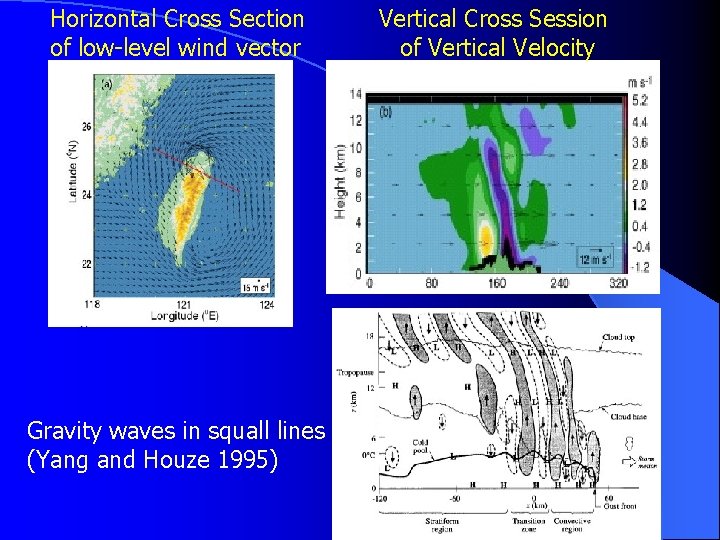
Horizontal Cross Section of low-level wind vector Gravity waves in squall lines (Yang and Houze 1995) Vertical Cross Session of Vertical Velocity
Summary ■ After detailed comparisons, the MM 5 simulated these features of Typhoon Nari reasonably well: the storm track, the landfalling location, the intensity change and shrinking of eyewall during landfall process, pressure gradient near the inner core, and many observed precipitation and kinematic structures ■ Taiwan’s topography enhanced asymmetry on the kinematic structure with higher wave-number variations on the radail wind during the landfall process. ■ After landfall, the vertical axis of eyewall and tangential wind tilted toward the terrain, with maximum heating located along the mountain slope. ■ Two significant rainfall regimes are found: one with storm’s vortex circulation, and the other with topographic precipitation.
Part II: Terrain Experiments
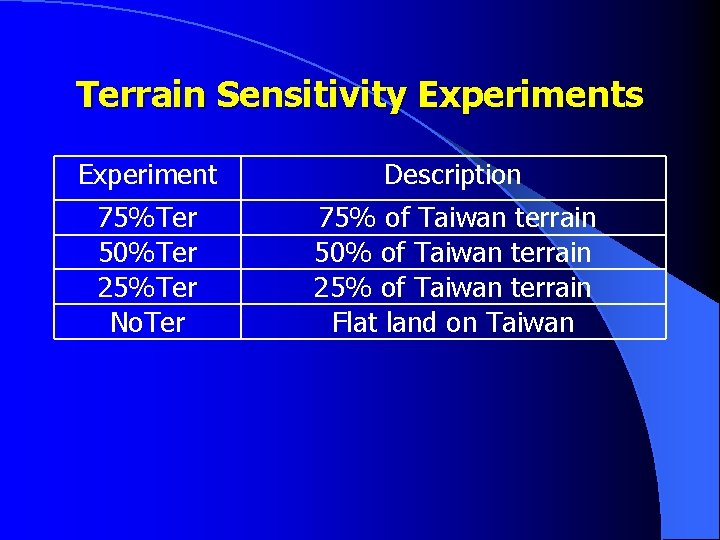
Terrain Sensitivity Experiments Experiment Description 75%Ter 50%Ter 25%Ter No. Ter 75% of Taiwan terrain 50% of Taiwan terrain 25% of Taiwan terrain Flat land on Taiwan
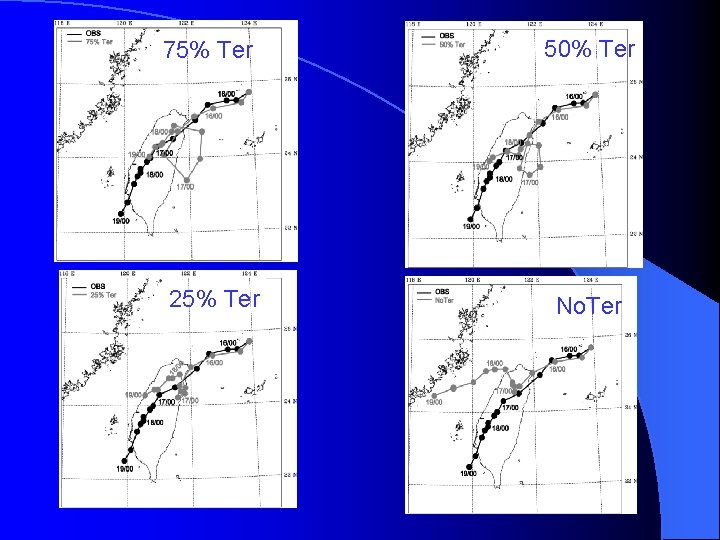
75% Terrain 75% Ter 25% Terrain 50% Ter No Terrain
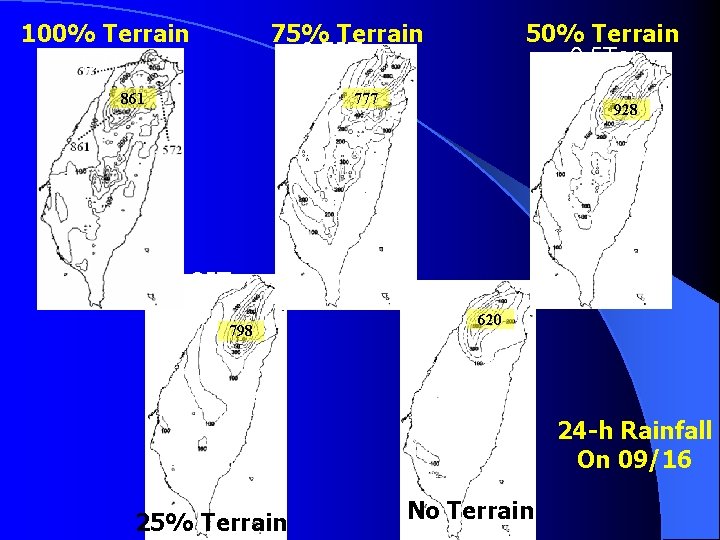
100% Terrain CTL 75% Terrain 0. 75 Ter 777 861 50% Terrain 0. 5 Ter 777 928 0. 25 Ter 798 NT 620 798 24 -h Rainfall On 09/16 25% Terrain No Terrain
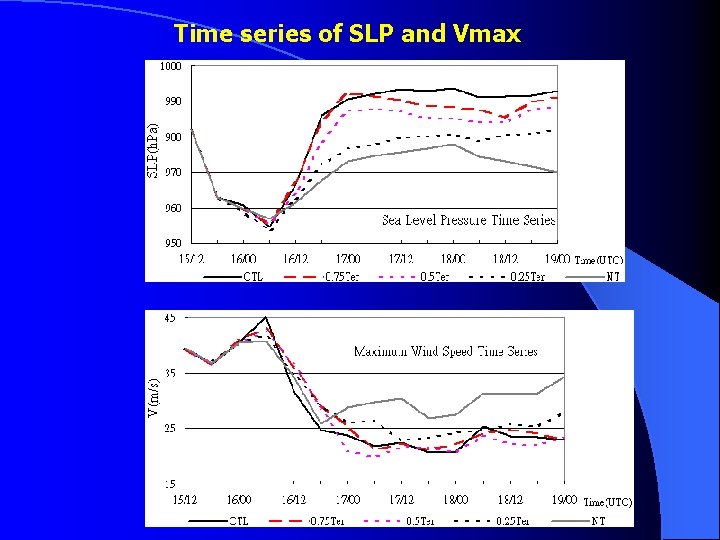
Time series of SLP and Vmax
Summary ■ The terrain impact on Nari’s intensity is quite linear, i. e. , higher terrain producing a weaker typhoon. ■ However, terrain effects on Nari’s track and the accumulated rainfall on Taiwan are nonlinear. ■ Nari’s tracks near Taiwan result from the complicated interactions between the steering flow, Taiwan topography, and terrain-induced mesoscale forcings
Part III: River Runoff Simulation (Coupling MM 5 with FLO-2 D) In Cooperation with Ming-Hsu Li Ref: Li, M. -H. , M. -J. Yang, R. Soong, and H. -L. Huang, 2005: Simulating typhoon floods with gauge data and mesoscale modeled rainfall in a mountainous watershed. J. Hydrometeor. , 6, 306– 323.
Shihmen Basin
DTM of Shihmen Watershed
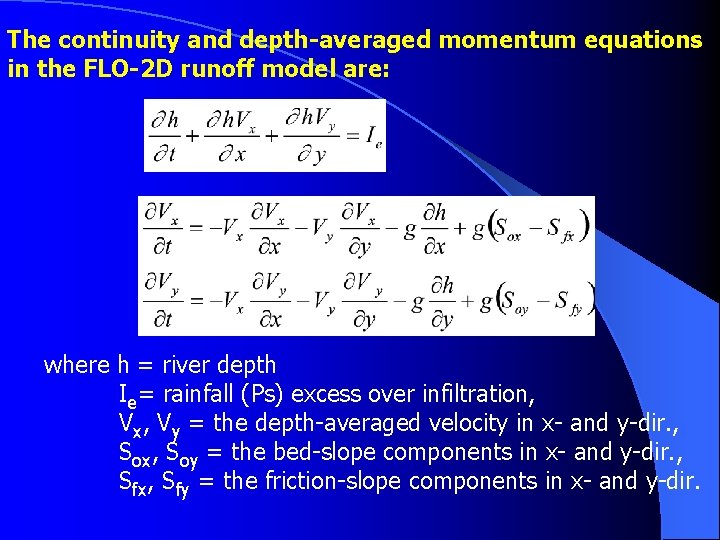
The continuity and depth-averaged momentum equations in the FLO-2 D runoff model are: where h = river depth Ie= rainfall (Ps) excess over infiltration, Vx, Vy = the depth-averaged velocity in x- and y-dir. , Sox, Soy = the bed-slope components in x- and y-dir. , Sfx, Sfy = the friction-slope components in x- and y-dir.
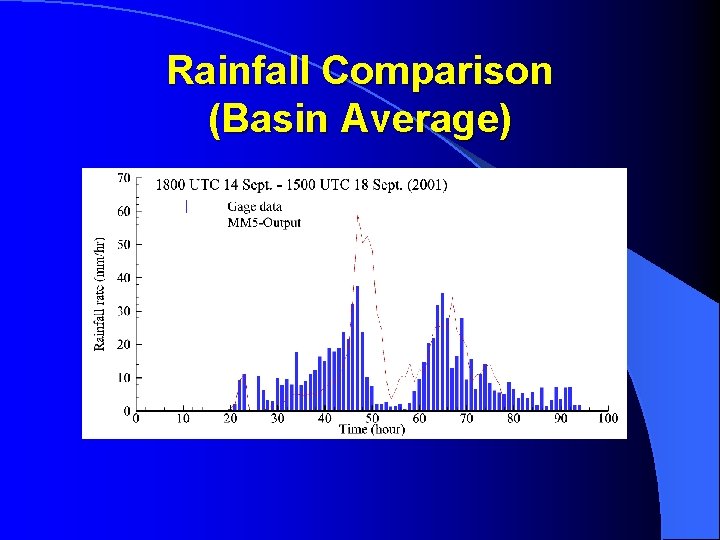
Rainfall Comparison (Basin Average)
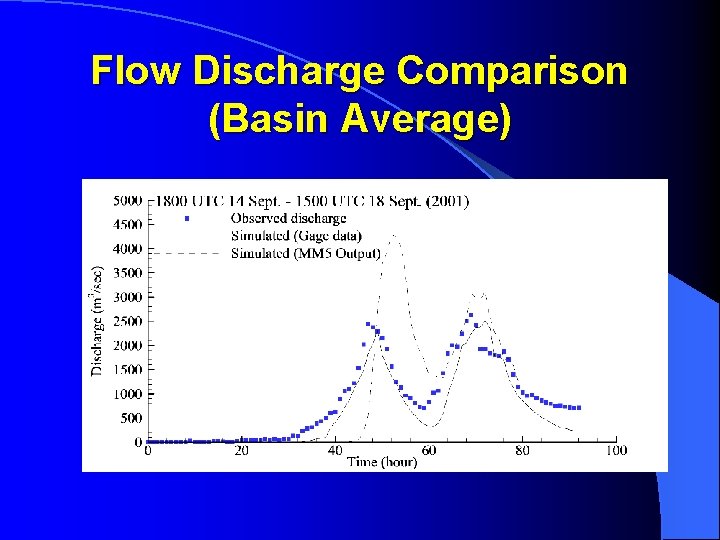
Flow Discharge Comparison (Basin Average)
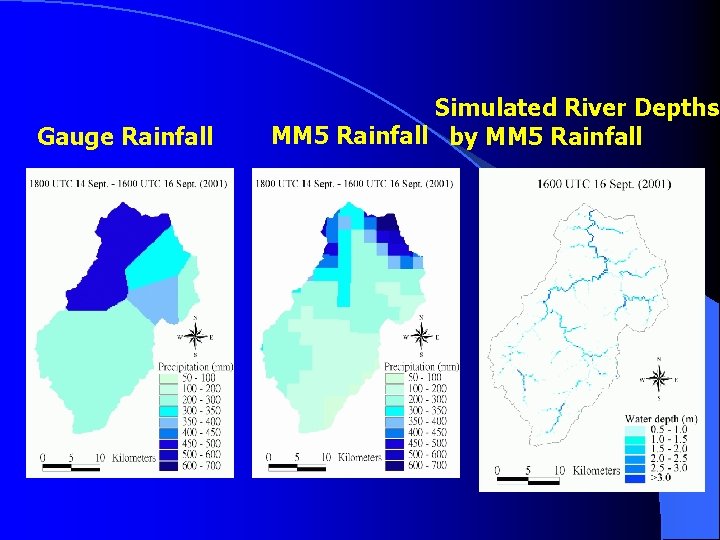
Gauge Rainfall Simulated River Depths MM 5 Rainfall by MM 5 Rainfall
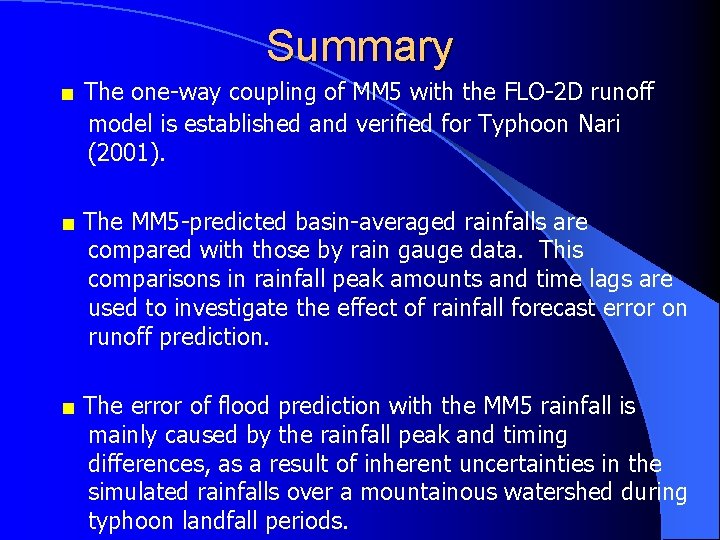
Summary ■ The one-way coupling of MM 5 with the FLO-2 D runoff model is established and verified for Typhoon Nari (2001). ■ The MM 5 -predicted basin-averaged rainfalls are compared with those by rain gauge data. This comparisons in rainfall peak amounts and time lags are used to investigate the effect of rainfall forecast error on runoff prediction. ■ The error of flood prediction with the MM 5 rainfall is mainly caused by the rainfall peak and timing differences, as a result of inherent uncertainties in the simulated rainfalls over a mountainous watershed during typhoon landfall periods.
Thank You !