
A Model of the Solar Chromosphere Structure and


![[Song and Vasyliūnas, 2011] Plasma-neutral Interaction • • • Plasma (red dots) is driven](https://slidetodoc.com/presentation_image_h2/34ee7b78d488e5a10fcc20fbfbe5923e/image-21.jpg "[Song and Vasyliūnas, 2011] Plasma-neutral Interaction • • • Plasma (red dots) is driven")
![Observation Range 1000 km [Song and Vasyliūnas, 2011] 200 km 1000 km [Reardon et](https://slidetodoc.com/presentation_image_h2/34ee7b78d488e5a10fcc20fbfbe5923e/image-23.jpg "Observation Range 1000 km [Song and Vasyliūnas, 2011] 200 km 1000 km [Reardon et")
![Perturbation in the Photosphere [Tu and Song, 2013] Random perturbations of the photosphere which](https://slidetodoc.com/presentation_image_h2/34ee7b78d488e5a10fcc20fbfbe5923e/image-24.jpg "Perturbation in the Photosphere [Tu and Song, 2013] Random perturbations of the photosphere which")
![[Tu and Song, 2013] Heating rate as function of height and time for chromospheric](https://slidetodoc.com/presentation_image_h2/34ee7b78d488e5a10fcc20fbfbe5923e/image-25.jpg "[Tu and Song, 2013] Heating rate as function of height and time for chromospheric")
![Tu and Song, [2013] Collisional MHD Simulation [Song and Vasyliūnas, 2011] Analytical Stronger heating:](https://slidetodoc.com/presentation_image_h2/34ee7b78d488e5a10fcc20fbfbe5923e/image-26.jpg "Tu and Song, [2013] Collisional MHD Simulation [Song and Vasyliūnas, 2011] Analytical Stronger heating:")
![Total Heating Rate Dependence on B at the photosphere [Song and Vasyliūnas, 2014] Logarithm](https://slidetodoc.com/presentation_image_h2/34ee7b78d488e5a10fcc20fbfbe5923e/image-27.jpg "Total Heating Rate Dependence on B at the photosphere [Song and Vasyliūnas, 2014] Logarithm")

![Chromospheric Circulation [Song and Vasyliūnas, 2014] • Two (neutral) convection cells – Upper cell:](https://slidetodoc.com/presentation_image_h2/34ee7b78d488e5a10fcc20fbfbe5923e/image-29.jpg "Chromospheric Circulation [Song and Vasyliūnas, 2014] • Two (neutral) convection cells – Upper cell:")


- Slides: 44
A Model of the Solar Chromosphere: Structure and Internal Circulation Paul Song Space Science Laboratory and Department of Physics University of Massachusetts Lowell Acknowledgments: V. M. Vasyliūnas (Song, 2016, Ap. J in press) 1
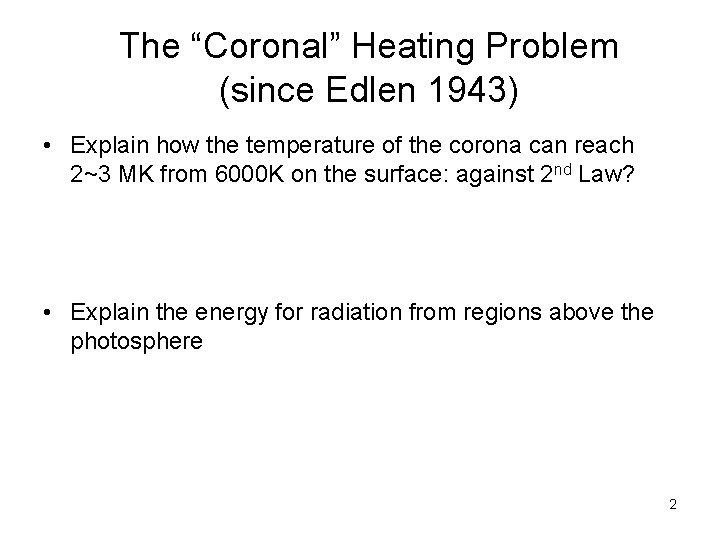
The “Coronal” Heating Problem (since Edlen 1943) • Explain how the temperature of the corona can reach 2~3 MK from 6000 K on the surface: against 2 nd Law? • Explain the energy for radiation from regions above the photosphere 2
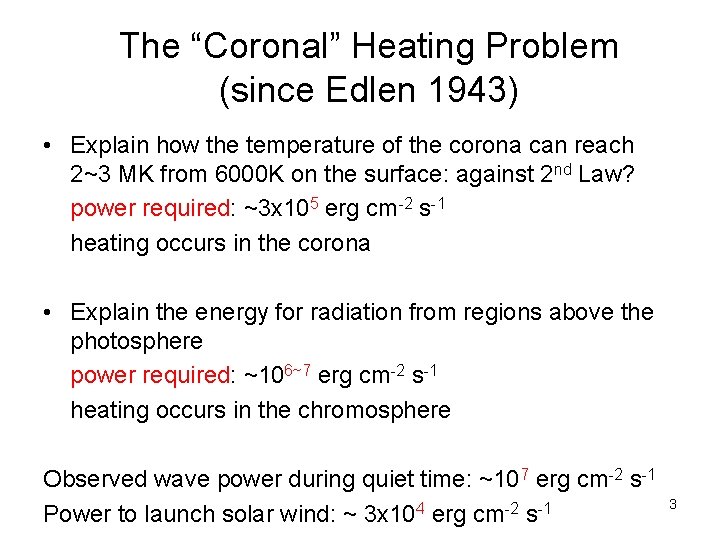
The “Coronal” Heating Problem (since Edlen 1943) • Explain how the temperature of the corona can reach 2~3 MK from 6000 K on the surface: against 2 nd Law? power required: ~3 x 10⁵ erg cm-2 s-1 heating occurs in the corona • Explain the energy for radiation from regions above the photosphere power required: ~106~7 erg cm-2 s-1 heating occurs in the chromosphere Observed wave power during quiet time: ~107 erg cm-2 s-1 Power to launch solar wind: ~ 3 x 10⁴ erg cm-2 s-1 3
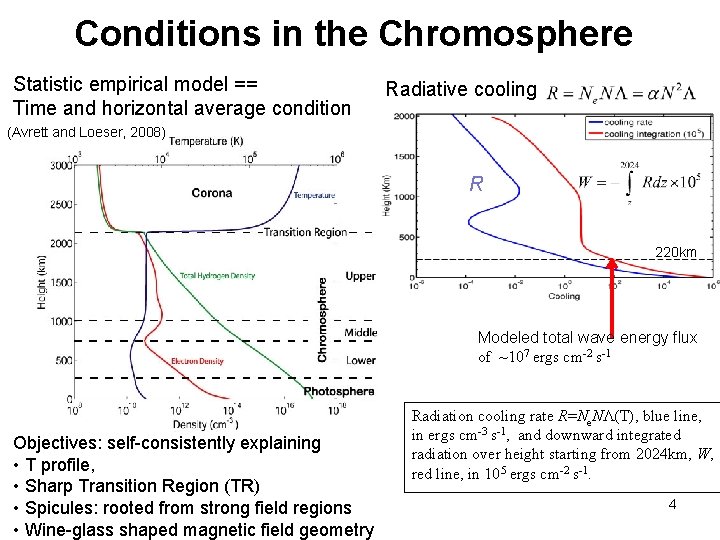
Conditions in the Chromosphere Statistic empirical model == Time and horizontal average condition Radiative cooling (Avrett and Loeser, 2008) R 220 km Modeled total wave energy flux of ~107 ergs cm-2 s-1 Objectives: self-consistently explaining • T profile, • Sharp Transition Region (TR) • Spicules: rooted from strong field regions • Wine-glass shaped magnetic field geometry Radiation cooling rate R=Ne. NΛ(T), blue line, in ergs cm-3 s-1, and downward integrated radiation over height starting from 2024 km, W, red line, in 105 ergs cm-2 s-1. 4
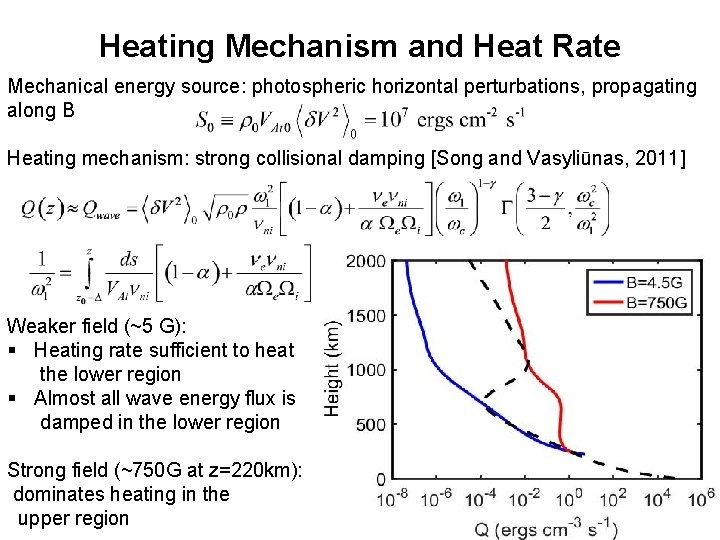
Heating Mechanism and Heat Rate Mechanical energy source: photospheric horizontal perturbations, propagating along B Heating mechanism: strong collisional damping [Song and Vasyliūnas, 2011] Weaker field (~5 G): § Heating rate sufficient to heat the lower region § Almost all wave energy flux is damped in the lower region Strong field (~750 G at z=220 km): dominates heating in the upper region 5
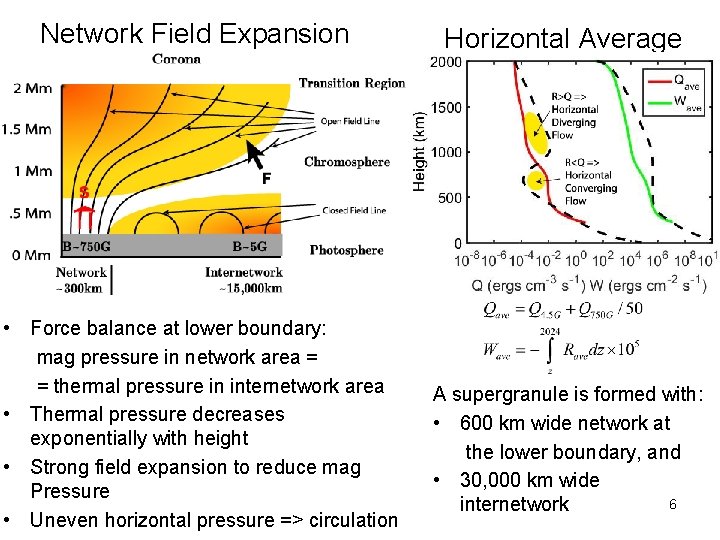
Network Field Expansion • Force balance at lower boundary: mag pressure in network area = = thermal pressure in internetwork area • Thermal pressure decreases exponentially with height • Strong field expansion to reduce mag Pressure • Uneven horizontal pressure => circulation Horizontal Average A supergranule is formed with: • 600 km wide network at the lower boundary, and • 30, 000 km wide 6 internetwork
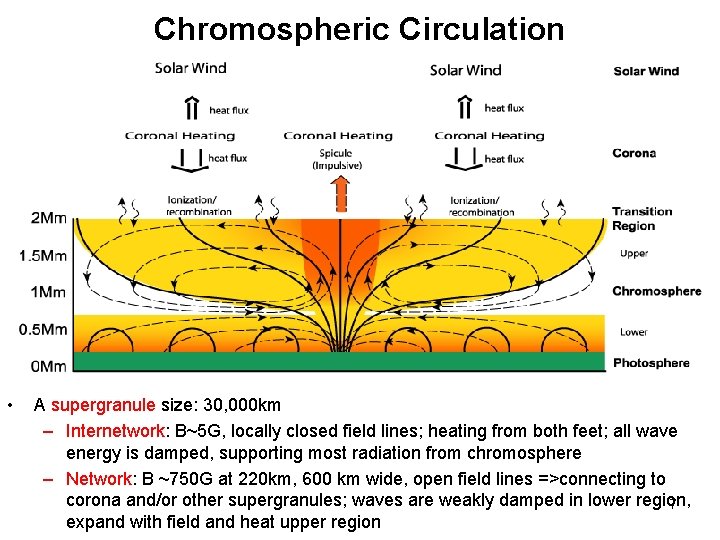
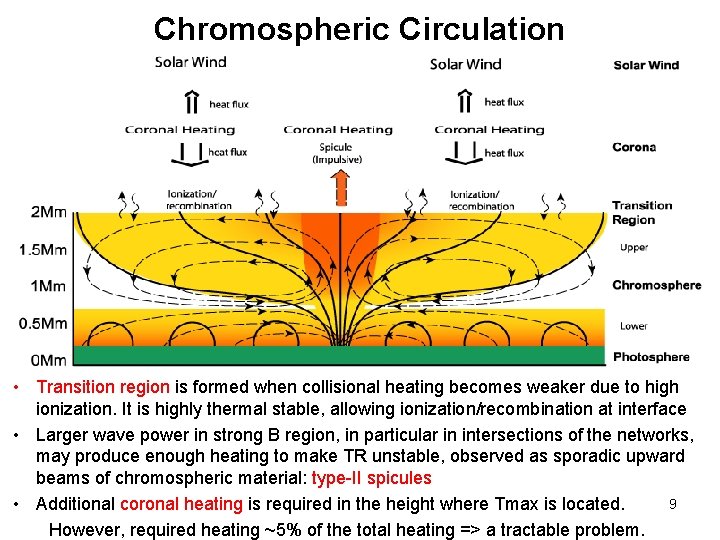
Chromospheric Circulation • A supergranule size: 30, 000 km – Internetwork: B~5 G, locally closed field lines; heating from both feet; all wave energy is damped, supporting most radiation from chromosphere – Network: B ~750 G at 220 km, 600 km wide, open field lines =>connecting to corona and/or other supergranules; waves are weakly damped in lower region, 7 expand with field and heat upper region
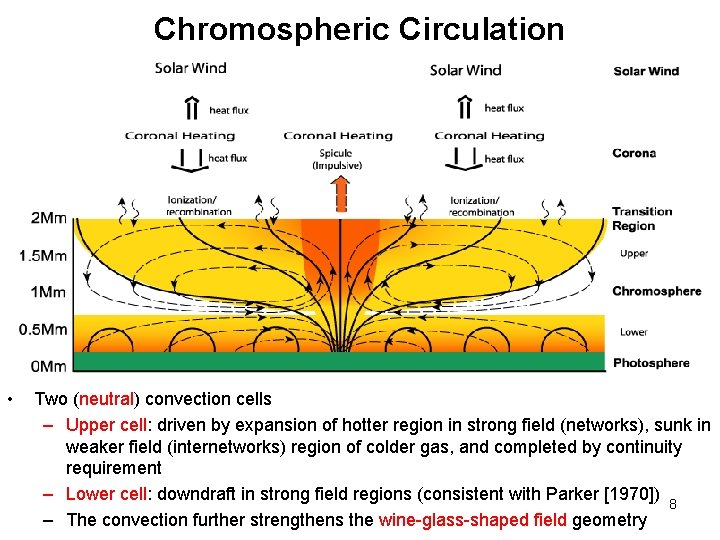
Chromospheric Circulation • Two (neutral) convection cells – Upper cell: driven by expansion of hotter region in strong field (networks), sunk in weaker field (internetworks) region of colder gas, and completed by continuity requirement – Lower cell: downdraft in strong field regions (consistent with Parker [1970]) 8 – The convection further strengthens the wine-glass-shaped field geometry
Chromospheric Circulation • Transition region is formed when collisional heating becomes weaker due to high ionization. It is highly thermal stable, allowing ionization/recombination at interface • Larger wave power in strong B region, in particular in intersections of the networks, may produce enough heating to make TR unstable, observed as sporadic upward beams of chromospheric material: type-II spicules 9 • Additional coronal heating is required in the height where Tmax is located. However, required heating ~5% of the total heating => a tractable problem.
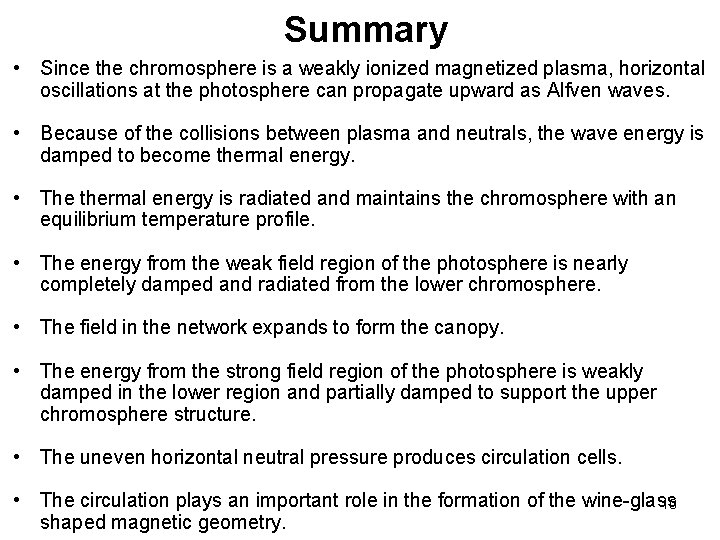
Summary • Since the chromosphere is a weakly ionized magnetized plasma, horizontal oscillations at the photosphere can propagate upward as Alfven waves. • Because of the collisions between plasma and neutrals, the wave energy is damped to become thermal energy. • The thermal energy is radiated and maintains the chromosphere with an equilibrium temperature profile. • The energy from the weak field region of the photosphere is nearly completely damped and radiated from the lower chromosphere. • The field in the network expands to form the canopy. • The energy from the strong field region of the photosphere is weakly damped in the lower region and partially damped to support the upper chromosphere structure. • The uneven horizontal neutral pressure produces circulation cells. • The circulation plays an important role in the formation of the wine-glass 10 shaped magnetic geometry.
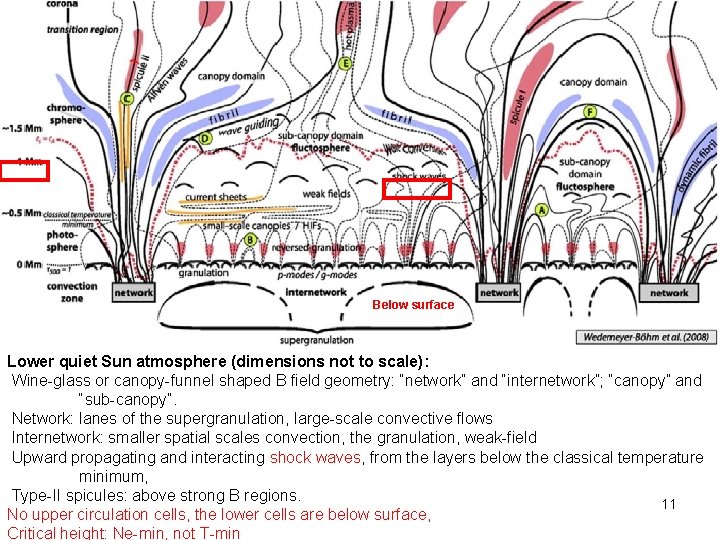
Below surface Lower quiet Sun atmosphere (dimensions not to scale): Wine-glass or canopy-funnel shaped B field geometry: “network” and “internetwork”; “canopy” and “sub-canopy”. Network: lanes of the supergranulation, large-scale convective flows Internetwork: smaller spatial scales convection, the granulation, weak-field Upward propagating and interacting shock waves, from the layers below the classical temperature minimum, Type-II spicules: above strong B regions. 11 No upper circulation cells, the lower cells are below surface, Critical height: Ne-min, not T-min
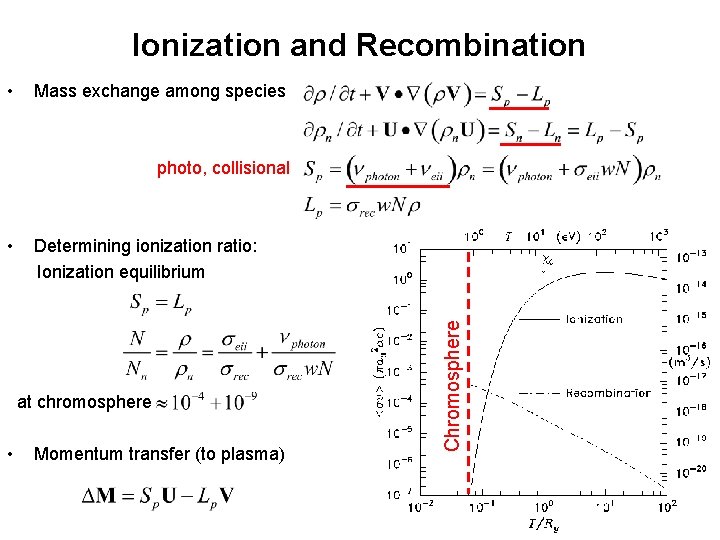
Ionization and Recombination • Mass exchange among species photo, collisional Determining ionization ratio: Ionization equilibrium at chromosphere • Momentum transfer (to plasma) Chromosphere • 12
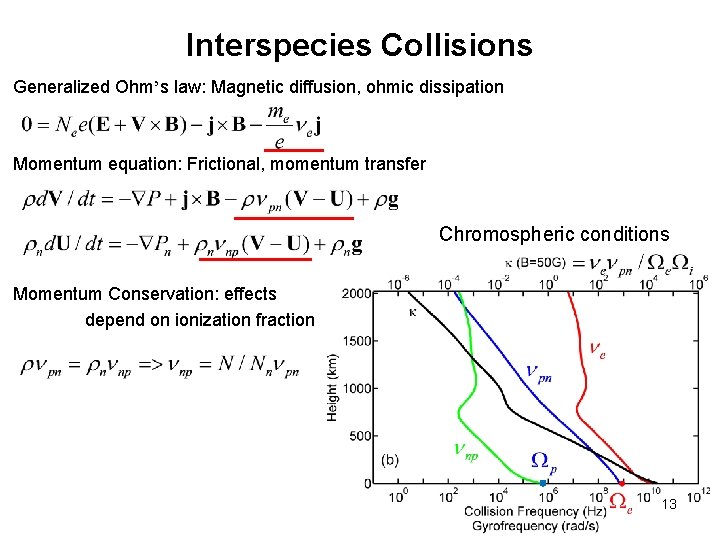
Interspecies Collisions Generalized Ohm’s law: Magnetic diffusion, ohmic dissipation Momentum equation: Frictional, momentum transfer Chromospheric conditions Momentum Conservation: effects depend on ionization fraction 13
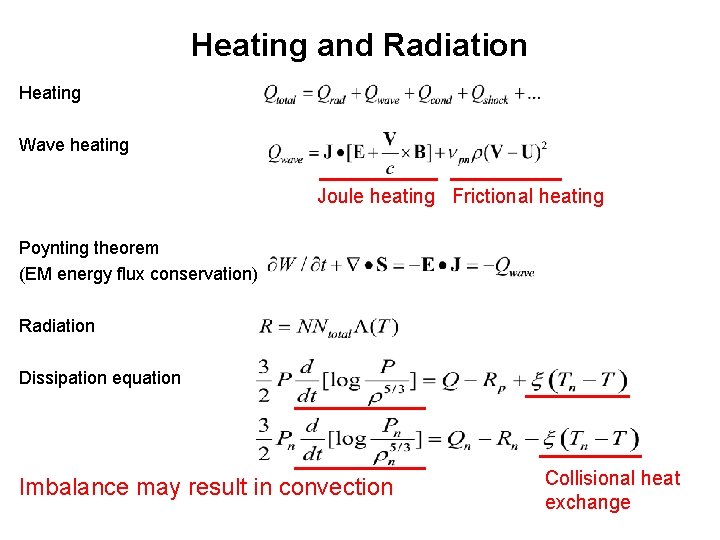
Heating and Radiation Heating Wave heating Joule heating Frictional heating Poynting theorem (EM energy flux conservation) Radiation Dissipation equation Imbalance may result in convection Collisional heat exchange
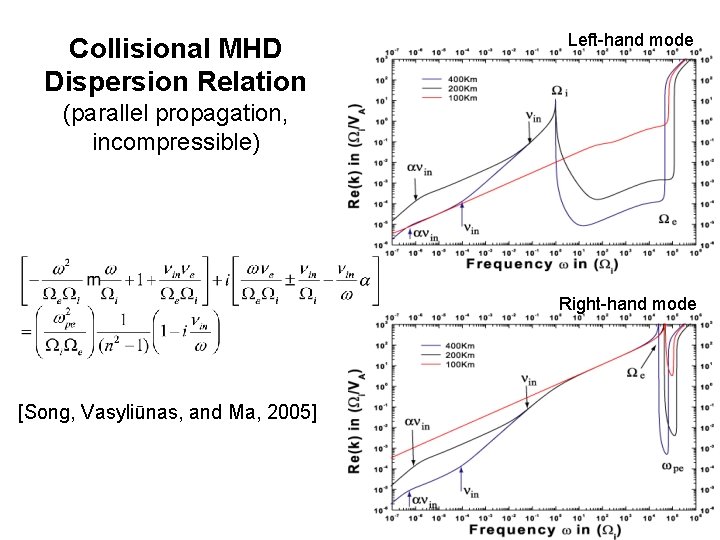
Collisional MHD Dispersion Relation Left-hand mode (parallel propagation, incompressible) Right-hand mode [Song, Vasyliūnas, and Ma, 2005]
Neutral collision and neutral motion effect collisionless Left-hand mode Infinite neutral Propagation velocity: Decreases from VA to Neutral inertia-loading process collisionless Infinite neutral [Song, Vasyliūnas, and Ma, 2005] Right-hand mode
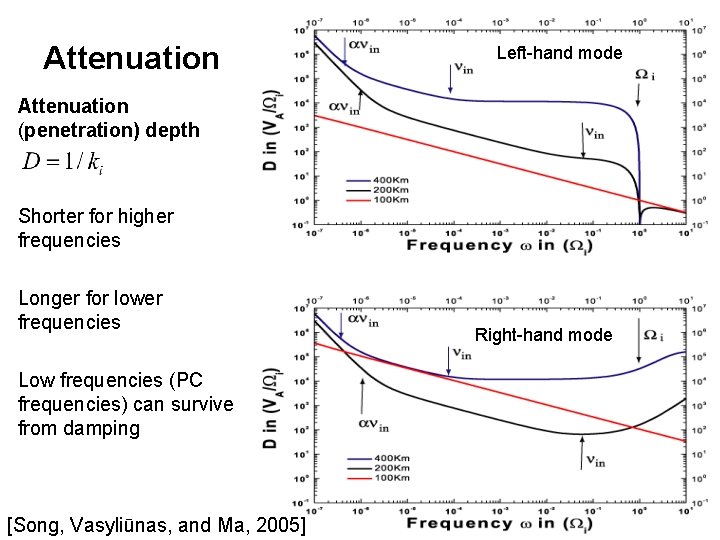
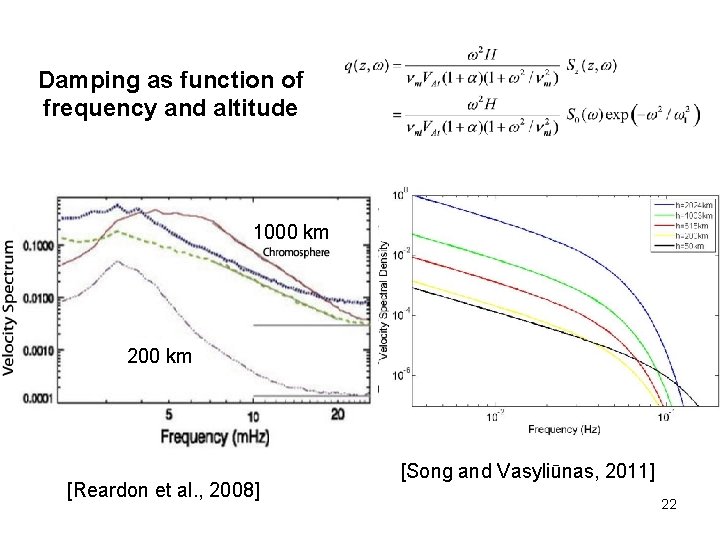
Attenuation Left-hand mode Attenuation (penetration) depth Shorter for higher frequencies Longer for lower frequencies Low frequencies (PC frequencies) can survive from damping [Song, Vasyliūnas, and Ma, 2005] Right-hand mode
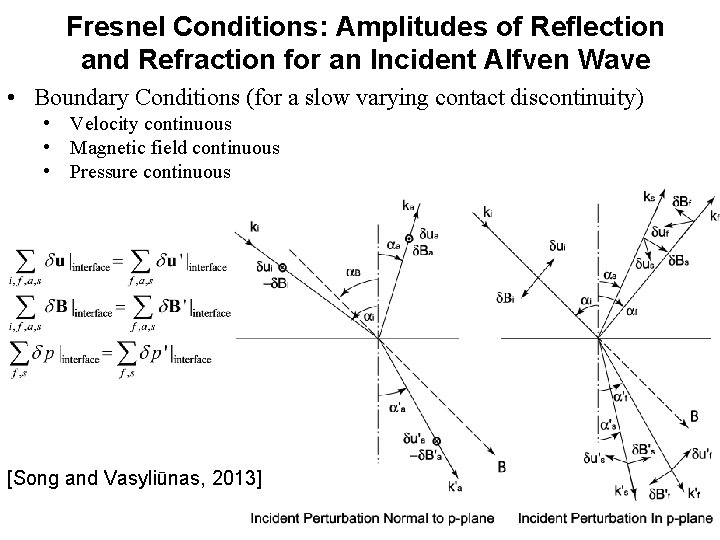
Snell’s Law and Generalized Law of Reflection for an Ideal Alfven Wave Incident onto Transition Region For parallel Alfven incidence Reflection angle is not equal to incident angle [Song and Vasyliūnas, 2013]
Fresnel Conditions: Amplitudes of Reflection and Refraction for an Incident Alfven Wave • Boundary Conditions (for a slow varying contact discontinuity) • Velocity continuous • Magnetic field continuous • Pressure continuous [Song and Vasyliūnas, 2013]
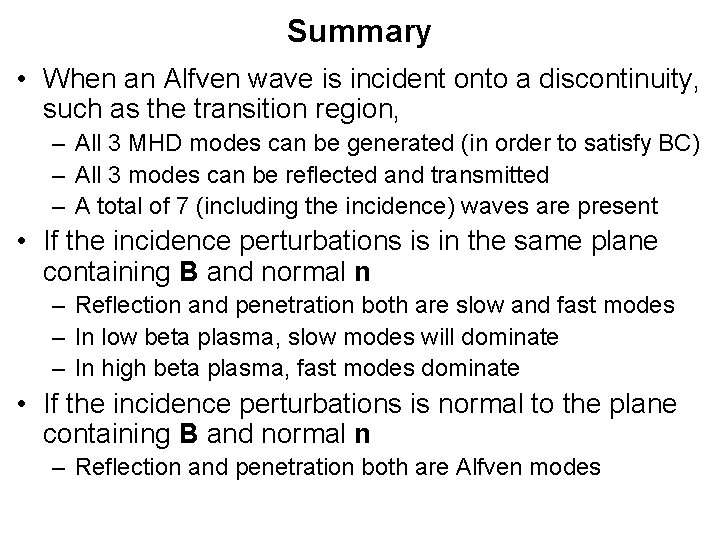
Summary • When an Alfven wave is incident onto a discontinuity, such as the transition region, – All 3 MHD modes can be generated (in order to satisfy BC) – All 3 modes can be reflected and transmitted – A total of 7 (including the incidence) waves are present • If the incidence perturbations is in the same plane containing B and normal n – Reflection and penetration both are slow and fast modes – In low beta plasma, slow modes will dominate – In high beta plasma, fast modes dominate • If the incidence perturbations is normal to the plane containing B and normal n – Reflection and penetration both are Alfven modes
[Song and Vasyliūnas, 2011] Plasma-neutral Interaction • • • Plasma (red dots) is driven with the magnetic field (solid line) perturbation from below Neutrals do not directly feel the perturbation while plasma moves Plasma-neutral collisions accelerate neutrals (open circles) Longer than the neutral-ion collision time, the plasma and neutrals move nearly together with a small slippage. Weak friction/heating On very long time scales, the plasma and neutrals move together: no collision/no heating Similar interaction/coupling occurs between ions and electrons in frequencies below 21 the ion collision frequency, resulting in Ohmic heating
Damping as function of frequency and altitude 1000 km 200 km [Reardon et al. , 2008] [Song and Vasyliūnas, 2011] 22
Observation Range 1000 km [Song and Vasyliūnas, 2011] 200 km 1000 km [Reardon et al. , 2008] 200 km 23
Perturbation in the Photosphere [Tu and Song, 2013] Random perturbations of the photosphere which assumes a power law spectrum of slop 5/3 and total energy flux of 10 -7 erg cm-2 s-1. for B=50 G 24
[Tu and Song, 2013] Heating rate as function of height and time for chromospheric density and temperature assumed according to the empirical model [Avrett and Loeser, 2008], B 0 = 50 G. 25
Tu and Song, [2013] Collisional MHD Simulation [Song and Vasyliūnas, 2011] Analytical Stronger heating: • weaker B in lower region • stronger B in upper region 26
Total Heating Rate Dependence on B at the photosphere [Song and Vasyliūnas, 2014] Logarithm of heating per cm, Q, as function of field strength over all frequencies in erg cm-3 s-1 assuming 27 n=5/3, ω0/2π=1/300 sec and F 0 = 107 erg cm-2 s-1.
Heating Rate Per Particle • Heating and radiative loss balance R≈Q • Radiative loss is R ~ N (T) • Temperature is T ~ (Q/N) pn/ i e/ e Expected T profile • Tmin near 600 km • T is higher in upper region with strong B • T is higher in lower altitudes with weaker B B (Gauss) Logarithm of heating rate per particle Q/Ntot in erg s-1 [Song and Vasyliunas, 2014] 28
Chromospheric Circulation [Song and Vasyliūnas, 2014] • Two (neutral) convection cells – Upper cell: driven by expansion of hotter region in strong field (networks), sunk in weaker field (internetworks) region of colder gas, and completed by continuity requirement – Lower cell: downdraft in strong field regions (consistent with Parker [1970] • B-field: wine-glass shaped – expanding in the upper region to become more uniform by convection in addition to total pressure balance – B-field: more concentrated in the lower cell as pushed by the flow 29
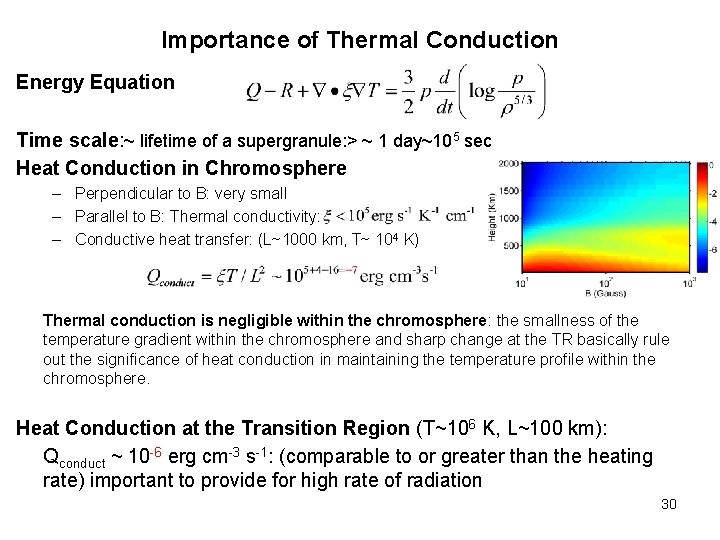
Importance of Thermal Conduction Energy Equation Time scale: ~ lifetime of a supergranule: > ~ 1 day~105 sec Heat Conduction in Chromosphere – Perpendicular to B: very small – Parallel to B: Thermal conductivity: – Conductive heat transfer: (L~1000 km, T~ 104 K) Thermal conduction is negligible within the chromosphere: the smallness of the temperature gradient within the chromosphere and sharp change at the TR basically rule out the significance of heat conduction in maintaining the temperature profile within the chromosphere. Heat Conduction at the Transition Region (T~106 K, L~100 km): Qconduct ~ 10 -6 erg cm-3 s-1: (comparable to or greater than the heating rate) important to provide for high rate of radiation 30
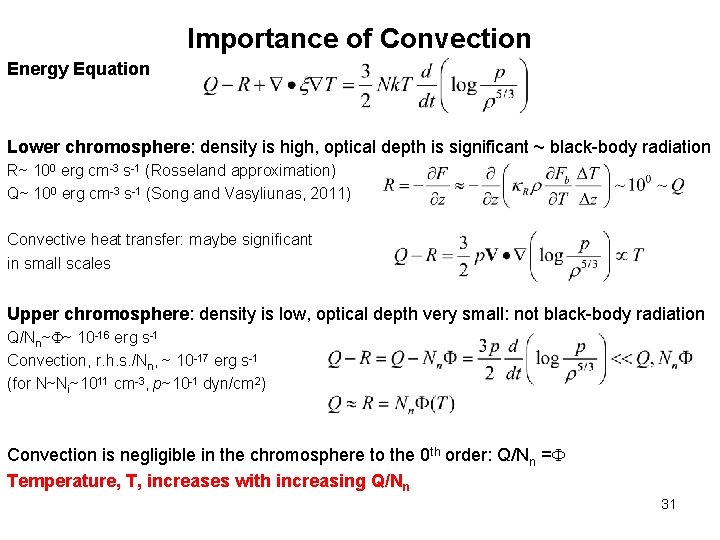
Importance of Convection Energy Equation Lower chromosphere: density is high, optical depth is significant ~ black-body radiation R~ 100 erg cm-3 s-1 (Rosseland approximation) Q~ 100 erg cm-3 s-1 (Song and Vasyliunas, 2011) Convective heat transfer: maybe significant in small scales Upper chromosphere: density is low, optical depth very small: not black-body radiation Q/Nn~ ~ 10 -16 erg s-1 Convection, r. h. s. /Nn, ~ 10 -17 erg s-1 (for N~Ni~1011 cm-3, p~10 -1 dyn/cm 2) Convection is negligible in the chromosphere to the 0 th order: Q/Nn = Temperature, T, increases with increasing Q/Nn 31
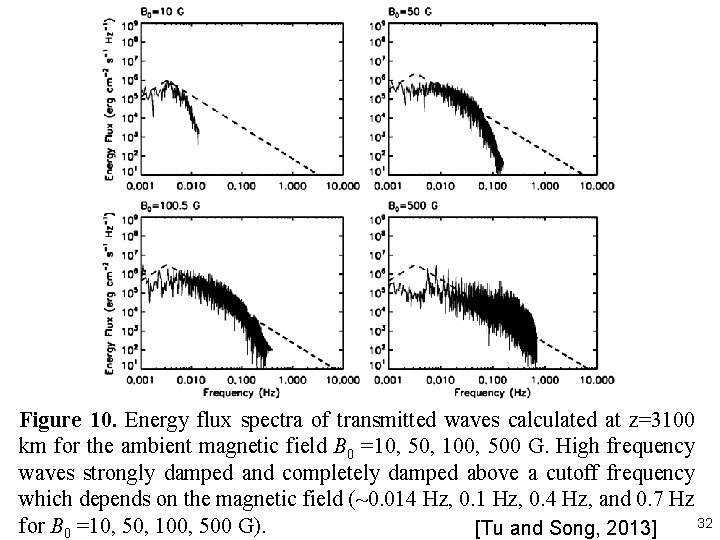
Figure 10. Energy flux spectra of transmitted waves calculated at z=3100 km for the ambient magnetic field B 0 =10, 50, 100, 500 G. High frequency waves strongly damped and completely damped above a cutoff frequency which depends on the magnetic field (~0. 014 Hz, 0. 1 Hz, 0. 4 Hz, and 0. 7 Hz 32 for B 0 =10, 50, 100, 500 G). [Tu and Song, 2013]
Chromospheric Circulation • Two (neutral) convection cells – Upper cell: driven by expansion of hotter region in strong field (networks), sunk in weaker field (internetworks) region of colder gas, and completed by continuity requirement – Lower cell: downdraft in strong field regions (consistent with Parker [1970]) • B-field: wine-glass shaped – expanding in the upper region to become more uniform by convection in addition to total pressure balance – B-field: more concentrated in the lower cell as pushed by the flow 33
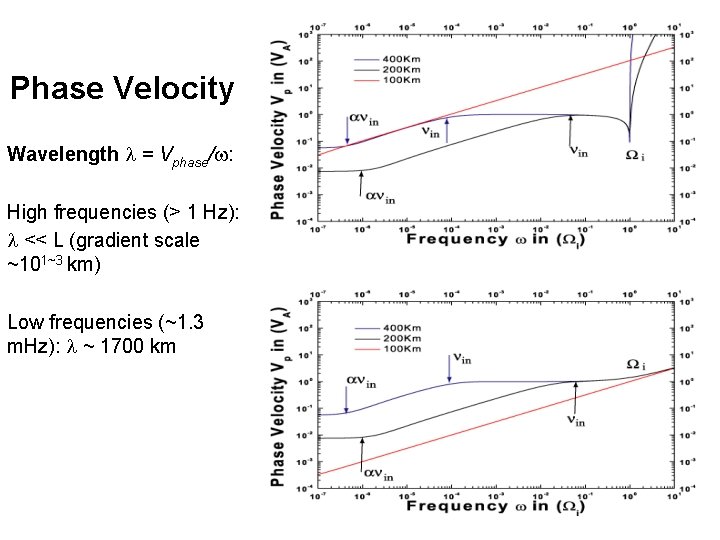
Phase Velocity Wavelength = Vphase/ : High frequencies (> 1 Hz): << L (gradient scale ~101~3 km) Low frequencies (~1. 3 m. Hz): ~ 1700 km
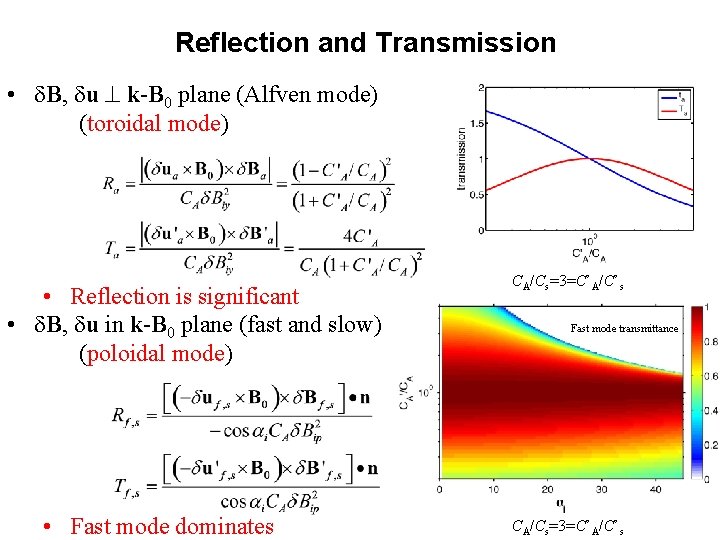
Reflection and Transmission • B, u k-B 0 plane (Alfven mode) (toroidal mode) • Reflection is significant • B, u in k-B 0 plane (fast and slow) (poloidal mode) • Fast mode dominates CA/Cs=3=C’A/C’s Fast mode transmittance CA/Cs=3=C’A/C’s
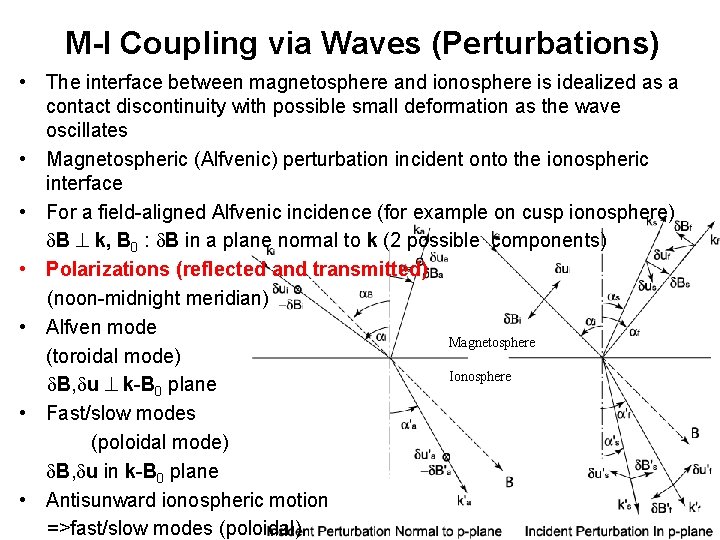
M-I Coupling via Waves (Perturbations) • The interface between magnetosphere and ionosphere is idealized as a contact discontinuity with possible small deformation as the wave oscillates • Magnetospheric (Alfvenic) perturbation incident onto the ionospheric interface • For a field-aligned Alfvenic incidence (for example on cusp ionosphere) B k, B 0 : B in a plane normal to k (2 possible components) • Polarizations (reflected and transmitted) (noon-midnight meridian) • Alfven mode Magnetosphere (toroidal mode) Ionosphere B, u k-B 0 plane • Fast/slow modes (poloidal mode) B, u in k-B 0 plane • Antisunward ionospheric motion =>fast/slow modes (poloidal)
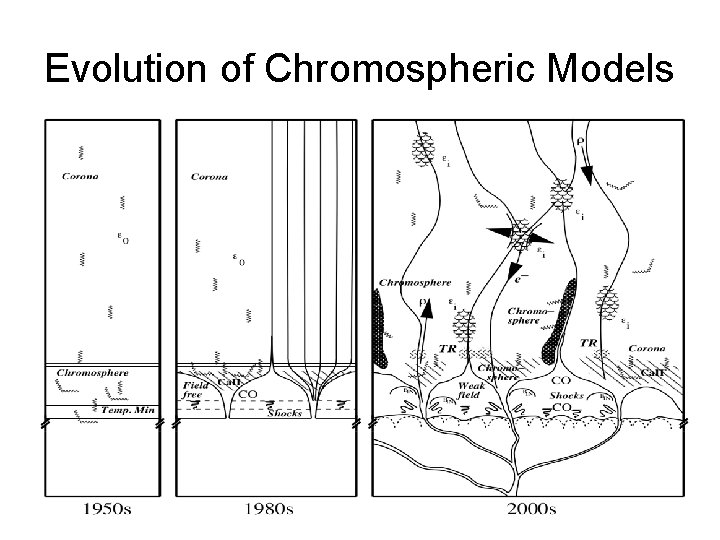
Evolution of Chromospheric Models
Something is Wrong: • With increased complexity, the fundamental problems are not resolved (not even addressed)! • Mutual assurance between simulations (with parameters that are 1000 times different from observations) and interpretations • Heating rate is 100 times too small (or waves need 100 times stronger • What forms field geometry? • What forms the temperature profile? • What forms the transition region? • What produces spicules? 38 • Not self-consistent physical processes
The Solar Atmospheric Heating Problem (since Edlen 1943) • Explain how the temperature of the corona can reach 2~3 MK from 6000 K on the surface • Explain the energy for radiation from regions above the photosphere Solar surface temperature 39
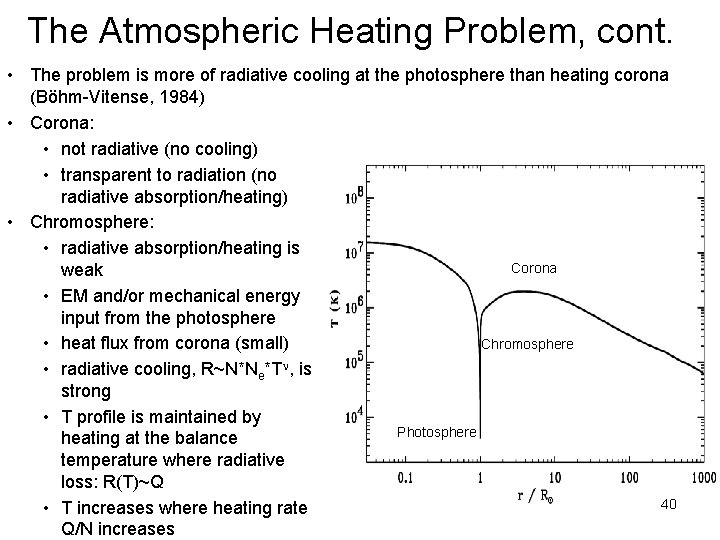
The Atmospheric Heating Problem, cont. • The problem is more of radiative cooling at the photosphere than heating corona (Böhm-Vitense, 1984) • Corona: • not radiative (no cooling) • transparent to radiation (no radiative absorption/heating) • Chromosphere: • radiative absorption/heating is Corona weak • EM and/or mechanical energy input from the photosphere • heat flux from corona (small) Chromosphere • radiative cooling, R~N*Ne*T , is strong • T profile is maintained by Photosphere heating at the balance temperature where radiative loss: R(T)~Q 40 • T increases where heating rate Q/N increases
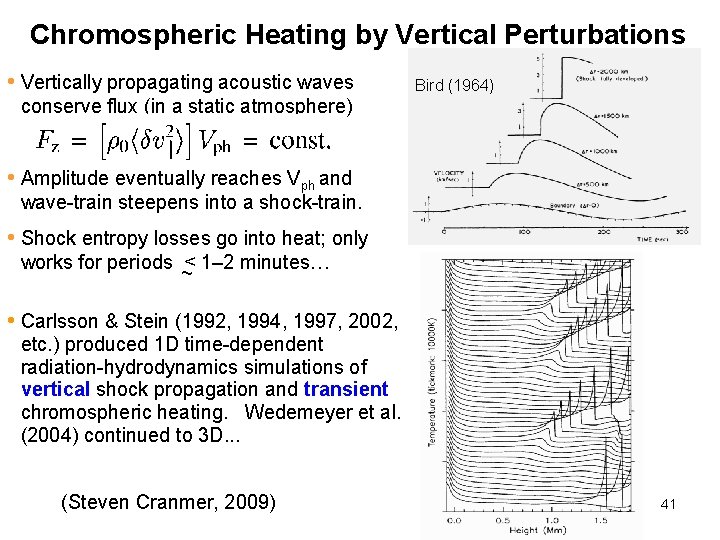
Chromospheric Heating by Vertical Perturbations • Vertically propagating acoustic waves Bird (1964) conserve flux (in a static atmosphere) • Amplitude eventually reaches Vph and wave-train steepens into a shock-train. • Shock entropy losses go into heat; only works for periods < 1– 2 minutes… ~ • Carlsson & Stein (1992, 1994, 1997, 2002, etc. ) produced 1 D time-dependent radiation-hydrodynamics simulations of vertical shock propagation and transient chromospheric heating. Wedemeyer et al. (2004) continued to 3 D. . . (Steven Cranmer, 2009) 41
Heating by Horizontal Perturbations (previous theories) • Single fluid MHD: heating is due to internal “Joule” heating (evaluated correctly? ) • Single wave: at the frequencies of peak power, not a spectrum • Weak damping: “Born approximation”, the energy flux of the perturbation is constant with height • Insufficient heating (a factor of 50 too small): a result of weak damping approximation • Less heating at lower altitudes • Stronger heating for stronger magnetic field (? ) 42
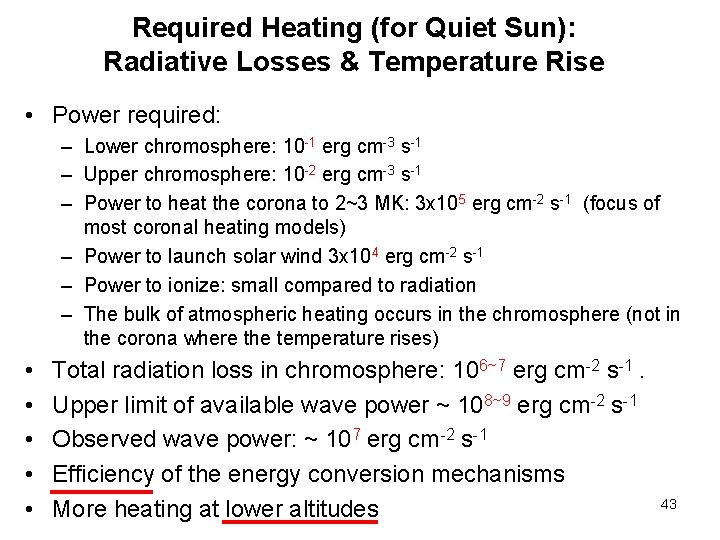
Required Heating (for Quiet Sun): Radiative Losses & Temperature Rise • Power required: – Lower chromosphere: 10 -1 erg cm-3 s-1 – Upper chromosphere: 10 -2 erg cm-3 s-1 – Power to heat the corona to 2~3 MK: 3 x 10⁵ erg cm-2 s-1 (focus of most coronal heating models) – Power to launch solar wind 3 x 10⁴ erg cm-2 s-1 – Power to ionize: small compared to radiation – The bulk of atmospheric heating occurs in the chromosphere (not in the corona where the temperature rises) • • • Total radiation loss in chromosphere: 106~7 erg cm-2 s-1. Upper limit of available wave power ~ 108~9 erg cm-2 s-1 Observed wave power: ~ 107 erg cm-2 s-1 Efficiency of the energy conversion mechanisms More heating at lower altitudes 43
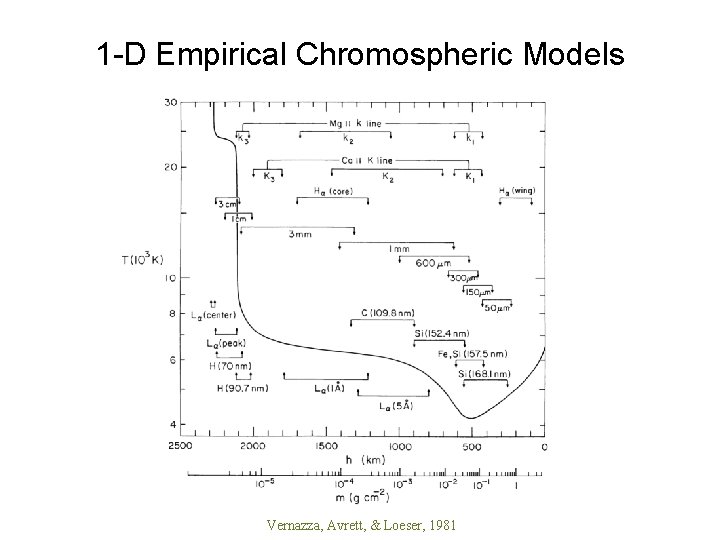
1 -D Empirical Chromospheric Models Vernazza, Avrett, & Loeser, 1981