
A Model of One Proton Emission from Deformed
- Slides: 17
A Model of One Proton Emission from Deformed Nuclei Jim Al-Khalili University of Surrey, UK PRESPEC Decay Physics Workshop University of Brighton, 12 -13 January 2011 1
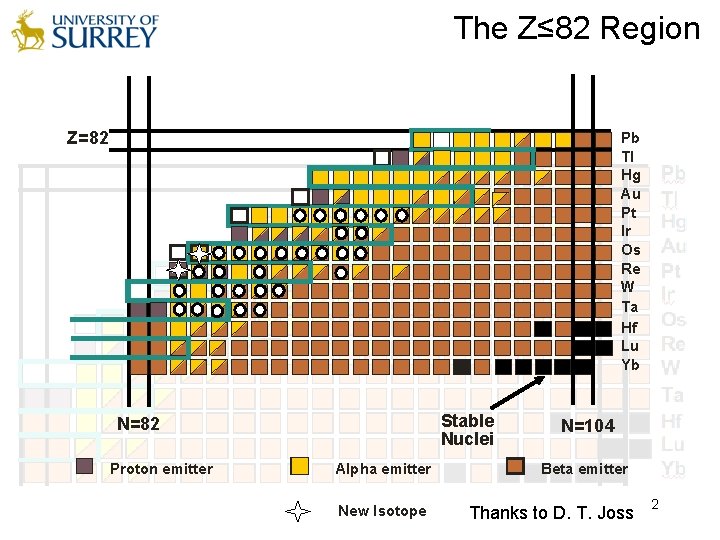
The Z≤ 82 Region Z=82 Pb Tl Hg Au Pt Ir Os Re W Ta Hf Lu Yb Stable Nuclei N=82 Proton emitter Alpha emitter New Isotope N=104 Beta emitter Thanks to D. T. Joss 2
• Many nuclei at or beyond proton dripline are unstable against proton emission. • Initially, parent nucleus is in a quasi-stationary state, and proton decay may be considered as a process where the proton tunnels through a potential barrier. • Large Coulomb potential and centrifugal barrier mean this can often extend out to almost 100 fm. • Consequently, measurement of decay half-lives (ranging from microseconds to seconds) provides reliable spectroscopic information. • In principle, proton decay should be easy to model (since no preformation factors like alpha particles). • Reviews: Experimental: Woods and Davids, Ann. Rev. Nucl. Part. Sci. 47 (1997) 541 Theoretical: Delion, Liotta and Wyss, Phys. Rep. 424 (2006) 113. 3
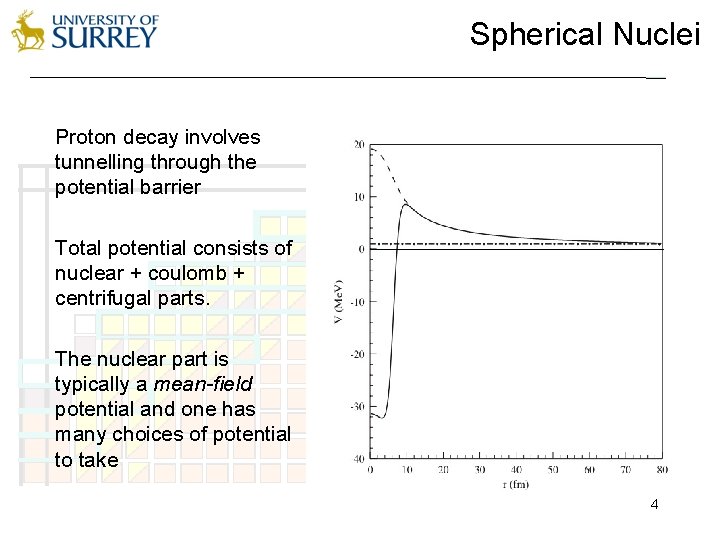
Spherical Nuclei Proton decay involves tunnelling through the potential barrier Total potential consists of nuclear + coulomb + centrifugal parts. The nuclear part is typically a mean-field potential and one has many choices of potential to take 4
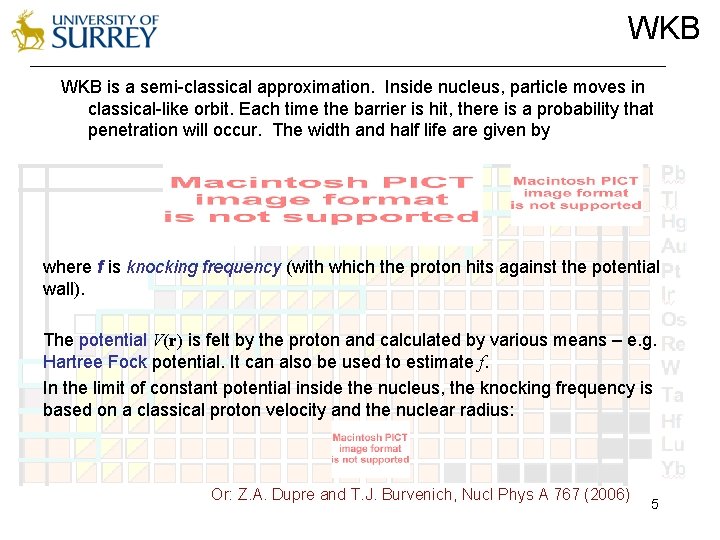
WKB is a semi-classical approximation. Inside nucleus, particle moves in classical-like orbit. Each time the barrier is hit, there is a probability that penetration will occur. The width and half life are given by where f is knocking frequency (with which the proton hits against the potential wall). The potential V(r) is felt by the proton and calculated by various means – e. g. Hartree Fock potential. It can also be used to estimate f. In the limit of constant potential inside the nucleus, the knocking frequency is based on a classical proton velocity and the nuclear radius: Or: Z. A. Dupre and T. J. Burvenich, Nucl Phys A 767 (2006) 5
Quasistationary picture • Nuclear decays are time-dependent processes. • However, typical decay lifetimes v. long on nuclear timescale => stationary state problem (Gamow 1928). • Usually treated as scattering problem (poles in S-matrix or resonances in scattering amplitude). This is the time reverse of decay, that is wave comes in from infinity and becomes trapped by potential. • However, quasistationary states of interest here might be closer to bound states (despite having continuous rather than discrete spectrum). • Can use perturbative method reliably by starting from bound state problem. 6
Two-Potential approach Alternative method is known as the Two Potential approach (TPA). This is a fully quantum method, using perturbation theory developed by Shmuel Gurvitz. Ø S. A. Gurvitz and G Kalbermann, Phys. Rev. Lett. 59 (1987) 262 Ø S. A. Gurvitz, Phys. Rev. A 38 (1987) 1747 Ø S. Åberg, P. Semmes and W. Nazarewicz, Phys. Rev. C 56 (1997) 1762 Ø S. A. Gurwitz, P. B. Semmes, W. Nazarewicz and T. Vertse, Phys. Rev. A 69 (2004) 042705 7
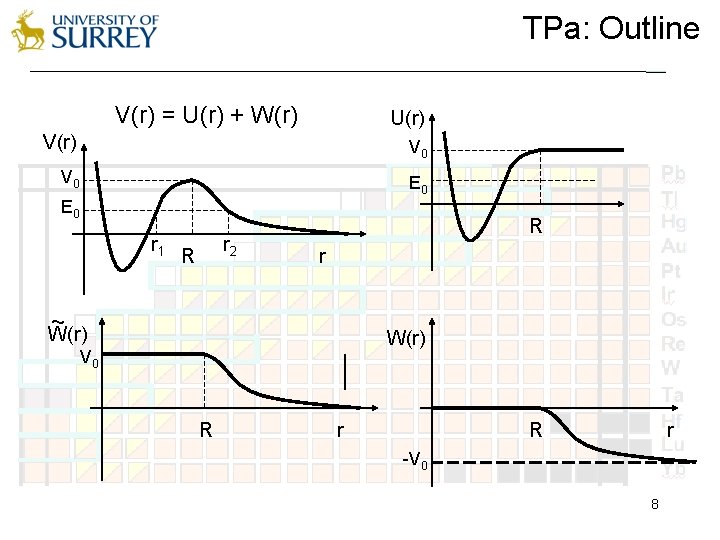
TPa: Outline V(r) = U(r) + W(r) U(r) V 0 V 0 E 0 r 1 r 2 R R r ~ W(r) V 0 R r -V 0 8
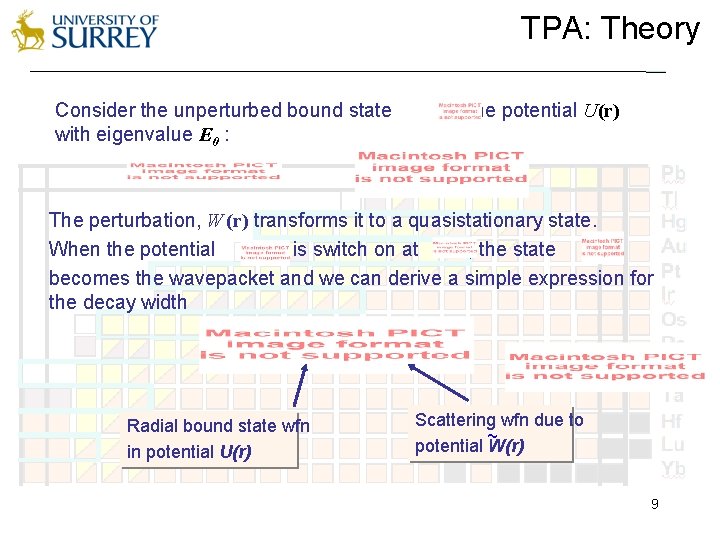
TPA: Theory Consider the unperturbed bound state with eigenvalue E 0 : in the potential U(r) The perturbation, W (r) transforms it to a quasistationary state. When the potential is switch on at , the state becomes the wavepacket and we can derive a simple expression for the decay width Radial bound state wfn in potential U(r) Scattering wfn due to ~ potential W(r) 9
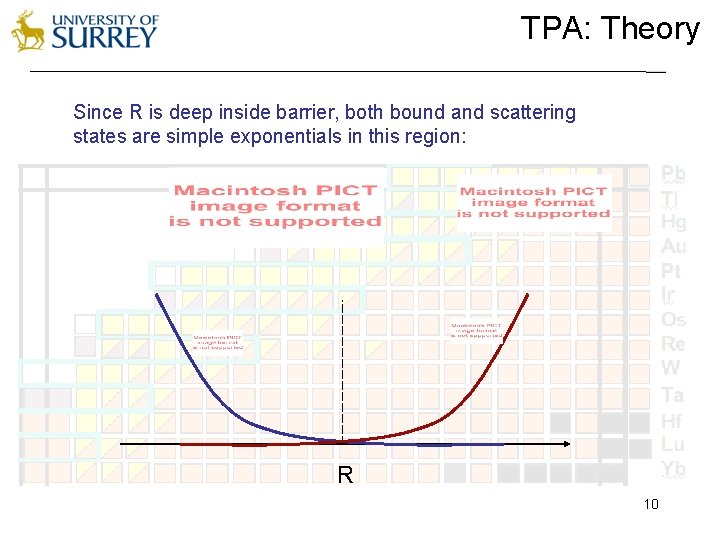
TPA: Theory Since R is deep inside barrier, both bound and scattering states are simple exponentials in this region: R 10
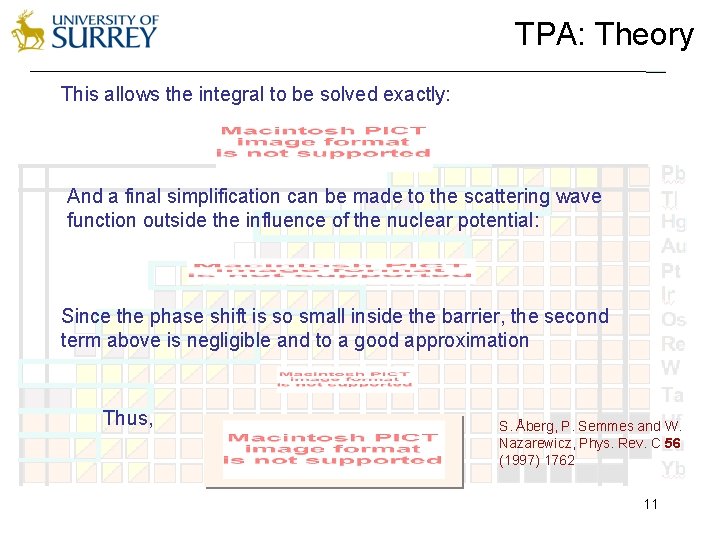
TPA: Theory This allows the integral to be solved exactly: And a final simplification can be made to the scattering wave function outside the influence of the nuclear potential: Since the phase shift is so small inside the barrier, the second term above is negligible and to a good approximation Thus, S. Åberg, P. Semmes and W. Nazarewicz, Phys. Rev. C 56 (1997) 1762 11
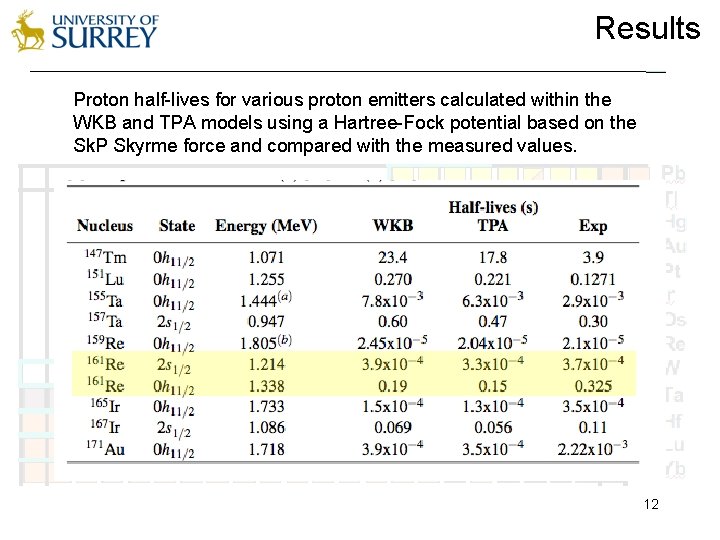
Results Proton half-lives for various proton emitters calculated within the WKB and TPA models using a Hartree-Fock potential based on the Sk. P Skyrme force and compared with the measured values. 12
Summary for Spherical Emitters • Proton emission using spherical potentials with WKB or TPA give reasonable results and in close agreement • In principle, HF mean field potential provides proton energy too. • In practice, the potential has to be scaled slightly to give correct proton energy. • Underlying mean field cannot predict single particle energies sufficiently well. 13
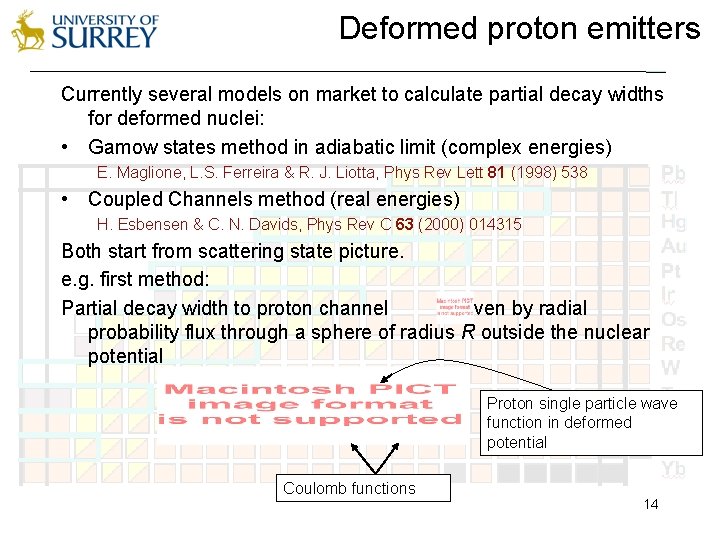
Deformed proton emitters Currently several models on market to calculate partial decay widths for deformed nuclei: • Gamow states method in adiabatic limit (complex energies) E. Maglione, L. S. Ferreira & R. J. Liotta, Phys Rev Lett 81 (1998) 538 • Coupled Channels method (real energies) H. Esbensen & C. N. Davids, Phys Rev C 63 (2000) 014315 Both start from scattering state picture. e. g. first method: Partial decay width to proton channel is given by radial probability flux through a sphere of radius R outside the nuclear potential Proton single particle wave function in deformed potential Coulomb functions 14
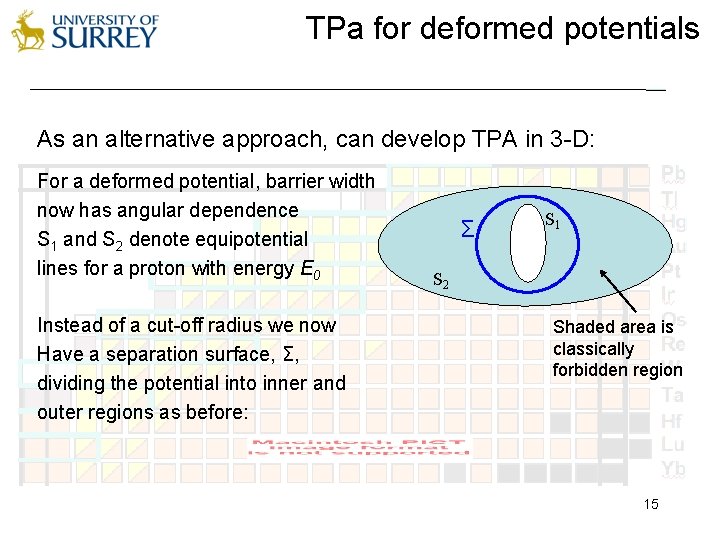
TPa for deformed potentials As an alternative approach, can develop TPA in 3 -D: For a deformed potential, barrier width now has angular dependence S 1 and S 2 denote equipotential lines for a proton with energy E 0 Instead of a cut-off radius we now Have a separation surface, Σ, dividing the potential into inner and outer regions as before: Σ S 1 S 2 Shaded area is classically forbidden region 15
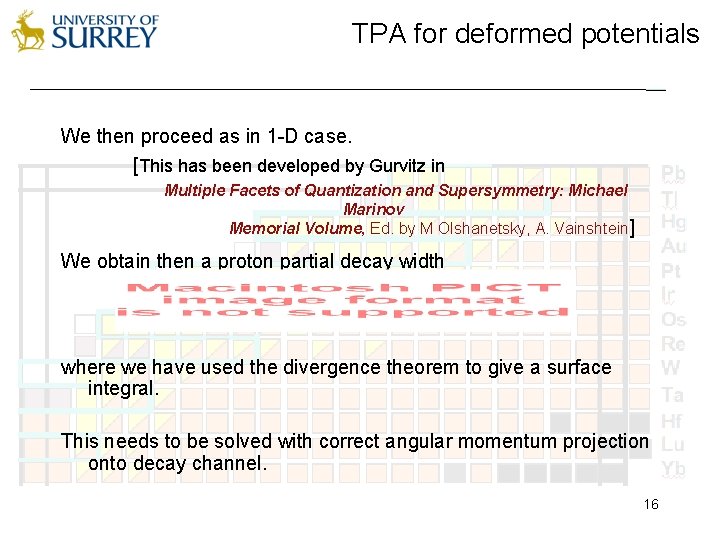
TPA for deformed potentials We then proceed as in 1 -D case. [This has been developed by Gurvitz in Multiple Facets of Quantization and Supersymmetry: Michael Marinov Memorial Volume, Ed. by M Olshanetsky, A. Vainshtein] We obtain then a proton partial decay width where we have used the divergence theorem to give a surface integral. This needs to be solved with correct angular momentum projection onto decay channel. 16
Summary and Acknowledgements It is hoped that the 3 -D TPA model of Gurvitz can be applied to study the single proton emission from deformed nuclei and compared with existing scattering state methods. This study formed part of a project with Paul Stevenson at Surrey, Robert Page and Dave Joss at Liverpool and John Simpson at Daresbury. 17