
A MODEL OF CONCRETE CARBONATION USING COMSOL MULTIPHYSICS

A MODEL OF CONCRETE CARBONATION USING COMSOL MULTIPHYSICS ® A. Rodriguez R. 1, B. Chinè 1, R. Cuevas H. 2, R. Jimenez S. 1, 1. School of Materials Science and Engineering, Costa Rica Institute of Technology, Cartago, Costa Rica 2. School of Construction Engineering, Costa Rica Institute of Technology, Cartago, Costa Rica

CONCRETE CARBONATION • CO 2 permeates the porous and fractured structure of concrete. • Establishes conditions of concrete degradation. • May cause corrosion around reinforcing bars, causing deterioration of material and structure mechanical properties. Figure 1. Carbonation of an OPC, validated also for pozzolanic cements [Papadakis et al, 1992]
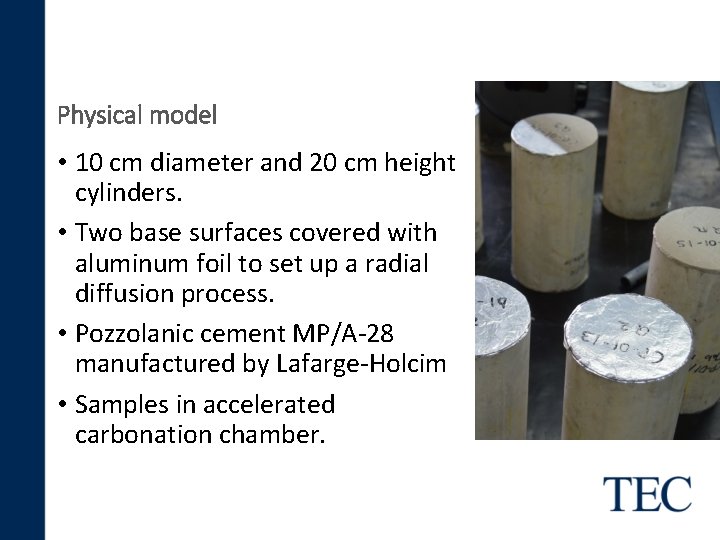
Physical model • 10 cm diameter and 20 cm height cylinders. • Two base surfaces covered with aluminum foil to set up a radial diffusion process. • Pozzolanic cement MP/A-28 manufactured by Lafarge-Holcim • Samples in accelerated carbonation chamber.
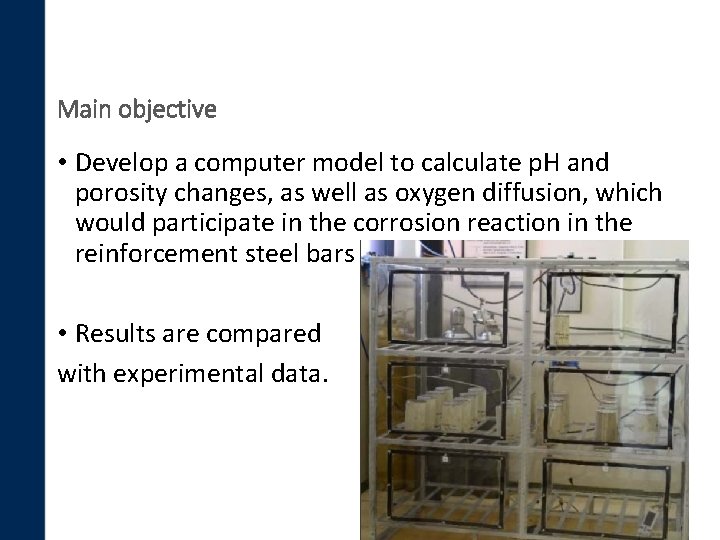
Main objective • Develop a computer model to calculate p. H and porosity changes, as well as oxygen diffusion, which would participate in the corrosion reaction in the reinforcement steel bars • Results are compared with experimental data.
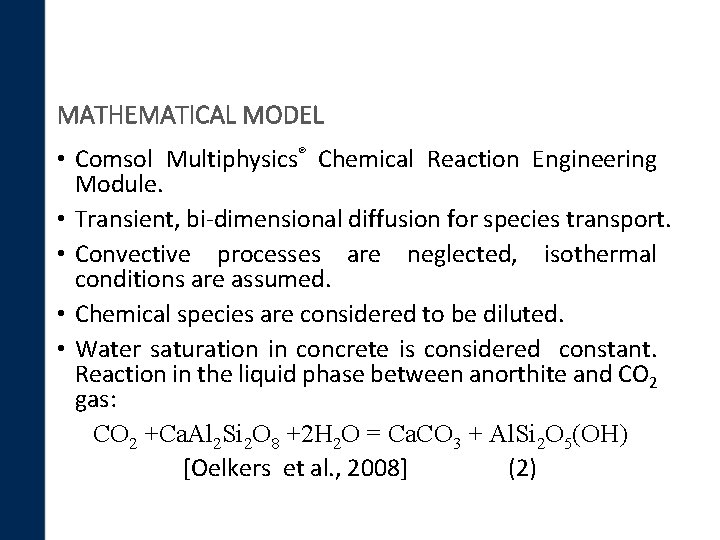
MATHEMATICAL MODEL • Comsol Multiphysics® Chemical Reaction Engineering Module. • Transient, bi-dimensional diffusion for species transport. • Convective processes are neglected, isothermal conditions are assumed. • Chemical species are considered to be diluted. • Water saturation in concrete is considered constant. Reaction in the liquid phase between anorthite and CO 2 gas: CO 2 +Ca. Al 2 Si 2 O 8 +2 H 2 O = Ca. CO 3 + Al. Si 2 O 5(OH) [Oelkers et al. , 2008] (2)

MATHEMATICAL MODEL •
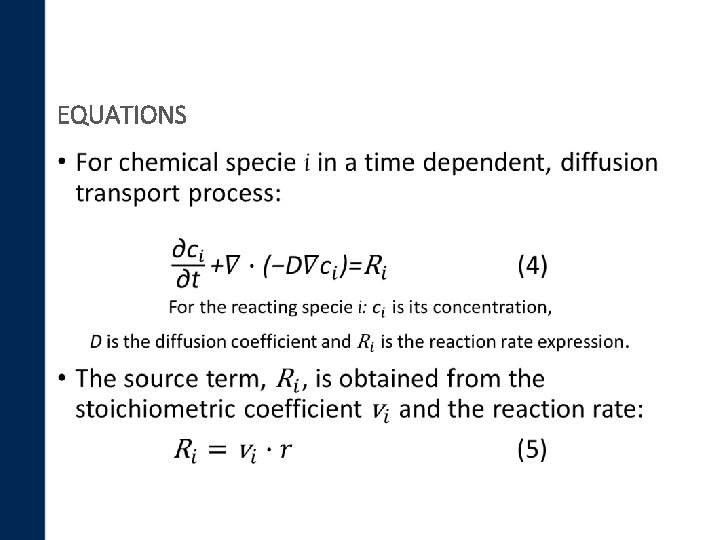
EQUATIONS •
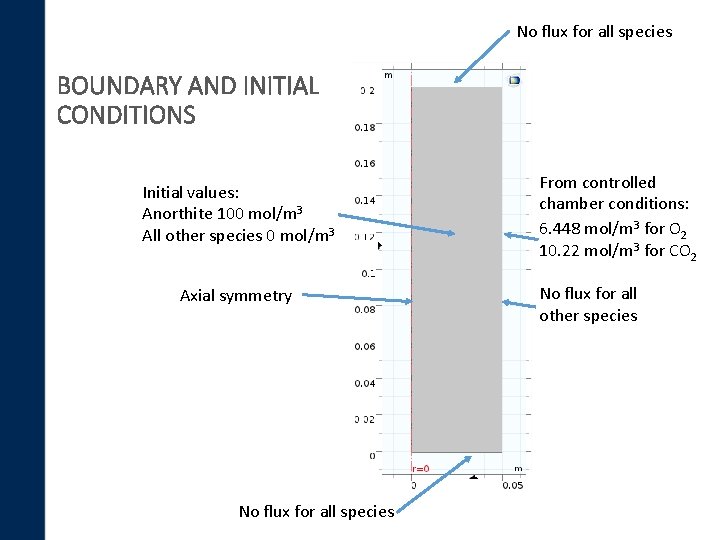
No flux for all species BOUNDARY AND INITIAL CONDITIONS Initial values: Anorthite 100 mol/m 3 All other species 0 mol/m 3 Axial symmetry No flux for all species From controlled chamber conditions: 6. 448 mol/m 3 for O 2 10. 22 mol/m 3 for CO 2 No flux for all other species
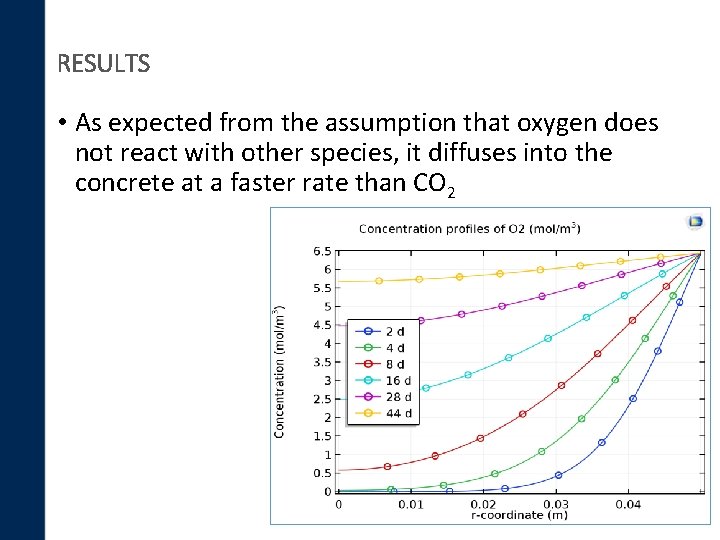
RESULTS • As expected from the assumption that oxygen does not react with other species, it diffuses into the concrete at a faster rate than CO 2
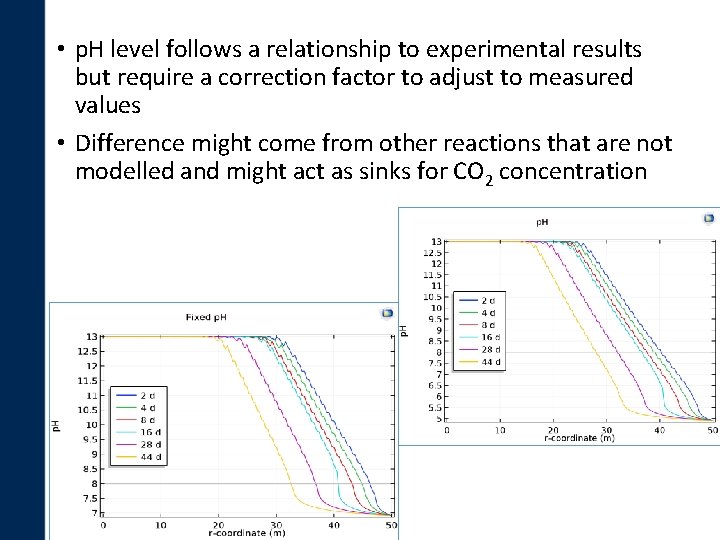
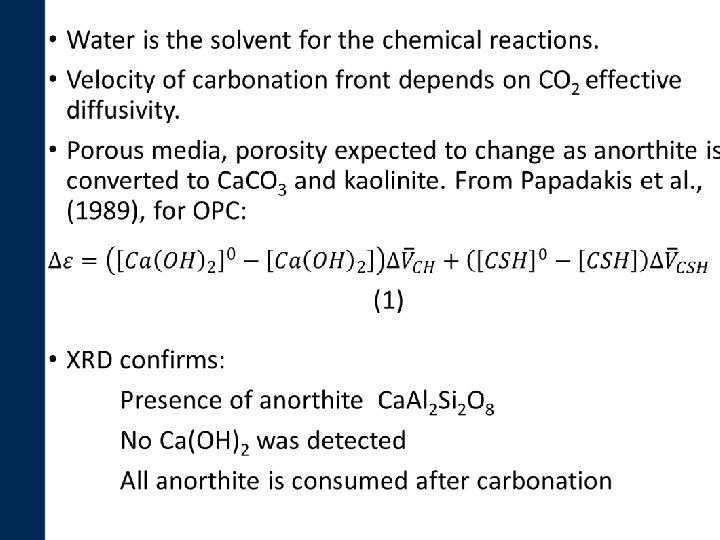
• p. H level follows a relationship to experimental results but require a correction factor to adjust to measured values • Difference might come from other reactions that are not modelled and might act as sinks for CO 2 concentration
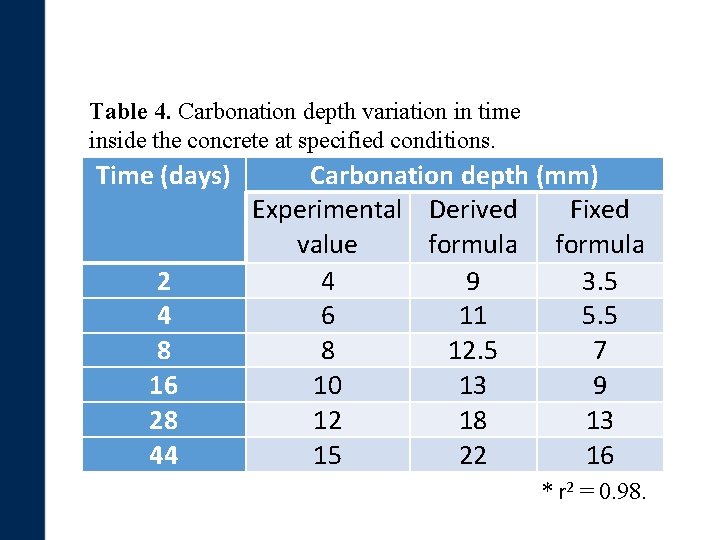
Table 4. Carbonation depth variation in time inside the concrete at specified conditions. Time (days) 2 4 8 16 28 44 Carbonation depth (mm) Experimental Derived Fixed value formula 4 9 3. 5 6 11 5. 5 8 12. 5 7 10 13 9 12 18 13 15 22 16 * r 2 = 0. 98.

• Numerical instability of the model affected modelling the porosity change • Attempts to model a transient change of porosity caused convergence problems. • Some analysis is required to find the possible causes for this • Temporarily the porosity change was calculated through a relationship to Ca. CO 3 concentration
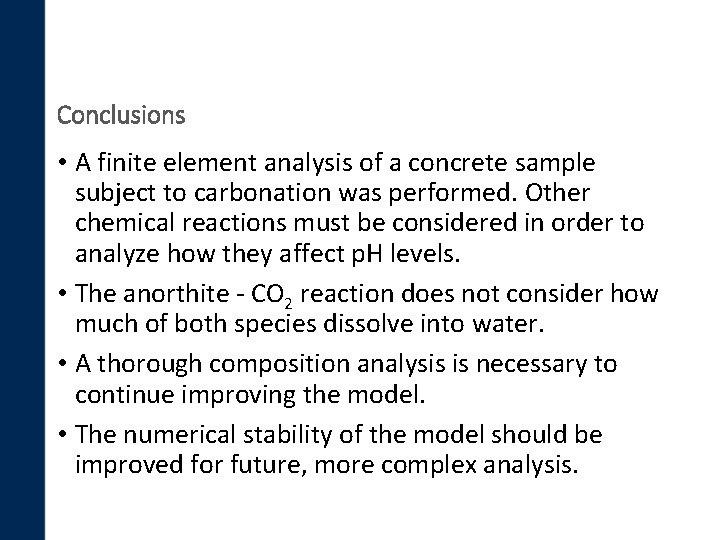
Conclusions • A finite element analysis of a concrete sample subject to carbonation was performed. Other chemical reactions must be considered in order to analyze how they affect p. H levels. • The anorthite - CO 2 reaction does not consider how much of both species dissolve into water. • A thorough composition analysis is necessary to continue improving the model. • The numerical stability of the model should be improved for future, more complex analysis.

Acknowledgements The authors gratefully acknowledge the financial aid provided by the Vicerrectoria de Investigación y Extensión of the Instituto Tecnológico de Costa Rica, through the project 1490017.

- Slides: 16