
A Model of Chronic Temporal Lobe Epilepsy Presenting
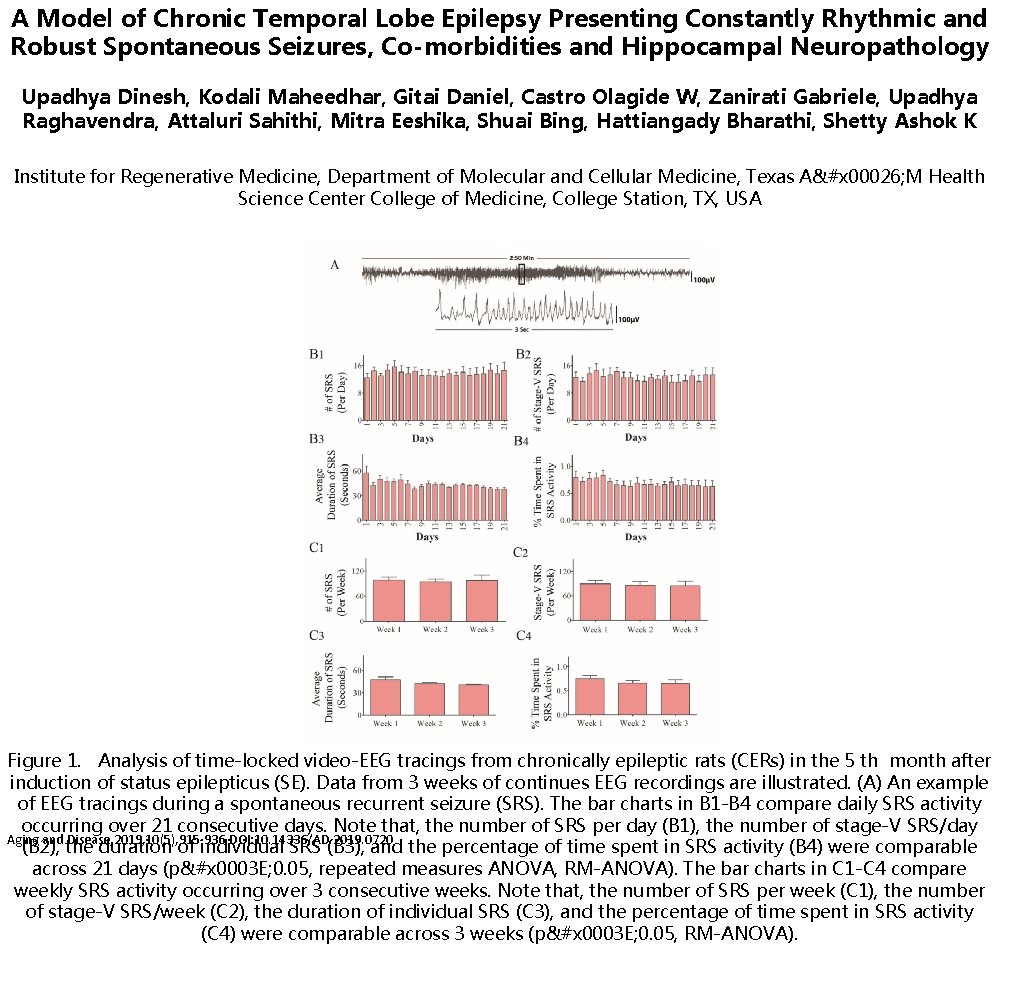
A Model of Chronic Temporal Lobe Epilepsy Presenting Constantly Rhythmic and Robust Spontaneous Seizures, Co-morbidities and Hippocampal Neuropathology Upadhya Dinesh, Kodali Maheedhar, Gitai Daniel, Castro Olagide W, Zanirati Gabriele, Upadhya Raghavendra, Attaluri Sahithi, Mitra Eeshika, Shuai Bing, Hattiangady Bharathi, Shetty Ashok K Institute for Regenerative Medicine, Department of Molecular and Cellular Medicine, Texas A&#x 00026; M Health Science Center College of Medicine, College Station, TX, USA Figure 1. Analysis of time-locked video-EEG tracings from chronically epileptic rats (CERs) in the 5 th month after induction of status epilepticus (SE). Data from 3 weeks of continues EEG recordings are illustrated. (A) An example of EEG tracings during a spontaneous recurrent seizure (SRS). The bar charts in B 1 -B 4 compare daily SRS activity occurring over 21 consecutive days. Note that, the number of SRS per day (B 1), the number of stage-V SRS/day Aging and Disease, 2019, 10(5), 915 -936. DOI: 10. 14336/AD. 2019. 0720 (B 2), the duration of individual SRS (B 3), and the percentage of time spent in SRS activity (B 4) were comparable across 21 days (p&#x 0003 E; 0. 05, repeated measures ANOVA, RM-ANOVA). The bar charts in C 1 -C 4 compare weekly SRS activity occurring over 3 consecutive weeks. Note that, the number of SRS per week (C 1), the number of stage-V SRS/week (C 2), the duration of individual SRS (C 3), and the percentage of time spent in SRS activity (C 4) were comparable across 3 weeks (p&#x 0003 E; 0. 05, RM-ANOVA).
- Slides: 1