
A Model For UniversityIndustry Collaboration The Center for
A Model For University-Industry Collaboration: The Center for Analog and Mixed Signal Integrated Circuit Design at WPI John Mc. Neill Electrical and Computer Engineering Dept. Worcester Polytechnic Institute mcneill@ece. wpi. edu http: //ece. wpi. edu/analog 1
Presentation Overview • Background • Industry-University Partnership • Center Overview • Operational Details • Advice • Conclusion Mc. Neill, “A Model for University-Industry Collaboration …, ” EWME 2004 2
Background: Personal 1979 -1983 A. B. Engineering, Dartmouth College 1983 -1986 Design Engineer, Analogic Corp. 1986 -1990 Design Engineer / Engineering Manager, Adaptive Optics Associates (AOA) 1990 -1991 MSEE, University of Rochester 1991 -1994 Ph. D, Boston University 1994 -2004 Assistant / Associate Professor, WPI Mc. Neill, “A Model for University-Industry Collaboration …, ” EWME 2004 3
Background: WPI • Founded 1865 – USA's 3 rd-oldest technological university • Located in Worcester, Massachusetts – 1 hour from Boston • Full-time enrollment: ~ 2700 Undergrad, ~ 500 Grad (~220 FT Faculty) – Small size allows close faculty interaction • University with core focus on science, engineering, and management of technology • Grants bachelor's, master's and doctoral degrees in 30+ disciplines Mc. Neill, “A Model for University-Industry Collaboration …, ” EWME 2004 4
Background: Curriculum • "Technological humanist" – Prepare students for entire career and life path • Projects (Close collaboration with faculty mentor) – Humanities Project • Express creativity in nontechnical fields – Interdisciplinary Project • Society-technology interface. • Option: Global sites from London to Bangkok – Disciplinary Project (Capstone) • Obtain professional-level design experience • Integrate, apply, knowledge • Solve “ real-world” problems Mc. Neill, “A Model for University-Industry Collaboration …, ” EWME 2004 5
Presentation Overview • Background • Industry-University Partnership – Goals – Traditional Research Model – Collaborative Design Center • Center Overview • Operational Details • Advice • Conclusion Mc. Neill, “A Model for University-Industry Collaboration …, ” EWME 2004 6
Industry / University Partnership: Goals • Industry – Technical • Stay current with "cutting edge" research • Explore / develop "back burner" ideas – Human Resources • Identify good engineers to hire! • University – Intellectual Mission (Research) • "Create knowledge" – Customer Service (Education) • Instruction, research relevant to needs of student, industry constituencies Mc. Neill, “A Model for University-Industry Collaboration …, ” EWME 2004 7
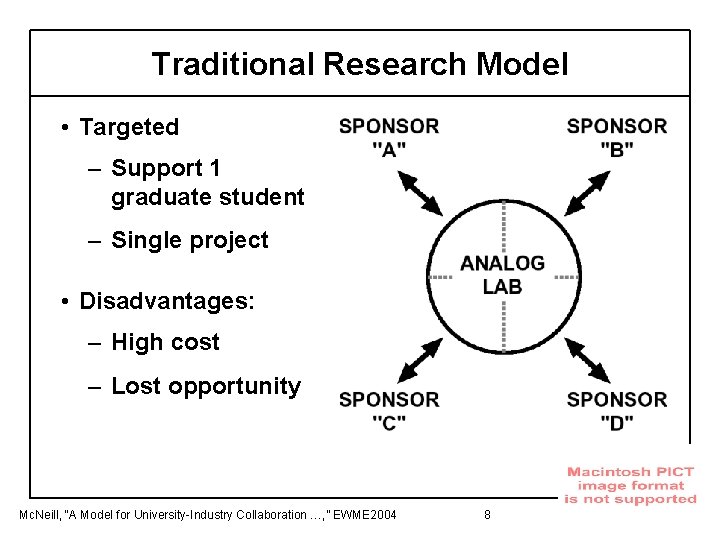
Traditional Research Model • Targeted – Support 1 graduate student – Single project • Disadvantages: – High cost – Lost opportunity Mc. Neill, “A Model for University-Industry Collaboration …, ” EWME 2004 8
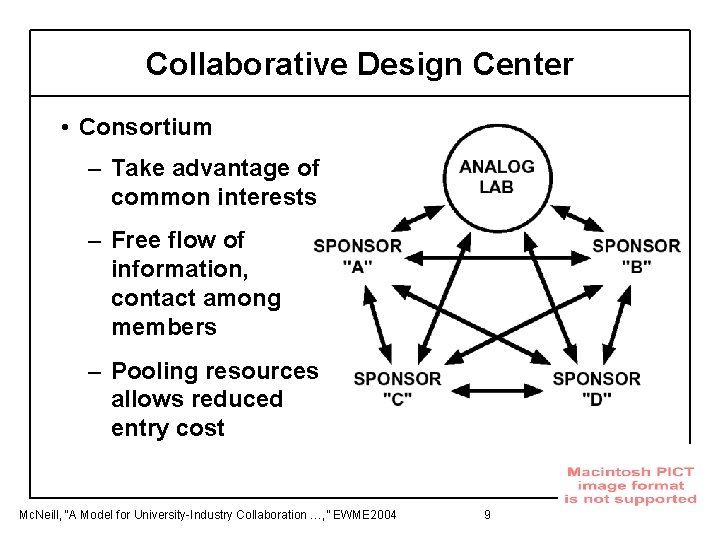
Collaborative Design Center • Consortium – Take advantage of common interests – Free flow of information, contact among members – Pooling resources allows reduced entry cost Mc. Neill, “A Model for University-Industry Collaboration …, ” EWME 2004 9
Presentation Overview • Background • Industry-University Partnership • Center Overview – Organization – Benefits for Students – Benefits for Sponsors – Choices for Faculty • Operational Details • Advice • Conclusion Mc. Neill, “A Model for University-Industry Collaboration …, ” EWME 2004 10
Center Overview • The Center for Analog and Mixed Signal IC Design at WPI conducts graduate research and undergraduate projects in all aspects of mixed signal IC design. • These activities are conducted in an environment that supports the complete "real world" integrated circuit design process. • The Center is supported by contributions from member companies, who help to determine the direction of Center research. Mc. Neill, “A Model for University-Industry Collaboration …, ” EWME 2004 11
Design Center Overview: Organization • Membership: Company pays $35, 000 annual fee • Student / faculty participation: – 16 students/year: 4 capstone teams, 4 MS – 4 faculty involved • Advisory Board – Representatives from member companies – One-day meetings in fall, spring – Review progress, choose future projects – Direct interaction with students • Project Ideas – Proposed by companies, faculty – Sponsors select (Advisory board vote) Mc. Neill, “A Model for University-Industry Collaboration …, ” EWME 2004 12
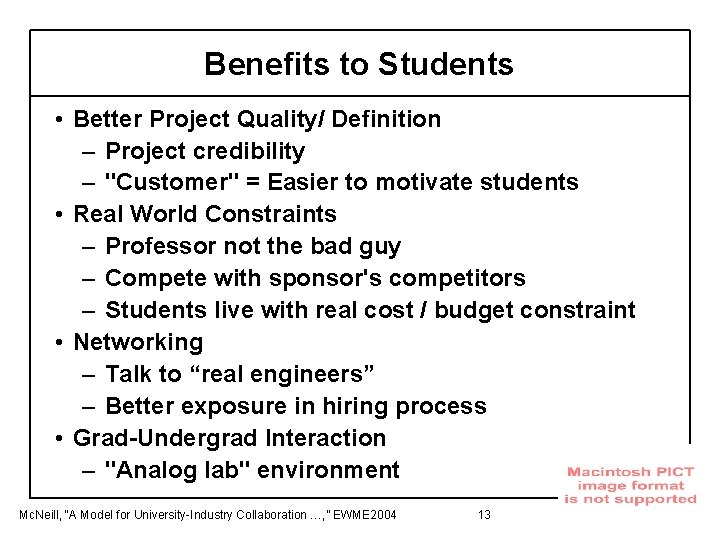
Benefits to Students • Better Project Quality/ Definition – Project credibility – "Customer" = Easier to motivate students • Real World Constraints – Professor not the bad guy – Compete with sponsor's competitors – Students live with real cost / budget constraint • Networking – Talk to “real engineers” – Better exposure in hiring process • Grad-Undergrad Interaction – "Analog lab" environment Mc. Neill, “A Model for University-Industry Collaboration …, ” EWME 2004 13
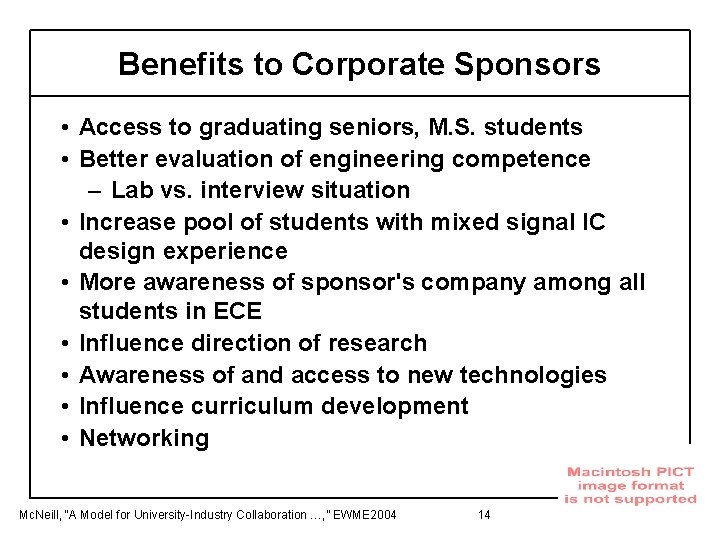
Benefits to Corporate Sponsors • Access to graduating seniors, M. S. students • Better evaluation of engineering competence – Lab vs. interview situation • Increase pool of students with mixed signal IC design experience • More awareness of sponsor's company among all students in ECE • Influence direction of research • Awareness of and access to new technologies • Influence curriculum development • Networking Mc. Neill, “A Model for University-Industry Collaboration …, ” EWME 2004 14
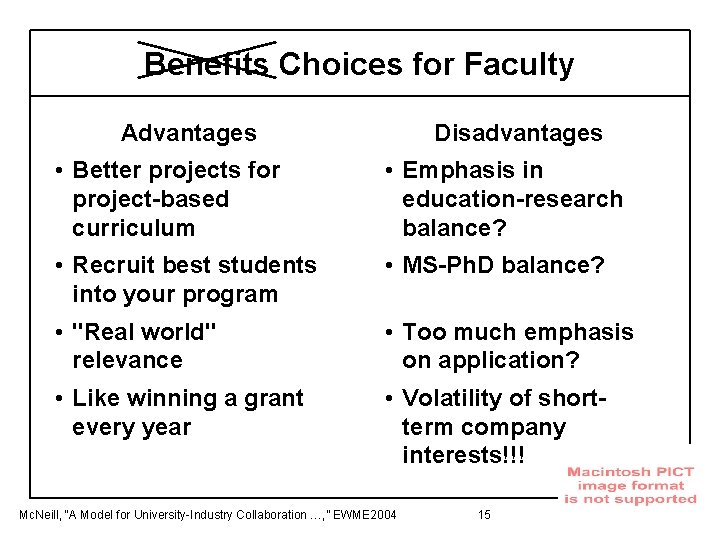
Benefits Choices for Faculty Advantages Disadvantages • Better projects for project-based curriculum • Emphasis in education-research balance? • Recruit best students into your program • MS-Ph. D balance? • "Real world" relevance • Too much emphasis on application? • Like winning a grant every year • Volatility of shortterm company interests!!! Mc. Neill, “A Model for University-Industry Collaboration …, ” EWME 2004 15
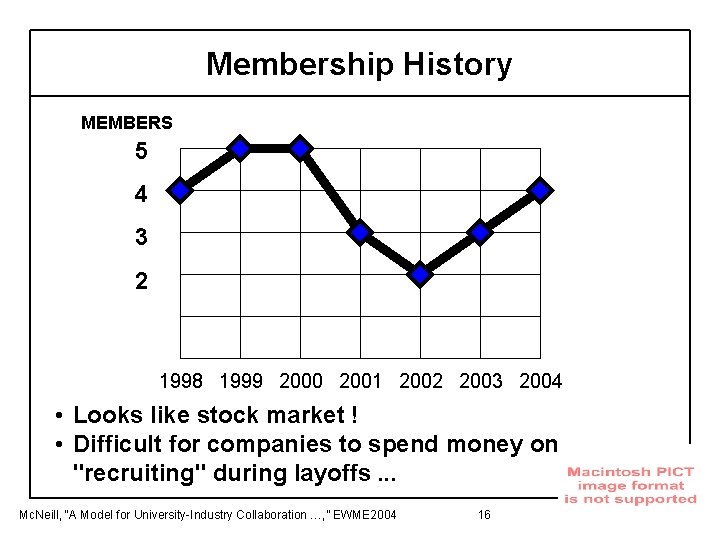
Membership History MEMBERS 5 4 3 2 1998 1999 2000 2001 2002 2003 2004 • Looks like stock market ! • Difficult for companies to spend money on "recruiting" during layoffs. . . Mc. Neill, “A Model for University-Industry Collaboration …, ” EWME 2004 16
Presentation Overview • Background • Industry-University Partnership • Center Overview • Operational Details – Communication – Intellectual Property Policy • Advice • Conclusion Mc. Neill, “A Model for University-Industry Collaboration …, ” EWME 2004 17
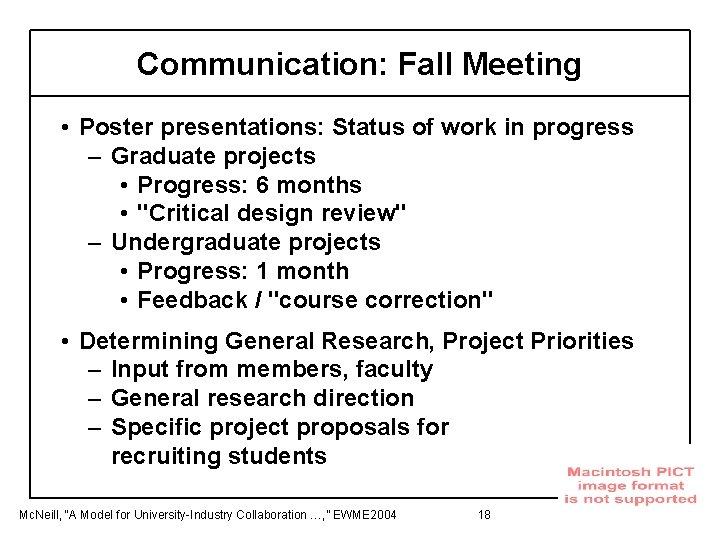
Communication: Fall Meeting • Poster presentations: Status of work in progress – Graduate projects • Progress: 6 months • "Critical design review" – Undergraduate projects • Progress: 1 month • Feedback / "course correction" • Determining General Research, Project Priorities – Input from members, faculty – General research direction – Specific project proposals for recruiting students Mc. Neill, “A Model for University-Industry Collaboration …, ” EWME 2004 18
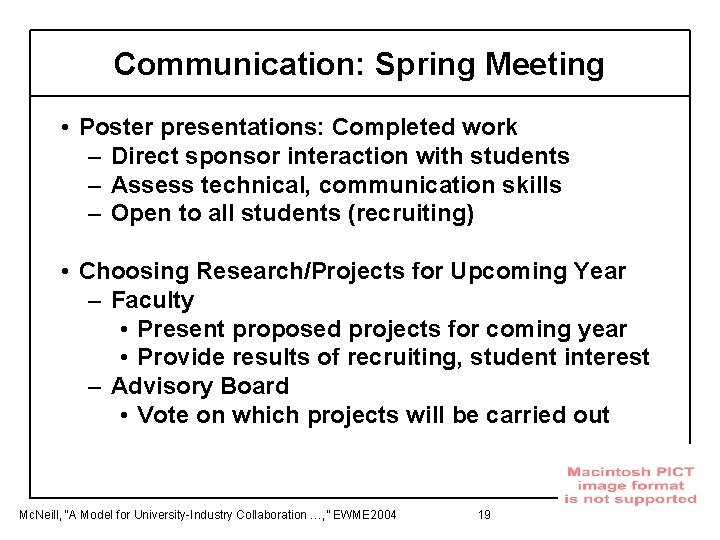
Communication: Spring Meeting • Poster presentations: Completed work – Direct sponsor interaction with students – Assess technical, communication skills – Open to all students (recruiting) • Choosing Research/Projects for Upcoming Year – Faculty • Present proposed projects for coming year • Provide results of recruiting, student interest – Advisory Board • Vote on which projects will be carried out Mc. Neill, “A Model for University-Industry Collaboration …, ” EWME 2004 19
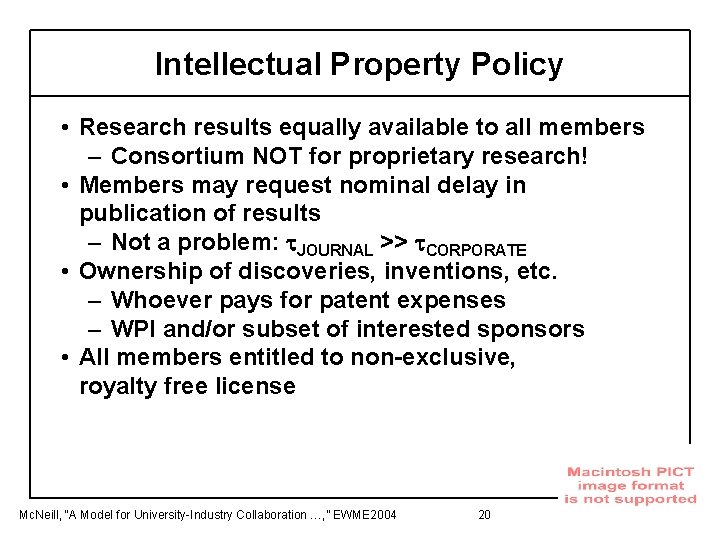
Intellectual Property Policy • Research results equally available to all members – Consortium NOT for proprietary research! • Members may request nominal delay in publication of results – Not a problem: t. JOURNAL >> t. CORPORATE • Ownership of discoveries, inventions, etc. – Whoever pays for patent expenses – WPI and/or subset of interested sponsors • All members entitled to non-exclusive, royalty free license Mc. Neill, “A Model for University-Industry Collaboration …, ” EWME 2004 20
Presentation Overview • Background • Industry-University Partnership • Center Overview • Operational Details • Advice – Starting a Center – Industry Contacts – Selling to Sponsors – Recruiting Students • Conclusion Mc. Neill, “A Model for University-Industry Collaboration …, ” EWME 2004 21
Starting a Center • Talk to / get ideas from as many people as you can: • People at your institution doing something similar • People at other institutions doing something similar – Acknowledgment: Terri Fiez, CDADIC, OSU • Contacts at potential sponsors / member companies • Consider teaming with other faculty – Within department: Cover several subdisciplines – From other departments: Interdisciplinary Mc. Neill, “A Model for University-Industry Collaboration …, ” EWME 2004 22
Starting a Center: Industry Contacts Quantity Rules • To get 1 good idea, you need 10 bad ideas • To make 1 sale, you need to live through 10 rejections • To get 1 sponsor. . . • If a potential contact isn’t producing, spend time elsewhere! Mc. Neill, “A Model for University-Industry Collaboration …, ” EWME 2004 23
Industry Contacts: Where to get them? • Anywhere and everywhere! – Former students – Former employers/employees – Your Ph. D advisor's contacts – Help from colleagues in your department – People who see your publications – People who see you at. . . • Conferences • Local professional society talks Mc. Neill, “A Model for University-Industry Collaboration …, ” EWME 2004 24
Selling Your Center To Sponsors • Any contact to get you in the door – Engineering, Human Resources, anything • Work your way up corporate food chain – "This will make you look good for your boss" – Find the person in organization who can say "This is a good idea - let’s spend $35, 000 on it!" – Title different depending on organization • Work your way back down corporate food chain – Whoever’s actually interested in technical work – Point of (frequent) contact once work is happening Mc. Neill, “A Model for University-Industry Collaboration …, ” EWME 2004 25
Selling Your Center To Sponsors "$35, 000 is a lot of money" • Compare to cost of hiring process – Key: Sponsor access to students with experience, interest in company's field – Curriculum, research less important – Cheap compared to recruiting / headhunter cost • Don't be afraid to ask for a lot of money – Sponsor's attitude: Little money committed = low priority – Find good partners; OK if bad partner says no! Mc. Neill, “A Model for University-Industry Collaboration …, ” EWME 2004 26
Educating Sponsors: Expectations • Be aware of industry biases / constraints – Ideal: Instant, cost-free product development – 18 months = eternity • Manage sponsor expectations – Cultivating long term relationship – Not product development – Not on critical path • Example: Educational mission of capstone project – Teach design process • Time for students to brainstorm, research, . . . – Not "get something done" Mc. Neill, “A Model for University-Industry Collaboration …, ” EWME 2004 27
Recruiting Students • Two words: FREE FOOD – Student recruiting event after Fall meeting Mc. Neill, “A Model for University-Industry Collaboration …, ” EWME 2004 28
Recruiting Students • Two words: FREE FOOD – Student recruiting event after Fall meeting • Two more words: FREE CLOTHING – Analog Lab T-shirts Mc. Neill, “A Model for University-Industry Collaboration …, ” EWME 2004 29
Recruiting Students • Two words: FREE FOOD – Student recruiting event after Fall meeting • Two more words: FREE CLOTHING – Analog Lab T-shirts • Another two words: OPEN HOUSE – Invite students in department to presentations – See ongoing projects; cool place to work Mc. Neill, “A Model for University-Industry Collaboration …, ” EWME 2004 30
Recruiting Students • Two words: FREE FOOD – Student recruiting event after Fall meeting • Two more words: FREE CLOTHING – Analog Lab T-shirts • Another two words: OPEN HOUSE – Invite students in department to presentations – See ongoing projects; cool place to work • Teach courses in your area with enthusiasm – Frequently mention related, high quality, sponsored projects – Lecture examples from industry / project work • Most important: Student word-of-mouth, positive peer "buzz" Mc. Neill, “A Model for University-Industry Collaboration …, ” EWME 2004 31
Presentation Overview • Background • Industry-University Partnership • Center Overview • Operational Details • Advice • Conclusion Mc. Neill, “A Model for University-Industry Collaboration …, ” EWME 2004 32
Conclusion • Collaborative Design Center – Serves needs of constituencies: Students, Sponsors, Faculty • Selling to Sponsors – Benefits not features! – Know their needs, constraints – Be clear about your educational mission • Sometimes "no" is the right answer! • Working with Students – Create environment that attracts best students – Expect success: Believe in your students Mc. Neill, “A Model for University-Industry Collaboration …, ” EWME 2004 33
- Slides: 33