
A Model for Implementing ACGME Competencies within a
- Slides: 20
A Model for Implementing ACGME Competencies within a Department Berend Mets MD, Ph. D, FRCA Eric A Walker Professor and Chair Department of Anesthesiology
Implementation of ACGME Competencies • • Challenge Opportunity Vision Translation into Action Vision without action is a daydream! Action without vision is a nightmare!
Implementation of ACGME Competencies: The Challenge “Programs will be expected to show evidence of how educational outcome data is used to improve individual resident and overall program performance”
Implementation of ACGME Competencies: The Challenge “Programs must define the specific knowledge, skills and attitudes as well as provide educational experiences for their residents to demonstrate 6 General Competencies”
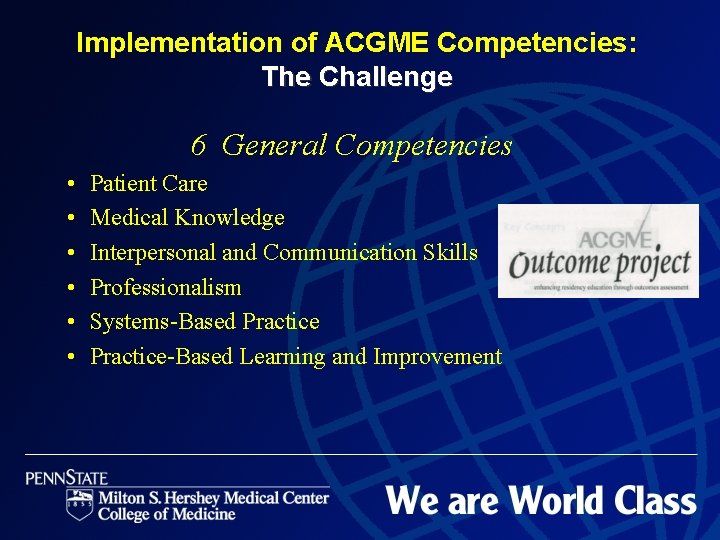
Implementation of ACGME Competencies: The Challenge 6 General Competencies • • • Patient Care Medical Knowledge Interpersonal and Communication Skills Professionalism Systems-Based Practice-Based Learning and Improvement
Implementation of ACGME Competencies: The Opportunity • Anesthesiology Department: 35 Faculty + 45 Residents/Fellows • Known for Excellence in Education • Capitalize on Existing Expertise • Align department around a cohesive educational goal
Implementation of ACGME Competencies: The Vision A Model Department of Anesthesiology • • • Future Anesthesiology, Today! Attract Patients to the Institution! Improve and Advance Patient Health Through Research! Educating for Future Competence! A Springboard to Leadership!
Vision: Translation into Action It’s not how many ideas you have. It’s how many you make happen. (Accenture)
Implementation of ACGME Competencies: Process • • • Set the goals Build the teams Provide Education/Information/Support Provide the focus (Retreat – 7 weeks later) Provide medium and forums for presentation and departmental updates
Implementation of ACGME Competencies: Process: Set the Goals • Executive Committee • Selected 4/6 competencies • Identified team leaders • Identified Retreat Focus (7/52) • Identified what needed to be achieved at the retreat
Implementation of ACGME Competencies: Process: Build the Teams • Faculty informed of vision “Educating for Future Competence” • Faculty meeting outlined goals and structure of retreat (6/52) • Faculty/Resident sign-up for teams of choice
Implementation of ACGME Competencies: Process: Provide Education/Information/Support • Faculty and Residents: Brief lecture on competencies • Invited Grand Rounds Speaker: National Expert (R. Patel, MD) • Provided Toolbox and outline address for information • Provided team leaders with coaching (Bob Marine) • Goal Development
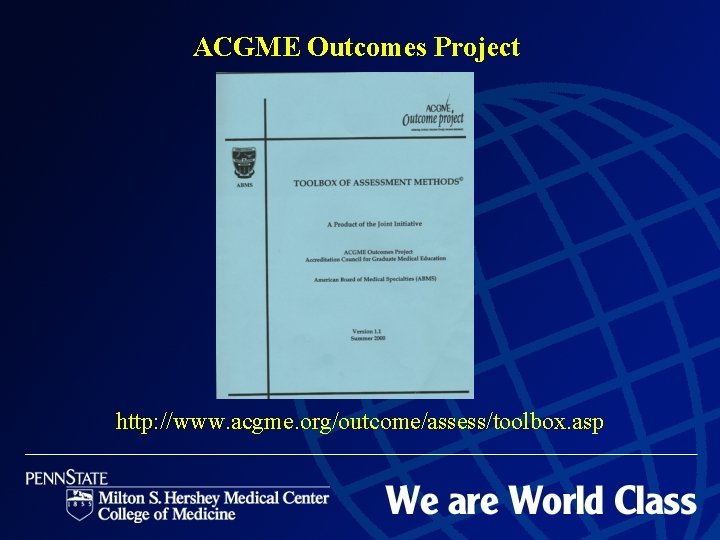
ACGME Outcomes Project http: //www. acgme. org/outcome/assess/toolbox. asp
Implementation of ACGME Competencies: Process: Provide Education/Information/Support • Faculty and Residents: Brief lecture on competencies • Invited Grand Rounds Speaker: National Expert (R. Patel, MD) • Provided Toolbox and outline address for information • Provided team leaders with coaching (Bob Marine) • Goal Development
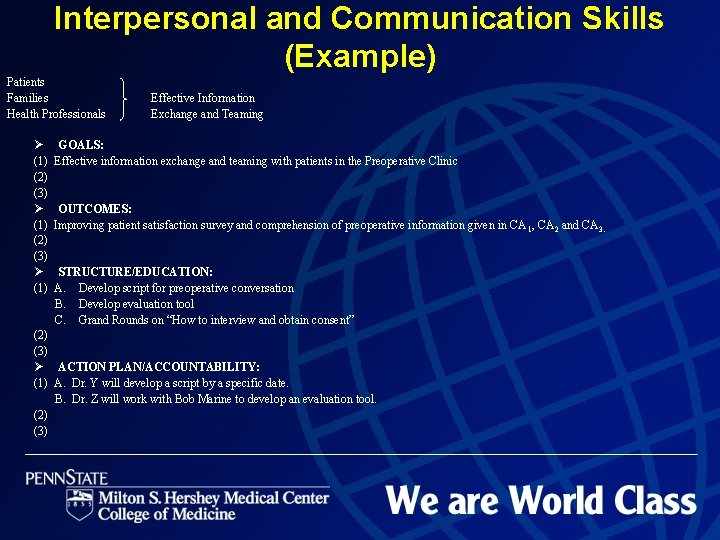
Interpersonal and Communication Skills (Example) Patients Families Health Professionals Effective Information Exchange and Teaming Ø GOALS: (1) Effective information exchange and teaming with patients in the Preoperative Clinic (2) (3) Ø OUTCOMES: (1) Improving patient satisfaction survey and comprehension of preoperative information given in CA 1, CA 2 and CA 3. (2) (3) Ø STRUCTURE/EDUCATION: (1) A. Develop script for preoperative conversation B. Develop evaluation tool C. Grand Rounds on “How to interview and obtain consent” (2) (3) Ø ACTION PLAN/ACCOUNTABILITY: (1) A. Dr. Y will develop a script by a specific date. B. Dr. Z will work with Bob Marine to develop an evaluation tool. (2) (3)
Implementation of ACGME Competencies: Process: Provide the Focus • Retreat as a Goal • Defined what a successful retreat would look like
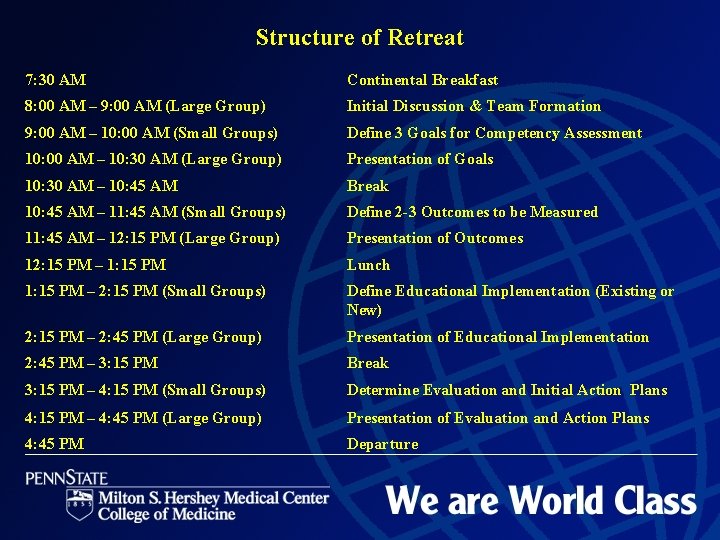
Structure of Retreat 7: 30 AM Continental Breakfast 8: 00 AM – 9: 00 AM (Large Group) Initial Discussion & Team Formation 9: 00 AM – 10: 00 AM (Small Groups) Define 3 Goals for Competency Assessment 10: 00 AM – 10: 30 AM (Large Group) Presentation of Goals 10: 30 AM – 10: 45 AM Break 10: 45 AM – 11: 45 AM (Small Groups) Define 2 -3 Outcomes to be Measured 11: 45 AM – 12: 15 PM (Large Group) Presentation of Outcomes 12: 15 PM – 1: 15 PM Lunch 1: 15 PM – 2: 15 PM (Small Groups) Define Educational Implementation (Existing or New) 2: 15 PM – 2: 45 PM (Large Group) Presentation of Educational Implementation 2: 45 PM – 3: 15 PM Break 3: 15 PM – 4: 15 PM (Small Groups) Determine Evaluation and Initial Action Plans 4: 15 PM – 4: 45 PM (Large Group) Presentation of Evaluation and Action Plans 4: 45 PM Departure
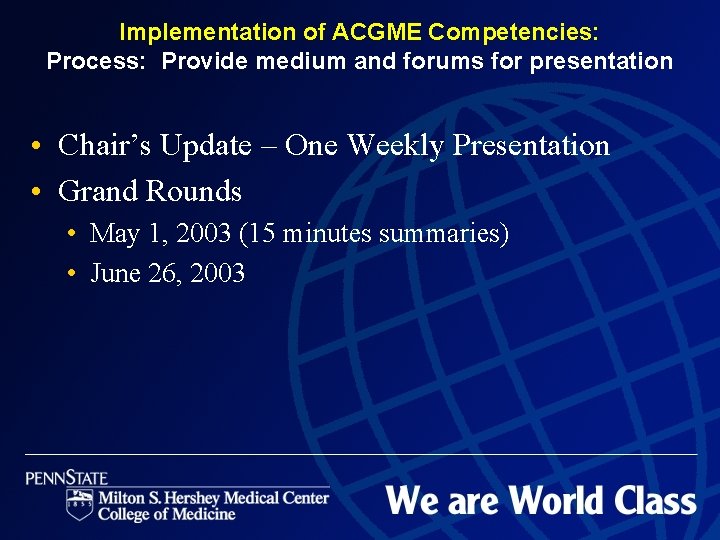
Implementation of ACGME Competencies: Process: Provide medium and forums for presentation • Chair’s Update – One Weekly Presentation • Grand Rounds • May 1, 2003 (15 minutes summaries) • June 26, 2003
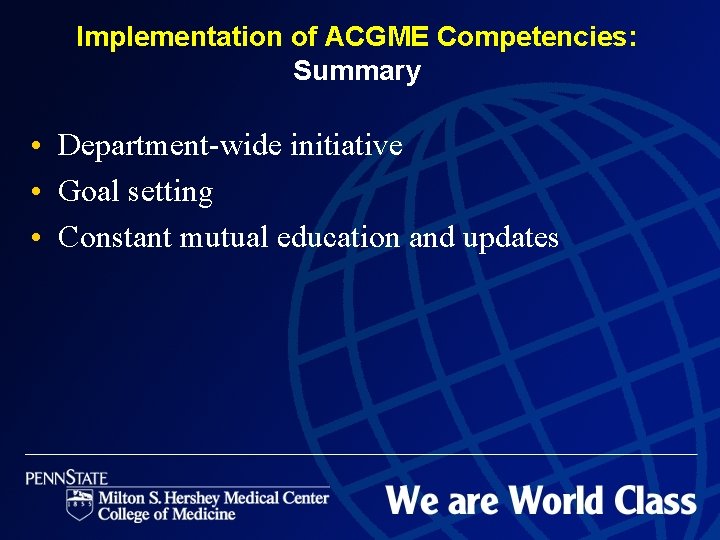
Implementation of ACGME Competencies: Summary • Department-wide initiative • Goal setting • Constant mutual education and updates
A Model for Implementing ACGME Competencies within a Department