
A MINOR PROJECT REPORT ON Fabrication of a
A MINOR PROJECT REPORT ON Fabrication of a Manually Operated Paper-Recycling Machine Faculty of Engineering & Technology Gurukula Kangri Vishwavidyalaya Haridwar-249404 (UK) Session: 2016 -17 Submitted by: Abhijit Kumar (Roll No. 01) Amrendra Kumar (Roll No. 10) Prakhar Katiyar (Roll No. 59) Shivram Kumar (Roll No. 81) Under the guidance of: Mr. Shobhit Srivastava Assistant Professor Department of Mechanical Engineering 1
CONTENTS • Introduction • Literature Review • Discription of Paper Recycling Machine • Working Principle of Paper Recycling Machine • Design procedure of Paper Recycling Machine • Advantages & Disadvantages of Paper Recycling Machine • References 2
INTRODUCTION • Paper recycling is the process of recovering waste paper and remaking it into new paper products. • There are three categories of paper that can be used as feedstock for making recycled paper: I. mill broke, II. pre-consumer waste, and III. post-consumer waste. • Designing a manually operated paper recycling plant ensures that a cheap and noncomplex method. • The fabricated plant consists of six major component units that include the disc refiner, the hydropulper, the head box, the felt conveyor, the driers and the rollers. • The designing and fabricating of a used paper recycling plant is a welcome development as it will ensure that the source of raw material for paper production is multiplied and also waste paper that could have constituted into wastes are recycled for various productive purposes. • Paper recycling saves the nature. 3
Literature Review • Kenneth W. B. (1970), “The paper recycling, means the repeated defibring, grinding and drying, when there altered the mechanical properties of the secondary stock, the chemical properties of fibres, the polymerisation degree of pulp polysaccharidic components, mainly of cellulose, their supramolecular structure, the morphological structure of fibres, range and level of inter fibres bonds. ” • Carlson W. E. C. (May 6, 1991), ” Designing a manually operated paper recycling plant ensures that a cheap and noncomplex method of production of paper product is guaranteed. Recycling, which is the extraction and recovery of valuable materials from scrap or other discarded materials, is employed to supplement the production of paper. ” • Flory, P. J. (1942), ”Paper is one of the most important products ever invented by man. The primary raw material for the paper production is pulps fibres obtaining by acomplicated chemical process from natural materials, mainly from wood. ” 4
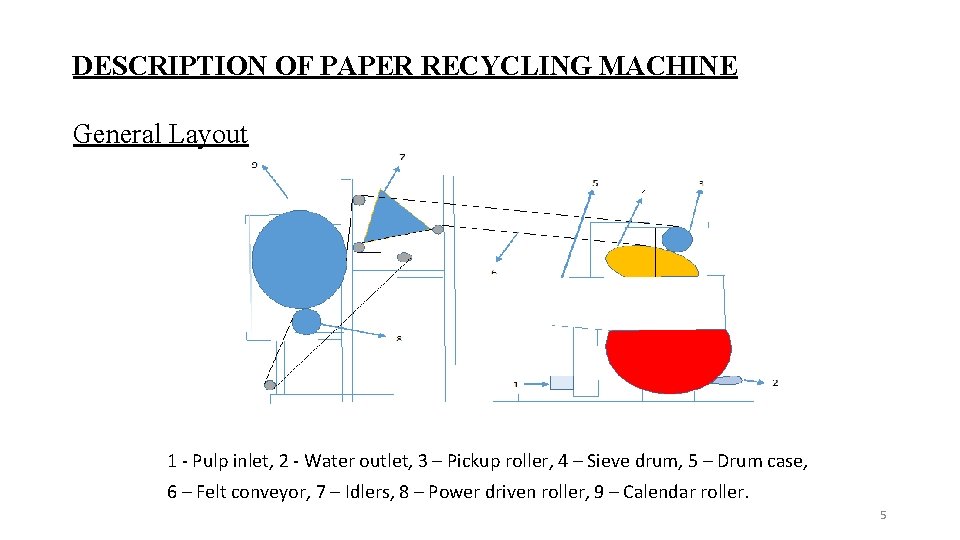
DESCRIPTION OF PAPER RECYCLING MACHINE General Layout 1 - Pulp inlet, 2 - Water outlet, 3 – Pickup roller, 4 – Sieve drum, 5 – Drum case, 6 – Felt conveyor, 7 – Idlers, 8 – Power driven roller, 9 – Calendar roller. 5
• The designed of a waste paper recycling plant included the determination of the volume of the refiner, hydropulper and head box. • The bulk of the parts of the plant were fabricated using mild steel due to its versatility, very cheap and readily available compare to other metals. • The manually operated paper recycling machine unit broadly consists of the following four systems: - I. Pulp feeding system- It consists of the sieve drum, drum case and the pickup roller. Its function is the preparation of pulp slurry and feeding it. II. Pulp transferring system- It consists of the nylon felt conveyor and the set of pulley & idler. Its function is to transfer the slurry to the calendaring system. III. Calendaring system- It consists of two calendar rollers. Here the pulp gets calendared to paper and then the paper is removed out. IV. Driving mechanism- It consists of an electric motor, a gear box and a pulley-belt drive. 6
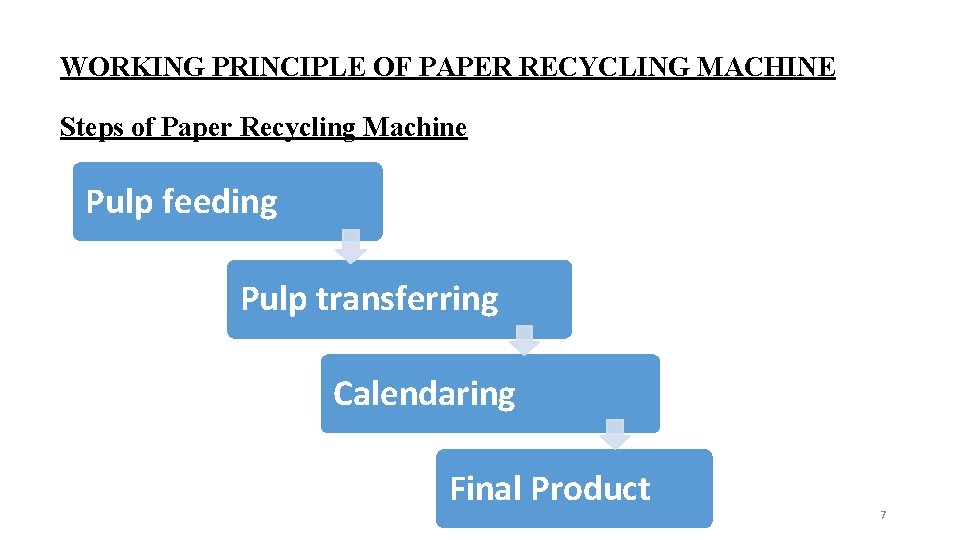
WORKING PRINCIPLE OF PAPER RECYCLING MACHINE Steps of Paper Recycling Machine Pulp feeding Pulp transferring Calendaring Final Product 7
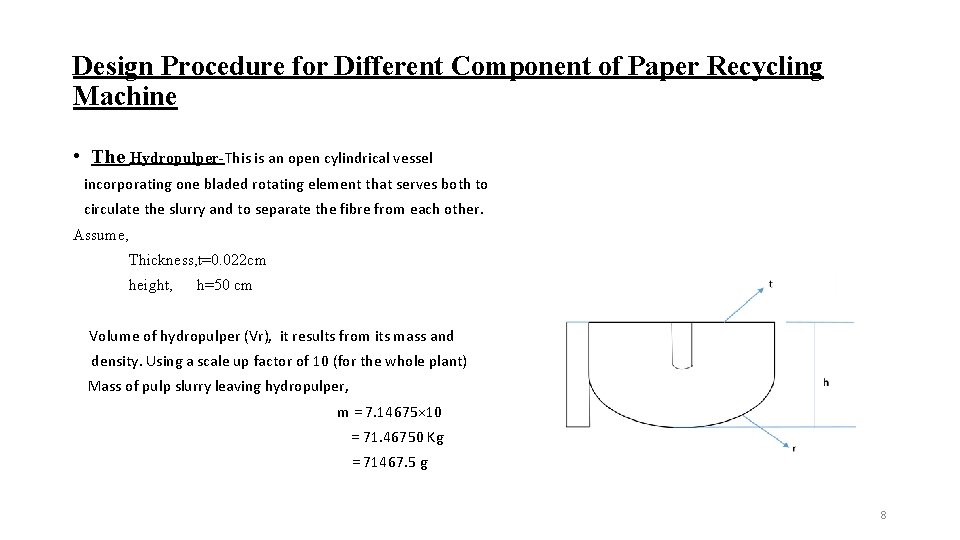
Design Procedure for Different Component of Paper Recycling Machine • The Hydropulper-This is an open cylindrical vessel incorporating one bladed rotating element that serves both to circulate the slurry and to separate the fibre from each other. Assume, Thickness, t=0. 022 cm height, h=50 cm Volume of hydropulper (Vr), it results from its mass and density. Using a scale up factor of 10 (for the whole plant) Mass of pulp slurry leaving hydropulper, m = 7. 14675× 10 = 71. 46750 Kg = 71467. 5 g 8
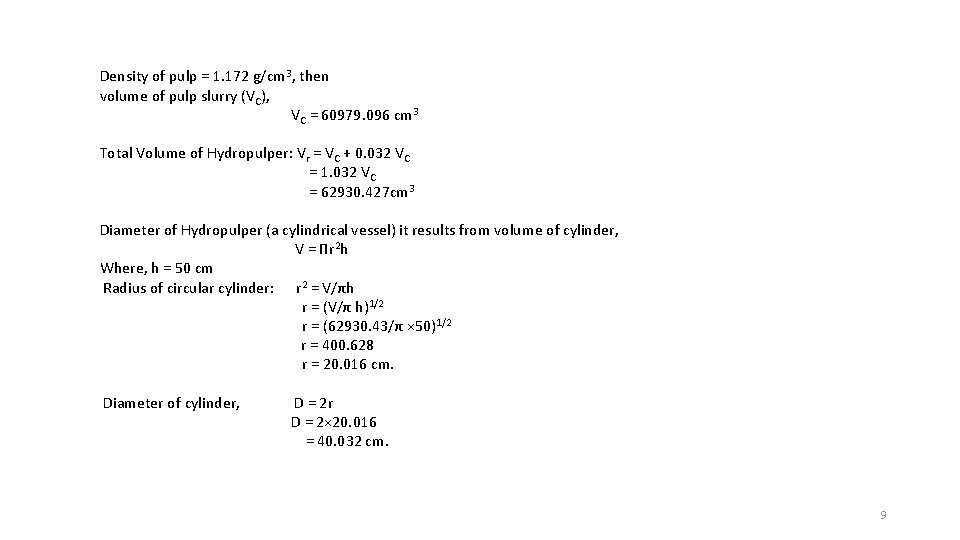
Density of pulp = 1. 172 g/cm 3, then volume of pulp slurry (VC), VC = 60979. 096 cm 3 Total Volume of Hydropulper: Vr = VC + 0. 032 VC = 1. 032 VC = 62930. 427 cm 3 Diameter of Hydropulper (a cylindrical vessel) it results from volume of cylinder, V = Πr 2 h Where, h = 50 cm Radius of circular cylinder: r 2 = V/πh r = (V/π h)1/2 r = (62930. 43/π × 50)1/2 r = 400. 628 r = 20. 016 cm. Diameter of cylinder, D = 2 r D = 2× 20. 016 = 40. 032 cm. 9
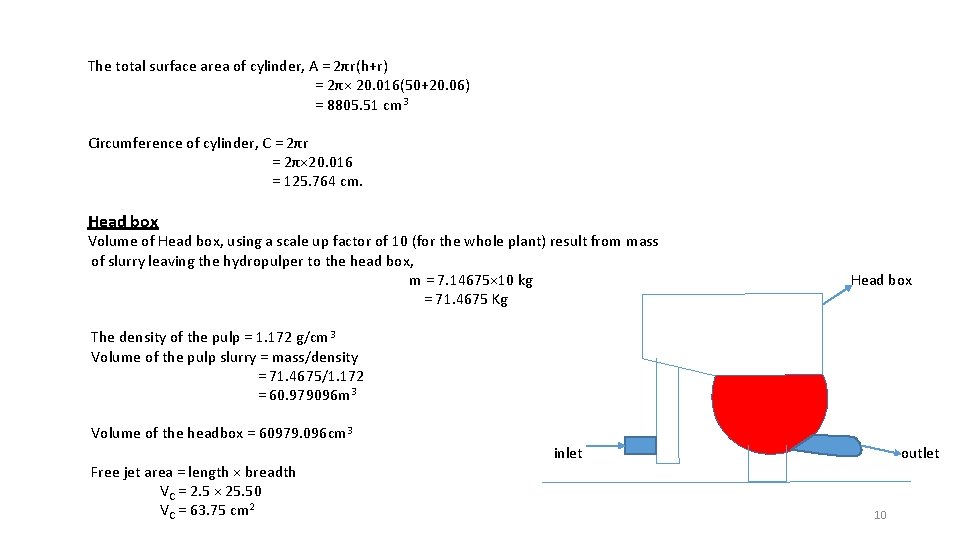
The total surface area of cylinder, A = 2πr(h+r) = 2π× 20. 016(50+20. 06) = 8805. 51 cm 3 Circumference of cylinder, C = 2πr = 2π× 20. 016 = 125. 764 cm. Head box Volume of Head box, using a scale up factor of 10 (for the whole plant) result from mass of slurry leaving the hydropulper to the head box, m = 7. 14675× 10 kg Head box = 71. 4675 Kg The density of the pulp = 1. 172 g/cm 3 Volume of the pulp slurry = mass/density = 71. 4675/1. 172 = 60. 979096 m 3 Volume of the headbox = 60979. 096 cm 3 inlet outlet Free jet area = length × breadth VC = 2. 5 × 25. 50 VC = 63. 75 cm 2 10
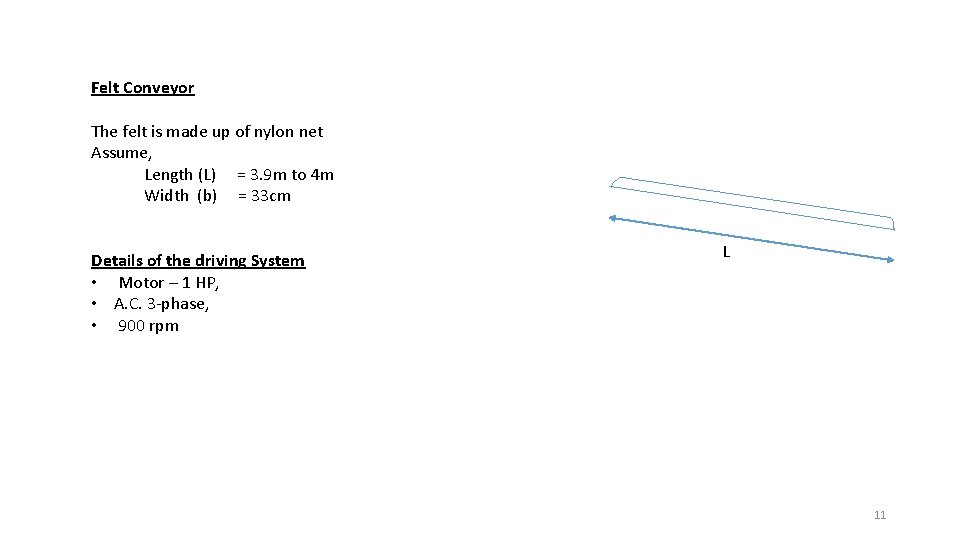
Felt Conveyor The felt is made up of nylon net Assume, Length (L) = 3. 9 m to 4 m Width (b) = 33 cm Details of the driving System • Motor – 1 HP, • A. C. 3 -phase, • 900 rpm L 11
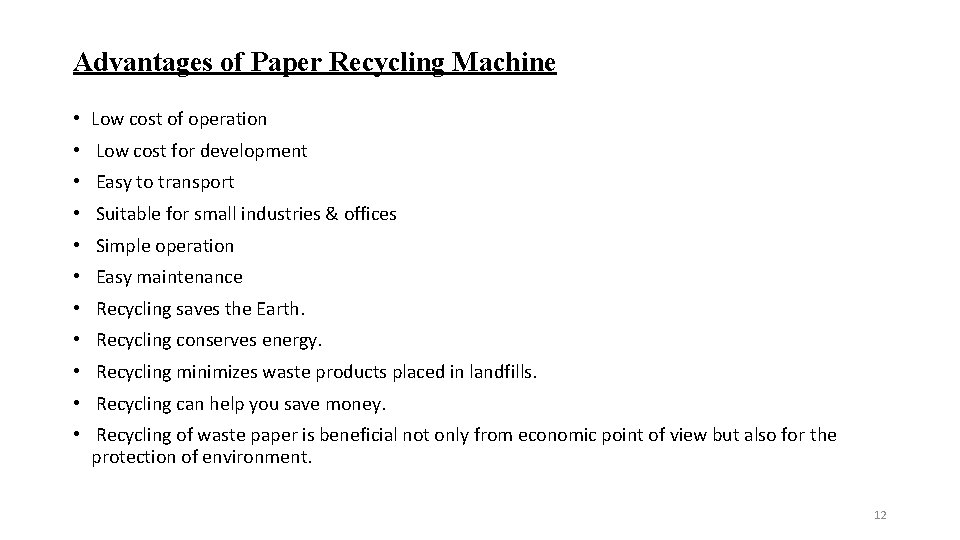
Advantages of Paper Recycling Machine • Low cost of operation • Low cost for development • Easy to transport • Suitable for small industries & offices • Simple operation • Easy maintenance • Recycling saves the Earth. • Recycling conserves energy. • Recycling minimizes waste products placed in landfills. • Recycling can help you save money. • Recycling of waste paper is beneficial not only from economic point of view but also for the protection of environment. 12
Disadvantages of Paper Recycling Machine • Recycling can create problems, if not done right. • Recycling can increase low quality jobs. • Recycling is not always cost-efficient. 13
References • Kenneth W. B. , Handbook on Pulp and Paper Technology, Second Edition, Van Nostrand Reinhold Co. , New York, 1970. • Carlson W. E. C. , Recycle Process Inc. USA, PCT/US 91/03084, May 6, 1991. • Paul, D. R. , Vinson, C. E. , and Locke, C. E. , Polym. Eng. and Sci. , 12, 3 (1972). • Flory, P. J. , J. Chem. Phys. , 10, 51 (1942). • Mondragon, I. and Nazabal, J. , Polym. Eng. Sci. , 32, 6191 (1986). • Hills, Richard, "Papermaking in Britain 1488– 1988", Athlone Press, 1988. • Meyers R. A. , Encyclopaedia of Physical Science and Technology, Vol. 9, 14 and 15, Second Edition, Academic Press, London, 1992. 14
- Slides: 14