
A Midsummers Nightmare An Editing Drama in Several
- Slides: 13
A Midsummer’s Nightmare An Editing Drama in Several Acts Loosely based on the drama, Midsummer’s Night Dream, by William Shakespeare. Modified from Caught Ya! by Jane Bell Kiester
Caught Ya! Grammar Twice a week, you will read a short passage from a revised version of Shakespeare’s play, A Midsummer’s Night Dream, here entitled A Midsummer’s Nightmare. Copy the day’s passage into the right column of your Cornell note form, editing as you go. Correct as many errors as you can find. To earn extra credit, find and correct the day’s “Caught Ya!” error. Your teacher will be moving around the room giving you a hint as to whether you found it or not. You can also earn extra credit by defining the bold print vocabulary in your own words, or looking for special
Caught Ya! Grammar How to Check Your Answers Once time is called, you will see the passage written correctly. As your teacher goes over the errors, use a different color pen to put a check mark (� ) over any error that you found on your own. If you found and corrected the day’s Caught Ya! error, put an extra check mark on it. For every error that you missed, use the appropriate editing mark (see the handout) to correct it. If you use an editing mark, you can still receive credit for the correction if you record the rule in the left column of your notes.
Caught Ya! Grammar How to Grade Your Answers You will calculate two scores for this exercise. First Score: Count the number of checks and put that number over the total errors. For example, if there were 20 errors, and you found 10, you would write 10/20. Then divide the bottom number (denominator) into the top number (numerator) to find your percent. Remember that your answer will be in decimal form. To turn this into a percentage, move the decimal two places to the right. In this example, 10/20 = 0. 50. Move the decimal to get 50%.
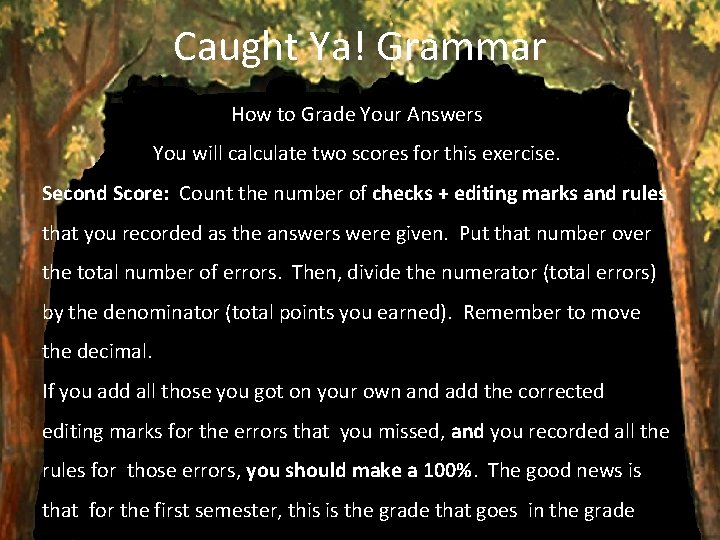
Caught Ya! Grammar How to Grade Your Answers You will calculate two scores for this exercise. Second Score: Count the number of checks + editing marks and rules that you recorded as the answers were given. Put that number over the total number of errors. Then, divide the numerator (total errors) by the denominator (total points you earned). Remember to move the decimal. If you add all those you got on your own and add the corrected editing marks for the errors that you missed, and you recorded all the rules for those errors, you should make a 100%. The good news is that for the first semester, this is the grade that goes in the grade
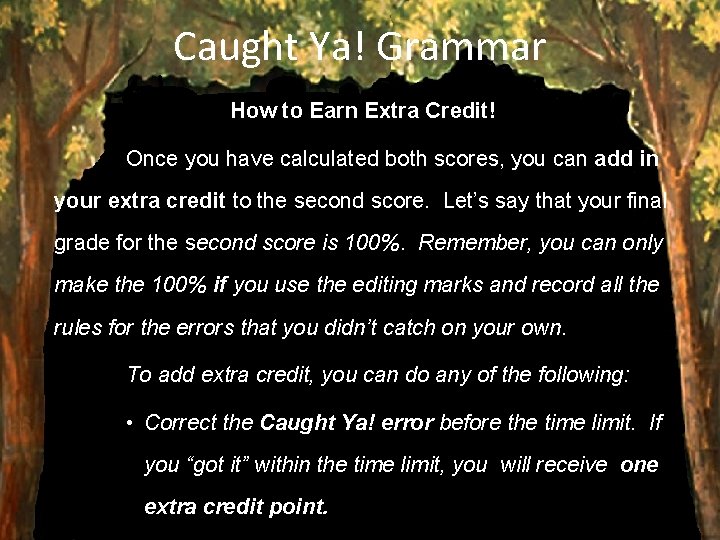
Caught Ya! Grammar How to Earn Extra Credit! Once you have calculated both scores, you can add in your extra credit to the second score. Let’s say that your final grade for the second score is 100%. Remember, you can only make the 100% if you use the editing marks and record all the rules for the errors that you didn’t catch on your own. To add extra credit, you can do any of the following: • Correct the Caught Ya! error before the time limit. If you “got it” within the time limit, you will receive one extra credit point.
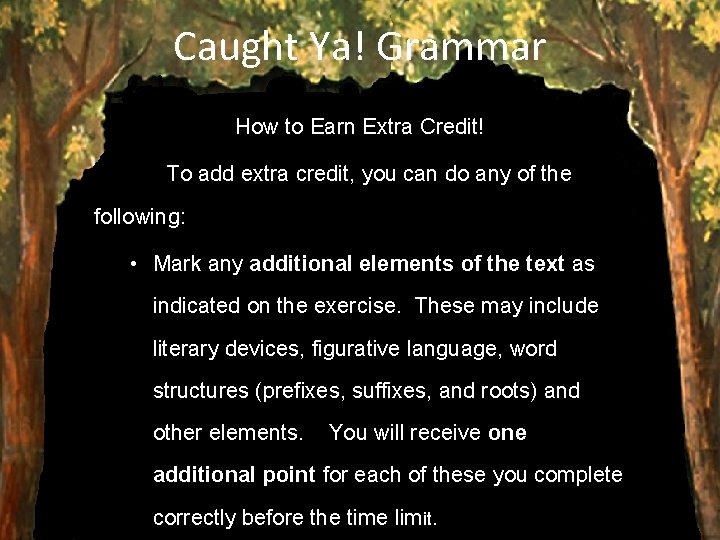
Caught Ya! Grammar How to Earn Extra Credit! To add extra credit, you can do any of the following: • Mark any additional elements of the text as indicated on the exercise. These may include literary devices, figurative language, word structures (prefixes, suffixes, and roots) and other elements. You will receive one additional point for each of these you complete correctly before the time limit.
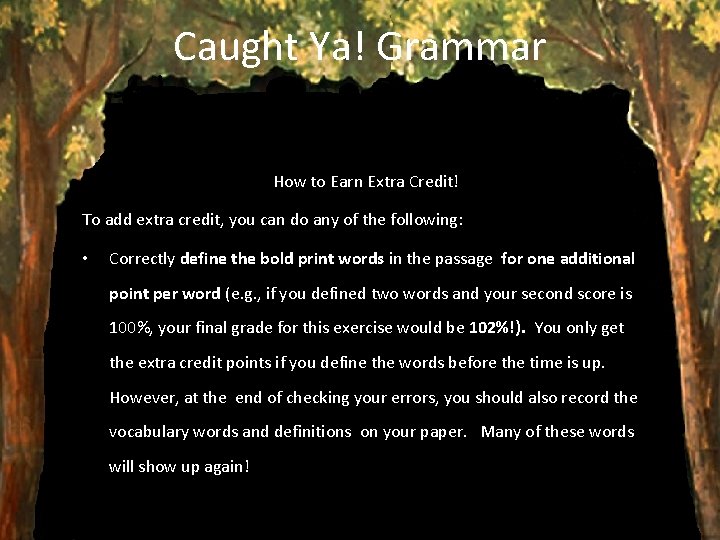
Caught Ya! Grammar How to Earn Extra Credit! To add extra credit, you can do any of the following: • Correctly define the bold print words in the passage for one additional point per word (e. g. , if you defined two words and your second score is 100%, your final grade for this exercise would be 102%!). You only get the extra credit points if you define the words before the time is up. However, at the end of checking your errors, you should also record the vocabulary words and definitions on your paper. Many of these words will show up again!
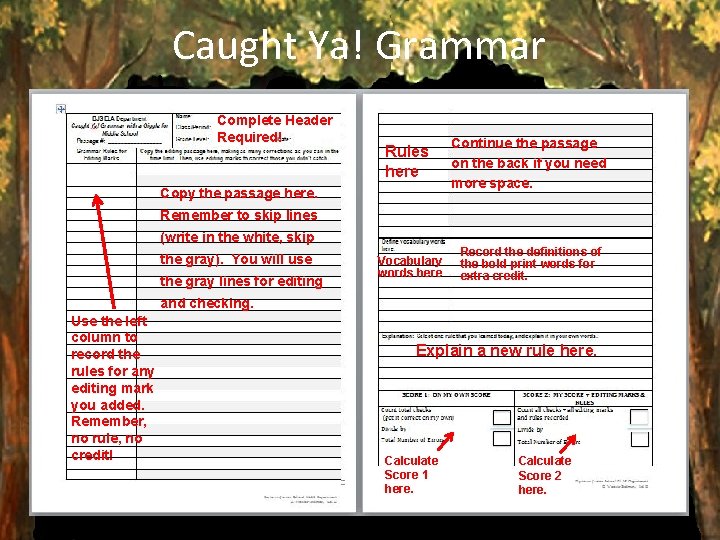
Caught Ya! Grammar Initially, you will use the Caught Ya! note page to record your answers. After you have mastered this format, you will recreate it on your own notebook paper. Take a look at the parts of the note page.
Caught Ya! Grammar Complete Header Required! Rules here Copy the passage here. Continue the passage on the back if you need more space. Remember to skip lines (write in the white, skip the gray). You will use the gray lines for editing Vocabulary words here Record the definitions of the bold print words for extra credit. and checking. Use the left column to record the rules for any editing mark you added. Remember, no rule, no credit! Explain a new rule here. Calculate Score 1 here. Calculate Score 2 here.
Caught Ya! Grammar Today’s Practice Just to make sure we all understand how this process works, we are going to use the first paragraph of our story as a practice. Listen carefully as your teacher reads the passage aloud. This will help you understand the meaning of the passage and give you hints as to the errors in grammar, spelling, and punctuation. Then, copy the passage and make as many corrections as you can find. You will write the passage in the right-hand column of the Caught Ya! notepaper. Skip lines as you write to give yourself plenty of room for the check marks and
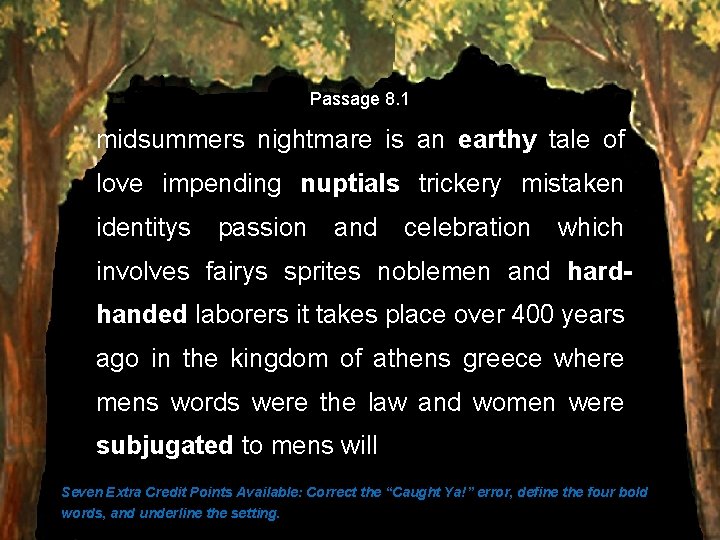
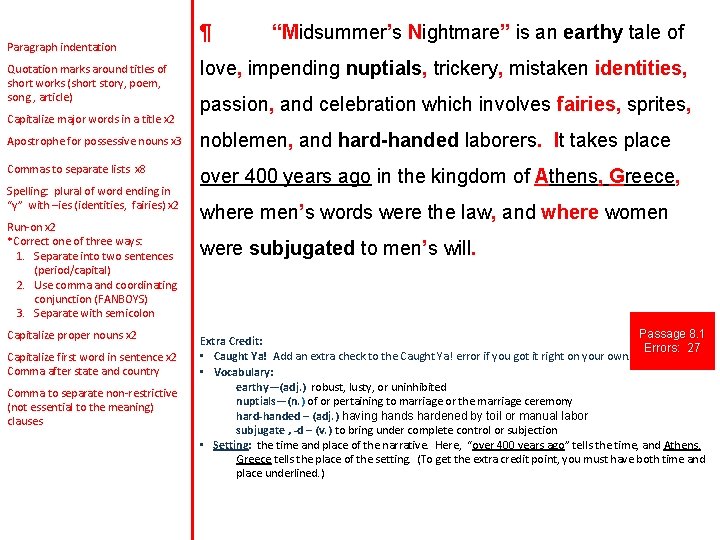
Passage 8. 1 midsummers nightmare is an earthy tale of love impending nuptials trickery mistaken identitys passion and celebration which involves fairys sprites noblemen and hardhanded laborers it takes place over 400 years ago in the kingdom of athens greece where mens words were the law and women were subjugated to mens will Seven Extra Credit Points Available: Correct the “Caught Ya!” error, define the four bold words, and underline the setting.
Paragraph indentation Quotation marks around titles of short works (short story, poem, song , article) Capitalize major words in a title x 2 ¶ “Midsummer’s Nightmare” is an earthy tale of love, impending nuptials, trickery, mistaken identities, passion, and celebration which involves fairies, sprites, Apostrophe for possessive nouns x 3 noblemen, and hard-handed laborers. It takes place Commas to separate lists x 8 over 400 years ago in the kingdom of Athens, Greece, Spelling: plural of word ending in “y” with –ies (identities, fairies) x 2 Run-on x 2 *Correct one of three ways: 1. Separate into two sentences (period/capital) 2. Use comma and coordinating conjunction (FANBOYS) 3. Separate with semicolon Capitalize proper nouns x 2 Capitalize first word in sentence x 2 Comma after state and country Comma to separate non-restrictive (not essential to the meaning) clauses where men’s words were the law, and where women were subjugated to men’s will. Passage 8. 1 Extra Credit: Errors: 27 • Caught Ya! Add an extra check to the Caught Ya! error if you got it right on your own. • Vocabulary: earthy—(adj. ) robust, lusty, or uninhibited nuptials—(n. ) of or pertaining to marriage or the marriage ceremony hard-handed – (adj. ) having hands hardened by toil or manual labor subjugate , -d – (v. ) to bring under complete control or subjection • Setting: the time and place of the narrative. Here, “over 400 years ago” tells the time, and Athens, Greece tells the place of the setting. (To get the extra credit point, you must have both time and place underlined. )