
A Midsummer Nights Dream By William Shakespeare A

A Midsummer Night’s Dream By William Shakespeare

A Midsummer Night’s Dream - Key Facts • Author · William Shakespeare Genres • Comedy, fantasy, romance, farce Date of first publication • 1600 Time and place • written · London, 1594 or 1595 2
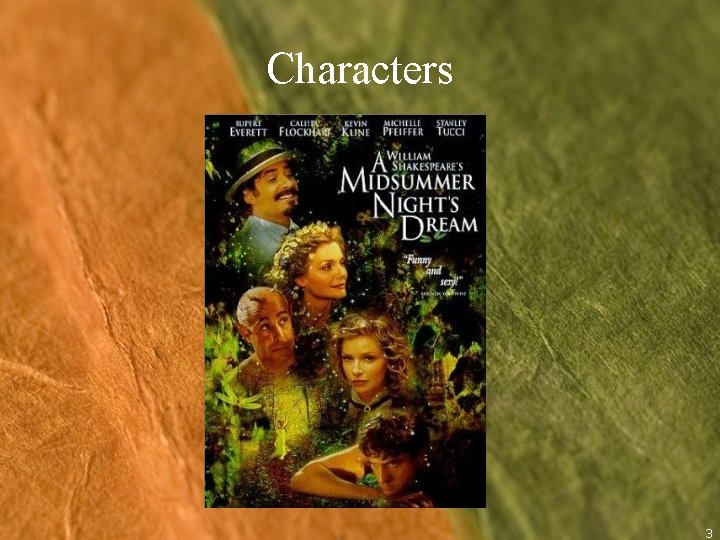
Characters 3
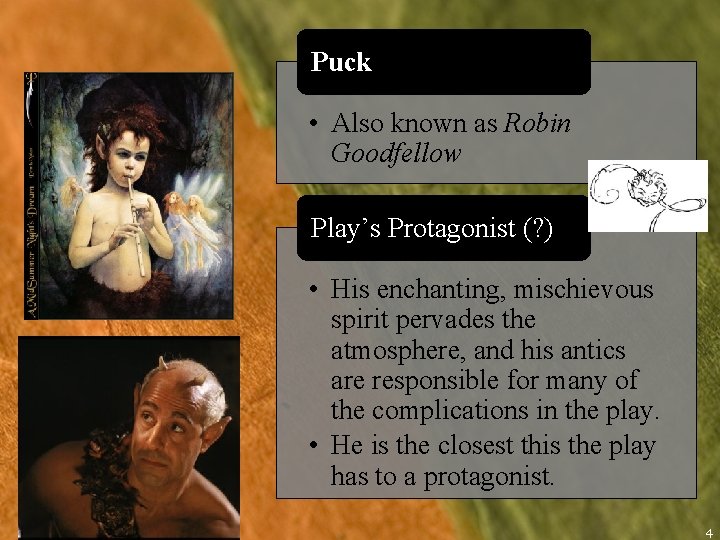
Puck • Also known as Robin Goodfellow Play’s Protagonist (? ) • His enchanting, mischievous spirit pervades the atmosphere, and his antics are responsible for many of the complications in the play. • He is the closest this the play has to a protagonist. 4
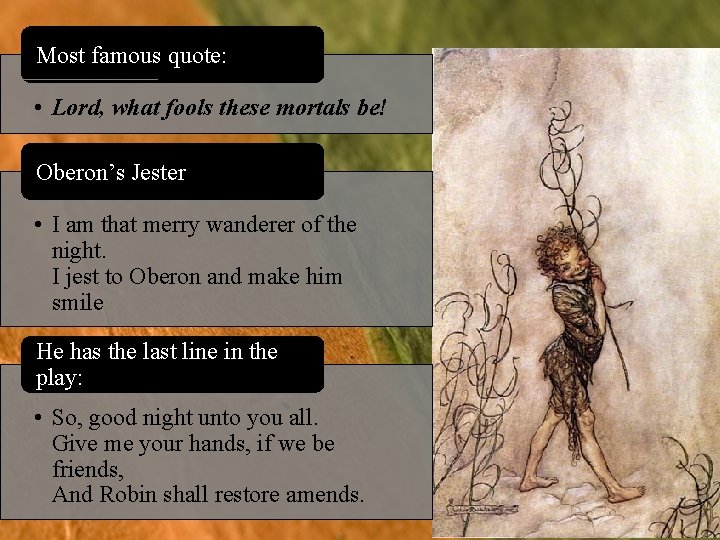
Most famous quote: • Lord, what fools these mortals be! Oberon’s Jester • I am that merry wanderer of the night. I jest to Oberon and make him smile He has the last line in the play: • So, good night unto you all. Give me your hands, if we be friends, And Robin shall restore amends. 5
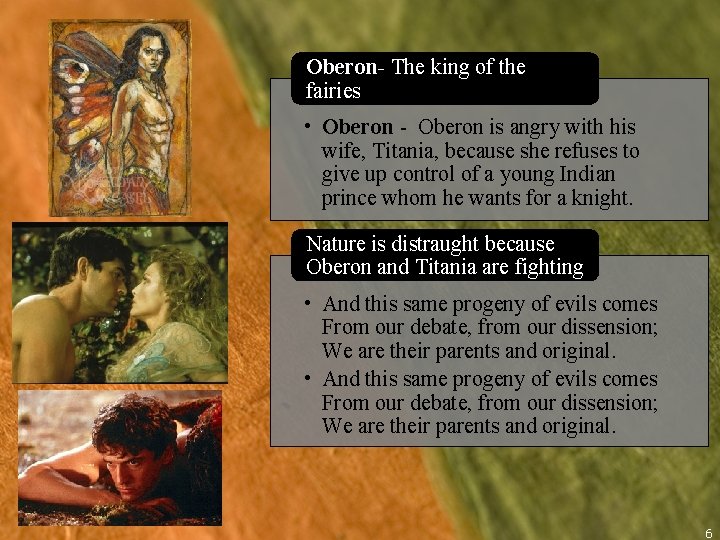
Oberon- The king of the fairies • Oberon - Oberon is angry with his wife, Titania, because she refuses to give up control of a young Indian prince whom he wants for a knight. Nature is distraught because Oberon and Titania are fighting • And this same progeny of evils comes From our debate, from our dissension; We are their parents and original. 6
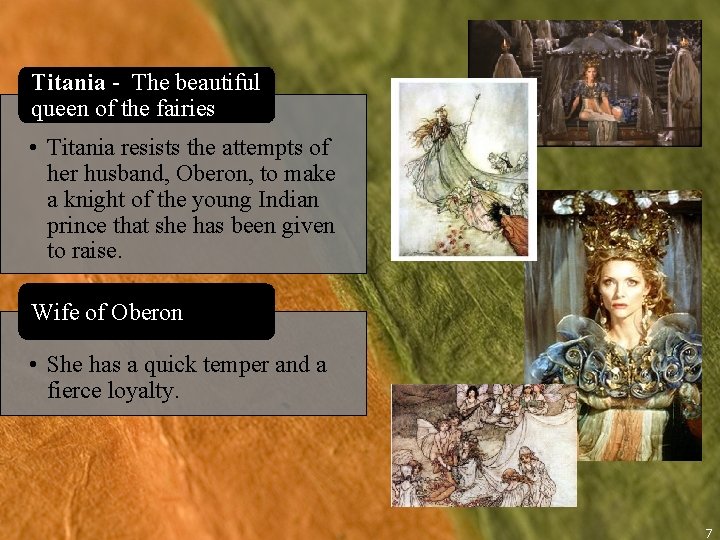
Titania - The beautiful queen of the fairies • Titania resists the attempts of her husband, Oberon, to make a knight of the young Indian prince that she has been given to raise. Wife of Oberon • She has a quick temper and a fierce loyalty. 7
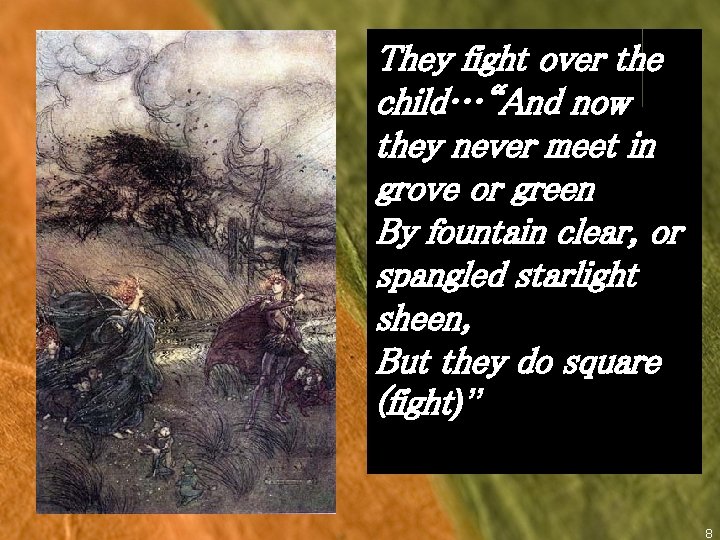
They fight over the child…“And now they never meet in grove or green By fountain clear, or spangled starlight sheen, But they do square (fight)”. 8
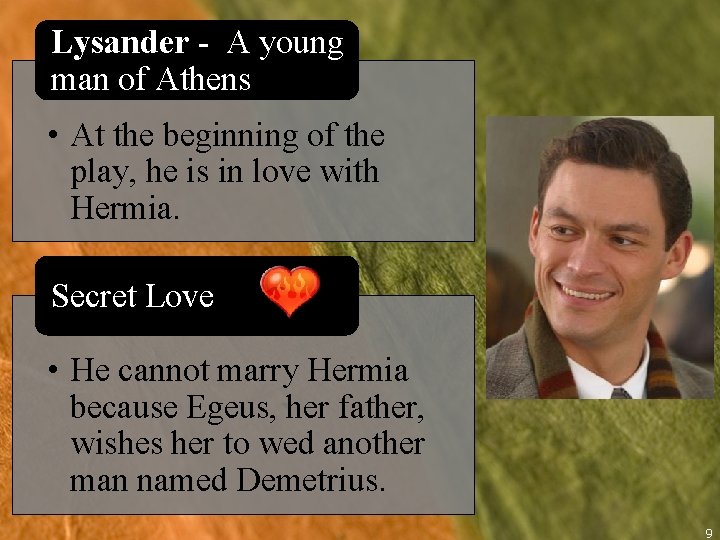
Lysander - A young man of Athens • At the beginning of the play, he is in love with Hermia. Secret Love • He cannot marry Hermia because Egeus, her father, wishes her to wed another man named Demetrius. 9
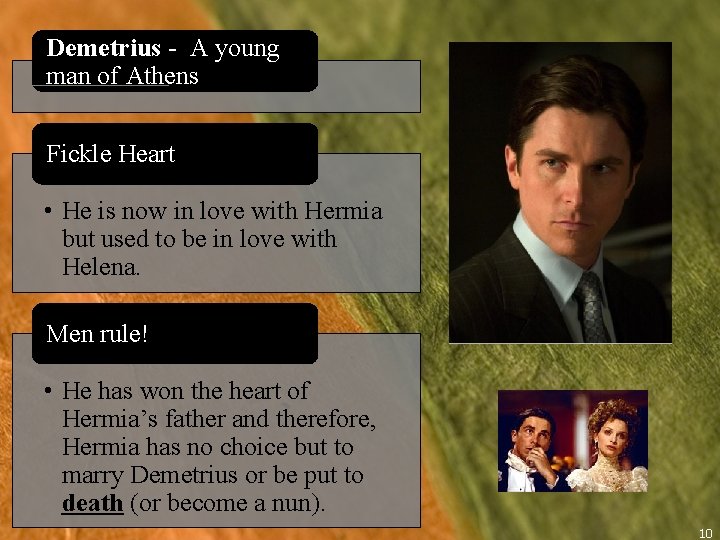
Demetrius - A young man of Athens Fickle Heart • He is now in love with Hermia but used to be in love with Helena. Men rule! • He has won the heart of Hermia’s father and therefore, Hermia has no choice but to marry Demetrius or be put to death (or become a nun). 10
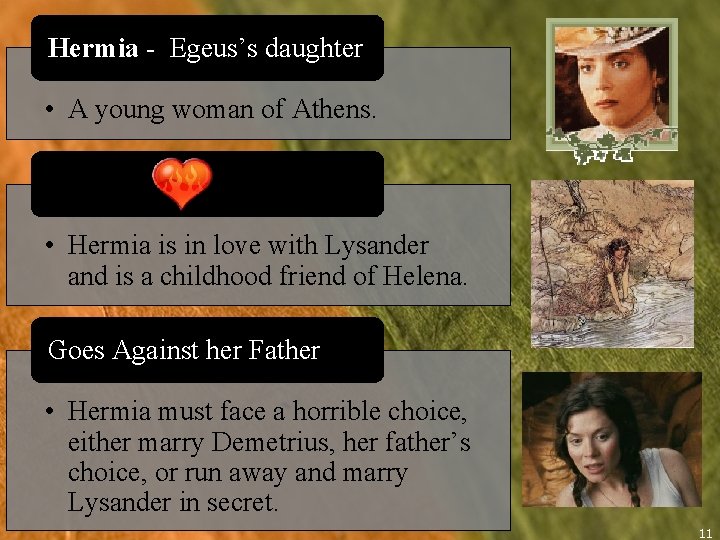
Hermia - Egeus’s daughter • A young woman of Athens. • Hermia is in love with Lysander and is a childhood friend of Helena. Goes Against her Father • Hermia must face a horrible choice, either marry Demetrius, her father’s choice, or run away and marry Lysander in secret. 11
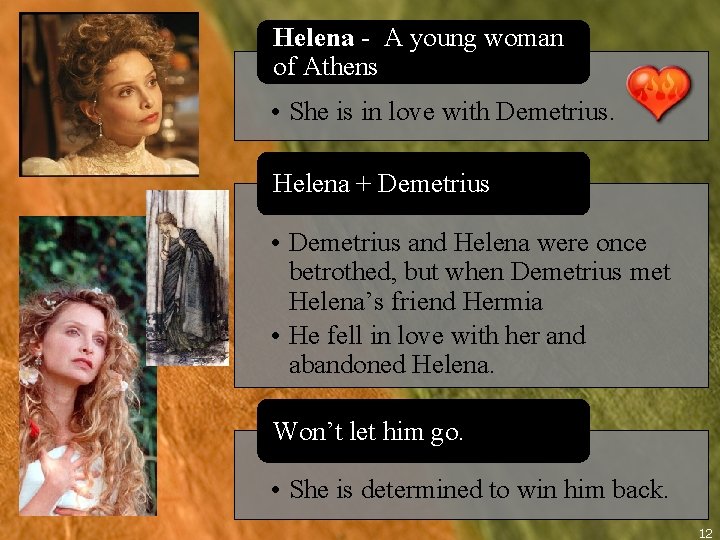
Helena - A young woman of Athens . • She is in love with Demetrius. Helena + Demetrius • Demetrius and Helena were once betrothed, but when Demetrius met Helena’s friend Hermia • He fell in love with her and abandoned Helena. Won’t let him go. • She is determined to win him back. 12
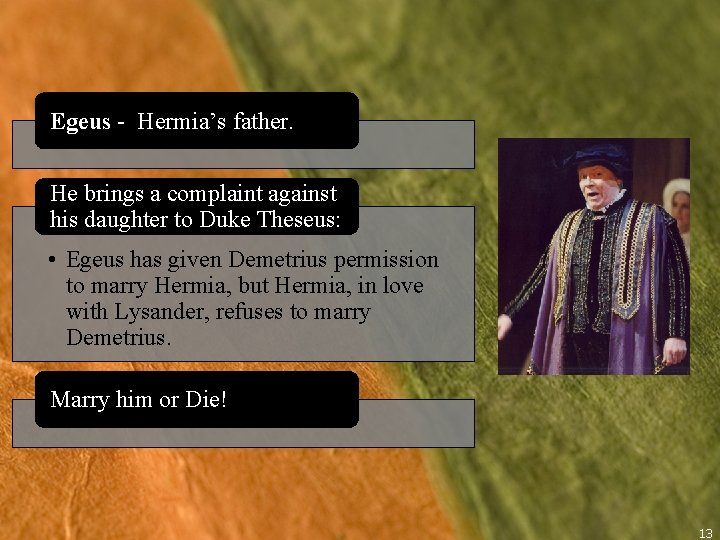
Egeus - Hermia’s father. He brings a complaint against his daughter to Duke Theseus: • Egeus has given Demetrius permission to marry Hermia, but Hermia, in love with Lysander, refuses to marry Demetrius. Marry him or Die! 13
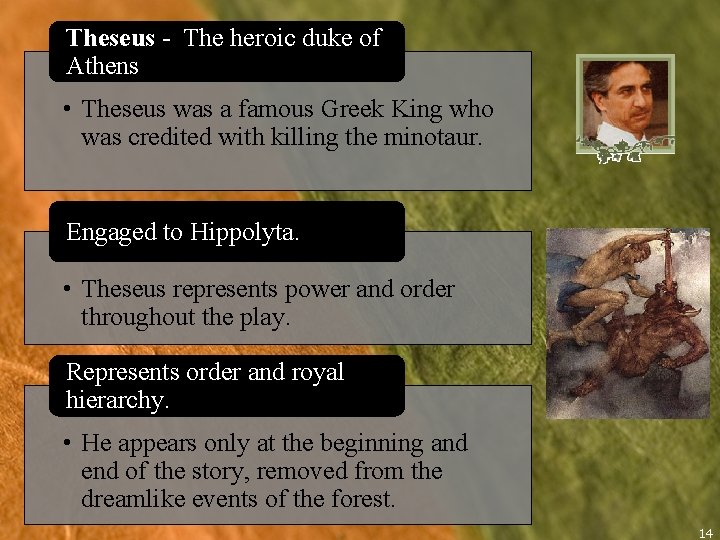
Theseus - The heroic duke of Athens • Theseus was a famous Greek King who was credited with killing the minotaur. Engaged to Hippolyta. • Theseus represents power and order throughout the play. Represents order and royal hierarchy. • He appears only at the beginning and end of the story, removed from the dreamlike events of the forest. 14
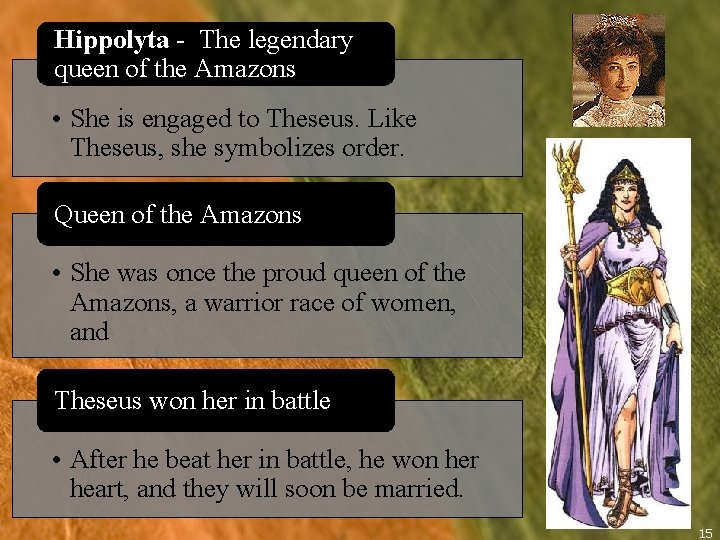
Hippolyta - The legendary queen of the Amazons • She is engaged to Theseus. Like Theseus, she symbolizes order. Queen of the Amazons • She was once the proud queen of the Amazons, a warrior race of women, and Theseus won her in battle • After he beat her in battle, he won her heart, and they will soon be married. 15
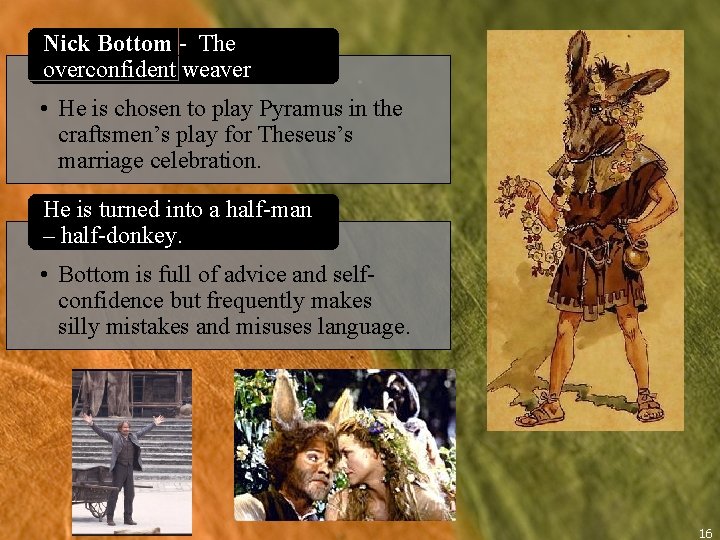
Nick Bottom - The overconfident weaver . • He is chosen to play Pyramus in the craftsmen’s play for Theseus’s marriage celebration. He is turned into a half-man – half-donkey. • Bottom is full of advice and selfconfidence but frequently makes silly mistakes and misuses language. 16
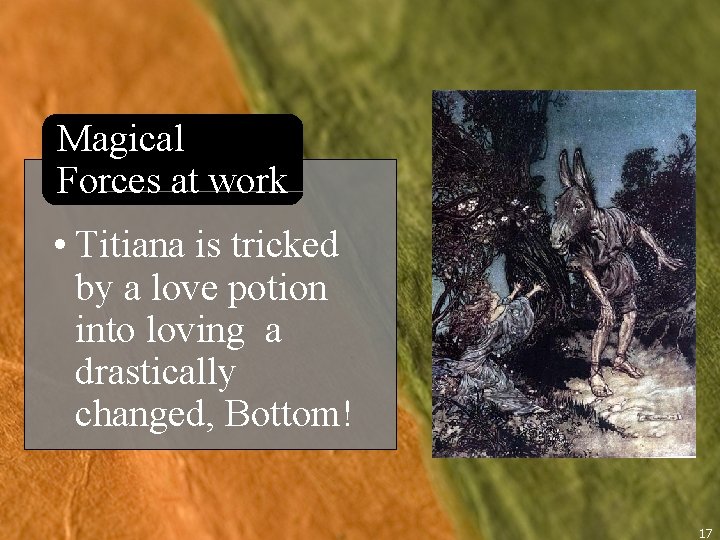
Magical Forces at work • Titiana is tricked by a love potion into loving a drastically changed, Bottom! 17
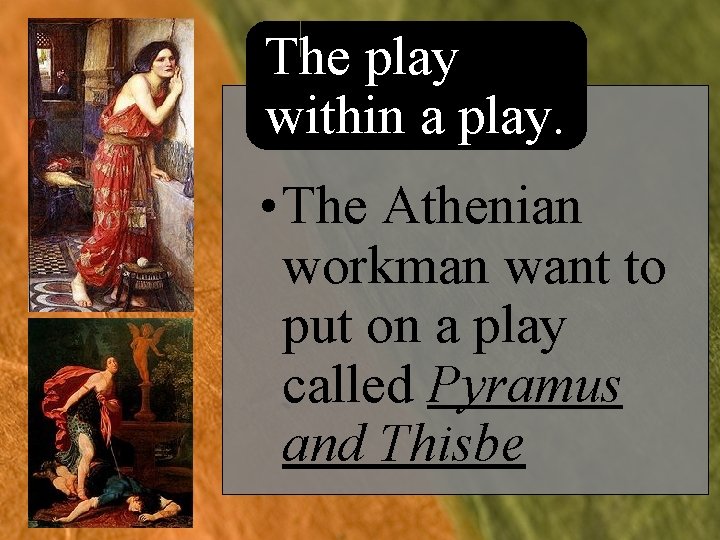
The play within a play. • The Athenian workman want to put on a play called Pyramus and Thisbe
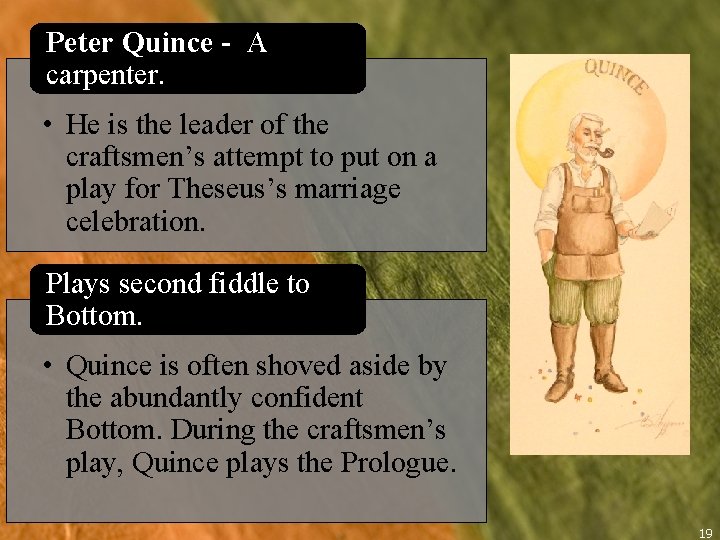
Peter Quince - A carpenter. • He is the leader of the craftsmen’s attempt to put on a play for Theseus’s marriage celebration. Plays second fiddle to Bottom. • Quince is often shoved aside by the abundantly confident Bottom. During the craftsmen’s play, Quince plays the Prologue. 19
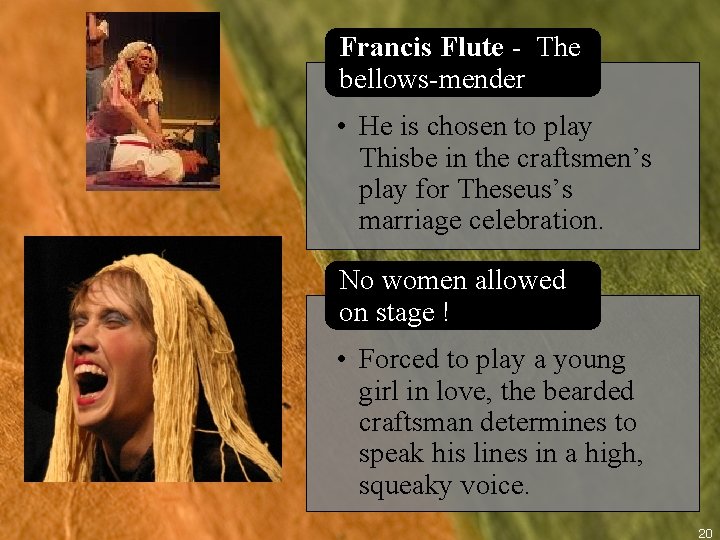
Francis Flute - The bellows-mender • He is chosen to play Thisbe in the craftsmen’s play for Theseus’s marriage celebration. No women allowed on stage ! • Forced to play a young girl in love, the bearded craftsman determines to speak his lines in a high, squeaky voice. 20
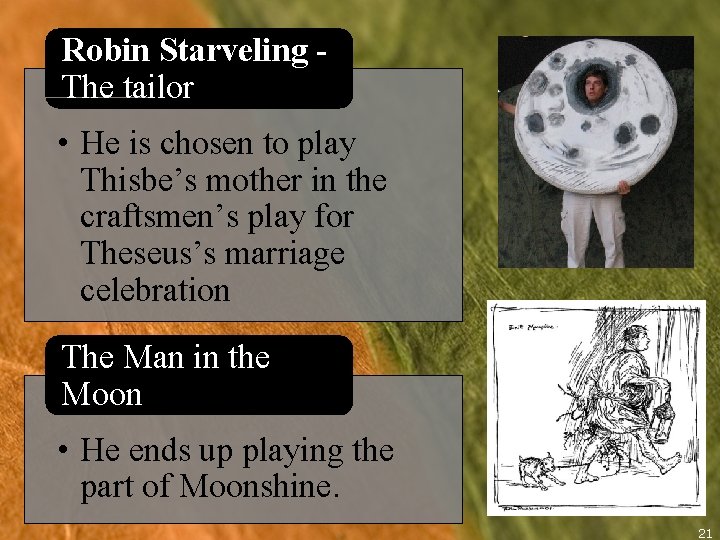
Robin Starveling - The tailor • He is chosen to play Thisbe’s mother in the craftsmen’s play for Theseus’s marriage celebration The Man in the Moon • He ends up playing the part of Moonshine. 21
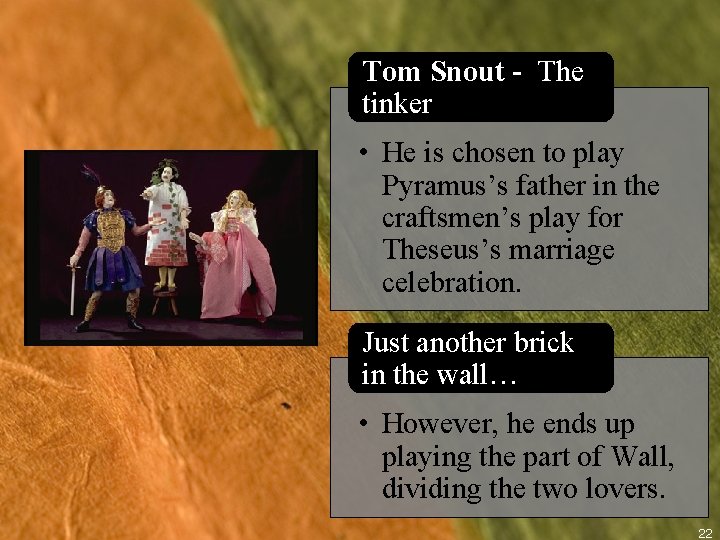
Tom Snout - The tinker • He is chosen to play Pyramus’s father in the craftsmen’s play for Theseus’s marriage celebration. Just another brick in the wall… • However, he ends up playing the part of Wall, dividing the two lovers. 22
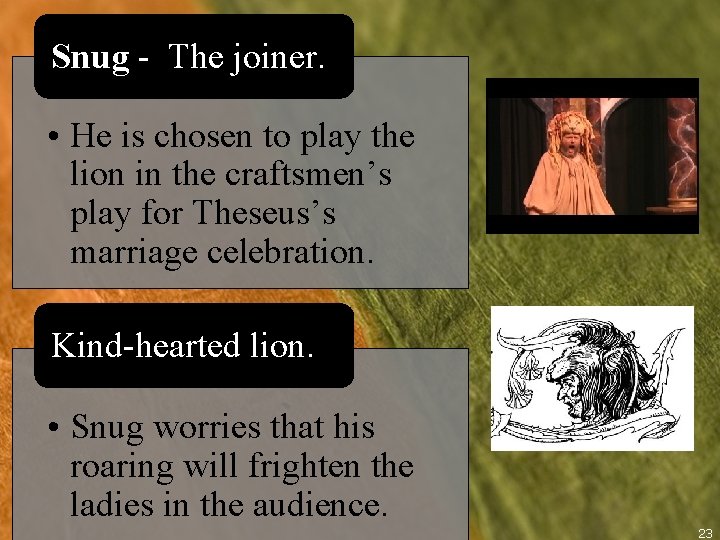
Snug - The joiner. • He is chosen to play the lion in the craftsmen’s play for Theseus’s marriage celebration. Kind-hearted lion. • Snug worries that his roaring will frighten the ladies in the audience. 23
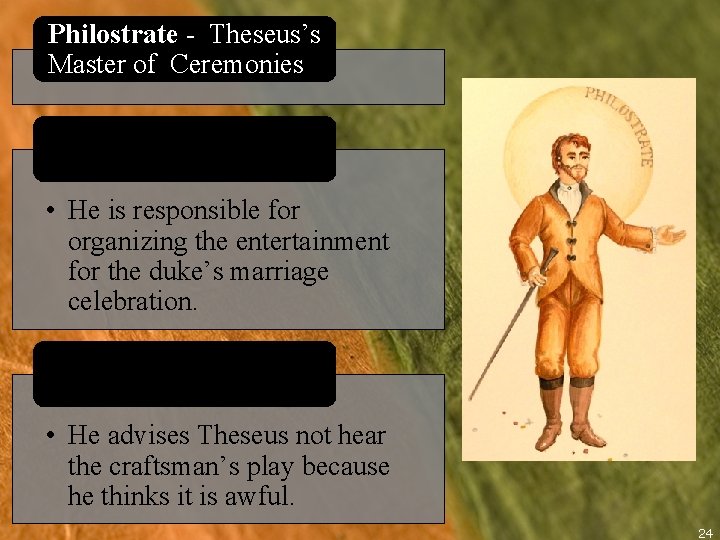
Philostrate - Theseus’s Master of Ceremonies • He is responsible for organizing the entertainment for the duke’s marriage celebration. • He advises Theseus not hear the craftsman’s play because he thinks it is awful. 24
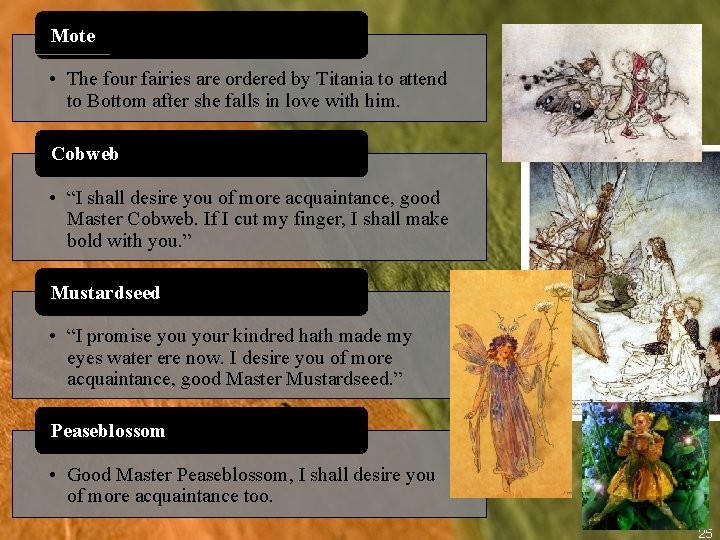
Mote • The four fairies are ordered by Titania to attend to Bottom after she falls in love with him. Cobweb • “I shall desire you of more acquaintance, good Master Cobweb. If I cut my finger, I shall make bold with you. ” Mustardseed • “I promise your kindred hath made my eyes water ere now. I desire you of more acquaintance, good Master Mustardseed. ” Peaseblossom • Good Master Peaseblossom, I shall desire you of more acquaintance too. 25
Symbols • Symbols are objects, characters, figures, and colors used to represent abstract ideas or concepts. 26
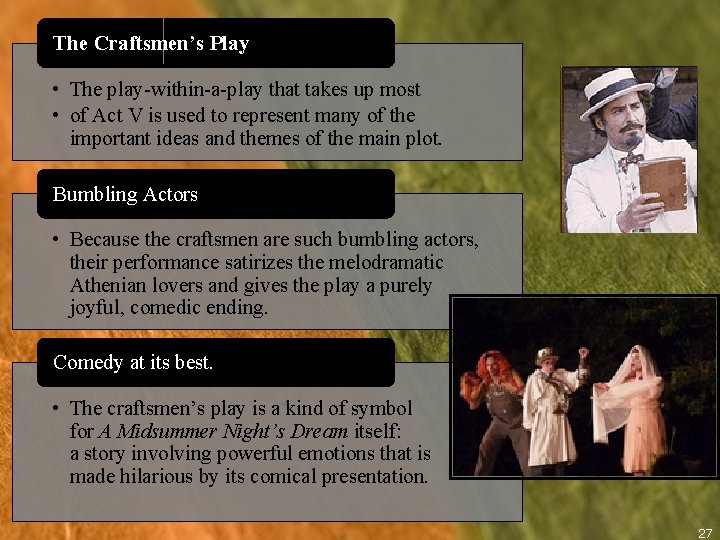
The Craftsmen’s Play • The play-within-a-play that takes up most • of Act V is used to represent many of the important ideas and themes of the main plot. Bumbling Actors • Because the craftsmen are such bumbling actors, their performance satirizes the melodramatic Athenian lovers and gives the play a purely joyful, comedic ending. Comedy at its best. • The craftsmen’s play is a kind of symbol for A Midsummer Night’s Dream itself: a story involving powerful emotions that is made hilarious by its comical presentation. 27
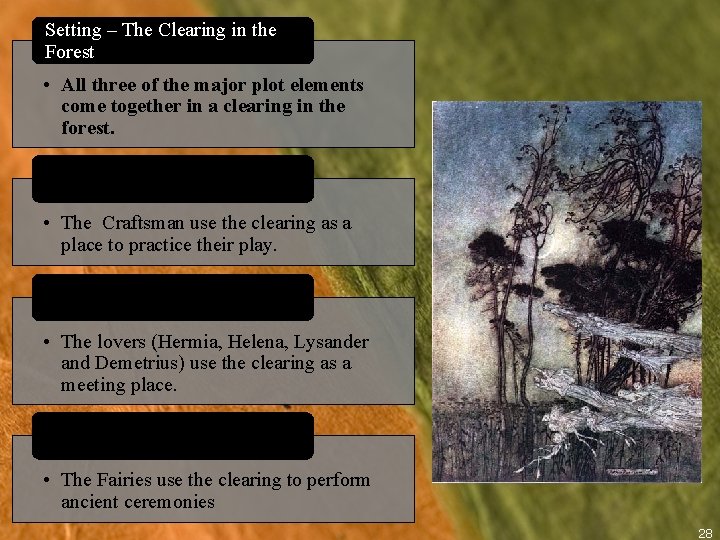
Setting – The Clearing in the Forest • All three of the major plot elements come together in a clearing in the forest. • The Craftsman use the clearing as a place to practice their play. • The lovers (Hermia, Helena, Lysander and Demetrius) use the clearing as a meeting place. • The Fairies use the clearing to perform ancient ceremonies 28
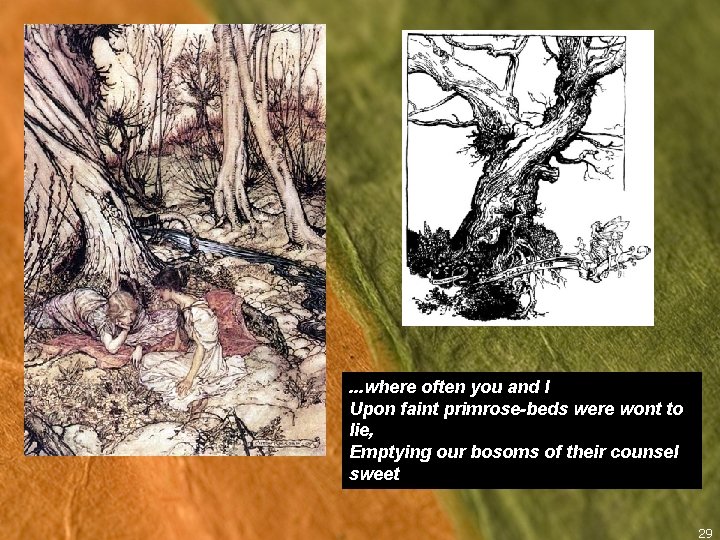
. . . where often you and I Upon faint primrose-beds were wont to lie, Emptying our bosoms of their counsel sweet 29
THE END Images found at: http: //classics. freehome page. com/midsummer/a cttwo. html 30
- Slides: 30