
A Microfluidics Computational Simulation for Clinical POC LOC
- Slides: 1
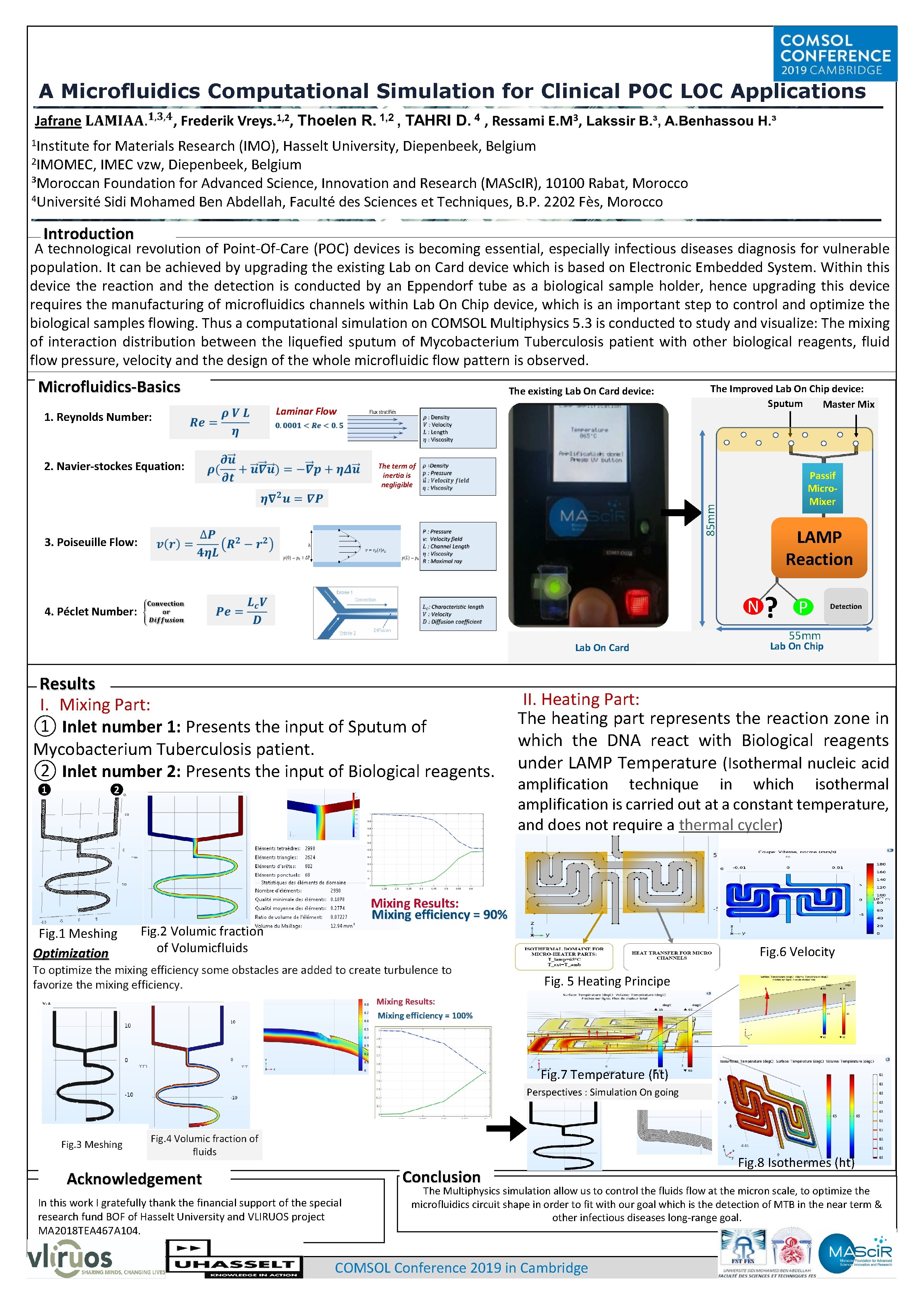
A Microfluidics Computational Simulation for Clinical POC LOC Applications 1 Institute for Materials Research (IMO), Hasselt University, Diepenbeek, Belgium 2 IMOMEC, IMEC vzw, Diepenbeek, Belgium ³Moroccan Foundation for Advanced Science, Innovation and Research (MASc. IR), 10100 Rabat, Morocco 4 Université Sidi Mohamed Ben Abdellah, Faculté des Sciences et Techniques, B. P. 2202 Fès, Morocco Introduction A technological revolution of Point-Of-Care (POC) devices is becoming essential, especially infectious diseases diagnosis for vulnerable population. It can be achieved by upgrading the existing Lab on Card device which is based on Electronic Embedded System. Within this device the reaction and the detection is conducted by an Eppendorf tube as a biological sample holder, hence upgrading this device requires the manufacturing of microfluidics channels within Lab On Chip device, which is an important step to control and optimize the biological samples flowing. Thus a computational simulation on COMSOL Multiphysics 5. 3 is conducted to study and visualize: The mixing of interaction distribution between the liquefied sputum of Mycobacterium Tuberculosis patient with other biological reagents, fluid flow pressure, velocity and the design of the whole microfluidic flow pattern is observed. Microfluidics-Basics 1. Reynolds Number: The existing Lab On Card device: Laminar Flow 2. Navier-stockes Equation: The term of inertia is negligible LAMP Reaction N 4. Péclet Number: Lab On Card Results I. Mixing Part: ① Inlet number 1: Presents the input of Sputum of Mycobacterium Tuberculosis patient. ② Inlet number 2: Presents the input of Biological reagents. 2 Fig. 1 Meshing Optimization Passif Micro. Mixer 85 mm 3. Poiseuille Flow: 1 The Improved Lab On Chip device: Sputum Master Mix ? P Detection 55 mm Lab On Chip II. Heating Part: The heating part represents the reaction zone in which the DNA react with Biological reagents under LAMP Temperature (Isothermal nucleic acid amplification technique in which isothermal amplification is carried out at a constant temperature, and does not require a thermal cycler) Mixing Results: Mixing efficiency = 90% Fig. 2 Volumic fraction of Volumicfluids Fig. 6 Velocity To optimize the mixing efficiency some obstacles are added to create turbulence to favorize the mixing efficiency. Fig. 5 Heating Principe Mixing Results: Mixing efficiency = 100% Fig. 7 Temperature (ht) Perspectives : Simulation On going Fig. 3 Meshing Fig. 4 Volumic fraction of fluids Conclusion Acknowledgement In this work I gratefully thank the financial support of the special research fund BOF of Hasselt University and VLIRUOS project MA 2018 TEA 467 A 104. Fig. 8 Isothermes (ht) The Multiphysics simulation allow us to control the fluids flow at the micron scale, to optimize the microfluidics circuit shape in order to fit with our goal which is the detection of MTB in the near term & other infectious diseases long-range goal. COMSOL Conference 2019 in Cambridge