
A Methodology for Role Based Modeling of Open
A Methodology for Role. Based Modeling of Open Multi-Agent Software Systems Prof. Haiping Xu Concurrent Software Systems Laboratory Computer and Information Science Department University of Massachusetts Dartmouth North Dartmouth, MA 02747 Email: hxu@umassd. edu URL: http: //www. cis. umassd. edu/~hxu/ 5/26/2005 CIS Dept. , UMass Dartmouth 1
Outline l l l Background and Motivation An Organizational Approach Role-Based Multi-Agent System Design Case Study: Organizing a Conference Conclusions and Future Work 5/26/2005 CIS Dept. , UMass Dartmouth 2
Background and Motivation l l l Multi-agent system (MAS) is a concurrent software system with more than one agent A traditional MAS consists of a fixed number of software agents In an open MAS, agents can l l 5/26/2005 join or leave an agent society at will take or release roles dynamically CIS Dept. , UMass Dartmouth 3
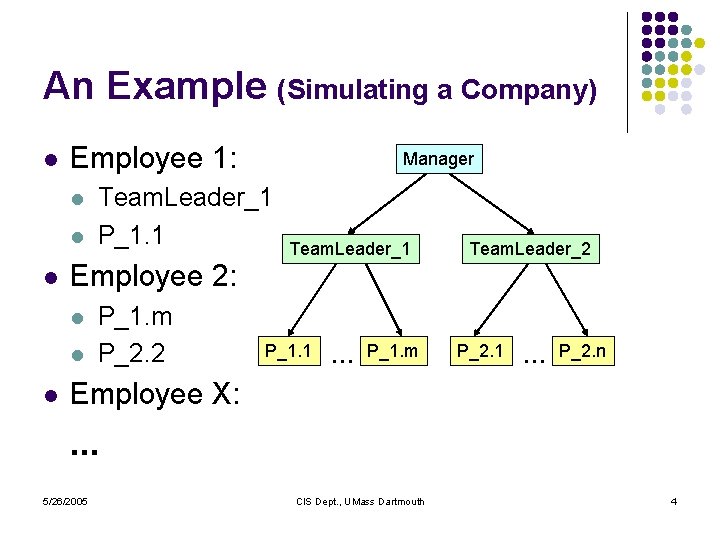
An Example (Simulating a Company) l Employee 1: l l l Team. Leader_1 P_1. 1 Team. Leader_2 Employee 2: l l l Manager P_1. m P_2. 2 P_1. 1 … P_1. m P_2. 1 … P_2. n Employee X: . . . 5/26/2005 CIS Dept. , UMass Dartmouth 4
Role-Based Modeling l l Role-based modeling is one of the most effective methodologies for agent-based system analysis and design In most of the existing work l l abstract constructs used to conceptualize and understand the system no realizations in the implemented system Suitable for closed multi-agent systems We propose a methodology for role-based modeling of open multi-agent systems 5/26/2005 CIS Dept. , UMass Dartmouth 5
An Organizational Approach l Separate the concepts of role organization and role space l l role organization contains conceptual roles role space contains role instances At the third layer, we define an agent society that consists of agent instances The agent society can be designed independently of the role organization and role space 5/26/2005 CIS Dept. , UMass Dartmouth 6
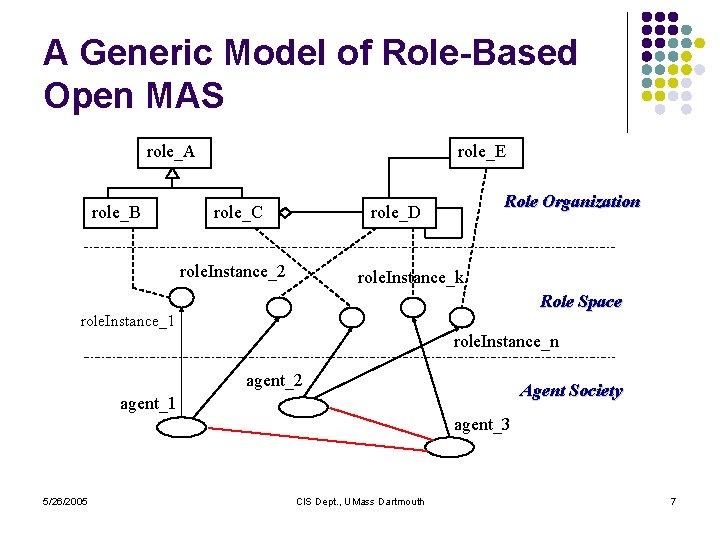
A Generic Model of Role-Based Open MAS role_A role_B role_E role_C Role Organization role_D role. Instance_2 role. Instance_k Role Space role. Instance_1 role. Instance_n agent_2 Agent Society agent_1 agent_3 5/26/2005 CIS Dept. , UMass Dartmouth 7
Formal Specifications - Role and Role Organization 5/26/2005 CIS Dept. , UMass Dartmouth 8
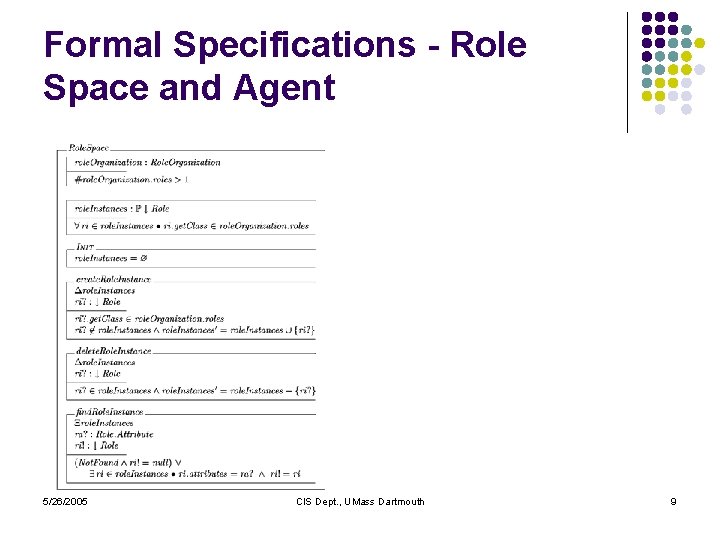
Formal Specifications - Role Space and Agent 5/26/2005 CIS Dept. , UMass Dartmouth 9
Role-Based MAS Design l Design Role classes and their relationships l l l inheritance relationship aggregation relationship association relationship incompatibility relationship To ease software engineer’s effort, we propose a design process for MAS development 5/26/2005 CIS Dept. , UMass Dartmouth 10
A Generic Procedure to Design Open MAS 1. 2. 3. 4. 5. 5/26/2005 Design the set of Role classes and their relationship 1: X [IH | AG], where IH and AG represent the relationship types of inheritance and aggregation, respectively. Design the role organization according to the class schema Role. Organization, and define any association relationships and incompatibility relationships between classes, i. e. , 2: X [AS | IC], where AS and IC represent the relationship types of association and incompatibility, respectively. Design the role space according to the class schema Role. Space. The role space should support creating, advertising, and searching for role instances. It may use existing middleware, e. g. , Sun Jini, for its purpose. Refine the Agent class with a set of sensors and a set of appropriate reasoning mechanisms. This step may overlap with Step 1 -3. Design agent society according to the class schema Agent. Society. The agent society contains a set of agent instances of type Agent, and it corresponds to the role organization with the same organization/society design purpose. CIS Dept. , UMass Dartmouth 11
Open Role Space and Open Agent Society l Open role space l l role instances can be added into or deleted from a role space dynamically Open agent society l l 5/26/2005 agents can join or leave the system at will agents can take or release role instances in a role space dynamically CIS Dept. , UMass Dartmouth 12
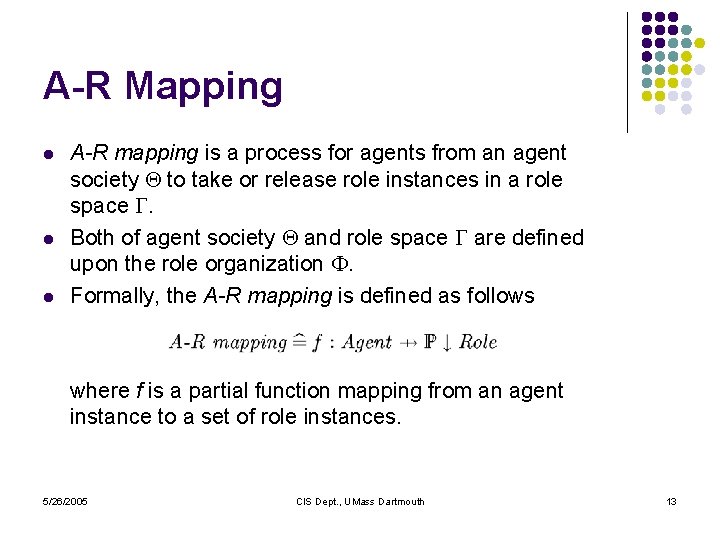
A-R Mapping l l l A-R mapping is a process for agents from an agent society to take or release role instances in a role space . Both of agent society and role space are defined upon the role organization . Formally, the A-R mapping is defined as follows where f is a partial function mapping from an agent instance to a set of role instances. 5/26/2005 CIS Dept. , UMass Dartmouth 13
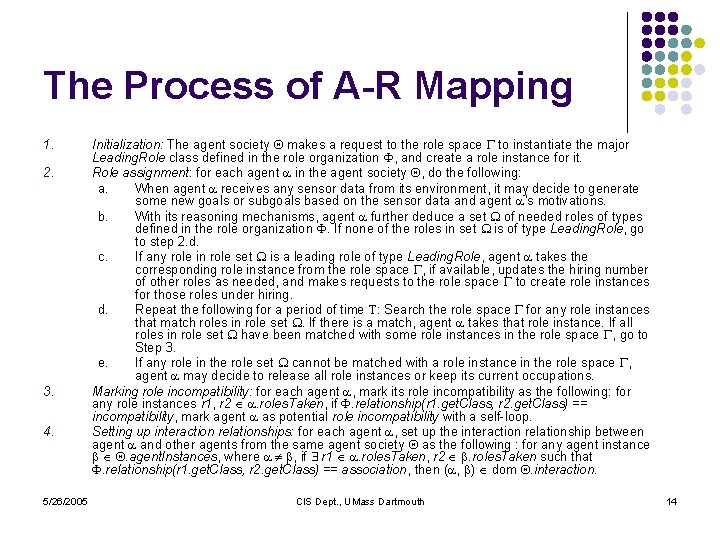
The Process of A-R Mapping 1. 2. 3. 4. 5/26/2005 Initialization: The agent society makes a request to the role space to instantiate the major Leading. Role class defined in the role organization , and create a role instance for it. Role assignment: for each agent in the agent society , do the following: a. When agent receives any sensor data from its environment, it may decide to generate some new goals or subgoals based on the sensor data and agent ’s motivations. b. With its reasoning mechanisms, agent further deduce a set of needed roles of types defined in the role organization . If none of the roles in set is of type Leading. Role, go to step 2. d. c. If any role in role set is a leading role of type Leading. Role, agent takes the corresponding role instance from the role space , if available, updates the hiring number of other roles as needed, and makes requests to the role space to create role instances for those roles under hiring. d. Repeat the following for a period of time : Search the role space for any role instances that match roles in role set . If there is a match, agent takes that role instance. If all roles in role set have been matched with some role instances in the role space , go to Step 3. e. If any role in the role set cannot be matched with a role instance in the role space , agent may decide to release all role instances or keep its current occupations. Marking role incompatibility: for each agent , mark its role incompatibility as the following: for any role instances r 1, r 2 . roles. Taken, if . relationship(r 1. get. Class, r 2. get. Class) == incompatibility, mark agent as potential role incompatibility with a self-loop. Setting up interaction relationships: for each agent , set up the interaction relationship between agent and other agents from the same agent society as the following : for any agent instance . agent. Instances, where , if r 1 . roles. Taken, r 2 . roles. Taken such that . relationship(r 1. get. Class, r 2. get. Class) == association, then ( , ) dom . interaction. CIS Dept. , UMass Dartmouth 14
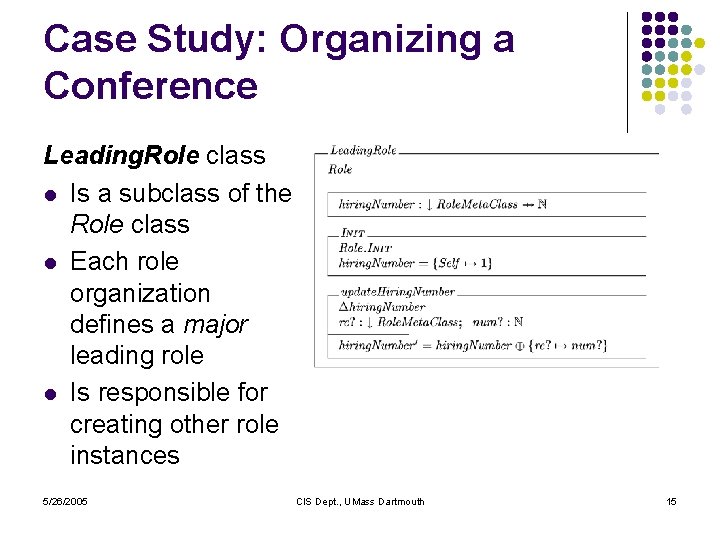
Case Study: Organizing a Conference Leading. Role class l Is a subclass of the Role class l Each role organization defines a major leading role l Is responsible for creating other role instances 5/26/2005 CIS Dept. , UMass Dartmouth 15
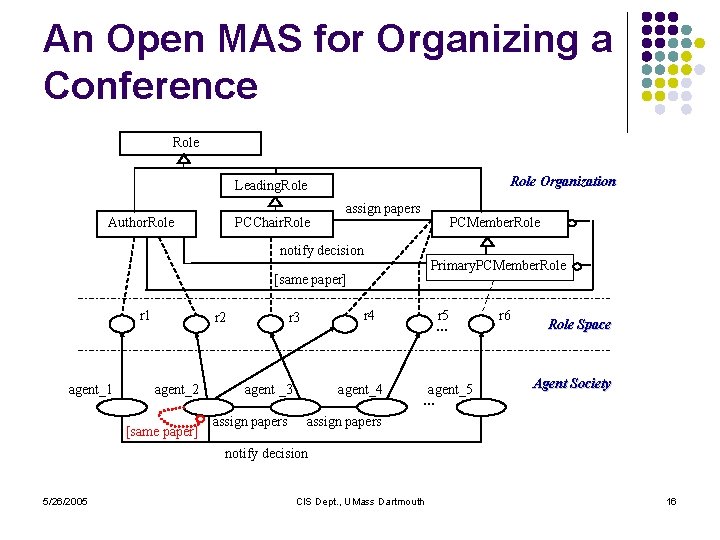
An Open MAS for Organizing a Conference Role Organization Leading. Role Author. Role PCChair. Role assign papers PCMember. Role notify decision Primary. PCMember. Role [same paper] r 1 agent_1 r 2 agent_2 [same paper] r 4 r 3 agent _3 assign papers agent_4 r 5 … agent_5 … r 6 Role Space Agent Society assign papers notify decision 5/26/2005 CIS Dept. , UMass Dartmouth 16
Conclusions l l A role-based methodology has been proposed for development of open MAS The design of roles and agents can be separated, which simplifies agent development Inheritance relationships between roles support reuse of role design Relationships between agents can be easily derived from A-R mapping 5/26/2005 CIS Dept. , UMass Dartmouth 17
Future Work l l Refine the association relationship into more specific relationships Design social norms or rules in role organization and check for consistency Automate the verification process based on the A-R mapping mechanism. Develop an Role-based Agent Development Environment (RADE) for rapid agent development. 5/26/2005 CIS Dept. , UMass Dartmouth 18
Thank you for your attention! The slides for this talk can be downloaded from http: //www. cis. umassd. edu/~hxu 5/26/2005 CIS Dept. , UMass Dartmouth 19
- Slides: 19