
A Method for InSitu and InOperando Cavity Loaded
- Slides: 38
A Method for In-Situ and In-Operando Cavity Loaded Q-Extraction in SRF Accelerators Accelerator Seminar 2020 -07 -16 Frank Marhauser
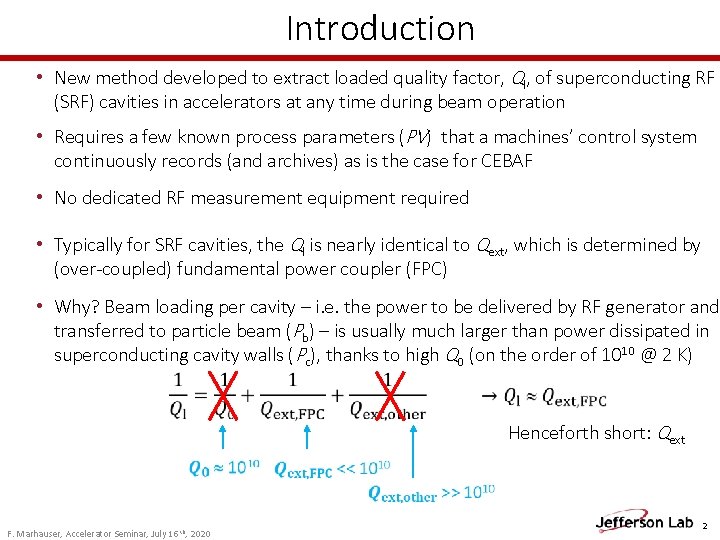
Introduction • New method developed to extract loaded quality factor, Ql, of superconducting RF (SRF) cavities in accelerators at any time during beam operation • Requires a few known process parameters (PV) that a machines’ control system continuously records (and archives) as is the case for CEBAF • No dedicated RF measurement equipment required • Typically for SRF cavities, the Ql is nearly identical to Qext, which is determined by (over-coupled) fundamental power coupler (FPC) • Why? Beam loading per cavity – i. e. the power to be delivered by RF generator and transferred to particle beam (Pb) – is usually much larger than power dissipated in superconducting cavity walls (Pc), thanks to high Q 0 (on the order of 1010 @ 2 K) Henceforth short: Qext F. Marhauser, Accelerator Seminar, July 16 th, 2020 2
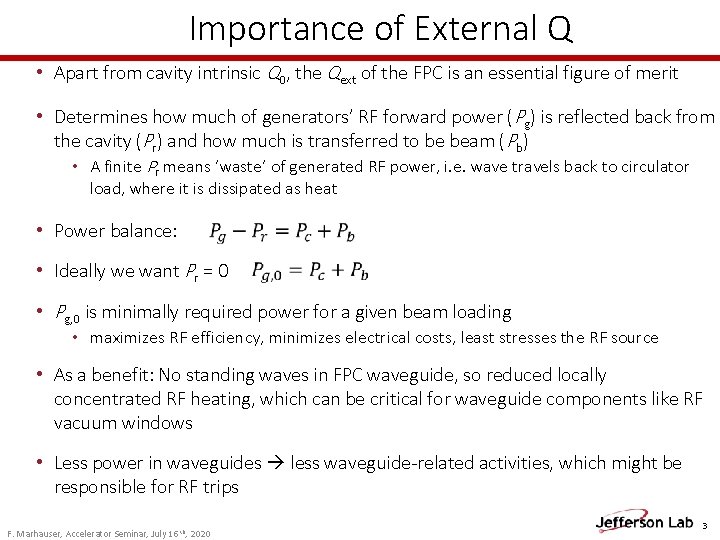
Importance of External Q • Apart from cavity intrinsic Q 0, the Qext of the FPC is an essential figure of merit • Determines how much of generators’ RF forward power (Pg) is reflected back from the cavity (Pr) and how much is transferred to be beam (Pb) • A finite Pr means ‘waste’ of generated RF power, i. e. wave travels back to circulator load, where it is dissipated as heat • Power balance: • Ideally we want Pr = 0 • Pg, 0 is minimally required power for a given beam loading • maximizes RF efficiency, minimizes electrical costs, least stresses the RF source • As a benefit: No standing waves in FPC waveguide, so reduced locally concentrated RF heating, which can be critical for waveguide components like RF vacuum windows • Less power in waveguides less waveguide-related activities, which might be responsible for RF trips F. Marhauser, Accelerator Seminar, July 16 th, 2020 3
Importance of External Q • At a fixed (optimum) Qext-value, efficient coupling of RF generator to beam is only possible for one given (nominal) beam loading condition Pb • A central question: How efficient are CEBAF cavities matched to RF generators ? • Short answer: C 100 cavities usually well C 20/C 50 cavities usually badly • Main reasons: 1) Nominal Qext has been chosen for different allowable beam loading cases, and thus differing average beam current levels (Iavg) • For 12 Ge. V era: Iavg = 0. 465 m. A • For 4 Ge. V era: Iavg = 1 m. A results in low Qext-values for C 20/C 50 not adequate anymore these days mismatch 2) Moreover: Many cavities exhibit Qext-values largely below their nominal values increased mismatch 3) Note: CEBAF waveguide couplers have a fixed Qext by design, but Qext can be adjusted (within limits) by waveguide stub tuners located in service buildings • But: Not all cavities are equipped with stub tuners - 107 out of 200 cavities in North Linac have stub tuners (53. 5%) - 140 out of 200 cavities in South Linac have stub tuners (70%) • Let’s take a first quantitative look F. Marhauser, Accelerator Seminar, July 16 th, 2020 4
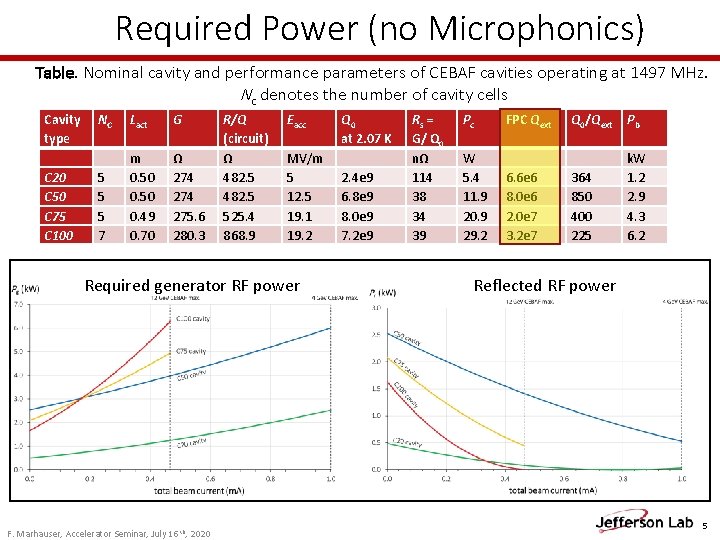
Required Power (no Microphonics) Table. Nominal cavity and performance parameters of CEBAF cavities operating at 1497 MHz. Nc denotes the number of cavity cells Cavity type C 20 C 50 C 75 C 100 NC Lact G 5 5 5 7 m 0. 50 0. 49 0. 70 Ω 274 275. 6 280. 3 R/Q (circuit) Ω 482. 5 525. 4 868. 9 Eacc MV/m 5 12. 5 19. 1 19. 2 Required generator RF power F. Marhauser, Accelerator Seminar, July 16 th, 2020 Q 0 at 2. 07 K 2. 4 e 9 6. 8 e 9 8. 0 e 9 7. 2 e 9 Rs = G/ Q 0 nΩ 114 38 34 39 Pc W 5. 4 11. 9 20. 9 29. 2 FPC Qext 6. 6 e 6 8. 0 e 6 2. 0 e 7 3. 2 e 7 Q 0/Qext Pb 364 850 400 225 k. W 1. 2 2. 9 4. 3 6. 2 Reflected RF power 5
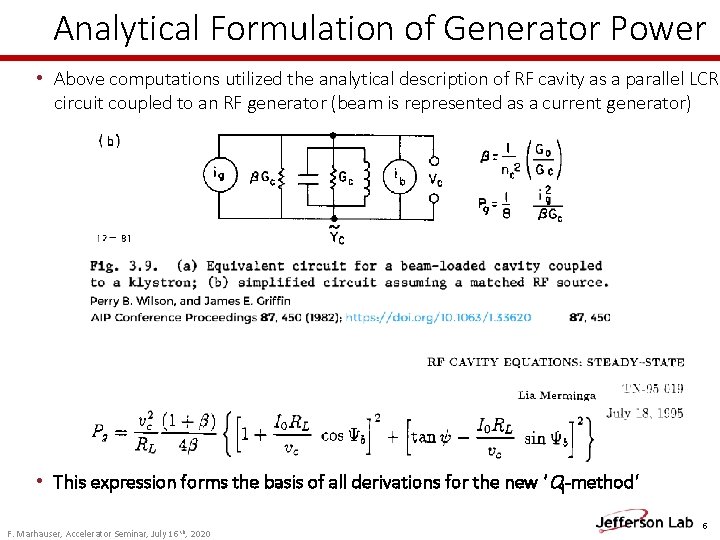
Analytical Formulation of Generator Power • Above computations utilized the analytical description of RF cavity as a parallel LCR circuit coupled to an RF generator (beam is represented as a current generator) • This expression forms the basis of all derivations for the new ‘ Ql-method‘ F. Marhauser, Accelerator Seminar, July 16 th, 2020 6
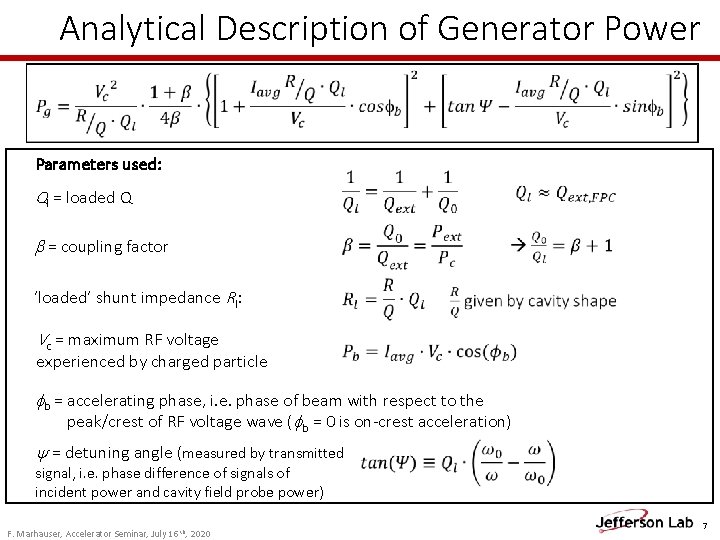
Analytical Description of Generator Power Parameters used: Ql = loaded Q = coupling factor ‘loaded’ shunt impedance Rl: Vc = maximum RF voltage experienced by charged particle b = accelerating phase, i. e. phase of beam with respect to the peak/crest of RF voltage wave ( b = 0 is on-crest acceleration) = detuning angle (measured by transmitted signal, i. e. phase difference of signals of incident power and cavity field probe power) F. Marhauser, Accelerator Seminar, July 16 th, 2020 7
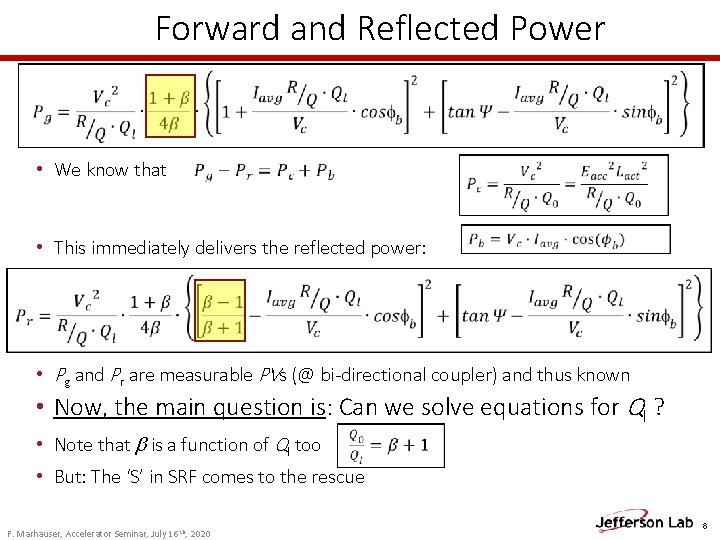
Forward and Reflected Power • We know that • This immediately delivers the reflected power: • Pg and Pr are measurable PVs (@ bi-directional coupler) and thus known • Now, the main question is: Can we solve equations for Ql ? • Note that is a function of Ql too • But: The ‘S’ in SRF comes to the rescue F. Marhauser, Accelerator Seminar, July 16 th, 2020 8
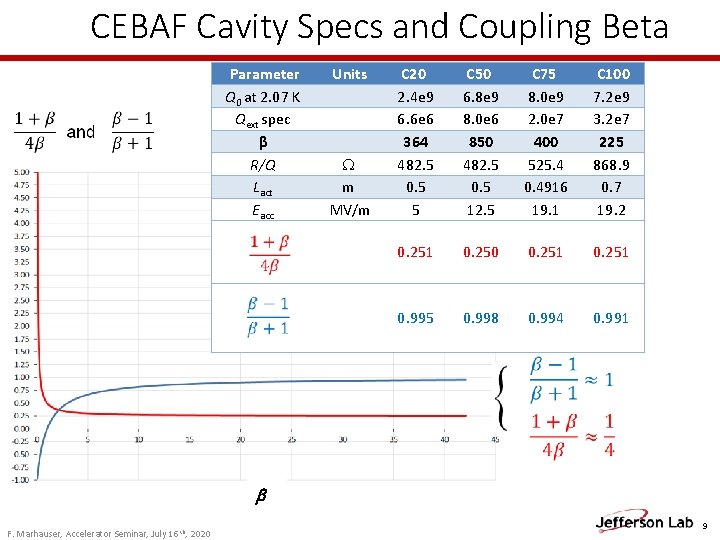
CEBAF Cavity Specs and Coupling Beta Parameter Q 0 at 2. 07 K Qext spec β R/Q Lact Eacc Units W m MV/m C 20 2. 4 e 9 6. 6 e 6 364 482. 5 0. 5 5 C 50 6. 8 e 9 8. 0 e 6 850 482. 5 0. 5 12. 5 C 75 8. 0 e 9 2. 0 e 7 400 525. 4 0. 4916 19. 1 C 100 7. 2 e 9 3. 2 e 7 225 868. 9 0. 7 19. 2 0. 251 0. 250 0. 251 0. 995 0. 998 0. 994 0. 991 for β >> 1: F. Marhauser, Accelerator Seminar, July 16 th, 2020 9
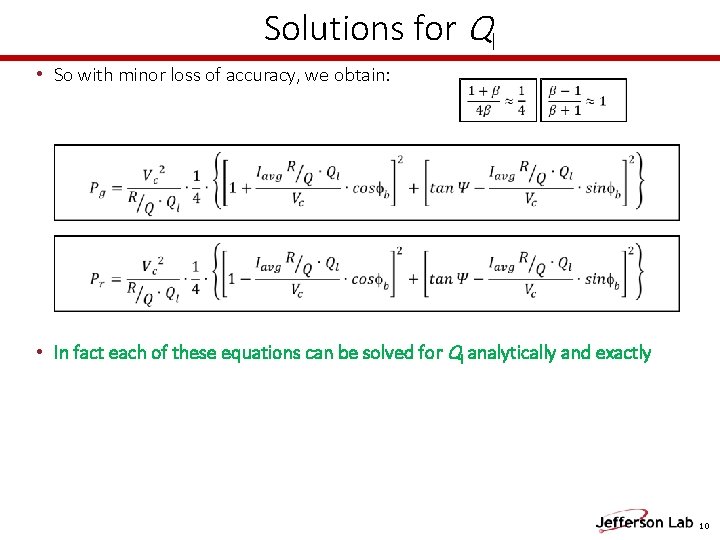
Solutions for Ql • So with minor loss of accuracy, we obtain: • In fact each of these equations can be solved for Ql analytically and exactly 10
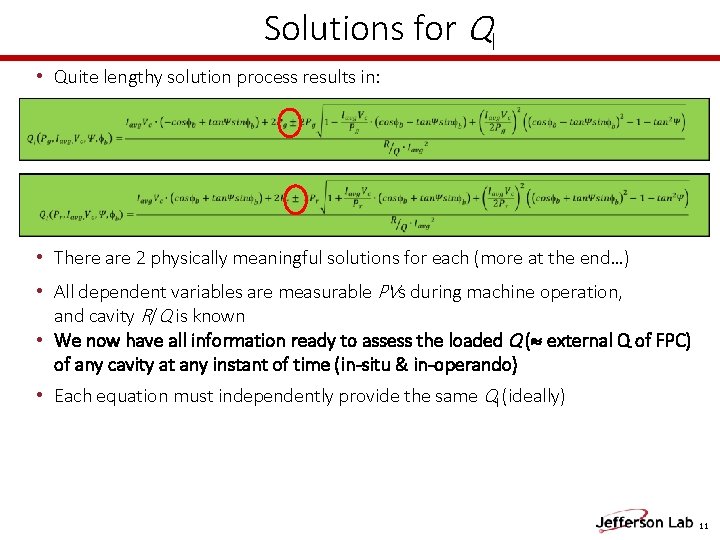
Solutions for Ql • Quite lengthy solution process results in: • There are 2 physically meaningful solutions for each (more at the end…) • All dependent variables are measurable PVs during machine operation, and cavity R/Q is known • We now have all information ready to assess the loaded Q ( external Q of FPC) of any cavity at any instant of time (in-situ & in-operando) • Each equation must independently provide the same Ql (ideally) 11
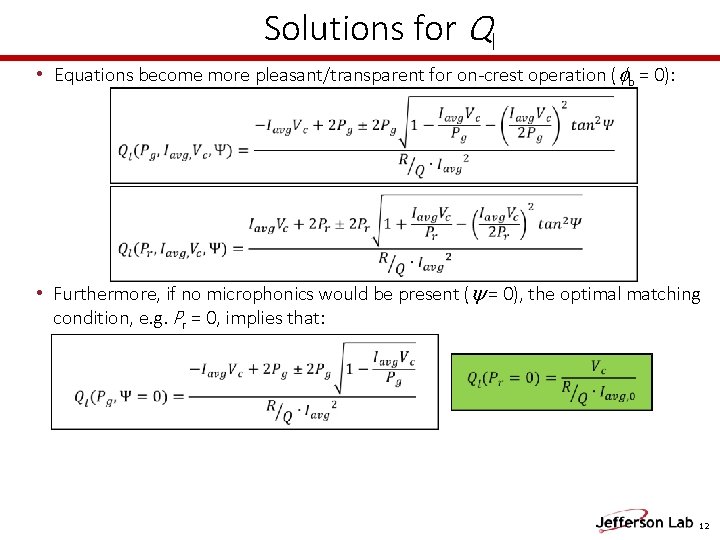
Solutions for Ql • Equations become more pleasant/transparent for on-crest operation ( b = 0): • Furthermore, if no microphonics would be present ( = 0), the optimal matching condition, e. g. Pr = 0, implies that: 12
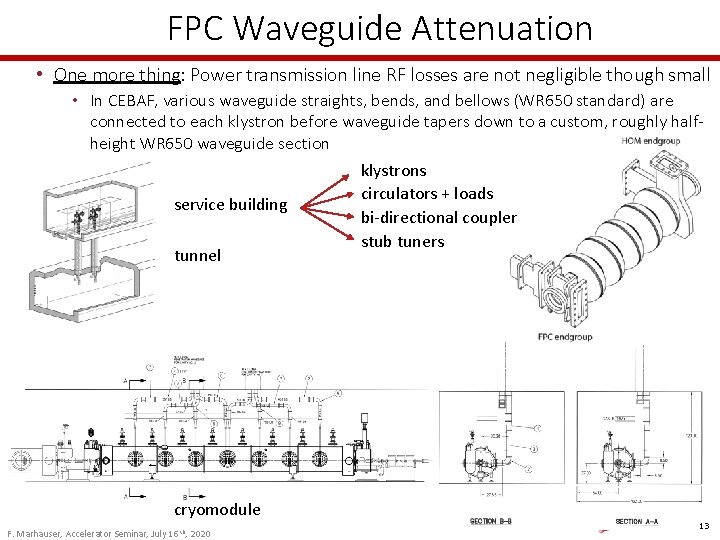
FPC Waveguide Attenuation • One more thing: Power transmission line RF losses are not negligible though small • In CEBAF, various waveguide straights, bends, and bellows (WR 650 standard) are connected to each klystron before waveguide tapers down to a custom, roughly halfheight WR 650 waveguide section klystrons circulators + loads service building bi-directional coupler stub tuners tunnel cryomodule F. Marhauser, Accelerator Seminar, July 16 th, 2020 13
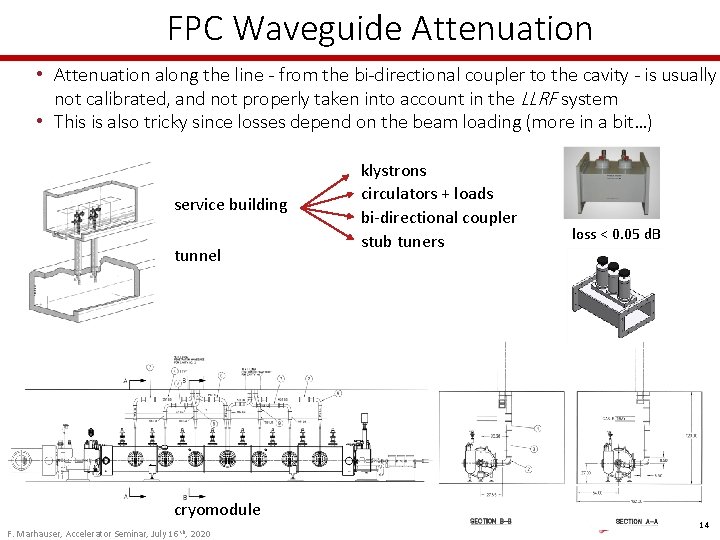
FPC Waveguide Attenuation • Attenuation along the line - from the bi-directional coupler to the cavity - is usually not calibrated, and not properly taken into account in the LLRF system • This is also tricky since losses depend on the beam loading (more in a bit…) service building tunnel cryomodule F. Marhauser, Accelerator Seminar, July 16 th, 2020 klystrons circulators + loads bi-directional coupler stub tuners loss < 0. 05 d. B 14
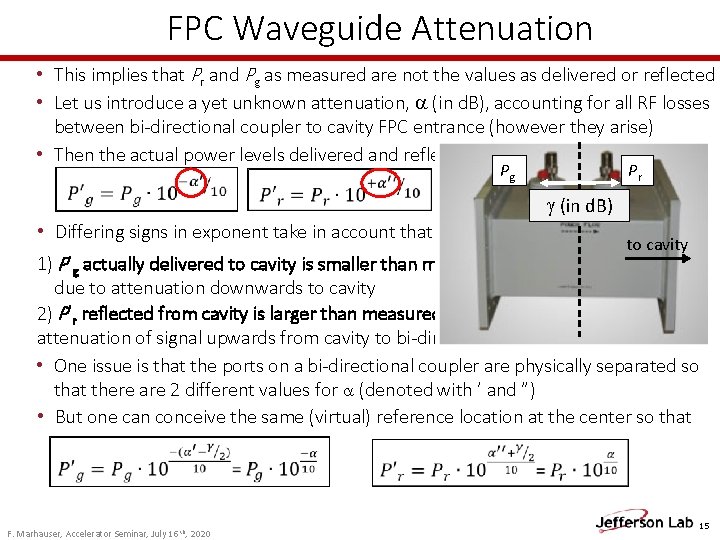
FPC Waveguide Attenuation • This implies that Pr and Pg as measured are not the values as delivered or reflected • Let us introduce a yet unknown attenuation, (in d. B), accounting for all RF losses between bi-directional coupler to cavity FPC entrance (however they arise) • Then the actual power levels delivered and reflected from a cavity, resp. , are Pg Pr (in d. B) • Differing signs in exponent take in account that to cavity 1) P’g actually delivered to cavity is smaller than measured at bi-directional coupler due to attenuation downwards to cavity 2) P’r reflected from cavity is larger than measured at bi-directional coupler due to attenuation of signal upwards from cavity to bi-directional coupler • One issue is that the ports on a bi-directional coupler are physically separated so that there are 2 different values for (denoted with ’ and ”) • But one can conceive the same (virtual) reference location at the center so that F. Marhauser, Accelerator Seminar, July 16 th, 2020 15
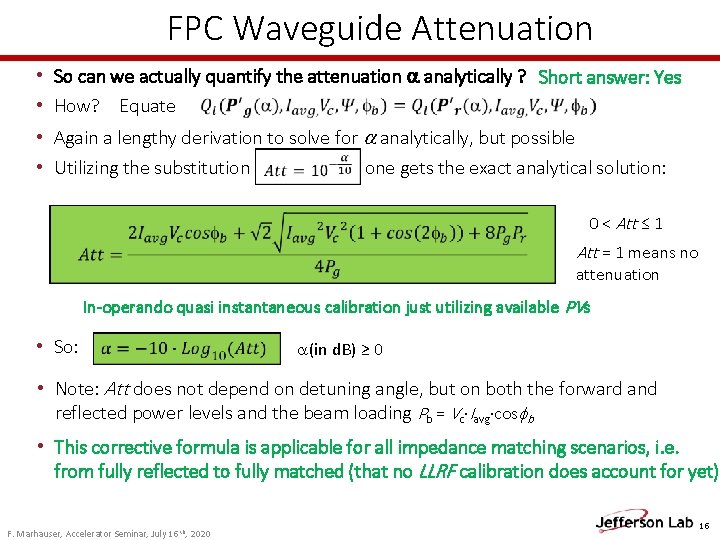
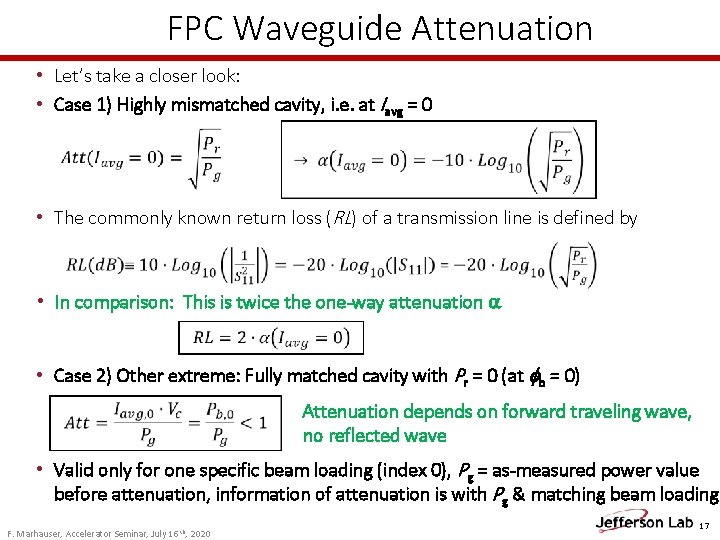
FPC Waveguide Attenuation • So can we actually quantify the attenuation analytically ? Short answer: Yes • How? Equate • Again a lengthy derivation to solve for analytically, but possible • Utilizing the substitution one gets the exact analytical solution: 0 < Att ≤ 1 Att = 1 means no attenuation In-operando quasi instantaneous calibration just utilizing available PVs • So: (in d. B) ≥ 0 • Note: Att does not depend on detuning angle, but on both the forward and reflected power levels and the beam loading Pb = Vc Iavg cos b • This corrective formula is applicable for all impedance matching scenarios, i. e. from fully reflected to fully matched (that no LLRF calibration does account for yet) F. Marhauser, Accelerator Seminar, July 16 th, 2020 16
FPC Waveguide Attenuation • Let’s take a closer look: • Case 1) Highly mismatched cavity, i. e. at Iavg = 0 • The commonly known return loss (RL) of a transmission line is defined by • In comparison: This is twice the one-way attenuation • Case 2) Other extreme: Fully matched cavity with Pr = 0 (at b = 0) Attenuation depends on forward traveling wave, no reflected wave • Valid only for one specific beam loading (index 0), Pg = as-measured power value before attenuation, information of attenuation is with Pg & matching beam loading F. Marhauser, Accelerator Seminar, July 16 th, 2020 17
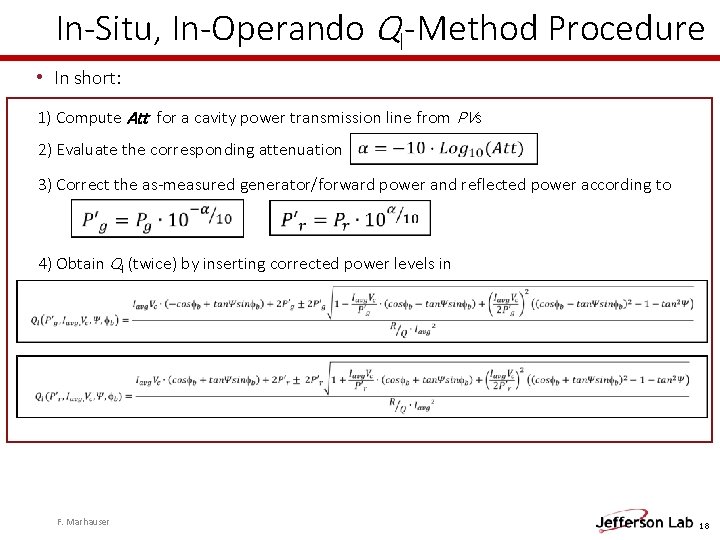
In-Situ, In-Operando Ql-Method Procedure • In short: 1) Compute Att for a cavity power transmission line from PVs 2) Evaluate the corresponding attenuation 3) Correct the as-measured generator/forward power and reflected power according to 4) Obtain Ql (twice) by inserting corrected power levels in F. Marhauser 18
First Application of Ql-Method • So let’s apply the Ql-method to CEBAF cavities • Note: The Ql-method is meant to be implemented in CEBAFs EPICS system, so up to now I could only utilize archived PVs from previous runs • Done using data archived during CEBAF ramp-up period during April 6 -8, 2018 • Investigated 418 SRF cavities ‘one by one’ to demonstrate the usability of the method (some cavities were switched off) • Revealing information can be obtained by plotting all power levels and Ql vs. Iavg • e. q. allows assessing: - How reliable Ql is in the entire beam current regime - How large reflected power levels are (mismatched or matched) - How strong the difference is between as-measured and corrected power levels (are LLRF calibration factors correct? ) - Whether anything unusual is observed • overall good use as a diagnostic tool F. Marhauser, Accelerator Seminar, July 16 th, 2020 19
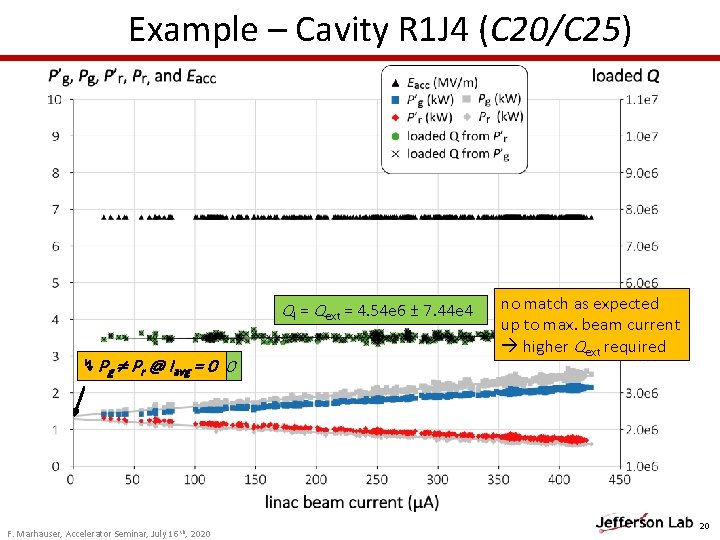
Example – Cavity R 1 J 4 (C 20/C 25) Ql = Qext = 4. 54 e 6 ± 7. 44 e 4 ↯✓PP’ Pr. P’ @r @ Iavg = 0= 0 g g F. Marhauser, Accelerator Seminar, July 16 th, 2020 no match as expected up to max. beam current higher Qext required 20
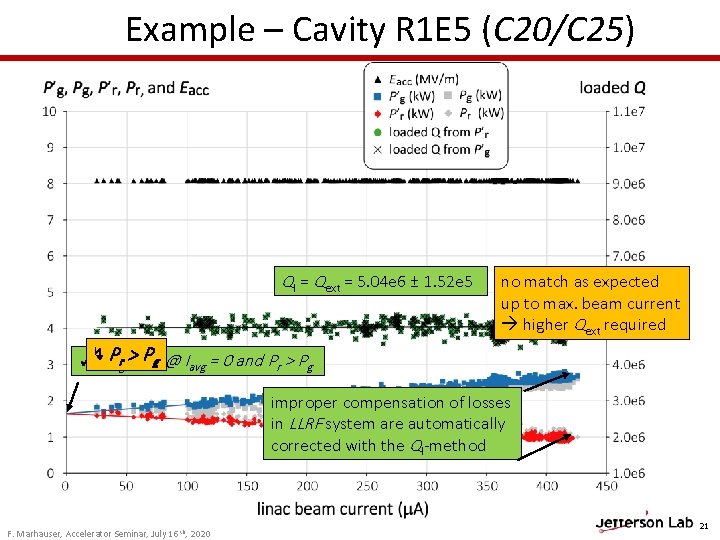
Example – Cavity R 1 E 5 (C 20/C 25) Ql = Qext = 5. 04 e 6 ± 1. 52 e 5 no match as expected up to max. beam current higher Qext required Pgr > PP’gr @ Iavg = 0 and Pr > Pg ✓↯ P’ improper compensation of losses in LLRF system are automatically corrected with the Ql-method F. Marhauser, Accelerator Seminar, July 16 th, 2020 21
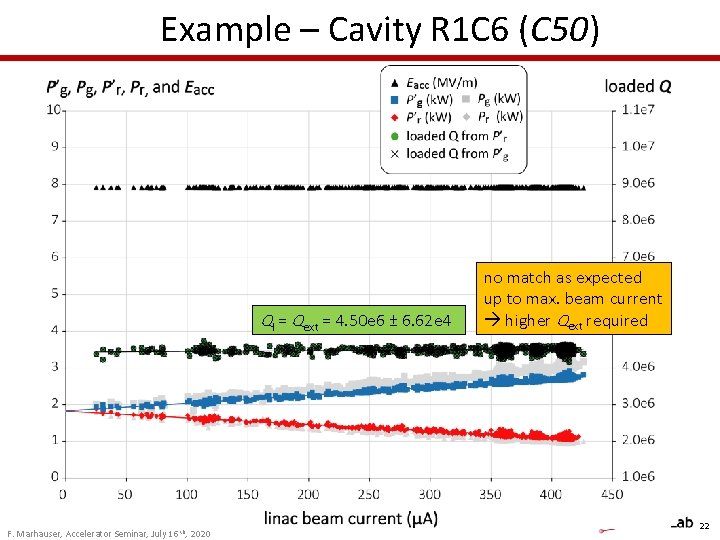
Example – Cavity R 1 C 6 (C 50) Ql = Qext = 4. 50 e 6 ± 6. 62 e 4 F. Marhauser, Accelerator Seminar, July 16 th, 2020 no match as expected up to max. beam current higher Qext required 22
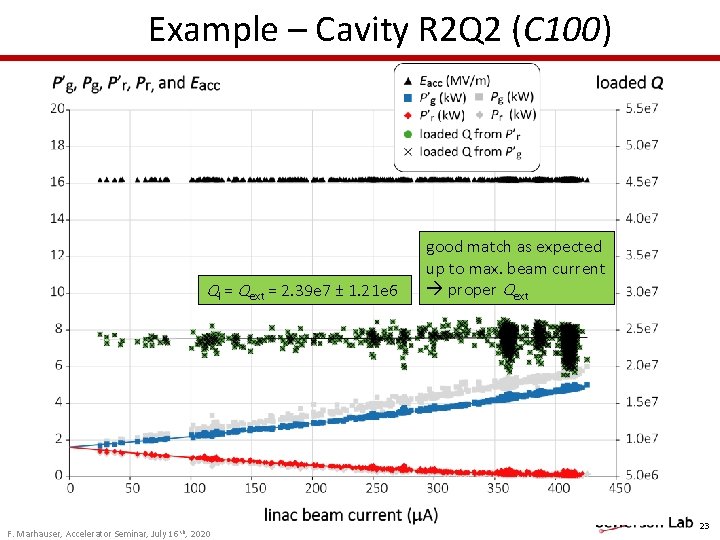
Example – Cavity R 2 Q 2 (C 100) Ql = Qext = 2. 39 e 7 ± 1. 21 e 6 F. Marhauser, Accelerator Seminar, July 16 th, 2020 good match as expected up to max. beam current proper Qext 23
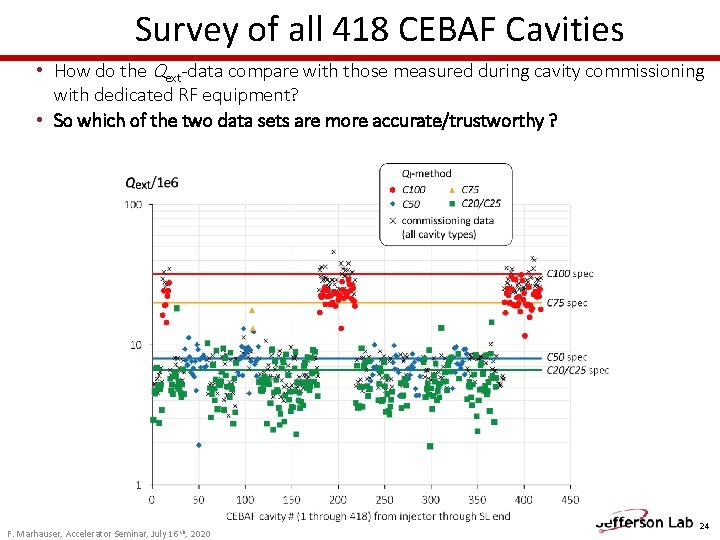
Survey of all 418 CEBAF Cavities • How do the Qext-data compare with those measured during cavity commissioning with dedicated RF equipment? • So which of the two data sets are more accurate/trustworthy ? F. Marhauser, Accelerator Seminar, July 16 th, 2020 24
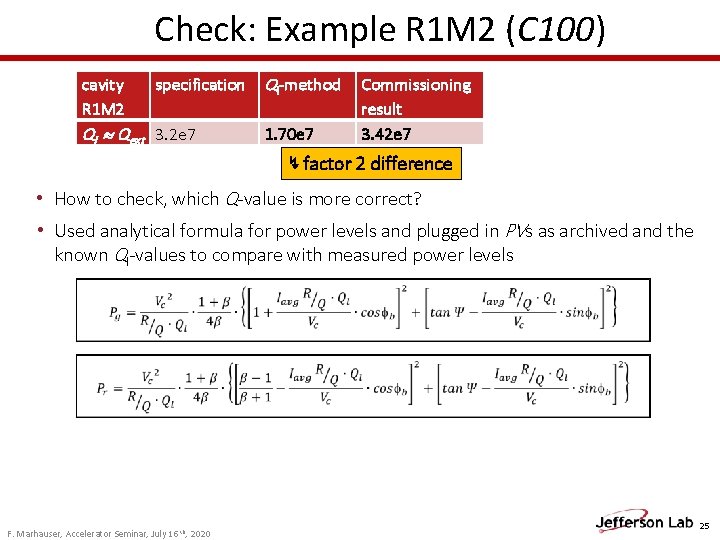
Check: Example R 1 M 2 (C 100) cavity R 1 M 2 specification Ql Qext 3. 2 e 7 Ql-method 1. 70 e 7 Commissioning result 3. 42 e 7 ↯ factor 2 difference • How to check, which Q-value is more correct? • Used analytical formula for power levels and plugged in PVs as archived and the known Ql-values to compare with measured power levels F. Marhauser, Accelerator Seminar, July 16 th, 2020 25
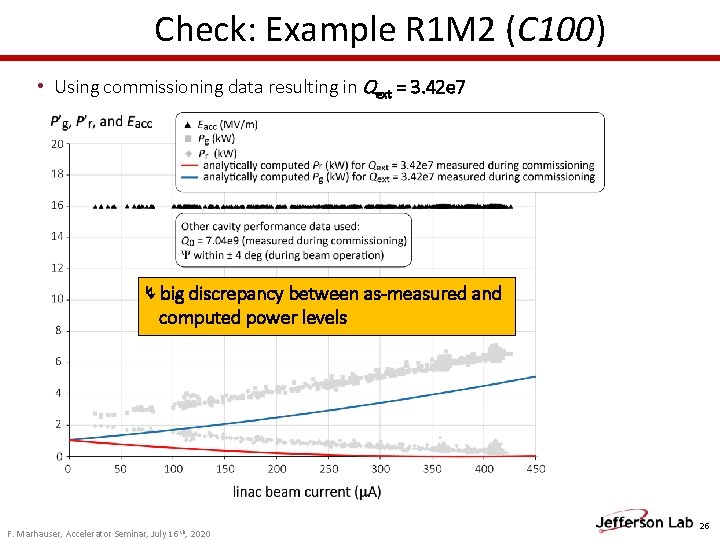
Check: Example R 1 M 2 (C 100) • Using commissioning data resulting in Qext = 3. 42 e 7 ↯ big discrepancy between as-measured and computed power levels F. Marhauser, Accelerator Seminar, July 16 th, 2020 26
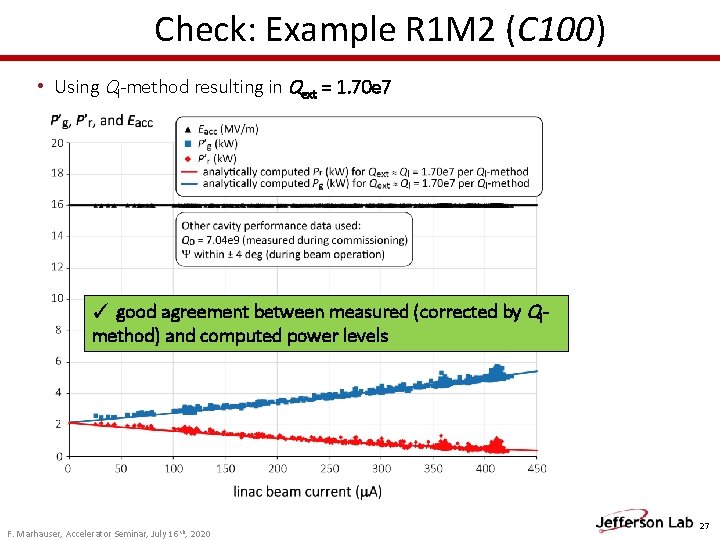
Check: Example R 1 M 2 (C 100) • Using Ql-method resulting in Qext = 1. 70 e 7 ✓ good agreement between measured (corrected by Qlmethod) and computed power levels F. Marhauser, Accelerator Seminar, July 16 th, 2020 27
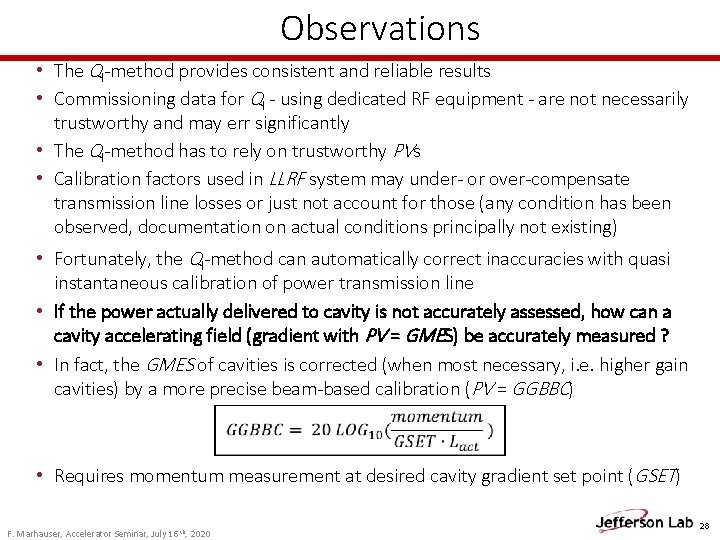
Observations • The Ql-method provides consistent and reliable results • Commissioning data for Ql - using dedicated RF equipment - are not necessarily trustworthy and may err significantly • The Ql-method has to rely on trustworthy PVs • Calibration factors used in LLRF system may under- or over-compensate transmission line losses or just not account for those (any condition has been observed, documentation on actual conditions principally not existing) • Fortunately, the Ql-method can automatically correct inaccuracies with quasi instantaneous calibration of power transmission line • If the power actually delivered to cavity is not accurately assessed, how can a cavity accelerating field (gradient with PV = GMES) be accurately measured ? • In fact, the GMES of cavities is corrected (when most necessary, i. e. higher gain cavities) by a more precise beam-based calibration (PV = GGBBC) • Requires momentum measurement at desired cavity gradient set point (GSET) F. Marhauser, Accelerator Seminar, July 16 th, 2020 28
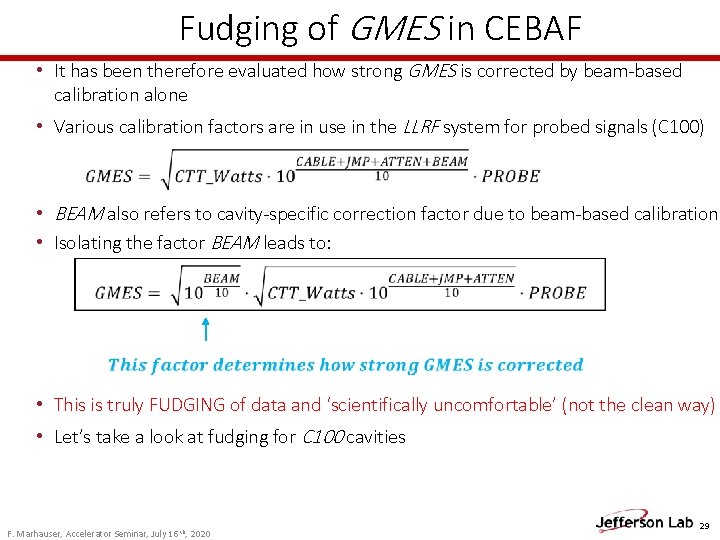
Fudging of GMES in CEBAF • It has been therefore evaluated how strong GMES is corrected by beam-based calibration alone • Various calibration factors are in use in the LLRF system for probed signals (C 100) • BEAM also refers to cavity-specific correction factor due to beam-based calibration • Isolating the factor BEAM leads to: • This is truly FUDGING of data and ‘scientifically uncomfortable’ (not the clean way) • Let’s take a look at fudging for C 100 cavities F. Marhauser, Accelerator Seminar, July 16 th, 2020 29
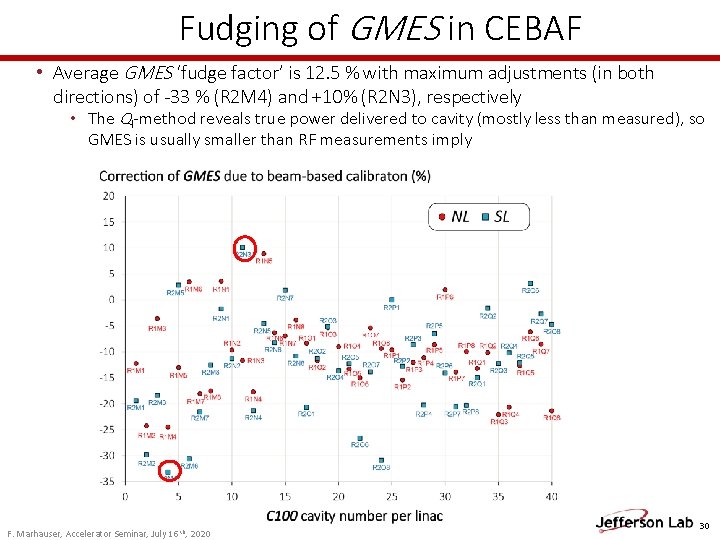
Fudging of GMES in CEBAF • Average GMES ‘fudge factor’ is 12. 5 % with maximum adjustments (in both directions) of -33 % (R 2 M 4) and +10% (R 2 N 3), respectively • The Ql-method reveals true power delivered to cavity (mostly less than measured), so GMES is usually smaller than RF measurements imply F. Marhauser, Accelerator Seminar, July 16 th, 2020 30
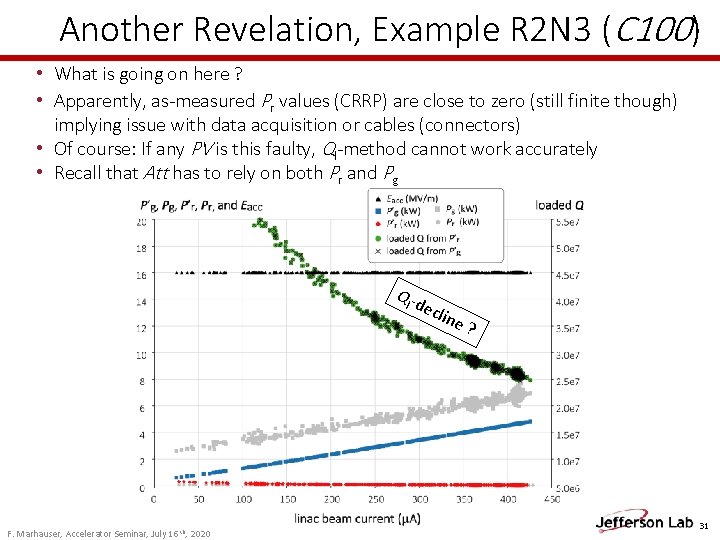
Another Revelation, Example R 2 N 3 (C 100) • What is going on here ? • Apparently, as-measured Pr values (CRRP) are close to zero (still finite though) implying issue with data acquisition or cables (connectors) • Of course: If any PV is this faulty, Ql-method cannot work accurately • Recall that Att has to rely on both Pr and Pg Q -d l F. Marhauser, Accelerator Seminar, July 16 th, 2020 ecl ine ? 31
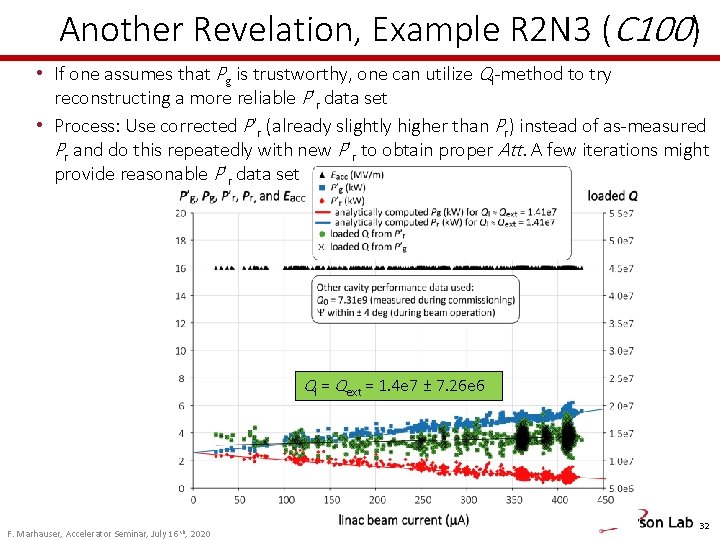
Another Revelation, Example R 2 N 3 (C 100) • If one assumes that Pg is trustworthy, one can utilize Ql-method to try reconstructing a more reliable P’r data set • Process: Use corrected P’r (already slightly higher than Pr) instead of as-measured Pr and do this repeatedly with new P’r to obtain proper Att. A few iterations might provide reasonable P’r data set Ql = Qext = 1. 4 e 7 ± 7. 26 e 6 F. Marhauser, Accelerator Seminar, July 16 th, 2020 32
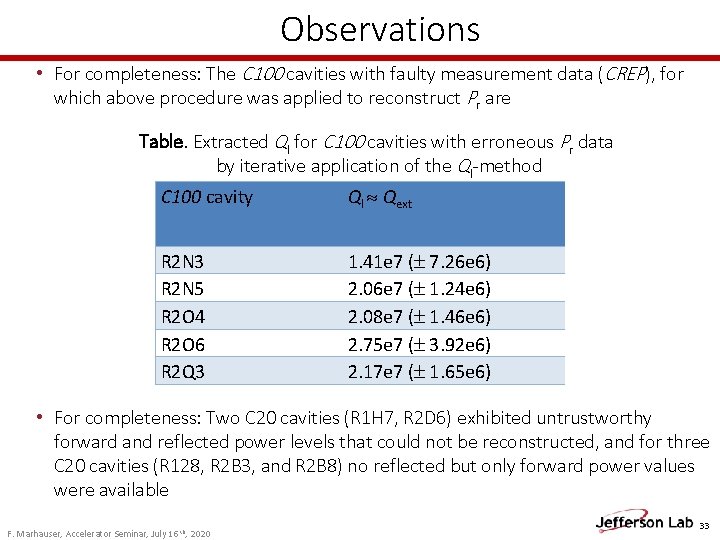
Observations • For completeness: The C 100 cavities with faulty measurement data (CREP), for which above procedure was applied to reconstruct Pr are Table. Extracted Ql for C 100 cavities with erroneous Pr data by iterative application of the Ql-method C 100 cavity Ql Qext R 2 N 3 R 2 N 5 R 2 O 4 R 2 O 6 R 2 Q 3 1. 41 e 7 ( 7. 26 e 6) 2. 06 e 7 ( 1. 24 e 6) 2. 08 e 7 ( 1. 46 e 6) 2. 75 e 7 ( 3. 92 e 6) 2. 17 e 7 ( 1. 65 e 6) • For completeness: Two C 20 cavities (R 1 H 7, R 2 D 6) exhibited untrustworthy forward and reflected power levels that could not be reconstructed, and for three C 20 cavities (R 128, R 2 B 3, and R 2 B 8) no reflected but only forward power values were available F. Marhauser, Accelerator Seminar, July 16 th, 2020 33
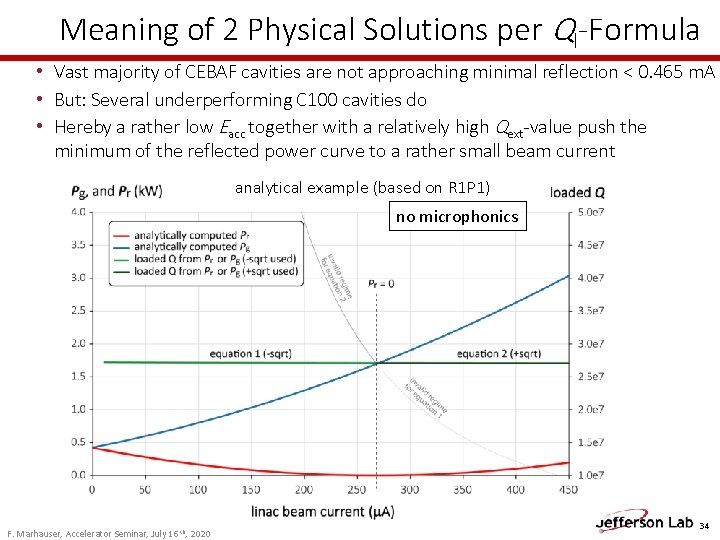
Meaning of 2 Physical Solutions per Ql-Formula • Vast majority of CEBAF cavities are not approaching minimal reflection < 0. 465 m. A • But: Several underperforming C 100 cavities do • Hereby a rather low Eacc together with a relatively high Qext-value push the minimum of the reflected power curve to a rather small beam current analytical example (based on R 1 P 1) no microphonics F. Marhauser, Accelerator Seminar, July 16 th, 2020 34
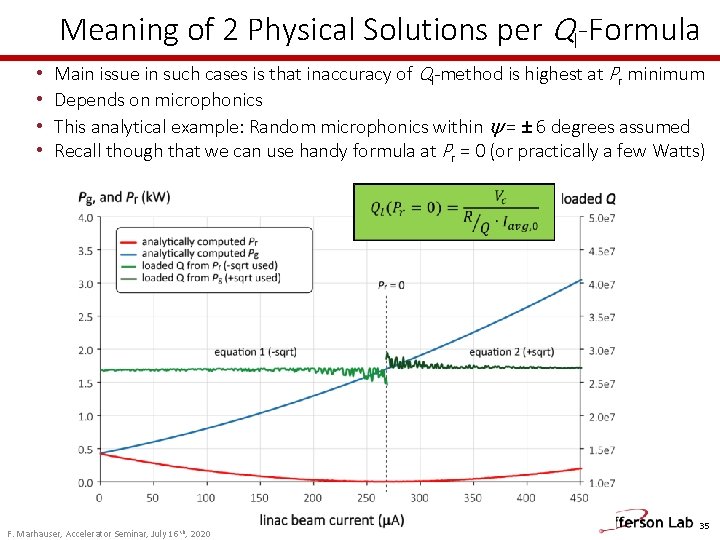
Meaning of 2 Physical Solutions per Ql-Formula • • Main issue in such cases is that inaccuracy of Ql-method is highest at Pr minimum Depends on microphonics This analytical example: Random microphonics within = ± 6 degrees assumed Recall though that we can use handy formula at Pr = 0 (or practically a few Watts) with microphonics F. Marhauser, Accelerator Seminar, July 16 th, 2020 35
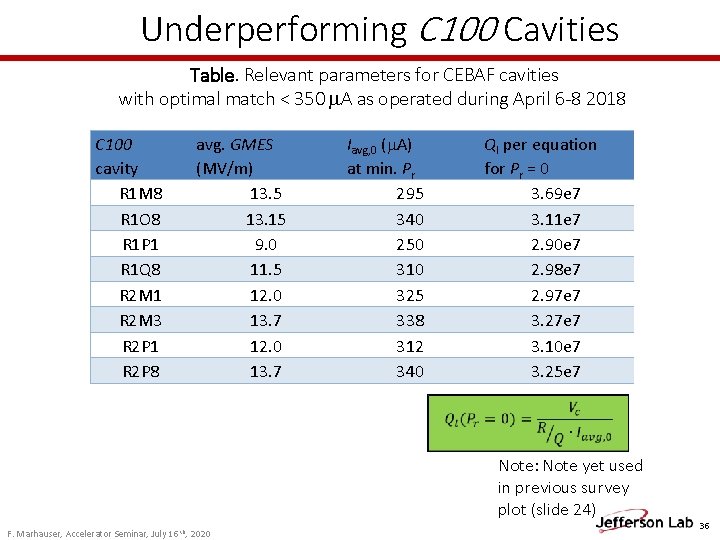
Underperforming C 100 Cavities Table. Relevant parameters for CEBAF cavities with optimal match < 350 A as operated during April 6 -8 2018 C 100 cavity R 1 M 8 R 1 O 8 R 1 P 1 R 1 Q 8 R 2 M 1 R 2 M 3 R 2 P 1 R 2 P 8 avg. GMES (MV/m) 13. 5 13. 15 9. 0 11. 5 12. 0 13. 7 Iavg, 0 ( A) at min. Pr 295 340 250 310 325 338 312 340 Ql per equation for Pr = 0 3. 69 e 7 3. 11 e 7 2. 90 e 7 2. 98 e 7 2. 97 e 7 3. 27 e 7 3. 10 e 7 3. 25 e 7 Note: Note yet used in previous survey plot (slide 24) F. Marhauser, Accelerator Seminar, July 16 th, 2020 36
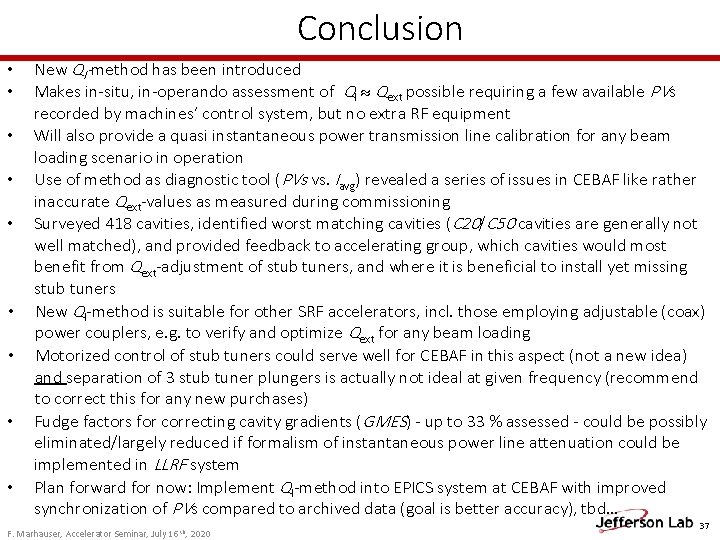
Conclusion • • • New Ql-method has been introduced Makes in-situ, in-operando assessment of Ql Qext possible requiring a few available PVs recorded by machines’ control system, but no extra RF equipment Will also provide a quasi instantaneous power transmission line calibration for any beam loading scenario in operation Use of method as diagnostic tool (PVs vs. Iavg) revealed a series of issues in CEBAF like rather inaccurate Qext-values as measured during commissioning Surveyed 418 cavities, identified worst matching cavities ( C 20/C 50 cavities are generally not well matched), and provided feedback to accelerating group, which cavities would most benefit from Qext-adjustment of stub tuners, and where it is beneficial to install yet missing stub tuners New Ql-method is suitable for other SRF accelerators, incl. those employing adjustable (coax) power couplers, e. g. to verify and optimize Qext for any beam loading Motorized control of stub tuners could serve well for CEBAF in this aspect (not a new idea) and separation of 3 stub tuner plungers is actually not ideal at given frequency (recommend to correct this for any new purchases) Fudge factors for correcting cavity gradients (GMES) - up to 33 % assessed - could be possibly eliminated/largely reduced if formalism of instantaneous power line attenuation could be implemented in LLRF system Plan forward for now: Implement Ql-method into EPICS system at CEBAF with improved synchronization of PVs compared to archived data (goal is better accuracy), tbd… F. Marhauser, Accelerator Seminar, July 16 th, 2020 37
Many Thanks! • Acknowledgements to • Rongli Geng for his support and many fruitful discussions • Adam Carpenter and George Lathi for working on the CEBAF implementation of the Ql-Method • All other colleagues, who were willing to answer questions in the frame of this work F. Marhauser, Accelerator Seminar, July 16 th, 2020 38