
A Mechanized Model of the Theory of Objects
A Mechanized Model of the Theory of Objects Ludovic Henrio and Florian Kammüller 1. Functional -calculus in Isabelle 2. Confluence Proof in Isabelle 3. Ongoing Work, Applications, Conclusion Objective Provide a framework for (mechanically) proving properties on object-oriented languages and programs Distribution, parallelism, concurrence
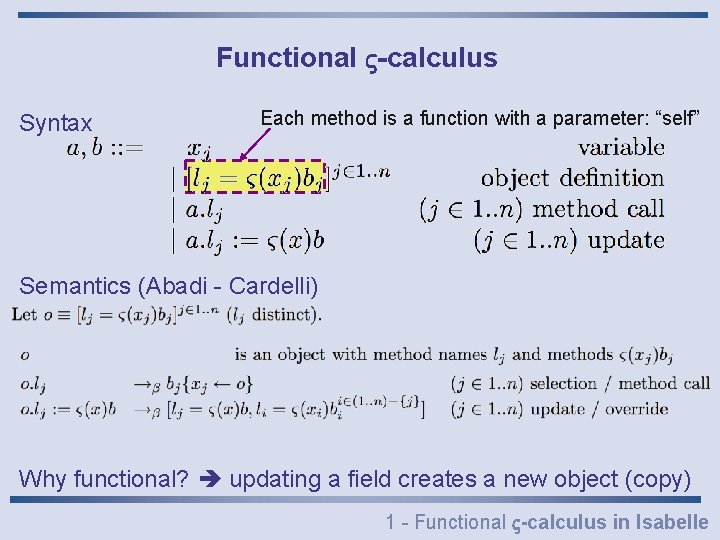
Functional -calculus Syntax Each method is a function with a parameter: “self” Semantics (Abadi - Cardelli) Why functional? updating a field creates a new object (copy) 1 - Functional -calculus in Isabelle
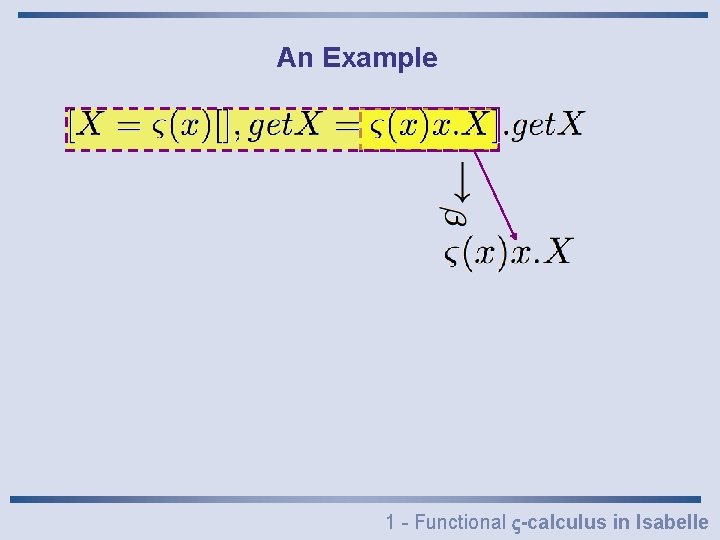
An Example 1 - Functional -calculus in Isabelle
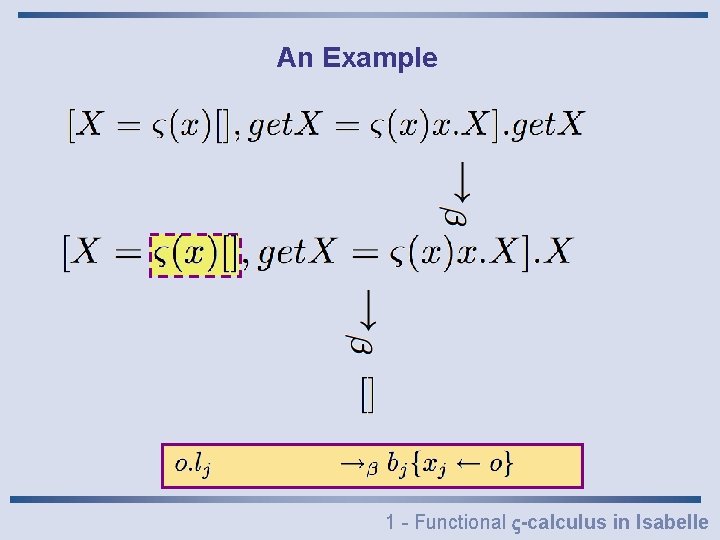
An Example 1 - Functional -calculus in Isabelle
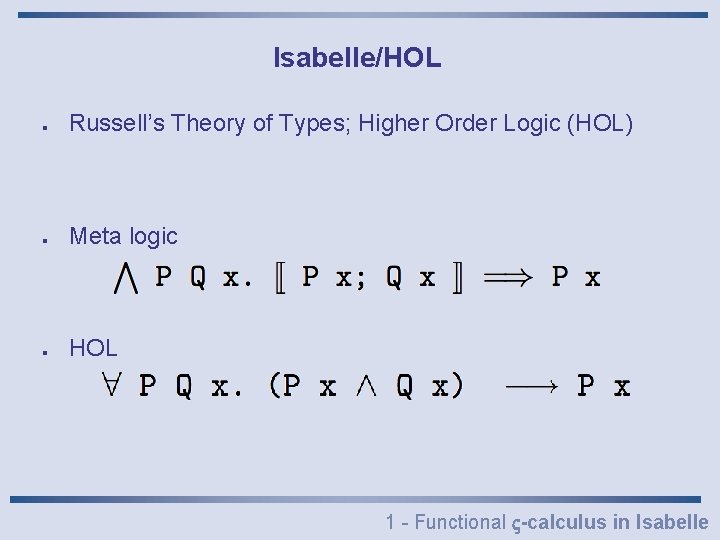
Isabelle/HOL l Russell’s Theory of Types; Higher Order Logic (HOL) l Meta logic l HOL 1 - Functional -calculus in Isabelle
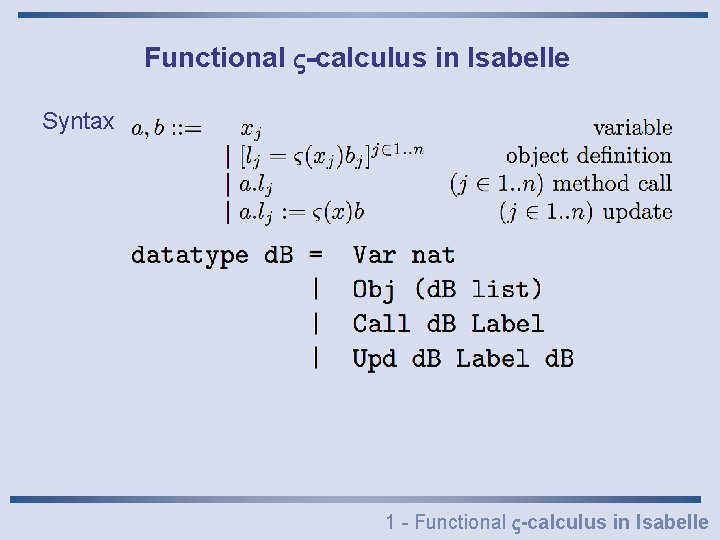
Functional -calculus in Isabelle Syntax 1 - Functional -calculus in Isabelle
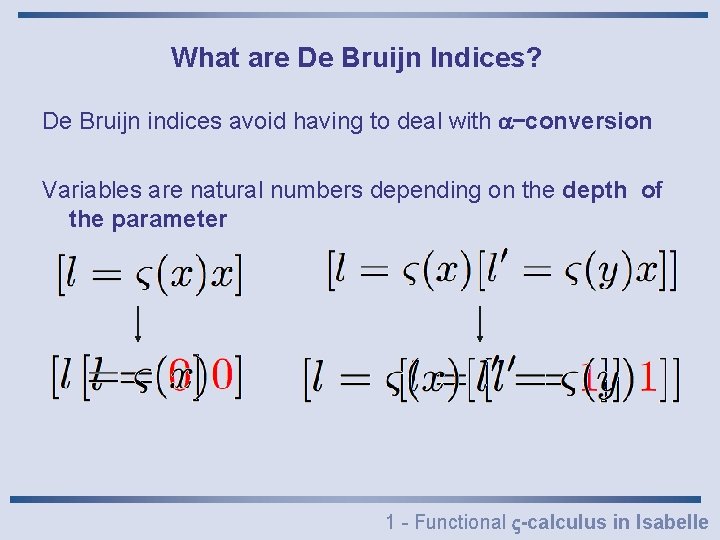
What are De Bruijn Indices? De Bruijn indices avoid having to deal with -conversion Variables are natural numbers depending on the depth of the parameter 1 - Functional -calculus in Isabelle
Why De Bruijn Indices? Drawbacks: l l Terms are “ugly” We are interested in general properties / not for extracting an interpreter … Lot of additional definitions/lemmas are necessary: De Bruijn indices are perhaps not the best solution - Definition subst and lift: implementation semantics more complex butofallowed a fast - Proofs of several additional (easy) lemmas Advantages l Established approach l Reuse Nipkow’s framework for confluence of the -calculus Alternative approaches, e. g. nominal techniques probably better on the long term 1 - Functional -calculus in Isabelle
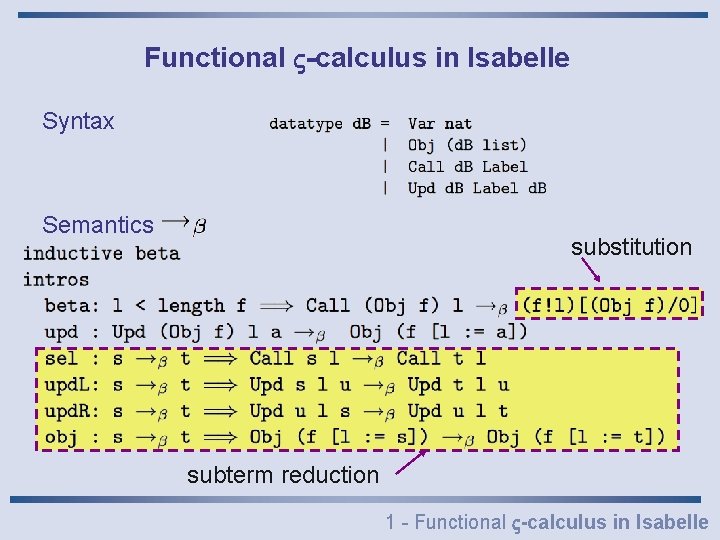
Functional -calculus in Isabelle Syntax Semantics substitution subterm reduction 1 - Functional -calculus in Isabelle
2 - Confluence
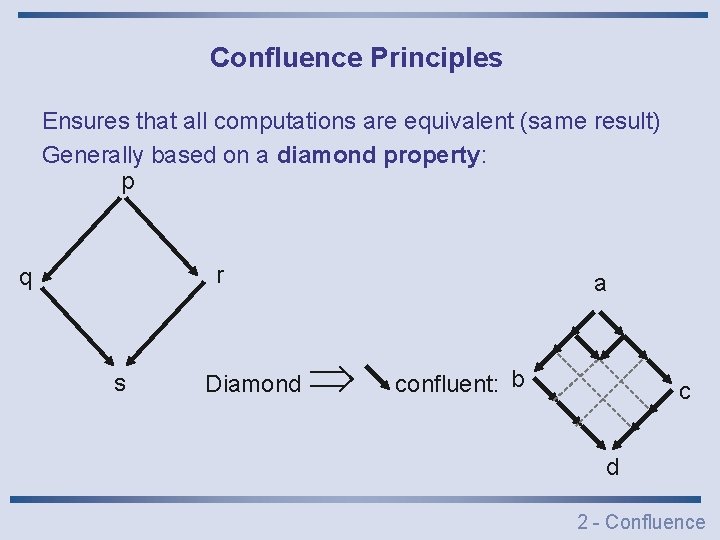
Confluence Principles Ensures that all computations are equivalent (same result) Generally based on a diamond property: p r q s Diamond a confluent: b c d 2 - Confluence
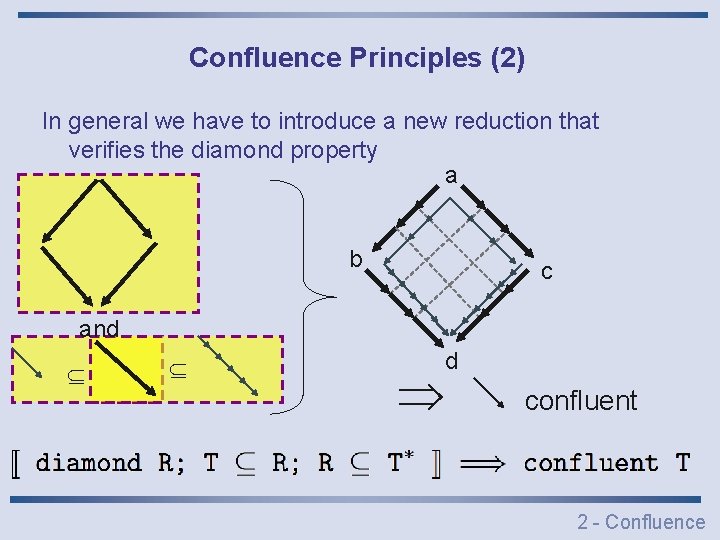
Confluence Principles (2) In general we have to introduce a new reduction that verifies the diamond property a b c and d confluent 2 - Confluence
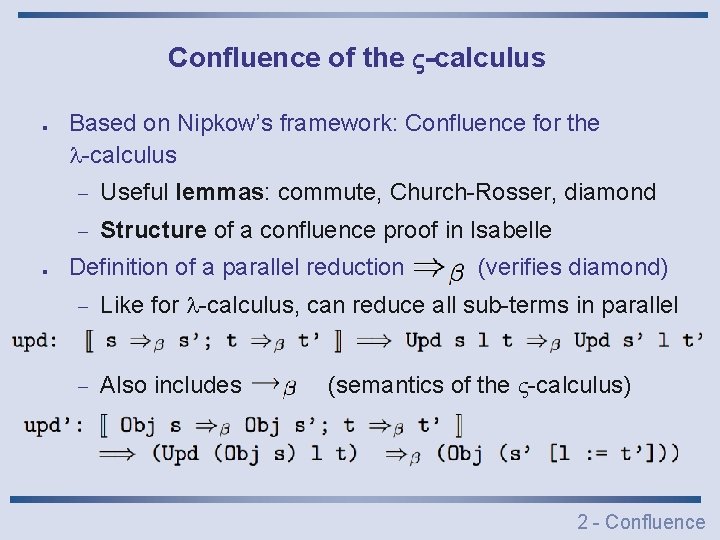
Confluence of the -calculus l l Based on Nipkow’s framework: Confluence for the -calculus - Useful lemmas: commute, Church-Rosser, diamond - Structure of a confluence proof in Isabelle Definition of a parallel reduction (verifies diamond) - Like for -calculus, can reduce all sub-terms in parallel - Also includes (semantics of the -calculus) 2 - Confluence
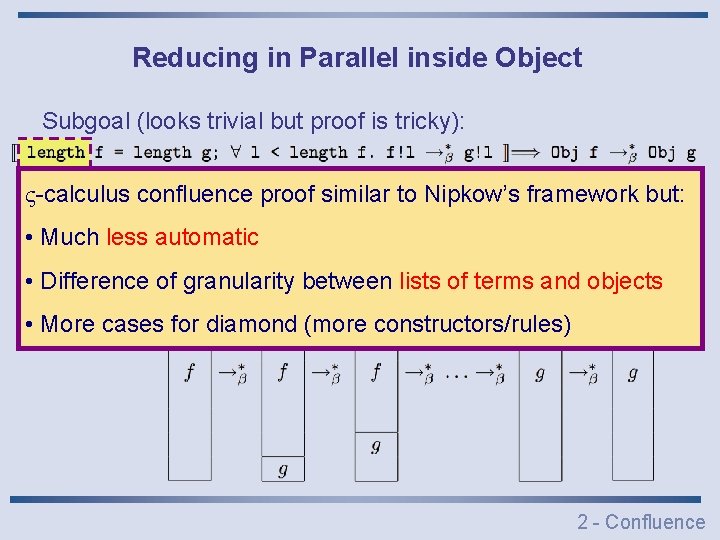
Reducing in Parallel inside Object Subgoal (looks trivial but proof is tricky): Solution: confluence split into several on objectframework fields -calculus proof reductions similar to Nipkow’s but: • Much less automatic Number of methods • Difference of granularity between lists of terms and objects • More cases for diamond (more constructors/rules) 2 - Confluence
In the Meantime … Objects as finite maps from labels to methods instead of lists of methods - Definition of finite maps and a new induction principle - Closer to original -calculus (syntax and semantics); new recurrence principle on terms Formalization of the basic type system for the functional -calculus - Typing rules (Abadi - Cardelli) - Subject reduction, progress (no stuck configuration) 3 - Ongoing Work, Applications, Conclusion
Todo List Remove De Bruijn indices “nominal techniques”? Introduce methods with a parameter: (x, y) / a. l(b) Apply to other results on object languages (concurrence, mobility, …) A base model for Aspect Oriented Programming 3 - Ongoing Work, Applications, Conclusion
Towards Distribution A model for the ASP calculus in Isabelle; ASP formalizes: - Active objects (AO) without shared memory - AO is the entry point and the master object of the activity - Communicating by asynchronous method calls with futures Currently: - Definition of a functional ASP in Isabelle - Proof of well-formedness of the reduction (no creation of reference to non-existing active objects or futures) To do …. - A type system for ASP - Proof of confluence for the functional ASP - Extension of the concurrency in the functional calculus - Case of the imperative ASP calculus … 3 - Ongoing Work, Applications, Conclusion
Conclusion A formalization of the -calculus in Isabelle A confluence proof for the functional -calculus - Parallel reduction inside objects A base framework for developments on objects, confluence and concurrency A lot of possible applications (distribution / typing / AOP …) Experiments on Isabelle (few months development) -User-friendly, relatively fast development -Finding the right structure/representation is crucial -Difficulties when modifying / reusing code http: //www. cs. tu-berlin. de/~flokam/isabelle/sigma/ 3 - Ongoing Work, Applications, Conclusion
- Slides: 18