
A Mathematical Model of Historical Semantics and the
- Slides: 25
A Mathematical Model of Historical Semantics and the Grouping of Word Meanings into Concepts Martin C. Cooper Presented by Xue Ying Chen School of Computer Science Carleton University
Outline Ø An empirical rule on historical semantics Ø Word, sense, concept Ø A mathematical model Ø Applying the model to experimental data Ø Future research 2
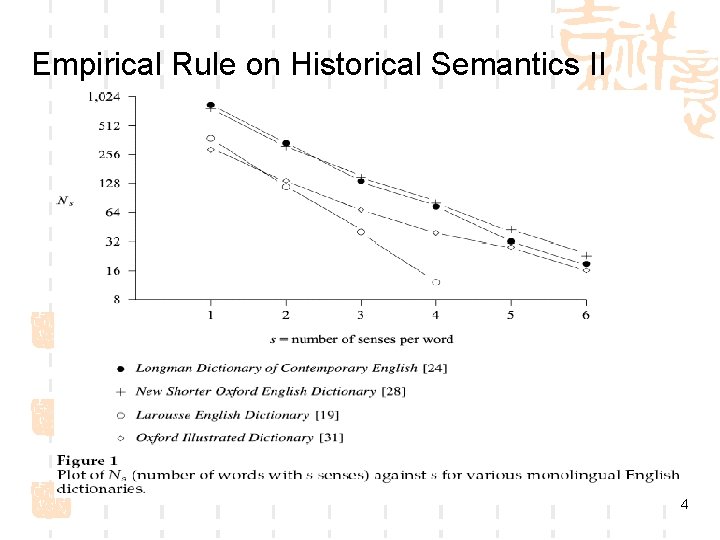
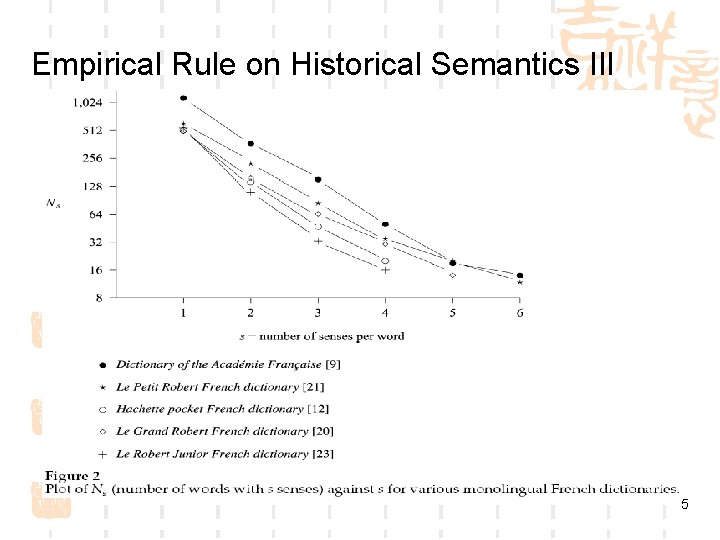
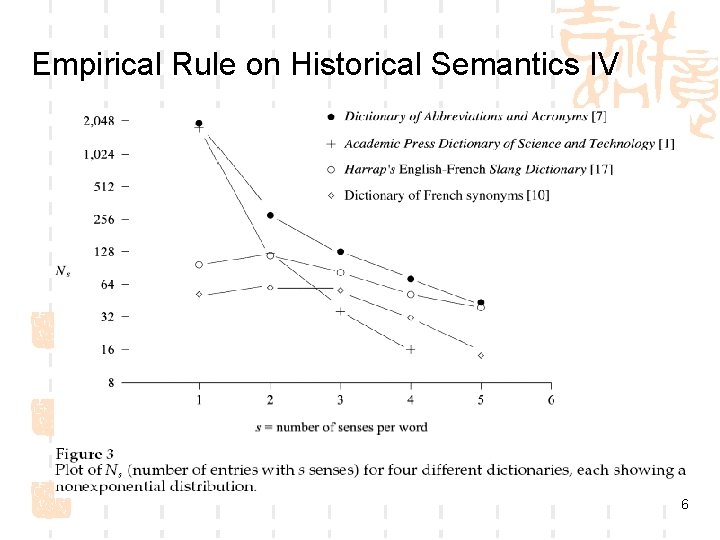
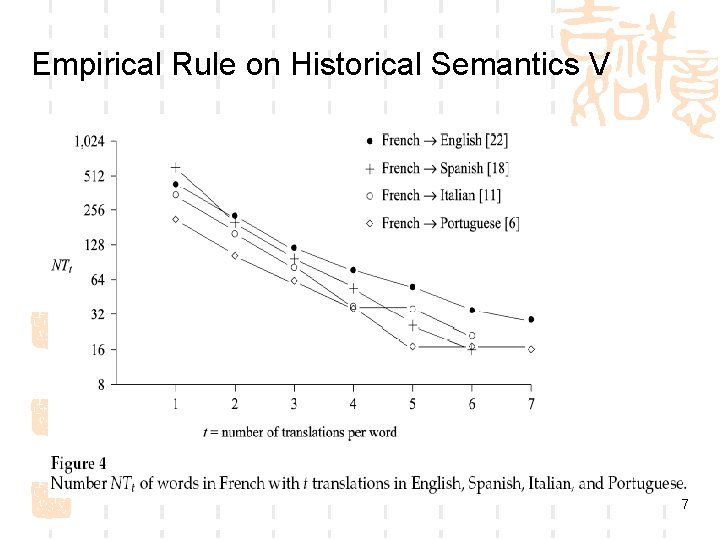
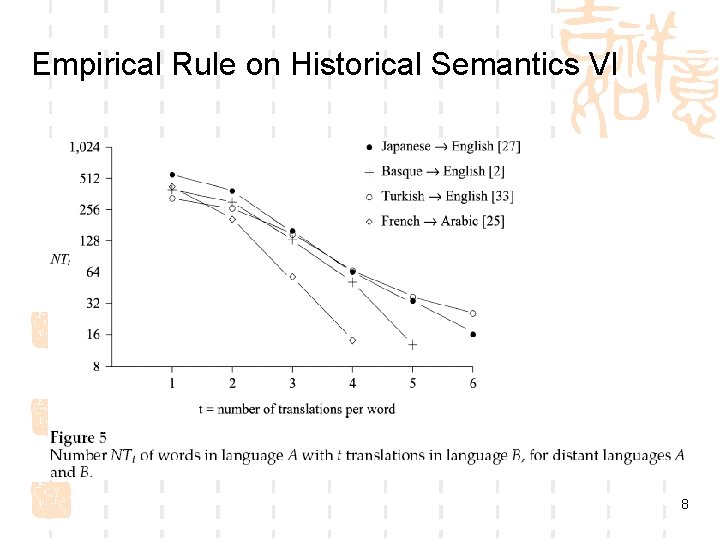
Empirical Rule on Historical Semantics I By counting the number of senses listed per word in 16 different monolingual dictionaries, the following empirical rule is observed. Near-Exponential Rule: The number of senses per word in a monolingual dictionary has an approximately exponential distribution. Testing this rule: plot log(Ns ) against s, where Ns is the number of words in the dictionary with exactly s senses 3
Empirical Rule on Historical Semantics II 4
Empirical Rule on Historical Semantics III 5
Empirical Rule on Historical Semantics IV 6
Empirical Rule on Historical Semantics V 7
Empirical Rule on Historical Semantics VI 8
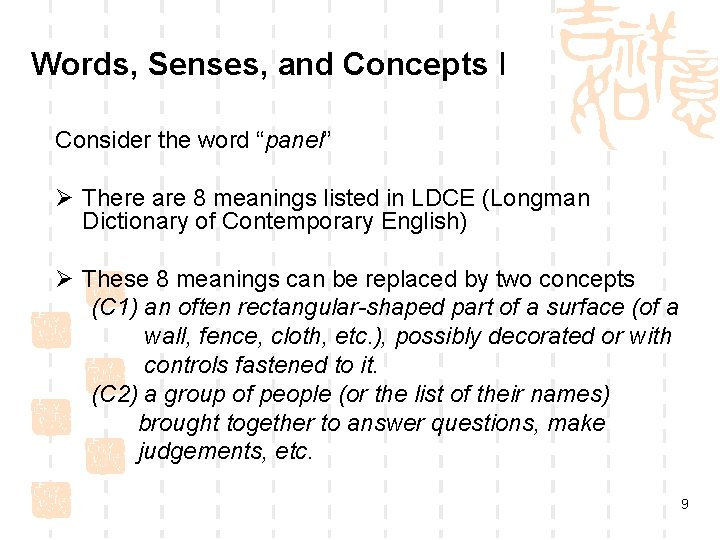
Words, Senses, and Concepts I Consider the word “panel” Ø There are 8 meanings listed in LDCE (Longman Dictionary of Contemporary English) Ø These 8 meanings can be replaced by two concepts (C 1) an often rectangular-shaped part of a surface (of a wall, fence, cloth, etc. ), possibly decorated or with controls fastened to it. (C 2) a group of people (or the list of their names) brought together to answer questions, make judgements, etc. 9
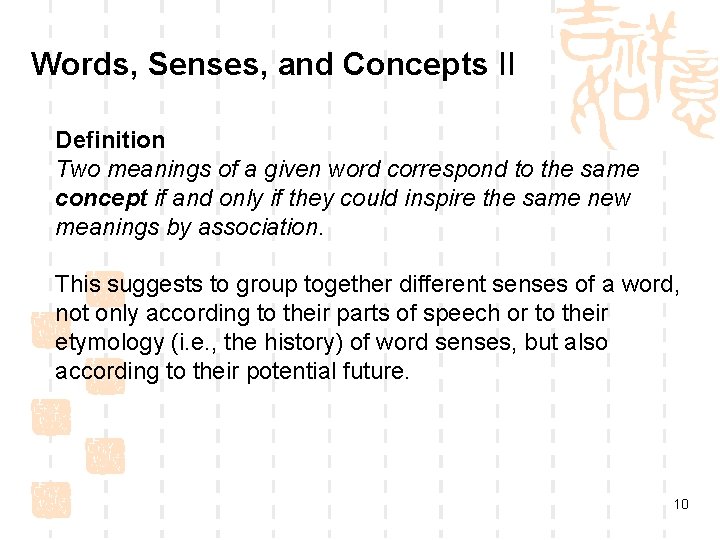
Words, Senses, and Concepts II Definition Two meanings of a given word correspond to the same concept if and only if they could inspire the same new meanings by association. This suggests to group together different senses of a word, not only according to their parts of speech or to their etymology (i. e. , the history) of word senses, but also according to their potential future. 10
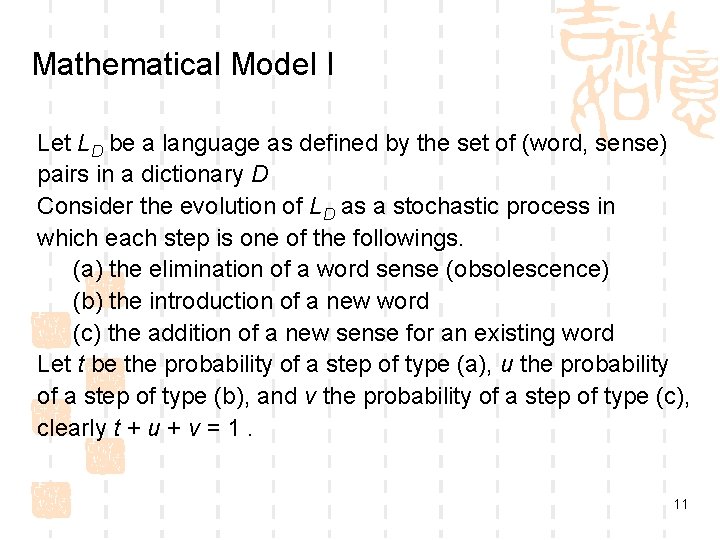
Mathematical Model I Let LD be a language as defined by the set of (word, sense) pairs in a dictionary D Consider the evolution of LD as a stochastic process in which each step is one of the followings. (a) the elimination of a word sense (obsolescence) (b) the introduction of a new word (c) the addition of a new sense for an existing word Let t be the probability of a step of type (a), u the probability of a step of type (b), and v the probability of a step of type (c), clearly t + u + v = 1. 11
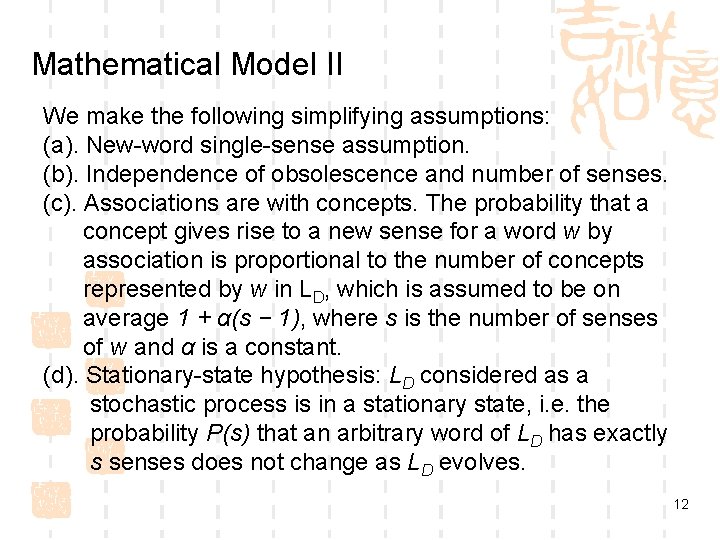
Mathematical Model II We make the following simplifying assumptions: (a). New-word single-sense assumption. (b). Independence of obsolescence and number of senses. (c). Associations are with concepts. The probability that a concept gives rise to a new sense for a word w by association is proportional to the number of concepts represented by w in LD, which is assumed to be on average 1 + α(s − 1), where s is the number of senses of w and α is a constant. (d). Stationary-state hypothesis: LD considered as a stochastic process is in a stationary state, i. e. the probability P(s) that an arbitrary word of LD has exactly s senses does not change as LD evolves. 12
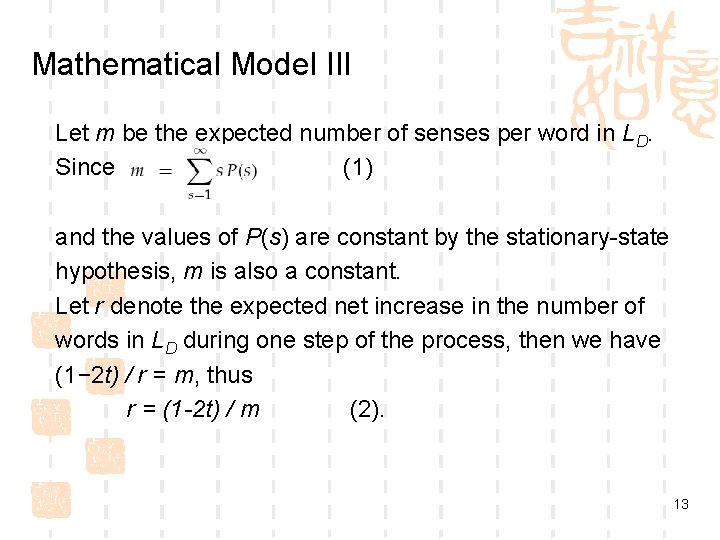
Mathematical Model III Let m be the expected number of senses per word in LD. Since (1) and the values of P(s) are constant by the stationary-state hypothesis, m is also a constant. Let r denote the expected net increase in the number of words in LD during one step of the process, then we have (1− 2 t) / r = m, thus r = (1 -2 t) / m (2). 13
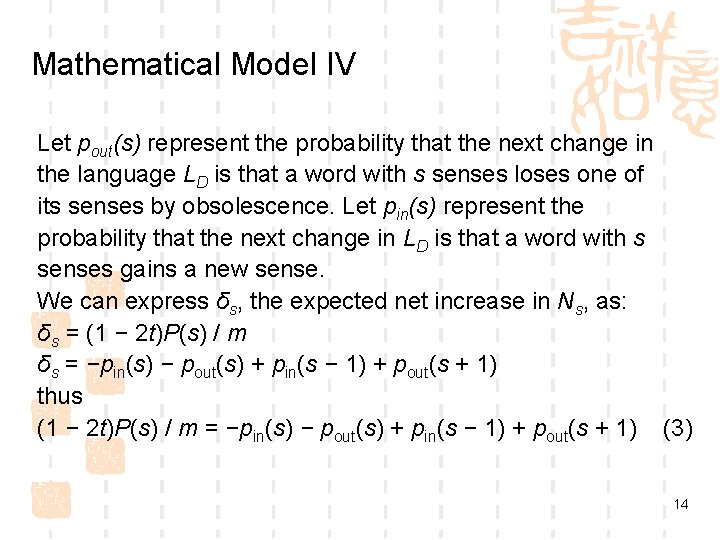
Mathematical Model IV Let pout(s) represent the probability that the next change in the language LD is that a word with s senses loses one of its senses by obsolescence. Let pin(s) represent the probability that the next change in LD is that a word with s senses gains a new sense. We can express δs, the expected net increase in Ns, as: δs = (1 − 2 t)P(s) / m δs = −pin(s) − pout(s) + pin(s − 1) + pout(s + 1) thus (1 − 2 t)P(s) / m = −pin(s) − pout(s) + pin(s − 1) + pout(s + 1) (3) 14
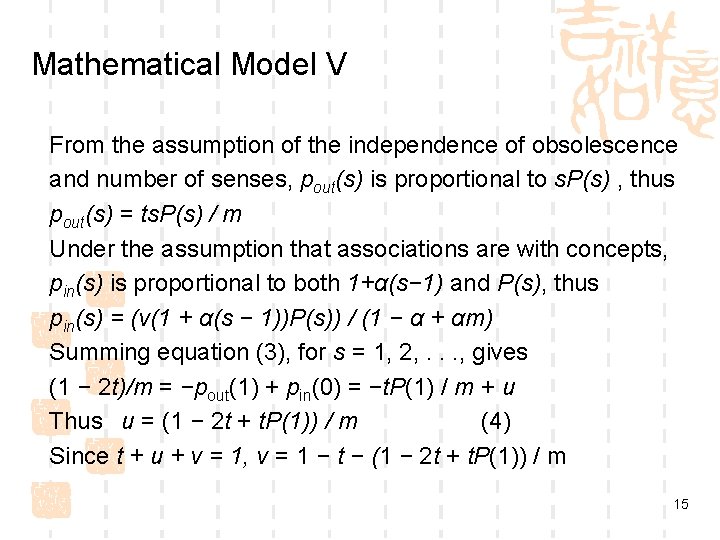
Mathematical Model V From the assumption of the independence of obsolescence and number of senses, pout(s) is proportional to s. P(s) , thus pout(s) = ts. P(s) / m Under the assumption that associations are with concepts, pin(s) is proportional to both 1+α(s− 1) and P(s), thus pin(s) = (v(1 + α(s − 1))P(s)) / (1 − α + αm) Summing equation (3), for s = 1, 2, . . . , gives (1 − 2 t)/m = −pout(1) + pin(0) = −t. P(1) / m + u Thus u = (1 − 2 t + t. P(1)) / m (4) Since t + u + v = 1, v = 1 − t − (1 − 2 t + t. P(1)) / m 15
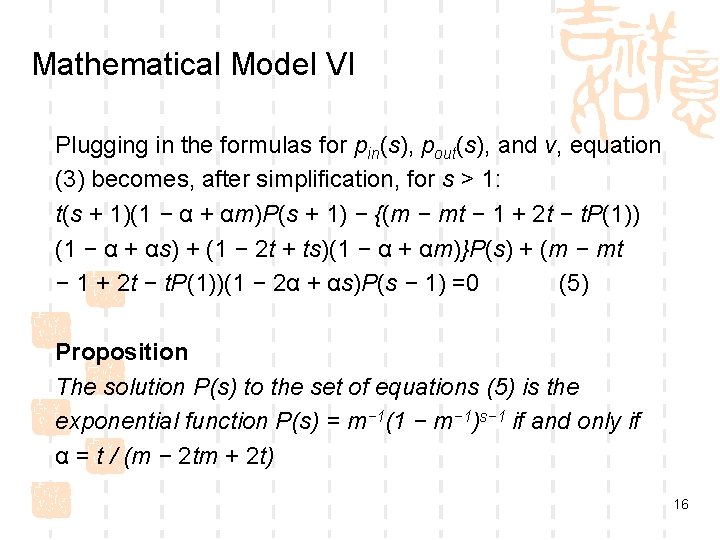
Mathematical Model VI Plugging in the formulas for pin(s), pout(s), and v, equation (3) becomes, after simplification, for s > 1: t(s + 1)(1 − α + αm)P(s + 1) − {(m − mt − 1 + 2 t − t. P(1)) (1 − α + αs) + (1 − 2 t + ts)(1 − α + αm)}P(s) + (m − mt − 1 + 2 t − t. P(1))(1 − 2α + αs)P(s − 1) =0 (5) Proposition The solution P(s) to the set of equations (5) is the exponential function P(s) = m− 1(1 − m− 1)s− 1 if and only if α = t / (m − 2 tm + 2 t) 16
Mathematical Model VII Study in more detail the special case in which t = 0, the following result follows immediately from equation (4) by setting t = 0 Proposition When t = 0, the probability that the next addition to LD is the creation of a new word is u = 1 / m. 17
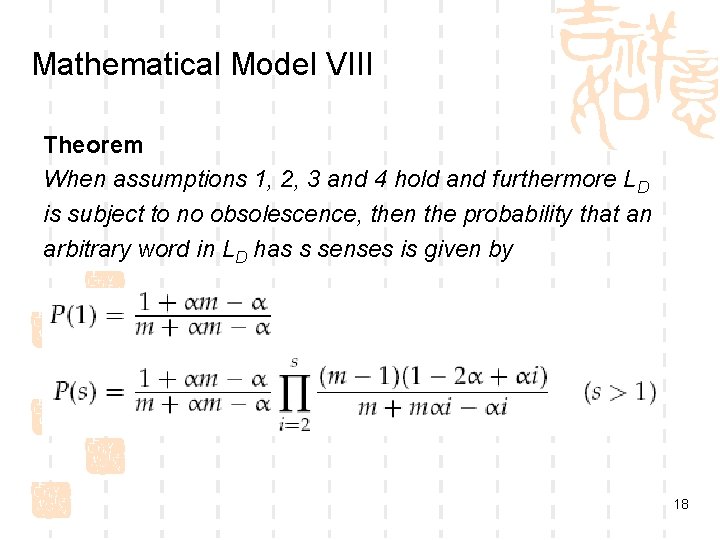
Mathematical Model VIII Theorem When assumptions 1, 2, 3 and 4 hold and furthermore LD is subject to no obsolescence, then the probability that an arbitrary word in LD has s senses is given by 18
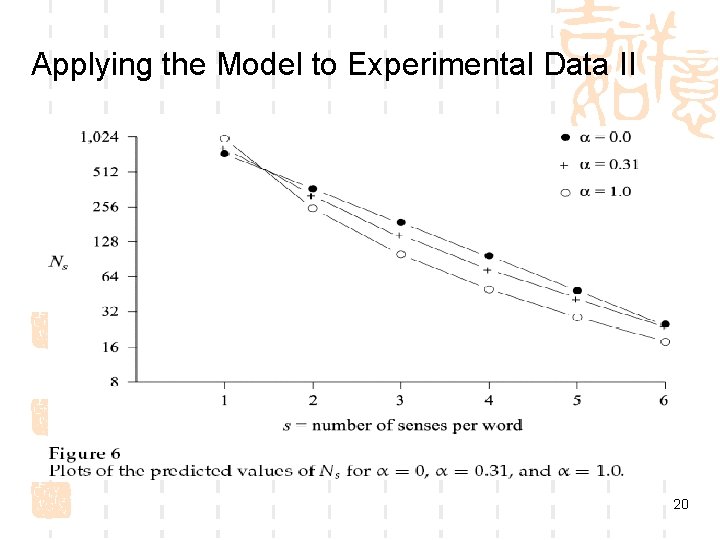
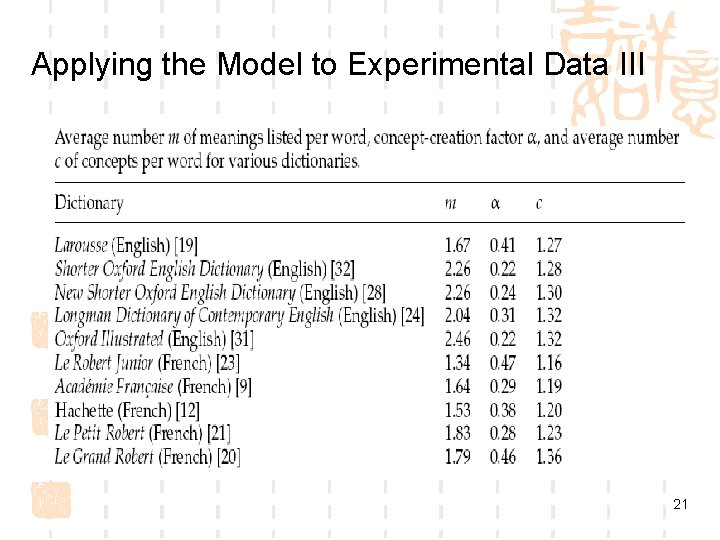
Applying the Model to Experimental Data I Now we can get back to the curves in Figure 1. Those curves are approximately straight lines, but all have a slight positive curvature. This curvature can be explained by the fact that α>0. To evaluate visually the influence of the value of α on the predicted values of Ns, we can generated the values of Ns using equation (6) for various values of α instead of counting them in the dictionaries. 19
Applying the Model to Experimental Data II 20
Applying the Model to Experimental Data III 21
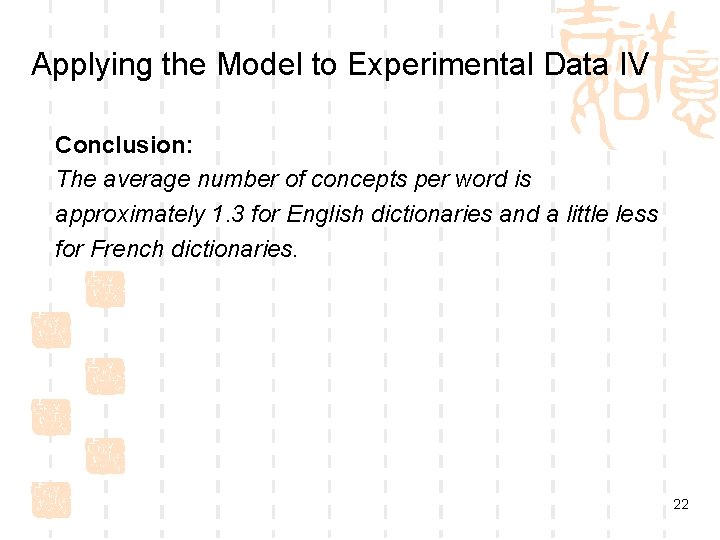
Applying the Model to Experimental Data IV Conclusion: The average number of concepts per word is approximately 1. 3 for English dictionaries and a little less for French dictionaries. 22
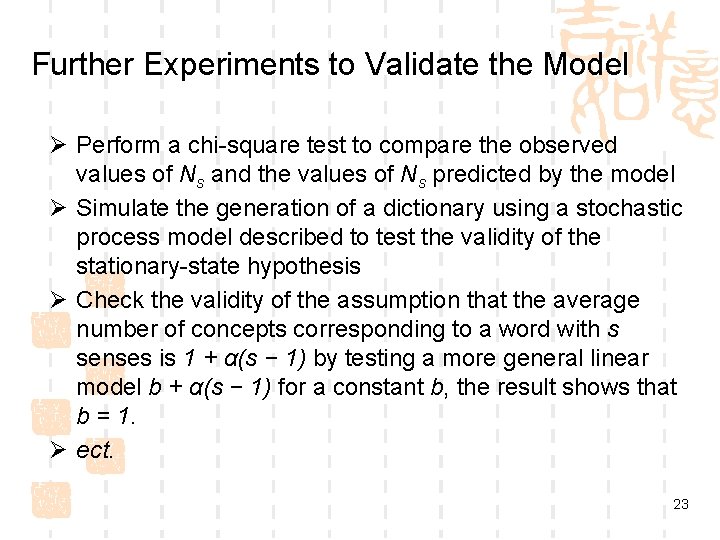
Further Experiments to Validate the Model Ø Perform a chi-square test to compare the observed values of Ns and the values of Ns predicted by the model Ø Simulate the generation of a dictionary using a stochastic process model described to test the validity of the stationary-state hypothesis Ø Check the validity of the assumption that the average number of concepts corresponding to a word with s senses is 1 + α(s − 1) by testing a more general linear model b + α(s − 1) for a constant b, the result shows that b = 1. Ø ect. 23
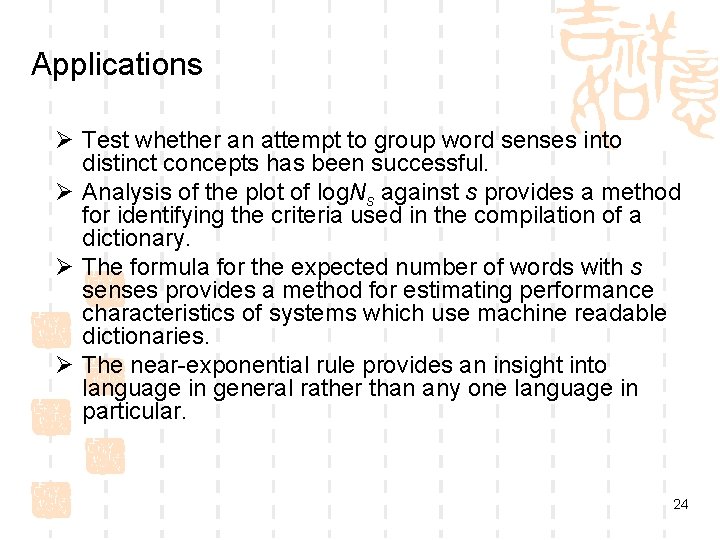
Applications Ø Test whether an attempt to group word senses into distinct concepts has been successful. Ø Analysis of the plot of log. Ns against s provides a method for identifying the criteria used in the compilation of a dictionary. Ø The formula for the expected number of words with s senses provides a method for estimating performance characteristics of systems which use machine readable dictionaries. Ø The near-exponential rule provides an insight into language in general rather than any one language in particular. 24
Future Research Ø Refine the model by, for example, distinguishing among different parts of speech, or distinguishing between everyday and technical terms. Ø Investigate the possibility of using statistical analysis of dictionaries to model synonymy. 25