
A mass balance model for the fate of
A mass balance model for the fate of PAHs in the San Francisco Estuary Ben K. Greenfield Jay A. Davis San Francisco Estuary Institute Presented at the Calfed Science Conference, January, 2003
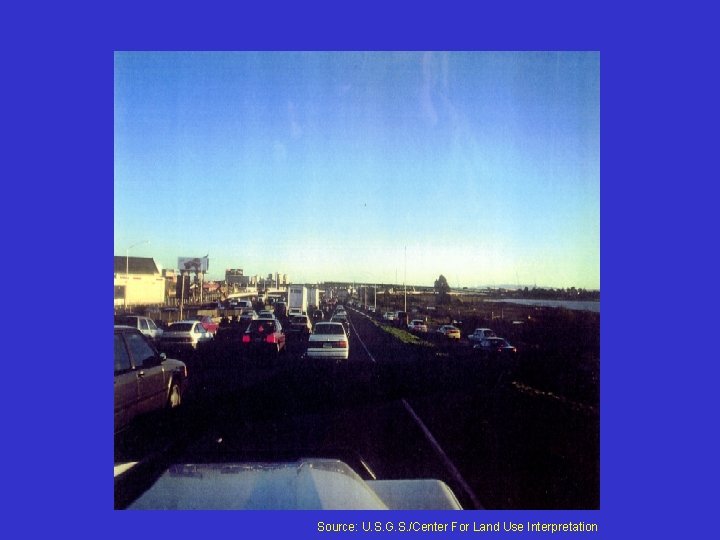
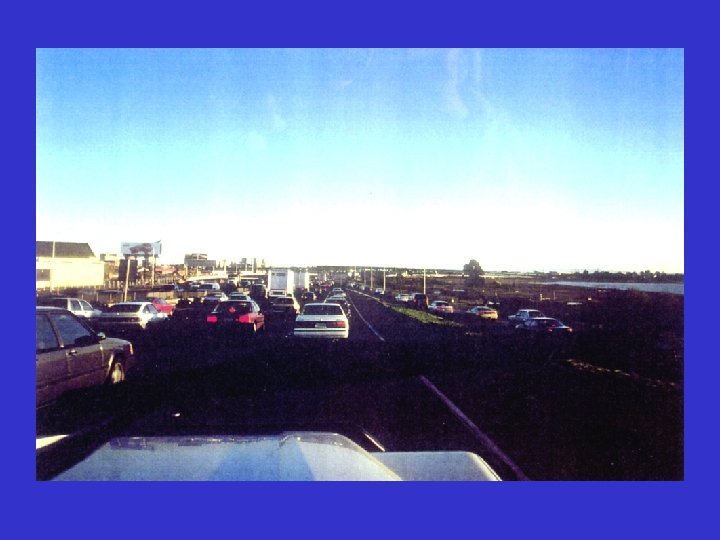
Source: U. S. G. S. /Center For Land Use Interpretation
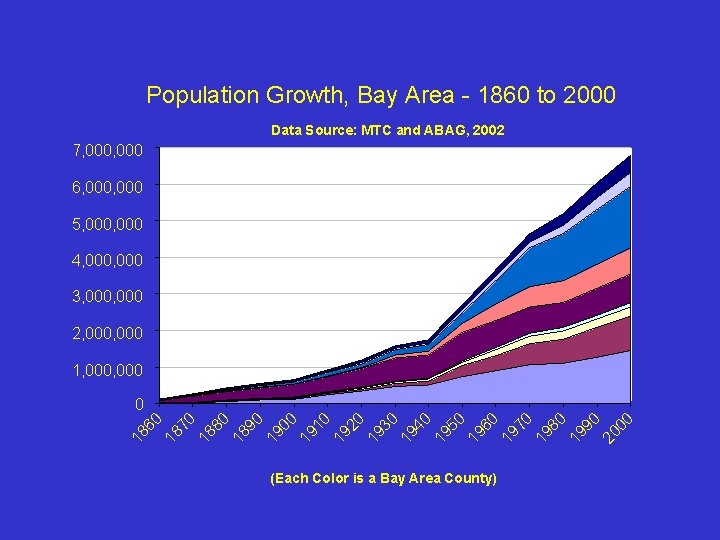
Population Growth, Bay Area - 1860 to 2000 Data Source: MTC and ABAG, 2002 7, 000 6, 000 5, 000 4, 000 3, 000 2, 000 1, 000 (Each Color is a Bay Area County) 80 19 90 20 00 19 70 19 60 19 50 19 40 19 30 19 20 19 10 19 00 19 90 18 80 18 70 18 18 60 0
Mass balance models • Understand compound fate • Identify research priorities (e. g. chemical properties) • Synthesize available data • Estimate loading rate

Simple mass balance model • Mackay et al. (1994) • Equilibrium partitioning based on chemical properties • Single pool of interacting water and sediment • Daily rate constants • Spreadsheet format
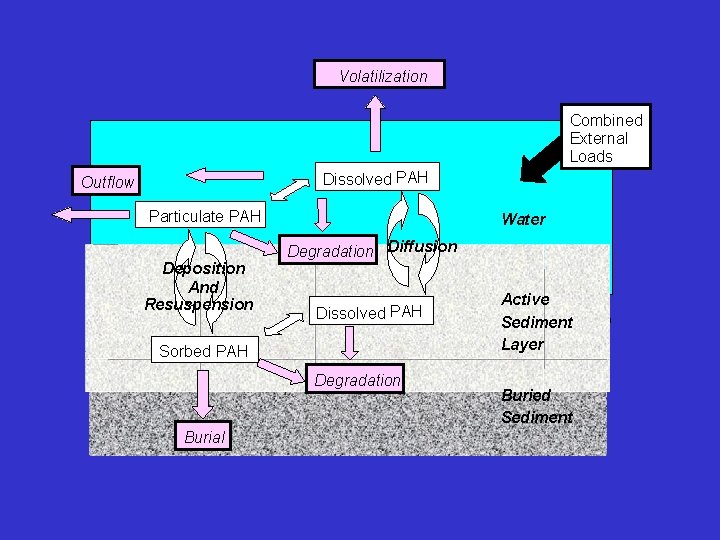
Volatilization Combined External Loads Dissolved PAH Outflow Particulate PAH Deposition And Resuspension Water Degradation Diffusion PAH Dissolved. PCB Sorbed PAH Degradation Burial Active Sediment Layer Buried Sediment
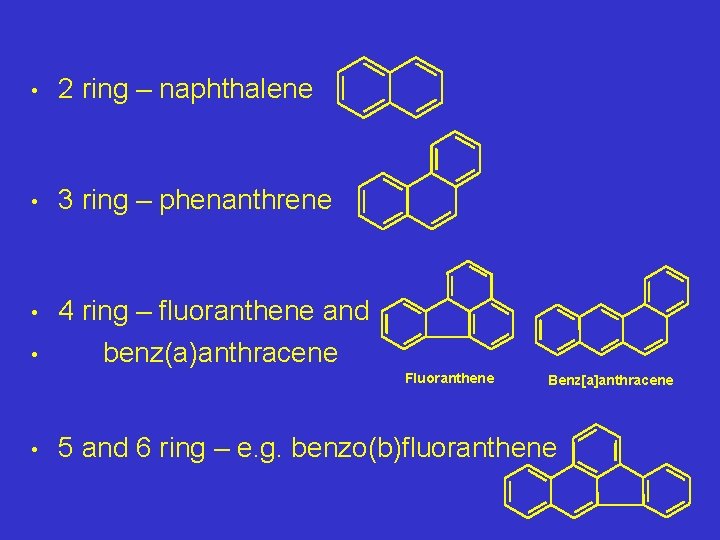
• 2 ring – naphthalene • 3 ring – phenanthrene • 4 ring – fluoranthene and • benz(a)anthracene Fluoranthene • Benz[a]anthracene 5 and 6 ring – e. g. benzo(b)fluoranthene
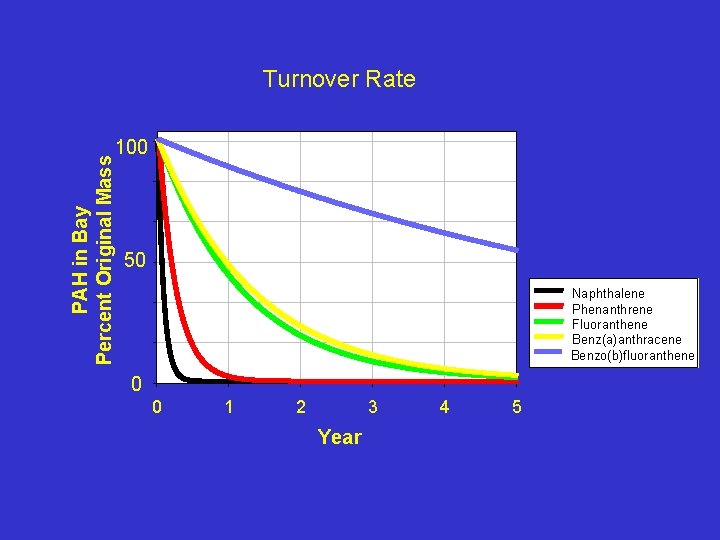
Turnover Rate PAH in Bay Percent Original Mass 100 50 Naphthalene Phenanthrene Fluoranthene Benz(a)anthracene Benzo(b)fluoranthene 0 0 1 2 3 Year 4 5
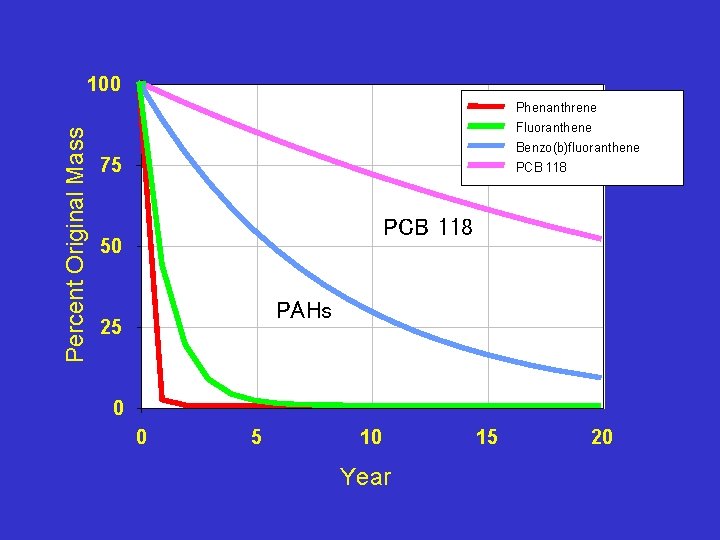
100 Percent Original Mass Phenanthrene Fluoranthene Benzo(b)fluoranthene 75 PCB 118 50 PAHs 25 0 0 5 10 Year 15 20
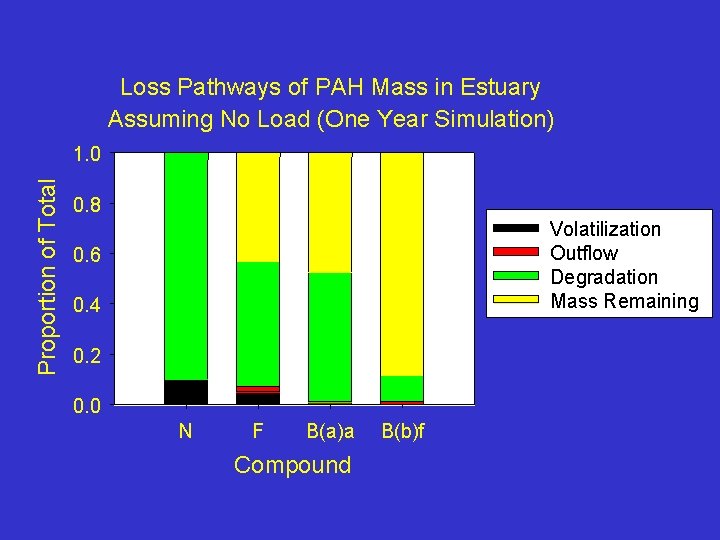
Loss Pathways of PAH Mass in Estuary Assuming No Load (One Year Simulation) Proportion of Total 1. 0 0. 8 Volatilization Outflow Degradation Mass Remaining 0. 6 0. 4 0. 2 0. 0 N F B(a)a Compound B(b)f
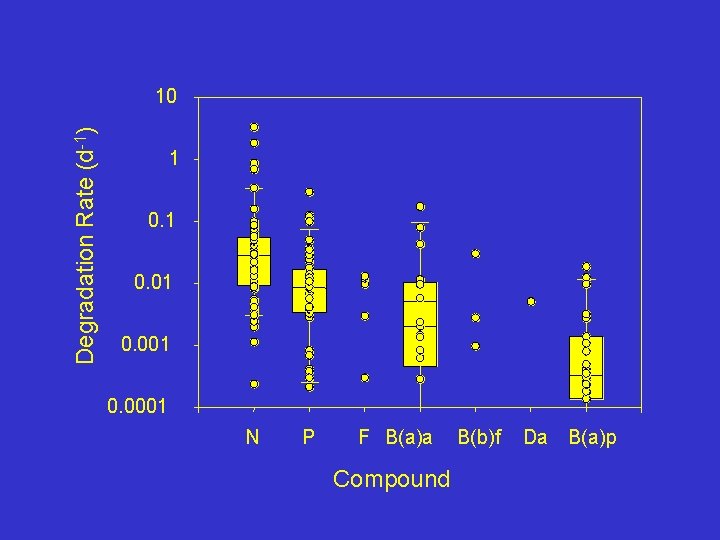
Degradation Rate (d-1) 10 1 0. 01 0. 0001 N P F B(a)a Compound B(b)f Da B(a)p
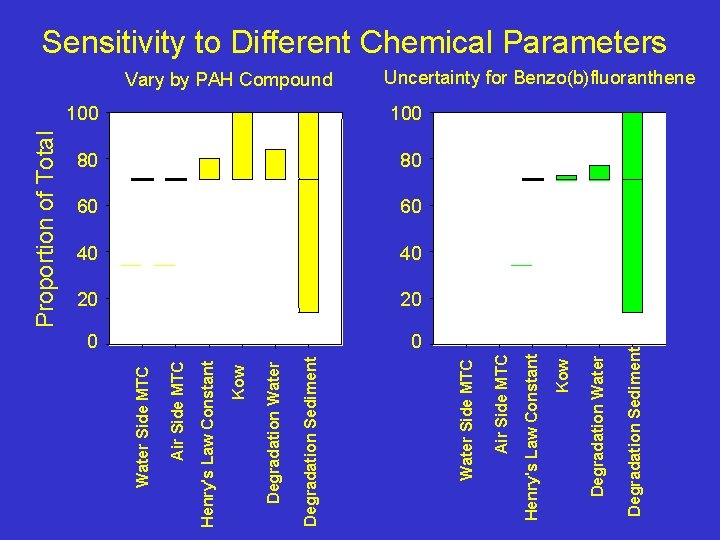
60 60 40 40 20 20 0 0 Degradation Sediment 80 Degradation Water 80 Kow 100 Henry's Law Constant 100 Air Side MTC Vary by PAH Compound Water Side MTC Degradation Sediment Degradation Water Kow Henry's Law Constant Air Side MTC Water Side MTC Proportion of Total Sensitivity to Different Chemical Parameters Uncertainty for Benzo(b)fluoranthene
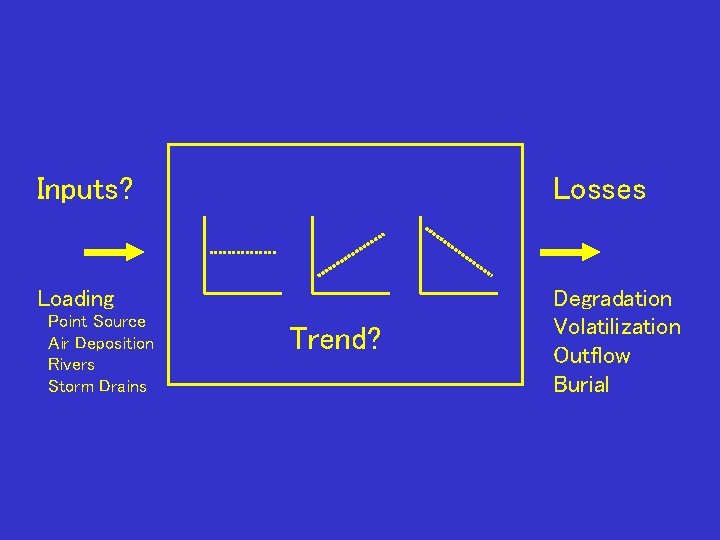
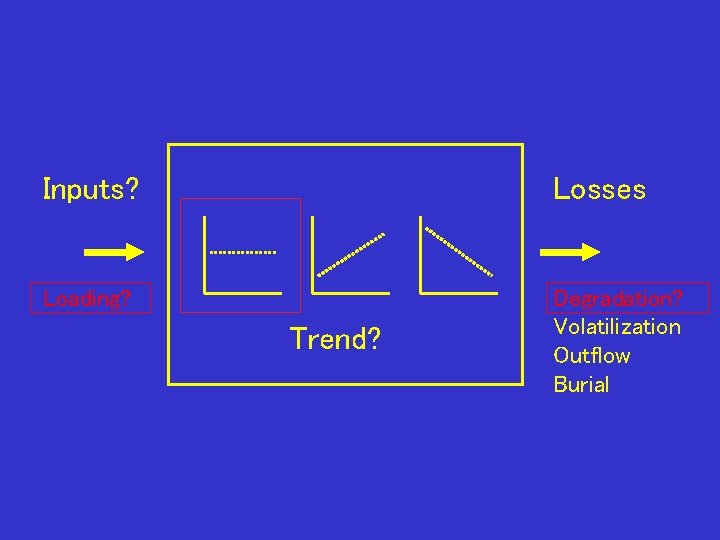
Inputs? Losses Loading Degradation Volatilization Outflow Burial Point Source Air Deposition Rivers Storm Drains Trend?
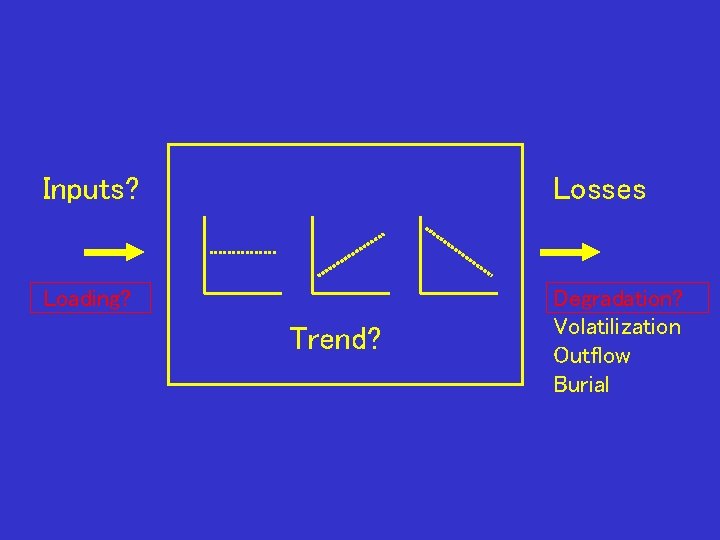
Inputs? Losses Loading? Degradation? Volatilization Outflow Burial Trend?
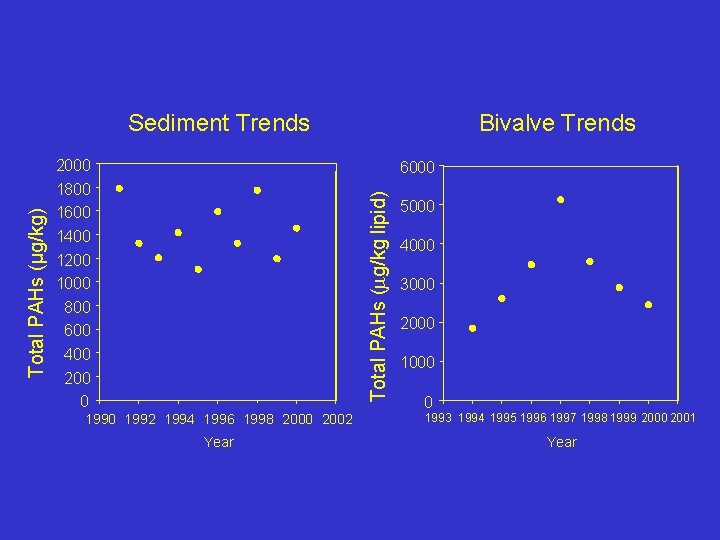
2000 1800 1600 1400 1200 1000 800 600 400 200 0 Bivalve Trends 6000 Total PAHs (mg/kg lipid) Total PAHs (µg/kg) Sediment Trends 5000 4000 3000 2000 1000 0 1992 1994 1996 1998 2000 2002 1993 1994 1995 1996 1997 1998 1999 2000 2001 Year
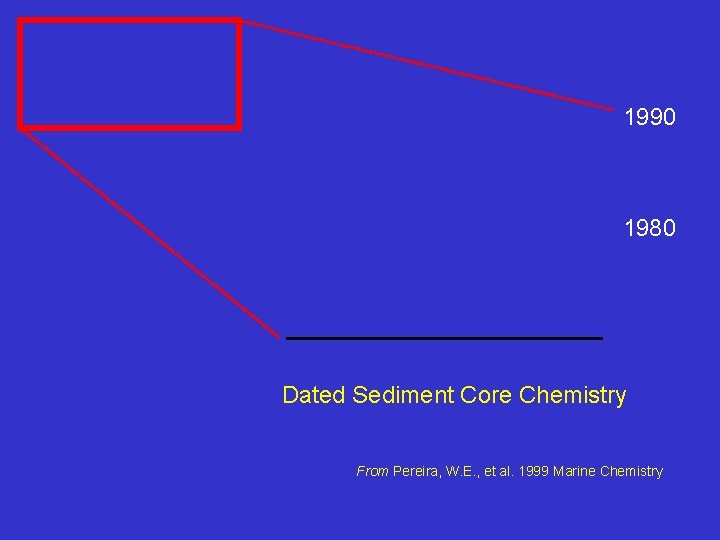
1990 1980 Dated Sediment Core Chemistry From Pereira, W. E. , et al. 1999 Marine Chemistry
Inputs? Losses Loading? Degradation? Volatilization Outflow Burial Trend?
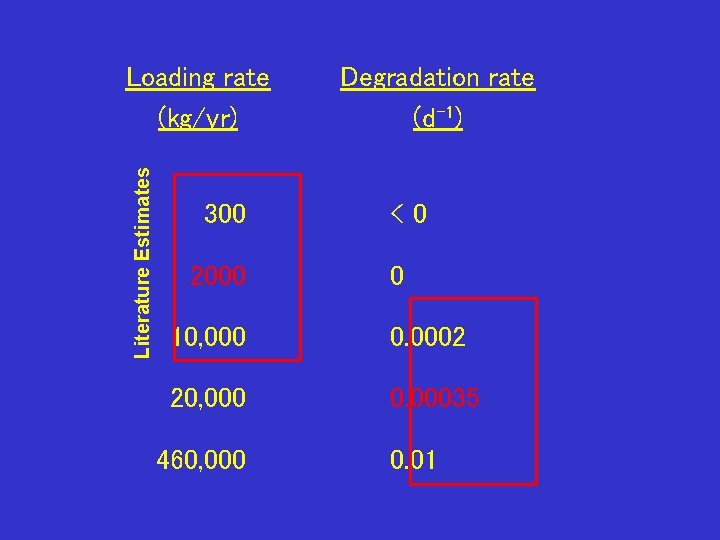
Literature Estimates Loading rate (kg/yr) 300 2000 Degradation rate (d-1) <0 0 10, 000 0. 0002 20, 000 0. 00035 460, 000 0. 01
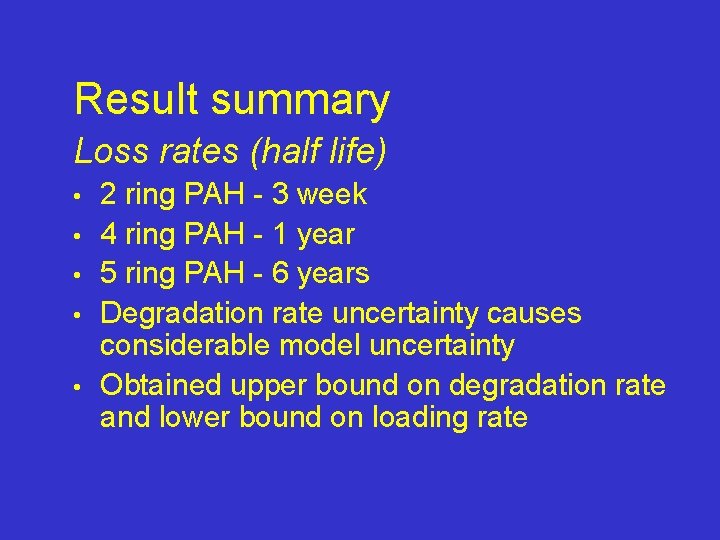
Result summary Loss rates (half life) • • • 2 ring PAH - 3 week 4 ring PAH - 1 year 5 ring PAH - 6 years Degradation rate uncertainty causes considerable model uncertainty Obtained upper bound on degradation rate and lower bound on loading rate
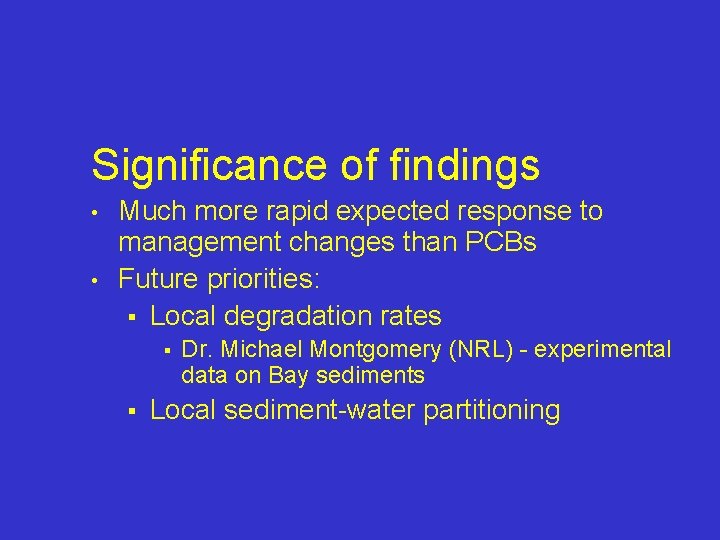
Significance of findings • • Much more rapid expected response to management changes than PCBs Future priorities: § Local degradation rates § § Dr. Michael Montgomery (NRL) - experimental data on Bay sediments Local sediment-water partitioning

Acknowledgments • • • Don Yee Jon Leatherbarrow Sarah Lowe Cristina Grosso Patricia Chambers
- Slides: 23